Category Archives: Bad ideas

State Violence against Peaceful Assemblies in Kashmir: JKCCS

Guest Post by Jammu & Kashmir Coalition for Civil Society (JKCCS)

Over the last week – August 29 to 5 September, of uninterrupted curfew in Kashmir, the government’s unbridled use of force on peaceful public meetings/rallies, which are either funeral processions of the civilians killed by government forces or peaceful political rallies where people demand their right to self determination, across Kashmir valley has resulted in injuries to 1215+ people, many of whom are injured by pellets shot guns. The violence used by government forces against un-armed peaceful rallies deflates its claims that its forces only resort to violence when they are pelted with stones. Contrary to government claims, the use of force against the peaceful demonstrators acts as a provocation to people and youth in particular who then retaliate by stone throwing on Indian forces. The sheer number of peaceful pro-freedom rallies held in the last week alone symbolizes the nature of the current anti-India uprising which has seen lakhs of Kashmiris on streets to voice their demand for right to self-determination. Such attacks are against the internationally, and domestically, recognized fundamental rights of peoples to peaceful assembly and association, and freedom of opinion and expression, including India’s obligation under the ICCPR. Continue reading State Violence against Peaceful Assemblies in Kashmir: JKCCS

Kashmir Scholars Action Group Letter to the UN High Commission for Human Rights on the Situation in Jammu&Kashmir: KSAG

Guest Post by Kashmir Scholars Action Group

To Mr. Zeid Ra’ad Al Hussein

UN High Commissioner for Human Rights

Re: Urgent action needed to end state violence in Indian-controlled Kashmir

We are writing to you to express our concern about the situation in Indian-controlled Kashmir where the already subjected population is currently living in a state of siege due to the massive violence unleashed by the Indian forces. We appreciate your decision to create a fact-finding mission and deplore the refusal of the Indian government to allow access to UN human rights monitors (1). In the absence of such a mission, we feel it incumbent upon civil society groups to provide regular updates on the situation.

We, the Kashmir Scholars Action Group, are an interdisciplinary group of scholars of various nationalities engaged in research on the region of Kashmir. Our research on Kashmir, its history, its consequences for the region and beyond, and its possible resolution, delves into the implications for an internationally mediated political solution, and is of relevance to policy makers. Based on our long and active engagement with civil society groups in Indian-controlled Kashmir, we have undertaken to document and communicate the situation on ground since the Indian state’s violence against civilians has continued to mount from July 7th, 2016 onwards. Each of us has written about Kashmiri history, society and politics; and we are particularly concerned about the present conditions of violence. We write to you now as part of our urgent efforts to check the brutality of the state’s response to Kashmiris, scores of whom have mobilized in support of their demand for azadi (freedom). Even as we will go on to list some of the details of the humanitarian crisis, we wish to make clear that we are calling not only for the resumption of basic civil services, the rule of law, and the restoration of human rights in Kashmir, but, most importantly, for an internationally mediated political solution for this ongoing crisis. Continue reading Kashmir Scholars Action Group Letter to the UN High Commission for Human Rights on the Situation in Jammu&Kashmir: KSAG

Reaching for the Universe


“Universal” is a tricky word. It has an enormous appeal, an unquestioned romance of taking every one along. Universal human rights, universal access to basic services, housing for all. It is the barometer of inclusion done right. The dark side of the romance is that it’s one of the hardest things to actually achieve. Often the “universal” is a vanishing horizon and, like all horizons, the mirage is what makes you lose sight of the very real trade-off’s and constraints in your way.

This week the Delhi Jal Board announced a new horizon towards the idea of universal access to a basic urban service and human need: water. The “Jal Adhikar Connection” (a Right to Water Connection) promises to let households within slums in Delhi apply for legal, metered water connections “irrespective of the status of their residence.” This move – following the Government of Delhi’s already given pledge to extend water and sanitation services to unauthorized colonies – implies that legal, public and metered water could (like electricity) actually cover the city as it exists rather than as it is imagined in plans and laws.

Continue reading Reaching for the Universe

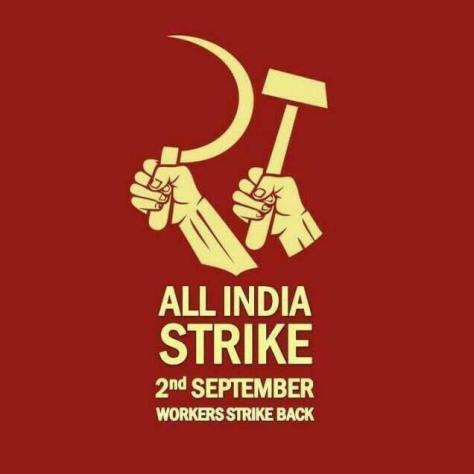
Workers Strike Back : Statement by NSI on the All India Strike

Guest Post by New Socialist Initiative (NSI)

All trade union federations in India, except the BMS affiliated with the RSS, have declared a one day nationwide strike on 2nd September against the price rise and economic policies of Modi government. One of the main demands is a minimum wage of Rs 18,000/ per month. At present the legal minimum wage in most of the Aountry is less than one third of this. The overwhelming majority of workers in India work for even less than the legal minimum wage. The condition of agricultural workers is the worst. In Pudducherry the legal minimum wage for agricultural workers is Rs 1650/ per month. On the other hand, if the minimum wage is calculated to provide consumption needs of three persons for fooAd, clothing, housing, education and medical expenses, then it should be around Rs 26,000/. Clearly, the economic system in the country has failed to provide even essentials of life to the most of its working people. Indian capitalism is a predatory system which feeds on the living labour of Indian people without providing them even the bare minimum needed to survive. Everybody in a working class family has to work. It is no surprise that India has the largest number of child labourers in the world. Working parents can not earn enough to take care of their children. Capitalism in India makes super profits from patriarchy and caste system. As Ambedkar said, caste is division of labourers. It divides workers and forces Dalits to do the least remunerative and dangerous work as agricultural workers, manual scavengers, sanitation workers and in other ‘untouchable’ activities. Women workers are paid a pittance. Without their unpaid extra domestic work, working class families would simply collapse.
All governments in India favour employers over working people. The Modi government however has been specially vicious in attacking workers. It has systematically degraded the National Rural Employment Guarantee scheme by starving it of funds. The proposed GST is likely to stoke the fires of already high food inflation even higher. It has dismantled the existing labour inspection system for the sake of ‘ease of doing business’. Its law on Child labour permits children to work in household units. Make in India programme is premised upon Indian labour being cheaper than global competitors.
The strike call of 2nd September has broken new ground. The trade union movement so far has remained confined to the organised sector which employs only seven percent of the workforce. Workers in the unorganised sector work on contract with no job security. By making the demand for a reasonable minimum wage the main slogan of the strike, trade unions have taken an important first step towards forging the class wide unity of the entire working people.
New Socialist Initiative stands in solidarity with this strike and wishes it a grand success. The road to a society without capitalist exploitation, and which honours and justly rewards the labour of working people is long and arduous. Nationwide strikes which strengthen working class solidarity are its important milestones.



‘गाय की दुम तुम रखो, हमें हमारी जमीन दो’ 

फैलता दलित विद्रोह और बदहवास हिन्दुत्व ..
Image result for una struggle
(Photo Courtesy : indianculturalforum.in, Radhika Vemula addresses Dalit Mahasammelan in Una)
जब मैं पैदा हुआ तब मैं बच्चा नहीं था
मैं एक स्वप्न था, एक विद्रोह का स्वप्न
जिसे मेरी मां, जो हजारों सालों से उत्पीड़ित थी
उसने संजोया था
अब अभी भी मेरी आंखों में अछूता पड़ा है
हजारों सालों की झुर्रियों से ढंका उसका चेहरा
उसकी आंखें, आंसूओं से भरे दो तालाबों ने
मेरे शरीर को नहलाया है ….
– साहिल परमार
/गुजराती के जानेमाने कवि साहिल परमार की  कविता ‘जब मैं पैदा हुआ’ के एक हिस्से का मूल गुजराती से अनुवाद, जीे के वनकर द्वारा,http://roundtableindia.co.in/lit-blogs/?tag=sahil-parmar/
1
गाय से प्रेम, मनुष्य से नफरत ?
 
हर अधिनायकवादी परियोजना की विकासयात्रा में ऐसे मुक़ाम अचानक आ जाते हैं कि उसके द्वारा छिपायी गयी तमाम गोपनीय बातें अचानक जनता के सामने बेपर्द हो जाती हैं और बिगड़ते हालात को संभालना उसके लिए मुश्किल हो जाता है। हिन्दुत्व की ताकतें फिलवक्त़ अपने आप को इसी स्थिति में पा रही हैं। गुजरात में उदघाटित होते दलित विद्रोह ने उसके लिए बेहद असहज स्थिति पैदा कर दी है, जो आज भी विकसित होता दिख रहा है।

Continue reading ‘गाय की दुम तुम रखो, हमें हमारी जमीन दो’ 

The new war on piracy

This is a piece that has come out in today’s Hindu


Recent reports about the change in copyright infringement warnings on various websites have triggered anxiety among many Internet users in India. While the government has maintained a list of banned websites for quite some time, the warning that one earlier saw merely mentioned that the website had been blocked under directions from the Department of Telecommunications, while the new message warns against the viewing, downloading, exhibition and duplication of the contents of the URL as being offences which are punishable under Sections 63, 63-A, 65 and 65-A of the Copyright Act. It further states that these provisions prescribe a punishment of up to three years and a fine of up to Rs.3 lakh.

Internet users in India, many of whom routinely use torrent sites to access a range of entertainment and other content, are understandably worried about the new punitive rhetoric that underlies the warning. It may therefore be useful to unpack what the law actually says on the point and also examine the impulse behind this rhetorical shift within the logic of copyright enforcement.

Conflating various provisions

Sec. 63 of the Copyright Act, which deals with the offence of infringement, provides that any person who ‘knowingly’ infringes copyright or abets in the infringement of the same may be punished with imprisonment (minimum of six months and extendable to three years) and fined up to Rs.2 lakh. The new warning seems to have accounted for inflation and arbitrarily extended the fine amount to Rs.3 lakh, but that is only one part of its disingenuity. What the warning does is to conflate all the provisions and flatten them as though they all deal with a singular thing called infringement. Continue reading The new war on piracy

Dalit Uprising and After …

Why Hindutva Would Not Be The Same Again ?

Image result for una struggle

(Photo Courtesy : newsclick.in)

When I was born I was not a child
I was a dream, a dream of revolt
that my mother, oppressed for thousands of years ,
dreamt.
Still it is untouched in my eyes
Covered with wrinkles of thousand years, her face
her eyes, two lakes overflowing with tears
have watered my body…..

– Sahil Parmar*

Well known Gujarati poet Sahil Parmar’s poem ‘When I Was Born’ perhaps reverberates these days in Gujarat when we are witnessing a Dalit Upsurge- a first of its kind at least in that regions history. It will be a talk of folklore for times to come how flogging of dalits in a village in Saurashtra by Hindutva fanatics suddenly erupted into a mass movement of dalits which could catch imagination of the people cutting across different sections of society. An attempt is being made here to understand the dynamics of the movement and its likely impact on the future trajectory of Hindutva.

Continue reading Dalit Uprising and After …

In Chhattisgarh, a slow and determined CBI cover-up

Statement on Recent Developments in Kashmir: Delhi University Students, Academics and Other Concerned Individuals

Guest Post by Delhi University Students, Faculty and Other Concerned Individuals

The current escalation of violence in Kashmir started on July 8, 2016 after the killing of Hizb ul Mujahideen’s Burhan Wani by the armed forces of the Indian State. As per reports from the local media, Burhan’s funeral was attended by an estimated 4 lakh people, apart from the numerous other assemblies of mourning held in-absentia across the valley.

The essential character of resistance to the Indian state in Kashmir today is not primarily in the form of a guerrilla war between the armed forces and the militants. Since 2008 mass rebellions have broken out against the Indian state, including stone pelting by youth. In the years 2008, 2009, and 2010, the Indian government has responded to the mass movement through the use of brutal violence leading to the killing of over two hundred civilians, and injuring thousands, many of whom have been blinded for life through the use of pellet guns by the Indian armed forces. We have also witnessed how the Indian state has responded to these agitations by imposing continuous curfews, curbing the local press, snapping all forms of communication and by incarcerating the pro-freedom leadership, thus denying the people all avenues to express and demand the fulfillment of their aspirations peacefully. In 2016 the State continues to respond much the same way. As we write this, sixty nine civilians have been killed, including Amir Nazeer, who studied at the University of Delhi. Thousands have been injured and yet again scores have lost their eyesight forever due to the firing of pellet guns. The government has yet again as always, blamed Pakistan for instigating the protests, thus completely refusing to acknowledge the ground reality in Kashmir. Continue reading Statement on Recent Developments in Kashmir: Delhi University Students, Academics and Other Concerned Individuals

Adventures in Creepland: An Open Letter to the District Collector, Calicut, Kerala

This letter is jointly written by the signatories.


Dear Mr Prasanth Nair

We, the undersigned participants of the 7th Queer Pride March held on 12 August 2016 in Calicut, would like to bring to your attention the unforgivably irresponsible attitude of the Kozhikode police towards the rights of young people who identify themselves as queer, and their allies. In what should have been a completely joyous event, their attitude cast a dark shadow, for sure. Continue reading Adventures in Creepland: An Open Letter to the District Collector, Calicut, Kerala

Slow Rendering of an Ache & Mahesh Verma’s Translation : Prasanta Chakravarty

This is a guest post by PRASANTA CHAKRAVARTY


“If the translation of poetry is impossible, then the translation of poetry is a genuine art.”

~Nasos Vayenas, Eight Positions on the Translation of Poetry


Translation is an act in the wake of literature. Both the languages – source and target – are variations on literary themes, with neither having priority. But translation depends on an essential paradox: a collision between restlessness and poise, detachment and recreation. In the best translations of poetry this paradox turns into a synthesis that must remain unfinished. Continue reading Slow Rendering of an Ache & Mahesh Verma’s Translation : Prasanta Chakravarty

Civil War in Hindu Society – Happy Independence Day!

UPDATE FROM UNA :  THIS IS FROM TEAM UNA

Received August 15th evening

Violence broke out this morning on the highway.

We’ve been at Una Police Station since afternoon. The Una victim families, Balubai Sarvaiyya and others who feel threatened want police to escort them back to their villages after violence broke out on the highway today morning. Two cars have been burnt, vehicles are being stoned, roads are blocked. They also want police to put up a post in their villages. But the police is keeping mum. The families continue to agitate in whatever ways they can to express their anguish but the police is clearly indifferent. The Yatra came to an end today on a high note but how much has anything changed?

As Dalits march in hundreds of thousands in the Dalit Asmita Yatra from different places to Una, where four Dalits were flogged for skinning dead cattle, one contingent was physically attacked by ‘upper’ caste villagers at Samter village yesterday. A Bolero with 8 people inside was attacked, the vehicle was damaged and petrol was poured on the vehicle

(Video courtesy Dalit Camera)

Here is the route of this extraordinary journey covering 81 kilometers

Continue reading Civil War in Hindu Society – Happy Independence Day!

What exactly happened in Jamia Millia Islamia on 13th August? Jamia Millia Islamia Students

Guest Post by Jamia Millia Islamia Students

What exactly happened in Jamia Millia Islamia on 13th August?

The sequence of events:

Just two days before Independence Day, all the hostel residents were informed personally by the administrative authorities to be careful as there may be some raid by IB or CBI or Delhi Police. Students were instructed not to keep any non-resident student in the hostel.

While it is okay to instruct students not to keep any non-resident student in the hostel, what is problematic is the atmosphere of fear that was created among students. Many of the students were told to be careful regarding ‘KASHMIRI STUDENTS’ in particular.

The hostel authorities repeatedly instructed the students not to come out of their rooms and to be careful.

On the 13th of August, at around 3 p.m., two police constables in uniform and around 15-20 officials in plain clothes were seen sitting just outside the hostel gate. Two constables came inside the gate and started having conversation with the guards while around 10 officials were sitting in their cars inside the hostel campus.
Continue reading What exactly happened in Jamia Millia Islamia on 13th August? Jamia Millia Islamia Students

Open Letter against Raids in Jamia Millia Islamia University Hostels: Protesting Students from Jamia Millia Islamia

Guest Post by Jamia Millia Islamia Students, Delhi

At the stroke of midnight Jamia Students are leading a massive protest against the administration at Jamia Millia Islamia university and while the concerned authorities are no where to be seen. The protests erupted following the intrusion of Delhi police personnals and some unknown people in plainclothes within the hostel premises. The proctor and the provost of Boys hostel who visited the protesting students stated that they had no information about any such “surprise raid” as it is being reported by a section of media. However, the same media reports are categorically mentioning that the Jamia administration says it was a routine exercise. The students who reside in the hostels are contradicting the administrations claim of being in no knowledge of the so-called “surprise raids” as they were warned by their care-takers that there will be a raid or search soon.

The proctor and the Provost along with other university officials came and assured the students that they are writing a letter to the DCP of Delhi police urging him to take cognisance of the matter and inquire into it. The students demand that the university officials shall call a press conference and tell the media that how without their permission the Delhi police entered the hostel premise. The students have vowed not to disperse from the main gate of the university as a mark of protest until the administration acts on the demands of the protesting students.

The students are articulating this incident with the larger attacks by the cohorts of this government and its various institutions upon universities and students. This incident has raised a plethora of question among students of the university. This institution on account of being a minority institution has been a target of this government and the party in power. Why only Jamia comes under the scanner? Why not such “surprise raids” in the premises of Delhi University, Jawaharlal Nehru University, Ambedkar University and scores of private institutions located in the NCR region? What makes Jamia, its hostel and students so suspicious elements that Delhi police needs to intrude into the premise without taking prior permission?
We students of Jamia Millia Islamia do not wish to be misquoted or misrepresented into the media therefore we take the onus upon ourselves to spread our word and request all democratic and progressive forces to stand with us. 
(A copy of this letter has been sent to Kafila, Wire, The Citizen and others)

एक विद्रोहिणी का अकेलापन

इरोम हम जैसा होना चाहती है ?
Image result for irom sharmila
(Photo Courtesy : Times of India)
कुछ कुछ तस्वीरें ताउम्र आप के मनमस्तिष्क पर अंकित हो जाती हैं।
चंद रोज पहले टीवी के पर्दे पर नज़र आयी और बाद में प्रिन्ट मीडिया में भी छायी उस तस्वीर के बारे में यह बात दावे के साथ कही जा सकती है। इस फोटोग्राफ में इरोम शर्मिला – जो आज़ाद भारत के सबसे खतरनाक दमनकारी कानून सशस्त्र बल विशेष अधिकार अधिनियम (Armed Forces Special Powers Act) के खिलाफ संघर्ष की एक प्रतीक बनी रही हैं – अपना सोलह साल से चल रहा अनशन तोड़ती दिख रही हैं। उन्हें एक चम्मच में शहद आफर किया जाता है और वह बेहद भावुक हो जाती हैं, महज एक बंूद लेकर उसे लौटा देती हैं।
ईमानदारी की बात है कि इस तस्वीर को कई कोणों से पढ़ा जा सकता है – एक कोण हो सकता है कि एक किस्म का हताशाबोध कि दुनिया के पैमाने पर ऐतिहासिक कही जा रही इतनी लम्बी भूख हड़ताल के बावजूद इस खतरनाक कानून को टस से मस नहीं किया जा सका, एक अन्य कोण हो सकता है इस एहसास का कि यह सरकार इस कदर संवेदनाशून्य हो चुकी है कि उससे लड़ने के लिए एक नयी किस्म की रणनीति की जरूरत है – बेकार में जान देने के बजाय, अपनी उर्जा को नए सिरेसे एक नए किस्म के संघर्ष मंे लगाने का – तीसरा कोण यह भी हो सकता है कि  महामानव या महामानवी घोषित किए गए किसी व्यक्ति का उस आरोपित प्रतिमा से तौबा करते हुए यह बताने का कि वह भी एक साधारण मानवी है, जिसके अन्दर बाकी लोगों जैसा जीवन जीने की हसरत है।

Continue reading एक विद्रोहिणी का अकेलापन

Not Pakistan, but Modi has pushed Kashmir on the Brink : Ashok Swain

This is a guest post by ASHOK SWAIN

Since the death of a young and charismatic separatist named Burhan Wani, Kashmir has erupted into violence and chaos. Weeks of violent protests in the Valley have resulted in the deaths of at least 50 people and over 5,000 injuries. Kashmir is not new to violent protests and civilian deaths, but this time the intensity of the protest and the passion of the protesters is unprecedented. Continue reading Not Pakistan, but Modi has pushed Kashmir on the Brink : Ashok Swain

नामवर सिंह का जन्मदिन: कुछ सवाल

नामवर सिंह के नब्बेवें जन्मदिन के उत्सव को लेकर विवाद चल रहा है. यह आयोजन इंदिरा गांधी राष्ट्रीय कला केंद्र में, उसके द्वारा आयोजित किया गया.केंद्र राष्ट्रीय महत्त्व की संस्था है. लेकिन आजतक उसने किसी जीवित व्यक्ति का जन्मदिन मनाया हो,इसके उदाहरण नहीं हैं. यह असाधारण अपवाद नामवरजी के लिए किया जा सकता है क्योंकि वे हैं भी असाधारण व्यक्तित्व.तकरीबन सत्तर साल तक वे हिंदी साहित्य के केंद्र में बने रहे हैं.हिंदी ही नहीं,अन्य ज्ञानानुशासनों के बीच भी उनकी प्रतिष्ठा है. वे जैसे लेखक हैं, वैसे ही प्रखर वक्ता.कोई राष्ट्रीय संस्था उन्हें सम्मानित करे,इसमें क्या विवाद हो सकता है?

सामान्य समय होता तो न होता. लेकिन हम असाधारण समय में रह रहे हैं.भारत को अघोषित लेकिन निश्चित रूप से हिन्दू राष्ट्र में बदला जा रहा है.शायद ही कोई दिन जाता हो जब किसी देश के किसी हिस्से में गाय या किसी और बहाने से मुसलमानों पर हमला न हो रहा  हो या उन्हें अपमानित न किया जा रहा हो. दलित अब हमलों के नए शिकार हैं.लेकिन इसमें कोई शक नहीं कि निशाने पर मुसलमान हैं.गाय के नाम पर हमलों को सड़क छाप गुंडों की हरकत मानकर नज़रअंदाज नहीं किया जा सकता. सरकार बनने के तुरत बाद सीमा सुरक्षा बल की तारीफ़ करते हुए गृह मंत्री राजनाथ सिंह ने कहा कि उन्हें इसलिए शाबाशी दी जानी चाहिए कि उन्होंने सीमा पर चौकसी इतनी सख्त कर दी है कि बांग्लादेश को गायों की तस्करी रुक-सी गई है.उसी भाषण में उन्होंने कहा कि इससे उस देश में गोमांस की कीमत बहुत बढ़ गई है. फिर उन्होंने जवानों का आह्वान किया कि वे ऐसा उपाय करें कि पड़ोसी देश के लोग गोमांस खाना ही भूल जाएँ. Continue reading नामवर सिंह का जन्मदिन: कुछ सवाल

Democratic centralism – ‘freedom of thought (sic.) and unity in action’? Rajinder Chaudhary

This is a guest post by RAJINDER CHAUDHARY; you can view his previous post on democratic centralism, on Kafila here.

The title of this note uses a quotation from ‘On Democratic Centralism’ by Com Prakash Karat carried in The Marxist, XXVI, 1, January-March 2010. This piece by the then General Secretary of the CPI(M) and the constitution of CPI(M) available on its official site (as updated in October 2015) throws interesting insights into operationalisation of the principle of democratic centralism, which recently once again came into public view in the Jagmati Sangwan episode. (All quotations henceforth are from either of these two documents.)

            Prima facie ‘unity in action’ appears quite desirable but is it really so in all situations? Does it require to ‘bind the entire collective into implementing that decision’ in all situations as Karat argues, or ‘the individual shall subordinate himself to the will of the collective’ as article XIII 1(b) of party constitution requires? Do all actions-decisions that a communist party undertakes in a parliamentary democracy like ours are of the war like situation requiring marshalling of all resources without exception? Obviously, all organisational decisions cannot be equally crucial to require binding the whole organization to it. Why can’t there be freedom of action where some members or units decide to focus on health issues and others on educational issues, and some may refrain from either? Why can’t some members/units try particular tactics of organization, follow a calendar of their own and others a different one? If it sounds that one is stretching the centralism aspect a bit too far, it may be noted that Karat points out that the ‘democracy is practiced, before the conference when the political line is being formulated. Centralism comes in when the line is being implemented’, ‘when the party is formulating its policies, at the time of conferences etc., there will be democracy in action, free discussions within the party forums. Once a call for action is given, the aspect of centralism will predominate’. As if defining the political line once in three years, clinches everything and thereafter, on no other issues independent and dencentralised decisions can be taken. In fact article XXXIII of the party constitution, makes it explicit that democratic centralism means “the centralised leadership based on inner-Party democracy under the guidance of the centralised leadership”. There is a whole article on “Inner-Party Discussions” (article XXI) which states thatState Committee can initiate inner-Party discussion on an important question of Party policy concerning that particular State… with the approval of the Central Committee” (emphasis added). So, even discussion at state level on state issues can only be initiated with the approval of the Central Committee (and off course format has to be approved too). This amply clarifies the meaning of ‘freedom of thought (sic.) and unity in action’ and where emphasis lies in ‘democratic centralism’. No wonder many times one has come across situation where Party members are just curious to know what the party line on particular issue was and not the detailed arguments and would not speak on a current issue until unless party line was clear.

Continue reading Democratic centralism – ‘freedom of thought (sic.) and unity in action’? Rajinder Chaudhary

A response to “Kashmir is Feminist Issue” by Sonam Mittal: Tupur Chatterjee

Guest Post by Tupur Chatterjee

Sonam Mittal’s recent piece in Kafila, “Kashmir is Feminist Issue” draws upon an oft-cited gendered analogy to describe the Kashmir’s relationship with India and Pakistan. Though it makes a few pertinent points about the nexus of power and patriarchy and the urgent need for Indian feminist solidarity with the Kashmiri resistance, I found the analogy deeply problematic and strongly feel that it needs further unpacking to underline its worrying implications.

Continue reading A response to “Kashmir is Feminist Issue” by Sonam Mittal: Tupur Chatterjee

सात-वर्षीय विश्वविद्यालय का हाल-ए-दिल: युगांधर

GUEST POST by YUGANDHAR

2009 ई. में भारत सरकार ने देश के उन राज्यों में एक-एक केंद्रीय विश्वविद्यालय की स्थापना की जहाँ पहले से कोई केंद्रीय विश्वविद्यालय नहीं था | इसी प्रक्रिया में बिहार में भी एक केंद्रीय विश्वविद्यालय की स्थापना हुई | तत्कालीन केंद्र सरकार और राज्य सरकार के बीच प्रस्तावित विश्वविद्यालय के स्थायी परिसर को लेकर खींचातानी शुरू हुई | लगभग तीन साल की कशमकश के बाद यह फैसला हुआ कि बिहार में दो विश्वविद्यालय स्थापित किए जाएँगे | इसकी भी औपचारिकताएँ पूरी करते-करते सन् 2014 आ गया | कुल मिलाकर यह कि गंगा नदी के उस पार मोतिहारी में ‘महात्मा गाँधी केंद्रीय विश्वविद्यालय’ और गंगा के इस पार गया जिला के पंचानपुर-दरियापुर में ‘दक्षिण बिहार केंद्रीय विश्वविद्यालय’  की स्थापना का निर्णय लिया गया |

चूँकि ‘दक्षिण बिहार केंद्रीय विश्वविद्यालय’ स्थायी परिसर गया में बनना था इसलिए तत्कालीन कुलपति ने 2013 ई. में कुछ विषयों की पढ़ाई गया में आरंभ की | जुलाई 2013 ई. से नए सत्र की शुरुआत हुई | मार्च 2014 ई. में संस्थापक कुलपति का कार्यकाल समाप्त हो गया | भारत सरकार की लेटलतीफी के कारण लगभग डेढ़ साल यह विश्वविद्यालय प्रभारी कुलपति के सहारे चलता रहा | अभी आलम यह है कि कुछ विषयों का पठन-पाठन  पटना में और कुछ विषयों का अध्ययन-अध्यापन  गया में किराए की जगह में चल रहा है | विश्वविद्यालय के स्थायी परिसर के निर्माण का काम भी चल रहा है |  Continue reading सात-वर्षीय विश्वविद्यालय का हाल-ए-दिल: युगांधर

An Example of the Liberal Media Defending Powerful Neoliberal Elites: Aditya Velivelli

Guest post by ADITYA VELIVELLI

A wife’s career taking a backseat due to her husband’s work is no trivial issue. However, Outlook magazine used this issue to defend a powerful couple who had giant conflicts of interest among them.

In the recent cabinet reshuffle, Minister of State for Finance, Jayant Sinha, was shifted out of the finance ministry. A few news articles came out speculating that Sinha’s transfer was due to his wife Punita Sinha’s conflicts of interest and because a Tea party organised by Jayant Sinha involved schmoozing between Corporates and bank officers. Jayant Sinha was in the process of organising a bailout fund for the bad corporate loans at that time. This bailout fund would be paid for by the tax payers.  Continue reading An Example of the Liberal Media Defending Powerful Neoliberal Elites: Aditya Velivelli