Freedom at midnight put some people in a spot – those Muslims who chose to stay back in India and did not opt for Pakistan. Pakistan was always conceived as a nation that would be created in areas where Muslims were in a majority in undivided India i.e., the north-western portion and a part of the eastern portion. It was difficult to visualize how all of India’s Muslims would be accommodated there because the reality was that Muslims were and are found in every nook and corner in this country. How then was Pakistan going to fulfill its purpose? It clearly could not. Recognizing this and recognizing the danger to those Muslims who could not go to the ‘promised land’, many Muslim leaders opposed the creation of Pakistan. Muslims against Partition by Shamsul Islam (Pharos Media, 2015) is their story. It details how such leaders were in effect betrayed after having striving unreservedly for a united India. Continue reading Betrayal at Midnight – Review of ‘Muslims against Partition’ : Guest Post by Karthik Venkatesh→
Muslims were equated to “demons” and “descendants of Ravana”, and warned of a “final battle”, as the Sangh Parivar held a condolence meeting here for VHP worker Arun Mahaur, who was killed last week allegedly by some Muslim youths. Among those present on the dais were Union Minister of State, HRD, and BJP Agra MP Ram Shankar Katheria as well as the BJP’s Fatehpur Sikri MP Babu Lal, apart from other party local leaders, who joined in the threats to Muslims. Speaker after speaker urged Hindus to “corner Muslims and destroy the demons (rakshas)”, while declaring that “all preparations” had been made to effect “badla (revenge)” before the 13th-day death rituals for Mahaur.
What does someone do in the winter of one’s own life when you discover that the values you cherished, the principles for which you fought for have suddenly lost their meaning and the world before you is turning upside down ?
Perhaps you express your anguish to your near and dear ones or write a letter about the deteriorating situation around you in your favourite newspaper or as a last resort appeal to the custodians of the constitution that how you are ‘forced to hang your head in shame’.
Perhaps this is the infection, the gangrene, that Justice Pratibha Rani fears: a slogan, chanted in the streets of Srinagar as a matter of routine, finds an opening at a university campus in New Delhi. Freed from the usual suspects, unmoored from the routine skirmishes, deaths, and encounters, along the Line of Control, the slogan floats through a university corridor – distracting rows of disciplined students from their academic pursuits.
A slogan’s explosive power, it seems, is not just about what is shouted – but rather where it appears, and who takes up the call. This realisation offers us an opportunity, long sought, to think through this troubling question of “Freedom of Expression.” Read the rest of this piece here
कन्हैया ‘देशद्रोही’ से देश का दुलारा बन गया है.कल तक जो उसकी जान लेने को आमादा थे, आज उसे अपने भविष्य का नेता मान रहे हैं.ऐसा क्यों हुआ और कैसे?
ऐसा हुआ तो इसलिए कि इस बार कन्हैया को ध्यान से, गौर से सुना जा सका है. पहले कन्हैया की आवाज़ नारों के शोर में दब गई थी.आज हम टेलीविज़न चैनलों की आपाधापी में,उनके शोर शराबे में कन्हैया को सिर्फ देख नहीं रहे, सुन रहे हैं,सुनने की कोशिश कर रहे हैं.
सुनना एक सचेत क्रिया है. ‘सुनो, सुनो’, आप फुसफुसाते हुए गाँधी को सुनते हैं, जब वे उत्तेजित भीड़ को शांत करने की कोशिश कर रहे होते हैं. सुनने के लिए पहले उत्तेजना का शमन आवश्यक है.उत्तेजित अवस्था में हम वह सुनते हैं, जो हमारे भीतर पहले से बज रहा होता है, हमारे अपने पूर्वग्रहों के कारण या कामनाओं के कारण. Continue reading सुनो, सुनो: सुनने में श्रम है→
There has been a lot of talk about what exactly ‘Azadi’ (freedom) means, especially in the wake of Kanhaiya Kumar’s post release midnight speech at JNU on the 4th of March. So lets talk some more. No harm talking. If there is noise, there must also be a signal, somewhere.
Kanhaiya Kumar clarified in his electrifying, riveting speech that his evocation of Azadi was a call for freedom ‘in’ India, not a demand, or even an endorsement of a demand for freedom ‘from’ India.
This may come as a sigh of relief to some, – Kanhaiya , the man of the moment, proves his ‘good’ patriotic credentials, leading to an airing of the by now familiar ‘good nationalist vs. bad nationalist’ trope. And everyone on television loves a nationalist, some love a good nationalist even more.
[ P.S. : Since writing this last night, a more careful reading of the bail order has suggested to me that the actual terms of bail are not so bad after all. Bail is in fact granted, as far as I can see, fairly unconditionally. Kanhaiya is not asked, for instance, to step down from his position in the students’ union, nor are restrictions placed on his movement and activity. So in technically legal sense, the bail provisions need not be interpreted in a tightly restricted manner. The egregious political hortations, the references to infection, antibiotics, amputation and gangrene, which are over and above the legal instructions, are indeed terrible, but operationally, they have no executive authority backing them.]
But to say just that the text of the bail order is what shaped Kanhaiya’s midnight speech would be ungenerous, and miserly, especially in response to the palpably real passion that someone like Kanhaiya has for a better world, and for a better future for the country he lives and believes in. I have no doubt about the fact that coming as he does from the most moderate section of the Indian Left (the CPI – well known for their long term affection for the ‘national bourgeoisie’ despite the national bourgeouisie’s long term indifference/indulgence towards them), Kanhaiya is a genuine populist nationalist patriot [I have corrected ‘nationalist’ to ‘patriot’ here in response to the criticism and suggestion held out by Virat Mehta’s comment – see below in the comments section] and a democrat moulded as he says, equally by Bhagat Singh and Dr. Ambedkar. There is a lot to admire in that vision, even in partial disagreement. And while some may not necessarily share his nationalism, this does not mean that one has to treat it with contempt either. I certainly don’t.
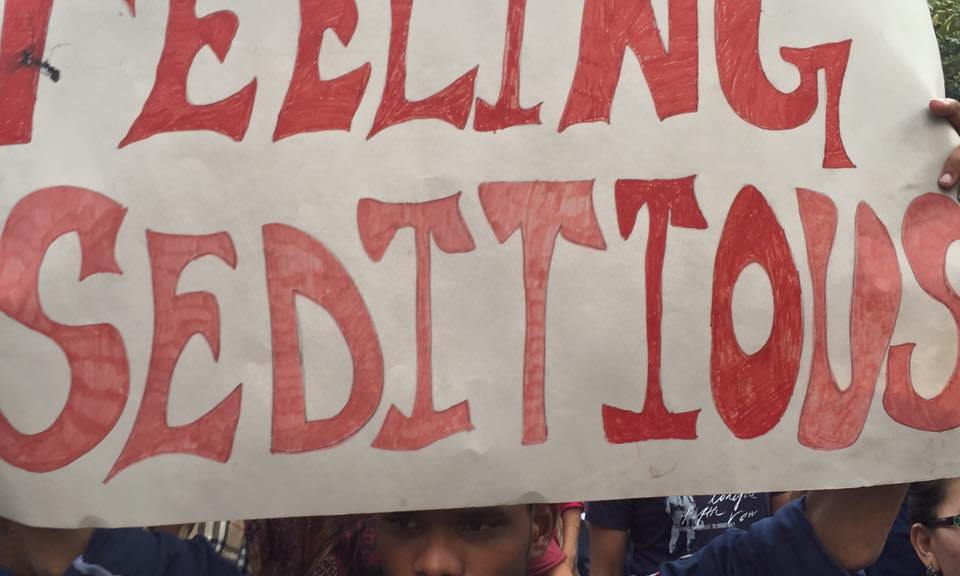
For the third time within a span of two weeks since the middle of February, thousands of people came out on the streets of Delhi to express their solidarity with the detained students of JNU (Kanhaiya Kumar, Umar Khalid and Anirban) and to voice their anger with the venal Modi regime.
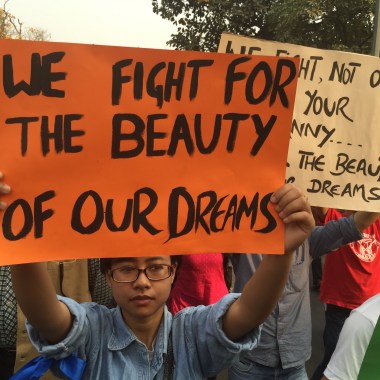
Protest demonstrations (at least in northern India) tend to have something of the monotonous in them, the same cadence, the same rhythm and the same wailing, complaining tone. They tend to have an air of events staged by the defeated, for the defeated. But if we take the last three big protests in the city, and the many gatherings in JNU in the last two weeks or so, as any indicator of what the pulse of our time is, we will have to agree that there has been a qualitative transformation in the language, vocabulary and affect of protests. This afternoon, like the afternoon of the 18th (the first big JNU solidarity march), and of the 23rd of February (the Justice for Rohith Vemula March), was as much about the joy of togetherness and friendship as it was about rage and anger.
Guest post by SIDDHARTH PETER DE SOUZA and SABA SHARMA
In a world where breaking news cycles drive our imagination and interaction with events and incidents around us, it often becomes difficult to not to have a fragmented idea of trends because they evolve and develop so rapidly. Does this volume of information necessarily imply that we become unable to view similar types of stories because they are portrayed as isolated, anomalous and disconnected? Is this also because it is much more comfortable to forget, rather than remember and reflect on an accumulation of incidents that maybe unpleasant, inglorious and inconvenient. Amartya Sen recently stated that “The problem is not that Indians have turned intolerant. In fact to the contrary we have been much too tolerant of intolerance”. Is our numbness because we are overwhelmed by these incidents or because we perceive them to be isolated without an underlying systemic pattern?
Intolerance Tracker is a visual story telling and crowd-mapping platform that seeks to engage with some of these issues. The idea of using a map is because it provides a compelling medium through which information can be consolidated, and presented across temporal and spatial boundaries.
It aims to utilize the power of the community to identify, report and map instances of intolerance across South Asia, and organically create and curate a visual storytelling database. This initiative is primarily led by students at the University of Cambridge, and has been set up on an entirely voluntary basis by people who are passionate and committed to the cause of documenting intolerance across the region. Continue reading Intolerance Tracker – A Community Curated Visual Storytelling Platform: Siddharth Peter de Souza and Saba Sharma→
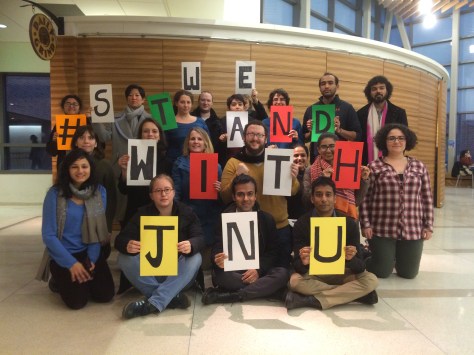
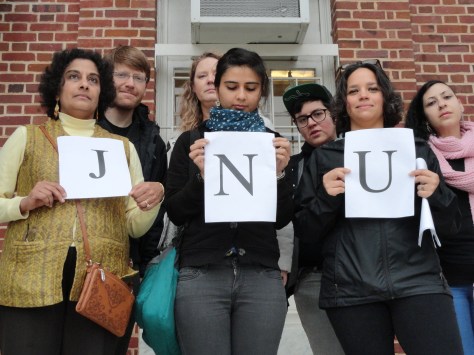
Kafila posted a set of solidarity statements recently in support of the students, faculty and autonomy of JNU. We are posting another set, received from the following organisations:
First-Decade JNU Graduates and Other Graduates – 548 signatories.
Faculty, Staff and Students at the Indian Institute of Management, Bangalore.
California Students and Faculty. California, U.S.
Current Fellows of the Jawaharlal Nehru Institute of Advanced Study, JNU, Delhi.
Colorado College, Colorado, U.S.
Faculty at DePaul University, Chicago, U.S.
Faculty, Students and Staff, Brown University, Rhode Island School of Design (RISD) and University of Rhode Island, Providence, U.S.
McGill and Concordia Universities, Canada.
Canadian Academics from Various Universities.
Please click on Read More below for the statements and signatories:
लोकसभा में स्मृति ईरानी जी की सफाई उर्फ़ भाषण बहुत भावुक, मनोरंजक और प्रभावशाली था। लोग उन्हें ‘आयरन लेडी’ का खिताब दे रहे हैं- यह उनके तर्क के लिए या उनके तेवर के लिए, या फिर उनके यह कहने के लिए की वो अपना सर काट के मायावती जी के चरणों में रख देंगी, पता लगाना थोड़ा मुश्किल है । सोचा था स्मृति जी कुछ सवालों का जवाब देंगी पर असल में मिली एक लम्बी, मेलोड्रामाटिक सफाई जिससे उन्होंने अपनी सरकार की सारी गलतियों पे पर्दा डाल दिया।ऐसी स्तिथि में हम मजबूर हो गए हैं की स्मृति जी से जो सवाल पूछे जाएँ वो तथ्य-सम्बंधित होने के साथ साथ अति भावनात्मक भी हों।
स्मृति जी के अभिनय के सारे सालों का अनुभव उनके भाषण में साफ़ दिखाए दिया। लोकसभा में स्मृति जी के हाव भाव से आक्रोश टपक रहा था पर क्या उन्हें इतना क्रोधित होने का हक़ है? स्मृति जी का यह मानना है की उनके ऊपर काफी बेबुनियादी आरोप लगे हैं, पर यह मामला स्मृति ईरानी जी के बारे में नहीं है, यह मामला उन मासूम छात्रों के बारे में है जिनकी ज़िन्दगी को उन्होंने दांव पर लगा दिया है। आखिर उन ‘बच्चों’ का क्या जिनके ऊपर उन्होंने और उनकी सरकार ने पिछले कुछ दिनों में अनगिनत आरोप लगाये हैं? स्मृति ईरानी जी तो मंत्री हैं, अगर आरोप लगे भी, तो उनकी ज़िन्दगी बर्बाद नहीं होगी, पर जिस क्रूरता से सरकार और मीडिया ने छात्रों का चरित्र-हनन किया, वह कभी भी इससे उभर नहीं पाएंगे। कन्हैया, उमर और अनिर्बान न ही मंत्री हैं जिनके पास कोई राजनैतिक सहारा है और न ही उनके परिवार इतने धनी हैं की वह अपना जीवन, अपनी इज़्ज़त पुननिर्मित कर पाएं। स्मृति जी, आप तो सिर्फ अपने बारे में सोच रही थीं की आप पर और आपकी परफॉरमेंस पर क्या क्या सवाल उठाये गए, क्या आपने एक बार भी सोचा की इन छात्रों के पास आगे ज़िन्दगी में सफाई देने का कोई मौका नहीं होगा? क्या आपने, माँ होने के नाते, यह सोचा की यह छात्र अब कभी भी साधारण जीवन नहीं जी पाएंगे?
There is an uncanny academic public silence over the Jat quota stir and the unjustified violence enacted during the stir in Haryana. The scale of violence and destruction is such that it competes for the worst instance of caste violence in Haryana’s post-Independence history. So far 30 people have lost their lives while over 200 people were injured in the nine-day violent Jat agitation demanding job quotas in Haryana. There is anger, fear and helplessness among those who lost their kin, homes, businesses and properties.At least 10 Haryana districts were severely affected by the violence. After such a huge loss, as if it was a routine, matter the Union Home Minister announced that a committee led by M Venkaiah Naidu will examine the demand by Jats for reservation in central government jobs.
In Haryana, the BJP’s government in the state has promised to bring a Bill granting OBC status to Jats in the upcoming assembly session. The Jats’ demand for reservations in the central OBC list is not new. Since 1995, Jats in Haryana have been demanding an OBC (Other Backward Class) status, which will help them secure the 27 per cent reservation in government jobs. Earlier in 1997, the Jats in Haryana, Uttar Pradesh and Madhya Pradesh had demanded themselves to be included in the central OBC list. It was rejected by the National Commission for Backward Classes. Subsequently UPA government’s decision to include Jats from 9 states in the OBC list was also rejected by the Supreme Court in March 2015. Despite all this, political parties such as Congress and BJP continue promising quota to Jats during election campaigns. These promises have encouraged the Jats to organize and agitate for quotas. However, their agitations for reservations have not been so violent. That is why the most pressing and important question that needs analyses is why has the current agitation by Jats been so violent? Perhaps three factors will help us to understand this severe violence and loss of property worth crores of rupees.
Guest Post by Shehla (Vice-President, JNUSU) and Rama Naga (General Secretary, JNUSU)
To all Friends (in Delhi, India and the World) who have Supported the Struggle of JNU students and students elsewhere in India in the past few weeks.
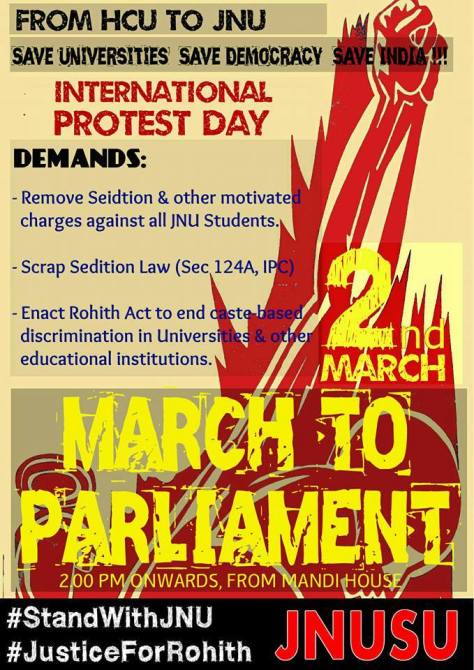
Thank you for your message of solidarity. In this hour of unprecedented attack on us, what has been a source of great strength are messages like these, which we have pasted all over the Administration Building. We have not been able to respond to each message because of being extremely overburdened. However, we are writing back today, in order to update you regarding the status of the struggle, and with a call to action on the 2nd of March, 2016 in your city.
Call for Global Day of Protest and March to Parliament for JNU – March 2nd, 2016
Pakistan was created as a homeland for the sub-continent’s Muslims and yet, even before it had formally taken birth, its founder in a famous speech delivered on August 11, 1947 stated his intention to establish a secular nation where religion would be relegated to the private sphere and the public discourse would be given to pressing development issues. Jinnah’s first cabinet consisted of an Ahmadi (considered by orthodox Muslims as a heretical sect), Sir Zafarullah Khan and Jogendranath Manadal, a Hindu from East Pakistan. Jinnah himself was a Shia while the majority of Pakistan’s Muslims were Sunnis. Roughly one-quarter of Pakistan was non-Muslim at the time of independence and secularism seemed a realistic option. Also, Jinnah’s actions appeared to imply that it would actually be practised. But events proved otherwise.
संसद में दिए गए आपके भाषण को सुना. इससे पहले की मै अपनी बात रखूँ , यह स्पष्ट कर दूं की यह पत्र किसी “बच्चे” का किसी “ममतामयी” मंत्री के नाम नहीं है बल्कि यह पत्र एक खास विचारधारा की राजनीति करने वाले व्यक्ति का पत्र दूसरे राजनैतिक व्यक्ति को है. सबसे पहले मै यह स्पष्ट कर दूं कि मै किसी भी व्यक्ति की योग्यता का आकलन उसकी शैक्षणिक योग्यता के आधार पर नहीं करता हूँ बल्कि साफ़ साफ़ कहूं तो मै “योग्यता”(मेरिट) के पूरे कांसेप्ट को खारिज करता हूँ.
मानव संसाधन मंत्रालय का पद भार लेने के साथ ही यह अपेक्षा की जाती है कि आप इस देश के केंद्रीय विश्वविद्यालयों में उनकी ऑटोनोमी का सम्मान करते हुए उसके लिए उत्तरदायी होंगी. रोहित वेमुला के मामले में आपने क्या किया यह सबके सामने है कि किस तरह से वहाँ के प्रशासन पर आपने दबाव डाला जिसका नतीजा रोहित के institutional मर्डर के रूप में हमारे सामने आया. लेकिन मै इन सारी चीजो पर अभी बात नही करना चाहता. आप बार बार अपनी औरत होने की पहचान (आइडेंटिटी) को assert करतीं हैं और इसको करना भी चाहिए क्यूंकि नारी जाति उन ढेर सारे हाशिये पर किए गए लोगों में एक है जिनको सदियों से शोषित किया गया है. मै आपसे यह पूछना चाहता हूँ कि एक दलित स्त्री जो कि हर तकलीफ उठाते हुए अकेले अपने दम पर जब अपने बेटे बेटियों को इस समाज में एक सम्मानपूर्ण जगह देने के लिए संघर्ष कर रही थी तब एक नारी होने के कारण आप की क्या जिम्मेदारी बनती थी ? क्या आपको उस महिला के जज्बे को सलाम करते हुए उसकी बहादुरी के आगे सर झुकाते हुए उसके साथ नहीं खड़ा होना चाहिए था? हाँ, मै रोहित की माँ के बारे में बात कर रहा हूँ. जो महिला इस ब्रहामणवादी व पितृसत्तात्मक समाज से लड़ी जा रही थी, अपने बच्चों को अपने पहचान से जोड़ रही थी, उस महिला को आप व आपकी सरकार उसके पति की पहचान से क्यूँ जोड़ रहे थे? आपको भी अच्छा लगता होगा की आपकी अपनी एक स्वतंत्र पहचान है. लेकिन यह अधिकार आप उस महिला से क्यूँ छीन रहीं थीं? क्या आप भी पितृसत्तात्मक व ब्रहामणवादी समाज के पक्ष में खड़ी होती हैं? अपना पूरा नाम बताते हुए अपनी जाति के बारे में आपने सवाल पूछा और आपका भाषण खत्म होने के पहले ही लोगों ने आपकी जाति निकाल दी. मै आपकी जाति के बारे में कोई दिलचस्पी नहीं रखता हूँ और मै यह बिलकुल नहीं मानता हूँ की अगर आप उच्च जाति के होते हैं तो आप जातिवादी ही होंगे लेकिन आपके विभाग/मंत्रालय के तरफ से जो चिट्ठियाँ लिखी गई उसमे रोहित और उसके साथियों को जातिवादी /caste-ist बताया. मैडम क्या आप caste-ism और caste assertion का अन्तर समझती हैं? मै समझता हूँ की आप ये अन्तर भली – भाँति समझती हैं क्यूंकि आर एस एस जो आपकी सरकार और मंत्रालय को चलाता है, वह वर्ण व्यवस्था के नाम पर जाति व्यस्वस्था को भारतीय समाज की आत्मा समझता है और आर-एस-एस के एजेंडे को लागू करवाने की राजनैतिक दृढ़ता हमने समय समय पर आप में देखी हैं.
The interpretation of law does not only take place in courts. In our season of ‘seditious’ speech this would seem an obvious point as the police administration is as much engaged in the process of legal interpretation or, as legal speak would have it, exercising discretionary powers. However, while courts have to at least minimally ensure that their decisions are backed by reason and aligned with previous decisions, the cases filed against Kanaihya Kumar and others seems to suggest that the police administration can operate almost as a universe unto itself in its interpretation of Indian criminal law. Of course police action will have to tested and defended in court but what if the police bring flimsy cases to trial to inflict long drawn out legal process as punishment for dissenting speech?
There has been an avalanche of excellent recent writing in recent days on the criminal offence of sedition. These have emphasised two broad points. On the one hand they have traced the offence of sedition to the authoritarian designs of the British colonial state seeking to control restive Indian opinion. On the other, opinion has also noted that Indian Courts while upholding the constitutionality of the offence of sedition have held that the speech can be penalised on this ground only when accompanied by an imminent threat of disorder, disturbance or violence. However, the JNU fracas as other similar cases in recent memory involving Arundhati Roy, Binayak Sen and Aseem Trivedi among others, demonstrate that this judicial standard reading down the offence of sedition to a very narrow set of speech acts has not constrained subsequent police action. On the contrary police administrations in the current JNU case have pursued citizens for seditious speech even when their speech could not in any objective manner be tied to imminent threats of disorder. That is, the criminal provisions on sedition section are used against the spirit of the law as laid down by the Supreme Court and is mobilised to with little cause but the harassment of dissenting opinion. In such situations what can defenders of free speech do to ensure that legal process is not abused to harass dissent?
Kafila has been receiving a huge number of solidarity statements from around the world in support of JNU students who have been arrested or charged recently. We are consolidating the statements received in the past few days in the following post. The institutions/groups are as follows in order of date received, starting from February 24, 2016:
Johns Hopkins Stands With JNU
Duke University Stands With JNU
Teachers at Delhi University
Professional Staff Congress, the City University of New York faculty and staff union (PSC-CUNY)
Pinjra Tod, Delhi.
Academics, Students, Writers, Academics and Activists from Australia.
U.S Community Organisations.
Students and Faculty at Johns Hopkins University, U.S.
Academicians in Gujarat
Students at Cornell University, U.S.
South Asian Communities at Tufts and Harvard Universities, U.S
Students, Faculty and Other Workers at Duke University, U.S.
Mumbai students.
Please click on “read more” for the statements and signatories:
Just saw your post condemning The Telegraph’s representation of Smriti Irani as ‘Aunty’. I understand your indignation, though I am curious to know why few people like us stand up and protest when the people who supporte her, the sanghis, throw vile abuse at dissenters and feminists, label them prostitutes, and threaten them regularly with rape and disfigurement. My daughter was recently threatened in Delhi and warned not to behave like a ‘JNU randi’; senior women teachers from JNU were showered with similar abuse, shoved, groped, and hit at the Patiala House, and many of them have received direct and indirect threats. JNU women have been portrayed in the most despicable terms recently, before which Telegraphs’s characterisation of Irani as ‘Aunty’ is tame indeed even if unacceptable.
Earlier this week, I tried to join the many dots of violence at universities into a coherent pattern. My central contention is:
Spirited resistance in campuses across the country suggests the politics of India’s youth are more fluid and assertive than expected. The mid-1990s empowerment of historically oppressed castes, narratives of economic aspiration from the 2000s and an instinctive suspicion of authoritarianism have come together to forge a bold poetic new politics of desire that has befuddled even ruthless and astute politicians like the prime minister.
and
Modi’s government uses outdated laws, a pliant police force and Hindu student organizations as a battering ram to crush this awakening, exacerbating the discord between a prime minister determined to stamp his authority on an unruly nation and students enraptured by a thrilling moment of unlikely solidarities that could define their generation.
The return of BJP to power in 2014 was the return centre-stage of the caste question. Not that caste had gone away. Far from it.But our public life had been unmistakably altered by caste radicalism in the last few decades. 1990s onwards, powerful and triumphant dalit voices – intellectual, literary and political – transformed the nature of our democracy such that questions of caste injustice and caste assertion could no longer be circumvented, passed over, as it was done in earlier decades, by both reactionaries and progressives. Nor could the dalit and the low-caste subject be any longer portrayed as mere outcast or victim. She had come into her own as an autonomous and assertive political subject, sometimes even the ruler. Christophe Jaffrelot called this India’s silent revolution, and rightly so. What we see today with the rise (and imminent fall) of Hindutva nationalism is an attempt at a counter-revolution, nothing less.
The Counter-revolution – Targeting Dalits
The signs are easy to read. Right after Modi’s win began the so-called gharvapasi campaign of the Hindutvavadis, seeking to reconvert to Hinduism those who had earlier seceded in favour of Islam and Christianity. While the issue was pitched as an issue of religion, it was clear that at the heart of the matter was caste. Continue reading Why Caste is the Crux and Hindutva’s Fall Imminent: Prathama Banerjee→
Hamlet in New Delhi, 2016: “India, Pakistan, security, sovereignty, nation, anti-national…words, words, words”
According to Sigmund Freud, when we dream, and when we suffer psychotic delusions, we treat words as pictures and things. A word’s meaning, in these conditions, becomes the shape of the word and its appearance is the same as feeling its physical impact, its blow. We cannot grasp anymore that a word refers to an object or idea outside in the world or that it can be used as a metaphor or an indirect analogy and image. We cannot even receive the rhetorical communication of words intended to persuade, exhort, transgress or insult. In each of these communications intended by an addresser we already feel physically, viscerally and as a consequence, mentally under the assault of the words of the addresser as if they are blows.
So in response we don’t persuade, exhort, transgress or insult back but instead, we curse (the upper limit of lucid discourse in this state), punch, grab the addresser by the throat, pull a knife or gun if we have any of these articles in our possession – or we cringe, weep, hold our heads in our hands and rock to and fro. Now it is very unlikely that in a real psychotic condition, we are able to invoke a particular law or clause of law in our favor, complain to the police and come up with a fluent image of language as justification for our actions. “We had no choice but to do what we did because the other(s) insulted our Mother India”. In a real psychotic condition, it is more likely we will be the ones to be taken away. Continue reading A Close Look at Certain Words Allegedly Shouted Recently in JNU and Their Impact on Our National Intelligence: Soumyabrata Choudhury→
‘Umar is my son.’, I want to say. I have never met him. I do not know him. And yet, I want to claim him as my son. I do not have a son. All I have is a daughter. A daughter fast approaching the age when young minds come into their own. Omar is past that age. He is already an independent, autonomous mind. And a heart bleeding for the oppressed of the earth, burning with rage for injustices against them, crying for justice for them.
Umar is the son every parent should desire and be proud of. Because he is one who can disagree , who can have the courage to rebel against his parents, who can break free from the cage of identity his family or community or religion has built for him. Who can prove his humanity by transcending the boundaries others fear to cross. Continue reading Umar Khalid, My Son→
I noticed yesterday, a tweet from Anupam Kher where he compared state action over the events of the last few weeks, as a kind of “pest control” – required, of course to keep the house clean. His exact tweet is – “Gharon mein pest control hota hai to cockroach, keede makode ityadi bahar nikalte hain. ghar saaf hota hai. waise hi aajkal desh ka pest control chal raha hai.”
The similarity of this thought to Hitler’s on ethnic cleansing hasn’t gone unnoticed (look at Rajdeep Sardesai’s tweet and this article – http://www.jantakareporter.com/india/anupam-kher-hitler-modi/38514) and I’m sure much more will be written about it in the days to come. Anupam Kher’s inability to develop a logical argument or even notice the illogicality of his own actions has never ceased to surprise me, but the casualness with which he endorses state violence is interesting. But mere tweeting is not sedition. Do I find this tweet distasteful, offensive and also legitimizing state and mob violence? Yes, I do. Am I worried by the sentiment expressed in this tweet? Yes, I am. Am I additionally worried because this is not a man, sitting in an obscure corner somewhere, just airing his views, but a well known personality whose words seem to garner some weird kind of legitimacy because of his status as a Hindi film actor? Yes, I am. Do I think he should be arrested? No. Continue reading Does the Nation Really Even Want to Know? Shweta Radhakrishnan→







 KAFILA - COLLECTIVE EXPLORATIONS SINCE 2006