Category Archives: Bad ideas

Of imagined solidarities and real fears – The politics of the Sri Lankan Tamil cause in Tamil Nadu: Anonymous

This is a guest post by ANONYMOUS:  When elephants fight it is the grass that suffers, so goes an old Kenyan proverb. In the maelstrom of political hysteria unleashed by Jayalalitha and Karunanidhi ostensibly in aid of Sri Lankan Tamils, democracy, truth and solidarity have been the biggest casualties. Over the past few months, Tamil Nadu has witnessed attacks on Sri Lankan Buddhist monks and Christian pilgrims, and the government sanctioned blockade of Sri Lankan schoolchildren and sportspersons.

The latest salvo from Chennai regarding Sri Lanka is the Tamil Nadu assembly resolution calling upon India to press for a United Nations Security Council mandated referendum amongst Tamils living in Sri Lanka as well as Tamils of Sri Lankan origin in other countries on the question of carving out an independent Tamil Eelam in Sri Lanka. This is in addition to demands to declare Sri Lanka a ‘hostile state’, impose some form of sanctions etc. Continue reading Of imagined solidarities and real fears – The politics of the Sri Lankan Tamil cause in Tamil Nadu: Anonymous
Haryana Police and Administration Repress Ongoing Maruti Workers’ Struggle: MSWU

Guest Post by Maruti Suzuki Workers Union, Provisional Working Committee

Third Day of our Fast Unto Death – Police and Administration Gearing up for Further Repression of Our Struggle!

Friends,

Today is the third day of our fast unto death that began on 28th March. However it seems that the state is adamant on responding to our peaceful movement with increased violence and use of brute force. Today, when the local people of nearby villages and our family members came to lend their support to us at the site of the hunger strike, they were greeted by an increased number of policemen. When we tried to meet Haryana Industrial Minister Randeep Surjewala – we have been sitting outside whose residence for the last 6 days braving rains and the cold – he flatly refused to meet us. When the family members surrounded him demanding our rights then a large number of police men appeared at the site and the minister left the place using the police to disperse the people. Now there are 2 police vans stationed here and the small shopkeepers and tea stall owners in the area are being threatened by the administration to withdraw their support from our movement. When the administration realized that we are not going to abandon our struggle because of their threats then they put pressure on the owner of the plot where we are sitting and tried to use him force to us out.
Continue reading Haryana Police and Administration Repress Ongoing Maruti Workers’ Struggle: MSWU

Crimes of Exclusion: Siddharth Narrain

Guest post by Siddharth Narrain.

It is anger on the streets that brought back to the forefront the neglected issue of sexual violence, energized a government appointed Committee to put together clear and well reasoned recommendations on law reform, and forced the government to table the Criminal Law Amendment Bill (2013).  It is public pressure and years of struggle by the women’s movement that is reflected in the more progressive parts of the Bill, passed recently by both Houses of Parliament.  Unfortunately, despite unanimity from a large cross section of society, that the definition of rape cannot be restricted to an outdated understanding of rape as perpetrated by men on women, the version of the Criminal Law Amendment Bill that was finally passed by Parliament retains this language. The law, if passed in this form will be a betrayal of the rights of millions of transgender persons, intersex persons and sexual minorities not born women.

Continue reading Crimes of Exclusion: Siddharth Narrain

Muslim Right: Baring Its True Fangs!

Image

Any death is regrettable and those who died due to police fire may also come under this category. What is interesting is Jamaat’s modus operandi. The lone survivor of 14 December mass murder of intellectuals described in a recent TV documentary how Al Badr killed Prof Munier Chowdhury and others. Some were bitten with iron bars to death and at the final point; they would insert such bars into the head of their victims to ensure death. Jamaat-Shibir reportedly did exactly the same couple of weeks ago when they killed some police constables and others. It shows Jamaat-Shibir’s Standard Operating Procedure has remained unchanged for the last four decades…

(Rabiul H. Zaki, 1952, 1971, the genocide and Shahbagh)

“The Pakistani soldiers unleashed a reign of terror on the soil of Bangladesh in 1971. They brutally killed innocent people, molested Bengali women and ruined the economy. The Jamaat leaders, Ghulam Azam and Matiur Rahman Nizami, issued the fatwa that those activities were permissible to save Islam” (Dr Mohammed Hannan, Page 252, Bangladeshe Fatwar Itihas, 1999).

 I

What is common between Syed Md Nurur Rahman Barkati, Shahi Imam of Tipu Sultan Masjid, Kolkatta and Maulana Syed Athar Abbas Rizvi, imam, Cossipore Masjid or Md Qamruzzaman, general secretary, All Bengal Minorities Youth Federation ? Well, if media reports are to be believed then they would be the leading lights of a demonstration to be held on March 30 th in Kolkata demanding stepping down of Bangladesh Prime Minister Sheikh Haseena’s resignation. Continue reading Muslim Right: Baring Its True Fangs!

Reject the National Food Security Bill: Right to Food Campaign

This release was put out by the RIGHT TO FOOD CAMPAIGN on 19 March 2013

More than 500 people of the Right to Food Campaign sitting at Jantar Mantar in New Delhi rejected the National Food Security Bill 2013 which was passed by the cabinet of the UPA Government today evening and will now be placed in the Parliament in this session.

NO TIME FRAME FOR IMPLEMENTATION

People were shocked to learn that according to the Bill that was passed, the law will not be applied in one stroke. The language of the law is that different dates may be appointed for different states and different provisions for the implementation of the Act.  This clearly means that there is no time frame for full implementation or objective criteria for phased implementation. It means the government in power has the choice to decide which state and what provisions need to be implemented. We condemn this as being against the fundamental rights of the people and the federal nature of the Indian state.  This also clearly shows that the Government is not really committed towards ensuring the end of food insecurity of the teeming millions of the country. Continue reading Reject the National Food Security Bill: Right to Food Campaign

India, International Law and an Act of Hypocrisy: JKCCS

Press release put out 24 March by the JAMMU AND KASHMIR COALITION OF CIVIL SOCIETY

Srinagar: The 21 March 2013, United Nations Human Rights Council [UNHRC] resolution is a welcome initial step in the ongoing struggle to hold countries responsible for human rights violations, ranging from Genocide, Crimes against Humanity and War Crimes to Enforced Disappearance, Torture, Rape and Extra-judicial executions. The watered down resolution, moved by the United States, and India’s support for the resolution, requires both commendation and severe criticism at the same time.

There can be no selective morality when it comes to standing against the commission of human rights violations by State’s. Every country must be held to the same standards, as Sri Lanka has been in the instant case, regardless of economic or geo-political concerns. In this regard, the United States and India stand accused of hypocrisy in their dealings with human rights violations in their regions or across the world. Similarly, Pakistan’s vote against the resolution raises serious questions on its own approach to human rights violations in the region or elsewhere. Continue reading India, International Law and an Act of Hypocrisy: JKCCS

On Narendra Modi’s strange bedfellows in Washington DC: Zahir Janmohamed

Guest post by ZAHIR JANMOHAMED

PTI photo
PTI photo

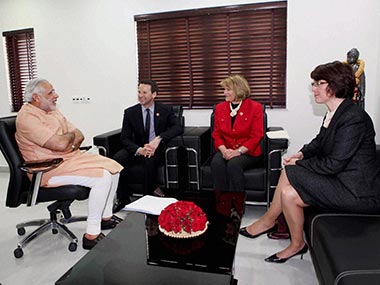
The headline on Zee News at 5:09pm today read: “America opens its gates for ‘very dynamic’ Narendra Modi.”

The Business Standard in an article posted a few minutes earlier, at 4:57pm, wrote: “After UK, now US softens stand on Modi.”
Indeed three members of the US Congress, along with a few US business leaders, did meet with the Gujarat Chief Minister today in Gujarat. But should we infer any shift in US policy towards Narendra Modi?

In short, no.
Continue reading On Narendra Modi’s strange bedfellows in Washington DC: Zahir Janmohamed

The Delhi University Four Year Structure – Myths and Reality

This document has been prepared by the  JOINT ACTION BODY OF DELHI UNIVERSITY.

Myth 1

The four-year system is a measure of reform that is necessitated by the state of higher education in India today.

Reality

There is no clarity in the objective of why Delhi University is moving to a four-year undergraduate system. Is it to introduce more value based courses, or is to elevate the university to “global standards”? Unless the issue is understood, debated and discussed publicly and democratically, reforms will be ill-conceived and not in general public interest as the following sections will show. Continue reading The Delhi University Four Year Structure – Myths and Reality

Why the Delhi Police Special Cell will continue to manufacture terrorists: JTSA

This release was put out yesterday by the JAMIA TEACHERS’ SOLIDARITY ASSOCIATION

Last year, JTSA compiled and released a report documenting 16 cases where the Delhi Police, especially its Special Cell, had framed innocents as terrorists. An overwhelming number of these unfortunate men were from Kashmir. Despite the fact that we cited court judgements which reprimanded the Cell for refusing to join independent witnesses, for willfully violating established procedures, for illegally detaining accused and showing their arrests on later dates; for fabricating evidence and failing to provide an iota of evidence in support of their charges – neither the leadership of the Delhi Police nor the Home Ministry felt the need for any enquiry. Continue reading Why the Delhi Police Special Cell will continue to manufacture terrorists: JTSA

No Time for Grieving – Or Why We Should Talk Some More About Kai Po Che: Debashree Mukherjee

Guest post by DEBASHREE MUKHERJEE

Okay, so the popular consensus is that Kai Po Che is a good film. Everyone agrees that it’s well shot and edited, the relatively unknown heroes are excellent, and the narrative is taut and emotionally resonant. It is competent and follows all the right cues worthy of a buddy movie about growing up and testing loyalties. But the film is hardly an event. It has been seized upon as a significant cinematic landmark for its depiction of the Gujarat pogrom of 2002. It might be worth our while to get some perspective here.

Today I will look at some other questions about our collective liberal attitude to this film, and what it indicates about our memory of select incidents of mass violence in this country. The main question to ponder is whether there is something dangerous about a historically-contextualized cultural product that can be coopted by a range of political perspectives? Is there something objectionable about a film (and the emotions it generates) which is deliberately toothless in the face of power? Over the last few weeks we have witnessed a range of informed cultural commentators  protest that critics of the film are making much to-do about what is in fact the first “realistic” and engaging Bollywood depiction of the Gujarat massacre. This post rejects that opinion and appeals for responsible film criticism and an alert, active mode of spectatorship.

Continue reading No Time for Grieving – Or Why We Should Talk Some More About Kai Po Che: Debashree Mukherjee

Aadhar/UID is Against Equality and Democracy: Moiz Tundawala

Guest Post by Moiz Tundawala

After the suppression of the 1857 Mutiny and the British take over of Delhi, Mirza Ghalib was once asked by a military official whether he were Muslim or not. Ghalib is said to have quipped: “Only half Muslim; I drink wine but refrain from swine.” For me, this ripost evinces a flippant disdain for modern forms of rule which essentialize persons and groups purely based on certain attributes which are deemed definitive and prioritized over others. As far as Ghalib’s case was concerned, the idea may have been to find out based on his religious identity if at all he could pose problems for the newly established colonial regime. In later years, this policy, which African intellectual Mahmood Mamdani has recently termed ‘define and rule’, gradually became integral to governmental practices in most parts of the modern world; today, populations are ever so readily classified and enumerated based on empirically observable characteristics in order to make them amenable to effective government. The Aadhaar project of the Unique Identification Authority of India clearly falls within the gamut of such practices, marking a transition to modernity in a radical break from the past. So my reservations with it are just the same as those with any other modernity inspired programme wherein personal and collective identities are reduced to a somewhat arbitrarily determined bare essence which may have no real connection with lived experiences of fuzzy and contextually constructed identities.

Continue reading Aadhar/UID is Against Equality and Democracy: Moiz Tundawala

Modi and me: Sharad Mathur

This is a guest post by SHARAD MATHUR

1999

In the summer of 1999, practising our family tradition, we were availing a government LTC that my father was entitled to, being a senior central government officer.  Since we could travel by air, we decided to take a trip to Darjeeling, while halting at Allahabad, Varanasi, Lucknow, and Calcutta for some sight-seeing. Those were the days when flying was an experience for most Indians; yet the emotional memory of this trip did not record much of the excitement induced by flying, but took vivid account of disappointment – with a chance conversation and of missing another.

It was on our flight from Lucknow to Calcutta, I was sitting with my younger brother while my parents were sitting together in a row behind us. I was on the window seat and was too occupied with the process of luggage sliding inside the plane, to notice two gentlemen who came and sat next to my parents and my brother respectively. My gawking was however interrupted by my father excitedly introducing me to one Devi Singh ji, who I was told happened to be Personal Assistant to Shri Bhairon Singh Shekhawat. Being a big BJP enthusiast, partly because of their mesmerizingly bright coloured flags, I looked up to this BJP heavyweight and was elated to meet his personal assistant. My excitement was doubled when Devi Singh ji introduced us to a gentleman sitting next to my brother, on the aisle seat, as Modi ji who was accompanying Bhairon Singh ji to the Bihar convention of BJP. However, this excitement remained short lived.

Continue reading Modi and me: Sharad Mathur

When rape survivor becomes victim: Sherin B.S.

SHERIN B.S. writes from Hyderabad: There is a constant demand for a change in the terminology from ‘rape victim’ to ‘rape survivor’ in the agenda of feminist concerns in discourses related to rape. But beyond the feminist investment on surviving rape, a systematic reading of public discourses presents the traumatic sustenance of layers of violence that follows rape. The Suryanelli girl has survived rape, but the violent experience of life after rape perpetrated by systemic structures of patriarchy places her at the receiving end of a system that consciously alienates, humiliates and hunts her down.

While referring to the Suryanelli rape case there are two kinds of discourses circulated widely. One is the question of legality of the crime involved, with a heavily prejudiced and unsympathetic legal frame work attempting to frame the girl as an eternal victim subject for whom justice is almost impossible, mediated through parallel machinery of the state, including law enforcement. The impossibility of justice is not the intention of the legal machinery but it comes through the operating forces of judgments, prosecution stands, law enforcing offices like police stations and officers, and questions of evidence, alibis and so on. Continue reading When rape survivor becomes victim: Sherin B.S.

Ilyas Masih wants to stay in the dustbin: Saad Sarfraz Sheikh

This slideshow requires JavaScript.

SAAD SARFRAZ SHEIKH sends us this photo essay from Lahore: On 9th March, 2013, I saw an entire neighborhood burn right in front of my eyes. All I could do was watch, as the houses fell and their residents watched in vain.

And now, there are burnt teddy bears and dolls, broken doors and melted buckets stuck on the floor. It seems I am on fire.

Nasreen’s defunct washing machine is now as black as the night. Her child sits on it and weeps. Like a surgeon, she salvages the motor and tells me that it could still work. But her microwave, she tells me, is a painful puddle on the floor. Continue reading Ilyas Masih wants to stay in the dustbin: Saad Sarfraz Sheikh

The Jamaat factor in Bangladesh politics: Jyoti Rehman

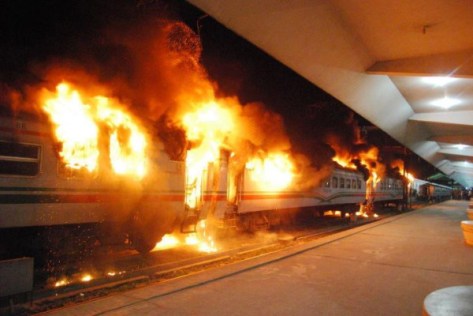
jamaat-train
A train in Bangladesh set on fire by activists of the Jamaat-e-Islami Bangladesh

This is a guest post by Bangladeshi commentator JYOTI REHMAN: Delwar Hossain Sayedee, an Islamic preacher and a senior leader of Jamaat-e-Islami Bangladesh, the country’s largest Islam-pasand party, was sentenced to death on 28 February for war crimes committed during the 1971 Liberation War. Within hours, Jamaat cadres and activists clashed violently with police and law enforcement agencies. Scores have been killed in some of the worst political violence the country has experienced in recent years.

Five other senior Jamaat leaders, including its current and former chiefs, are being prosecuted for war crimes committed in 1971. Another leader was sentenced to life imprisonment on 5 February. That sentence triggered what has come to be called the Shahbag Awakening—a month of largely peaceful gathering of tens of thousands of people in the middle of Dhaka. A key demand of the largely government-supported Awakening is to ban Jamaat. Continue reading The Jamaat factor in Bangladesh politics: Jyoti Rehman

A Curfew in Spring: Rich Autumns

1-rich-autumns2
Photograph by Rich Autumns

RICH AUTUMNS writes from Srinagar: The capital of Kashmir is under tight curfew. Tight does not qualify curfew. It qualifies Srinagar. Srinagar is tight under curfew. The city has stopped breathing. It is an enforced exercise that the Valley undergoes regularly for the sake of law and order. On the deserted streets of Srinagar, Indian Army men stand in army issued jackets nursing rifles under the fresh green leaves of the Chinar. Occasionally a milk man cycles by. Sometimes, he is stopped and turned back. Sometimes he is allowed to pass, after an identity check. Continue reading A Curfew in Spring: Rich Autumns

Pot calling the dynasty black: Ajaz Ashraf

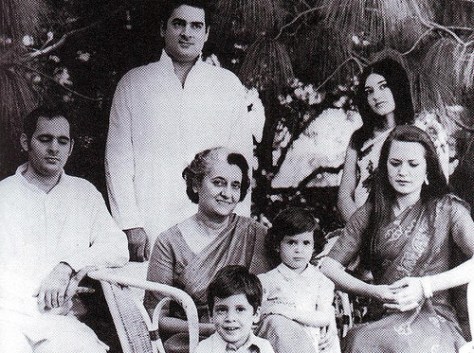
gandhi-family

AJAZ ASHRAF writes: It is time we examined the society we have created before we invoke the rather trite argument of dynastic rule to stridently criticise the Gandhis and the Congress. No doubt, dynasty is antithetical to democratic politics. Yet, it is also true that dynastic succession is the norm outside the Indian political realm as well. Its sheer pervasiveness explains why people dismiss outright the hypocritical media outcry against dynastic succession to routinely vote pater familias to power, in state as well at the Centre. Continue reading Pot calling the dynasty black: Ajaz Ashraf

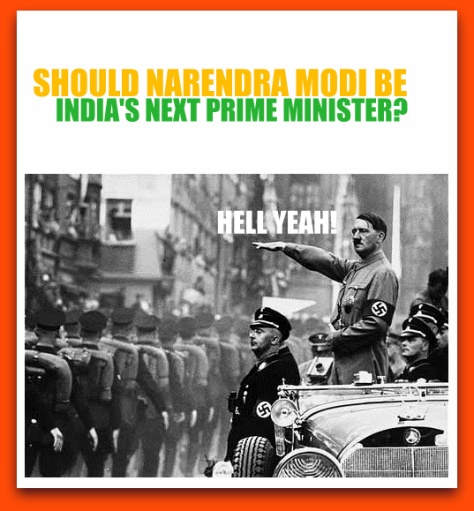
Should Narendra Modi be India’s next Prime Minister?

MODI-HITLER

Sheela Bhatt writes: Continue reading Should Narendra Modi be India’s next Prime Minister?

Class Feminism vs. Classy Feminism … Or, Everybody Loves the Governable Woman!

A few weeks ago, I mentioned on Kafila a certain gentleman who delivered a memorable address in Government Women’s College, Thiruvananthapuram, which contained sage advice on how to bring under control the unruly bodies of ungovernable women.  After that I have been receiving unsigned letters from his admirers who feel that their innocent hero has been most unfairly criticized. Like the grumpy ground-lubber types who are either incapable of ascending or simply unable to climb coconut trees and do not appreciate the free services rendered by the chivalrous heroes high above, I have erred in judgment, they claim. Continue reading Class Feminism vs. Classy Feminism … Or, Everybody Loves the Governable Woman!

India’s other education crisis: The English Teacher

This is a guest post by ‘The English Teacher’
Here are some statistics detailing the current state of education in India. 4% of Indian children – eight million – never start school. 57%, 74 million, don’t complete primary school. 90% – 172 million children – don’t complete secondary school. To call the situation alarming is an understatement; we have in our country a full-blown disaster. 90% of our nation’s children are victims of this disaster, with barely 10% emerging as survivors. But how fortunate are the 10% really?I’ve been a teacher since 2010, a year after I graduated from university. I taught social studies for a while, pottered a bit in the areas of curriculum and school policy development for a while longer, and have, for the past two years, taught English to middle school students. If these terms – middle school, curriculum and school policy development seem a bit foreign to you, it’s because they are. I happen to work – or happened to, until very recently – in an international school.

When you hear “international school” you may imagine any number of a range of things  – let me tell you right off, though, that we aren’t talking top range international school here. As far as school infrastructure goes, my former place of work is a damned sight better than any of the schools the 90% go to in our country, but as far as international schools go, mine lay in the majority of them that are just coming up in the country, especially in Mumbai. The sort that’s less than ten years old and an educational disaster zone of its own kind.

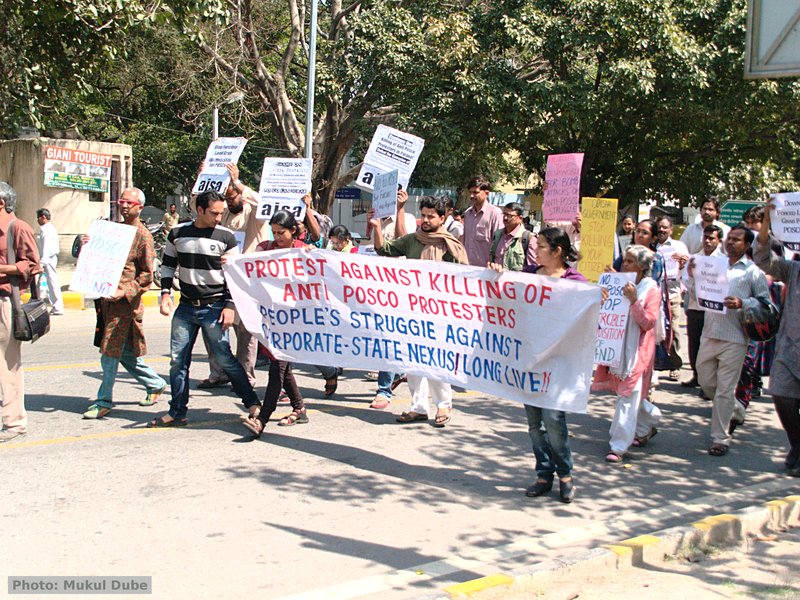
Protest Against Killing of Anti – POSCO Activists and Forcible Land Grabbing in Odisha

Copy of the Memorandum to The Chief Minister, Government of Odisha Image
In the continuum of brutal attacks on the struggle against forcible land acquisition for a POSCO steel plant in Odisha, the most recent case of blatant violence perpetrated by the corporate–police-goonda nexus in the region saw the murder of 4 people in Jagatsinghpur district.
On 2nd March, hired musclemen of POSCO with the full complicity of Odisha Police threw bombs at anti-POSCO activists in Patana village, in which 4 activists were killed and several others were seriously injured. Out of the 4, 3 were killed as a direct consequence of the police’s refusal to arrive at the spot for 15 hours after the bombing, or arrange for an ambulance to take the injured to a hospital.