Category Archives: Culture

This is What Frightens Them….

And the struggle continues, image courtesy Manorama online
And the struggle continues…Kochi, image courtesy Manorama online
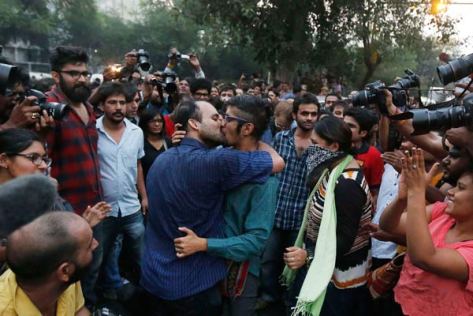
“If conservative elements can capture our public spaces and impose their diktat on us, we will do the same in retaliation. Our university spaces, parks and roads are not free any more. We are reclaiming them now. We live in an age where a Dalit man is hacked to 40 pieces because he fell in love with a woman from a higher caste. This Kiss of Love campaign is a defiance of moral policing and a struggle to uphold the spirit of love in all its forms and for everyone,” said Zareen, a campaigner.
Kiss of love Delhi, image courtesy, DNA

‘Downtown’ – Where the Kiss of Love Began: Sudha K. F.

Guest post by SUDHA K. F.

[This article was written in response to the recent incident of vandalism and violence meted out by BJP- affiliated Yuvamorcha activists against a restaurant called Downtown in Kozhikode, Kerala. This was the incident that led to the protest – the Kiss of Love at Kochi, Kiss of Love in Kolkata, and now, most audaciously outside the RSS Office in Jhandewalan. Wherever it goes, it acquires a flavour of its own. Thus in Kolkata, hokkolorob (let there be turmoil) mutated into another set of slogans – hokchumban (let there be kiss – or, let us kiss) and now, Sanghi gunde hoshiyar, tere saamne karenge pyar (beware Sangh goons, we will (make) love right before you. Sudha K. F. gives a sense of what it felt like after the goons attacked, the sense of indignation that subsequently burst forth.]

Kiss of love, Delhi
Kiss of love, Delhi, from the official facebook page

The now “notorious” Downtown restaurant is 5 minutes away by foot, from my home in my hometown Kozhikode. During my schooldays, that place was an old workshop. The restaurant came up after I had been away from my hometown for quite a while for my higher education. I remember being thrilled at the sight of this fine looking restaurant/coffee shop with glass windows, near my home during one of my visits. Earlier a few establishments had replaced the old workshop but didn’t do well commercially and closed down hastily. As I passed Downtown one evening, its busiest hour, my father remarked that this might have a longer life because it is so crowded with so many people frequenting the place for dinner. Still I remained a stranger to that place. Continue reading ‘Downtown’ – Where the Kiss of Love Began: Sudha K. F.

Resist the Sangh Parivar’s Hatred of Love: Nayanjyoti and Subhashini

Guest Post by Nayanjyoti and Subhashini

In late October, the youth wing of the Sangh Pariwar among others vandalised a café in Calicut on the pretext that lovers ‘date’ each another sitting in this café. When many young men and women in Kochi gathered together to protest by expressing their love in public, they got beaten up by various right wing groups and the police in response. The students and youths in different regions of the country gathered in solidarity of this protest going by the name of ‘Kiss of Love’. At the same time, as the news spread rapidly through the media and social networking site, a polarization continues to develop in the society, even among the individual activists and similar organizations, for and against the form of this movement.

Continue reading Resist the Sangh Parivar’s Hatred of Love: Nayanjyoti and Subhashini

Oh Darling, Kiss is India! Parodevi Pictures

Do you know more words for “kiss” in an Indian language? Send them to Parodevi Pictures.


tumblr_nedtapC07P1u2ecoeo1_r1_1280

Challenging the Empire of Chicken Littles – Kiss of Love at Kochi

So the Kiss of Love event in Kochi did make waves that will stay in our memories for long. A very small group of young people did manage to publicly express affection and love at Kochi as planned despite all kinds of intimidation in the days leading up to the event. The lead organizers were constantly heckled and harassed; the event was grossly  misrepresented; there were attempts to stop it legally; threats galore were openly brandished against anyone who dared to participate; the police and the media, who ought to have been neutral, participated in the general hysteria that painted the event as a law-and-order problem. The core group was arrested and removed before the event to prevent trouble, apparently. Yet they did not back off; this event will indeed be remembered in the history of twenty-first century Kerala.

No one who knows life in Kerala would have expected it to ‘succeed’. The right-wing troll brigade has been celebrating obscenely, but then they clearly can’t see beyond their precious noses, because anyone who knows the strength of the united tightass coalition in Kerala and the depth of their irrational fear of touch (which, no doubt underlies much of the everyday mental and emotional pathologies in Kerala, the subject of much hand-wringing among the tightasses themselves) would know that there is no victory worth the name there. But of course they are also devoid of basic moral sense which would have made it evident that it is no big deal for an idiotic bully of a child, many times the size of a firefly, to kill it in a single swat. Nor can they be expected to have any inkling of the fact that the stupid hulk might crush the firefly with its sheer weight but is incapable of producing that speck of light which the firefly alone can ignite. Continue reading Challenging the Empire of Chicken Littles – Kiss of Love at Kochi

Love for Fawad Khan vs Jihad against Love: Charu Gupta

Guest post by CHARU GUPTA

Fawad Khan, a Pakistani Muslim male, has become an endearing and enduring metaphor, a fascinating icon, the new heartthrob and fantasy of Indian girls and women. Zindagi, an Indian entertainment television channel, launched just four months ago, which telecasts cross-border serials from Pakistan, has captured our imagination. The central idiom of the channel has proven to be Fawad Khan, who besides having looks to die for and undeniable charm, portrays a sensitive, emotional and mature lover and husband in top of the charts serials Zindagi Gulzar Hai and Humsafar. He has entered Bollywood through the film Khubsoorat. Fan mails from women have poured over websites. One of them says: ‘You have to be living under a rock if you have not heard of Fawad Khan yet…. Did your mother just tell you she has a crush on Fawad Khan? Your female colleagues are probably head-over-heels in love with him too…. Women maybe have more photos of Fawad Khan in their phones than their own.’ Describing the film Khubsoorat, Shobha De articulates: ‘So, who is the real “khubsoorat” in the movie….Any guesses? You’ve got it! It’s a slim, bearded bloke from across the border…. He’s as yummy as those irresistible Lahori kebabs, and desi ladies want him.’

Fawad Khan’s religious and national identity is not hidden or muted; it is explicit and out there. But Indian women, most of them Hindu, are totally disinterested or unconcerned with the fact. While the ‘love jihad’ hysterics are crying themselves hoarse, Indian girls are not giving a damn whether Fawad Khan is a Muslim or a Pakistani. Instead, they are dreaming of having someone like him in their lives to romance and to love, who can make them feel so very special. This swooning over Fawad Khan by Indian girls and women of all ages reveals a religious and national liminality that can stump the hysteria over the constructed bogey of love jihad. The representation of Fawad Khan and the construction of love jihad, both in very different ways are part of fictive imaginations, myths and rhetoric, spectacles and obsessions. At the same time, they undercut each other, reflecting women’s desires on the one hand and Hindu male fears on the other. Love for Fawad Khan personifies allegories of intimacy and romance, while the love jihad campaign embodies hatred and anxieties. One contests power, the other attempts to reinstate it. It is these disjunctive representations that make their juxtaposition stimulating. Continue reading Love for Fawad Khan vs Jihad against Love: Charu Gupta

Hok Kolorob! A Strange Chatter in the Air – Ranabir Samaddar’s Fictofacts: Anindya Sengupta

This post continues the ongoing debate on Kafila occasioned by the charge made by Prof. Ranabir Samaddar in the DNA Newspaper about what he thinks is the ‘elitist’ character of the students movement that is continuing at Jadavpur University, Kolkata.

Guest Post by Anindya Sengupta

Now Ranabir Samaddar has done it. This charge of elitism – as evident in his article’s title ‘Elitist Protest in Jadavpur’ – is not new; it was in the air right from the onset of the movement, evident in numerous threads of comments in social networks. But when such labelling, as is regularly dished out by a Trinamul Congress backed Bengali daily like Khobor 365 Din, finds an echo in left-wing scholars, it hurts. It was almost a relief that Prof. Samaddar didn’t repeat the accusation that these rebelling students are a doped and debauched lot.

Looking up for the word ‘elite’ in the dictionaries yielded this among many: “A group or class of persons enjoying superior intellectual or social or economic status”.

Continue reading Hok Kolorob! A Strange Chatter in the Air – Ranabir Samaddar’s Fictofacts: Anindya Sengupta

Boycott the Israeli embassy sponsored performance of the Maria Kong Dance Company in Delhi: INCACBI

Statement from The Indian Campaign for the Academic and Cultural Boycott of Israel 

Don’t let apartheid onstage!

Protest against the ‘Israel in India’ initiative!

Boycott the Israeli embassy sponsored performance of the Maria Kong Dance Company at Kamani Auditorium, New Delhi, November 4, 2014

On 4th November, 2014, the Maria Kong Dance Company will perform at the Kamani Auditorium as part of the “Israel in India” initiative, with support from the Israeli embassy in India. This is part of the 8th Delhi International Arts Festival, organised by the Prasiddha Foundation with the support of organisations including the ICCR.

The festival aims to “serve as a significant platform for cultural diplomacy” and “provide a common ground for interaction between the artists and the mass audience”. Is a common ground possible between the Israel and Indians of conscience, whether artists or citizens? Is “cultural diplomacy” possible with Israel when it has attacked Gaza so brutally earlier this year, and held its people to ransom for years? Since Israel does not respect international law and recognize the Palestinian people’s right to freedom, equality and justice, the Indian Campaign for the Academic and Cultural Boycott of Israel (InCACBI) demands that Israel be boycotted from the Indian cultural arena.

Continue reading Boycott the Israeli embassy sponsored performance of the Maria Kong Dance Company in Delhi: INCACBI

Ghulam Azam : Death of a War Criminal

Wily strategists meet their nemesis in unexpected ways.

Ghulam Azam, the once all powerful leader of Jamaat-e-Islami Bangladesh, who died recently, might have brooded over this old dictum, in his last days in detention. It was only last year that he was sentenced to 90 years of imprisonment for his crimes against humanity which he committed when people of the then East Pakistan – todays Bangladesh – had risen up against the occupation army of Pakistan in the year 1971.

It was not surprising that the funeral of this man who evoked intense hatred and loathing from a large cross-section of the population of B’desh for his role during and after the liberation of the country witnessed protest demonstrations all over the country. There were even demands that his body be sent to Pakistan for final rites and should not be buried here.

“The janaza (funeral prayer) of a war criminal can never be held at the national mosque,”

Ziaul Hasan, chairman of Bangladesh Sommilito Islami Jote, an alliance of progressive Islamic parties, said at a human chain near the Baitul Mukarram National Mosque where Azam’s body was taken for funeral prayers. (The Telegraph, 27 th Oct 2014). Continue reading Ghulam Azam : Death of a War Criminal

Sanskrit and Language Politics Then and Now: Muruganandham

Guest post by MURUGANANDHAM*

When all the arrangements were made by the corporate media and Hinduist forces for ensuring that Modi became the next Prime Minister, the democratic forces and progressive political organizations were still trying hard to make people understand his real agenda of imposing corporate capitalism and Brahminical Hinduism, in a rapidly fascist manner, in the guise of “development”. Middle class voters were lured by the media and believed him to be the harbinger of “development”. After taking over the rule at the center, Modi’s government has taken up the burden of disproving the undue trust placed on it by the unfortunate Indian middle class – through an array of anti-people activities like cutting of the gas subsidy, privatization of the public sector and substantial hike in train-fare, not to mention the red-carpet rolled out to FDI investments in defense and railway sectors. The Modi government has also been quite manipulative, and has tried to distract people’s attention from these vicious schemes, by working out cultural and social programs with attractive sounding slogans.  The imposition of Sanskrit week, Hindi usage for official purposes, Guru Utsav and more recently the Svach Bharat Abhiyan are only some of those programs which rely purely upon empty rhetoric, hardly having any logic or working mechanism. Invoking people’s imagination towards the “national” symbols is a constant resort of the rulers for political mobilization. More often than not in the Indian context, Sanskrit has been used for this political end in order to sustain the eternal hegemony of Brahminical forces. The present politics behind imposing Sanskrit as the symbol of national heritage and culture by the BJP government certainly demands a much broader understanding of the historical role played by Sanskrit and other languages in shaping the societal structure and cultures. The language which was once denied to the people is now promoted to be the language of all Indians. Let’s attempt to unearth this irony of imposing Sanskrit as the language of “ALL” so as to reveal the ridiculousness of these announcements and the urgent need to oppose them. Continue reading Sanskrit and Language Politics Then and Now: Muruganandham

“Haider” – Hamlet in Kashmir: Suhas Munshi

This is a guest post by SUHAS MUNSHI

The challenge of telling stories of a conflict is its victims. Each, traumatized in their own way, needs their own story. The narrator is bound to fail not only those he didn’t include but those who didn’t see their stories recreated faithfully. Had Basharat Peer set himself the task of faithfully adapting the violence done to Kashmiris he would have had to script a pornographic narrative for the screen. Some of the bile directed at him from Kashmiris comes from a dissatisfaction of not depicting the true extent of the brutality of the Indian army and rendering its casualties adequately pitiful. An opinion piece written on the movie in ‘The Parallel Post’ titled ‘Setting the wrong precedent’ condemns torture scenes in the movie as having actually undermined the actual extent of army atrocity in Kashmir. The piece goes on to say, ‘army excesses wane out by the time movie reaches its climax.’

However, the only service that a story teller from Kashmir could do to art and to humanity is to depict the people living there, especially the victims, as humans; as people, just as they are found anywhere else in the world, and not continue to peddle the cliché of the valley being a dehumanized pastoral paradise. Accusations of betrayal, conceit and condescension are being hurled at Basharat Peer, the writer, when he has got, for the first time ever, the words ‘plebiscite’, ‘half-widows’ and the rousing call of ‘Azadi’ in a script, through a movie, on mainstream cinema. Continue reading “Haider” – Hamlet in Kashmir: Suhas Munshi

Un-owning – Archives in General, Ambedkar in Particular: Rajshree Chandra

Guest post by RAJSHREE CHANDRA

The immediate motivation for writing this piece has been the passionate and often partisan debate that surrounded the publication of the new, annotated critical edition of B. R. Ambedkar’s work, Annihilation of Caste (AoC) by Navayana Publishing. Sufficient water has flowed under the bridge to soften the various sharp edged stones and so it is perhaps time for some dispassionate perspective on the matter.

There are two kinds of debate that got triggered off by the publication of AoC. One of course relates to the 124 page provocative introduction to AoC written by Arundhati Roy titled ‘The Doctor and the Saint’ – The “Doctor” being Ambedkar and the “Saint” referring to Gandhi. The other relates to questions of ownership of archival material and questions of its fair dissemination. While the former has been hotly, and often intractably, debated by experts, scholars, followers and fans of Gandhi and Ambedkar, it is the latter that has received less attention than it deserves.

The question is important: It does not merely relate to the question of who owns Ambedkar, but in general relates to a wider question of authorship and representation of intellectual heritage. And as I have argued in my earlier posts on Kafila [1], for me the legal question is preceded by a normative concern and a political question, which is this: Should the answer to the question of who speaks for and about Ambedkar be selective? And relatedly, should ideas, works and publications of our thinkers and philosophers be policed and guarded by caretakers and/or representatives deemed to be “authentic” and/or “legal”? But before I come to these questions let me briefly contextualize the publication of AoC, as only a specific instance of his large body of work. Continue reading Un-owning – Archives in General, Ambedkar in Particular: Rajshree Chandra

Rip Van Winkle and Raman Singh Government

Can an elected Panchayat deprive a section of its own people belonging to a minority community its constitutionally granted right to practise its religion – e.g. organise prayers or engage in religious propaganda and have sermons?

Or can it ever deprive them of their mandatory quota of grain under PDS (public distribution system) which is focused more on persons living below poverty line?

Anyone conversant with rudimentary understanding of law would reply in the negative. It appears that in Chattisgarh they do it differently. In fact, Sirisguda, Kunguda and many other villages in Jagdalpur and adjoining areas in the state are in the news for similar reasons. Continue reading Rip Van Winkle and Raman Singh Government

The old Gods haven’t fled: Sankar Radhakrishnan

Guest Post by SANKAR RADHAKRISHNAN

On a morning not long ago, chaya cup in hand, I was getting my regular Kafila fix, when I paused mid-click. What caught my eye was a headline with ‘Gods, Own and Country’ in it. Now that combination of words could only mean one thing — a piece on Kerala. It helped though that right below the headline was a picture of a Kathakali artist in sthree vesham or female makeup.

So I dived right into the essay on Thiruvananthapuram by Professor Mohan Rao. The first couple of lines had me grinning with delight for he wrote of his “four wonderful days” in the city, one that’s been my home for much of the past three decades.

I was so pleased by this that I skimmed the next few lines. Only to be stopped in my tracks, almost spilling some scalding chaya on myself in the process, by the Professor’s declaration that “… Ganesha is not a deity widely worshipped in Kerala.”

Now I’m no expert in Hinduism, but I do know that my extended, and very Malayali, family used to perform a ‘Ganapathy homam’ on a number of specific occasions; before moving into a new house, for instance. And this has been going on for decades. I also remember that both my grandmothers had an image of Ganapathy in their personal pooja spaces. Just to make sure that I hadn’t got my wires crossed, I checked with a couple of Malayali Hindu friends who confirmed that Ganapathy and Ganapathy homams were an integral part of their families’ religious landscape too.  Continue reading The old Gods haven’t fled: Sankar Radhakrishnan

Can Caste Be Swept Away? New Socialist Initiative

Statement by New Socialist Initiative, Delhi State Chapter
It is cleaning season in India. Country’s prime minister has gone to town with a broom. He started the campaign to clean India by sweeping a dalit neighburhood of erstwhile untouchables, seemingly breaking many caste barriers. There are very few public defenders of caste system nowadays. Upper caste men and women, whose ancestors only three generations ago fought tooth and nail to not yield even an inch of their caste privileges, now cry and organise under the slogan of Equality, once affirmative action for lower castes in educational institutions and government jobs has begun to have some traction. Is now not an opportune time to sweep away the garbage of caste into the dustbin of history?
Reality is too complex for this simple hope. If caste appears to be disregarded, or flouted, in some domains, its prejudices and violence are flourishing in others. The day country’s news channels were busy showing the prime minister sweeping a dalit basti in the heart of the capital, a young woman of Madurai in Tamil Nadu was burnt alive by her family for marrying a dalit. She could have been from anywhere in the country, from Haryana in the North to Maharashtra in the West, or Bihar in the East, to have met a similar fate; if not murder, certainly social ostracism. In all villages, where majority of Indians live, habitation areas are divided along caste lines; upper castes occupying the most secure central areas with easiest access to public utilities like road, school, and panchayat ghar; and dalits on the outskirts. In cities too, where caste markers are less visible, caste networks are the most potent resource the poor fall back upon while searching for job and habitation.

Continue reading Can Caste Be Swept Away? New Socialist Initiative

Swachh Bharat Abhiyan: Too Many Erasures

The Hindu Social Order is based upon a division of labour which reserves for the Hindus clean and respectable jobs and assigns to the untouchables dirty and mean jobs and thereby clothes the Hindus with dignity and heaps ignominy upon the untouchables.

(The Revolt of the Untouchables, Excerpted from Essays on Untouchables and Untouchability : Dr Babasaheb Ambedkar, Writings and Speeches, Vol 5 (Mumbai : Govt of Maharashtra, 1989, 256-58)

1.

The inauguration of the Swachh Bharat Abhiyan, (Clean India Campaign) with much fanfare, with ministers, bureaucrats and others holding Jhadoos evoked an interesting reaction from a ragpicker Sanjay who lives in Mehrauli with his parents. “These are the same people from whose houses we pick up garbage every day. This is part of our life. We don’t really understand why they are making it such a big deal,” Continue reading Swachh Bharat Abhiyan: Too Many Erasures

On The Real Tragedy of Secular Modernity: Anand Vivek Taneja

This is a guest post by ANAND VIVEK TANEJA

anandpost

In the discussion around Aarti Sethi’s essay on Remembering Maqsood Pardesi some very important questions arose. As these questions are directly relevant to my work, but also to the larger concerns of the Kafila community, I decided to dwell on them at some length. As these reflections were written in response to the comments of one particular person, I address him directly in what follows below.

Dear Imtiaz,

In your comments on Aarti’s essay, you say the following things about my work:

The tragedy of secular moderns of India is their fascination with Islam… And it appears secular modern Hindus are too busy analyzing jinns of Delhi, which is really sad!

… what do I do with the knowledge of emerging liberal ideologues working for the empire writing enchanting texts about chattan baba or the jinns?


I think that your opening statement is profound. But to understand its true depth, we need to revisit the terms “secular”, and “modern”, as well as our understandings of “Hinduism” and “Islam.” As an entry point into these questions, I will address your (rhetorical) question about what one should, and can do with “enchanting” texts about jinns. Continue reading On The Real Tragedy of Secular Modernity: Anand Vivek Taneja

Report on Alleged Plan of Cow Slaughter in JJ Colony Bawana: IFTU,PMS,PDSU

A team comprising of Dr. Mrigank (Delhi Committee, Indian Federation of Trade Unions, IFTU), Poonam Kaushik (Gen. Secy. Pragatisheel Mahila Sangathan, PMS), Rajeev (Convener, Progressive Democratic Students’ Union, PDSU) visited JJ Colony Bawana and made investigations into the reports of alleged planned cow slaughter and intimidation of Muslims.

Bawana JJ Colony is situated opposite CRPF Camp near Bawana City. It has resettled people, displaced from Yamuna Pushta, Saraswati Vihar, Laxmi Nagar etc. its population is about 1.5 lakh and about 70% are Muslims (as we were told). It is under Outer Delhi district of Delhi Police and two Police stations covers the area. Bawana PS covers village and Narela covers JJ Colony. Mr. Udit raj of BJP is MP here, who has not even been seen by the people. We were told by people that CPI (M-L) New Democracy has sent an urgent e-mail to Commissioner of Police, Delhi demanding urgent deployment of forces. Continue reading Report on Alleged Plan of Cow Slaughter in JJ Colony Bawana: IFTU,PMS,PDSU

Marginalized Sections Living Under Fear – A Letter to NHRC

[We are reproducing below a letter to the NHRC Chairperson by Teesta Setalvad, Secretary, Citizens for Justice and Peace, Mumbai]

October 6, 2014
To the Chairperson Mr Balakrishnan, National Human Rights Commission.

Dear Sir,

There are extremely disturbing reports about the climate of abject fear that the poor and marginalised communitoies of JJ Colony, Bawana are living in, following recent incidents. Prominent residents of Delhi have carried out an independent fact finding into allegations of cow slaughter and the systematic intimidation of local Muslims. The team consisting of Dr. Mrigank (Delhi Committee, Indian Federation of Trade Unions, IFTU), Poonam Kaushik (Gen. Secy. Pragatisheel Mahila Sangathan, PMS), Rajeev (Convener, Progressive Democratic Students’ Union, PDSU) visited JJ Colony Bawana.

This report available here.

We urge Sir that the National Human Rights Commission carries out a suo moto inquiry into the incident and especially inquires into the following;-

From the above Report (see below) the observations made are :

1. That the allegations that there is plan of cow slaughter is bogus. There is no possibility of hiding the cows. And no cows were found.

2. That there is intimidation of Muslims and they are living amidst fear. The police protection is not enough.

3. That the organizations like Hindu Krantikari Sena are not spontaneous organizations. It is clears from the fact that among the main organizer was the nephew of BJP MLA. Also total inactivity of BJP MP is a clear indication.

4. That there is total communal harmony in JJ Colony and even today they are together. Continue reading Marginalized Sections Living Under Fear – A Letter to NHRC

Towards a Rational Literacy – Education and Beyond: Shivali Tukdeo

[Anyone who is familiar with the writings and positions of various Kafila authors will see, we do not subscribe to or share many of the views expressed by Shivali Tukdeo in this essay. Several of us have our own fairly strong critiques of the processes of colonial and post-colonial knowledge formation which condemned a whole host of practices, and the lifeworlds in which they were located, as “andhvishwas”. However there is also a simultaneous extremely interesting history of efforts at the inculcation of a “rational temperament” that used emergent discourses of science and modernity to question traditional hierarchies of caste and so on. Maharashtra is an especially vibrant locale for such experiments and their location within long histories of oppressed caste mobilizations. Recent violent assertions by the Hindu Right on the grounds of “tradition”, as evidenced in the tragic murder of Dr. Dabholkar, further complicate the terrain within which these questions arise. So we are carrying this essay as an offering and opening to what we hope will be a spirited conversation around reason, science and faith of all varieties – andh, kana and trilochan. AS]

This is a guest post by SHIVALI TUKDEO

In what can only be termed as an ultimate irony and deep embarrassment, the Maharashtra police allegedly resorted to relying on planchet tricks of a self-claimed god-man to investigate the brutal murder of Dr. Narendra Dabholkar, a rationalist and organiser of Andhashraddha Nirmoolan Samiti (ANS)—Committee against Eradication of Blind Faith[i]. The ‘supernatural intervention’ in this high-profile murder case is painfully damaging, no doubt; however, it is neither an isolated instance nor is it confined to the police department alone. As reportage in the aftermath of the case reveals, police departments routinely subscribe to such practices. Moreover, the widespread practice of offering prayers to Thirupathi before a space launch or the decision to conduct excavation based on a Sadhu’s dream aptly illustrate the powerful hold superstitions have. Such instances also point to the deep and long standing crisis in India’s education. Continue reading Towards a Rational Literacy – Education and Beyond: Shivali Tukdeo

On Hasan Suroor’s “Islam and Its Interpretations”: Zeeshan Reshamwala

Guest post by ZEESHAN RESHAMWALA

Many Interpretations are Still Better Than One

[Hasan Suroor suggests in an op-ed that one of the causes of Islamist violence is the ambiguity of the Quran and the hadith, adding that perhaps it is time to develop an “authorised” version of the Islamic tradition. This article critiques Suroor’s assumption that it is possible to achieve a “pure” interpretation of a text, whether it be from a religious tradition or otherwise. In addition, it argues against Suroor’s tendency to imagine violence as a “medieval” phenomenon, and world-history as a deterministic forward-moving arrow.]

Hasan Suroor suggests that the problem of Islamist fundamentalism and the violence that follows in its wake can be solved by untangling the multiple interpretations of ambiguous Islamic texts. In his op-ed in The Hindu (29 September), “Islam and its Interpretations,”  Suroor points out this apparent paradox: that although on the one hand Muslims cite verses and hadith that provide injunctions against violence, on the other hand a more violent strain of believers (such as the Taliban) are also able to cite Quranic verses and hadith that justify their violence. The problem, he claims, does not lie completely with the manner in which Islamic texts are interpreted, but instead with the fact that the Quran is an extremely ambiguous text, arranged athematically, and whose meaning is often dependent on the context of each individual revelation. More so the hadiths, written down from the sayings of Mohammed, are of variable authenticity. The lack of a single authoritative version of Islamic texts, says Suroor, leaves the tradition “open for fanatics to distort at will.” Continue reading On Hasan Suroor’s “Islam and Its Interpretations”: Zeeshan Reshamwala