[भारत में 1 जुलाई से लागू हुई नई न्याय संहिताओं के साथ-साथ महाराष्ट्र में एक नया जनसुरक्षा कानून भी आया है। यह कानून उस ‘शहरी नक्सल’ के खतरे पर अंकुश के लिए बनाया गया है, जिसके बारे में इस देश का गृह राज्यमंत्री संसद में कह चुका है कि गृह मंत्रालय और सरकार की आधिकारिक शब्दावली में यह शब्द है ही नहीं। ऐसे अनधिकारिक और अपरिभाषित शब्दों के नाम पर बनाए जा रहे कानून और की जा रही कार्रवाइयों के मकसद और मंशा पर नजर ..]
ऐसे अवसर बहुत कम आते हैं जब कोई साधारण सा ट्वीट सामने आ रही वास्तविकता को स्पष्ट शब्दों में रेखांकित कर दे। जानी-मानी वकील और मानवाधिकार कार्यकर्ता इंदिरा जयसिंह का 30 जून को किया ट्वीट ऐसा ही था, जिसमें उन्होंने अगली सुबह से लागू होने वाले तीन नए फौजदारी कानूनों पर चिंता जाहिर की थी।
इंदिरा जयसिंह के ट्वीट में ‘पुलिस राज’ का रूपक इस बात का संकेत था कि सत्ताधारी केवल ताकत की भाषा समझते हैं। वे न तो संवाद में विश्वास करते हैं और न ही किसी के साथ संवाद करने को तैयार हैं- सिवाय अपने मित्रों के एक चुनिंदा गिरोह के।
इस चिंता में वे अकेली नहीं थीं। अन्य प्रमुख वकील और मानवाधिकार कार्यकर्ता भी इस बारे में समान रूप से चिंतित हैं।
ऐसे खतरों को समझते हुए भी उस वक्त शायद किसी को इस बात का जरा सा भी अंदाजा नहीं था कि इसके आगे भी कुछ और होने वाला है, जिसके संकेत आम चुनाव के बाद महाराष्ट्र के मुख्यमंत्री एकनाथ शिंदे ने अपने एक भाषण में दे दिए थे। ..उस समय किसी को भी यह अनुमान नहीं था कि इस भाषण के एक महीने के भीतर ही राज्य सरकार अर्बन नक्सल के ‘खतरे’ को रोकने के लिए एकविधेयक लेकर आ जाएगी। [ Read the full article here :https://followupstories.com/politics/a-police-state-in-the-becoming-the-maharashtra-special-psa-2024/]
““I am reminded of Pandit Nehru ‘s speech “ At the stroke of midnight India will awake to freedom” . At the stroke of midnight night 1st July 2024 India will awake to police raj,” (1)
There are rare occasions when a simple tweet underlines the unfolding reality in stark terms.
Noted lawyer and human rights activist Indira Jaising’s tweet a fortnight back created similar ripples. Her concern was over the three new criminal laws coming into operation the next morning.
And she was not alone, other leading lawyers and human rights activists seemed equally concerned about it …
But perhaps nobody had a faint idea that more was in the offing.
Post elections, Eknath Shinde, Chief Minister of Maharashtra in one of speeches had talked of Urban Naxals ‘penetrating NGOs and help creating ‘..false narratives against the government’ A speech made during a rally for BJP Konkan Graduates Constituency in the MLC polls was considered out of tune with the ambiance.
Bhakti Era as the Plebeian Plateau in the Civilizational Landscape of India
Guest Post by Ravi Sinha on a possible framework for looking at the millennial trajectory of Indian civilization
We have by now devoted several sessions to mapping the millennial trajectory of the Bhakti Movement across the history and the cultural geography of the subcontinent. Starting with the Tamil lands in the 7th century we followed Bhakti performing the pradakshina of the cultural landmass of the subcontinent, crossing the Vindhyas in its northward journey sometime in the 13-14th century. Our endeavour has been to understand the role of Bhakti in shaping the cultural and the civilizational mind of India. This, in turn, has been motivated by task of making sense of the role this mind plays in contemporary politics and in the rise of fascistic Hindutva in recent decades.
As we stated in the proposal to a previous session, we seek to understand the impact of Bhakti at two different time-scales. On the shorter time-scale of contemporary politics one looks at the phenomenon of communalism. The mainstream of the anti-colonial national movement considered Bhakti Movement as the harbinger of religious tolerance and syncretism that would help evolve the Indian brand of secularism. The subsequent history, however, paints a mixed picture. A social fabric and a cultural mind weaved by the Bhakti ideologies do not offer the kind of resistance to communalism and sectarianism as was expected of them. In our previous sessions we mainly stayed with evaluating the impact of Bhakti at the political-historical time-scale characterized by the problem of communalism and the rise of Hindutva.
On a longer – millennial – time-scale, however, one can evaluate the Bhakti phenomenon in the civilizational context. One can ask something like the Needham Question – why did the Indian civilization, despite its glory and accomplishments in the ancient and the medieval periods, fail to realize its cultural and scientific potentials? Why was it defeated often and why was it eventually colonized? Why did the West forge ahead, why has India lagged behind? Did the cultural mind and social ethos prepared by the Bhakti Movement play a role in the civilizational decline of India? These are very large questions not amenable to easy answers. But one must prepare to wrestle with them as they are of crucial importance for imagining and fashioning a desirable future for India. In this session, we finally arrive at the task of outlining a framework for asking and answering these questions.
For this purpose, we propose to take help of two large concepts – one of Axiality and the other of Modernity. The idea of axial revolutions was proposed for the civilizational breakthroughs that happened in the middle centuries of the first millennium BC in several different and unconnected societies – Judea (land of the Old Testament in the era of prophets), Greece (of pre-Socratic philosophers as well as of Socrates, Plato and Aristotle), China (of Confucius, Mencius and others) and India (of Upanishads, six systems of philosophies, and of Buddha) being the prime examples. We will briefly go through the idea of Axiality and see how we can understand it in the sequence of human cultural and cognitive evolution progressively from the mimetic (pre-linguistic, primarily based on gestures, rituals and body-language) to the mythic (linguistic but largely oral and narrative-based) to the theoretic (rational, abstract, normative and self-reflective). We will try to locate the Indian antiquity in the sequence of cultural evolution.
We will then make a millennial jump and outline the idea of Modernity, which can, in this context, be seen as a new kind of axial transition. The first axial transition did take the civilizations concerned from the mythic era to the theoretic era, but it still depended on the idea of the transcendental to reorder life in the realm of the mundane. The transition to Modernity, for the first time in human history, brings human autonomy to the centre-stage of history and civilization. Elimination of human dependence on the super-natural and on the transcendental is brought explicitly on the agenda and an objective and scientific knowledge of the cosmos is deployed into the service of human emancipation and freedom.
While the Indian civilization was a key example of the axial breakthrough two and a half millennia ago, its transition to Modernity has been faltering and patchy. While this may be true for many civilizations, it is especially disconcerting in the case of India which has had such a glorious antiquity at least in the domains of the mythic and of the theoretic. Of course, entire history of the intervening two millennia culminating in the colonial subjugation at the hands of the modernist imperialists is implicated in the complex and faltering progress of Modernity on the subcontinent and it cannot be explained on the basis of one cause or developments in any single arena. But one can be reasonably certain that the developments in the cultural-religious-civilizational arena play an important role in the civilizational transitions and transformations. The role of the millennial march of Bhakti must be assessed and evaluated in this context.
We will also engage with the theoretical issues that arise in this context of the materialist explanation of historical progress. There is no doubt that the historicalbreakthroughs and the transitions from one stage of history to the next happen through the push of advancing forces of production and, in this respect, the cultural-civilizational transformations are correlated with the developments in the material conditions of life. But there is a significant difference between the respective dynamics of systems and civilizations. While history progresses through replacement of one system by the next, in case of civilizations the older ones never entirely go out of existence. The older ones merely become the subterranean layers on which new layers arise or get deposited. The mimetic-ritualistic and the mythic, for example, have not disappeared from human civilization even after the axial-theoretic and the modernist-scientific stages have become increasingly entrenched.
Once again, I am not sure whether all this can be covered in one session even at the level of very sketchy outline of the argument. But the idea is to start thinking about these issues which, abstract and theoretical as they may sound, are of critical importance in making sense of contemporary politics and history.
Select Bibliography
Johann P Arnason, “The Labyrinth of Modernity: Horizons, Pathways and Mutations”, Rowman and Littlefield, 2020
Robert N Bellah, “Religion in Human Evolution: From the Paleolithic to the Axial Age”, Harvard University Press, 2011
S N Eisenstadt, “The Great Revolutions and the Civilizations of Modernity”, Brill, 2006
Neville Morley, “Antiquity and Modernity”, Wiley-Blackwell, 2009
Sheldon Pollock, “The Language of the Gods in the World of Men: Sanskrit, Culture, and Power in Pre-modern India”, University of California Press, 2006
Israel’s unending war against Palestine – with due support from the Western World – is widely known.
Less known is the fact that representatives of extreme patriarchal Judaism have unleashed a war of a different kind against women. (1)
With their growing ascent in social life their emphasis has been increasingly on segregation of women in public domain….including their being bundled to the back side of public transport buses. (2)
Much has already been written about situation of women in Muslim majority countries.
Right from they being denied right to education, one can cite numerous examples about the laws and customs which prohibit or restrict their participation in education, job or other professions or they being prohibited from mixed gatherings. (3)
What does it portend for the unfolding struggle to save the Constitution and reinvigorate democracy?
Despotic kings or autocratic leaders share one thing in common. They have an uncanny ability to live in their bubbles or not learning from the immediate or past history at their own peril.
Narendra Damodardas Modi, the Rashtriya Swayamsevak Sangh (RSS) Pracharak (propagandist), who famously declared during elections held for the 18th Lok Sabha that he was ‘non-biological’, looks no different. He has returned as the Prime Minister of India – for the third time, albeit with a reduced majority and with support from mercurial allies. Yet, he still wants to believe that nothing has changed. The oath taking ceremony, where (barring Pakistan) leaders of other neighbouring countries were invited, looked like a coronation of sorts.
Much on the lines of a king from a literary fairy tale written by a legendary Danish author, he is going about his business with usual élan.
Representational image. Women voters in queue, image courtesy Hindustan Times
A Turning Point
We have all been justly euphoric since 4 June 2024 as results started pouring in, especially since the non-biological being himself was trailing behind the Congress candidate Ajay Rai for quite some time. If the claim made in a video of a hardcore BJP worker Ujjwal Kumar from Banaras is to be believed, they – the unsung workers – had to arrange for ‘extra votes’ to ensure that ‘he’ wins. Regardless of whether his claim is correct, we kept up our euphoria even as the ECI website stopped updating counting figures and reports kept coming in from different constituencies in UP and some other places that INDIA alliance candidates were being forcibly declared lost after having won.
The debacle faced by BJP at Ayodhya-Faizabad is a big loss of face for the party and the broader Sangh Parivar.
“Those who cannot remember the past are condemned to repeat it.”
– George Santayana, The Life of Reason, 1905.
‘Zor ka Jhataka Dheere Se Lage‘ (roughly translated ‘powerful jolt felt lightly’)
The catch line of a song – or perhaps a famous ad campaign – very well describes the reverses faced by the Bharatiya Janata Party (BJP) in the recently held Lok Sabha elections.
Towards 75 years of adopting the Constitution, it is time for a new beginning.
‘Secularism is the religion of humanity …. It is a protest against theological oppression, against ecclesiastical tyranny, against being the serf, the subject or slave of any phantom, or of the priest of any phantom. “
– Robert Green Ingersoll
Simple ideas are perhaps the most difficult to implement.
For a country of around 1.4 billion, which has witnessed internecine violence on religious lines at the time of Independence, and which has turned a new leaf by adopting a Constitution based on secularism, which abhorred even mentioning the word God, why it is still difficult to avoid religious rituals in public domain, at least in the precincts of the courts?
How Ten Years of Modi Regime Has Undermined Constitutional Rights to Dalits
Image courtesy: Wikimedia commons
“If the fundamental rights are opposed by the community, no Law, no Parliament, no Judiciary can guarantee them in the real sense of the word”,..“What is the use of fundamental rights to the Negro in America, to the Jews in Germany and to the untouchables in India. As Burke said there is no method found for punishing the multitude’
– Ambedkar
Introduction
Within less than a fortnight we will have a new government in power.
Indian people normally make a judicious choice while electing their representatives, their government and this year won’t be different.
One can recall their wisdom when their united resistance helped unseat Indira Gandhi regime after the emergency (1977) or their concerted action could overthrow the Vajpayi government ( 2004) despite the much hyped ‘India Shining’ rhetoric pushed by it.
Today also ground currents definitely suggest change is in the air.
People’s desire to defeat the Republic of Hate which is pushed before them and regain their Republic of Hope seems overwhelming.
As already expressed by scholars, political activists, concerned citizens, if the elections remain free and fair, if the various guardrails of democracy can remain true to their mandate , we will have real ‘Acche Din‘ waiting for us.
It is an opportune time to look back and see how this much trumpeted regime fared in the last decade in various aspects of India’s society and state.
It is opportune to see how the ‘New India’ – which we have supposedly ushered in – has fared via-v-vis Dalits. What follows is not an exhaustive picture of the last decade of Modi rule but a cursory glance at the issue at hand.
The Right-wing party has been justifying and legitimising Mir Jafar, Mir Sadiq and associates, while demonising Siraj-ud-Daulah and Tipu Sultan.
The tomb of Nawab Siraj-ud-Daulah. Image credit: Wikimedia Commons
Elections to the 18th Lok Sabha have broken records in many ways.
Right from the arrests of Opposition leaders on the eve of elections, the spinelessness shown by the Election Commission (EC) to the open mouthing of hateful speeches targeting a community by top members of the ruling dispensation, to complete metamorphosis of the mainstream media into a cheerleader of the government, all such signs are ominous for the future of democracy in the country.
May be one should add to it the open justification by ruling Bharatiya Janata Party (BJP) leaders of the betrayal by the likes of Mir Jafar and his associates like Raja Krishnachandra Roy, Jagat Seth, Omi Chand — which lead to defeat of the Siraj-ud-Daulah (1733-July 2,1757), the last independent Nawab of Bengal in the Battle of Plassey, which ultimately opened the gates of conquest of the rest of India by the Britishers.
If 2019 elections are still remembered because BJP had fielded candidates who were accused of involved in terrorist acts, the 2024 elections would also be remembered how they helped betrayals covered in glory. ( Read the full article here : https://www.newsclick.in/how-bjp-covers-betrayals-glory)
आधा ज्ञान या आधी जानकारी हमेशा ही खतरनाक साबित होती है।
2021 की जनगणना तक करने में फिसड्डी साबित हो चुकी मोदी सरकार की इकोनॉमिक एडवाइजरी काउंसिल की तरफ से चुनावों के ऐन बीच जारी आंकड़े शायद यही कहानी कहते हैं। इस रिपोर्ट के जरिए 1951 से 2015 के कालखंड के दौरान विभिन्न समुदायों की आबादी में हुए परिवर्तनों के आंकड़े पेश किए गए, जिसमें हिन्दुओं, जैनियों तथा अन्य धार्मिक अल्पसंख्यकों की आबादी मे कुल गिरावट देखने को मिली है, जबकि मुसलमानों की आबादी बढ़ी है। और इस रिपोर्ट को लेकर सत्ताधारी पार्टी के प्रवक्ताओं ने तथा मुख्यधारा के गोदी चैनलों ने जनसंख्या का हौवा दिखाते हुए बहस भी छेड़ने की कोशिश की ।
पीटीआई की तरफ से जारी यह आंकड़े इस प्रकार थे:
वर्ष 1951 से 2015 के बीच जहां हिन्दुओं की आबादी में 7.8 फीसदी की घटोत्तरी हुई वहीं मुसलमानों की आबादी 43.1 फीसदी बढ़ी। अगर हम आंकड़ों का ब्रेकअप करें तो 1950 में जहां आबादी में हिन्दुओं की तादाद 84.68 फीसदी थी तो वह 2015 में 78.06 फीसदी तक पहुंची थी , जबकि मुसलमानों की आबादी जहां 1950 में कुल आबादी का 9.84 फीसदी थी तो 2015 में वह 14.09 फीसदी तक पहुंची। भारत के जैन समुदाय के बारे में भी बताया गया कि उनकी आबादी देश की कुल आबादी के 0.45 फीसदी से लेकर 0.36 फीसदी तक कम हुई है।
The Vajpayee government tried to change the Constitution, but lost in 2004. We must be vigilant, as a similar chorus is being raised again by Hindutva Supremacist forces.
..make India an independent sovereign republic and guarantee and secure for all the people of India social, economic and political justice; equality of status and opportunities and equality before law; and fundamental freedoms—of speech, expression, belief, faith, worship, vocation, association and action—subject to law and public morality;
and also ensure that
adequate safeguards shall be provided for minorities, backward and tribal areas, and depressed and other backward classes.
(Excerpts of Objectives Resolution in the Constituent Assembly, moved by Pandit Nehru on December 13, 1946 and adopted unanimously by the Constituent Assembly on January 22, 1947)
It was just another press conference in the national capital.
The only difference was that it was held at the house of a member of Parliament belonging to Bharatiya Janata Party (BJP), the main opposition party then…
This was on December 25, 1992. Less than three weeks before India had witnessed one of its deeply troubling, disturbing moment in its history where a mosque, which stood for more than 500 years, had been demolished by a horde of people who had gathered there from different parts of the Country, mobilised by the forces of Hindutva supremacism.
..Swami Muktanand and Vamdeo Maharaj, who were closely associated with the Ram Mandir movement (India Today, January 31, 1993) addressed the press meet.
‘This Constitution is anti Hindu‘ and needs to be rejected.”We have no faith in country’s laws‘ and ‘Sadhus are above the law of the land‘.’
..The press meet ended rather abruptly.
Journalists, who had gathered there to hear something about the movement, felt cheated that what unfolded there was an anti-climax.
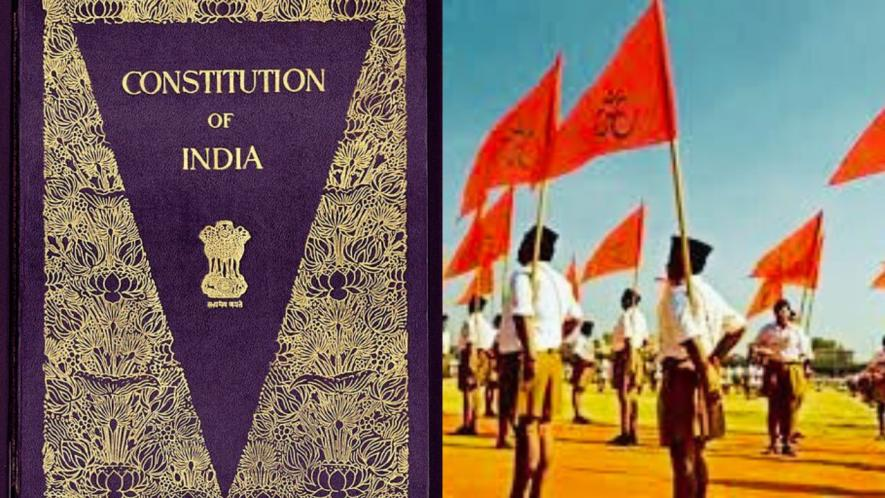
लोकसभा चुनाव के प्रचार के कई भाजपा नेता संविधान बदलने के लिए बहुमत हासिल करने की बात दोहरा चुके हैं. उनके ये बयान नए नहीं हैं, बल्कि संघ परिवार के उनके पूर्वजों द्वारा भारतीय संविधान के प्रति समय-समय पर ज़ाहिर किए गए ऐतराज़ और इसे बदलने की इच्छा की तस्दीक करते हैं.
कुछ तारीखें हर जम्हूरियत की तवारीख में सदा के लिए अंकित हो जाती हैं.
6 दिसंबर 1992 ऐसी ही एक तारीख है. इस घटना के तीन सप्ताह के अंदर दिल्ली में एक प्रेस सम्मेलन हुआ था. 25 दिसंबर 1992 को स्वामी मुक्तानंद और वामदेव महाराज, जो राम मंदिर आंदोलन से क़रीब से जुड़े थे, उन्होंने मौजूदा संविधान को बदलने की बात छेड़ दी और कहा कि यह संविधान ‘हिंदू विरोधी है’. (इंडिया टुडे, 31 जनवरी 1993 )
एक सप्ताह बाद 1 जनवरी 1993 को स्वामी मुक्तानंद के नाम से हिंदूवादी संगठनों की तरफ से एक श्वेत पत्र जारी किया गया, जिसमें भारतीय संविधान को ‘हिंदू विरोधी’ घोषित किया गया था. श्वेत पत्र के कवर पेज पर दो प्रश्न पूछे गए थे: एक, ‘भारत की एकता, बंधुत्व और सांप्रदायिक सद्भाव को नष्ट किसने किया?’ और ‘ किसने भुखमरी, गरीबी, भ्रष्टाचार और अधर्म फैलाया ?’
श्वेत पत्र का शीर्षक इस प्रश्न का जवाब दे रहा था , ‘वर्तमान इंडियन संविधान’!
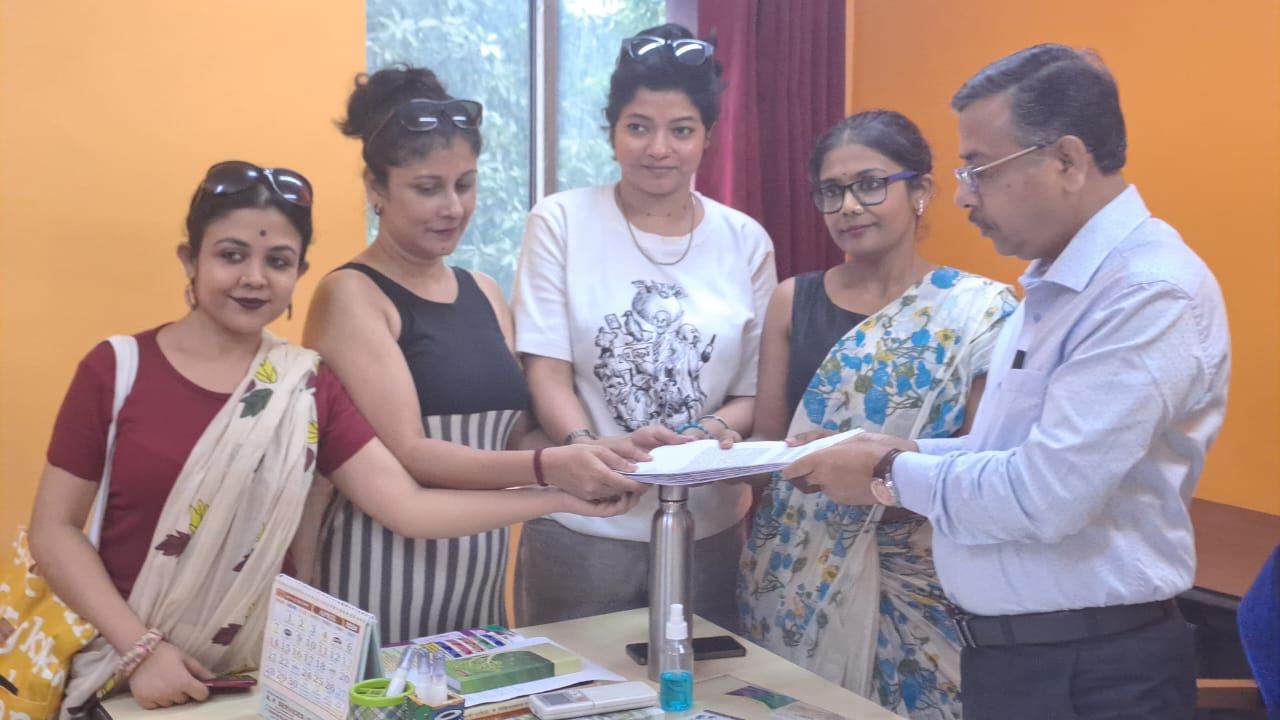
SUROKKHA ISTEHAR (Safety Manifesto), is a recently formed forum of theatre workers and individuals and organizations concerned with gender justice in Bangla Theatre. The forum was formed following a raging recent controversy arising from providing a forum to an accused in many sexual harassment cases. A deputation of Surokkha Istehar submitted a memorandum to the member Secretary, Paschimbanga Natya Akademi (the WB government body invested with the recognition and welfare of Bengal theatre groups) seeking immediate information about sexual harassment redressal mechanisms within the ambit of the Akademi, fair representation of all segments of the theatre workers’ community in the constitution of the Akademi as well as accountability of theatre groups and the Akademi in ensuring persons accused of sexual harrasment do not occupy positions of power within the Akademi, etc.
Published below is the memorandum, containing more than 900 signatures, which also announces the launch of the forum, which seeks to offer assistance to survivors of sexual harassment in theatre spaces, to ensure gender justice in Bengali theatre, among others.
Deputation of Surokkha Istehar submitting their Memorandum to the Pashchimbanga Natya Akademy
The Memorandum submitted to Pashchimbanga Natya Akademi
How a Central university is being allowed to humiliate/ stigmatise Ambedkar and a conspiracy of silence still pervades it.
Mahatma Gandhi Antarrashtriya Hindi Vishwavidyalaya, Wardha, Maharashtra is again in the news for wrong reasons. It has been more than around four months that a unique initiative of doing readings from Ambedkar has been forcibly stopped, show-cause notices being issued and even punitive action being taken against Dalit teachers, but there is no murmur of protest about it and despite being in the know of these developments, the top bosses of the UGC or University Grants Commission are silent over it.
Stop readings on Ambedkar in open in University Campus, it could endanger the “safety and health of (participating) students and reputation of the university‘
The news of this unbelievable diktat by an educational institution remained dormant for a day.
Expectedly, the tremendous nationwide uproar about Prime Minister Narendra Modi’s election speech in Banswara, which is considered his most ‘divisive’ in last 30 years, overshadowed other similar urgent issues.
The institution under scanner for this diktat to teachers is Mahatma Gandhi Antarrashtriya Hindi Vishwavidyalaya, Wardha, Maharashtra, a Central university. You would recall that some time ago, this institution had similarly attracted eyeballs when a team of Hindi research scholars from China had visited it. A visit that was followed by this team’s meeting with RSS (Rashtriya Swayamsevak Sangh) leaders at their headquarters in Nagpur.
What is rather troubling to note is that it has been more than four months that this unique experiment of doing readings from Ambedkar, in open, which was an initiative undertaken by the Dalit teachers of the vishwidyalaya, under the informal group called Ambedkar Study Circle India, stands forcibly stopped, show-cause notices being issued to teachers involved and even punitive action taken against three of them, but a conspiracy of silence has pervaded it.
What must have prompted this action by the University administration against the teachers, who were were just following the UGC recommended Code of Professional Ethics? ( Please read the full article here : https://www.newsclick.in/new-india-no-ambedkar-readings)
A wedding party travelling by night depicting Sultan Muhammad Quli Qutb Shah of Golconda (r.1580-1612) bringing home his bride, the beautiful Hindu dancing-girl Bhagmati. (Ashmolean Museum, University of Oxford)
Compared to the more complicated record of the last Nizam of Hyderabad, the popular memory of Mohammad Quli Qutb Shah continues to be one associated with love.
It was Muhammad Quli Qutb Shah who sincerely prayed for his city, his Fakhunda Buniyad (the city with fortunate foundations) or Bhagnagar – “mera shahar logan su mamur kar, rakhyan jun tun darya mein min ya sami” (fill my city with people, as you would a river with fish). And he did not pray for only certain species or kinds of fish.
And so, we now have Greater Hyderabad, starting from that one prayer. He ruled from 1565 to 1611 over the kingdom of Golconda – for 31 years and died at the age of 46. He built the capital city of Hyderabad and many architectural wonders, the most famous among them being Charminar (1591), the Jami (Mecca) Masjid (1597), and the Darush Shifa (1595) – which housed a Unani hospital, many gardens, palaces and so forth.
Muhammad Quli also poured his heart out in other ways, such as in ghazals, Marsiya (elegy), Rekhti (“women expressing sentiments for men in a language exclusively spoken by them”), and so on. Some of these (as recorded in the book by Narendra Luther, Prince, Poet, Lover, Builder Muhammad Quli Qutb Shah, The Founder of Hyderabad, Publications Division, Government of India, 1991), being relevant to the times, are reproduced below. Continue reading But what about Love? Hyderabad and the 2024 Elections PART II: R. Umamaheshwari→
[From a painting (artist not mentioned) in Narendra Luther, Prince, Poet, Lover, Builder Muhammad Quli Qutb Shah, The Founder of Hyderabad, Publications Division, Government of India, 1991]
Backdrop
This is a two-part article on the current electoral battle for the Hyderabad constituency between what is ostensibly being perceived (in some circles) as a contest between majority and minority fundamentalism, represented by BJP’s Madhavi Latha and AIMIM’s Asaduddin Owaisi, respectively. But this is a staid and limited perspective. More to it lies in its history being re-configured in a linear and straitjacketed manner by the Hindutva politics, to the exclusion of all else. Hence, this essay is in two parts: the present electoral contest set in context and second part (the final word) being that which always troubles Hindutva: Inter-faith Love, plural histories, of what made the city which is now contested, yet again.
Part 1 – Setting the Context
The entire stretch of Hyderabad between Golconda and Malakpet, approximately 20-25 kms, on the southern bank of the now slushy Musi River, is perceived as the ‘old’ city. The term itself has a relatively new genesis. Roughly 5 kilometers of road divides Charminar (in the ‘old’) from Abids (a commercial hub in the ‘new’ city), 5 kms from Golconda (in the ‘old’) to Mehdipatnam (in the new) and around 4 kms from Malakpet to Koti.
There are 16 revenue mandals in the Municipal Corporation of Hyderabad area, 6 of which are in the old city. These are – Charminar, Bandlaguda, Bahadurpura, Sayeedabad, Asifnagar and Golconda. Back in 2004, 500 of the 811 notified slums (of the 1800 squatter settlements) were in the old city. Their numbers seem to have increased in recent times. Continue reading A City built on Love – Hyderabad and the 2024 elections PART I: R. Umamaheshwari→
A brief outline of the talk is also shared below :
Theme : Bhakti Streams of Religious Movements in Medieval North India
Outline
The idea is to take up discussion of the Bhakti Movement as it moves to medieval North India. It is often stated that the Bhakti Movement was born in the Tamil land in the 6th-7th centuries and over the next millennium it made its way to the northern and eastern parts of the subcontinent. In his famous Patel Lectures of 1964, the famous Sanskritist Professor V Raghavan engagingly described the pradakshina yatra (clockwise circumambulation) of the Bharat Bhumi by Bhakti carried on the shoulders of singing saint-poets. Such a narrative, however, can contain only partially the historical truth. It is difficult to locate a singular source of a phenomenon that covered the entire subcontinent and took twelve hundred years to accomplish that. Given its scope and complexity and its temporal span, it is even more difficult to attribute to it a linear historical momentum that would carry it along an identifiable trajectory across the subcontinent. ..
‘The anger and anxieties over ‘Agnipath’ scheme – have not died down.
Gone is the period of open protests by youth and students and other ordinary people which rocked when the scheme was hastily announced (June 2022).
It does not mean that the youth are now happy about this scheme.
In an ambience of rising unemployment how is it possible to be happy about the fact that “[d]ue to the implementation of the Agniveer scheme, around 1.5 lakh candidates selected for the Indian Army, Air Force and Navy between 2019 and 2022 were allegedly denied joining.( 2)and all future possibilities of such an employment being closed forever.
Anyone who is keen to know how Agnipath has literally ‘destroyed’ thousands of jobs in military can take a tour of Kuchman City in Nagour ( Rajasthan) once a hub of more than 200 defence coaching academies preparing students from Rajasthan, Haryana and neighbouring parts of Western UP for entrance exams in Military..
…The anger and discontent of the Youth will continue to harm the ruling dispensation – whatever gloss they try to apply over the scheme.
How the policy of PPP (Public Private Partnership) Model in Sainik Schools is counter to all Constitutional principles and values
Representation Image
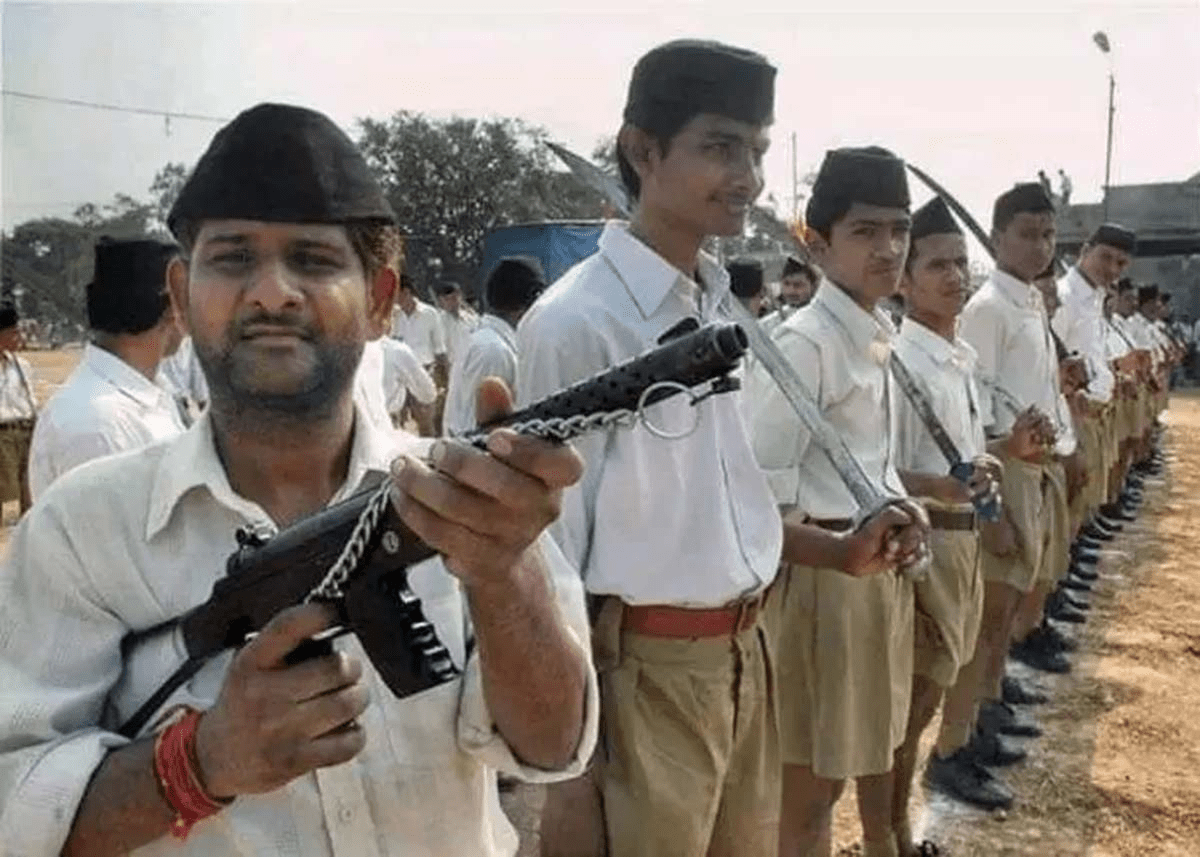
In a controversial and much reviled decision, the union government under prime minister, Narendra Modi “decided” to hand over “67 per cent of Sainik Schools to the Sangh Parivar (and its allied organisations who are self-acclaimed majoritarian and unconstitutional), BJP Politicians and allies. This investigation was undertaken by meticulous examination by the Reporter’s Collective and became public on April 3, 2024. This piece looks at the gross implications of this move.
“It’s the day of resurrection…”:
Swami Avdheshanand Giri after Pran Pratishtha ceremony in Ayodhya[1]
It was October 2020 when a Sainik School for boys was inaugurated in Shikarpur Tehsil of Bulandshahr District.[2] Right from Indresh Kumar, or Ram Lal, to Mahant of Junagarh Avadheshanand Giri, a seer supposed to be close to the proponents of Hindutva, many leading lights of the RSS and its frontal organisations or co-travellers of their ideology attended the high profile function.
The event made headlines for several reasons:
One, it was called the ‘first Sainik School of RSS’.
Two, a whooping sum of Rs 40 crores was supposed to be spent over it – thanks to the largesse extended by the union (Modi) government.
Thirdly, it was one of those rare occasions when RSS had moved beyond its founder member Dr Hedgewar to build memorials. Remember Rajendra Singh alias Rajju Bhaiya (1922-2003) was the first non-Brahmin and non-Maharashtrian Supremo of RSS from 1994-2000. This Sainik School is located in the same place where he (Raju Bhaiya) was born.
Normally, an idea to start a school is met with jubilation. This one however had the opposite effect. There were voices of concern raised by educationists, social activists as well as political leaders,
The added concern was that Vidya Bharati, the education wing of the RSS – which already runs 20,000 schools across India – would now also be running this military school although there was a clarification that this Army School will follow the CBSE curriculum and will have classes running from Class 6 to Class 12.
The same Vidya Bharatii (of the RSS’) whose stated mission is
“To develop a National System of Education which would help building a generation of young men and women that is committed to Hindutva and infused with patriotic fervour”. [3]
Questioning the whooping sum of Rs 40 crores which would be spent over it, Akhilesh Yadav, leader of the Samajwadi {arty (SP) and former Chief Minister of UP, had, at the time, underlined that since we already have enough such institutions “[r]un by the government so where is the need for RSS to run its own army school,”[4]
He did not hide his apprehensions about what curriculum be taught there.
“RSS apparently wanted to serve its political purpose by opening the army school where the students will “probably be taught lessons in mob lynching and disrupting social harmony”.[5]
The concern expressed by many about this project could not be brushed aside easily. It is a different matter that in today’s mediatised world, things move with such a speed that the issue of a RSS run military school , the RBSVM – Rajju Bhaiya Sainik Vidya Mandir – and the attendant furore soon died down. Little did anyone carry the premonition that the founding of RBSVM was just a trailer of what lay in store: asli film abhi baaki thi‘.







 KAFILA - COLLECTIVE EXPLORATIONS SINCE 2006