
The other day, the citizens of Kerala witnessed an extraordinary coming -together of CPM and BJP leaders in Thiruvananthapuram — in support of the Adani sea port, against the fisher community of the Thiruvananthapuram coast.
Continue reading Stop the Slander: Solidarity Statement Against Attempts to Tarnish Activists in the Anti-Adani Seaport Struggle at VizhinjamCategory Archives: Debates
The Partition of India: Three Outstanding Questions – Professor Pervez Hoodbhoy
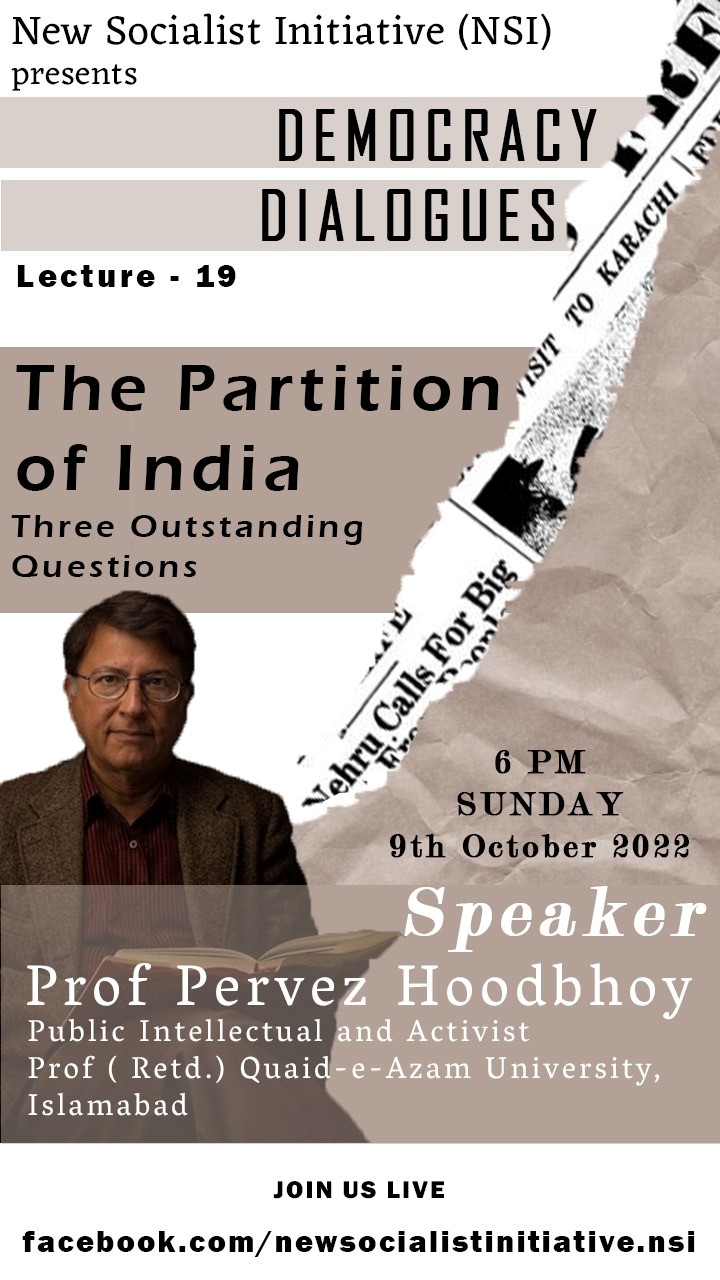
Professor Pervez Hoodbhoy, eminent physicist, author, public intellectual and a forceful voice for reason, science and democracy will be delivering the 19th Democracy Dialogues lecture on Sunday, October 9th, 2022 at 6 PM (IST)
The Partition of India: Three Outstanding Questions
Seventy five years after the communal storm of 1947 countless important questions still remain. From among them I will concentrate upon three which are particularly important in understanding the past but which, in addition, continue to influence current trajectories.
- How, when, and why did the two-nation theory emerge?
- Why is Pakistan a praetorian state but India is not?
- Was Partition preventable and had it not happened what might have been the consequences?
Speaker:
Pervez Hoodbhoy is a nuclear physicist, a frequent commentator on Pakistani television channels, founder-director of The Black Hole in Islamabad, and an author. He received his undergraduate and graduate degrees from MIT and taught physics at Quaid-e-Azam University for 47 years.
The lecture will be held on zoom and for security reasons the link will be shared individually only closer to the event. Please write to us at democracydialogues@gmail.com if you want to join the lecture online.
It will also be live streamed at facebook.com/newsocialistinitiative.nsi
Where Are We – 75 Years after Independence : Prof Aditya Mukherjee

Eminent scholar of Modern Indian History Prof Aditya Mukherjee, ( Retd.) Centre for Historical Studies, JNU who is also editor of the ‘Sage Series in Modern Indian History’ will deliver the next (18 th) Lecture in the Democracy Dialogues series organised by New Socialist Initiative.
He will be speaking on ‘Where Are We : 75 Years After Independence.’ on Sunday, 28 th August 2022 at 6 PM (IST).
Join Zoom Meeting
https://us02web.zoom.us/j/81606280893?pwd=U3daWGVYSFV6MFIyMzROVDJ0Qm40Zz09
Meeting ID: 816 0628 0893
Passcode: 356973
The programme will also be live streamed at facebook.com/newsocialistinitiative.nsi .
Theme :
Where Are We : 75 Years after Independence
“As we celebrate 75 Years of India’s independence, it is time to reflect on the extent to which the Indian nation-state has lived up to the vision of the Indian national movement and the spirit of the new Constitution. The core ideas behind this vision envisaged that Independent India would be sovereign, democratic, secular republic that will have a pro-poor orientation and would be based on reason rather than blind faith and obscurantism.
With the recent changes in the governmental power at the Centre and in many states where forces following precepts of the Right – forces which had remained outside the spectrum of the national movement – have become dominant resulting in a grave threat to the core components of the Idea of India. There is a reason why the world is no longer accepting India as a full democracy and is, instead, being variously describing it as a “partially free democracy”, a “flawed democracy” and even as an “electoral autocracy”.
In this lecture we will trace the course of developments that has led India to this predicament and will outline future prospects for overcoming the challenges.”
About the Speaker :
Prof Aditya Mukherjee has been associated with Centre for Historical Studies, JNU for the last more than four decades.
He has been Editor of the Series, ‘Sage Series in Modern Indian History’ published by SAGE publications, and a member of Scientific Committee, International Review of Sociology, Rome, since 2011 and Regional Editor, International Journal of AsianStudies, Tokyo (Cambridge University Press)
He has been Visiting Professor at Duke University, USA ; was a Visiting Fellow at Institute of Advanced Study, Lancaster University, UK ; Fellow at Institute of Advanced Study, Nantes, France ; Visiting Fellow , Institute of Advanced Study, Sao Paulo, Brazil ; Visiting Professor, La Sapienza, University of Rome at various periods during his long career.
He is author / co-author of many books : India’s Struggle for Independence, which has gone into 80 reprints ; India After Independence, 1947 – 2000 ; Imperialism, Nationalism and the Making of the Indian Capitalist Class 1927-1947 ; India Since Independence, Penguin, More than 35 reprints till 2016.7 ; RSS, School Texts and The Murder of Mahatma Gandhi: The Hindu Communal Project , (co-author),
When ‘With the Survivor ‘ Rings Hollow: Observations on the Rage over the Civic Chandran Case
The internet frenzy over the Civic Chandran case has reached a new zenith over the two highly problematic — deeply elitist, sexist, logically and empirically flawed — anticipatory bail orders issued to the accused by the Sessions Court. There was a strange silence about the first one which was stuffed with elitist statements, and an even stranger pause over the blatantly sexist and conservative order before the active condemnation of the latter began to be voiced over the internet. Even stranger, because there is far more tolerance of elitism among the internet woke-folk than of conservative sexist understandings of the appropriate clothing for women’s bodies in Kerala. The three-day break from expressions of outrage did not, and still does not make sense.
Continue reading When ‘With the Survivor ‘ Rings Hollow: Observations on the Rage over the Civic Chandran CaseDebating Strategy for the New Phase of Janatha Aragalaya: MAYA JOHN
Guest post by MAYA JOHN
[This article is based on the discussions with activists of the Janatha Aragalaya and concerned Sri Lankan citizens. It is a humble contribution towards ongoing debates within the movement. As the French proverb goes: “De choc des opinions jaillit la vérité” – Truth arises from a conflict of opinions. – MJ]
With the deepening crisis of the world capitalist system, we see social upheavals erupting in one country after another. Most recently, Sri Lanka, a relatively small island country in South Asia that is enveloped by a staged debt crisis, has amply revealed circumstances which are infused with revolutionary possibilities. Resembling dark clouds that announce the gathering of a storm, Sri Lanka has shown how rapidly a revolutionary situation can develop.
Heading the floundering ruling establishment, and harbouring perpetual dismissiveness of the swelling discontent, the ruling family of Rajapaksas expectedly attracted massive public ire. Fighting hunger, spiralling inflation, long queues for fuel and rations, crumbling medical facilities, loss of employment, frequent and long power outages, angered citizens came to see the Rajapaksas as well as other mainstream politicians as creators and perpetuators of the grave crisis. Importantly, the distrust of the people has not been limited to individual politicians and ruling cliques whose moral right to govern is being openly challenged, but is a latent distrust for the system itself. At present, majority of the public rightfully views all established parties with deep suspicion and hostility. The majority perceives the rise to power of President Ranil Wickremesinghe as an epitome of the rot in the political system. They see his government as an illegitimate one.
Continue reading Debating Strategy for the New Phase of Janatha Aragalaya: MAYA JOHNCarceral Feminism and the Punitive State: Why I am not with the Mob — 3
In the light of the above history it seems no surprise at all that mainstream feminists in Kerala do not seem to need a critique of the punitive state at all. Nor are they really troubled by the withdrawal of the welfare state or its perversion, even in matters that crucially affect women and children. Being moored in it, even the withdrawal of the welfare state from even support services to child-victims of sexual violence (citing ‘convenience’ which turned to be ‘convenience’ for the government alone), and the stuffing of crucial committees dealing with the welfare of and justice to women and children with dubious candidates with nepotistic connections – has rarely excited significant united protest from Kerala’s mainstream feminists.
Indeed, in a recent case of baby-abduction in which the infant born to Anupama Chandran, the daughter of a local CPM leader, in her relationship with Ajith, a dalit man, was trafficked with the active connivance of child welfare officials, this feminist mainstream was mostly silent; many prominent voices in it were rallied against the aggrieved mother; some of them even participated in the unspeakable cyber-lynching of the couple, spreading rumours and making unfounded accusations. Though the large numbers of young sexual violence victims belong to the oppressed castes, and though the Anupama-Ajith case was plainly one of caste hostility and violence, these features did not trigger animated responses from the feminist mainstream. These tepid or hostile responses are in sharp contrast to the manner in which sexual harassment campaigns are conducted. Continue reading Carceral Feminism and the Punitive State: Why I am not with the Mob — 3
Carceral Feminism and the Punitive State: Why I am Not With the Mob — 2
II
In the 1980s, when the first feminist articulations began to be heard in Kerala, left-leaning feminists often sought to maintain a critical distance from the state, emphasizing its inherently patriarchal nature. This was not surprising as feminists of that generation had radical-Marxist roots or strong connections with it. Radical Marxism in that generation was clearly suspicious of the state – quite unlike the mainstream left.
Continue reading Carceral Feminism and the Punitive State: Why I am Not With the Mob — 2भारतीय फ़ासीवाद और प्रतिरोध की संभावना : आशुतोष कुमार
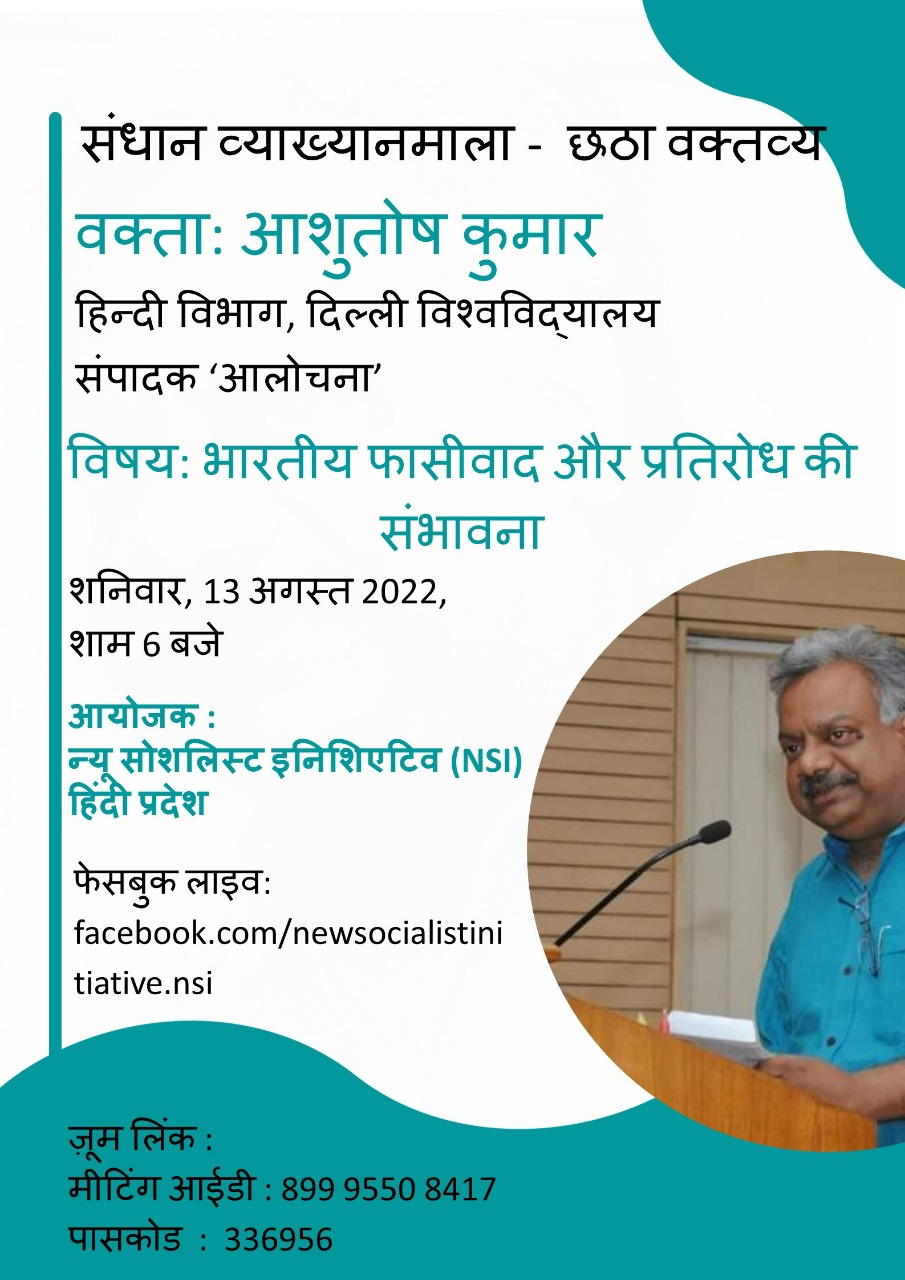
Leading Critic Ashutosh Kumar, Editor ‘Aalochana’ , who teaches at Department of Hindi, Delhi University will be delivering the sixth lecture in the ‘Sandhan Vyakhyanmala Series’ ( in Hindi) on Saturday,13 th August, 2022, at 6 PM (IST).
He will be speaking on ‘ भारतीय फ़ासीवाद और प्रतिरोध की संभावना’ ( Indian Fascism and Possibility of Resistance)
This online lecture would be held on zoom and will also be shared on facebook as well : :facebook.com/newsocialistinitiative.nsi
Join Zoom Meeting https://us02web.zoom.us/j/89995508417?pwd=QWdlMVVjNElaUXEyQURZd2dFVTNrUT09
Meeting ID: 899 9550 8417
Passcode: 336956
Organised by :NEW SOCIALIST INITIATIVE ( NSI) Hindi Pradesh
संधान व्याख्यानमाला : छठा वक्तव्य
विषय : भारतीय फ़ासीवाद : प्रतिरोध की संभावना
वक्ता : अग्रणी लेखक एवं संपादक ‘आलोचना’
आशुतोष कुमार
हिंदी विभाग, दिल्ली विश्वविद्यालय
शनिवार, 13 अगस्त, शाम 6 बजे
सारांश :
| भारतीय फ़ासीवादऔर प्रतिरोध की संभावना कुछ प्रश्न: क्या भारत की वर्तमान परिस्थिति को फासीवाद के रूप में चिन्हित किया जा सकता है? अथवा क्या इसे केवल सांप्रदायिक ध्रुवीकरण , धार्मिक कट्टरता और रूढ़िवाद की राजनीति के रूप में देखा जाना चाहिए? यह सवाल महत्वपूर्ण इसलिए है किस के जवाब पर इस परिस्थिति से मुकाबला करने की रणनीति निर्भर करती है। अगर यह फासीवाद है तो इसके उद्भव और वर्तमान शक्ति-सम्पन्नता के आधारभूत कारण क्या हैं? क्या यह केवल वैश्विक वित्तीय पूंजीवाद के संकट की अभिव्यक्ति है, जैसा कि प्रभात पटनायक जैसे अर्थशास्त्री समझते हैं? क्या भारतीय फ़ासीवाद जैसी किसी अवधारणा के बारे में सोचा जा सकता है? या यह सिर्फ एक वैश्विक प्रवृत्ति है ? अगर यह फ़ासीवाद नहीं है तो क्या यह पश्चिम और पश्चिमपरस्त राजनेताओं और बौद्धिकों द्वारा अन्यायपूर्ण ढंग से दबाए गए हिन्दू राष्ट्रवाद का उभार है, जैसा कि के भट्टाचार्जी जैसे सावरकरी टिप्पणीकार दावा करते हैं? क्या यह संघ के बढ़ते लोकतंत्रीकरण के चलते उसके नेतृत्व में वंचित- उत्पीड़ित जन समुदाय द्वारा किया गया सत्ता परिवर्तन है, जिसने कुलीन वर्गों की कीमत पर अकुलीनों को शक्तिशाली बनाया है? जैसा कि अभय कुमार दुबे और बद्री नारायण जैसे सामाजिक लेखक संकेत करते हैं? क्या वर्तमान सत्ता संतुलन को बदला जा सकता है? इसे कौन कर सकता है और कैसे? कुछ बातें— फ़ासीवाद का सबसे बड़ा लक्षण कार्यपालिका,विधायिका और न्यायपालिका के एक गठबंधन के रूप में काम करने की प्रवृत्ति है। लोकतंत्र में इन तीनों के अलगाव और इनकी स्वायत्तता पर इसलिए जोर दिया जाता है कि कोई एक समूह राजसत्ता का दुरुपयोग न कर सके। तीनों निकाय एक दूसरे पर नजर रखने और एक दूसरे को नियंत्रित करने का कार्य करें। इस व्यवस्था के बिना एक व्यक्ति और एक गुट की निरंकुश तानाशाही से बचना नामुमकिन है। अयोध्या-विवाद से लेकर गुलबर्ग सोसाइटी जनसंहार और छतीसगढ़ जनसंहार तक के मामलों में हमने सुप्रीम कोर्ट को संविधान-प्रदत्त नागरिक अधिकारों और न्याय की अवधारणा के विरूद्ध राज्य के बहुमतवादी फ़ैसलों के पक्ष में खड़े होते देखा है. हाल ही में सुप्रीम कोर्ट ने धन-शोधन निवारण अधिनियम के अन्यायपूर्ण प्रावधानों के खिलाफ दी गई याचिका पर राज्य के पक्ष में फैसला दिया है. सीएए और धारा 370 के निर्मूलीकरण जैसे मामलों में चुप्पी साधकर भी उसने नागरिक अधिकारों के विरुद्ध राजकीय निरंकुशता का समर्थन किया है. नाज़ी जर्मनी में ग्लाइसेशतुंग या समेकन के नाजी कानूनों के जरिए इसी तरह राज्य के सभी निकायों को सकेन्द्रित और एकात्म बनाया था. हिटलर की तरह मुसोलिनी ने भी ‘राष्ट्र-राज्य सर्वोपरि’ के सिद्धांत के तहत न्यायपालिका को पालतू बनाने का काम किया था. भारत में भी हमने गृह मंत्री अमित शाह को सबरीमाला मामले में सुप्रीम कोर्ट को चेतावनी देते देखा है. भारत में फ़ासीवाद के सभी जाने पहचाने लक्षण प्रबल रूप से दिखाई दे रहे हैं। एक व्यक्ति की तानाशाही और व्यक्ति पूजा का व्यापक प्रचार। मुख्य धार्मिक अल्पसंख्यक समूह के विरुद्ध नफरत, हिंसा और अपमान का अटूट सिलसिला। अल्पसंख्यकों के खिलाफ अधिकतम हिंसा के पक्ष में जनता के व्यापक हिस्सों का जुनून। विपक्ष की बढ़ती हुई असहायता। स्वतंत्र आवाजों का क्रूर दमन। दमन के कानूनी और ग़ैरकानूनी रूपों का विस्तार। मजदूरों और किसानों के अधिकारों में जबरदस्त कटौती। आदिवासियों, दलितों और स्त्रियों के सम्मान के संघर्षों का पीछे ढकेला जाना। शिक्षा पर भगवा नियंत्रण। छात्रों के लोकतांत्रिक अधिकारों का विलोपन। फ़ासीवादी प्रचार के लिए साहित्य, चित्रकला, मूर्तिकला, सिनेमा और दीगर कला-विधाओं के नियंत्रण और विरूपण को राज्य की ओर से दिया जा रहा संरक्षण और प्रोत्साहन। अभी भी कुछ लोग भारत में फासीवादी निज़ाम से सिर्फ इसलिए इंकार करते हैं कि इस देश में गैस चैंबर स्थापित नहीं किए गए हैं। उन्हें समझना चाहिए कि भारतीय फ़ासीवाद ने फ़ासीवाद अतीत से बहुत कुछ सीखा है। उसने समझ लिया है कि भारत जैसे विशाल और विविधतापूर्ण देश में भौतिक गैस चैंबर से कहीं अधिक असरदार और स्थायी व्यवस्था है देश के भीतर सामाजिक और मनोवैज्ञानिक गैस चैम्बरों का विस्तार। लगभग समूचे देश को एक ऐसे सांस्कृतिक गैस चेंबर में बदल दिया गया है, जिसमें एक व्यक्ति और एक विचारधारा की गुलामी से इनकार करने वाले स्वतंत्रचेता जन अपने जीवित होने का कोई मतलब ही ना निकाल सकें। यूरोप की लोकतांत्रिक परम्पराओं के कारण फ़ासीवादी राज्य की स्थापना के लिए कानूनी बदलावों की जरूरत थी. भारत में ‘भक्ति-परम्परा‘ की जड़ें बहुत गहरी हैं. शर्तहीन-समर्पण का संस्कार प्रबल रहा है. क्या यह भी एक कारण है कि भारत में यूएपीए और अफ्स्पा जैसे कुछ विशेष कानूनों के अलावा व्यापक कानूनी बदलावों की जरूरत नहीं पड़ी है? फ़ासीवाद की मुख्य जीवनी शक्ति नफ़रत की भावना है। हमारे देश में वर्ण व्यवस्था और जाति प्रथा के कारण अपने ही जैसे दूसरे मनुष्यों से तीव्र नफरत का संस्कार हजारों वर्षों से फलता फूलता रहा है। वोट तंत्र ने इस नफरत को उसकी चरम सीमा तक पहुंचा दिया है। क्या भारतीय फ़ासीवाद नफरत के इस चारों ओर फैले खौलते हुए समंदर से उपजे घन-घमंड के रूप में ख़ुद को जनमानस में स्थापित कर चुका है? इस बातचीत में मैं ऐसे ही कुछ सवालों के जरिए यह देखने की कोशिश करूंगा कि क्या हम ‘भारतीय फासीवाद’ की कोई व्यवस्थित सैद्धांतिकी निर्मित करने के करीब पहुँच गए हैं. ऐसी किसी संभावित सैद्धांतिकी की रूपरेखा क्या होगी और इस उद्यम से हम अपने किन सवालों के जवाब हासिल करने की उम्मीद कर सकते हैं. |
The Role of Individuals in resisting the Majoritarian State – Aakar Patel
Eminent author and rights activist Aakar Patel will be delivering the 17 th lecture in the Democracy Dialogues Series, organised by New Socialist Initiative, at 6 PM (IST), Sunday, 3 rd July, 2022.
He will speak on ‘The role of individuals in resisting the majoritarian state’. You can also watch it live at facebook.com/newsocialistinitiative.nsi
About the Speaker :
Aakar Patel is a syndicated columnist, author and rights activist and is Chair, Amnesty International India
He has edited English and Gujarati newspapers. His translation of Saadat Hasan Manto’s Why I Write was published in 2014 ( Tranquebar). His study of majoritarianism in India ‘ Our Hindu Rashtra : What It Is. How We Got There came out in 2020 ( Westland) and his next book which seeks to explain data and facts on India’s performance under Narendra Modi, titled ‘Price of ‘The Modi Years‘ was published in 2021 ( Westland). His forthcoming book is on protest and participation by citizens
Abstract :
The role of individuals in resisting the majoritarian state.
India is going through a transformational period when many feel constitutional values have been undermined, an oligopoly has been handed control over large parts of the economy and the secular and pluralist basis of the nation are being eroded.
What can the individual do in these circumstances? A talk on the ways of meaningful resistance
Why Google News Does Not Want To Talk Caste ?
The Google episode shows the right-wing vision of unity is exclusionary. But this vision is increasingly being challenged in the United States and beyond.

On 9 May 1916, a young BR Ambedkar presented a paper at Colombia University in the United States titled Castes in India: Their Mechanism, Genesis and Development. He referred to caste as a “local problem, but one capable of much wider mischief”. He wrote, “…if Hindus migrate to other regions on earth, Indian caste would become a world problem.”
More than a century later, as one of the biggest corporations, Google, battles allegations of caste discrimination in the United States, the predictive value of Ambedkar’s words is evident. Recently, Google News cancelled a scheduled talk by Thenmozhi Soundararajan, the founder and executive director of Equality Labs, after many Google employees (of Indian origin or Indians) opposed it. The discussion was supposed to mark Dalit Equality Month, celebrated every April to mark the month Ambedkar, the first law minister of independent India and its leading anti-caste activist, was born. Equality Labs is a leading non-profit group in the United States that advocates Dalit rights. According to its 2016 survey, a third of Hindu students in the United States reported experiencing caste discrimination.
Thenmozhi was subjected to an organised campaign led by a section of Google employees, who called her “Hindu-phobic” and “anti-Hindu”. The name-calling went on in emails her opponents sent to company bosses and documents they posted on a mailing list that thousands of Indian employees access.
( Read the full article here)
No End to ‘Tamas’ ( Darkness) Around ?
One can imagine that if the plan to provoke riots before Eid in Ayodhya would have been successful, how it could have easily spilled over to the other parts of the country.

It was the early 1970s when Bhisham Sahni, the legendary Hindi writer had penned the novel Tamas. It looks at the Hindu-Muslim riots in India in the backdrop of the Partition. Its central character is Nathu, who is Dalit and does the work of removing hides from dead animals. A local politician persuades Nathu to kill a pig; the act is later used to foment a riot in the city.
It has been more than 40 years since the novel was written, but it still resonates with today’s India as it throws light on the ‘fault lines’ of Indian society and shows the ease with which they can be weaponised.
A fortnight back, a similar attempt to provoke a riot was made in Ayodhya using a similar technique; however, prompt action by the district police averted a riot there.
( Read the full article here)
Politics of Cultural Nationalism, People’s Opinion and Hindi Intellectual : Virendra Yadav
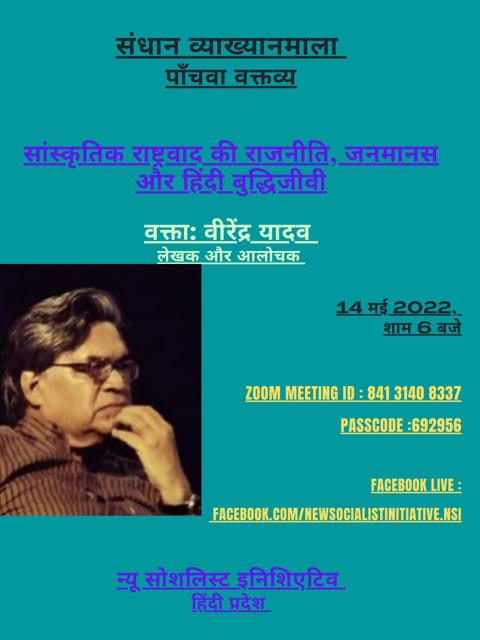
Leading Writer and Critic Virendra Yadav will be delivering the fifth lecture in the ‘Sandhan Vyakhyanmala Series’ ( in Hindi) on Saturday,14 th May, 2022, at 6 PM (IST).
He will be speaking on ‘सांस्कृतिक राष्ट्रवाद की राजनीति , जनमानस और हिंदी बुद्धिजीवी’ ( Politics of Cultural Nationalism, People’s Opinion and Hindi Intellectual)
This online lecture would be held on zoom and will also be shared on facebook as well : :facebook.com/newsocialistinitiative.nsi
Join Zoom Meeting
https://us02web.zoom.us/j/84131408337?pwd=ZUp6eWg5WGdYVVY1ZkdzQ3ZzRnhoQT09
Meeting ID: 841 3140 8337
Passcode: 692956
Organised by :
NEW SOCIALIST INITIATIVE ( NSI) Hindi Pradesh
——–
संधान व्याख्यानमाला – पांचवा वक्तव्य
विषय : सांस्कृतिक राष्ट्रवाद की राजनीति , जनमानस और हिंदी बुद्धिजीवी
वक्ता : अग्रणी लेखक एवं आलोचक वीरेंद्र यादव
शनिवार, 14 मई , शाम 6 बजे
सारांश :
1- ‘सांस्कृतिक राष्ट्रवाद’ मात्र एक राजनीतिक व्यूहरचना न होकर एक ऐसी अवधारणा है जिसकी गहरी जड़े पारम्परिक रूप से हिंदू जनमानस में मौजूद हैं।
2- 1857 से लेकर 1947 तक विस्तृत ‘स्वाधीनता’ विमर्श में इस हिन्दू मन की शिनाख्त की जा सकती है।
3- स्वाधीनता आंदोलन इस हिन्दू मन से मुठभेड़ की नीति न अपनाकर मौन सहकार की व्यावहारिकता की राह पर ही चला।
4- हिंदी क्षेत्र में तर्क, ज्ञान व वैज्ञानिक चिंतन की धारा भारतीय समाज की वास्तविकताओं में कम अवस्थित थीं, उनकी प्रेरणा के मूल में पश्चिमी आधुनिकता व वैश्विक प्रेरणा अधिक थी।
5- हिंदी क्षेत्र व समाज में ज़मीनी स्तर व हाशिये के समाज के बीच से जो तार्किक, अंधविश्वास विरोधी व विज्ञान सम्मत सुधारवादी प्रयास हुए उन्हें मुख्यधारा के चिंतन-विचार में शामिल नहीं किया गया।
6- ध्यान देने की बात है कथित ‘हिंदी नवजागरण’ विभेदकारी वर्ण-जातिगत सामाजिक संरचना की अनदेखी कर प्रभुत्ववादी मुहावरे में ही विमर्शकारी रहा।
7- संविधान सम्मत धर्मनिरपेक्ष आधुनिक भारत की परियोजना में भारतीय समाज की धर्म व जाति की दरारों के जड़मूल से उच्छेदन को प्रभावी ढंग से शामिल नहीं किया जा सका।
8-सारी आधुनिकता के बावजूद हिंदी बुद्धिजीवियों का वृहत्तर संवर्ग वर्ण और वर्ग से मुक्त होकर जनबुद्धिजीवी की भूमिका न अपना सका।
9- सामाजिक न्याय की अवधारणा का मन में स्वीकार भाव न होना, हिंदी बुद्धिजीवी की एक बड़ी बाधा है।
10- ‘सांस्कृतिक राष्ट्रवाद’ का प्रतिविमर्श रचने के हिंदी बुद्धिजीवी के उपकरण वही रहे जो हिंदू बुद्धिजीवियों के।
11- हिंदी बुद्धिजीवी के सवर्णवादी अवचेतन से उपजा दुचित्तापन ‘सांस्कृतिक राष्ट्रवाद’ का प्रतिविमर्श रचने में एक बड़ी बाधा है।
आयोजक : न्यू सोशलिस्ट इनिशिएटिव NSI ( हिंदी प्रदेश)
‘पृथ्वी के असंख्य घाव’ गिनता अकेला आदमी
…..यह हमारी सोच की एक अनपहचानी सीमा है
नहीं समझते हम
कि अकेला आदमी जब सचमुच अकेला होता है
तो वह गिन रहा होता है
पृथ्वी के असंख्य घाव
और उनके विरेचन के लिए
कोई अभूतपूर्व लेप तैयार कर रहा होता है।
(अकेला आदमी – विमलेश त्रिपाठी)
कालजयी रचनाएं समय स्थान की सीमाओं को लांघ कर किस तरह आप को अपनी लगने लगती हैं, इसको बयां करना मुश्किल है।
हान्स क्रिश्चन एंडरसन (2 अप्रैल 1805- 4 अगस्त 1875) महान डैनिश लेखक – जिन्होंने नाटकों, यात्रा वृत्तांतों , उपन्यासों और कविताओं के रूप में प्रचुर लेखन किया – अपनी परिकथाओं के लिए दुनिया भर में जाने जाते हैं। उनकी परिकथाएं नौ खंडों में प्रकाशित हुई हैं और दुनिया की 125 जुबां में अनूदित भी हुई हैं।
उनकी एक ऐसी अदभुत रचना है ‘राजा के नए कपड़े’ – जिसे हम ‘निर्वस्त्र राजा’ के तौर पर अधिक जानते हैं।
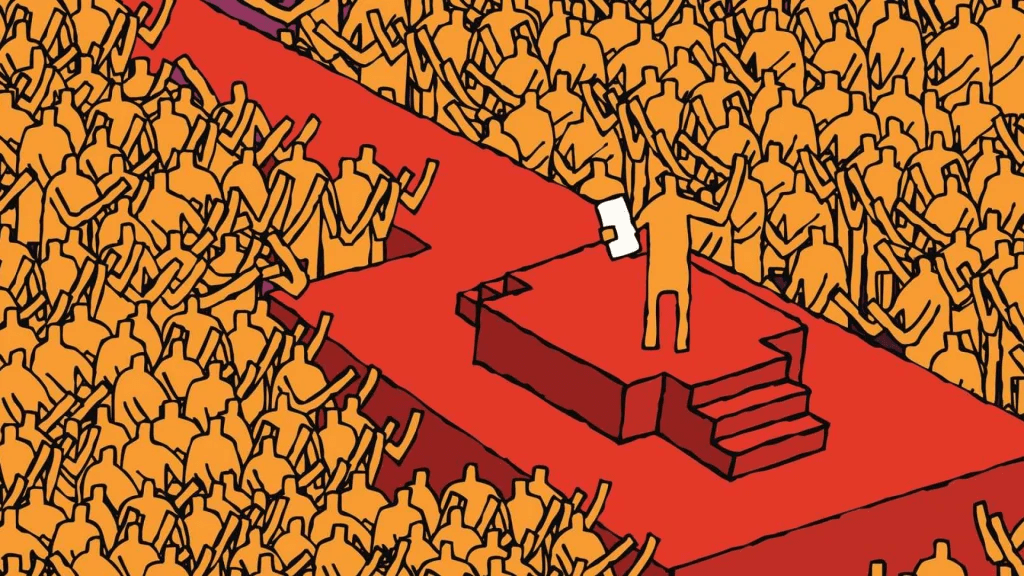
जब जब किसी मुल्क में अधिनायकवाद की हवाएं चलने लगती हैं, और लोगों पर अधिनायक की अजेयता का जादू सर चढ़ कर बोलने लगता है और उसके खिलाफ बोलना भी कुफ्र में शुमार किया जाने लगता है, यह कहानी नए सिरेसे मौजूं हो जाती है।
विशाल जुलूस में निर्वस्त्र निकल पड़ा राजा, जो कथित तौर पर जादूई वस्त्र पहना है – जिन्हें देख कर अधिकतर लोग खूप गुणगान किए जा रहे हैं – और उसकी सच्चाई को बतानेवाले उस नन्हे बच्चे का रूपक आज भी मन को मोहित करता रहता है।
एक संवेदनशील, न्यायप्रिय व्यक्ति को अन्दर ही अन्दर ताकत देता रहता है।
ऐसी ही एक अन्य रचना है ‘Enemy of the People ’ (जनता का दुश्मन,1882 ) जिस नाटक की रचना नॉर्वे के महान नाटककार हेनरिक इब्सेन (20 मार्च 1928 – 23 मई 1906 )ने की थी। बताया जाता है कि शेक्सपीयर के बाद दुनिया भर में इन्हीं के नाटक आज भी खेले जाते हैं। नाटक का प्रमुख सन्देश यही है कि एक व्यक्ति, जो अकेला खड़ा रहता है, वह जनता की भीड़ से अधिक ‘‘सही’’ होता है। अपने दौर की उस धारणा को कि समुदाय/समाज बहुत महान संस्था है और जिस पर भरोसा किया जाना चाहिए उसी को वह चुनौती देता है।
(Read the complete article here)
How Did UP Decide : Identities, Interests and Politics – Prof Zoya Hasan

Prof Zoya Hasan, Professor Emerita, Jawaharlal Nehru University and Distinguished Faculty, Council for Social Development, New Delhi, will be delivering a Special lecture in the Democracy Dialogues Series, organised by New Socialist Initiative, at 6 PM, (IST) Sunday, 24 th April, 2022.
She will be speaking on ‘‘How did UP Decide: Identities, Interests and Politics”
Join Zoom Meeting
https://us02web.zoom.us/j/81240964790?pwd=OEd1OU00ejA5d1ZxYWlMRzFaOGNkdz09
Meeting ID: 812 4096 4790
Passcode: 975399
Facebook Live on – http://fb.com/newsocialistinitiative.nsi
Abstract
How did UP Decide: Identities, Interests and Politics
Uttar Pradesh has just seen an intensely contested assembly election which resulted in a second straight victory for the Bharatiya Janata Party in this politically crucial state. This momentous outcome is the subject of intense debate among analysts and indeed the public at large. There was a premise this time, particularly in UP, that communal polarisation wasn’t working because of acute economic discontent which could trigger electoral change. However, the large-scale discontent over many economic issues, including jobs, did not translate into a decision to vote out the government. Many analysts have attributed BJP’s reelection to welfare measures and free rations to the poor during the lockdown. This cannot explain BJP’s persistent success which extends beyond this election. The welfarist argument ignores the compelling logic of long term communalism and the systematic construction of the Hindu vote in UP politics since the time of the Ramjanmabhoomi movement centered in UP and the communal campaigns in the last five years, its impact is reflected in the election results.This construction of the Hindu vote also trumped the caste-based politics of the regional Samajwadi Party and Bahujan Samaj Party through a mobilization of upper caste and non-dominant backward and lower caste communities. Communal polarization and identity politics is the keystone of their strategy and the decisive factor driving electoral choices.
जीत भाजपा की नहीं निराशावाद की है : राजेंद्र चौधरी
Guest post by RAJINDER CHAUDHARY
इच्छा और आशा में अंतर होता है. विशेष तौर पर किसान आन्दोलन के आलोक में, बहुत से लोगों की तरह मैं भी चाहता था कि भाजपा हारे और मुझे इस की थोड़ी आशा भी थी परन्तु कोई विशेष आस नहीं थी. भाजपा की जीत मेरे लिए दुखदायी है परन्तु अनपेक्षित नहीं है. चुनाव परिणामों की समीक्षा के तौर पर बहुत कुछ लिखा-कहा गया है परन्तु एक महत्वपूर्ण पक्ष का ज़िक्र कम हुआ है.
क्या उत्तरप्रदेश, जिस का कम से कम एक हिस्सा किसान आन्दोलन के सक्रिय केन्द्रों में शामिल था, में भाजपा की जीत से यह साबित हो जाता है कि भारतीय मतदाता हिन्दुत्ववादी हो गया है? ऐसा बिलकुल नहीं है. भाजपा को उतर प्रदेश में कुल पंजीकृत मतदाताओं के 25% ने ही वोट दिया है. भाजपा के वोट अनुपात में जिस बढ़ोतरी की चर्चा हो रही है वह असल में वोट डालने वालों में से भाजपा के पक्ष में वोट डालने वालों के अनुपात की बढ़ोतरी है. ग़ैर-भाजपा वोटर के वोट ही न देने से और भाजपा वोटर के पहले की तरह वोट देने मात्र से भाजपा के समर्थन में बढ़ोतरी दिखाई देती है. वास्तविकता यह है कि 10 में से लगभग 4 पंजीकृत वोटर तो इतने निराश हैं कि वे वोट डालने ही नहीं गए (वोट न डालने वालों का एक छोटा हिस्सा निश्चित तौर पर ऐसा होगा जो किसी अन्य कारण जैसे शहर से बाहर होने के कारण या अन्य व्यस्तता के चलते वोट नहीं डाल पाया होगा परन्तु यह हिस्सा बहुत छोटा ही होने की संभावना है). 2017 में भी कुल पंजीकृत वोटरों में से भी लगभग इतने ही प्रतिशत वोटरों ने भाजपा के पक्ष में वोट डाला था. यानी बहुमत अभी भी हिन्दू वादी नहीं है, उत्तर प्रदेश में भी नहीं.
Continue reading जीत भाजपा की नहीं निराशावाद की है : राजेंद्र चौधरीChallenges to India’s Democracy : Prof Zoya Hasan
Prof Zoya Hasan, Professor Emerita, Jawaharlal Nehru University and Distinguished Faculty, Council for Social Development, New Delhi, will be delivering the 16 th lecture in the Democracy Dialogues Series, organised by New Socialist Initiative, at 6 PM, (IST) Sunday, 27 th March, 2022.
She will be speaking on ‘Challenges to India’s Democracy‘
Prof Zoya Hasan has written and edited many books on state, political parties, ethnicity, gender and minorities in India and society in north India and has been a visiting Professor to the Universities of Zurich, Edinburgh and Maison des Sciences de L’Homme, Paris.
Her most recent publications include Forging Identities : Gender, Communities And The State In India ( edited) , Agitation to Legislation – Negotiating Equity and Justice in India , Congress after Indira: Policy, Power and Political Change (1984–2009), Politics of Inclusion: Castes, Minorities and Affirmative Action, (2009) and a collection of essays titled Democracy and the Crisis of Inequality
Abstract
Challenges to India’s Democracy
The 75th anniversary of Indian Independence is a landmark event in the history of our democracy. It is for this reason a significant moment to assess the state of India’s democracy. As the largest democracy in the non-western world, India is a success story. Its success, however, has primarily been recognized as an electoral democracy, with regular free and fair elections registering high voter participation, and also peaceful transfer of power. Elections certainly are a climactic moment of the democratic process but by no means the only important one. Politics between elections is central for understanding the challenges facing Indian democracy, and it is important, therefore, to contextualize democracy.
Three years since the Bhartiya Janata Party government was re-elected has seen the consolidation of the process begun in 2014 – the establishment of a Hindu state. This process has been facilitated by the combination of majoritarianism and authoritarianism which has resulted in democracy becoming thinner, not accidentally, but deliberately. This does raise certain questions about the relationship between Hindu nationalism and democracy which seems to weaken the idea of democracy moderated by institutions.
This paper tries to make sense of these shifts through a thematic exploration of the trajectory of Indian democracy since 2014 focusing on three overlapping developments -the consolidation of a majoritarian brand of politics, the decline of independent institutions and the shrinking space for political dissent and protests -which has undermined democracy. Each of these issues distinct and significant in its own right when taken together constitutes a major risk to Indian democracy. However, public protests in the last few years have emerged as a major bulwark against authoritarian rule and the erosion of democratic dissent. For the Opposition it’s a moment of reckoning but there are signs of churning among the Opposition as well.
Axing Scholarships, Denying Opportunities
When Government itself Does Not Have Any Qualms in rationalising Drona Mindset

[H]istory has come to a stage when the moral man, the complete man, is more and more giving way, almost without knowing it, to make room for the . . .commercial man, the man of limited purpose. This process, aided by the wonderful progress in science, is assuming gigantic proportion and power, causing the upset of man’s moral balance, obscuring his human side under the shadow of soul-less organization.
—Rabindranath Tagore, Nationalism, 1917
( Quoted in ‘Not for Profit – Why Democracy Needs Humanities, Martha Nussbaum, Princeton University Press, 2010)
A single story is sometimes enough to tell how an institution functions and how it needs to be overhauled.
Aruna’s long struggle to get overseas scholarship is one such story.
Son of landless agricultural labourers from Orissa, this bright student, belonging to a socially oppressed community, had applied to get a overseas scholarship via the National Overseas Scholarship – which awards scholarships to students from SC, ST, Denotified tribes etc – and even had lost two years in bureaucratic wrangling despite the fact that he had already got admission into Essex University.
Thanks to the timely intervention of a group of Ambedkarite thinkers from Nagpur, who filed a petition in the Delhi Highcourt on his behalf , which ultimately ruled in the student’s favour.
It would be cliche to say that Aruna’s struggle is an exception.
Story of Vishal Kharat is qualitatively no different who is still trying to get a scholarship for the last two years and has discovered to his dismay that the scholarship portal itself does not work properly.
Instances galore how this ambitious scheme which was launched in the wee hours of India’s independence when Nehru was the Prime Minister and a great scholar and freedom fighter Maulana Abul Kalam Azad was a Cabinet Minister for education, has been left to go slowly into oblivion.
The latest decision by the Union ministry of social justice and empowerment, to not to fund scholarships for marginalised students keen to study India’s history, culture abroad, is just another indication of how it is being implemented.
We can recall that it was the year 2012 when UPA government led by Congress was in the saddle this scheme was extended to Humanities as well and every year 100 students from the socially deprived, oppressed communities started receiving it but with the change of power at the centre things started changing drastically.
Like many of its earlier decisions, this decision to axe scholarship to study humanities abroad was taken without consulting the stakeholders involved in the process or without even giving a hint of how the government wants to proceed in this unique empowerment initiative. The fact that the final date to apply for this scheme is to expire on 31 st March and when there was hardly anytime left to young scholars who are keen to study abroad, to search for alternate path to fulfill their dreams.
The rationale being provided by the powers that be appears unconvincing.
It talks of utilising rich availability of repositories, records as well as books available in Indian institutions and various experts on this subject of India’s culture, civilisation etc and divert the resources thus saved to study other subjects like Science, technology.
It is rather difficult to believe this claim but even if for the sake of discussion we concede, can it be said with certainty that the existing faculty and these institutions would be sensitive to the issue or the concerns of emerging talents from the oppressed, exploited sections of our society, and would be accommodating as well! Fact is that even Higher Educational Institutions are not free from exclusions, discrimination on the basis of caste, gender, community and despite constitutional provisions for affirmative action existing since decades, the character of the academia in most of these institutions is very much exclusive mainly dominated by the so called upper castes.
Cases of discrimination faced by students from such Institutions keep piling up leading even to many unfortunate incidents – rightly called as ‘institutional murders’ of many such talents.
The stories of suicides of the likes of of RohithVemula, ( HCU, Hyderabad) ; Payal Tadvi ( Medical College, Mumbai,) or Fathima Latheef ( IIT Madras) and many of their ilk cannot be seen as exceptions.
A related point is the status of academic freedom in India.
With the ascendance of right-wing politics world over the very idea of academic freedom has come under attack globally – including India
Thanks to the majoritarian turn in the Indian politics where religious minorities are being further marginalised and invisibilised – the ambience which exists here within the academia itself is a pale shadow of its earlier situation. It is becoming increasingly difficult nay impossible to have a critical, open minded discussion on themes, topics which are found not palatable to the ruling dispensation which is a prerequisite for any healthy educational institution.
We have before us cancellation of international seminars on innocuous themes even like Scientific Temper or teachers being hauled to courts after taking up discussions about ‘Kashmir within the class ‘ or for engaging in open ended discussion about nationalism inside class or students-teachers being charged with sedition for protesting about highhandedness of the government.
Secondly, with the rightwing holding reins of power with a brutal majority, has also led to radical changes in the content of humanity studies playing mythology over facts e.g. there are allegations how the draft history syllabus pushed by the UGC presents a theory of the origin of caste system which relates to the advent of the ‘Muslim rule’ here.
Can we ever accept that these bright students opting for scholarships abroad who have themselves experienced caste, community or class based deprivation, discrimination in their younger days, would be ever ready to easily gulp down such trash as intellectual discourse.
Definitely not.
This decision to axe funds to socially oppressed sections to study humanity abroad very much gels with the overt concerns of the people in power which are evident in the New Education Policy 2020 which envisions restoring the the role of India as a ‘Vishwa Guru’ and interestingly remains silent on caste and other discriminations and even does not talk about reservations. It clubs SC / ST, OBC and minority communities as an acronym SEDGs – Socially and Economically Disadvantaged Groups.
What needs to be underlined that this step by the Ministry has raised concerns among the members of the international academic community, and scholars of India spread all over the world as well and in an open letter addressed to the Ministry of Social Justice and Empowerment they have demanded that the government withdraws this immediate changes in the policy.
It emphasises how ‘[t]he argument that one need not go abroad to study India is intellectually flawed and will only serve to isolate Indian scholarship from the rest of the world.’ and these amendments attest to a lack of understanding of how interdisciplinary research is conducted today, where natural sciences, law, history, sociology and the humanities work together beyond national boundaries.
Another important point which it make that how it will further negatively impact women recipients of this scholarship who are already ‘disproportionately under-represented in scientific and technological disciplines and tend to more easily find opportunities in the Social Sciences and Humanities’
Last but not the least it also displays the great hiatus between the outwardly, strong image of the ruling dispensation and how paranoid, insecure it is about deeper fault lines of the Indian society.
Perhaps it worries that with increasing interest of the academia of the west in what is happening to the largest democracy in the world, and the study of caste and its attendant asymmetries receiving special attention by them, and also dalit activists, scholars there pursuing it at various levels there, these exclusivist hierarchies have rapidly attracted attention. Not some time ago the California State University system added caste to its non-discrimination policy, prohibiting caste-based discrimination or bias across its 23 campuses.
The ruling dispensation knows very well that the more students from dalit, adivasi and other deprived sections of society go out to study abroad, it will have to be ready to face many such embarassing moments because whereas it itself is keen to invisibilise caste once for all, and even clubbed all these sections – the SC / ST, OBC and minority communities as an acronym SEDGs – Socially and Economically Disadvantaged Groups; the reality as it exists would continue to haunt it.
Secularism, Communalism and Indian Politics Today : Professor Achin Vanaik
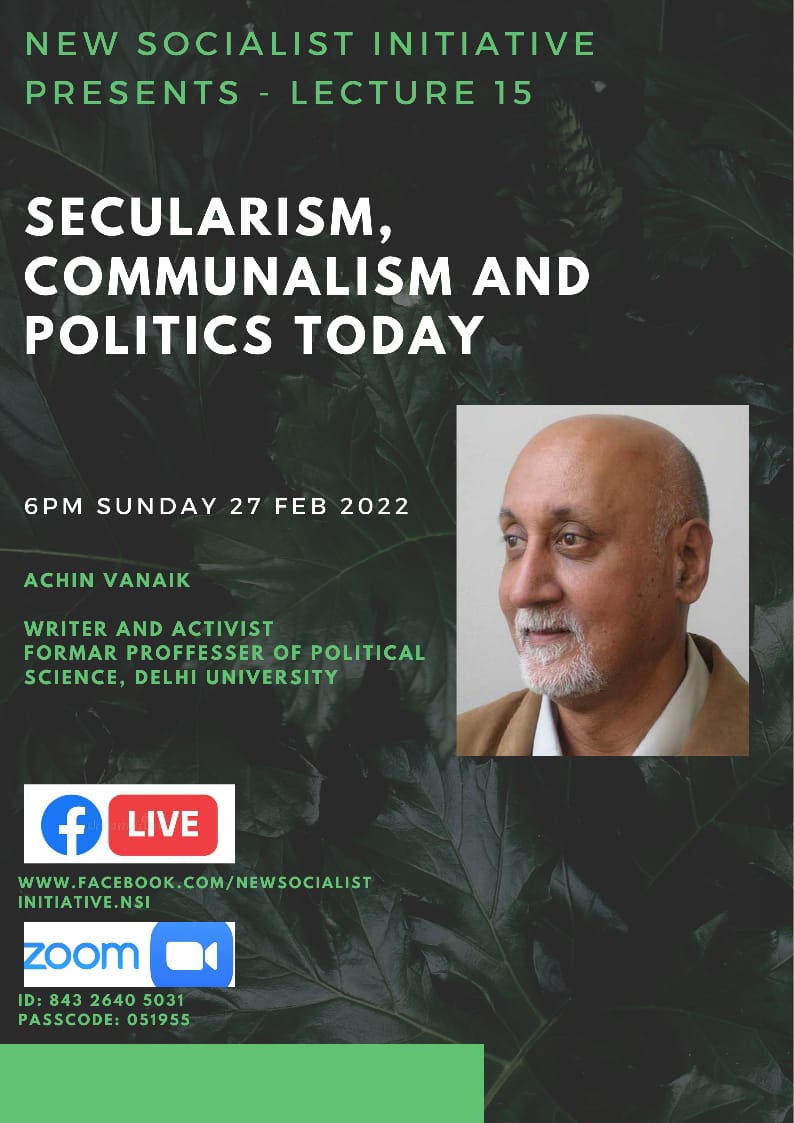
The 15 th lecture in the Democracy Dialogues Series will be delivered by Prof Achin Vanaik on Sunday, 27 th February at 6 PM (IST)
He will be speaking on
‘Secularism, Communalism and Indian Politics Today‘
Speaker
Writer and Social Activist, Former Professor of Political Science at Delhi University Prof Achin Vanaik is a fellow of the Transnational Institute
He is author of numerous books including The Furies of Indian Communalism ( 1997) , The Painful Transition : Bourgeois Democracy in India ( 1990) , Hindutva Rising – Secular Claims, Communal Realities (2017), “Nationalist Dangers, Secular Failings:A Compass for an Indian Left”
Summary :
The presentation will start with a series of definitions of crucial concepts such as secular, secularization, secularism as well as distinguishing between religious fundamentalism, religious nationalism and communalism. This is important to get a handle on how the widespread Indian understanding of secularism as an ancient form of ‘tolerance’ is dangerously mistaken. Of course the rise of the political right and far-right is a global phenomenon in the last few decades giving rise to different forms of what can be called the ‘politics of cultural exclusivism’. So the first principle of explanation for this rise has also to be transnational. After this the question of the rise of the Sangh/BJP in the wider context of developments in India over time will be taken up. It is obvious that the Sangh/BJP is seeking to expand its existing power and influence i.e., to establish and expand its hegemony and this must be understood as well as what are the projects central to its efforts to establish a Hindu Rashtra or Nation. It should be obvious that its particular conception of how to secure a strong Indian nation/nationalism must be exposed and combated. The presentation will end with recognising that this is a long term struggle and how we must go about it.
New Socialist Initiative
हिंदी साहित्य और स्त्रीवादी चिंतन का नया आलोक : प्रोफेसर सविता सिंह

The third lecture in the ‘Sandhan Vyakhyanmala’ series – initiated by New Socialist Initiative ( Hindi Pradesh) will be delivered by Prof Savita Singh, leading poetess, feminist scholar and writer on Saturday 19 th February 2022, at 6 PM (IST). She will be speaking on ‘Hindi Literature and New Light of Feminist Thought (हिंदी साहित्य और स्त्रीवादी चिंतन का नया आलोक’ )
The focus of this lecture series – as you might be aware – is on the Hindi belt, especially, on literature, culture, society and politics of the Hindi region where we intend to invite writers, scholars with a forward looking, progressive viewpoint to share their concerns.
You are cordially invited to attend and participate in the ensuing discussion.
This online lecture would be held on zoom and will also be shared on facebook as well : :facebook.com/newsocialistinitiative.nsi
Zoom Link
https://us02web.zoom.us/j/89853669536?pwd=OTVkZUNKejhNem5hODE5ZEsveGZTQT09
Meeting ID : 898 5366 9536
Passcode : 825447
New Socialist Initiative ( Hindi Pradesh)
संधान व्याख्यानमाला – तीसरा वक्तव्य
वक्ता: प्रोफ़ेसर सविता सिंह
प्रसिद्ध कवयित्री, नारीवादी सिद्धांतकार और लेखिका
विषय: ‘हिंदी साहित्य और स्त्रीवादी चिंतन का नया आलोक’
19 फरवरी शाम 6बजे
सारांश
स्त्रीवाद को लेकर हिंदी साहित्य में आजकल बहुत सारी बातें हो रही हैं। वे अपनी अंतर्वस्तु में नई भी हैं और पुरानी भी। यह भी कह सकते हैं की पितृसत्ता ने अपने भी स्त्रीवादी विमर्श तैयार किए हैं स्त्रियों के लिए। जब स्त्रियां इसे अपना लेती हैं, अपना कह कर इसे किसी वसन की तरह पहन लेती हैं तो जरूरी हो जाता है इनपर गहनता और गहराई से बात करना। वह एक बात थी जब स्त्री लेखिकाओं ने अपने को स्त्रीवादी होने या कहे जाने से परहेज किया, और यह दूसरी जब स्त्रीवाद के अनेक रूप गढ़े गए। भारतीय परिवेश में स्त्री विमर्श के भीतर बहुलता और भिन्नता तो होनी ही थी। इसी विषय पर हम क्यों न इसपर बात करें। क्या हिंदी में स्त्रीवादी लेखन कोई नया समाज बनाने के संकल्प से लिखा जा रहा है या फिर अभी भी पितृसत्ता का सह उत्पादन ही हो रहा है, यह हमारे लिए चिंता और बहस का मुद्दा बनना ही चाहिए।
Electoral Politics and the Left
Guest Post by Dr Ravi Sinha
(Opening remarks in an ongoing discussion within New Socialist Initiative (NSI) on Left’s approach to Electoral Politics in Contemporary India)
The Speaker :
Ravi Sinha is an activist-scholar who has been associated with progressive movements for nearly four decades. Trained as a theoretical physicist, Dr. Ravi has a doctoral degree from MIT, Cambridge, USA. He worked as a physicist at University of Maryland, College Park, USA, at Physical Research Laboratory, Ahmedabad and at Gujarat University, Ahmedabad before resigning from the job to devote himself full time to organizing and theorizing. He is the principal author of the book, Globalization of Capital, published in 1997, co-founder of the Hindi journal, Sandhan, and one of the founders and a leading member of New Socialist Initiative.
Why feminists must oppose the hijab ban in Karnataka colleges
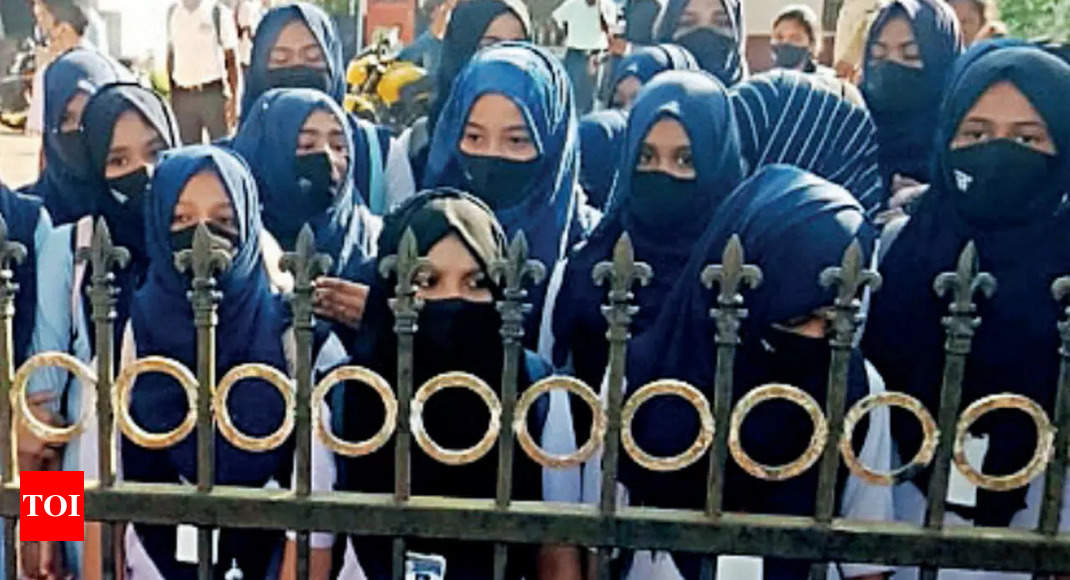
Images of educational institutions barring their gates to women in hijab are dense with implied violence. Used as we have become to the extreme physical violence on display during the period of this regime, both by state authorities and by street mobs launched by Hindutva outfits, in these images is captured in one frozen instant, the ideological violence of Hindu Rashtra. Here is the marked and stigmatized Muslim female body, exiled from the resources of the nation, kept out by iron gates, to be admitted only on the terms set by Hindutva.
But let us note that this is not “only ideological” violence, the power of which we have witnessed in plenty since 2014. We know what terror “mere” words can threaten – “love jihad”, “gau hatya”, “kapdon se pehchane jayenge” – the last, the murderously weighted words of the Prime Minister himself, that those who protest the CAA can be identified by their clothes.
So ideological violence yes, but implicit physical violence too, held only temporarily in abeyance – what if the women decided to climb the gates and insisted on attending class? Or sat quietly on dharna outside? What kind of violence by private security and police would not be unleashed? Just before the pandemic, did we not witness the brutality of police attacks on peaceful student protests against fee hikes in Delhi?
As more and more colleges in Karnataka deny women wearing hijab entry into colleges, and therefore their right to education, the RSS/BJP government of Karnataka backed such moves, invoking the Karnataka Education Act of 1983, Section 133 (2) of which states that students will have to wear a uniform dress chosen by the college authorities. Continue reading Why feminists must oppose the hijab ban in Karnataka colleges
 KAFILA - COLLECTIVE EXPLORATIONS SINCE 2006