Category Archives: Debates

Summer of Rage: JNU Students Begin Fast Unto Death against HLEC Report

13083178_1763261193905640_250606241251585686_n

Spring has given way to the beginning of a turbulent summer. April, is a cruel month. Temperatures have risen, and so has the level of rage in university campuses. The JNU University Authorities (and their masters – in the Ministry of Human Resources Development, the Prime Minister’s Office and the RSS Citadels in Mahal, Nagpur and Jhandewalan, Delhi) thought that they could break the resolve of the students by enacting a series of harsh measures against them just before exams begin and the university term ends in summer vacations.
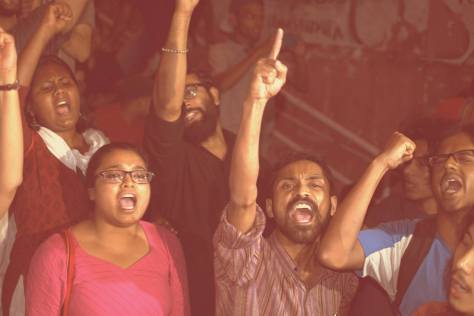
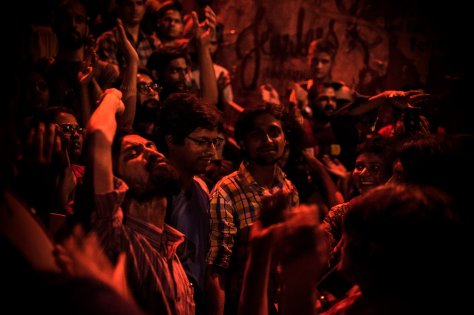
Chintu Kumari, Anirban Bhattacharya and other students give the call to protest against the HLEC and call for a Hunger Strike. Photo, Courtesy, Azhar Amim

13055719_10154616732485016_4978357478249045500_o

This is a time, they must have thought, when students will be busy with preparations, and the rising heat will discourage the kind of mass mobilizations that the campus has seen since February. Students in JNU resolved a few hours ago to prove them wrong, and decided to fight back . A massive gathering stood its ground at the Administrative Block, aptly re-christened, ‘Freedom Square’.
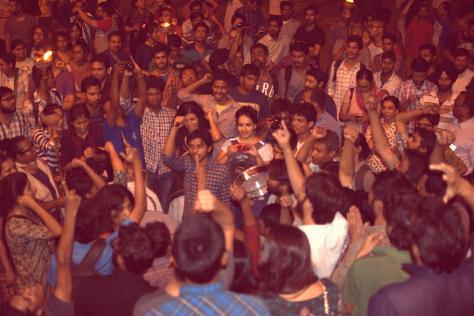
Rama Naga, Gen.Sec. JNUSU, (Centre) and JNU Students Calling for Indefinite Hunger Strike on April 27, 2016. Photo, Courtesy, Azhar Amim

They have decided that a batch of students will sit on indefinite hunger strike – a ‘fast unto death’ – until the JNU authorities roll back the draconian measures listed in the HLEC Report.

The 20 students who will be sitting in indefinite hunger strike at JNU.

There’s no looking back now. Whatever happens from now on wards, will be seen as a consequence of the cruel, evil mindset of the current regime, which truly treats the lives of the young as dispensable ballast. Its time to prove them wrong. This is a call that goes out to all students and teachers, and sensible individuals, not just in JNU, not just in Universities and Colleges all across India and all the territories administered by the Indian republic, but to everyone reading this post anywhere in the world, to stand by the courageous students of JNU. It is our responsibility to see that the JNU Authorities see reason and back down. If anything untoward happens to any student, the university authorities, and the regime backing them, will be clearly culpable.

Here is Umar Khalid, speaking just before commencing his Hunger Strike

Here is Chintu, former Gen. Sec. JNUSU, speaking at the Mashaal Juloos, (Torchlight Procession) just before beginning the Hunger Strike.

Listen to Kanhaiya Kumar, President of the JNUSU – restating the reasons for the continuation of the movement.

Thanks to the ‘We are JNU Media Group’ and the AISA Youtube Channel, for the videos.
Sanghis, Sex and University Students – What is it Really All About? Ayesha Kidwai

Guest Post by Ayesha Kidwai

[ The prurient fantasies contained in the ‘JNU Dossier’, produced by some right wing faculty members of JNU in or around October 2015, have been ‘outed’ by an excellent report by Ajoy Ashirwad Mahaprashasta in Wire.org. This comes exactly at the time when the JNU administration has shown its fangs by delivering a low blow by way of the measures outlined in the report of the ‘High Level Enquiry Committee’ appointed by the Vice Chancellor. An impartial examination of the HLEC document and the ‘Dossier’ in will reveal some startlingly resonant patterns. Clearly, the ‘Dossier’, which had been dismissed by the former Vice-Chanceller, Prof. Sopory, has been reincarnated at the express orders of the Nagpuri masters of the present dispensation. We are sharing below an excellent response to the ‘Dossier’ by Ayesha Kidwai, one of the professors – ‘named’ in the dossier. This is taken from Ayesha Kidwai’s status update on her Facebook Page.

For another take down of the ‘Dossier’ – see also – “Sex and sedition: What the JNU dossier tells us about the right-wing imagination” – in Scroll.in by Kavita Krishnan. Meanwhile, JNU Students have commenced on a ‘fast unto death’ in protest against the university administration’s senseless measures. Kafila]

Sanghi smut is in season again! For the authors of the Dirty Dossier, JNU nights are forever scented with musk, with couples draped on every bush, suitably fortified by free alcohol, thoughts of secession, and cash payments supplied by the Awesome Foursome. At its peak, the party can practically involve the whole university, because as per Shri Gyan Dev Ahuja’s estimates, the number of students frolicking this will be 7000 (3000 condom users X 2, plus 500 injectable walas X 2). (Assuming of course that the few hundred left over have gone to fieldwork, have exams, or are abstemious and/or abstinent in nature.)

Laugh as we may (and must) at these feverish imaginings, it’s also important to understand that the very notion of a free university challenges not only misogyny, but also the social apartheid produced by caste and exclusionary religion.

Continue reading Sanghis, Sex and University Students – What is it Really All About? Ayesha Kidwai

Rise Up against the Proxy War on Students by the Modi Regime: Shehla Rashid

Guest Post by Shehla Rashid, (Vice President, Jawaharlal Nehru University Students’ Union)

Rise up against the proxy war on students by the Modi regime.

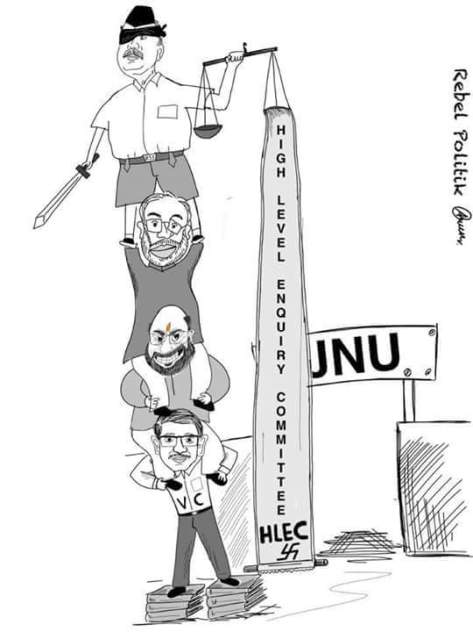
Cartoon by V. Arun Kumar

JNUSU rejects the report of the enquiry committee constituted by the Vice-Chancellor to look into the 9th of February incident. JNUSU also rejects its reports and any punishment handed out by it. The JNUSU and JNUTA had repeatedly asked the administration to democratise the enquiry committee, but this was not done.  Now, when the holidays are here, the VC has made public the punishments, after one and a half months of submission of the HLEC (High Level Enquiry Committee) report. Continue reading Rise Up against the Proxy War on Students by the Modi Regime: Shehla Rashid

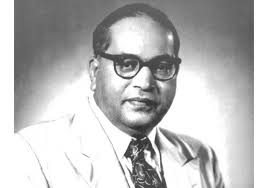
Jayadeva Uyangoda on Ambedkar’s Legacy

Text of the talk delivered on April 22, 2016 at the Indian Cultural Centre, Colombo on the occasion of B. R. Ambedkar Commemoration.

Ambedkar’s Legacy: Critique of Religion, Quest for Social Justice and the Paradox of Constitutionalism

Jayadeva Uyangoda, Senior professor of Political Science, University of Colombo

Ambedkar

May I begin my talk this evening by thanking His Excellency Y. K. Sinha the Indian High Commissioner in Colombo for inviting me to deliver this lecture on B. R. Ambedkar? This event is part of a series of celebrations in connection with the 125th birth anniversary of Babasaheb Ambedkar, which fell on the 14th of April. I am afraid my talk may not celebrate great Ambedkar’s memory and legacy as such. It will only present some disjointed and hurriedly constructed thoughts about the life and legacy of this great son of South Asia.

Ambedkar’s name is well known in Sri Lanka. In Sinhalese society, the popular culture of which I am somewhat familiar with, Ambedkar is known as the leader of India’s Harijan communities. The word dalit is not in much use in Sinhalese society. The Gandhian neologism of harijan is better known. Ambedkar is respected as the Harijan leader who embraced Buddhism along with several thousands of his followers. Sinhalese Buddhists are particularly sympathetic to Ambedkar and his social reform movement. For them, Ambedkar’s project constituted a critique and a rejection of Hinduism. This is despite the fact that Buddhism has historically and in terms of elite as well as popular practices been closely interwoven with Hinduism. Quite independent of Ambedkar, Sri Lankan Buddhists have a somewhat ambivalent attitude towards Hinduism and Hindu traditions as well. It is almost like their ambivalence towards India in general, as some of their intellectuals and professionals seem to be inclined to demonstrate these days. Continue reading Jayadeva Uyangoda on Ambedkar’s Legacy

Media figures call for Release of Himal Editor Kanak Mani Dixit

New Delhi, April 23 — Editors and media figures as well as intellectuals and scholars from India, Nepal, Bangladesh, UK, US, Australia and Sri Lanka have called for the release of Himal editor and prominent Nepali journalist Kanak Mani Dixit who was arrested yesterday in Katmandu by anti-graft officials.

The following is the text of the statement:

It is with deep concern that we have learned of the arrest today of Kanak Mani Dixit, the widely respected founder-editor of Himal Media and a courageous voice for transparency, freedom of expression and democratic rights in Nepal and across South Asia. The charges are related to alleged corruption but Kanak Dixit says it is part of a vendetta pursued against him by people in Government.

We have known Kanak Dixit as a true professional, human rights defender and energetic journalist whose credentials are built on robust research and tremendous courage. Himal Media, a pioneer in South Asia journalism, has published Himal South Asia, Nepali Times and Himal Khabar Patrika (in the Nepali language). He has written extensively for international media including leading newspapers in India and is chairman of Sajha Yatayat, a state run transportation company, which he has been turning around from a loss-making entity. Continue reading Media figures call for Release of Himal Editor Kanak Mani Dixit

जी हाँ, हम राजनीति करते हैं : अनन्त प्रकाश नारायण

Guest Post by Anant Prakash Narayan

जे.एन.यू. में 9 फरवरी को एक घटना घटी. घटना क्या थी अब उसके बारे में बहुत सी चीजे स्पष्ट हो चुकी है. सरकार का दमन चला जिसके परिणामस्वरुप एक आन्दोलन चला. कहा ये जा रहा है कि आन्दोलन के कारण सरकार बैकफुट पर है. ये आन्दोलन अभी भी चल रहा है. जब ये मुद्दा पुरे देश में गरमाया जा रहा था  उस समय बहुत सारी चीजे डिबेट का हिस्सा बनी जैसे राष्ट्रवाद क्या है? अभिव्यक्ति की स्वतंत्रता (Right to Freedom of Speech and Expression) को कैसे देखा जाये? आज़ादी की सीमा क्या होगी? क्या टैक्स से पढने वाले स्टूडेंट्स को “इतना बोलना” शोभा देता है? क्या जब सीमा पर जवान मर रहे है तो “ये काम” किया जा सकता है? ये सारे मुद्दे बहुत ही जोर–शोर से सरकार के पक्ष से या फिर इसके उलट लोकतंत्र के पक्ष में बात रखने वालों की तरफ से भी की जा रही थी. लेकिन इसी बीच में एक खतरनाक अवधारणा सरकार के तरफ से बात रखने वाले और जाने अनजाने लोकतंत्र की तरफ से भी बात रखने वाले टी.वी. चैनलो, अखबारों, इंटेलेक्चुअल, राजनीतिज्ञों की तरफ से रखी जा रही थी. वो अवधारणा थी कि राजनीति बहुत बुरी चीज है और छात्र राजनीति तो बदतर. यहाँ तक कि हमारी पैरोकारी करने वाला पक्ष भी यह बार-बार साबित करने का प्रयास कर रहा था कि ये सामान्य से पढने लिखने वाले छात्र है इनका राजनीति से कोई मतलब नही है. ये लोग तो बस कभी कभी कुछ यू हीं करते रहते हैं. क्या अगर हमारे बारे में यह टैग लग जाता कि हम राजनीति करने वाले लोग है तो हमारे पक्ष से बात रखना इतना मुश्किल हो जाता. जबकि यह सर्वविदित है कि जिन कुछ छात्रो के नाम राजद्रोह के तहत लिए जा रहे है वे वामपंथ की सक्रिय राजनीति का हिस्सा है. आने वाले समय में हम आन्दोलन को किस हद तक जीतते है और आगे ले जा करके इसको इस फासिस्ट सरकार के लिए कितना खतरनाक बना पाते है ये अभी तय होना बाकी है लेकिन “मुख्याधारा” की राजनीति करने वाली पार्टियाँ, जिसको प्रोग्रेसिव छात्र-आन्दोलन ने हमेशा उनके जन –विरोधी रवैये के कारण चैलेंज दिया है, एक बार इस मौके को राजनीति, खासतौर से अगर छात्र करे तो, बहुत ही गलत चीज है इसको स्थापित करने में लगी हैं. छात्रों का काम काज सिर्फ पढना-लिखना है और इसके इतर वो अगर कोई और काम करते है तो वो अपनी “सीमा” लांघते है. बड़ी-बड़ी मल्टीनेशनल कंपनियों में छोटे-छोटे उम्र के कमाने वाले लोगों के साथ तुलना करके ये समझाने की कोशिश की गई कि आप जितनी कम उम्र में जितना ज्यादा कमा लेते है आप उतने ही सफल स्टूडेंट है. हम अभी लगभग बीस दिन के एक कैंपेन में थे. इस कैंपेन के तहत देश के विभिन्न हिस्सों खास तौर से उत्तर भारत के गाँवो और छोटे-छोटे कस्बो और कुछ शहरो में मेरा जाना हुआ. जिसमे जे. एन. यू. पर बात होती, भगत सिंह और डॉ. अम्बेडकर के विज़न पर बात होती. जब इन विषयों पर बात होती तो नैचुरली मोदी सरकार के ऊपर बात होती. उन कार्यक्रमों में कुछ ऐसे लोग भी मिलते जिनका कहना होता कि आप लोगों के साथ जो हुआ गलत हुआ लेकिन इस मैटर को लेकर अब आप लोग राजनीति कर रहे है. मोदी के खिलाफ आप लोग जो इतना बोल रहे है उससे अब आप लोग एक्सपोज हो गये है कि आप लोग राजनीति कर रहे है. क्या सच में राजनीति इतनी बुरी चीज है कि उससे स्टूडेंट्स को दूर रहना चाहिए? Continue reading जी हाँ, हम राजनीति करते हैं : अनन्त प्रकाश नारायण

Responding to the Challenges of Blue and Red – Reminiscences of a JNU-HCU Alumna: Shipra Nigam

This is a guest post by SHIPRA NIGAM

That the past few months have been cataclysmic is an understatement. Personal tragedies and political catastrophes have exploded within our most cherished spaces, and brought a churning in them.  What was truly transformative was the experience of both the emergence of broad solidarities against right-wing fascism, and of the reminders of multiple registers and contexts within them. These underline the need for multiple conversations to understand both our common struggles, as well as the contradictions within, and to renew a resolve for introspection through them as we move towards real ‘azaadi’.

There is of course an ongoing debate on this, and here I felt that some binaries being invoked in it are not very convincing, while others brought home stark truths that pose challenges to a patriarchal, majoritarian caste hindu ordering of society, within which we are all located at different levels of hierarchy, complicity, and engagement.

I have been part of both public universities under fire right now, and the present brings home the urgency of the dual task of defending the public university as a space for pushing the boundaries of critical thought, and confronting the very hierarchies and complicities with power that shape it. This is necessary even as processes of democratisation and affirmative action take root in public institutions . So these are some reminiscences from an alumna of both these public universities who has been wrestling with articulations and complexities which lie beyond institutional labels or binaries. Continue reading Responding to the Challenges of Blue and Red – Reminiscences of a JNU-HCU Alumna: Shipra Nigam

The Difference between What They Tell Us and What We Know: Shehla Rashid

Guest Post by Shehla Rashid. Based on a Status Update on her Facebook Page.

They tell us that the military is meant for fighting the “terrorists”; But most of the time, it is the civilians who are killed.

They tell us that “special powers” for the army are necessary for national unity; But the army only teaches us how to hate India.

They say the University is anti-national because it wants to break India; But it’s the University that teaches us to love Indians.

Then, who is anti-national? Those who teach us how to hate India, or those who teach us how to love Indians?

Yes, we see the difference between India and Indians; India is at war with Indians throughout India.

I wish the Indian state could also see the difference between Kashmir, which it claims as its own, and Kashmiris who belong to no one; They claim to love Kashmir but hate and kill Kashmiris.

Continue reading The Difference between What They Tell Us and What We Know: Shehla Rashid

Open Letter from SC/ST Faculty Forum of University of Hyderabad to VC Appa Rao About Resignation from Administrative Positions: SC/ST Faculty Forum, UoH

Guest Post by SC/ST Faculty Forum, University of Hyderabad

[ We have recently received a request from The SC/ST Faculty Forum of the University of Hyderabad to publish a correspondence between them and the Vice Chancellor of the University of Hyderabad, Prof. Podile Appa Rao regarding the collective decision of the SC/ST Faculty Forum members to resign from administrative positions in the university. Accordingly, we are publishing below an open letter from the SC/ST Faculty Forum to the Vice Chancellor which is a response to a letter from the VC to the Convener of the SC/ST Faculty Forum, Dr. Sudhakar Babu. This letter is, in turn, a response to the original communication from the SC/ST Faculty Forum containing the collective decision to resign from administrative posts. These letters are being published in solidarity with the SC/ST Facutly Forum and in furtherance of the spirit of transparency, and public awareness, that they seek to uphold vis-a-vis all communication with the current vice chancellor.- Kafila]

Dear Prof.Appa Rao,

Thank you for your mail. We reiterate our collective decision to resign from administrative positions  for the following reasons:

The Forum represents the collective will of the community. Its decision is not reducible to individual members of the community. By asking the forum members to individually give reasons for their resignations, you are downplaying the community’s experience of continuing caste atrocity on the campus. In fact, this mail of yours may be construed as a threat against  individual members of the community and suggestive of demoralising the SC/ST members in a way that infringes upon and restrains their right to complain against you.

The Forum traces its history as a response to the rustication of ten Dalit students on the campus in 2001. Incidentally, you were one of the main perpetrators of caste atrocities on the students at that time. Today, you are not only responsible for the suicide of Rohit Vemula on January 17th but also the police brutalities and arrest of faculties including a Dalit faculty on trumped up charges following the March 22nd unforgivable and unforgettable event.  An atmosphere of caste violence prevails on the campus —of fear, intimidation, social boycott  and the SC/ST community feels extremely insecure by your presence.

We vehemently condemn the expeditious and inappropriate manner in which you have accepted the resignation of the Controller of Examinations and the mischievous way through which you are persuading the other members of the community to hold on to their resignations. This diabolic and unbecoming style of your leadership is at once appalling and extremely damaging to the interests of the SC/ST community on the campus.

Under the circumstances, we demand that you desist from holding individual Dalit faculty responsible for the collective decision of the Forum and thereby attempting to isolate and intimidate them.

Dr.Sudhakar Babu,

Convener, SC/ST Faculty Forum

THIS IS IN RESPONSE TO A LETTER FROM THE VC To Dr. Sudhakar Babu, which is reproduced below.

Dear Dr. Sudhakar Babu,T

he Vice Chancellor office received your email conveying the decision of the SC/ST Teachers Forum that its members are not willing to work in administrative posts in the University.  Since you have conveyed this message on behalf of our colleagues, I would like to request you to convey to all those who have expressed such concern to continue in their respective office.  VC office would like to continue with their services in respective positions.

If any of our faculty colleagues from SC/ST Teachers Forum are unwilling to consider my request for their continuation in administrative office, please advise individual faculty members to tender resignation giving reason(s) which will be considered by the University accordingly.   It may not be appropriate for the administration to act on the request from the convener of a forum about continuation of individual members of the forum in an administrative job.

You may recall that we have all worked together for a long time.  I would like to continue with the same relationship with everybody in the University.

With best wishes,

Prof. Appa Rao Podile FASc, FNASc, FNAAS,

Vice Chancellor

Tata Innovation Fellow (DBT)

University of Hyderabad

Hyderabad – 500 046, Telangana, India

How to be free of Caste – Guest Post by Suhas Borker

Guest Post by Suhas Borker

This year, India has sponsored the observation of the birth anniversary of Babasaheb Ambedkar at the United Nations for the first time. The Permanent Mission of India to the UN shall commemorate the 125th birth anniversary of the Dalit icon on April 13 at the UN headquarters, a day before his date of birth, with an international seminar on ‘Combating inequalities to achieve Sustainable Development Goals (SDGs)’. A note circulated by the Indian mission says that the “national icon” remains an inspiration for millions of Indians and proponents of equality and social justice across the globe. “Fittingly, although it’s a matter of coincidence, one can see the trace of Babasaheb’s radiant vision in the SDGs adopted by the UN General Assembly to eliminate poverty, hunger and socio-economic inequality by 2030.”

Juxtapose this with a recent report on caste-based discrimination by the United Nations Human Right Council’s Special Rapporteur for minority issues that has stung the Indian government, provoking it to raise questions about the lack of “seriousness of work” in the UN body and the special rapporteur’s mandate. Ambedkar, the architect of the Indian Constitution, would definitely not be pleased. Nor are the Dalit rights activists in India and abroad.

( Read the rest of the piece here : http://www.thehindu.com/opinion/op-ed/how-to-be-free-of-caste-in-india/article8467518.ece?homepage=true)

Fifty Shades of Grey – Without the Thrills

[This is a response to Shourajenda Nath Mukherjee’s open letter on Kafila by Prof Makarand Paranjape]

Mr. Shourjendra Nath Mukherjee’s “Open Letter” of April 5, 2016 makes only one substantive point, concerning the agency of students, which needs attention. The rest of it, as the Dormouse said to Alice, is “much of a muchness” – confusion, rigmarole, and thumb-twiddling over precious little, which scarcely need be dignified by serious confutation. Continue reading Fifty Shades of Grey – Without the Thrills

An Open Letter to Prof Makarand Paranjape

Guest post by SHOURJENDRA NATH MUKHERJEE

Please note that this response was first sent to Swarajya Mag, where Prof Paranjpe’s Open letter appeared, but was not published. It was then sent to Kafila.

Dear Prof Paranjape

I am Shourjendra, an MPhil research scholar in the Department of History, DU. I write this letter as a rejoinder to your open letter in response to Maitreyee Shukla. Your open letter was not addressed to me and therefore you can feel free to not reply to my letter.

You sir, seem to reflect a lot of the opinions expressed very strongly by a section of the urban middle classes. Granted, these views are by their very nature not ‘fascist’ but nonetheless they help perpetuate and legitimate the regime in power. You are also one of the most eminent academicians to have sought to engage in these raging debates in the public sphere, and I very strongly appreciate you for this. Your open letter is one such statement and I would like to take this up as an opportunity to critically engage with some of the issues that you have raised. (Since, your statements are mostly uncritical appreciation and endorsement of these ideas, I would regard your statements as statements made by an academician who has paused to think academically.) Continue reading An Open Letter to Prof Makarand Paranjape

Apropos Fetishizing Higher Education and University Politics

This is a guest post by PRATIK ALI.

[This article summarizes quite well the very many criticisms that have been raised from broadly the left of the political spectrum, about the Standwithjnu campaign. We do hope it generates a lively debate that will enlarge our horizons and strengthen the struggle against fascism]

Whether it has been the scrapping or stagnancy of the Non-NET Fellowship, the increased interference of the State in student activity in universities of higher-education, or merely the (routine) introduction of symbols of the ruling party in cultural institutions (of which universities are a part), a dangerous, and even strange trend is seen emerging in the student response: asserting their isolation from other sections of society as valuable uniqueness. Continue reading Apropos Fetishizing Higher Education and University Politics

Who will take responsibility if the threat to “storm JNU” and kill students is carried out?

One Amit Jani has received considerable media attention with his threats to JNU students, promising a ‘shoot-out’ if JNUSU President Kanhaiya Kumar and Umar Khalid, do not meet the ‘deadline’ he has given for them to leave campus.
Almost immediately as this came to the attention of the JNU community, students and teachers took steps to bring this threat to the attention of Facebook, where the threat was initially posted; of Delhi Police and of JNU Administration.
These steps are listed below, so that later, nobody should be able to say We Did Not Know. The media, which covers every petty letter written to the police by ABVP with great alacrity, has not seen fit to recognize the steps being taken by an increasingly anxious JNU community over clear and specific threats to the life of our students, and indeed to everyone on JNU campus.
1. JNUSU wrote to the VC, bringing this time-bound threat to his attention. JNUSU also filed a complaint at the Vasant Kunj North Police Station to take appropriate action against those indulging in intimidation and threat to students. Students also met the SHO personally and requested him to take the issue seriously and file an FIR. A Complaint has also been sent to Commissioner of Police by JNUSU, with a copy of the complaint to LG and CM.
There has been no response from the police so far.

Stand With UoH: Statement by Concerned Members of the IIT Bombay Community


We, the undersigned members of IIT Bombay community, strongly condemn the police repression that has been unleashed on students and faculty of University of Hyderabad who seek justice for Rohith Vemula, with the active connivance of the University administration. The testimonies of the events have been singularly disturbing. We cannot let educational institutions become play fields of state repression. Continue reading Stand With UoH: Statement by Concerned Members of the IIT Bombay Community

Medico Friend Circle Welcomes Report of Parliamentary Standing Committee to Clean up Medical Education Regulation

A statement from MEDICO FRIENDS CIRCLE

Mfc (Medico Friend Circle) wholeheartedly welcomes the 92nd Parliamentary Committee Report on the Functioning of the Medical Council of India (MCI) that was presented to the Rajya Sabha on March 8, 2016.

The Report is comprehensive, wide ranging and has come out with sound recommendations. Implementing these recommendations is in the best interests of the health of the people of India and the medical profession.

The MCI was expected to be the regulator with everything related to medical education but has ended up being the single major factor in the country responsible for the commoditization and corruption of medical education. Successive occupants of top posts at the MCI have perfected the MCI as an ATM. Every requirement of approval of a private (and public) medical college had a price and still does. We agree with the Report that unless there is a whole sale exit of vested interests that have clogged the MCI, nothing can change and it will be ‘business’ as usual. Continue reading Medico Friend Circle Welcomes Report of Parliamentary Standing Committee to Clean up Medical Education Regulation

Bhagat Singh Then and Now: Harsh Mander

Guest post by HARSH MANDER

Eighty five years ago, on 23 March 1931, Bhagat Singh walked bravely, proudly to the gallows, his two young colleagues Rajguru and Sukhdev by his side. His lustre continues undimmed as an icon for succeeding generations, so that it is easy to forget he was only 23 years old. Subhash Bose spoke then of Bhagat Singh as a ‘symbol of the new awakening among youth’. Nehru saw in him ‘a spark that became a flame in a short time and spread from one end of the country to another dispelling the prevailing darkness everywhere’. His popularity rivalled that of Mahatma Gandhi.

In the decades after his passing, in times of public ferment, despair, confusion and anger, successive generations in India have found their own inheritors of young Bhagat Singh’s mantle, men and women embodying defiant youthful idealism and dissent, young people battling for social and economic equality, for true freedom, sparks that once again set aflame a beleaguered wearied country battling the darkness of the times.

Continue reading Bhagat Singh Then and Now: Harsh Mander

Let us not be little Arnolds in these times : Sudha K F

This is a guest post by SUDHA K F

“His right to march where he likes, meet where he likes, enter where he likes, hoot where he likes, threaten who he likes, smash as he likes. All this I think tends to anarchy. (Mathew Arnold, Culture and Anarchy, 1866)

….It certainly does. Nothing is stranger, in Arnold’s often scrupulous, often self-consciously charming and delicate prose, than the escalation, the coarseness of these Hyde Park verbs…It is a point of view. Certainly it contrives to forget the start of the disorder: the defeat of the reform legislation, the locking of the gates against the reform meeting (for which, as it happens, there were no legal grounds). As so often, it picks up the story at a convenient point: at the point of response, sometimes violent, to repression; not at the repression itself. Even so, it is a point of view and a familiar one.”


The above excerpt is from an essay by the British Marxist thinker Raymond Williams “One Hundred Years of Culture and Anarchy”, which is part of his path-breaking collection of essays Culture and Materialism. The first paragraph is a quotation that Williams makes from Mathew Arnold’s essay Culture and Anarchy written in the 1860s in response to the workers’ demonstration at Hyde Park asking for voting rights for workers. Arnold’s argument and language is all too familiar to us now, as that is the language available to us through mainstream media and in general the middle class public sphere, while talking about the brutal deployment of force and violence on the students at the University of Hyderabad. Many seem to be in the business of picking up stories at convenient points. Continue reading Let us not be little Arnolds in these times : Sudha K F

Break the Blockade: A Message from a Faculty Member at UoH

[I just got this message from a friend who teaches at UoH and has been trying to support students there. The situation sounds so serious, I asked her permission to post part of the email on Kafila]

 … It has been a very crazy time for us here. However, at this point, in my personal opinion the highest priority is to remove the blockade of entry into the campus. Let me document for you what is still happening in the campus.


1. Parents of students arrested and sister of Thathagata, the arrested faculty member are also not being allowed into campus.

2. Bhim Rao who is the currently acting lawyer of the Velivada students was also not allowed into the campus yesterday. Two of us faculty went and fought with the security officer and told him to give in writing that following the orders of the registrar, he is refusing entry of the lawyer into the campus. Then, he talked to the Registrar, went and got approval and allowed the lawyer in.

3. Rohith’s mother has attempted entry into the campus alone and with the help of civil society multiple times and has been refused entry always. On March 26th morning she was coming to the univ. and fell ill due to her high BP and her right hand going numb. She needed immediate medical attention. When a faculty member attempted to bring her into the campus so she can be looked at by the doctors in the health centre, she was not allowed. Then, doctors went out of the main gate and measured her vital parameters and got her shifted to a hospital. She was under observation for 24hrs.

4. There is still police patrolling on campus.

5. We hear now that new names have been added to an existing FIR in which students are named but not yet arrested.

So, the harassment continues. Students are standing strong despite the extreme intimidation by the administration.

I am sorry to say this and I may be accused of overstating it. However, I feel we are in Chattisgarh when I see the mainstream newspapers. We are in a war without witnesses too, it seems. No reporter is even attempting entry into the campus. There is no media outrage at what is happening on campus. There are no opinion pieces on what is happening on campus from any of the intelligentia of this country in the newspapers. I remember seeing a piece every day about JNU and we were with them. But, we now feel utterly abandoned by all. Is there no way to pressure at least the print media to cover what is happening? Maybe we do not know how to be publicity savvy?! We are stretched so thin trying to protect students – whenever there is any demo by students and so on, at least two of us faculty are around to be at least a witness if not to stop any attacks.

Appreciate any help/advice from you people on this. But, our appeal is that civil society with political parties HAS TO BREAK THE BLOCKADE OF ENTRY. The Registrar’s order states: political parties, politicians, external student organisations and media ONLY. How come lawyers are not being allowed inside? How come parents and families of affected students and faculty are not being allowed inside? What is happening in this country?

Continue reading Break the Blockade: A Message from a Faculty Member at UoH

Solidarity Statement from Concerned EFLU Alumni Against State Crackdown in UoH


We, the alumni of English and Foreign Languages University, Hyderabad, condemn in the strongest possible words the brutality unleashed by the police with the cooperation of the university administration on 22 March 2016, after the Vice Chancellor, Prof Appa Rao Podile, ‘took charge’. We are disturbed seeing the chain of events that the VC triggered to ensure ‘his smooth return’, in spite of being accused of abetting the suicide of research scholar, Rohith Vemula. In the wake of an ongoing case, the VC chose to orchestrate his return with the aid of the police so that any voice of dissent opposing his return is crushed mercilessly. As former students of this university, we are extremely angry seeing this State sponsored violence inside a university and disturbed seeing students become victims to it. An ideal university must exist as a space for dialogue, dissent and strive to be devoid of power structures inherent in relationships that students have amongst themselves, with the university workers and the teachers. However, like the world outside of the university space, all of our classrooms have not in effect been a ‘clean space’. Rather, it has been a microcosm of the realities that exist outside of our pristine gates. Thus, when ASA activist and research scholar, Rohith Vemula took his life, what was thrown open to this nation was the bare truth of caste that the intellectual and political class has been avoiding for long. Instead of interrogating this systemic problem that has been a part and parcel of this nation since its formation, the UoH administration under VC Prof Appa Rao sought to suppress a student movement, unleasing a first of its kind seeking justice for Vemula and all other Dalit, Adivasi and Bahujan students that were ruthlessly harassed and humiliated by universities. Triggering nation-wide protests, the movement had also become a topic of discussion in the center where news such as the death of a Dalit student had often been blacked out.
It is in the wake of this two months long peaceful student protest that the VC used the might of the police and the RAF to ‘protect himself’ from the democratically protesting students. Alleging that the protesters vandalised the VC’s residence (with zero evidence), the police came down heavily on the student protesters and went onto assault faculty members who were trying to protect these students. Arresting 30 students and 2 faculty members and taking them to ‘unknown’ locations, the police managed to create an atmosphere of terror for the students of UoH, wherein possibilities of fake encounters creeped on everyone’s mind. If this wasn’t enough, the VC also managed to convince workers to go on strike and leave the student community without food for 48 hours. Power and internet were subsequently cut off and women students who tried to hold their ground were threatened with rape by the RAF. When there was no food, a few students who took the initiative of cooking food at the university premises were beaten and detained, all the while when the UoH VC had taken ‘steps’ to store milk and water at his residence. Now, with reports of the police particularly picking and beating up the Muslim students badly, among those who were arrested, we are forced to believe that what happened at UoH is the ugliest face of this regime with respect to student community in India. Even more so with the Telengana government standing as mute spectator to the protest, fully knowing how students across universities in Hyderabad had supported the Telengana movement. The police has also released a fresh list of students to be arrested.
This is a planned and systematic attempt to break down the students movement demanding action against the VC and the implementation of Rohith Act. In the wake of such brutalities, we are amazed seeing the spirit of the students of UoH in standing up to the bullies and goons who have taken law into their hands. We stand in solidarity with them, their struggle and condemn the violation of their rights and dignity by the VC and the state government. We condemn the branding of students as ‘antinationals’ and vandalisers, the physical and emotional abuse of the arrested students and faculty, the assault on women students, faculty and media persons and the ruthless targeting of Muslim students by the police and the RAF. We condemn in strong words the rape threats and the police rule that was implemented on campus violating basic human rights. We demand the immediate withdrawal of cases against the students and faculty and the withdrawal of the police from the campus. We demand that the VC be removed from inflicting further harm to the students and that Rohith Act be implemented with immediate effect.
We have also seen photos and videos of the police brutally attacking student protesters in Chennai, Calicut and Mumbai who raised their voices against the atrocity meted by the UoH students. We condemn the act of the state government in the respective places and their draconian attempts of charging the protesters with IPC 153 etc to silence any voice of dissent.
In solidarity

Continue reading Solidarity Statement from Concerned EFLU Alumni Against State Crackdown in UoH

Insurgent Ambedkar and a New Moment in Politics

Both the Hyderabad Central University (HCU) and Jawaharlal Nehru University (JNU) events were “ultra-Left movements” also involving a small section of “jihadis”, Finance Minister Arun Jaitley contended on Sunday.

In the case of JNU, the predominant section of those involved in the agitation was “ultra-Left” barring a small section of “jihadis”, who had their faces masked during a demonstration on the campus on February 9 in which anti-national slogans were raised, Mr. Jaitley said.

The name of Dr. B.R. Ambedkar was “unfairly used” in the case of HCU, where protests erupted after the suicide by research scholar Rohith Vemula, he told PTI. (emphasis added. See full report in The Hindu here)


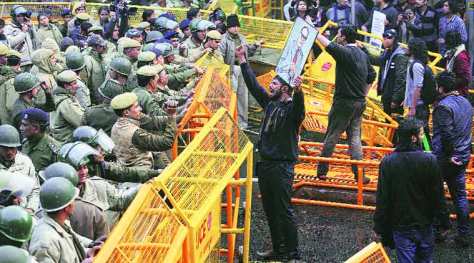
Ambedkar at the barricades, Express photo, courtesy Tashi Tobgyal

Ambedkar has become an insurgent figure today, breaking out of all the pre-set molds in which he was sought to be confined all these decades. He is no longer neither a mere Dalit leader, nor is he simply the Constitution-maker and constitutionalist who taught us to have faith in the law – the two comfortable and domesticated roles in which he has been presented to us so far by all interested parties and the powers-that-be. In the face of the new Sanghist/ fascist assault, he has broken his chains to come out on the streets, as universities and colleges across the country begin to reverberate with his spirit of rebellion. Ambedkar, the name and the face, is ubiquitous by his presence in all the struggles that mark this moment. Even as the struggle of the HCU students for justice for Rohith Vemula continues and the news of the first victory – their release on bail – trickles in, the figure of Ambedkar at the barricades gives the lie to Finance Minister Arun Jaitley’s claim above: that HCU and JNU movements were ‘ultra-Left movements’ and ‘jihadis’, and that “the name of Dr Ambedkar was ‘unfairly used’ in the case of HCU. How easy it would be, Mr Jaitley, to thus pronounce the dog mad and go about your business, and how embarrassing to have to confront Ambedkar facing your police and lathis, your courts and prisons. Continue reading Insurgent Ambedkar and a New Moment in Politics