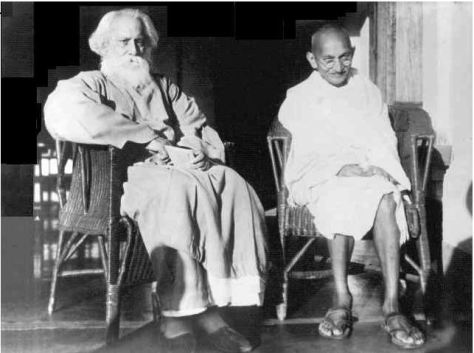
FromRABINDRANATH TAGORE‘s lectures on Nationalism, 1917
Our real problem in India is not political. It is social.This is a condition not only prevailing in India, but among all nations. I do not believe in an exclusive political interest. Politics in the West have dominated Western ideals, and we in India are trying to imitate you. We have to remember that in Europe, where peoples had their racial unity from the beginning, and where natural resources were insufficient for the inhabitants, the civilization has naturally taken the character of political and commercial aggressiveness. For on the one hand they had no internal complications, and on the other they had to deal with neighbours who were strong and rapacious. To have perfect combination among themselves and a watchful attitude of animosity against others was taken as the solution of their problems. In former days they organized and plundered, in the present age the same spirit continues—and they organize and exploit the whole world. Continue reading Nationalism in India: Rabindranath Tagore→
The watchdog metaphor obliges the media to step up their role, that of an opinion maker, and stir public opinion on hunger and food security in India
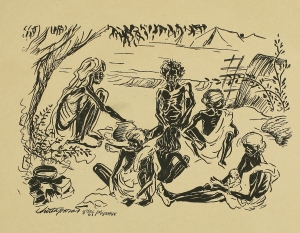
A priest turned beggar, his body starved thin; a family of destitute potters picking up grains soiled in mud; emaciated women forced into sex work; and a man scavenged by dogs and vultures. These were just a few of the scores of starving people journalist Chittaprosad Bhattacharya drew in black and white sketches in his travels through Bengal’s Midnapore district during the Great Bengal Famine of 1943, the last of a spate of famines that plagued colonial India during British rule. Bhattacharya’s portraits of the destitute ’showed’ stories of mass starvation, making visible through withering human flesh a nearly immeasurable tragedy of more than 3 million hunger deaths. Brutal yet compassionate, his graphic chronicles provoked the ire of colonial administrators, prompting officials to burn every copy of his book, Hungry Bengal (1943).
Drawing by Chittaprosad on the 1943 Bengal famine
Despite the censorship of his book, Bhattacharya continued to report on the famine for the Communist Party of India’s weekly newspaper, The People’s War.His sustained efforts to bring the realities of mass hunger to bear on the public conscience in colonial, famine-struck Bengal set a precedent for journalists to use the press as a watchdog that can impel the government to act. Today, his reportage is instructive for those in the profession who particularly cover hunger, poverty and inequality.
In today’s India, home to over 200 million chronically hungry and malnourished people, a significant but small number of dedicated editors, publishers, journalists, photographers and broadcasters are taking strides to highlight the complex nature of inequality in this country. A sporadic renewal of interest on the part of the media to report on hunger and starvation often only occurs in moments of crisis: starvation deaths, children’s deaths, or spoilage of grains in warehouses. Continue reading Reporting Hunger from the Margins: Agrima Bhasin and Ashwin Parulkar→
Does resistance necessarily have a direct relationship with suffering and inverse relationship with pleasure and happiness? This is a question that is particularly significant for long drawn resistance movements facing a formidable enemy insensitive to and largely unruffled by the exertions of resistance. The engagement with occupation often involves violent and non-violent struggle. Both demand sacrifices that warrant shunning of such mundane pleasures and opportunities taken for granted by the populations reconciled with power. If the struggle extends over multiple decades, it is bound to generate fatigue and disillusionment especially among those who have not voluntarily committed themselves to the life of endless self abnegation even while they may desire freedom from occupation. While all people want to be free from the indignity of living under occupation and dominance, human nature puts limits on how far individuals and populations may be willing to stretch themselves in their denial of bodily desires and material pleasures that life has to offer.
There is something disquieting in what Ashish Khetan has written and said recently on terror in India (in The Hindu and on Tehelka.tv), and centrally within it, the Indian Mujahideen. More so, because it comes from one of the most credible journalist’s today, who has done some commendable work over the years. A journalist I personally respect. But there are several reasons which compel this response. And yet, this is not just a response, but also an attempt to elucidate the many complex processes within which ‘terror’ is located today, and the way the discourse has transformed, and has implications for a people’s negotiated relationship with their state.
हर वर्ष इकतीस जुलाई को दिल्ली में ‘हंस’ पत्रिका की ओर से किसी एक विषय पर एक विचार-गोष्ठी का आयोजन किया जाता रहा है. बातचीत का स्तर जो हो, यह एक मौक़ा होता है तरह-तरह के लेखकों, पाठकों और साहित्यप्रेमियों के एक-दूसरे से मिलने का. कई लोग तो वहीं सालाना मुलाकातें करतें है. मेरी शिकायत हंस के इस कार्यक्रम से वही रही है जो दिल्ली में आमतौर पर होने वाले हिंदी साहित्य से जुड़े अन्य कार्यक्रमों से है: इंतजाम के हर स्तर पर लापरवाही और लद्धड़पन जो निमंत्रण पत्र में अशुद्धियों और असावधानी से लेकर कार्यक्रम स्थल पर अव्यवस्था, मंच संचालन में अक्षम्य बेतकल्लुफी तक फैल जाता है.प्रायः वक्ता भी बिना तैयारी के आते हैं और जैसे नुक्कड़ भाषण देकर तालियाँ बटोरना चाहते हैं.ऐसे हर कार्यक्रम से एक कसैला स्वाद लेकर आप लौटते हैं. श्रोताओं के समय, उनकी बुद्धि के प्रति यह अनादर परिष्कार के विचार का मानो शत्रु है. मैं हमेशा अपने युवा छात्र मित्रों को ऐसी जगहों पर देख कर निराशा से भर उठता हूँ : ये सब यहाँ से हमारे बारे में क्या ख्याल लेकर लौटेंगे?
यह भी हिंदी के कार्यक्रमों की विशेषता है कि जितना वे अपने विषय के कारण नहीं उतना आयोजन , आयोजक और प्रतिभागियों के चयन से सम्बद्ध इतर प्रसंगों के कारण चर्चा में बने रहते हैं. चटखारे लायक मसाला अगर उसमें नहीं है तो शायद ही मंच पर हुई ‘उबाऊ’ चर्चा को कोई याद रखे. अक्सर सुना जाता है कि फलां को तो बुलाया ही इसलिए गया था कि विवाद पैदा हो सके. विवाद अपने आप में उतनी भी नकारात्मक चीज़ नहीं अगर उससे कुछ विचार पैदा हो. लेकिन प्रायः विवाद और कुत्सा में अंतर करना हम भूल जाते हैं. विवाद में फिर भी मानसिक श्रम लगता है, कुत्सा में मस्तिष्क को हरकत में आने की जहमत नहीं मोल लेनी पड़ती. Continue reading आत्ममुग्ध क्रांतिकारिता और वरवर राव : अपूर्वानंद→
The word ‘closure’ has a reassuring, comforting resonance, particularly when it comes to matters of death. One achieves closure. It is granted. Those who are fortunate receive it as recompense for the necessary tasks of grief and mourning. We move on.
On the 25th of July, last week, after Rajender Kumar Shastri, 2nd Addiitional Sessions Judge of the South East (Saket) Court in New Delhi announced in open court that a young man named Shahzad Ahmad of Khalispur village in Uttar Pradesh’s Azamgarh Disttrict was guilty of causing the death of Inspector Mohan Chand Sharma of the Special Cell of the Delhi Police in Flat No. 108, L-18, Batla House, in South Delhi’s Jamia Nagar on the 19th of September, 2008, the word ‘closure’ began to ring out on prime time television. We were given to believe that the infamous ‘Batla House Encounter’ case had finally achieved closure. That the ‘martyrdom’ and sacrifice of Inspector Mohan Chand Sharma had now been vindicated. That all unseemly controversy could now be put to rest. We were told that it was time to move on.
‘शिक्षा बचाओ आन्दोलन’ ने आतंकवाद के खिलाफ अंतर्राष्ट्रीय युद्ध में नई जीत हासिल की है. वह कालीकट विश्वविद्यालय के स्नातक स्तर की अंग्रेज़ी की पाठ्यपुस्तक –‘लिटरेचर एंड कंटेम्पररी इश्यूज’ से ‘अल कायदा से जुड़े एक आतंकवादी’ इब्राहिम अल रुबाईश की कविता ‘ओड टू द सी’ को निकलवा देने में सफल रहा है. आन्दोलन की केरल इकाई के सचिव ने इस कविता को पाठ्यपुस्तक में शामिल करने को ‘गंभीर मामला’ बताते हुए कहा था कि किताब को वापस लेने और विश्वविद्यालय द्वारा माफी माँगने के बाद इसकी जांच होनी चाहिए कि ‘बोर्ड ऑव स्ट्डीज़’ और अकेडमिक काउन्सिल’ में आतंकवादियों के समर्थक कौन हैं जिससे इस तरह की सामग्री के चुनाव के पीछे की साजिश का पर्दाफ़ाश हो सके.
कुलपति ने फौरन अपने डीन प्रोफ़ेसर एम.एम. बशीर को मामले की जांच करने को कहा. उन्होंने कहा कि ऊपर से निर्दोष लगने वाली इस कविता में रुबाइश ने अत्यंत अर्थगर्भी प्रतीकों का इस्तेमाल किया है जो खतरनाक भी हो सकते हैं.मसलन, उसने ‘फेथलेस’ शब्द का प्रयोग किया है जो अरबी शब्द ‘काफिर’ का अंग्रेज़ी अनुवाद है. फिर जैसा आज का अकादमिक रिवाज है, वे इंटरनेट पर गए और पता किया कि इस कवि ने अमरीका के खिलाफ जंग का आह्वान भी किया था. भला इसके बाद और सोचने की ज़रूरत ही क्या रह जाती है?पाठ्यपुस्तक के संपादकद्वय में से एक ने लगभग माफी माँगते हुए कहा कि डेढ़ साल पहले इसे संपादित करते वक्त रुबाइश के बारे में ज़्यादा सामग्री ‘ऑनलाइन’ मौजूद न थी. अगर उन्हें कवि के राजनीतिक रुझान का जरा भी अंदाज होता तो वे इसे कतई न चुनते. Continue reading आतंकवादी कविता के विरुद्ध युद्ध: अपूर्वानंद→
A poem by Ibrahim al-Rubaish, a Guantanamo Bay prisoner written in the tragic circumstances of illegal incarceration has given rise to a baseless controversy in Kerala as it was included in a section titled ‘Literature and Contemporary Issues’ of the English text book for the third semester undergraduates in the University of Calicut. The poem was recommended for inclusion by the Board of Studies chaired by Dr K. Rajagopalan, and rightly so as the section dealt with creative writing based on contemporary issues including the issue of human rights. The poem goes like this: Continue reading GUANTANAMO II : K Satchidanandan→
Yashwant Sinha is a worried man these days. He is apprehensive of his leader Narendra Modi being taken for a ride by the Congress party. He says that the Congress party is laying a trap for him, a trap of the binary of Communalism and Secularism and fears that his upward looking Narendra Modi might fall in it. So, well wisher that he is of Narendra Bhai, he wants to alert him: do not get entangled in the conspiracy of the wily Congress. He appeals to Narendra Modi to stick to people’s issues and not let the political discourse shift to the terrain of the Secularism versus Communalism debate. Continue reading The BJP’s very own Stalin→
Guest post by ANANT MARINGANTI. Kapil Sibal may have unwittingly erased a whole historical geography of pre-windows software development in India. If the Times of India report on the release of Urdu fonts developed by National Council for Promotion of Urdu Language ( NCPUL) last week is accurate, Sibal said that India developed Urdu Software and fonts and thereby ended a longstanding dependency on Pakistan. This, according to him is beneficial to the 15 crore Urdu language users. There is a ‘pre-election Muslim wooing’ feel to the story which nicely blends with the ‘massaging of Indian (read Hindu) nationalist pride’ feel. The sense of triumph and pride at this historic achievement by Indian programmers would have been justified even if it could be read as symptomatic of the postcolonial condition that Amitav Ghosh captures in his recounting of the breakdown of conversation between himself and the Imam of Lataifa and Nashawy. Unfortunately however, Urdu language users in India were never dependent on Pakistan for software and fonts. This can be said in two different senses: first that Indian Urdu language computing originated in Hyderabad almost 25 years ago and has contributed significantly to local cultural economy. Second, to the extent that there has been exchange between India and Pakistan in Urdu language computing, the participants in that exchange have seen it primarily in terms of exchange. Afterall, people cannot help making language tools even if nation states do not pay them much attention. Continue reading Lok Sabha elections, software imperialism and the Urdu language: Anant Maringanti→
This is a guest post by ENAKSHI GANGULY and ANANT ASTHANA
July 17 was an important day. Supreme Court announced its judgment refusing to interfere with the Juvenile Justice Act. This was with respect to the eight petitions that were filed in the wake of the alleged involvement of a juvenile in the rape and murder of a 23 year young girl on December 16, 2012. The boy, who was found to be below 18 years, was described by the media as the most heinous of the rapists, a monster and a beast, and even the main accused—and this even before the police had filed the charge –sheets based on statements of the witnesses and evidence gathered. Should there be a fair judicial process that decides the case based on scrutiny of relevant facts or should we let media undertake a trial? Continue reading The media monster of the juvenile offender: Enakshi Ganguly and Anant Asthana→
By SHIVAM VIJ: A new documentary film, Katiyabaaz, presents a problem that I’ve been struggling with. Although the film is set in Kanpur, it’s a problem that faces many parts of South Asia. The film-makers, Fahad Mustafa and Deepti Kakkar, obstinately refuse to offer possible solutions. With catchy lyrics and music, the film celebrates Kanpur, its people, and this messed-up system. It’s a snapshot of who we are. It’s when you think about the film that it disturbs you.
The film’s anti-hero is a thief — Loha Singh helps a lot of people steal electricity in Kanpur. He connects the illegal wire that is known in north India as katiya. Katiya is the sort of simple solution to life’s problems that South Asians feel very smart about. It’s an example of jugaad, the shortcut to problem solving that’s now integral to pop management theories. Continue reading Katiyabaaz – the grid thief of Kanpur→
While the implausibility of David Headley having named Ishrat Jahan as an LeT operative has already been called out, there’s another problem here. How does anyone cross-check IB’s claim considering none of us has access to Headley?
In other words, the IB can make any insinuation and say Headley said it and we’ll have to believe at as truth.
This is apart from the fact that the judicial process in the news is not about whether or not Ishrat Jahan was an LeT terrorist. It’s about whether she was murdered in cold blood by Gujarat police. To that extent the IB does have a point in arguing that it cannot be blamed for how a state government interprets its inputs. Technically, the IB cannot be held responsible for murder by Gujarat police. But does that mean the IB cannot or should not be held accountable for what inputs it sends across?
Anyway, I posted a series of satirical tweets the other day making fun of the use of David Headley to justify the murder of Ishrat Jahan. Here are some of them.
How does one respond critically and effectively when non-politics, non-government, and non-sense, all rolled together, assail the political public? I have been thinking about this recently — surely, this is a question that troubles all those who would wish to keep the focus of public life on politics and power. We witness, in present-day Kerala,politics being reduced to the internal bickerings over power indulged in by the powerful elite interest-groups that constitute the ruling UDF. Or, reduced to ‘sex scandals’ or ‘domestic squabbles’ when gender politics surfaces. Simultaneously, we are witnessing the era of non-government and the severing of the link between public politics and government. While the bickerings between the coalition partners of the UDF continues unabated, news of infant deaths and severe malnutrition continue to flow from tribal hamlets in Attappady; the problems of mounting waste in both towns and rural areas continues to be criminally neglected; dengue and other dangerous fevers continue to exact daily, rising tolls all over the state. And even as the consequences of widening social inequalities become more and more visible, this government’s discourse of welfare remains pegged insistently on human mercy and charity. It continues to be dismissive of concerns of social justice and power — even as these harrowing tales continue to appear in the press, there is no dearth of advertisement of the goverment’s kaarunyam. And in the midst of all this, the Chief Minister being projected as the exemplar of human goodness and chairty! Or, the UN, ever-interested in ‘innovation’, conferring an award on his Mass Contact Programme at a time when his government has been least innovative or imaginative in solving problems that now stare us in the face. the This of course is the non-sense — the absurdity of it all. Continue reading ‘Ladies Still not Empowered in Kerala?’ Questions Raised by the Solar Scam→
Guest post by FARAZ AHMAD: Even after the Central Bureau of Investigations (CBI) presented of its charge-sheet in CBI special court in Ahmedabad on July 3 in the infamous Ishrat Jahan encounter case of Gujarat of 2004 charging the Gujarat police, together with the IB of faking the encounter with Ishrat and three others, the media campaign, more particularly of the Times of India to damage CBI’s credibility continued unabated, with Bharti Jain’s lament on behalf of the IB.
However it is obvious that Bharti Jain’s is neither the first nor the last spirited defence of the questionable activities of our security and intelligence officers committing all kinds of crimes under the cover of protecting the nation from supposed external and internal threat. Unmindful of this, the media campaign is so visibly influenced by the BJP, attempting to discredit the CBI investigations and label these as biased before these are examined by the rightful authority, the courts, guided by competent lawyers of both the prosecution as well as Defence. Continue reading Media Campaign and the Ishrat Jahan Case: Faraz Ahmad→
This guest post by TAMER SÖYLER is the third of a three-part series on Istanbul’s Taksim Square protests.
This is the final segment of a three-part account of the unrest in Turkey. The first part of the commentary discussed the unrest from the perspective of the political life course of Erdoğan. According to the protestors it was the Prime Minister as the key political figure who set the cat among the pigeons. Neither the opponents and nor the supporters of Erdoğan can make sense of Erdoğan’s turn to authoritarianism on the eve of critical election season. There are two possibilities: First, Erdoğan could have lost his emotional equilibrium and started to react to the events carelessly. Since the Prime Minister surrounded himself with advisors and party members who cannot dare to challenge him, he lost his bearings. Second, as an experienced politician Erdoğan must have a political strategy. Even if he is emotional his emotions are closely related to the concrete problems he faces. Continue reading The unbearable lightness of drowning in your own myth: Tamer Söyler→
The recent mob fury over the rumour of rape of a mentally challenged Garo girl and the consequent outburst of terror on migrant workers in Tura shouldn’t be read as a simple story of Garo men’s concern for women. If it was so, not so many labourers outside Tura would have been killed in cold blood by Garo miscreants. The claim that tribal society is free from the clutch of sexism, and that it is tribal women who face sexual abuse in the hands of non-tribals does not cut ice anymore. Continue reading Reading Violence in the Garo Hills : Rafiul Alom Rahman→
Given below is the text of a letter that was initially written by a group of individuals and sent as a rejoinder to the article written by Chetan Bhagat titled, ‘Letter from an Indian Muslim Youth’ published in The Times of India on 30 June 2013. The letter was sent to The Times of India The signatories include non-Muslims, because a large number of the emails read, ‘I am not a Muslim but I am equally disgusted by Chetan Bhagat’s letter’. Given below is the text of letter followed by more than 200 signatures:
A Letter to Mr. Chetan Bhagat from Indian Muslim Youth
This is a press release by the NARMADA BACHAO ANDOLAN
28th June 2013
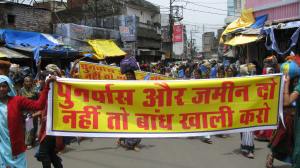
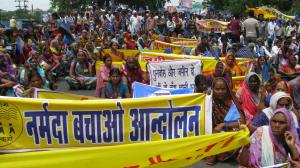
Thousands of oustees affected by the Indira Sagar, Omkareshwar, Maheshwar, Upper Beda and Man dam demonstrated in capital city Bhopal today and began their Satyagrah. Despite continuous rain in the entire Narmada valley, over 8000 men and women displaced persons have reached Bhopal to camp here for the next 5 days. The affected people demand that all the oustees of these dams should be rehabilitated and resettled with land and all other entitlements, and the injustice being wreaked on them for decades be stopped. Shri Alok Agarwal, senior activist of the Narmada Bacahao Andolan along with 4 men and women oustees have started their fast for 5 days in this “Narmada Jeevan Adhikar Satyagraha and Upwaas”.
This is a guest post by Rukmini Sen The Madras High Court on 17th June 2013 has delivered a judgment where it unambiguously states that ‘the main legal aspect for a valid marriage is consummation’ (pg 13). Consummation of a marriage, in many traditions and statutes of civil or religious law, is the first (or first officially credited) act of sexual intercoursebetween two people, either following their marriage to each other or after a prolonged sexual attraction. Its legal significance arises from theories of marriage as having the purpose of producing legally recognized descendants of the partners, or of providing sanction to their sexual acts together, or both(last accessed 22nd June 2013). In a country like India, where Section 377 of the Indian Penal Code still exists (although decriminalization of consensual sexual acts between two adults in private has been declared by the Delhi High Court in 2008), what constitutes the status of consummation in a gay/lesbian union or when two heterosexual adults live together, when the legal significance of consummation is connected only with giving birth to a ‘legitimate’ child? What about relationships where there are willfully no children, biological, adopted or surrogate? This is one of the many questions that this judgment raises and leaves me more bewildered about my legal identity as a cohabiting partner in a heterosexual relationship.
This guest post by TAMER SÖYLER is the second of a three-part series on Istanbul’s Taksim Square protests for Kafila.
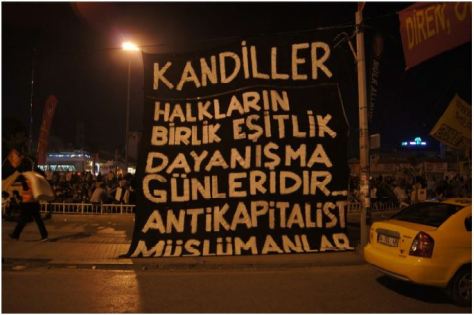
“Kandils are the times for equality, unity and solidarity – Anti-capitalist Muslims,” this banner reads. Kandil refers to the celebration of one of the five Islamic holy nights. While Erdoğan was accusing the protestors to be drinking beer and having some kind of a youth festival, anti-capitalist Muslims who were against the Taksim project from the very early on, wanted to give their support to the protestors. It was an interesting thing to witness. Socialists and communists were creating space for the members of the Anti-capitalist Muslims to perform a public prayer in the square. Clearly,the Taksim protests were not about secular vs. religious.
The first part of this commentary argued that as a part of his political strategy early Erdoğan had embraced a kaleidoscopic approach in governance by including various perspectives coming from citizens situated in different milieus. Erdoğan had given the impression to the citizens that his government was willing to hear the views of the citizens situated in all kinds of milieus. A simple strategy of inclusion proved to be extremely efficient for Erdoğan. Citizens who were not ideologically close to Erdoğan were quick to feel flattered by the symbolic gesture and did not hesitate to support Erdoğan.Continue reading For Erdoğan, you are with him or against him: Tamer Söyler→




 KAFILA - COLLECTIVE EXPLORATIONS SINCE 2006