Category Archives: Debates

A Modest Proposal from EFLU Students, Hyderabad: Anonymous

Anonymous Guest Post

[This is a response to the recent political developments in the English and Foreign Languages University, Hyderabad. On 1nd March, 2013, Mudasir Kamran, a Kashmiri Muslim PhD scholar of the university was taken to the police station by the Proctor and some other professors of the university in pretext of a personal enmity between Mudasir and his erstwhile room-mate, where he was detained throughout the night without any written complaint being filed. Mudasir came back broken, asking why he was treated like a thief and a criminal. On 2nd March, he committed suicide. A section of the students since then has been demanding for the suspension of the Proctor, an apology from the university, and compensation to the family. The university administration dealt with this in a fiercely draconian manner. They refused to meet the students, they enforced police protection, they threatened a null semester, even a total shut-down of the university. They did not issue a single apology, they appeared in front of media and produced false versions of the events hand in glove with the police (that was subsequently refuted by the alleged eye-witnesses), they constituted a faculty-only Fact-Finding Committee without removing the accused from his administrative position. Rumours have been floated about the alleged homosexuality and the mental instability, thus inciting the cultural stereotype of social aberration and criminality. One unofficially Leftist section alleged that the students are spreading rumours and contacting their “Kashmiri friends” to ignite the fire of unrest in Kashmir (although there has been and still is no connection between student’s demand and what is happening in Kashmir). On 8th March, they finally succeeded in coercing the students enough to make them ask for a resumption of normalcy on the campus. The Vice-Chancellor has threatened that any political activity on the campus will result in a null semester. She has ensured that classes will commence under heavy ‘police protection’ on Monday. A section of the teachers who has refused to accept the responsibility for Mudasir’s unfortunate death has demanded for criminal cases to be filed against the protesting students. Since the protesting side has been majorly comprised of dalits, OBCs, minorities, this is an attempt from their side to allegorically (and satirically, in the tradition of Jonathan Swift who once wrote his ‘modest proposal’ that the British landed aristocracy simply eat Irish children as a way to end the problem of poverty in Ireland) express some of the horrors they have to go through to even stage a basic minimum democratic protest in a so-called elite university.]

[This text has been slightly edited and modified, mainly to allow for easier reading, and to correct a few syntactical slips, but the general tone and style, including capitalization and some archaisms have been maintained so that it is clear that this is a legitimate work of satire, written in the public interest. Kafila]

​​A MODEST PROPOSAL FOR PREVENTING THE DALITS, MINORITIES, AND IN GENERAL THE POOR AND THE MARGINALIZED FROM BEING A BURDEN ON THE GLORY OF THE ENGLISH AND FOREIGN LANGUAGES UNIVERSITY, HYDERABAD AND FOR MAKING THEM BENEFICIAL TO THE UNIVERSITY.

Continue reading A Modest Proposal from EFLU Students, Hyderabad: Anonymous

Some Urgent Considerations on Genetically Modified Crops and Food Security: Neha Saigal

This is a guest post by NEHA SAIGAL: The Budget Session is upon us and we might be witness to one of UPA’s most ambitious flagship programmes, the National Food Security Bill (NFSB), becoming a reality. So it seems like Food Security is the flavour of this session with President, Mr Pranab Mukherjee, reiterating UPA 2’s commitment to food security in his maiden speech at the start of the Budget Session.

But this commitment comes under serious question when one of the responsible agencies of the Government dilutes the issue of food security and further misleads the debate on an important issue like hunger and malnutrition. I am referring to the Ministry of Agriculture (MoA) under Sharad Pawar mindlessly promoting GM crops as a solution to food security. Continue reading Some Urgent Considerations on Genetically Modified Crops and Food Security: Neha Saigal

Leaping Across a Troubled History – Launch of Pratiman

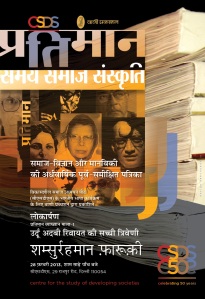
Poster of the launch event  for Pratiman
Poster of the launch event for Pratiman

A new research journal in Hindi, Pratiman – Samay, Samaj, Sanskriti, was launched on 28 February 2013, at the Centre for the Study of Developing Societies, Delhi. The occasion was historic in many ways. Given the long and troubled history of the great language divide between Hindi and Urdu and the lost traditions of Hindustani, the fact that the launch was marked by a public lecture by noted Urdu scholar-poet Shamsur Rahman Faruqi cannot but be anything but historic. There is a certain impertinence and perhaps even insolence, in the move to leap across that history of over a century and a quarter, in complete disregard of the custodians of purity on both sides, in the insistence that language is not what the custodians make of it but what lives in the world of creativity and exchange.

It was only befitting of this occasion that Faruqi chose to speak on “Urdu Adabi Ravayat ki Sachchi Triveni.” In what turned out to be a remarkable and breathtaking tour de force, Faruqi turned his scholarly apparatus to the task of dissecting the Urdu poetic and aesthetic tradition in a manner that revealed its three currents (the ‘triveni’) – namely, Arabi, Persian and Sanskrit.Through the metaphor of the Triveni at Allahabad, where the Ganga and Yamuna meet the third river Saraswati, which is invisible but nonetheless ‘present’, Faruqi too perhaps wanted to stress the significance of the third but invisible current of Sanskrit poetics.

Continue reading Leaping Across a Troubled History – Launch of Pratiman

The sickening political opportunism of Chetan Bhagat

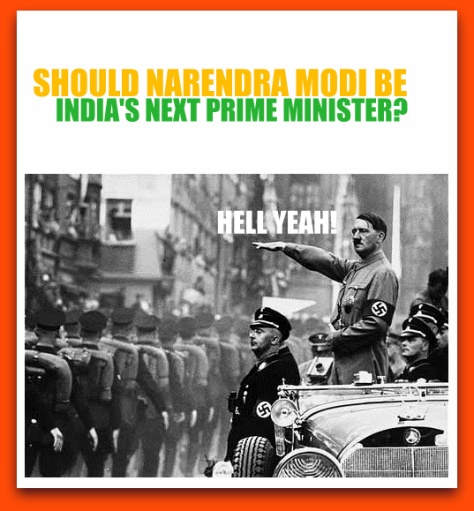
modi-chetan-bhagat

Snigdha Poonam watches Kai Po Che, whose script was written by Chetan Bhagat, based on his book The Three Mistakes of My Life:

In the film adaptation, Mr. Bhagat has also added what seems like justification for some Hindus to turn violent, like the death by burning of both of the parents of one of the three protagonists in the Sabarmati Express; in the novel, it was his nephew. We all know the level of vengeance with which Bollywood heroes respond to the targeting of their mothers: “Teri maa mari hai kya (Is it your mother who has died?),” the bereaved son explodes at a sensible friend trying to stop him from losing control of himself.

In his book, Mr. Bhagat clearly showed the 2002 riots as a state-sanctioned exercise (“Whatever it takes to quench the hurt feelings,” says a “senior Hindu Party leader”). But he excised that from the film completely. [Read]

That image above is via DeshGujarat.com, where an article quotes Bhagat as saying in a TV debate:

“It has been discussed much that Modi ji has done well in Gujarat, but what I believe is that he is a very good politician. A politician has to change with public mood. When communal issue mood was there in the country, that was Modi version 1, when he elected for the first time. And when he won the election for second time, he won it on development agenda.”

Clearly, Mr Chetan Bhagat is also a good politician.

The colonial legacy of capital punishment

G Mohan Gopal writes:

The British and their collaborators had made a similar mistake. They thought that the common people of India would be deterred and cowed down by the violence of the state. A young scholar from Columbia recently shared with me data collected from the National Archives showing that the British were hanging on average three people daily in the 1920s in a desperate bid to frighten Indians into obeying British rule. We know how that ended. The government should know how this will end too. [Frontline]

And Fahad Shah meets Maqbool Butt’s mother:

“Both Maqbool sahib and Guru sahib were innocent and on the right path. India thinks that this freedom movement will stop but it won’t stop. It will continue. There are so many Maqbools in Kashmir” [The Kashmir Walla]


On Ram Setu: ‘Mahakaal ka ling kiya hain?’

The Government of India again seems to be in the mood of going ahead with the Sethusamudram Shipping Canal Project that would reduce travel time for ships around coastal Tamil Nadu and Sri Lanka, and bring economic advantages to both countries. The project involves breaking limestone shoals that some regard to be the remains of the mythological Ram Setu. The controversy is an old one. In 2007, I had interviewed Hindutva ideologue Bharatendu Prakash Singhal, who was particularly vocal against the ‘destruction’ of the limestone shoals. Singhal is a former Rajya Sabha MP and a retired Indian Police Service officer. The bits from the interview that were directly about the Ram Setu controversy had appeared in Tehelka, but Singhal was more interested in talking about “mind, body and soul” than about Ram Setu. Here are the unpublished bits – though I had put them on my blog back then. Every word was transcribed faithfully from the recorded audio. Continue reading On Ram Setu: ‘Mahakaal ka ling kiya hain?’

Shahbagh: The Forest of Symbols: Naeem Mohaiemen

This is a guest post by NAEEM MOHAIEMEN

Shahbagh_SyedLatifHossain
© Syed Latif Hossain

There is a particular way of lensing mass movements, when we are observing from within immediate tactics. In a fast moving situation, with opponents and allies squared off, the first thing to shrink is the space for internal critique. Professor Azfar Hussain uses the term “critical solidarity” for his approach to Shahbagh. A critique that seeks to help the movement, but also a critique some are not ready to hear yet.

For the last sixteen days, Bangladesh has been in an intense new political phase. The ground has shifted and been recast by the scale of the Shahbagh movement. The flash point was the sentencing of the “Butcher of Mirpur” (a war criminal who collaborated with the Pakistan army in 1971). But, by now, the demands have expanded to a call for a ban on the main Islamist party Jamaat-e-Islami, or even Islamist politics altogether. Older leftist thinkers like Badruddin Umar are daring to ask questions of the hallowed place of “state religion” in the constitution. Younger bloggers are urging all to make it clear that the movement is about war criminals, not religion. But of course, with war criminals conflated with the Jamaat-e-Islami, and that party eager to present themselves as standing for “Islam,” category errors will happen. Continue reading Shahbagh: The Forest of Symbols: Naeem Mohaiemen

People’s Watch Over Parliament: Bekhauf Azadi Campaign

20130220-235633.jpg

  • Protestors at the ‘Freedom Parade’ Rally of the Bekhauf Azadi Campaign, New Delhi, 26 January, 2013

Guest Post by Bekhauf Azadi (Freedom Without Fear) Campaign.

People’s Watch Over Parliament: February 21, 1st Day of the Budget Session, Jantar Mantar
Gather in large numbers – 12 PM onwards at Jantar Mantar, New Delhi.
Are Our Lawmakers Ready to Listen to the Voice of the Movement Against Sexual Violence?

Continue reading People’s Watch Over Parliament: Bekhauf Azadi Campaign

Why India Needs the Death Penalty

poltu-hangman-gandhi-india

So, The Law has been taking its Own Course, without any help from the political bankruptcy of the Kangress party. The Law took its Own Course and hanged Ajmal Kasab before a Parliament session and co-incidentally Afzal Guru before another Parliament session. The Law’s Own Course is stranger than the river Kosi which changes direction at will (actually, even the Kosi river changes directions because of corruption in the unnecessary embankments the Bihar government builds). Continue reading Why India Needs the Death Penalty

Capital Punishment – An Agenda for Abolition: Yug Mohit Chaudhry

This is (a slightly modified) text of the second Shahid Azmi Memorial Lecture, delivered at the Indian Law Institute on 9 February 2013 by advocate YUG MOHIT CHAUDHRY. The lecture and its topic had been scheduled days in advance, but co-incidentally, Mohd. Afzal Guru was hanged in the morning of the day of the lecture. The Shahid Azmi Memorial Lecture has been instituted by his friends, comrades and students, who want to keep alive the memory of his inspiring work. Advocate was shot dead in his office on 11 February 2010, at the age of 32. At the time of his murder, Shahid was fighting several terrorism cases, including of those falsely accused in the Malegaon blasts and the 26/11 Mumbai attacks.You can read tributes to Shahid Azmi in Kafila archives by Mahtab Alam, Arvind Narrain and Saumya Una, and Susan Abraham.

In Furman v. Georgia (1972), where the U.S. Supreme Court struck down the death penalty, Justice Marshall said that if citizens were fully informed about how people are sentenced to death, they would find capital punishment shocking, unjust and unacceptable. However, research on the death penalty and public awareness of the exact nature of the death penalty have been the most neglected areas in the abolition campaign in India. The last three challenges to the constitutionality of the death penalty in India were rejected by the Supreme Court, inter alia, on the grounds that there is no empirical data to support the abolitionists’ claims. Unfortunately, the situation has not changed at all, and even now there is hardly any research on this subject. Therefore, the highest priority in any abolition campaign is to produce empirical research on the death penalty. That, and doing our utmost to stop each proposed execution and, failing that, to make it as difficult as possible for the state to carry out an execution, adopting all legal, political and social means at our disposal.   Continue reading Capital Punishment – An Agenda for Abolition: Yug Mohit Chaudhry

Who’s afraid of the Karachi Literature Festival?: Ayesha Siddiqa

Guest post by AYESHA SIDDIQA

Photo via Dawn.com

Here we are seemingly in an age of intellectual freedom, burgeoning media industry and literature festivals. There are numerous festivals held all over South Asia celebrating books new and old, bringing people together for exchange of ideas. But these festivals seem to be wrapped in their own politics. In some cases, certain cliques that want to encourage a peculiar perspective dominate the show. I understood this through my interaction with the Karachi Literature Festival. Continue reading Who’s afraid of the Karachi Literature Festival?: Ayesha Siddiqa

Raining Rape-Speech in Kerala

It is hardly news in Kerala by now that its been raining misogynists, rape-talkers, and swollen-rotten masculine egos in these early days of 2013. The PJ Kurien controversy has been a trigger of course. But I am astounded at the collective frenzy of Congress stalwarts. Kerala today is like a coconut garden taken over by a bunch of supremely drunken … well .. simians. Here we are, helplessly watching the tipsy horde ascend the fruit-laden coconut palms, pulling down ripe fruit and raw ones, tender leaves and drying ones, with  nary a care for all of us down here! Everyone, from senior leaders,  many insecure dumb ass-males on FB and Youtube, to minor lawyers in small-town courts with sadly dessicated minds but hugely swollen male-egos, to elected MLAs on the floor of the Kerala State Assembly, and judges whose guardian-angelic misogynist aura glints a bit more menacingly in private conversations,each of them seem to be up their own coconut tree throwing down various half-witted, asinine comments,venting their immense distrust of women who don’t fit into the homely-comely-motherly stereotype. Continue reading Raining Rape-Speech in Kerala

‘Death penalty in India is a legal lottery’

Justice Ajit Shah says that it has been proven beyond doubt that death sentence does not serve as a deterrent against crime; the reason why two third of the world has abolished it all together. He explains the bizarre nature of how the death sentence in India is judge centric and how under the same set of circumstances, some have received the death sentence, while others have been given life and still others acquitted. Death sentence is judge centric with many judges having a history of doling out death penalties and other being kind. Death sentence is thus nothing but a ‘legal lottery’ where if you are lucky you get a lenient judge you survive, else you end up at the gallows. He talks about the caste and class connection to death sentence, where the lower castes and lower classes are usually the ones sent to the gallows because they cannot afford proper legal aid. He says that this discriminatory nature renders death penalty unconstitutional and that there is the need for a larger debate on the same.  Continue reading ‘Death penalty in India is a legal lottery’

Death Penalty – an agenda for abolition: Yug Mohit Chaudhry

This is the audio of the Shahid Azmi Memorial Lecture delivered on 9 February 2013 by YUG MOHIT CHAUDHRY at the Indian Law Institute in Delhi. While the lecture date and topic – death penalty – were scheduled weeks in advance, it co-incidentally happened that Mohd Afzal Guru was hanged on the morning of the lecture. Shahid Azmi was a lawyer in Mumbai. He was 32 when he was shot dead on 11 February 2010.

On Shahid Azmi from Kafila archives:

Previously in Kafila by Yug Mohit Chaudhry:

See also:

More on Afzal Guru from Kafila archives:

Why the Delhi rapists should not be hanged

The shameless and cynical Manmohan Singh government has found an easy way out to appear strong, deflect attention from its failures and save itself from the opposition’s questioning. Just hang a death row convict before every Parliament session! It is very likely that if the 16 December Delhi rape-and-murder accused are placed on death row by this time next year, the UPA government will hang them just in time for the 2014 general elections.

I am opposed to death penalty in principle, and there are good reasons why so many democracies have abolished death penalty. But even if you do not agree that death penalty should be abolished, please consider why it should not be applied to the five accused in this case.

About a month ago I visited the Ravi Das “camp”, a slum colony near RK Puram where four of the six accused lived. I met the mother of one of them. Champa Devi’s son Vinay Sharma was the first to plead guilty and say he should be hanged; his father agreed on television. Continue reading Why the Delhi rapists should not be hanged

Lessons from Delhi and Dhaka: Nagesh Rao and Navine Murshid

Guest post by NAGESH RAO and NAVINE MURSHID

Photo credit: AFP/Getty Images

In the early hours of Saturday morning, a secret execution was carried out by the Indian government. Afzal Guru, a Kashmiri, was put to death for his alleged involvement in the 2001 attack on the Indian Parliament. Afzal’s family in Kashmir were cruelly denied a last visitation. They were informed that the Indian President had rejected his mercy petition, and of his imminent execution, by mail—the letter reached Afzal’s wife Tabassum two days after he was executed and buried in an unmarked grave inside Tihar Jail.

Meanwhile, across the border in Bangladesh, hundreds of thousands of Bangladeshis from all walks of life have occupied Shahbag Square near Dhaka University, outraged that a notorious war criminal might walk free after having been spared the death penalty by the Bangladeshi International War Crimes Tribunal. Abdul Quader Mollah, leader of the right-wing Islamist party Jamaat-i-Islami, and convicted of multiple counts of rape, torture and murder, was photographed flashing a victory sign as he left the court. Continue reading Lessons from Delhi and Dhaka: Nagesh Rao and Navine Murshid

What Afzal Deserves: Chandan Gomes

20130212-185109.jpg

Guest post by CHANDAN GOMES

Ever since the news of Afzal Guru’s execution broke out on the 9th, I have witnessed my personal space descend into a state of chaos. I woke up that morning to a number of emails/facebook messages by friends requesting me to join them at Jantar Mantar to protest against Guru’s execution. Many called that particular protest farcical, some even going to the extent of labelling these young men and women as traitors. Battle lines were drawn and a country stood divided. The more I thought about the execution, the more it saddened me. I could see myself and people like me (the ordinary citizens of this great nation) as pawns in a game of ugly power play, waiting to be sacrificed at the altar of ‘opportune moment’. Continue reading What Afzal Deserves: Chandan Gomes

राष्ट्रवादी न्याय से करुणा की विदाई

“अगर हम ‘लोकतांत्रिक सरकारों के छिपे इरादों और गैरजवाबदेह खुफिया शक्ति संरचनाओं की जांच करने और उन पर सवाल उठाने से इनकार करते हैं तो हम लोकतंत्र और मानवता, दोनों को ही खो बैठते हैं.” पत्रकार जॉन पिल्जर का यह वाक्य आज हमारे लिए कितना प्रासंगिक हो उठा है! हमें नौ जनवरी को खुफिया तरीके से अफज़ल गुरु को दी गयी फांसी के अभिप्राय को समझना ही होगा. काम कठिन है क्योंकि इसे लाकर न सिर्फ़ प्रायः सभी संसदीय राजनीतिक दल एकमत हैं बल्कि आम तौर पर देश की जनता भी इसे देर से की गई सही कार्रवाई समझती है.

नौ जनवरी के दिन के वृहत्तर आशय छह दिसम्बर जैसी तारीख से कम गंभीर नहीं क्योंकि इस रोज़ भारतीय राज्य ने गांधी और टैगोर की विरासत का हक खो दिया है.अगर अब तक यह साबित नहीं था तो अब हो गया है कि भारत की ‘संसदीय लोकतांत्रिक राजनीति’ का मुहावरा उग्र और कठोर राष्ट्रवाद का है. और राजनीतिक दलों में इस भाषा में महारत हासिल करने की होड़ सी लग गयी है.

Continue reading राष्ट्रवादी न्याय से करुणा की विदाई

Afzal Guru’s story – in his own words

Via Hindustantimes.com

Guru wrote in a letter in 2004:

In the Parliament attack case I was entrapped by Special Task Force of Kashmir. Here in Delhi the designated court sentenced me to death on the basis of special police version which works in nexus with STF, and also came under the influence of mass media in which I was made to accept the crime under duress and threat by special police ACP. Rajbir Singh. That threat even get confirmed to designated court by T.V. interviewer (Shams Tahir Aaj-Tak).

[…]

Special police told me that if I will speak according to their wishes they will not harm my family members and also gave me false assurance that they will make my case weak so that after sometime I will get released. Continue reading Afzal Guru’s story – in his own words

When women ask for it: Veena Venugopal

Guest post by VEENA VENUGOPAL

To me, the most memorable scene in Dev D is the one where Paro takes a mattress from home and ties it to her cycle. When she reaches the edge of the field, she abandons the cycle, lifts the mattress on her shoulder and marches to the clearing where she lays it down and waits for her lover. There are no words spoken and the camera holds her face close. Her expression is one of intense seriousness. You can see her desire is a field force of intensity that fuels every step. She is determined to see it through, to let that desire take over herself completely; not surrender to it but to let it explode out of her. You know that when she meets Dev, the sex would be passionate and powerful.  And yet, in the south Delhi multiplex where I was watching the film, most of the audience burst into rapacious laughter. The women smiled embarrassedly at each other. Which made me wonder, why is female desire a laughing matter? Continue reading When women ask for it: Veena Venugopal

The Day Afzal Died: Nirmalangshu Mukherji

Guest post by NIRMALANGSHU MUKHERJI

There are days in which streaks of hope shine through dark clouds of misery. The 9th of February, 2013, was such a day.

The day broke with the news that the noose of the Indian state had finally seized the throat of Mohammad Afzal Guru after years of careful conspiracy. With ill-concealed admiration, the television screens reported the military swiftness, the secrecy, and the perfection with which a nuclear-powered state with one of the largest armies in the world escorted an unarmed, hapless Kashmiri to the gallows, performed its rituals, and pulled the bolt. As the murder was officially videographed with full legal sanction, the body was kept dangling for thirty minutes before it was pulled down and immediately buried in an ‘unmarked’ grave, protected by layers and layers of impenetrable walls. The case of Afzal Guru was thus brought to a ‘closure’. So hoped the state. Continue reading The Day Afzal Died: Nirmalangshu Mukherji