Category Archives: Education

Bring Back Najeeb Ahmed to JNU: A Call to Resist Terror in Universities

14615765_679911288839993_8711625822412574391_o-1

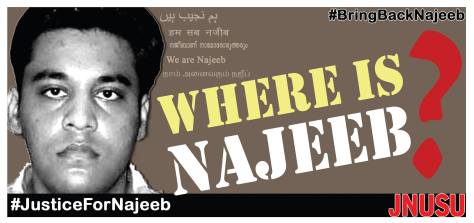
It is now more than a week since Najeeb Ahmed, an MSc (first year) student of Biotechnology at Jawaharlal Nehru University, Delhi has been reported missing, after an altercation with members of the RSS affiliated ABVP student organization, which reportedly left him injured and severely traumatized.

Continue reading Bring Back Najeeb Ahmed to JNU: A Call to Resist Terror in Universities →

Academics’ Letter to the VC, Central University of Haryana Regarding the ‘Draupadi’ Affair

Following is the text of a letter to the Vice Chancellor, Central University of Haryana, sent by some academics protesting the attacks on Dr Snehsata Manav and Dr Manoj Kumar regarding the students’ production of the play ‘Draupadi’:
To the Vice Chancellor,
Central University of Haryana
Dear Vice Chancellor:
We write in support of Dr. Snehsata Manav and Dr. Manoj Kumar of the Department of English and Foreign Languages who have recently come under attack for their sponsorship of a student production on your campus of the play “Draupadi” based on a story by Mahasweta Devi who, as you know, is universally recognized as a towering figure in contemporary Indian literature. Her writings, translated into most Indian languages, have highlighted the struggles of oppressed and marginalized women and men. Her story “Draupadi”, whose dramatized version has been highly acclaimed and performed all over India, deals with the sensitive but enormously important question of the ethics of deploying the armed forces in dealing with civil disturbances within the country. This question, along with specific instances of rapes committed by army personnel in different parts of India, continues to be debated in the Indian public media and has engaged the attention of political leaders as well as the courts.
We strongly believe that it is both unjust and unwise to accuse intellectually responsible teachers of hurting the sentiments of some sections of opinion. The recent demise of Mahasweta Devi was a perfect occasion to engage university students in a serious discussion on why some of the greatest writers and artists of India have been concerned about the excesses of state violence carried out at the behest of those in power, no matter what their party or ideology.
We hope you will convey our views to those who have accused Dr. Manav and Dr. Kumar of being hurtful and unpatriotic. The university campus needs to be fostered as a place where difficult questions can be debated in a spirit of intellectual openness and without fear of censure.
Sincerely,
Gayatri Chakravorty Spivak, University Professor in the Humanities, Columbia University, New York
Akeel Bilgrami, Stanley Morgenbesser Professor of Philosophy, Columbia University, New York
Gauri Viswanathan, Professor of English and Comparative Literature, Columbia University, New York
Partha Chatterjee, Professor of anthropology, Columbia University, New York
Romila Thapar, Professor Emeritus in History, Jawaharlal Nehru University, New Delhi
Ramachandra Guha, author, Bengaluru

Continue reading Academics’ Letter to the VC, Central University of Haryana Regarding the ‘Draupadi’ Affair →

International Scholars Condemn the Attack on Faculty and Students of Central University of Haryana

Over 70 UK and Europe-based scholars concerned with South Asia have written a letter to the Vice Chancellor of the Central University of Haryana. They have condemned the September 21, 2016 attack on a group of staff and students of CUH who were involved in putting together a performance based on the award-winning writer Mahasweta Devi’s acclaimed short story “Draupadi”. The attack and threats of charges of sedition against those involved in the performance were instigated by the BJP-affiliated student group ABVP as well as by the local press, which has falsely and maliciously spread the view that the play is anti-national and represented an attack on Indian soldiers. The letter appeals to the Vice Chancellor of CUH to protect the freedom of expression of the university’s staff and students, and to encourage the democratic exchange of ideas through means of debate and discussion.


Dear Vice-Chancellor Mahendra Pal Singh,

We, the undersigned, strongly condemn the attack on faculty members and students of the Department of English and Foreign Literatures at your university by members of the Akhil Bhartiya Vidyarthi Parishad (ABVP) for the performance of a play on 21 September 2016. The play was based on a short story by the eminent Bengali writer Mahasweta Devi. We understand that the staff and students involved in the performance had sought and received all necessary permissions for the event, which was organized to commemorate the literary achievements of Mahasweta Devi, the recipient of some of the most prestigious Indian and international awards.

We write to express our serious concern over this attack on the freedom of academic expression of the staff and students at your university. Mahasweta Devi’s story “Draupadi” was written in 1971 and represents her creative expression of the exploitation of India’s tribals.  It is regularly taught as part of course syllabi all over India and the world, including at the universities of some of the signatories to this letter. The claim by the ABVP and the local press that the play is an attack on Indian soldiers is manifestly fabricated. As one of the faculty members involved in the production, Dr Snehsata, has explained, students and teachers saw the programme as an academic and creative pursuit and their intention was certainly not to hurt the sentiments of soldiers as the ABVP has claimed: “In this event, I read the epilogue of the play recounting the data about atrocities on tribal people, especially sexual crimes against women by the Indian army. How ordinary soldiers are used by the state as a tool against its own people and how the body, especially the female body, becomes the site of revenge in the hands of Indian soldiers by the same state. All the teachers and students who were present there came up and congratulated us.”

Continue reading International Scholars Condemn the Attack on Faculty and Students of Central University of Haryana →

The Orphaning of ‘Women’s Collective Interests’ in Kerala


There is considerable outrage in Kerala about how the accused in the murder of the young woman worker Soumya in 2011 has slipped the noose at the Supreme Court. There is considerable doubt remaining on how the murder of the young dalit woman student Jisha was handled by the present government. In both cases, the accused are not men who would earn the sympathy of the Malayali middle-class – in one case, a tamil homeless man, and in the other, a Muslim migrant worker. Not surprisingly, the cry for their blood has been particularly shrill. Outrage at the Supreme Court’s refusal to endorse the lower court’s judgment in the first case is particularly striking – not only because of its loudness, but also because one is unable to forget the Suryanelli case. The difference between the present cases and the Suryanelli case is that in the latter, the victim has been condemned to living death, though she has persistently fought to be heard as a survivor of the most horrific violence. Yet her pleas that the powerful Malayali politician P J Kurien be also tried never roused the kind of outrage was have heard recently. It appears that the Malayali public is kinder to dead violated women than women who survive violation; it also seems harsher towards abjected males than to .powerful males who occupy the pedestal of elite masculinity. Continue reading The Orphaning of ‘Women’s Collective Interests’ in Kerala →

Self and Other : Indus Chadha

This is a guest post by INDUS CHADHA

The summer that I was 5-years-old, I took my first flight alone because I wanted to spend my holidays with my grandparents. My parents prepared me well—they even read aloud and recorded my favourite stories on an audio cassette which we put into our Walkman for my long solo journey. But there was one question they neglected to answer. “What should I do if the flight crashes?” I had asked. “It won’t…” they had brushed my question away. So when the flight attendant came out into the aisle and announced that one of our engines had failed and we would have to turn back to our point of origin to make an emergency landing—I wondered what I should do.

A man a few rows ahead of me got up from his seat and started shouting at the flight attendant. He was obviously afraid and seemed to hope oddly that he could frighten some comfort out of her. I remember him saying over and over again that he had a young child with him on the flight and that made me conscious of both the gravity of the situation and the fact that I was so young and all alone. I felt tears start to well up in my throat and took small sips of my orange juice to wash down the urge to cry. And then, out of the blue, the young man sitting beside me started talking to me. He asked me what I was studying at school and when I told him our theme for the last term had been pirates he exclaimed that he was a ‘shippie’ and knew all about them.

Continue reading Self and Other : Indus Chadha →

Historic Delhi High Court Judgement Dismisses Publishers’ Copyright Infringement Petition

In its much awaited judgment in the Delhi University photocopying case (The Chancellor Masters and Scholars of the University of Oxford v. Rameshwari Photocopy Services), the Delhi High Court has dismissed the copyright infringement petition initiated in August 2012 by three publishers (Oxford, Cambridge and Taylor & Francis) against a photocopy shop located in the premises of Delhi University. This case, which was being closely tracked by students, teachers and the publishing industry alike, was seen as one with immense significance for questions of access to knowledge. While initially involving only the publishers, the photocopier and the university, the case also saw intervention petitions being filed by a student group (Association of Students for Equitable Access to Knowledge) as well as by teachers and academics (Society for Promoting Educational Access and Knowledge). While the publishers made the argument that the creation of course packs and the photocopying of academic material for the same amounted to an infringement of the exclusive copyright of the authors and publishers, the defendants argued that the reproduction of materials for educational purposes fell within the exceptions to copyright under Section 52(1)(i) of the Copyright Act.

Not a moral right

In his considered and sharply reasoned judgment, Justice Rajiv Sahai Endlaw examines the gamut of arguments made by both sides and arrives at the conclusion that copyright is a statutory right and not a natural right, and hence any right that is granted to owners is also limited by exceptions carved out by law. The nature of Section 52 of the Copyright Act is such that any act falling within its scope will not constitute infringement. Section 52(1)(i) allows for the reproduction of any work i) by a teacher or a pupil in the course of instruction; or ii) as part of the questions to be answered in an examination; or iii) in answers to such questions.

Continue reading Historic Delhi High Court Judgement Dismisses Publishers’ Copyright Infringement Petition →

Victory for Students and Access to Knowledge in DU Copyright Case :ASEAK

Guest Statement by Association of Students for Equitable Access to Knowledge (ASEAK)

Victory for Students and Access to Knowledge in DU Copyright Case : Corporate Publishers Market ends at the gates of the University

In a rare and incredible order today, the Delhi High Court has dismissed the copyright infringement case filed by Oxford University Press, Cambridge University Press and Taylor and Francis (Routledge) against Rameshwari Photocopy Shop in Delhi School of Economics and Delhi University. Justice R.S Endlaw in a 94 pages long judgment interpreted educational exception under section 52(1)(i) of the copyright act in broad enough manner to cover the acts of photocopying.

The publishers sought to claim damages to the tune of 60 lakh rupees from the shop citing infringement of copyright which the publishers claimed was happening through photocopying of parts of books published by them. However, the publishers themselves stated that this case, for them, was a test case where they wanted to introduce licensing systems across universities in India. These licensing systems intended to control the extent to which material could be photocopied and also direct a share of profit from these reproductions to the publishers. We, the Association of Students for Equitable Access to Knowledge (ASEAK) demanded to be made a defendant in this case as we believed that it is the rights of students to access reading material that was at stake in this case- “Association of Students for Equitable Access to Knowledge (ASEAK) filed IA No.3454/2013 for impleadment in the present suit and which was allowed vide order dated 1st March, 2013 and ASEAK impleaded as defendant No.3.” (from the judgment). Continue reading Victory for Students and Access to Knowledge in DU Copyright Case :ASEAK →

ABVP and Dalit upsurge: Jatin Goraiya

Guest Post by JATIN GORAIYA who recently resigned from the post of Vice President of ABVP JNU unit. 

Read also his interview to The Telegraph here.

Jatin sent this statement to Kafila, which we publish here in full.

The right wing in our country is keen to strengthen the model of Hindutva fascism in India which is jeopardising the secular fabric of this country. This model of Hindutva fascism is based on a narrow, conservative sense of nation which tends to exclude a major population of dalits, adivasis, muslims and women. This imagination necessarily feeds on this idea of exclusion, the propagators of  RSS and Sangh ideology would never be able to sustain their dominance if they render equal status to Dalits, Adivasis, Muslims and women in this country. Hierarchy and inequality is the basic minimum to keep them in power. At the same time they are trying to inculcate and justify a particular kind of idea of nation and nationalism in people around the country. The BJP has not been able to do any good as far as the rhetoric of development is concerned, so the alternative strategy is to sway people in the name of nationalism and religion. Ideologically they are aware of their hollowness and bankruptcy, so the idea now is to mobilise people in the name of sentimental and unreasonable matters. For example they provide an ideological backup to the Manusmiriti, where women are seen as objects of seduction and are to remain under the feet of men all their lives no matter how brutal he is. Dalits are supposed to serve the upper castes and should be given inhuman punishments if they don’t comply. Following this kind of  mindset, they tend to keep the caste and gender hierarchies and divisions intact, while paying lip service to social justice.

Continue reading ABVP and Dalit upsurge: Jatin Goraiya →

Statement Of JNU Faculty On Incident Of Sexual Violence On Campus

We, the undersigned faculty members of JNU, express deep shock and dismay at the news that a complaint of rape has been lodged against a JNU student Anmol Ratan (an activist of a left students organisation but since then expelled from it), by another student of JNU. We express our support and solidarity for the complainant and request the JNU community, the administration, and the GSCASH to ensure that the due process of law is allowed to proceed without any hindrance.

It is of primary importance that the health and safety of the complainant be at the centre of all that the university community and the JNU administration does. This necessitates swift action to ensure that the accused (or those acting on his behalf) do not have any opportunity to intimidate, slander, or harm the complainant or the complainant’s witnesses, tamper with evidence or testimony, or otherwise create a campus environment that indulges in victim blaming or casting aspersions on the motives of the complainant.

We are therefore extremely dismayed to know that more than 48 hours after the complaint has been lodged, the accused has yet to be suspended or declared out of bounds from the university, so that safe conditions of complaint and testimony for the complainant may be maintained. We demand that this be done forthwith. This failure to act has tarnished the image of the JNU administration quite severely.

We also recognize the manner in which over the decades, teachers and students have made JNU a space in which women generally feel safe, and also empowered to report cases of sexual violence when these occur. This atmosphere however, has been caricatured in the recent past by sections of the media and by right-wing individuals as one of irresponsible sexual license, which the JNU administration has done nothing to counter.

We are dismayed also by the instrumental use of this case by some organizations on campus to further their political ambitions.

The JNU administration must undertake to cover all medical and legal costs of the complainant. It must fully cooperate with the investigation. So must all other members of the JNU community, as they are likely to have information relevant to the case and conduct of the accused.

As JNU faculty, we reiterate our commitment to building a campus that is safe, democratic, secular and mindful of the dignity of all sections of our community.

 Signed:

Mohan Rao

Rohit

Ayesha Kidwai

Nivedita Menon

Madhu Sahni

Ranjani Mazumdar

V Sujatha

Ritoo Jerath

Supriya Varma Continue reading Statement Of JNU Faculty On Incident Of Sexual Violence On Campus →

What exactly happened in Jamia Millia Islamia on 13th August? Jamia Millia Islamia Students

Guest Post by Jamia Millia Islamia Students

What exactly happened in Jamia Millia Islamia on 13th August?

The sequence of events:

Just two days before Independence Day, all the hostel residents were informed personally by the administrative authorities to be careful as there may be some raid by IB or CBI or Delhi Police. Students were instructed not to keep any non-resident student in the hostel.

While it is okay to instruct students not to keep any non-resident student in the hostel, what is problematic is the atmosphere of fear that was created among students. Many of the students were told to be careful regarding ‘KASHMIRI STUDENTS’ in particular.

The hostel authorities repeatedly instructed the students not to come out of their rooms and to be careful.

On the 13th of August, at around 3 p.m., two police constables in uniform and around 15-20 officials in plain clothes were seen sitting just outside the hostel gate. Two constables came inside the gate and started having conversation with the guards while around 10 officials were sitting in their cars inside the hostel campus.
Continue reading What exactly happened in Jamia Millia Islamia on 13th August? Jamia Millia Islamia Students →

Open Letter against Raids in Jamia Millia Islamia University Hostels: Protesting Students from Jamia Millia Islamia

Guest Post by Jamia Millia Islamia Students, Delhi

At the stroke of midnight Jamia Students are leading a massive protest against the administration at Jamia Millia Islamia university and while the concerned authorities are no where to be seen. The protests erupted following the intrusion of Delhi police personnals and some unknown people in plainclothes within the hostel premises. The proctor and the provost of Boys hostel who visited the protesting students stated that they had no information about any such “surprise raid” as it is being reported by a section of media. However, the same media reports are categorically mentioning that the Jamia administration says it was a routine exercise. The students who reside in the hostels are contradicting the administrations claim of being in no knowledge of the so-called “surprise raids” as they were warned by their care-takers that there will be a raid or search soon.

The proctor and the Provost along with other university officials came and assured the students that they are writing a letter to the DCP of Delhi police urging him to take cognisance of the matter and inquire into it. The students demand that the university officials shall call a press conference and tell the media that how without their permission the Delhi police entered the hostel premise. The students have vowed not to disperse from the main gate of the university as a mark of protest until the administration acts on the demands of the protesting students.

The students are articulating this incident with the larger attacks by the cohorts of this government and its various institutions upon universities and students. This incident has raised a plethora of question among students of the university. This institution on account of being a minority institution has been a target of this government and the party in power. Why only Jamia comes under the scanner? Why not such “surprise raids” in the premises of Delhi University, Jawaharlal Nehru University, Ambedkar University and scores of private institutions located in the NCR region? What makes Jamia, its hostel and students so suspicious elements that Delhi police needs to intrude into the premise without taking prior permission?
We students of Jamia Millia Islamia do not wish to be misquoted or misrepresented into the media therefore we take the onus upon ourselves to spread our word and request all democratic and progressive forces to stand with us. 
(A copy of this letter has been sent to Kafila, Wire, The Citizen and others)

Statement Against State Violence in Kashmir: Ashoka University Students and Alumni

Guest Post by Ashoka University Students and Alumni

Letter condemning the State Violence in Kashmir

To

The Govt of India. and the Govt. of Jammu and Kashmir.

We, the undersigned—current students, alumni of the Young India Fellowship, and faculty of Ashoka University—write to voice our deepest anguish and grave concern at the violent turn of events in Kashmir in the past few days. The violence perpetrated by the Indian State after the extra-judicial execution(1) of 22-year old Hizbul Mujahideen Commander Burhan Wani (2) is highly condemnable. The Indian Army, Kashmir Police and other task forces have reacted violently with bullets, pellets and lathis in the clashes that erupted after Burhan’s funeral. This was immediately followed by many more protests and demonstrations as part of Kashmiri resistance to the military occupation of Kashmir by the Indian State. In the violent repression of the protests which had a huge ground support (evident from the large attendance to Burhan’s funeral) , 55 civilians (3) have been killed and around 3100 people (4) were severely injured by the pellets(5), lathis and bullets, some of whom have lost their eyesight. We, unequivocally, condemn this brutal use of force by the Indian State in dealing with the protests after the killing of Burhan Wani. Continue reading Statement Against State Violence in Kashmir: Ashoka University Students and Alumni →

Students Protest in JNU Over Rising Civilian Casualties in Kashmir

The number of unarmed civilians killed in instances of firing by the armed forces, police and paramilitaries enforcing the occupation of Kashmir by the Indian state in the latest wave of violence has crossed fifty. Many more have been blinded by pellet guns. Hundreds have been injured and hospitalized. Reports of protests are coming not only from the Kashmir valley, Kargil, Drass and Jammu, but also from many cities in India. From Delhi (where there has been a public protest at Jantar Mantar, a press conference at Gandhi Peace Foundation and a student protest at Jawaharlal Nehru University), from Kolkata, which saw a massive turn out in a public march, from Chennai, from Patna, and from Kochi and Tricky in Kerala.

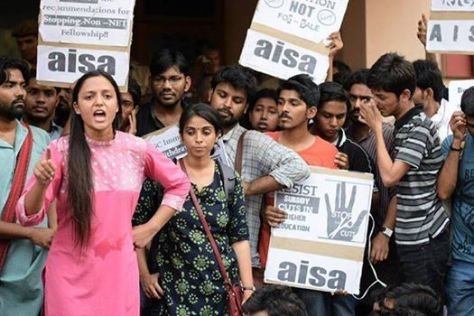
On Friday 22nd July, I went to a night protest march and public gathering by students at Jawaharlal Nehru University, Delhi. The march was called by Shehla Rashid, Vice President, JNUSU and Rama Naga, General Secretary, JNUSU (Both AISA activists) There were perhaps two hundred students gathered peacefully. The march began around 10:00 pm, made its way around the university campus and the protest continued well past midnight. Several student organizations, AISA, BASO, Hundred Flowers, Collective, DSU and individual students participated in the march. Shehla Rashid, Vice President, JNUSU and an AISA student activist, addressed the gathering before the march began, stating clearly, that this was going to be a peaceful expression of the democratic right to protest against the atrocities being enacted by the Indian state on the people of the part of Kashmir that is under Indian occupation. She asked the students to be vigilant in case any disruptive slogans were raised by planted agent-provocateurs. The entire march, and the protest meeting was documented by the students, so as to ensure that no ‘doctored videos’ would raise their ugly digital heads in the days to come. The students raised the demand for freedom for the people of Kashmir, and for people in all parts of South Asia. The slogans connected the realties of the people of Kashmir, the North East, Bastar, Jharkhand, with the experiences of Dalits, Workers, Peasants, Women, Students and Minorities. Slogans were raised against the killings and blindings by pellet guns in Kashmir. against torture, again rape, against draconian acts like AFSPA and PSA. The march made its way through the entire campus and culminated outside Chandrabhaga Hostel, where a meeting was held on the steps. The meeting lasted over two hours, was completely peaceful,and more than two hundred students listened to the speakers with close attention.

Police officers and campus security guards were present, and recorded everything. The students also recorded everything. And the indefatigable Shamim Asghor Ali made video recordings of several speeches, and uploaded them on to youtube, which we are lucky to be able to share here. We are also grateful for the still images uploaded by V. Arun, several others also took pictures and videos, which are now being shared on Facebook. Continue reading Students Protest in JNU Over Rising Civilian Casualties in Kashmir →

Hindu Nationalists and California’s History Curriculum: Pepper Chongh

Guest Post by PEPPER CHONGH

Gayatri Chakravorty Spivak once asked us to consider that the histories of people at the margins are constantly in competition with dominant histories– that when a marginal woman speaks in dissent, the narratives of more powerful social groups can silence or supplant others.[1] This concept is at the heart of controversies around the revision of history textbooks throughout the world. It’s at the heart of the current debates on South Asian history in the California public school curriculum, up for revision this year.

In 2005-6, U.S. wings of Hindu nationalist groups named together as the Sangh Parivar[2] (the Sangh) attempted to insert changes into California’s 6th grade history textbooks. Rewriting history is one of the Sangh’s political projects toward the realization of a Hindu nation, where upper-caste Hindus dominate and benefit from all aspects of society to the exclusion and subordination of all other groups. The 2005-6 effort follows another in India in 2002-2003, when the successful insertion of Hindu nationalist histories into Indian textbooks resulted in a protest walkout by education ministers from 16 states and a scholar-led suit filed before India’s Supreme Court to block the new textbooks. In 2006, South Asian scholars and minority and other progressive activists defeated the U.S. Sangh in a public clash.[3] The California State Board of Education (SBE) rejected most of the Sangh’s edits, leading the Sangh to file two lawsuits against the SBE, both of which lost on claims of discrimination against Hindus. Continue reading Hindu Nationalists and California’s History Curriculum: Pepper Chongh →

How Background Works – Reflections on NLS Socio-Economic ‘Census’ 2015-16: Chirayu Jain

Guest post by CHIRAYU JAIN

Last year I carried out a study to record background and performance data of all students at NLS. Managing to get 97.9% compliance, the data helped in preparing the report “The Elusive Island of Excellence”, which provides a microanalysis of the institution touted as the country’s best law school, and answers two broad questions: who is likely to get admitted to NLS, and how much does background influence one’s performance within NLS? This article details why this year-long study was conducted, reflections on certain key findings and insights received from academics and scholars hypothesizing probable reasons for the outcomes of the report.

When the final figures of the Census were tabulated, the dearth of Muslims or the financial affluence of the under-graduate students at NLS came as no surprise. But what was shocking was the magnitude. Muslims form not even 1% of the student body and with average family incomes being higher than Rs. 20 lakhs per annum- majority of the NLS students come from top one percentile of the country! Not a single student who declared their caste as scheduled caste/tribe was admitted through general category, and Brahmins continue to be disproportionately dominate the numbers by forming more than a quarter of the student body. Likewise, 77.8% of the students came from families where even their grandparents had gone to college, while 26% are those with even longer history of graduates in their families.

Continue reading How Background Works – Reflections on NLS Socio-Economic ‘Census’ 2015-16: Chirayu Jain →

Teacher Killings Ignite Calls for Revolution in Mexico

The violent police crackdown on teachers’ union protests recently have spurred widespread condemnation of the government’s privatization drive, backed by repression. The following is extracted from two reports by Lauren McCauley, staff writer, Common Dreams (commondreams.org)

Oaxaca protests, Mexico
Oaxaca protests- teachers block highway, Mexico, (Photo: Luis Alberto Hernandez/ AP)

An initial report in Common Dreams, on 20 June 2016 reported: ‘A Mexican teacher protest against neoliberal education policies turned deadly on Sunday, with nine people killed, after police unleashed gunfire on the demonstrators’ road blockade.

According to TeleSUR, teachers from the dissident union, Coordinadora Nacional de Trabajadores de la Educación (CNTE), “had set up the blockade as part of protests over an education reform implemented by President Enrique Peña Nieto and the arrest of several of the unions’ leaders over the past week,” which they said, were politically motivated.


Continue reading Teacher Killings Ignite Calls for Revolution in Mexico →

Resist the Modi Regime’s Assault on Students, Reject the Subramaniam Panel Report on Student Politics: Shehla Rashid

Guest Post by Shehla Rashid

When politics decides your future, decide what your politics should be !

Shehla Rashid (AISA), Vice President JNUSU, speaks at a student protest, during the 'Occupy UGC' Movement
Shehla Rashid (AISA), Vice President JNUSU, speaks at a student protest, during the ‘Occupy UGC’ Movement

The recent government constituted panel‘s (headed by former cabinet secretary T.S.R. Subramaniam) report on student politics is unconstitutional, highly regressive and politically motivated, and signals the upcoming onslaught of total commercialisation of education and imposition of Hindutva ideology in universities. The TSR Subramaniam Panel’s report is the logical follow up to the Birla Ambani report (which was submitted in 2000), following which student unions across the country were banned. The Birla Ambani report had lamented that student unions are not allowing commercialisation of education: we accept the charge and take pride in it! We believe that education should be a right of everyone, not a privilege of a handful of people.

Continue reading Resist the Modi Regime’s Assault on Students, Reject the Subramaniam Panel Report on Student Politics: Shehla Rashid →

An Open Letter to the DU Teachers from a DU Student – I Stand with You: Fatma M. Khan

Guest post by FATMA M. KHAN

Dear teachers,

After three years at the Delhi University, I have been disillusioned with a lot of things. But one thing which never ceases to surprise me is the tireless effort put in by a lot of you to create something better. It is often against the system, against the apathy of the students, against the examinations which reduce texts to regressive questions. This is for you.

This is for the teachers who hated the FYUP programme, but still tried hard to create meaningful project topics for the foundational courses out of the juvenile textbooks we had, not caring about the extra correction this created for themselves. This is for the teachers who went out of their way to conduct thought-provoking discussions on “Integrating Mind, Body and Heart”, a course which had no marking. Continue reading An Open Letter to the DU Teachers from a DU Student – I Stand with You: Fatma M. Khan →

An Open Letter to Students from DUTA

Dear Students,

I have received letters from some of you, especially final year students, expressing your anxiety about the likely delay in results caused by the evaluation boycott protest of teachers, and appealing to teachers to withdraw this particular form of protest.

Let me assure you that we are equally keen to get back to evaluation and to work overtime to bring out your results at the earliest. In fact, this is not a form of protest we would have embarked on had the situation not been so devastating. You would have seen in the last three years, we observed a one-day strike only once when services of two teachers were terminated, preferring alternative forms of struggle even during the grimmest of battles such as those over theSemesterisation, FYUP, CBCS, debilitating administrative corruption, no permanent appointments, violation of Constitutional provisions of reservation, denial of promotions, a draconian Code of Conduct to suppress dissent and extreme forms of victimization. Continue reading An Open Letter to Students from DUTA →

This Is Not Just About Kanhaiya Kumar & Delhi University Teachers: Mukul Mangalik

MUKUL MANGALIK in raiot.in

The Delhi University Teachers’ Association (DUTA) General Body Meeting (GBM) held on May 28, 2016 issued an appeal ‘to all students to support our struggle’ against the University Grants Commission (UGC) Notification 2016. The resolution passed by the DUTA GBM of June 2, 2016 ‘extends thanks to Jawaharlal Nehru University Students’ Union (JNUSU) for its support’ and to many other students’ organisations ‘which have expressed support for the ongoing struggle’. The DUTA Executive, in keeping with the letter and spirit of the sentiments expressed by successive GBMs invited representatives of teachers and students’ unions and organisations, including the JNUSU, to extend solidarity with the ‘khaali thaali’ (empty plates) dharna (sit-in) organized by the DUTA on 6th June outside the UGC compound. A section of Delhi University (DU) teachers did their best to prevent Kanhaiya Kumar, elected President of the JNUSU, from speaking on this occasion…

In trying to deny a student even a chance to speak, they have gone against everything that teaching should mean; in seeking to throttle words, speech and ideasinstead of countering them with other words, speech and ideas they, as university teachers have struck a blow against the freedom of expression that is the lifeblood of universities. They have gone against the idea of universities as potentially life-altering sites for students, places that encourage them to ask questions and speak freely; to read, write and think critically, analytically and with academic rigour, together and independently, in the endless pursuit of understanding and truth; to debate, disagree with, and discuss everything of consequence without fear of any forms of authority or power, but with respect for universal rights, ‘in the hope of creating a future in which liberty and human freedoms might be grounded in citizenship based on substantive equality’…

Let no one imagine that this moment of contestation in our history will spell political doom for the DU teachers’ movement. It shall not. If anything, we are likely to come out of this with an even stronger resolve, holding up a brighter flame of hope to all teachers and posing a more invulnerable front to Capital and State than has been the case thus far.

Read the whole article here.

शिक्षक: पेशेवर पहचान का संघर्ष

अपना  कार्यभार  बढ़ाने के खिलाफ शिक्षक आन्दोलन कर रहे हैं . बहुत दिनों के बाद शिक्षकों में इस तरह की एकजुटता और उत्तेजना देखी जा रही है. दिल्ली विश्वविद्यालय शिक्षक संघ को पिछले दिनों अक्सर ऐसे सवालों पर भी, जो शिक्षकों के हित से सीधे जुड़े थे, आन्दोलन में संख्या की कमी से निराशा होती रही थी. इस बार शिक्षक पूरी तादाद में सड़क पर हैं. संघ की सभाओं में हाल खचाखच भरे हुए होते हैं. क्षोभजन्य उत्साह से आन्दोलन में नई ऊर्जा दीख रही है.

अपने पेशे के अवमूल्यन से शिक्षक आहत और क्रुद्ध हैं. काम के घंटे बढ़ाने के निर्णय ने अध्यापक के काम की विलक्षणता को ख़त्म कर दिया है, यह अहसास उनमें है. अलावा इसके, एक शिक्षक का काम बढ़ जाने के बाद  यह कहा जा सकेगा कि अब चूँकि एक शिक्षक ही दो का काम करेगा, और पदों की आवश्यकता ही नहीं है.इसका असर उन शोधार्थियों पर पड़ेगा जो अध्यापन के पेशे में आने की तयारी कर रहे हैं. इसीलिए इस बार सड़क पर वे सब दिखलाई पड़ रहे हैं, जिन्हें दिल्ली विश्वविद्यालय में  एड्हॉक  कहा जाता है और जिससे  कई जगह बंधुआ मजदूर की तरह बर्ताव किया जाता है.

साधारण जनता को शिक्षक के पेशे की खासियत  के बारे में शायद ही मालूम हो! इसी कारण संभव है, वह यह सोचे कि हफ्ते में सोलह घंटे  पढ़ाने की जिद पर अड़े लोग कामचोर ही तो हैं. लेकिन ऐसी  समझ कुछ तब जाहिर हुई जब दिल्ली विश्वविद्यालय के पूर्व कुलपति प्रोफेसर दिनेश सिंह ने एक अखबार को कहा कि कार्यभार बढ़ने की शिकायत फिजूल है, शिक्षक चाहें तो रात में शोध का काम कर सकते हैं.उन्होंने अपना उदाहरण दिया कि वे भी रात को ही शोध का काम करते रहे हैं!  Continue reading शिक्षक: पेशेवर पहचान का संघर्ष →