- Share on X (Opens in new window) X
- Print (Opens in new window) Print
- Share on Facebook (Opens in new window) Facebook
- Email a link to a friend (Opens in new window) Email
- Share on Reddit (Opens in new window) Reddit
- Share on LinkedIn (Opens in new window) LinkedIn
- Share on Pinterest (Opens in new window) Pinterest
- Share on Tumblr (Opens in new window) Tumblr
Category Archives: Education
Do not let a university turn into a ‘shakha’ of a poisoned tree
Have the JNU students and faculty seriously considered taking legal action against the current Vice Chancellor? From every report that I have seen, all his actions in the recently concluded farcical Academic Council (AC) meeting seem to me to be instances of prima facie procedural violation. (Or am I incorrect in assuming this?)
From what I have heard, his conduct includes the deliberate misrepresentation of the minutes, pretending to consensual decisions where there were none, and disruptive and arrogant behavior towards Academic Council members. If this is indeed the case, could there not be strong legal grounds to ask for his removal on the grounds of his willful violation of institutional procedures and ethics? What do people with legal experience think of such a possibility? What do students and faculty think?
If recourse to legal action is not feasible or practical, what else can be done to remedy this situation? What kind of campaign can restore a semblance of sanity to JNU (and to universities, generally) that have been serially assaulted by university administrations acting at the behest of right-wing thugs.
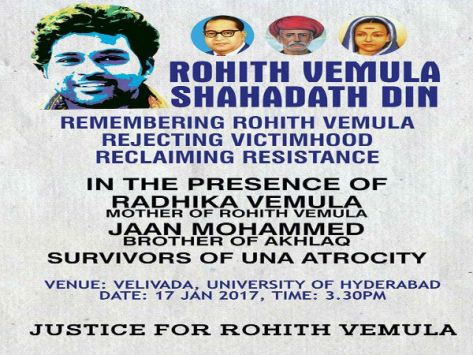
It seems to me, that this man, Mamidala Jagadesh Kumar (the current JNU vice-chancellor) is acting like a criminal, and I think he should be treated as such from now on. Co-operating with his decisions, or even tacit acceptance of his manner of functioning, should now be seen as complicity with an agenda to destroy the university. Let us also not forget that this VC continues to protect those who assaulted Najeeb Ahmed before he disappeared from JNU. In the unfortunate possibility of anything untoward having happened to Najeeb Ahmed, this VC should be seen as being responsible. He creates the conditions of impunity that threaten the safety of each and every student. His decision to punish the students who protested yesterday with arbitrary and unjust suspension orders is exactly analogous to the authoritarian conduct of Podile Appa Rao, VC of HCU, that led to the tragic suicide of Rohith Vemula. The manner in which both Jagadesh Kumar and Appa Rao have acted suggests a pattern of the deliberate victimization of students on the basis of their caste identities. This only brings shame and disrepute to the institutions headed by them.
In my considered view, (and please view this only as a suggestion) the time has come for Faculty and Students of JNU to come together (irrespective of their political positions and postures) to demand the unconditional removal of Mamidala Jagadesh Kumar from the vice-chancellorship of JNU and from the university itself. I think that all limits have now been crossed by his conduct. His declarations about what the AC decided should be treated as null and void (also because they are violative of the principles of social justice and democratic education), and the suspension orders against the students who were targeted must be revoked. I hope that the present JNUSU and JNUTA will not fail in their responsibility to conduct a coherent and militant campaign to reverse this situation. If they vacillate, or, are unable to offer a coherent, well worked out strategy, they too will be seen as responsible for the mess that JNU is in today.
I hope that every student (and here I mean ‘common students’ as well as student activists within and outside organizations) and every teacher at JNU is able to rise above the temptation of negativism and needless point-scoring at this juncture. Just as the JNUSU crucially must not see itself as immune to criticism, or fail to act with militant resolve and clarity, and in resonance with the concerns of students, (including of those outside the union) so too, those outside the union could help matters by not falling to the temptation of adopting ‘holier than thou’ postures that impede practical unity. Let there be solidarity in struggle, and the kind of criticality that aids , rather than impedes, solidarity.
This time, this opportunity, this moment of necessity for thoughtful, militant, intelligent unity of all students, teachers and all friends of the idea or a free and open university is too precious to lose at the altar of either posturing or prevarication.
Restore freedom to freedom square! Do not let a university turn into a ‘shakha’ of a poisoned tree! Eject Mamidala Jagadesh Kumar! Reject Podile Appa Rao! Bring back life to our universities !

JNU VC sabotages democratic functioning of Academic Council to push through anti-social justice policies
First, here is the statement issued by 20 faculty members of the Academic Council today, about half the members present at the adjourned 142nd AC Meeting.
PRESS RELEASE BY MEMBERS OF THE JNU ACADEMIC COUNCIL
We, faculty members of the JNU Academic Council, are shocked and dismayed at the manner in which the Vice Chancellor has conducted the 142nd Academic Council meeting of December 23rd (adjourned to December 26th). This was a thinly attended meeting since it was held at short notice in the middle of the winter vacation, despite several requests for rescheduling.
The minutes of the previous (141st) Academic Council meeting that had been circulated contained many errors, misrepresentations, and falsities. Several of these had been pointed out by many members of the Academic Council, including in written representations to the Registrar.
The Laziest Blog Post Ever Written – Educational reform and Demonetization
Remember the FYUP debacle? Remember (as repeatedly written about on Kafila as elsewhere) that it was the latest in a long series of badly-conceived, mindlessly-borrowed and forcibly-implemented ‘educational reforms’ that practically crippled universities around the country? And remember a certain Rev. Valson Thampu, authoritarian, controversy-soaked Principal of St. Stephens College and eager soldier for the reforms? Well Thampu, now-retired, has thrown his weight against demonetisation these days in a set of articles on The Daily O. Now the thing is, almost everything Thampu finds objectionable about monetary reform, can be said about educational reform.
No, literally, every single thing.
So I simply took his post and replaced some key words, to produce a post about education. I know, I know, it’s not nice to do this, especially when you know, he speaketh the truth on demonetisation and all. But it is too wonderful an opportunity to pass up, to not use Thampu’s own eloquent words to say, yet again, what he has steadfastly refused to listen to in the past. Besides, as I say above, this is the laziest blog post I have ever had to write – that’s always an incentive.
His article in the original can be read here.
POLITICS HIGHER EDUCATION | 5-minute 7-minute read | 22-12-2016 23-12-2006 VALSON THAMPU SUNALINI KUMAR
Continue reading The Laziest Blog Post Ever Written – Educational reform and Demonetization
परवेज हुदभॉय क्यों चिन्तित हैं ?

परवेज हुदभॉय (Pervez Hoodbhoy) भारतवासियों के लिए अपरिचित नाम नहीं है!
जानेमाने भौतिकीविद और मानवाधिकार कार्यकर्ता के अलावा उनकी पहचान एक ऐसे सार्वजनिक बुद्धिजीवी के तौर पर है जिनके अन्दर बुनियादपरस्त ताकतों से लोहा लेने का माददा है। पाकिस्तान में इस्लामीकरण की बढ़ती आंधी में वह ऐसे शख्स के तौर पर नमूदार होते हैं, जो सहिष्णुता, तर्कशीलता, की बात पर जोर देते रहते हैं। नाभिकीय हथियारों से लैस दोनों पड़ोसी मुल्कों में आपस में अमन चैन कायम हो इसके लिए आवाज़ बुलंद करते रहते हैं।
पिछले दिनों ‘डॉन’ अख़बार में लिखे अपने नियमित स्तंभ में उन्होंने पाठयपुस्तकों के माध्यम से प्रचारित किए जा रहे विज्ञान विरोध पर लिखा।( http://www.dawn.com/news/1300118/promoting-anti-science-via-textbooks ) खैबर पख्तुनख्वा में प्रकाशित जीवविज्ञान की पाठयपुस्तक का जिक्र करते हुए उन्होंने बताया कि किस तरह उसमें चार्ल्स डार्विन के सिद्धांत को सिरेसे खारिज किया गया है। किताब में लिखा गया है कि चार्ल्स डार्विन द्वारा प्रस्तावित इवोल्यूशन अर्थात विकासवाद का सिद्धांत ‘अब तक का सबसे अविश्वसनीय और अतार्किक दावा है।’ किताब इस धारणा को ही खारिज करती है कि संश्लिष्ट जीवन सरल रूपों से निर्मित हुआ। किताब के मुताबिक यह विचार कामनसेन्स/सहजबोध का उल्लंघन करता है और यह उतनाही ‘बकवास’ है जब यह कहा जाता हो कि दो रिक्शा के टकराने से कार विकसित होती है। हुदभॉय के मुताबिक प्रस्तुत किताब अपवाद नहीं है। खैबर पख्तुनवा की एक अन्य किताब बताती है कि ‘‘एक सन्तुलित दिमाग का व्यक्ति पश्चिमी विज्ञान के सिद्धांतों को स्वीकार नहीं कर सकता। /कहने का तात्पर्य सिर्फ पागल लोग स्वीकार सकते हैं ?/ सिंध की भौतिकी की पाठयपुस्तक स्पष्ट लिखती है कि ‘ब्रहमाण्ड तब अचानक अस्तित्व में आया जब एक दैवी आयत/श्लोक का उच्चारण किया गया।’ विज्ञान का यह विरोध निश्चित ही पाठयपुस्तकों तक सीमित नहीं है। वहां विज्ञान और गणित के तमाम अध्यापक अपने पेशे से असहज महसूस करते हैं। Continue reading परवेज हुदभॉय क्यों चिन्तित हैं ?
A Pinjra Tod Winter Afternoon In Jamia Millia Islamia, November 17, 2016
Statement by Pinjra Tod on November 19, 2016
A fiery anonymous open letter by a women resident of Jamia Millia Islamia to the VC on the arbitrary cancellation of late nights in August last year, marks the inception of Pinjra Tod as a movement. It has been an incredible year of reaching out to each other, connecting, discussing and collectivising in Jamia. Overcoming our anxieties of a repressive state machinery intent on criminalising minority voices and institutions, conquering our fear of an administration that has repeatedly targeted students (especially women) for raising their voices, we came together in Jamia last Thursday (17th Nov), drawing confidence from our collective strength, to hold our first ‘public’ event: an exhibition celebrating the struggle of women for education, and a session of poetry, songs and sharing of experiences.
Women students reiterated that the UGC circular issued on 2nd May’16 is being shamelessly flouted by Jamia administration, as in all other Universities and colleges. There are no sexual harassment complaints committee (the program was conducted beneath a huge anti-ragging banner), libraries and other facilities on campus remain inaccessible to women students after 8 PM, random show-cause notices for ‘misconduct’ are a common practice, very little democratic space for women students to organise events/discussions/screenings within hostel spaces and continuous surveillance.
Continue reading A Pinjra Tod Winter Afternoon In Jamia Millia Islamia, November 17, 2016
‘Degrees’ of Democracy – Field Notes from a Central University in Bihar: Debaditya Bhattacharya
Guest post by DEBADITYA BHATTACHARYA
This piece has long been in the coming. Soon after the summer of student protests in India exposed the terror-apparatuses of the state and unleashed a new vocabulary of progressive political resistance, the students of a certain Central University of South Bihar (in Gaya) went on strike against the university administration in the early days of August. They however were not fighting to protect constitutional rights, because their daily encounters with the university had already come to rest on a structural suspension of many such rights. Like those of speech, of rational thought and scientific inquiry, of gender-equality, and of resisting what Vemula called the event of being reduced to one’s “immediate identity”. These students merely decided to fight for their right to a degree.
They had come together to demand statutory recognition for courses that they were enrolled in since 2013, but most sections of the national media at that time deemed the issue ‘sub-national’ enough to be granted space or audience. Reporters from the local print-media were – in what seems like accepted practice across public institutions in the country – barred entry into the university campus, and hearsay reports constituted the stuff of low-key news-briefs with little context or compassion. Those who attempted to organise public opinion by writing on social and alternative media spaces, were – in a classic division of interests that administrative bureaucracies are deft at provoking – urged by students themselves to withdraw. The reason was simple: each social media post or conversation around the issue was declaredly spied on by the university administration in order to ‘detect’ subterranean alliances and “outside support” (as if it were a terrorist conspiracy!), and students were individually targeted and intimidated for passing on internal ‘secrets’ to ‘outsiders’. I know of specific Facebook posts which had been taken print-outs of and convened surreptitious meetings over, where administrative heads and proctorial board members put their heads together to crush the germ of student dissent and ‘outsider’-mobilizations. The agitated students continued in their own ways, despite open threats of disciplinary action and reminders of exam-time tactics of penalisation. The Vice-Chancellor marched off to Delhi to strike bargains for an interim settlement-package with officials in the ministry, and returned to meet the striking protestors with as much of an assurance as threats of expulsion. Continue reading ‘Degrees’ of Democracy – Field Notes from a Central University in Bihar: Debaditya Bhattacharya
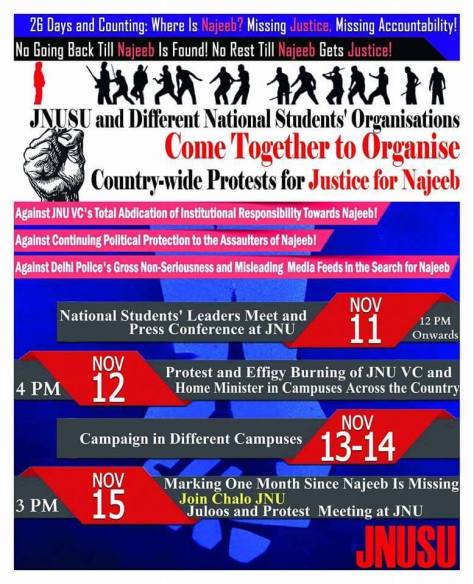
Appeal to Join “JNU Chalo” on 15 Nov Marking One Month of Najeeb’s Disappearance: JNUSU
Guest Post by JNUSU (Jawaharlal Nehru University Students Union)
Friends, on 14th October night, Najeeb Ahmed, a student of M.Sc. Biotechnology, JNU was brutally assaulted and violently threatened by a group of ABVP students. From 15th October morning, Najeeb went missing from the campus. The disappearance of a student from a central university in the national capital after assault and intimidation of right wing lumpens is no doubt an ominous reflection of the dark times we are living in. For past four weeks, students, teachers, staff members of JNU, and citizens of Delhi have been coming out on the streets demanding institutional accountability to bring back Najeeb.
The Anatomy of a Disappearance: Shehla Rashid
Guest Post by Shehla Rashid. Videos by Haider Saif and Samim Asgor Ali
Think of the person closest to you, and the place that they hold in your daily life, the bittersweet memories that they create each day in your life, the daily fights and the moments of affection. At times, you fight and simply want to go away from one another, seeking a temporary calm from each other’s absence. You resolve never to call him/her again, or to speak to her/him anymore. However, by the time dusk falls, you realise the emptiness of your time without them, and you make a phone call, speaking reservedly, trying not to sound desperate or sappy. You tell them that you are coming home, and ask whether you need them to get anything- as if that were the reason for the phone call. This person could be you sister, your partner, or your best friend. Continue reading The Anatomy of a Disappearance: Shehla Rashid
The Importance of Being Makarand Paranjape: Anirban Bhattacharya
Guest Post by ANIRBAN BHATTACHARYA
A few days back, drawing from Oscar Wilde’s classic, Makarand Paranjape wrote a piece titled The importance of being Narendra Modi. He urged his readers to ensure a second term for Modi saying “If Narendra Modi gets a second term, he will certainly change India in a lasting and significant way.” That he is going to change India, and is doing so already is not that far from truth, but the question is which way is this change taking us. Given the track record of Modi Ji(o) so far, the change is surely going to be for the worse. But this piece is not on Modi Ji(o). This one is on the Makarand Paranjapes of the world. Yes, they are not one. They are in fact a particular breed not new in history, and they have a particular role. Specifically, we would evaluate this role of theirs in the light of a recent piece of his on the gherao of the JNU VC.
Some would say that the piece was on the issue of Najeeb. But no, it wasn’t. Najeeb, a new student pursuing M.Sc in Bio-Tech living in Mahi-Mandavi hostel was publicly assaulted by identified ABVP goons in front of students as well as wardens on the night of 14th October. He was showered with dire consequences of which too there are multiple witnesses including again the hostel wardens. A vicious communal slur-campaign was set in motion by the sanghis writing “Muslims are terrorists” within the hostel premises. Amidst all of this and in the given context Najeeb “disappeared” on 15th October from his hostel. He had called his mother last, who, as it appears, had reached Anand Vihar and was on her way to meet her son in distress. But, by the time she was here, Najeeb went “missing” mysteriously and is yet to be found. After five days of entreating an unresponsive university administration to be proactive in creating conditions for Najee’s safe return, JNU students undertook an all night vigil on the 19th of October.
Continue reading The Importance of Being Makarand Paranjape: Anirban Bhattacharya
2 Weeks No #JusticeForNajeeb – A Few Thoughts on Yesterday’s March and the Way Forward: Shehla Rashid
Guest Post by Shehla Rashid.
Video and Photo Inputs from Naushad MK, Samim Asgor Ali and Amit Kumar
[ This post was written shortly after JNU students gathered in front of Vasant Vihar Police Station to articulate their concern and anger at the lax attitude taken so far by the Delhi Police and other concerned authorities in relation to the disappearance of Najeeb Ahmed almost two weeks ago. In this text, (originally uploaded as a note on Facebook and then sent to us to be posted at Kafila) Shehla Rashid, thinks aloud about what has happened so far and looks ahead at the possible way forward for the students of JNU and their supporters to focus on making sure that Najeeb Ahmed, wherever he is, returns safe and sound to the JNU campus. We hope that it will be widely read, and discussed to evolve strategies for the evolving future of the campaign to give justice to Najeeb. Kafila]
Shehla Rashid and Others Being Confronted by Delhi Police at the Vasant Vihar Chakka Jam on Oc. 26, 2016
First of all, I’d like to express my gratitude to all the students who joined the Chakka Jam at Vasant Vihar police station, where the ACP refused to even accept the paper with our demands and, instead, ordered a lathi-charge on us. Students marched as one and stayed together till the end, despite all differences, for one goal- justice for Najeeb, and his safe return to campus life. I salute this spirit of JNU students. Having said that, I must say that we need to do more. Students need to come out in even greater numbers, as the attack on us is of immense magnitude.
An Appeal by JNU Teachers on the Disappearance of Najeeb Ahmed
We, the undersigned teachers of JNU, are deeply concerned about the continued absence of Najeeb Ahmad, a student of M.Sc. Biotechnology, who was last reported as seen on JNU campus on 15 October 2016. We express our deepest sympathy and solidarity with Najeeb’s mother, sisters and extended family, and share in their anxiety and despair at the fact that even after ten days of Najeeb’s disappearance, neither the police not the JNU authorities have been able to provide any credible leads to his whereabouts; indeed, both have failed to even keep the JNU community informed of the progress of the search operations.
The JNUTA has repeatedly requested the VC to issue a personal appeal assuring Najeeb complete security and due process and to immediately set up a channel for the dissemination of this information, but to our dismay, the JNU administration has taken no concrete steps in this direction.The very least the JNU administration can do at this juncture is to issue a press release detailing all the steps it has taken thus far in facilitating the search for Najeeb, including its own efforts as well as its communications to the police and other authorities, and thereafter issue daily bulletins on the developments in the search. This willingness to share information with the JNU community and particularly Najeeb’s distraught and anxious mother and family, is absolutely imperative, both as a measure of enforcing accountability as well as to prevent the circulation of unfounded rumours. Continue reading An Appeal by JNU Teachers on the Disappearance of Najeeb Ahmed
The Twitter Gherao of Mamidala90 on the 10th Day of Najeeb Ahmed’s Disappearance from JNU: Shehla Rashid
Guest Post by Shehla Rashid
[ Between the 9th and 1oth day of the disappearance of Najeeb Ahmed from the JNU campus, the JNU Vice Chancellor, Mamidala Jagadesh Kumar decided to salvage his reputation on twitter, even as he squandered it on the grounds of the campus of the university he presides over. And so he let forth a volley of tweets, while sitting inside his office and his residence, even as he refused to meet or listen to the JNU students who have grown increasingly concerned and anxious at the university administrations callous laxity about the fate of Najeeb Ahmed, the missing students.
While students marched down the campus, forming a human chain that culminated at the gates of the VC’s residence near the university’s east gate, Mamidala90 (the handle with which the VC distinguishes himself in twitsville) began getting extremely active. While the students were peacefully assembled at the gates of the VC’s residence, very much not in ‘gherao’ or ‘blockade’ mode, Mamidala90 whined about being ‘blockaded’.

Bring Back Najeeb Ahmed to JNU: A Call to Resist Terror in Universities
It is now more than a week since Najeeb Ahmed, an MSc (first year) student of Biotechnology at Jawaharlal Nehru University, Delhi has been reported missing, after an altercation with members of the RSS affiliated ABVP student organization, which reportedly left him injured and severely traumatized.
Continue reading Bring Back Najeeb Ahmed to JNU: A Call to Resist Terror in Universities
Academics’ Letter to the VC, Central University of Haryana Regarding the ‘Draupadi’ Affair
Following is the text of a letter to the Vice Chancellor, Central University of Haryana, sent by some academics protesting the attacks on Dr Snehsata Manav and Dr Manoj Kumar regarding the students’ production of the play ‘Draupadi’:
To the Vice Chancellor,
Central University of Haryana
Dear Vice Chancellor:
We write in support of Dr. Snehsata Manav and Dr. Manoj Kumar of the Department of English and Foreign Languages who have recently come under attack for their sponsorship of a student production on your campus of the play “Draupadi” based on a story by Mahasweta Devi who, as you know, is universally recognized as a towering figure in contemporary Indian literature. Her writings, translated into most Indian languages, have highlighted the struggles of oppressed and marginalized women and men. Her story “Draupadi”, whose dramatized version has been highly acclaimed and performed all over India, deals with the sensitive but enormously important question of the ethics of deploying the armed forces in dealing with civil disturbances within the country. This question, along with specific instances of rapes committed by army personnel in different parts of India, continues to be debated in the Indian public media and has engaged the attention of political leaders as well as the courts.
We strongly believe that it is both unjust and unwise to accuse intellectually responsible teachers of hurting the sentiments of some sections of opinion. The recent demise of Mahasweta Devi was a perfect occasion to engage university students in a serious discussion on why some of the greatest writers and artists of India have been concerned about the excesses of state violence carried out at the behest of those in power, no matter what their party or ideology.
We hope you will convey our views to those who have accused Dr. Manav and Dr. Kumar of being hurtful and unpatriotic. The university campus needs to be fostered as a place where difficult questions can be debated in a spirit of intellectual openness and without fear of censure.
Sincerely,
Gayatri Chakravorty Spivak, University Professor in the Humanities, Columbia University, New York
Akeel Bilgrami, Stanley Morgenbesser Professor of Philosophy, Columbia University, New York
Gauri Viswanathan, Professor of English and Comparative Literature, Columbia University, New York
Partha Chatterjee, Professor of anthropology, Columbia University, New York
Romila Thapar, Professor Emeritus in History, Jawaharlal Nehru University, New Delhi
Ramachandra Guha, author, Bengaluru
International Scholars Condemn the Attack on Faculty and Students of Central University of Haryana
Over 70 UK and Europe-based scholars concerned with South Asia have written a letter to the Vice Chancellor of the Central University of Haryana. They have condemned the September 21, 2016 attack on a group of staff and students of CUH who were involved in putting together a performance based on the award-winning writer Mahasweta Devi’s acclaimed short story “Draupadi”. The attack and threats of charges of sedition against those involved in the performance were instigated by the BJP-affiliated student group ABVP as well as by the local press, which has falsely and maliciously spread the view that the play is anti-national and represented an attack on Indian soldiers. The letter appeals to the Vice Chancellor of CUH to protect the freedom of expression of the university’s staff and students, and to encourage the democratic exchange of ideas through means of debate and discussion.
Dear Vice-Chancellor Mahendra Pal Singh,
We, the undersigned, strongly condemn the attack on faculty members and students of the Department of English and Foreign Literatures at your university by members of the Akhil Bhartiya Vidyarthi Parishad (ABVP) for the performance of a play on 21 September 2016. The play was based on a short story by the eminent Bengali writer Mahasweta Devi. We understand that the staff and students involved in the performance had sought and received all necessary permissions for the event, which was organized to commemorate the literary achievements of Mahasweta Devi, the recipient of some of the most prestigious Indian and international awards.
We write to express our serious concern over this attack on the freedom of academic expression of the staff and students at your university. Mahasweta Devi’s story “Draupadi” was written in 1971 and represents her creative expression of the exploitation of India’s tribals. It is regularly taught as part of course syllabi all over India and the world, including at the universities of some of the signatories to this letter. The claim by the ABVP and the local press that the play is an attack on Indian soldiers is manifestly fabricated. As one of the faculty members involved in the production, Dr Snehsata, has explained, students and teachers saw the programme as an academic and creative pursuit and their intention was certainly not to hurt the sentiments of soldiers as the ABVP has claimed: “In this event, I read the epilogue of the play recounting the data about atrocities on tribal people, especially sexual crimes against women by the Indian army. How ordinary soldiers are used by the state as a tool against its own people and how the body, especially the female body, becomes the site of revenge in the hands of Indian soldiers by the same state. All the teachers and students who were present there came up and congratulated us.”
The Orphaning of ‘Women’s Collective Interests’ in Kerala
There is considerable outrage in Kerala about how the accused in the murder of the young woman worker Soumya in 2011 has slipped the noose at the Supreme Court. There is considerable doubt remaining on how the murder of the young dalit woman student Jisha was handled by the present government. In both cases, the accused are not men who would earn the sympathy of the Malayali middle-class – in one case, a tamil homeless man, and in the other, a Muslim migrant worker. Not surprisingly, the cry for their blood has been particularly shrill. Outrage at the Supreme Court’s refusal to endorse the lower court’s judgment in the first case is particularly striking – not only because of its loudness, but also because one is unable to forget the Suryanelli case. The difference between the present cases and the Suryanelli case is that in the latter, the victim has been condemned to living death, though she has persistently fought to be heard as a survivor of the most horrific violence. Yet her pleas that the powerful Malayali politician P J Kurien be also tried never roused the kind of outrage was have heard recently. It appears that the Malayali public is kinder to dead violated women than women who survive violation; it also seems harsher towards abjected males than to .powerful males who occupy the pedestal of elite masculinity. Continue reading The Orphaning of ‘Women’s Collective Interests’ in Kerala
Self and Other : Indus Chadha
This is a guest post by INDUS CHADHA
The summer that I was 5-years-old, I took my first flight alone because I wanted to spend my holidays with my grandparents. My parents prepared me well—they even read aloud and recorded my favourite stories on an audio cassette which we put into our Walkman for my long solo journey. But there was one question they neglected to answer. “What should I do if the flight crashes?” I had asked. “It won’t…” they had brushed my question away. So when the flight attendant came out into the aisle and announced that one of our engines had failed and we would have to turn back to our point of origin to make an emergency landing—I wondered what I should do.
A man a few rows ahead of me got up from his seat and started shouting at the flight attendant. He was obviously afraid and seemed to hope oddly that he could frighten some comfort out of her. I remember him saying over and over again that he had a young child with him on the flight and that made me conscious of both the gravity of the situation and the fact that I was so young and all alone. I felt tears start to well up in my throat and took small sips of my orange juice to wash down the urge to cry. And then, out of the blue, the young man sitting beside me started talking to me. He asked me what I was studying at school and when I told him our theme for the last term had been pirates he exclaimed that he was a ‘shippie’ and knew all about them.
Historic Delhi High Court Judgement Dismisses Publishers’ Copyright Infringement Petition
In its much awaited judgment in the Delhi University photocopying case (The Chancellor Masters and Scholars of the University of Oxford v. Rameshwari Photocopy Services), the Delhi High Court has dismissed the copyright infringement petition initiated in August 2012 by three publishers (Oxford, Cambridge and Taylor & Francis) against a photocopy shop located in the premises of Delhi University. This case, which was being closely tracked by students, teachers and the publishing industry alike, was seen as one with immense significance for questions of access to knowledge. While initially involving only the publishers, the photocopier and the university, the case also saw intervention petitions being filed by a student group (Association of Students for Equitable Access to Knowledge) as well as by teachers and academics (Society for Promoting Educational Access and Knowledge). While the publishers made the argument that the creation of course packs and the photocopying of academic material for the same amounted to an infringement of the exclusive copyright of the authors and publishers, the defendants argued that the reproduction of materials for educational purposes fell within the exceptions to copyright under Section 52(1)(i) of the Copyright Act.
Not a moral right
In his considered and sharply reasoned judgment, Justice Rajiv Sahai Endlaw examines the gamut of arguments made by both sides and arrives at the conclusion that copyright is a statutory right and not a natural right, and hence any right that is granted to owners is also limited by exceptions carved out by law. The nature of Section 52 of the Copyright Act is such that any act falling within its scope will not constitute infringement. Section 52(1)(i) allows for the reproduction of any work i) by a teacher or a pupil in the course of instruction; or ii) as part of the questions to be answered in an examination; or iii) in answers to such questions.
Victory for Students and Access to Knowledge in DU Copyright Case :ASEAK
Guest Statement by Association of Students for Equitable Access to Knowledge (ASEAK)
Victory for Students and Access to Knowledge in DU Copyright Case : Corporate Publishers Market ends at the gates of the University
In a rare and incredible order today, the Delhi High Court has dismissed the copyright infringement case filed by Oxford University Press, Cambridge University Press and Taylor and Francis (Routledge) against Rameshwari Photocopy Shop in Delhi School of Economics and Delhi University. Justice R.S Endlaw in a 94 pages long judgment interpreted educational exception under section 52(1)(i) of the copyright act in broad enough manner to cover the acts of photocopying.
The publishers sought to claim damages to the tune of 60 lakh rupees from the shop citing infringement of copyright which the publishers claimed was happening through photocopying of parts of books published by them. However, the publishers themselves stated that this case, for them, was a test case where they wanted to introduce licensing systems across universities in India. These licensing systems intended to control the extent to which material could be photocopied and also direct a share of profit from these reproductions to the publishers. We, the Association of Students for Equitable Access to Knowledge (ASEAK) demanded to be made a defendant in this case as we believed that it is the rights of students to access reading material that was at stake in this case- “Association of Students for Equitable Access to Knowledge (ASEAK) filed IA No.3454/2013 for impleadment in the present suit and which was allowed vide order dated 1st March, 2013 and ASEAK impleaded as defendant No.3.” (from the judgment). Continue reading Victory for Students and Access to Knowledge in DU Copyright Case :ASEAK
ABVP and Dalit upsurge: Jatin Goraiya
Guest Post by JATIN GORAIYA who recently resigned from the post of Vice President of ABVP JNU unit.
Read also his interview to The Telegraph here.
Jatin sent this statement to Kafila, which we publish here in full.
The right wing in our country is keen to strengthen the model of Hindutva fascism in India which is jeopardising the secular fabric of this country. This model of Hindutva fascism is based on a narrow, conservative sense of nation which tends to exclude a major population of dalits, adivasis, muslims and women. This imagination necessarily feeds on this idea of exclusion, the propagators of RSS and Sangh ideology would never be able to sustain their dominance if they render equal status to Dalits, Adivasis, Muslims and women in this country. Hierarchy and inequality is the basic minimum to keep them in power. At the same time they are trying to inculcate and justify a particular kind of idea of nation and nationalism in people around the country. The BJP has not been able to do any good as far as the rhetoric of development is concerned, so the alternative strategy is to sway people in the name of nationalism and religion. Ideologically they are aware of their hollowness and bankruptcy, so the idea now is to mobilise people in the name of sentimental and unreasonable matters. For example they provide an ideological backup to the Manusmiriti, where women are seen as objects of seduction and are to remain under the feet of men all their lives no matter how brutal he is. Dalits are supposed to serve the upper castes and should be given inhuman punishments if they don’t comply. Following this kind of mindset, they tend to keep the caste and gender hierarchies and divisions intact, while paying lip service to social justice.