Category Archives: Education

Delhi Police Tells Lies about Attacks on Protesting Students – #OccupyUGC

[ Video Footage, courtesy Akhil Kumar, taken from his Facebook Page ]

The ongoing movement to #OccupyUGC by students from all the universities in Delhi has so far seen two instances of vicious attack by the Delhi Police. Students were manhandled, abused and badly beaten with sticks and batons. Several had to be hospitalized and some are severely injured. However, police officers have been lying about their actions.

The Indian Express reported the lathi charge and also quoted a senior police officer – DCP (Central), Paramaditya as saying, “Around 45-50 protesters were detained. No one was lathicharged. Policemen did not have lathis… the protesters attacked and injured policewomen.”


Post on Akhil Kumar's Facebook Wall
Post on Akhil Kumar’s Facebook Wall

Here is a series of videos shot by Akhil Kumar, a young independent photo-journalist (who was himself severely beaten after this). This footage clearly shows up DCP (Central) Paramaditya as a liar.

Meanwhile, #OccupyUGC continues.

Statement of outrage against police crackdown on students at #Occupy UGC: Faculty Feminist Collective, JNU

The Faculty Feminist Collective of JNU stands in solidarity with the students protesting the revocation/review of the UGC non-NET fellowship. We are outraged at the brutal police action against students gathered in a protest demonstration since yesterday, without a single convincing response from the UGC or the MHRD that could allay the anxieties of thousands of students across India that the non-NET fellowship will not be discontinued. Prevarication on this basic demand by press releases announcing the setting up of a review committee has only indicated a malafide intent.

We are deeply dismayed to hear of the reports of significant injuries to unarmed protestors and the detention of a number of students by the police until late last night.

The MHRD Minister and the UGC Chairperson should understand that the situation can only be defused by their unequivocal assurance to the academic community that there shall be no rollback or any other amendment of the eligibility of students for the UGC Non-NET Fellowship scheme for the universities that are already in receipt of these fellowships in this or future academic years.

Furthermore, it should take positive and visible steps to meet students’ demands for an enhancement of fellowship remuneration and undertake to extend this fellowship scheme to state universities as well.

Education is a right, not a privilege, and as members of the academic community, we will resist all moves to subvert this basic understanding.

We fully endorse the JNUSU’s call for a strike, and in protest at state action and in solidarity with students, we will not be taking classes today.

The students have returned to UGC. Let us assemble there to show that we stand with them.

BRUTAL CRACKDOWN ON THE STUDENTS IN Day 7 of THE #‎OccupyUGC MOVEMENT in Delhi: Kanhaiya Kumar, President JNUSU

Guest Post by Kanhaiya Kumar, President, Jawaharlal Nehru Students Union (JNUSU)

BRUTAL CRACKDOWN ON THE STUDENTS IN THE #‎OccupyUGC MOVEMENT: DAY7

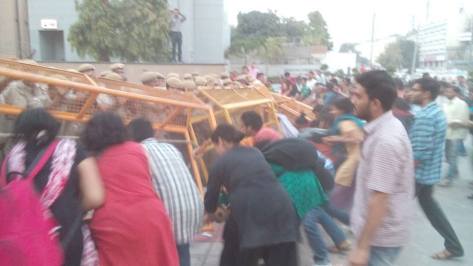
Students at the Police Barricades - #OccupyUGC
Students at the Police Barricades – #OccupyUGC

Students from JNU, AUD, DU and Jamia Milia Islamia University who were protesting in front of the UGC building, were brutally lathicharged on 27th October and 33 students have been detained. This is the second time that students have been lathicharged and detained since October 21, 2015. Students across universities in and beyond Delhi initiated the #OccupyUGC movement protesting against UGC’s decision to discontinue non-NET fellowships, refuse any enhancement and introduce ‘merit’ and ‘income’ criteria in allocating fellowships to research scholars. In today’s lathicharge, one student was hospitalized in critical condition, female protestors were mishandled by male police, they were abused verbally and many have been seriously injured.

This slideshow requires JavaScript.

JNUSU condemns the brutal lathicharge/crackdown against the protesting students by the Delhi Police and appeals to common citizens to support the cause of the ongoing #OccupyUGC movement.

Kanhaiya Kumar is President, JNUSU

The Move to Professionalise Research: Aswathy Senan

This is a guest post by ASWATHY SENAN

Researchers all over the country are protesting the move by the UGC to scrap the non-NET fellowship and students have gathered in hundreds to resume their agitation at the UGC office through OccupyUGC. it appears that one should be clear about what the student reaction means: it is much more than as a demand for monetary benefits. The student mobilization happened after the committee that met at the UGC office in Delhi to discuss and increase the non-NET fellowship, decided to scrap it. Following the protests that lasted through the nights from 21 October, the Minister of Human Resources Development tweeted that the fellowship shall be continued leaving out one crucial detail: its availability to new students. This decision to end all financial support of researchers doing their MPhil and PhD until they qualify NET or JRF is a huge threat for the research community in India as this is a clear move to professionalise research and make it a mere add on to teaching career. Continue reading The Move to Professionalise Research: Aswathy Senan

Statement From Teachers And Researchers In Support Of ‘Occupy UGC’ in Delhi

Statement in support of students protesting against the UGC’s proposal to scrap the Non-NET fellowship for research scholars, and in condemnation of the police crackdown on agitating students in Delhi on October 23, 2015

This is to express our complete solidarity with, and extend our full support to, students from universities across Delhi as well as other locations in the country who are protesting against the UGC’s decision to scrap Non-NET Fellowships for MPhil and PhD research scholars, and demanding an increase in the fellowship amounts. In particular, we condemn strongly the violent police action upon the peacefully protesting students on October 23, 2015, after the students had spent close to 48 hours in a sit-in at the UGC office in New Delhi protesting the failure of  the UGC authorities to extend a hearing to their grievances. We are shocked by the rapid escalation in aggression demonstrated by the UGC authorities against the students. At 6 am on Friday, 23rd October, about a hundred protesting students were forcefully evicted from the UGC premises and taken across the city to be detained for one whole day in the police station at C block, Rajiv Nagar, Bhalaswa Dairy.

As pressure from students and the public mounted, the police were obliged to let the students go at the end of the day. Meanwhile at the UGC a police lathi-charge grievously injured students who had gathered again to protest there, and from reports at least two students needed to be hospitalized. Continue reading Statement From Teachers And Researchers In Support Of ‘Occupy UGC’ in Delhi

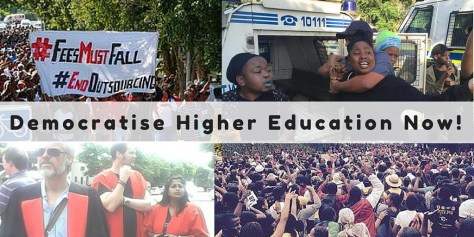
Statement from South African academics supporting Student Struggle in South Africa

Statement posted on Amandla.mobi

Transformation_is_rising_(1)

Statement to Vice-Chancellors, Minister of Higher Education & Training, Blade Nzimande, and the Minister of Finance, Nhlanhla Nene.

We the undersigned, as academics in South African institutions of higher education, and allies in South Africa and overseas, stand with students in their fight for the democratisation of our universities. The current student protests that have erupted across the country are historic. They demonstrate a younger generation willing to take up the struggle against inequality, and to insist on the principle of education for all. Our students are leading the national debate on education, and we insist that they deserve our respect and attention.

We have witnessed students act with extraordinary discipline, tactical skill and moral purpose. This commitment and self-control has gone unseen by many university managers, government leaders and the media who have misrepresented students as uninformed, irresponsible or irrational. Protesting students have faced and overcome potentially divisive tensions within their ranks, and have shown maturity in their intellectual arguments and political interventions. Above all, they have required us to confront a grievous national problem: the persistent exclusion of those who are black and poor from higher education, and from the opportunities that higher education makes possible. Continue reading Statement from South African academics supporting Student Struggle in South Africa

South African student protests and re-emergence of people’s power: Camalita Naicker

Guest Post by CAMALITA NAICKER

Students at University of the Western Cape Photo cred - Musaed Abrahams

Students at University of the Western Cape (Photo cred – Musaed Abrahams)

The #nationalshutdown of all major universities in South Africa continues, even after a historic victory yesterday, when, after several days of mass mobilisation by students and workers President Jacob Zuma was forced to concede a zero-percent fee increase in university tuition fees next year. Yet, it was bittersweet for the more than twelve thousand people who marched to the Union Buildings in Pretoria who were, once again, tear-gassed and shot at with rubber bullets and stun grenades. The police turned violent when students began demanding, after waiting for several hours, that the President address them. Instead, Zuma chose to speak to the media in a press briefing and leave the students to the police. In Cape Town, students marched to the airport to show their solidarity with those in Pretoria; there too police fired rubber bullets, tear gas, and stun-grenades even as students fled into the neighbouring residential areas. For many, the victory it is only a partial one, a short-term solution deferring the problem to another day. It does not resolve the issue of unaffordable education nor does it address other important issues that the national action has been tied to like the outsourcing of labour on university campuses or the general discontents of the lack of transformation at higher education institutions in the country. Continue reading South African student protests and re-emergence of people’s power: Camalita Naicker

Students Occupy UGC to Defend the Right to Research in Universities Across India: Sucheta De

Guest Post by Sucheta De.

[ Videos by V. Arun, Om Prasad, Akhil Kumar, with Facebook Post Updates by Shehla Rashid and Akhil Kumar ]


#SaveNonNETfellowship: A movement for ensuring democratic, inclusive and pluralistic research in India

The ideas of the ruling class are in every epoch the ruling ideas, i.e. the class which is the ruling material force of society, is at the same time its ruling intellectual force.”

― Karl MarxThe German Ideology

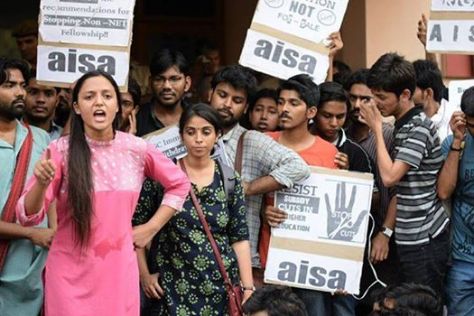
JNUSU vice president Shehla Rashid addressing protestors at UGC
JNUSU vice president Shehla Rashid addressing protestors at UGC HQ, Delhi

On the afternoon of 21st October, students from several universities in Delhi began ‘Occupying’ the Delhi premises of the head-office of University Grants Commission (UGC) –  the government mandated body under the Ministry of Human Resources that is supposed to govern the functioning of universities across the country.  The occupation continued through the night of the 21st, the day of the 22nd, and is still currently in process. The students occupying the UGC premises have decided, as of now, not to let the UGC function. Goons from the BJP aligned students organization Akhil Bharatiya Vidyarthi Parishad (ABVP) have now reached the UGC and are continuously harassing and abusing the student activists who are in ‘occupation’ of UGC. There is heavy police presence. There is a state of near siege at the UGC head quarters near ITO Chowk in Delhi.

Continue reading Students Occupy UGC to Defend the Right to Research in Universities Across India: Sucheta De

The Fiction of Fact Finding: Harassment of Delhi University Teachers Union President


PLEASE JOIN PROTEST AGAINST SHAMEFUL HARASSMENT OF DR. NANDITA NARAIN – MONDAY THE 19TH OF OCTOBER, VICEREGAL LODGE, DELHI UNIVERSITY 10.30 AM- 1.30 PM.


01Fir08-09.qxp
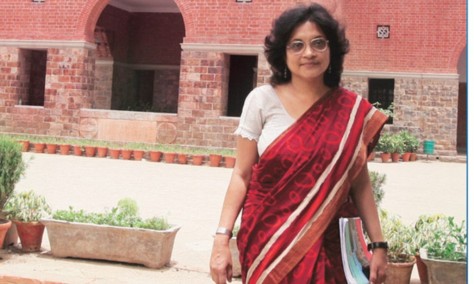
Dr. Nandita Narain, President of the Delhi University Teachers Association.

With apologies to Manoj Mitta’s excellent book on 2002 by the same name, it appears that yet another fact-finding commission has made a mockery of the process of law, not to mention truth and justice. Dr. Nandita Narain – yes that blood-curdling, fearsome figure in the picture above – has been accused of disrupting the work of 3 colleges in Delhi University and asked to appear before a fact finding committee appointed by the University, 10 days before the term of the current Vice Chancellor Professor Dinesh Singh ends. For those not acquainted with Dr. Narain, she is the popular President of the Delhi University Teachers Association, beloved Mathematics professor in St. Stephens’ College and a brilliant scholar in her own right. Having contested and won the recent Delhi University Teachers Association elections against the V.C’s relentless pressure tactics and a blitzkrieg of campaigning and publicity by other parties including the government-friendly National Democratic Teachers’ Front, Dr. Narain has evidently had nothing but her enormous personal integrity going for her.

Continue reading The Fiction of Fact Finding: Harassment of Delhi University Teachers Union President

Another One Bites the Dust: “Cultural Pollution” and the Nehru Memorial Museum & Library: Niyati Sharma and Snigdha Kumar

This is a guest post by NIYATI SHARMA AND SNIGDHA KUMAR

Courtesy thequint.com.

The latest in a line of institutions to fall victim to the BJP government’s campaign against “cultural pollution” is The Nehru Memorial Museum and Library (NMML). The agenda is loud and clear – anything which ‘pollutes’ the current government’s preferred way of life and thinking will be done away with. Bans such as the recent ones on porn and meat are the most obvious instruments at the disposal of the government to achieve this goal. The more effective interventions, however, are not those which instantly deny people their choices and freedoms. Presented instead as minor improvements and renovations, interventions in art, history and academic institutions allow the government to introduce subtle long term changes – changes with the capacity to access and alter our very being.

Given the enormity of these interventions in the long run then, it is particularly curious how the clear recent attempts to take over academic institutions such as the ICHR, FTII and now NMML have managed to raise only a few eyebrows while the bans on porn (and meat to an extent) have met with much protest and were subsequently lifted. Perhaps this is because such spaces appear to be remote islands inhabited only by those interested in history, film and/or academic research. Only such an impression can explain the rather meek public debate and outcry that these clearly targeted changes have generated.

Continue reading Another One Bites the Dust: “Cultural Pollution” and the Nehru Memorial Museum & Library: Niyati Sharma and Snigdha Kumar

Principal Anandarajan and the Legacies of a Long and Pointless War: Luther Uthayakumaran

Guest post by LUTHER UTHAYAKUMARAN

A lot has happened since the early 1980’s, when I first got to know Anandarajan. Nearly thirty-five years later, it seems a different world. A way of life has died between then and now. It is through these multiple layers of life and memories that I remember that evening. It was nearly dusk when the news spread through Jaffna ‘Principal Anandarajan shot dead” and then the other three words followed in a hushed tone, like a reluctant trailer, ‘….. by the boys’.

AnandarajanI first met Anandarajan when I was fourteen years old, a few weeks before I was to join St John’s. Anandarajan was introduced to me at a family function, as my would-be principal. The first thing I noticed about him was the total lack of aloofness. His response was ‘I say, I was a classmate of your mother at St John’s, and she was the only girl in the class whom I was scared of’ (which my mother vehemently denied!). In the years that followed I came to know Anandarajan more closely, first as a teacher, and then as a close family friend. In those days at St John’s the first year Advanced Level classes occupied the open sheds opposite the Vice-Principal’s house, and everyday from my classroom I would see Anandarajan walk purposefully across the school grounds from his residence to the principal’s office. If it was a Monday, I would see him again a few minutes later, wearing a black academic-gown walking up the stage of Peto Hall to chair the assembly. I used to enjoy those Monday morning assemblies, as they provided a welcome reprieve from the stress of cramming for exams. Anandarajan would invite interesting speakers to address us, from Hindu mystics to those who spoke on more earthy topics such as pollution and war in the Middle East. Ironically for many of us in those days, war was something that happened only in distant places. If there were no outside speakers Anandarajan would address the assembly himself. It was on one such occasions that I learnt a value that I have cherished ever since then. It is in Anandarajan’s own words: “Always defend yourself. Never let anyone accuse you falsely – not anyone – not even me. If you let that happen, part of the blame is yours”. Continue reading Principal Anandarajan and the Legacies of a Long and Pointless War: Luther Uthayakumaran

Kudumbashree in Chandydesham/Muneerland — In Three Parts

Part One: Prologue

In 2008, I reported the results of research on Kudumbashree women leaders at the village level, from seven districts in Kerala. Those were the days when Kudumbashree was being projected as the ultimate answer to all of women’s woes, and the chorus consisted of politicians, official feminists, researchers, bureaucrats, development experts – in other words, everyone, well, almost. What I had to say was not pleasant to their ears. However, implicit in my reporting was the essential changeability of Kudumbashree, which was after all a government programme. The discussions around the modifications of the Kudumbashree bye-law and its approval were on during our fieldwork, and even though we reported after it was finalised and approved, it was too early for us to assess its impacts.

Continue reading Kudumbashree in Chandydesham/Muneerland — In Three Parts

UGC Guidelines on the Safety and Security of Students in Higher Educational Institutions – Protecting Students or Building Walls ? Sujata Chandra

Guest Post by Sujata Chandra

The University Grants Commission has issued a set of ‘Guidelines on Safety of Students On and Off Campuses in Higher Educational Institutions‘ in April 2015, which is beginning to be discussed recently by students and faculty in many universities and higher educational institutions (HEI). They begin by discussing the height of walls and kind of barbed wire that are needed to ‘fence’ in higher educational institutions. But the most disturbing thing is the kind of walls and barbed wire they seek to install in the minds of students.

The ‘Guidelines’ feature a number of problematic provisions in the name of assuring a ‘safe and secure learning environment’ for students. These provisions, if implemented, will simply assert the state’s notion of morality and end up transforming students into submissive entities. The vision of ‘students’ in these guidelines is that of infantile beings who require ‘permission’ from authority figures (university administration, law enforcement officials and ‘parents’) at every stage of their life on and off campus.

One of the key provisions relates to the necessity of setting up police stations within university campuses. The presence of police forces within university campuses can only have a ‘chilling effect’ on student life, especially with regard to the quality of political activism and discussion. Universities are meant to be spaces of liberty and autonomy, and the presence of policemen on campus does not bode well for either. One can clearly envisage university authorities asking students to obtain ‘police permission’ to hold meetings, protests, screenings and simple gatherings. Ostensibly, the presence of a police station on campus is supposed to act as a deterrent to sexual harassment and sexual violence. Continue reading UGC Guidelines on the Safety and Security of Students in Higher Educational Institutions – Protecting Students or Building Walls ? Sujata Chandra

Appeal by the Striking Students of Delhi College of Art – Students of Delhi College of Art and Ambedkar University, Delhi

Guest Post by Students of Delhi College of Art, with a statement in solidarity by students of  Ambedkar University, Delhi (Department of Visual Arts)

[ This post compiles communications sent out by students of the College of Art, Delhi, their charter of demands (which include very basic and fundamental demands – and it is indeed a revelation that students have to resort to a strike to get this charter even noticed) and a letter in solidarity (see end of the post) with the College of Art students from Students of the Department of Visual Arts, Ambedkar University, Delhi. We are posting this to continue to bring to attention the condition of students of art, media and film in the country. Kafila has already posted articles on the conditions of the students of the Film & Television Institute of India. This post also needs to be seen in the context of the recent statement by the Minister of Culture, Government of India, about ‘cultural pollution’. Clearly, the rot is within institutions, and has not been caused, as the minister seems to think, by the ‘encroachment of Western culture’. We hope that this series of posts can contribute to a real debate about the state of art, culture and cultural institutions in India and the rest of South Asia. ]

Students of College of Art, New Delhi have been on strike for last thirteen days. The strike had to happen, when the individual voice of art students in the college was ignored and suppressed for years. This bundling up of dissent was inevitable.

Continue reading Appeal by the Striking Students of Delhi College of Art – Students of Delhi College of Art and Ambedkar University, Delhi

Muzaffarnagar Baaqi Hai – Critical Readings Online and Offline: Akash Bhattacharya and Arif Hayat Nairang

These are guest posts by Akash Bhattacharya and Arif Hayat Nairang

The film Muzaffarnagar Baaqi Hai has been in the news recently, and not always for the right reasons, having attracted disruptive and abusive protest at some screenings. Following a day of counter-protest in which the film was screened all over the country, a friend teaching in a Delhi University college suggested screening it in her college, only to be told by the student representative that it would “cause trouble” (“bawwal mach jayega ma’am!!”). She asked what that meant and if he had seen the film, and he simply said, “nahin, bhaiyya logon ne kaha hai ki woh film bahut buri hai” (No, but our elder brothers have said it’s a bad film). 

In an atmosphere where political self-censoring comes as easily to the current generation of students as scouring the net for “blocked content” we present below two readings of the reception of the film, the first ruminating on whether the film addresses the complexities of communal mobilisation adequately; and the second inquiring in the context of social media and particularly Facebook, what constitutes the ‘liking’ of an image or idea. The idea of posting these comments is as much to give space to these arguments as it is to make a larger point that the ‘sickular left’ voices that are presumably behind the film love discussion, critique and disagreement. That to my mind is the way forward, not pre-empting the always-already hurt sentiments of the bhaiyya log whosoever they may be.

Continue reading Muzaffarnagar Baaqi Hai – Critical Readings Online and Offline: Akash Bhattacharya and Arif Hayat Nairang

Allahabad High Court Order on Government Schools in U.P: Devanik Saha

This is a guest post by Devanik Saha

The judiciary in India can be highly unpredictable. Either it is accused of not doing enough to provide justice to victims or it is hailed for giving landmark judgments. In a recent controversial decision, the Allahabad High Court ordered that all children of government servants and elected representatives in Uttar Pradesh should mandatorily send their wards to government schools. It noted that “Only then would they be serious enough to look into the requirements of these schools and ensure that they are run in good condition”.

While the decision has evoked sharp reactions from UP legislators, it has been fiercely debated in the media fraternity, with mixed responses. The wretched condition of government schools (in every state) in India isn’t a hidden fact. While India has achieved impressive rates of school enrolment – the quality of education and learning outcomes – have been extremely dismal.

An analysis by data journalism portal IndiaSpend revealed that Rs 5,86,085 crore has been spent on primary education in the past 10 years and 80% of the expenditure on education is spent on teachers, but the state of affairs continue to be dreary, which has led to the mushrooming of low income private schools. The number of students enrolled in private schools in UP has risen from 32.2% in 2006 to 52.8% in 2014, according to the Annual Survey Education Report (ASER) by Pratham, an education NGO.

Continue reading Allahabad High Court Order on Government Schools in U.P: Devanik Saha

In Solidarity with the Students of the Film &Television Institute of India (FTII)

We, the undersigned teachers, scholars and researchers within and outside the university system in India, are disturbed by the repeated and systematic attempts to undermine the academic autonomy of universities and other institutions of teaching and learning, such as the FTII (Pune), by the government. There is a concerted effort to monopolise academic spaces by replacing substantive academic autonomy with policies aimed at destroying academic excellence, diversity, creativity and an atmosphere in which students and teachers can think critically and function freely.

Further, we strongly protest the organised attacks against students and other individuals, in universities and elsewhere, for critiquing the state, be it through film screenings, books, talks or exhibitions. The growing number of censorships and bans is encouraging a widespread culture of intolerance and anti-intellectualism that is openly threatening the freedom of academic expression, democractic and participatory governance, and fundamental rights. Continue reading In Solidarity with the Students of the Film &Television Institute of India (FTII)

Understanding the Neo-liberal Agenda of Knowledge: The Unexposed Dimensions of the CSAT Controversy: Ayan Guha

This is a guest post by AYAN GUHA

The Central Government’s decision, to make the Civil Services Aptitude Test (CSAT) a qualifying paper in the UPSC (Union Public Service Commission) Civil Services Examinationhas come as a huge boost to the morale and aspirations of the students of social science and vernacular background who have been badly bitten by the CSAT bug since introduction of the paper.Every time their counterparts from the science and technical fields raised the cut-off beyond their scoring reach. They have long been campaigning for scrapping the CSAT on the ground that it clearly favours the students of English medium and science and technical background. Continue reading Understanding the Neo-liberal Agenda of Knowledge: The Unexposed Dimensions of the CSAT Controversy: Ayan Guha

औसतपन के दिन

भारतीय फिल्म एवं टेलीविज़न संस्थान  के छात्रों की हड़ताल लम्बी खिंच रही है. उनका ऐतराज स्थान के अध्यक्ष पद पर ऐसे व्यक्ति को नियुक्त किए जाने से है जो फिल्म और टेलीविज़न की दुनिया में औसत से भी नीचे दर्जे के माने जाते हैं.फिर उनकी किस योग्यता की बाध्यता थी कि वे उस स्थान पर बैठाए गए जिसके साथ मृणाल सेन, अडूर गोपालकृष्णन,श्याम बेनेगल,गिरीश कर्नाड, विनोद खन्ना सरीखे श्रेष्ठ निर्देशकों और अभिनेताओं का नाम जुड़ा है?एक अनुमान शासक दल से उनके जुड़ाव को लेकर लगाया जा रहा है. यह अनुमान मात्र नहीं है, संस्थान की शासी परिषद में भी सत्तधारी दल से जुड़े अनाम लोगों को जगह मिली है, जिन्हें फ़िल्मी या संस्कृति की दुनिया में कोई नहीं जानता. इन नियुक्तियों के प्रति छात्रों के विरोध को यह कह कर लांछित किया जा  रहा है कि वे उनका विरोध मात्र उनकी विचारधारा और शासक दल से उनके संबंध  को लेकर कर रहे हैं.लेकिन क्या ऐसा कहना उचित है? Continue reading औसतपन के दिन

IMA, NCERT and Existing Inequalities – Issues Around Availability and Accessibility of Health Care: Sarojini N. B. and Deepa V.

Guest post by SAROJINI N.B. and DEEPA V

[A story appeared on 11 July 2015 in some newspapers about the Indian Medial Association demanding deletions from a class VII NCERT textbook. An immediate response appeared in Kafila to some of the issues raised by IMA.

This post, whose authors Sarojini and Deepa were centrally involved in the writing of the textbook in question, here put certain things in perspective. They present this as an initial clarificatory response to the news report. ]

We are writing regarding an article “Docs oppose ‘negative’ portrayal by NCERT” that appeared in the front page of The Hindu on 11 JUly 2015, Delhi edition by Bindu Shajan Perappadan. The article refers to the chapter “Role of the Government in Health” in the NCERT’s social science textbook on Social and Political Life-II for Class VII students. The article reports that the IMA has written to President Pranab Mukherjee, Prime Minister Narendra Modi and the Ministries of Health and Education, pointing to the “objectionable description” of private healthcare services. The IMA has also demanded “immediate remedial action” stating in their letter that the “matter should be taken seriously and the NCERT should be directed to delete or re-write this chapter”.

In 2007, several NCERT text books were developed, including the textbook in question Social and Political Life-II for Class VII, through a consultative and contributory process in which many of us were involved. The process led by NCERT was a progressive attempt at reviewing and developing content on a range of subject areas and issues in the country, in order to generate knowledge that is as contemporary and comprehensive as possible, and encourages critical and analytical thinking on the part of students.  While the issues were complex, authors / contributors as a group attempted to develop chapters that would reflect an understanding that is rooted in social, economic and political realities, while making them interesting and comprehensible for class VII students. The chapters foreground existing inequalities and discuss the issues around availability and accessibility of health care – including some key characteristics of the private and public health sector. Continue reading IMA, NCERT and Existing Inequalities – Issues Around Availability and Accessibility of Health Care: Sarojini N. B. and Deepa V.

Slow and Steady : Abhipsit Mishra

This is a guest post by ABHIPSIT MISHRA
“The Government of India would like to bring out a National Education Policy to meet the changing dynamics of the population’s requirement with regards to quality education, innovation and research, aiming to make India a knowledge superpower by equipping its students with the necessary skills and knowledge and to eliminate the shortage of manpower in science, technology, academics and industry.
One can come to trust long sentences less; especially those which are promises made by the state to the citizens; in particular those that are interspersed with cleverly placed punctuation. Continue reading Slow and Steady : Abhipsit Mishra