Category Archives: Education

Another One Bites the Dust: “Cultural Pollution” and the Nehru Memorial Museum & Library: Niyati Sharma and Snigdha Kumar

This is a guest post by NIYATI SHARMA AND SNIGDHA KUMAR

Courtesy thequint.com.

The latest in a line of institutions to fall victim to the BJP government’s campaign against “cultural pollution” is The Nehru Memorial Museum and Library (NMML). The agenda is loud and clear – anything which ‘pollutes’ the current government’s preferred way of life and thinking will be done away with. Bans such as the recent ones on porn and meat are the most obvious instruments at the disposal of the government to achieve this goal. The more effective interventions, however, are not those which instantly deny people their choices and freedoms. Presented instead as minor improvements and renovations, interventions in art, history and academic institutions allow the government to introduce subtle long term changes – changes with the capacity to access and alter our very being.

Given the enormity of these interventions in the long run then, it is particularly curious how the clear recent attempts to take over academic institutions such as the ICHR, FTII and now NMML have managed to raise only a few eyebrows while the bans on porn (and meat to an extent) have met with much protest and were subsequently lifted. Perhaps this is because such spaces appear to be remote islands inhabited only by those interested in history, film and/or academic research. Only such an impression can explain the rather meek public debate and outcry that these clearly targeted changes have generated.

Continue reading Another One Bites the Dust: “Cultural Pollution” and the Nehru Memorial Museum & Library: Niyati Sharma and Snigdha Kumar

Principal Anandarajan and the Legacies of a Long and Pointless War: Luther Uthayakumaran

Guest post by LUTHER UTHAYAKUMARAN

A lot has happened since the early 1980’s, when I first got to know Anandarajan. Nearly thirty-five years later, it seems a different world. A way of life has died between then and now. It is through these multiple layers of life and memories that I remember that evening. It was nearly dusk when the news spread through Jaffna ‘Principal Anandarajan shot dead” and then the other three words followed in a hushed tone, like a reluctant trailer, ‘….. by the boys’.

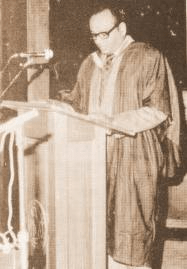
AnandarajanI first met Anandarajan when I was fourteen years old, a few weeks before I was to join St John’s. Anandarajan was introduced to me at a family function, as my would-be principal. The first thing I noticed about him was the total lack of aloofness. His response was ‘I say, I was a classmate of your mother at St John’s, and she was the only girl in the class whom I was scared of’ (which my mother vehemently denied!). In the years that followed I came to know Anandarajan more closely, first as a teacher, and then as a close family friend. In those days at St John’s the first year Advanced Level classes occupied the open sheds opposite the Vice-Principal’s house, and everyday from my classroom I would see Anandarajan walk purposefully across the school grounds from his residence to the principal’s office. If it was a Monday, I would see him again a few minutes later, wearing a black academic-gown walking up the stage of Peto Hall to chair the assembly. I used to enjoy those Monday morning assemblies, as they provided a welcome reprieve from the stress of cramming for exams. Anandarajan would invite interesting speakers to address us, from Hindu mystics to those who spoke on more earthy topics such as pollution and war in the Middle East. Ironically for many of us in those days, war was something that happened only in distant places. If there were no outside speakers Anandarajan would address the assembly himself. It was on one such occasions that I learnt a value that I have cherished ever since then. It is in Anandarajan’s own words: “Always defend yourself. Never let anyone accuse you falsely – not anyone – not even me. If you let that happen, part of the blame is yours”. Continue reading Principal Anandarajan and the Legacies of a Long and Pointless War: Luther Uthayakumaran
Kudumbashree in Chandydesham/Muneerland — In Three Parts

Part One: Prologue

In 2008, I reported the results of research on Kudumbashree women leaders at the village level, from seven districts in Kerala. Those were the days when Kudumbashree was being projected as the ultimate answer to all of women’s woes, and the chorus consisted of politicians, official feminists, researchers, bureaucrats, development experts – in other words, everyone, well, almost. What I had to say was not pleasant to their ears. However, implicit in my reporting was the essential changeability of Kudumbashree, which was after all a government programme. The discussions around the modifications of the Kudumbashree bye-law and its approval were on during our fieldwork, and even though we reported after it was finalised and approved, it was too early for us to assess its impacts.

Continue reading Kudumbashree in Chandydesham/Muneerland — In Three Parts

UGC Guidelines on the Safety and Security of Students in Higher Educational Institutions – Protecting Students or Building Walls ? Sujata Chandra

Guest Post by Sujata Chandra

The University Grants Commission has issued a set of ‘Guidelines on Safety of Students On and Off Campuses in Higher Educational Institutions‘ in April 2015, which is beginning to be discussed recently by students and faculty in many universities and higher educational institutions (HEI). They begin by discussing the height of walls and kind of barbed wire that are needed to ‘fence’ in higher educational institutions. But the most disturbing thing is the kind of walls and barbed wire they seek to install in the minds of students.

The ‘Guidelines’ feature a number of problematic provisions in the name of assuring a ‘safe and secure learning environment’ for students. These provisions, if implemented, will simply assert the state’s notion of morality and end up transforming students into submissive entities. The vision of ‘students’ in these guidelines is that of infantile beings who require ‘permission’ from authority figures (university administration, law enforcement officials and ‘parents’) at every stage of their life on and off campus.

One of the key provisions relates to the necessity of setting up police stations within university campuses. The presence of police forces within university campuses can only have a ‘chilling effect’ on student life, especially with regard to the quality of political activism and discussion. Universities are meant to be spaces of liberty and autonomy, and the presence of policemen on campus does not bode well for either. One can clearly envisage university authorities asking students to obtain ‘police permission’ to hold meetings, protests, screenings and simple gatherings. Ostensibly, the presence of a police station on campus is supposed to act as a deterrent to sexual harassment and sexual violence. Continue reading UGC Guidelines on the Safety and Security of Students in Higher Educational Institutions – Protecting Students or Building Walls ? Sujata Chandra

Appeal by the Striking Students of Delhi College of Art – Students of Delhi College of Art and Ambedkar University, Delhi

Guest Post by Students of Delhi College of Art, with a statement in solidarity by students of  Ambedkar University, Delhi (Department of Visual Arts)

[ This post compiles communications sent out by students of the College of Art, Delhi, their charter of demands (which include very basic and fundamental demands – and it is indeed a revelation that students have to resort to a strike to get this charter even noticed) and a letter in solidarity (see end of the post) with the College of Art students from Students of the Department of Visual Arts, Ambedkar University, Delhi. We are posting this to continue to bring to attention the condition of students of art, media and film in the country. Kafila has already posted articles on the conditions of the students of the Film & Television Institute of India. This post also needs to be seen in the context of the recent statement by the Minister of Culture, Government of India, about ‘cultural pollution’. Clearly, the rot is within institutions, and has not been caused, as the minister seems to think, by the ‘encroachment of Western culture’. We hope that this series of posts can contribute to a real debate about the state of art, culture and cultural institutions in India and the rest of South Asia. ]

Students of College of Art, New Delhi have been on strike for last thirteen days. The strike had to happen, when the individual voice of art students in the college was ignored and suppressed for years. This bundling up of dissent was inevitable.

Continue reading Appeal by the Striking Students of Delhi College of Art – Students of Delhi College of Art and Ambedkar University, Delhi

Muzaffarnagar Baaqi Hai – Critical Readings Online and Offline: Akash Bhattacharya and Arif Hayat Nairang

These are guest posts by Akash Bhattacharya and Arif Hayat Nairang

The film Muzaffarnagar Baaqi Hai has been in the news recently, and not always for the right reasons, having attracted disruptive and abusive protest at some screenings. Following a day of counter-protest in which the film was screened all over the country, a friend teaching in a Delhi University college suggested screening it in her college, only to be told by the student representative that it would “cause trouble” (“bawwal mach jayega ma’am!!”). She asked what that meant and if he had seen the film, and he simply said, “nahin, bhaiyya logon ne kaha hai ki woh film bahut buri hai” (No, but our elder brothers have said it’s a bad film). 

In an atmosphere where political self-censoring comes as easily to the current generation of students as scouring the net for “blocked content” we present below two readings of the reception of the film, the first ruminating on whether the film addresses the complexities of communal mobilisation adequately; and the second inquiring in the context of social media and particularly Facebook, what constitutes the ‘liking’ of an image or idea. The idea of posting these comments is as much to give space to these arguments as it is to make a larger point that the ‘sickular left’ voices that are presumably behind the film love discussion, critique and disagreement. That to my mind is the way forward, not pre-empting the always-already hurt sentiments of the bhaiyya log whosoever they may be.

Continue reading Muzaffarnagar Baaqi Hai – Critical Readings Online and Offline: Akash Bhattacharya and Arif Hayat Nairang

Allahabad High Court Order on Government Schools in U.P: Devanik Saha

This is a guest post by Devanik Saha

The judiciary in India can be highly unpredictable. Either it is accused of not doing enough to provide justice to victims or it is hailed for giving landmark judgments. In a recent controversial decision, the Allahabad High Court ordered that all children of government servants and elected representatives in Uttar Pradesh should mandatorily send their wards to government schools. It noted that “Only then would they be serious enough to look into the requirements of these schools and ensure that they are run in good condition”.

While the decision has evoked sharp reactions from UP legislators, it has been fiercely debated in the media fraternity, with mixed responses. The wretched condition of government schools (in every state) in India isn’t a hidden fact. While India has achieved impressive rates of school enrolment – the quality of education and learning outcomes – have been extremely dismal.

An analysis by data journalism portal IndiaSpend revealed that Rs 5,86,085 crore has been spent on primary education in the past 10 years and 80% of the expenditure on education is spent on teachers, but the state of affairs continue to be dreary, which has led to the mushrooming of low income private schools. The number of students enrolled in private schools in UP has risen from 32.2% in 2006 to 52.8% in 2014, according to the Annual Survey Education Report (ASER) by Pratham, an education NGO.

Continue reading Allahabad High Court Order on Government Schools in U.P: Devanik Saha

In Solidarity with the Students of the Film &Television Institute of India (FTII)

We, the undersigned teachers, scholars and researchers within and outside the university system in India, are disturbed by the repeated and systematic attempts to undermine the academic autonomy of universities and other institutions of teaching and learning, such as the FTII (Pune), by the government. There is a concerted effort to monopolise academic spaces by replacing substantive academic autonomy with policies aimed at destroying academic excellence, diversity, creativity and an atmosphere in which students and teachers can think critically and function freely.

Further, we strongly protest the organised attacks against students and other individuals, in universities and elsewhere, for critiquing the state, be it through film screenings, books, talks or exhibitions. The growing number of censorships and bans is encouraging a widespread culture of intolerance and anti-intellectualism that is openly threatening the freedom of academic expression, democractic and participatory governance, and fundamental rights. Continue reading In Solidarity with the Students of the Film &Television Institute of India (FTII)

Understanding the Neo-liberal Agenda of Knowledge: The Unexposed Dimensions of the CSAT Controversy: Ayan Guha

This is a guest post by AYAN GUHA

The Central Government’s decision, to make the Civil Services Aptitude Test (CSAT) a qualifying paper in the UPSC (Union Public Service Commission) Civil Services Examinationhas come as a huge boost to the morale and aspirations of the students of social science and vernacular background who have been badly bitten by the CSAT bug since introduction of the paper.Every time their counterparts from the science and technical fields raised the cut-off beyond their scoring reach. They have long been campaigning for scrapping the CSAT on the ground that it clearly favours the students of English medium and science and technical background. Continue reading Understanding the Neo-liberal Agenda of Knowledge: The Unexposed Dimensions of the CSAT Controversy: Ayan Guha

औसतपन के दिन

भारतीय फिल्म एवं टेलीविज़न संस्थान  के छात्रों की हड़ताल लम्बी खिंच रही है. उनका ऐतराज स्थान के अध्यक्ष पद पर ऐसे व्यक्ति को नियुक्त किए जाने से है जो फिल्म और टेलीविज़न की दुनिया में औसत से भी नीचे दर्जे के माने जाते हैं.फिर उनकी किस योग्यता की बाध्यता थी कि वे उस स्थान पर बैठाए गए जिसके साथ मृणाल सेन, अडूर गोपालकृष्णन,श्याम बेनेगल,गिरीश कर्नाड, विनोद खन्ना सरीखे श्रेष्ठ निर्देशकों और अभिनेताओं का नाम जुड़ा है?एक अनुमान शासक दल से उनके जुड़ाव को लेकर लगाया जा रहा है. यह अनुमान मात्र नहीं है, संस्थान की शासी परिषद में भी सत्तधारी दल से जुड़े अनाम लोगों को जगह मिली है, जिन्हें फ़िल्मी या संस्कृति की दुनिया में कोई नहीं जानता. इन नियुक्तियों के प्रति छात्रों के विरोध को यह कह कर लांछित किया जा  रहा है कि वे उनका विरोध मात्र उनकी विचारधारा और शासक दल से उनके संबंध  को लेकर कर रहे हैं.लेकिन क्या ऐसा कहना उचित है? Continue reading औसतपन के दिन

IMA, NCERT and Existing Inequalities – Issues Around Availability and Accessibility of Health Care: Sarojini N. B. and Deepa V.

Guest post by SAROJINI N.B. and DEEPA V

[A story appeared on 11 July 2015 in some newspapers about the Indian Medial Association demanding deletions from a class VII NCERT textbook. An immediate response appeared in Kafila to some of the issues raised by IMA.

This post, whose authors Sarojini and Deepa were centrally involved in the writing of the textbook in question, here put certain things in perspective. They present this as an initial clarificatory response to the news report. ]

We are writing regarding an article “Docs oppose ‘negative’ portrayal by NCERT” that appeared in the front page of The Hindu on 11 JUly 2015, Delhi edition by Bindu Shajan Perappadan. The article refers to the chapter “Role of the Government in Health” in the NCERT’s social science textbook on Social and Political Life-II for Class VII students. The article reports that the IMA has written to President Pranab Mukherjee, Prime Minister Narendra Modi and the Ministries of Health and Education, pointing to the “objectionable description” of private healthcare services. The IMA has also demanded “immediate remedial action” stating in their letter that the “matter should be taken seriously and the NCERT should be directed to delete or re-write this chapter”.

In 2007, several NCERT text books were developed, including the textbook in question Social and Political Life-II for Class VII, through a consultative and contributory process in which many of us were involved. The process led by NCERT was a progressive attempt at reviewing and developing content on a range of subject areas and issues in the country, in order to generate knowledge that is as contemporary and comprehensive as possible, and encourages critical and analytical thinking on the part of students.  While the issues were complex, authors / contributors as a group attempted to develop chapters that would reflect an understanding that is rooted in social, economic and political realities, while making them interesting and comprehensible for class VII students. The chapters foreground existing inequalities and discuss the issues around availability and accessibility of health care – including some key characteristics of the private and public health sector. Continue reading IMA, NCERT and Existing Inequalities – Issues Around Availability and Accessibility of Health Care: Sarojini N. B. and Deepa V.

Slow and Steady : Abhipsit Mishra

This is a guest post by ABHIPSIT MISHRA
“The Government of India would like to bring out a National Education Policy to meet the changing dynamics of the population’s requirement with regards to quality education, innovation and research, aiming to make India a knowledge superpower by equipping its students with the necessary skills and knowledge and to eliminate the shortage of manpower in science, technology, academics and industry.
One can come to trust long sentences less; especially those which are promises made by the state to the citizens; in particular those that are interspersed with cleverly placed punctuation. Continue reading Slow and Steady : Abhipsit Mishra

Stand in Solidarity with FTII Students on 3rd July in Delhi : An Appeal by FTII Alumni

Guest Post by FTII Alumni

(Image : ftii hashtag on twitter)

The students of Film & Television Institute of India (FTII) have been receiving tremendous support from across the country for their strike against the appointment of Mr. Gajendra Chauhan and others in the Governing council of FTII.

As a result of sustained public pressure , I&B ministry has opened up a channel of communication to discuss the issue and a meeting has been fixed with a delegation of students and alumni of FTII on 3rd July, 2015 at the Information and Broadcasting Ministry office, Shashtri Bhavan at 3 pm.

The students efforts at reaching out to more and more has been met with blocking of their various social media platforms.The mainstream media is sending out contradictory messages. This has left the
students vulnerable.

The struggle by FTII students becomes important for all of us since this is not an isolated attack on education and cultural institutions. When looked through the lens of the recent appointments at institutions like ICHR, NFDC, IIT Delhi, CFSI and CBFC or the de-recognition of Ambedkar Periyar Study Circle among others, the resistance of students at FTII becomes even more pertinent and important.

We, as alumni of FTII, urge you to come and stand in solidarity with FTII students as they talk with the ministry. We will assemble at 2pm outside Shastri Bhawan, I&B Ministry (next to Central Secretariat Metro Station). Continue reading Stand in Solidarity with FTII Students on 3rd July in Delhi : An Appeal by FTII Alumni

Do as iSay, not as iDo – Silicon Valley’s two faces on learning: Andrew Keen

ANDREW KEEN writes in The Sunday Times (June 15, 2015) on E-learning, which Indian universities are promoting as the latest and best. It turns out that Silicon Valley IT bigwigs, all frantically developing the perfect software that can finally eliminate human teachers, (a goal being promoted enthusiastically by the Indian system through Massive Online Open Courses MOOC), are themselves sending their children to ‘Waldorf Schools’, in which computers, tablets and smartphones are banned (yes, indeed, BANNED), because, says the Media and Technology Philosophy Statement of Waldorf School:

Waldorf educators believe it is far more important for students to interact with one another and their teachers, and work with real materials than to interface with electronic media or technology.

Oh my. Are they taking us back to the Dark Ages, as Indian teachers want us to?

Or (Heavy Irony Warning) – do children need ‘traditional’ education with human teachers and human interaction, so that they can develop the creative skills necessary to develop the software that can eliminate humans? 

And of course, it will inevitably be e-education for the masses, and increasingly expensive “traditional education” for the elites. As Keen puts it:

It is yet another irony that, over in California, the Waldorf School of the Peninsula says it provides a “Renaissance education in Silicon Valley”. While an online humanities-lite education is good enough for the masses, the children of successful venture capitalists and digital entrepreneurs are being educated in an unambiguously low-tech environment dominated by the physical relationship between teacher and student and a body of core knowledge that stretches back for hundreds of years.

Keen quotes William Deresiewicz:

Moocs, Deresiewicz argues, are “about reinforcing existing hierarchies and monetising institutional prestige. The kids at Harvard get to interact with their professors. The kids at San Jose State get to watch the kids at Harvard interact with their professors.”

Full article by Andrew Keen starts here:

Online learning is yet to take off in Britain as it has in America, where the market research firm Global Industry Analysts estimates that revenue for the online learning sector will reach more than $100bn (Pounds 64bn) this year.

But if on-line education really is the future, why are so many IT moguls choosing traditional schooling for their own children?

Among the rich and powerful families of Silicon Valley, the new-new thing is to give their children a “Waldorf” education that outlaws computers, tablets and smartphones. Continue reading Do as iSay, not as iDo – Silicon Valley’s two faces on learning: Andrew Keen

‘Merit’ Kills: An Open Letter to the National Commission for Scheduled Castes from Kerala

[This was sent to me by a group of concerned people. They prefer to stay nameless only because our educational institutions, especially technical institutions, which were never really liberal at any point, are now turning notoriously illiberal. The letter points to grave injustice which needs to be investigated and ended. The death of the young female Dalit student is a repeat almost of a similar suicide in Kerala by another female dalit student of Engineering a few years ago, who met her end strangled by ‘merit’, greed, and callous indifference. Here, the greed of the private sector in technical education cannot be blamed.]

Continue reading ‘Merit’ Kills: An Open Letter to the National Commission for Scheduled Castes from Kerala

An Open Letter to Mr Gajendra Chauhan by FTII Student

Guest Post by FTII student

As protests against the appointment of Mr Gajendra Chauhan as new chairman of the Institute gather steam, with students on an indefinite strike since 12th June and a joint protest being organised in Delhi on Tuesday at 11 am in front of I&B ministry in solidarity with the strike, here is an open letter written to the newly appointed Chairman by a FTII student.

Facts are also coming to the fore that not only Mr Chauhan but four of the eight members nominated under ‘Persons of Eminence’ category to the society also have saffron connections, further demonstrating how the Sangh Parivar is keen to change the very ethos and nature of these institutions and establish its regressive agenda.

Dear Mr Chauhan,

I am choosing to address you personally after listening to you respond on several TV news debates about the recent opposition against your appointment as Chairman at FTII. I am a student of FTII and part of the protest. Continue reading An Open Letter to Mr Gajendra Chauhan by FTII Student

Bread and Circuses? No sir, circuses alone will do.

Edited and updated version of the post.

I had the great fortune to be invited as an audience member to a live interaction with Union HRD Minister Smriti Irani last evening, televised live on Aaj Tak. I say “great fortune” because despite the fact that I walked out of this “interaction” in speechless disgust around an hour into the programme, I probably learned more about the state of politics and media in this country in one evening than I could have from years of academic study. And the irrelevance of academics was exactly what was on display last evening, never mind that the topic of the interaction was the state of higher education in the country.

I reached the venue – the auditorium of Khalsa College, Delhi University – at about 5.15 pm for a 5.30 pm programme. The mood was surprisingly charged, even electric for what I imagined would be a sober discussion on somewhat boring topics like syllabus formation, university infrastructure, promotions and pensions, the points system, and most importantly, the changes proposed under the Choice Based Credit System (CBCS). The auditorium was already packed – not so much with teachers and students – but with a large number of ABVP activists, BJP volunteers, and committed party supporters from within and outside the University. Nothing wrong with having a politically committed section dominating the audience of course. But if the resultant mix is innocently termed “the public” – the term the anchor used was “janta” – then that constitutes the first point of deception. I took a seat in the second row as instructed, surrounded by triumphant, pumped-up BJP supporters shaking hands with each other, suddenly feeling small and irrelevant, having come prepared with questions on Delhi University. At one point, turning to speak to the person next to me, I encountered a gentleman who introduced himself only as a “social worker” and asked me to elaborate on the problems with the university. As I began to list them however, he cut me short with a wave of a hand to say the government will prevail over all of them, and turned back to gaze admiringly at the life-sized posters of Modi all around us. I realised the person knew absolutely nothing about the University or teaching as a profession, and couldn’t care less.

Two anchors from Aaj Tak – Anjana Om Kashyap and Ashok Singhal – were on stage, interacting intermittently with the audience. At one point, Kashyap turned to the audience and said she was aware that there were many eminent professors in the first two rows who had been invited by Aaj Tak, but that she would begin the interaction with the Minister first with general questions on politics, and then move on to the topic of the evening – higher education. Nobody seemed happy with this, but having little choice, we vaguely nodded our assent. In walked Irani, striding up confidently on to the stage. Without so much as acknowledging the audience or making eye contact, she began to banter with the anchors, saying she only had half an hour and had not agreed to two hours, etc. While this time bargaining was going on, the crowd began to settle down somewhat, and the cameras began to roll. As planned and announced, Kashyap began with politics, asking Irani about her Twitter war with Rahul Gandhi and with her frequent visits to Amethi. As far as I or anybody who cares deeply about what is happening to Delhi University and other universities in the country was concerned, THAT WAS THE END OF THE EVENING.

Continue reading Bread and Circuses? No sir, circuses alone will do.

Position Paper on Higher Education: Academics for Creative Reform

“The manner in which the state is intervening in higher education is causing concern and even alarm in the academic community. Both the unlamented UPA—II regime and the current NDA government have been remarkably similar in their authoritarian impatience to introduce wholesale changes without adequate or careful preparation. This position paper is the collective product of roughly six months of discussion among teachers of several central universities in Delhi. It is an attempt to participate in the process of critical self evaluation of the university system as it is today. It is also our considered response to the many policy statements and directives issued by the MHRD and the UGC recently”

Please click on the link below for the complete position paper on proposed reforms in higher education, prepared by Delhi-based Academics for Creative Reform and released at a press conference today:

PositionPaper12May2015

बाल श्रम कानून में बदलाव का औचित्य :किशोर

Guest Post by Kishore

Photo courtesy : newznew.com

संसदीय कैबिनेट ने १३ मई को बाल श्रम प्रतिबंधन एवं नियमन कानून (CLPRA act) में संशोधन को मंजूरी दे दी. मुख्य सकारात्मक बदलावों में १४ वर्ष की आयु तक किसी भी व्यवसाय अथवा प्रक्रिया में बाल श्रम पर पूर्ण प्रतिबन्ध का प्रावधान किया गया है जो स्वागत योग्य है. साथ ही ज्यादा कठोर सजा एवं जुर्माने का प्रावधान भी किया गया है जो कि सकारात्मक है. हालाँकि अभी भी यह बाल अधिकार समझौते की कसौटी पर खरा नहीं उतरता क्योंकि इसमें १४ से १८ साल के बच्चों को गैर खतरनाक उद्योगों में काम करने की अनुमति दी है पर फिर भी चौदह वर्ष तक पूर्ण प्रतिबन्ध एक प्रगतिशील कदम है.

चौदह वर्ष तक पूर्ण प्रतिबन्ध के बावजूद पारिवारिक व्यवसायों में बच्चों के काम करने को छूट दी गयी है .बच्चे पारिवारिक व्यवसायों में काम कर सकते हैं बशर्ते यह काम बच्चे स्कूल जाने के बाद करते हों. सरकार इस छूट का मुख्य कारण यह बता रही है कि इससे बच्चों को अपने पारंपरिक काम सीखने का मौके मिलेगा.

आइये इस बात की समीक्षा की जाये कि यह कारण कहाँ तक तार्किक है. सरकार पारंपरिक कौशल को लेकर कितनी चिंतित है यह तो पिछले बीस साल में हथकरघा और अन्य पारम्परिक पेशों के लिए बनाई गई नीतियों से स्पष्ट है. कोई उनसे पूछे की पिछले बीस सालो में घरेलू उत्पाद में पारंपरिक व्यवसायों का योगदान किस दर से बड़ा है? अगर सरकार को पारंपरिक कौशल के लुप्त होने का इतना ही डर है तो क्यों नहीं इसे स्कूली पाठ्यक्रम में शामिल करती ? अगर इसे पाठ्यक्रम में शामिल किया जाये तो बच्चे पढाई के साथ साथ व्यावसायिक कौशल भी सीखेंगे जो उनके जीवन में काम आयेगा. साथ ही पढाई के साथ काम सीखने से पढ़े लिखे लोगों में श्रम को नीची नज़र से देखने के नज़रिए पर भी लगाम लगेगी और शिक्षा और शारीरिक श्रम के बीच का फासला घटेगा. Continue reading बाल श्रम कानून में बदलाव का औचित्य :किशोर

Rattling the bag – Language Knowledge and the transformation of the university in South Africa and India: Dilip Menon

[Note: Recent events in South Africa – from raging student movements across university campuses to xenophobic violence in the streets of Durban – seem to echo so many struggles both inside and outside the university “here.” This is the second post from South Africa that seeks to listen and travel across. The first, by Richard Pithouse, is here.]

Guest post by DILIP MENON 

Susa lo-mtunzi gawena. Hayikona shukumisa lo saka
Move your shadow. Don’t rattle the bag

JD Bold, Fanagalo Phrase Book, Grammar and Dictionary, the Lingua Franca of Southern Africa, 10th Edition, 1977

In the bad old days in South Africa, whites spoke English or Afrikaans, the languages of command. When they did engage with those that did not speak English, there was Fanagalo, a pidgin based on Zulu peppered with English and some Afrikaans. Fanagalo was developed in the mines and allowed directives, if not conversation. The struggle against apartheid produced its freedoms, its heroes and heroines and new dreams of equality. As Richard Pithouse in his article shows, twenty years down the line the sheen has worn. Unemployment, xenophobia, violence, crime and a seemingly entrenched inequality dog our dreams. We live with the constant premonition of becoming an ordinary country, a nation like any other. Continue reading Rattling the bag – Language Knowledge and the transformation of the university in South Africa and India: Dilip Menon

South Africa in the Twilight of Liberalism: Richard Pithouse

[Note: Recent events in South Africa – from raging student movements across university campuses to xenophobic violence in the streets of Durban – seem to echo so many struggles both inside and outside the university “here.” This is the first of hopefully several posts from South Africa, that seek to listen and travel across.]

Guest Post by RICHARD PITHOUSE

South Africa was supposed to be different. We attained our freedom, such as these things are, after everyone else but Palestine. It was late in the day but the afternoon sun was glorious and the best people, people who had passed through the long passage of struggle, told us that we would be able to avoid the mistakes made everywhere else.

There was a mass movement that, whatever its limits, had won tremendous popular support and carried some noble ideals through its travails. Its leaders cast long shadows. Our Constitution, we were always told, was as good as they get. Liberalism, apparently vindicated by history, had its evident limits but there was, it was said, lots of room for deft manoeuvre within those constraints. We were assured that there was room for everyone at what Aimé Césaire had called the ‘rendezvous of victory’.

For a long time the presence of all kinds of features of the past in the present was widely understood as something that would be resolved in time. Land would be redistributed, schools would flourish, houses would be built, there would be jobs – the kind of jobs that reward hard work – and universities would emerge, bright and bold, from their cocoons spun by settler culture. Time, it was generally believed, was on the side of justice and the eventual redemption of the suffering, striving and struggles of the past.

Continue reading South Africa in the Twilight of Liberalism: Richard Pithouse