Category Archives: Education

Freedom and the University – Reflections from a Teacher: Rimi.B.Chatterjee

Guest Post by RIMI B.CHATTERJEE. Photographs by RONNY SEN.

Graffiti on Jadavpur University Walls. Photograph by Ronny Sen

There has been a lot of noise about the recent agitation at Jadavpur University, and a lot of slanted media coverage. Allow me to set the record straight on a number of points.

Continue reading Freedom and the University – Reflections from a Teacher: Rimi.B.Chatterjee →

Prose of Power and the Poetry of Protest – An Outsider’s Attempt to Make Sense of the ‘Kolorob’ in Kolkata: Uditi Sen

Guest Post by UDITI SEN

51288650-29337-hokkolorob
#Hokkolorob – Embodied

It’s been more than a week since tens of thousands of students marched in a rain drenched Saturday in Kolkata, in solidarity with Jadavpur University students and their fight for justice. Much has happened since to delegitimise this mammoth, genuinely popular and student-led march. A counter-march, the co-optation of the victim’s father by the ruling party, adverse propaganda in the press and fatigue and confusion amongst the protestors have been some of the dampening developments that followed the unexpected show of student power. True to their clarion call, hok kolorob (let there be clamour), the marchers made a lot of noise. A week later, as the numbers of protestors on the streets have dissipated as fast as they had congregated, it is perhaps time to step back from the euphoria of the gathering and the intimidation and murky co-optation of protest that followed, to reflect on the political meanings and potential of this uprising.

The march was not organised by any single political party, though many with experience or background in student politics of one ilk or the other, marched. The vast majority, however, were students who had never marched before and had no experience of politics. The question therefore arises, what, if anything is the unifying ideology of this body of protestors? What goals motivate them? Above all, the question that is doing the rounds the most, on social media, on mainstream news and on the streets is what are the politics of the protestors? The question of politics is seldom posed directly. Its ubiquitous presence, however, can be clearly read in the answers provided regarding the nature of the march, the motivations of the protestors and the identity of the marchers. Unsurprisingly, diametrically opposite sets of answers emerge from members of the ruling party, inside and outside Jadavpur University; and the people who took to the streets on Saturday. From the Vice Chancellor, the Education Minister and officially ordained leaders of the ‘youth’, such as Abhishek Banerjee and Shankudeb Panda, characterisations emerge that focus on indiscipline on campus, presence of Maoist and other outsiders and deep conspiracies. From students of Jadavpur University and their sympathisers, assertions emerge that this protest is about justice and not about politics. Both characterisations fail to capture what is at stake.

Continue reading Prose of Power and the Poetry of Protest – An Outsider’s Attempt to Make Sense of the ‘Kolorob’ in Kolkata: Uditi Sen →

#Hokkolorob – Images from a Jadavpur Solidarity Meeting in Jantar Mantar, Delhi

Here are some images from a  meeting held in solidarity with Jadavpur University Students at Jantar Mantar, New Delhi, on Thursday, September 2014. Students from Delhi University, Jawaharlal Nehru University, Jamia Millia Islamia, Indian Institute of Mass Communications, teachers and professors from different universities in Delhi, Jadavpur University Ex-Students, Workers and Professionals from the Delhi NCR Region spoke at the meeting. A signature campaign was undertaken, and the assembled people wrote their statements on to a scroll in support of their friends at Jadavpur.

All Photographs are by Akhil Kumar, Youth Ki Awaaz. 

This slideshow requires JavaScript.

Khushi Ram, a terminated worker from the Maruti Suzuki Factory at Manesar had come from Haryana to express the solidarity that the workers of the Delhi-NCR region have for the students of Jadavpur University. He read a poem at the gathering. Kafila caught up with him as the meeting was about to end. Here is a video of him reading his poem for the readers of Kafila, and a brief record of a conversation with him about solidarity between workers and students.

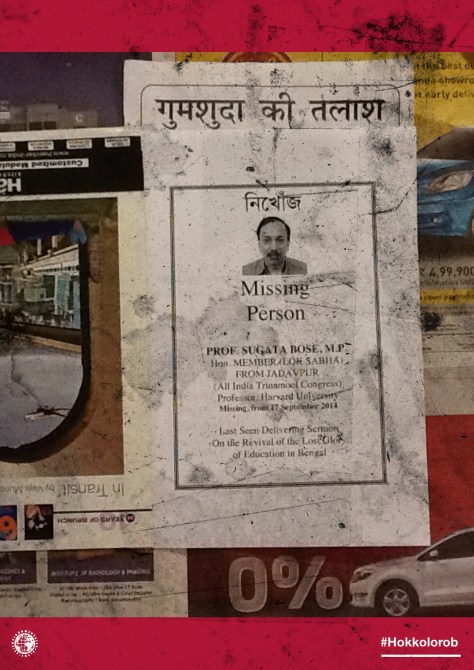
Missing Person Notice: Ben Zachariah

Guest Post by Benjamin Zachariah

Looking for Prof. Bose

It was not so long ago that Sugata Bose, now Lok Sabha Member for Jadavpur, made his way back from Harvard to serve his people. West Bengal had voted for ‘poriborton’, ‘change’, and as everybody assumed that Bengalis loved their fellow-men who had been anointed abroad, Sugata Bose returned to conquer the heights of Bengali higher education. The plan was to use a brand name within a brand name to shore up another brand name : Harvard, Netaji, Presidency. The Trinamul Congress, Bose was confident, would not interfere with his plans. Or so he said in public; his mother, Krishna Bose, had been the Trinamul Congress’s Presidential candidate, and long regarded as the force behind the attempted bhadramahilafication of Didi, apparently a prerequisite for political acceptability in West Bengal (otherwise known as Waste Bengal or Poschimbongobongo). It was therefore no surprise that his plans did not diverge from the plans of the TMC, although ‘internal differences’ were often heard of. It was also no surprise that, as the attempts to turn Presidency ‘University’ into the font of moral and intellectual legitimation for the TMC faltered, Bose took the mantle of his great-uncle upon himself and stood as a candidate for the TMC in the Lok Sabha elections, from the Jadavpur constituency. There was not even the pretence that Sugata Bose stood on his own credentials: his campaign marches were led by a child in Netaji uniform and Netaji glasses, prompting a complaint to the National Commission for Protection of Child Rights.

Now, in the Jadavpur constituency, duly won by Netaji’s heir, and not by a hair’s breadth, developments at Jadavpur University are cause for concern.

Continue reading Missing Person Notice: Ben Zachariah →

Note of Solidarity with the Students of Jadavpur University: Jagriti

Guest Post from Jagriti, Women’s Development Cell, Bharati College, Delhi University

(The authors of this post sent it to us at Kafila saying –  “…since we don’t have any direct mean of contacting them (Students of Jadavpur University), we wish to do so through, if possible, your website”. Accordingly, we are uploading this post to honour their wishes and their sense of solidarity)

Dear students of Jadavpur University (JU),

We, members of Jagriti, the Women’s Development Cell of Bharati College, University of Delhi, pledge our support to your struggle for gender justice and administrative and pedagogical accountability. We are deeply disturbed to receive news of administrative indifference to sexual harassment and of the consequent police brutality in JU campus. We unanimously and unequivocally condemn JU administration and the West Bengal police for ignoring students’ valid demands and for orchestrating violence onto students.

In iterating our support to you, we iterate also the belief that the entire administrative mechanism of JU failed to protect its own students. We hold the Vice-Chancellor (VC) and the Dean of Students responsible for not ensuring that the students’ demands were satisfactorily addressed; we also hold the Internal Complaints Committee responsible for letting what could have been only a campus-specific issue escalate into a major humanitarian and academic crisis. This incident is a lesson not just for JU but for educational institutions and workplaces globally to comprehensively commit themselves to gender justice and to accountability. University administrations are in anyway obliged to engage with their students in healthy and open dialogues on each and every issue that the students, persons whom the university is supposed to service, feel pertinent, and to do the complete opposite, to break down all communication and instead call armed police personnel to violently disperse students is totally unacceptable. JU has been known nationally as well as internationally as a hub of free and liberal thinking, and this shocking attempt to choke dissent out of it attracts our unstinting condemnation.

We support your demand for the non-extension of the tenure of Mr. Chakrabarti, the current interim VC. This issue is political, but it does not belong to any political party, and we commend your transcending political barriers in pursuance of your struggle against the JU administration. We commend your courage, strength and commitment to gender justice and to human rights, and offer our condolences for the losses which you have suffered these past few days. Through this note, we also appeal to the Governor of West Bengal to initiate a magisterial enquiry into the police brutality on JU campus, and have all officials, JU as well as police, who ordered this dismissed from service and tried in a court of law for gross dereliction of duty and for grievous injury to innocent lives.

Jagriti unanimously stands in solidarity with the complainant and the students of Jadavpur University.

This post was sent to us by Pallavi Rohatgi on behalf of Jagriti at Bharati College, Delhi University.


Jadavpur’s Infectious Autumn Thunder Goes Viral: Kasturi

Guest post by Kasturi

One of the slogans churned out of the womb of turbulent Paris in the Maydays of 1968 was ‘Don’t trust anyone over 30’. The student uprising of May ‘68 with its audacity and exaggeration might have failed. Yet the mahamichhil (grand rally) called by students which took command over the heart and pulse of Kolkata on 20th September was a literal, vivid, living embodiment of this slogan. As I stood with a video camera on a spot on the Jawaharlal Nehru Road, with hope to capture the moments and 50,000 faces that made history with each footstep, all I could see was an ocean of people most of who had perhaps not even reached their twenty fifth year, and many of who were walking their very first rally. Those slightly older, those weathered yet young at heart paced alongside them in solidarity. ‘Such a student gathering – so huge, determined and disciplined – I have not seen in my life’, wrote poet Sankha Ghosh, ‘This really moved me. It’s very early to say if this will mark the beginning of a new era but I will reiterate this is one of the biggest student rallies I have seen in my life’.

The rally was replete with slogans reflecting basic demands of the movement, but there was a unifying chant, rather a call to action, that instantly bonded with and caught the fancy of the first timers that hit the street – Hok, Hok, Hok Kolorob (‘let there be clamour’). A call, ripped off from a popular song by Bangladeshi singer Ornob and used as hashtag on social media to mobilize – was surreal, refreshing, imaginative enough to break the deafening silence, stupor and suffocation strangling students’ aspirations for democracy, freedom of expression and association across education campuses of Bengal. The other interesting aspect of this call was that unlike regular slogans where someone leads and the rest follow, here there was no single lead but many voices all chanting the four words in unison, accompanied by clapping of hands. As a comrade observed, ‘the zeitgeist and slogan of the contemporary present is #hokkolorob’!’ (‘Kolorob’/ ‘kalrav’, roughly translated here as ‘clamour’, conveys the sense of a symphony of birdsong in many Indian languages.) Continue reading Jadavpur’s Infectious Autumn Thunder Goes Viral: Kasturi →

A Letter to the Vice Chancellor of Jadavpur University, Kolkata: Ahona Panda

Guest Post by AHONA PANDA

[Ek Je Cchilo VC / Once There Was a VC – Thanks to Utsavdan, and to Manik-da of Bishop Lefroy Road]

To

The Vice Chancellor,
Jadavpur University,

and the Education System of West Bengal.

Respected Sir,

I would like to return to this university a gold medal that it awarded me, then a girl of 21, in the year 2009. I’ve never worn that medal since my convocation, and it lies in the box it was awarded in. I was a student of the English department in this university, and went on to study at Oxford and University of Chicago. Continue reading A Letter to the Vice Chancellor of Jadavpur University, Kolkata: Ahona Panda →

Partha Chatterjee on Partha Chatterjee – An Interview with an Impostor: Partha Chatterjee

Guest Post by PARTHA CHATTERJEE

Continue reading Partha Chatterjee on Partha Chatterjee – An Interview with an Impostor: Partha Chatterjee →

From Jadavpur to Everywhere #Hokkolorob – Let There be Clamour

#HOKKOLOROB
#HOKKOLOROB

More then one hundred thousand students and their friends (according to Kolkata Police estimates) defied the rain to walk in protest yesterday against the assault on Jadavpur University by Kolkata Police, backed by an insensitive University Vice Chancellor and a cynical State Government. There were students, ex students, professors, students from Presidency University, and many other colleges in Kolkata and the neighborhood, there were many ordinary citizens, some who had never been university students, and many who had stopped being university students a long time ago.

Continue reading From Jadavpur to Everywhere #Hokkolorob – Let There be Clamour →

Notes from Jadavpur: Ahona Panda

Guest Post by Ahona Panda

About eight years ago, while lounging about doing nothing much in the campus of Jadavpur University where I was a student of the English department, I came across some callously etched graffiti:

Jodi prem na dile praane
Tobe Jadavpure pathanor ki mane?
(If you haven’t given this life some love–
What is the point of sending one to Jadavpur?)

Eight years on I cannot imagine the luxury of lounging about doing nothing much. One moves on in life after graduating from Jadavpur University. Meanwhile, in home and the world, the complete freedom (some will persist in calling this anarchy) of the JU campus has made it a legend somewhat like Dirty Harry: either worship and put it in on a pedestal, or condemn it thoroughly. The reputation of JU since the infamous 1970s has been as a hub of constantly bubbling anarchism, where Naxalites are hatching their next program of action, where ignorant armies like SFI and other anti-SFI groups clash by night.

Continue reading Notes from Jadavpur: Ahona Panda →

Happy to Disturb – RJ Sayan and The Jadavpur Police Station, Kolkata

The disgusting police violence and simple thuggery unleashed by the Vice Chancellor of Jadavpur University at the behest of his masters in the Trinamool Congress Party and the West Bengal Government has resulted in a counter-offensive that features rage mixed with humour, mirth, music and creativity. Nothing can be more lethal for the zombies in power than the laughter and music of the young.

Here is a brilliant radio clip – produced by RJ Sayan (Meter Down, 104 FM, Kolkata).

Thanks to Debjani Dutta for the translations and the English subtitles in the video.

From Jadavpur University, Kolkata – ‘I am, one of those survivors, who has experienced a nightmare last night’: Tanumay Naskar 


Guest Post by TANUMAY NASKAR

[ This is an account of the events of last night in Jadavpur University, Kolkata, were students sitting in on a peaceful protest against university authorities inaction on a recent complaint of sexual harrassment. What followed (an attack from two fronts, by police and goons affiliated to the Trinamool Congress) brought back memories of the many times that students have been attacked mercilessly in JU. Currently, around 40 students have had to receive medical attention, and 38 are in police detention. Protests against this event are being organized today in Kolkata (at 4:00 in the afternoon, at Jadavpur University, and at 6:00 PM at JNU in Delhi, by the JNU Students Union]

Follow this link to read a detailed time-line of the events as they unfolded.

Follow this hashtag – ‪#‎hokkolorob‬ for details of how people are responding to the situation.


I am one of those survivors who has experienced a nightmare last night.
We were singing. We were dancing. We were peacefully protesting. 
When someone yelled, “Let’s make the barricades, the police is coming”. 
After that, we saw police (READ GOONS) of grade A, barred all the entrances and charged us with Lathis.

Continue reading From Jadavpur University, Kolkata – ‘I am, one of those survivors, who has experienced a nightmare last night’: Tanumay Naskar 
 →

Jadavpur University students struggle against gender violence

In Jadavpur University (a State aided university of West Bengal), the Arts Students Faculty Union organizes a students’ cultural festival, Sanskriti. On the second night of the festival, an incident of violence occurred in the campus that resulted in a chain of events.

On the night of 28th August, during the ongoing festival, a second year student from the Department of History, Jadavpur University, was allegedly molested inside campus premises by a group of people from the hostel, and her male friend (not a JU student), was beaten up. According to the victim, she had gone near the hostel to relieve herself given the unavailability of bathrooms at the time, accompanied by her friend. On their way back, a group of hostel boys allegedly passed snide remarks which led to a scuffle, and then escalated to something bigger. While her friend was allegedly pulled away and beaten up, she was dragged into the hostel, where she claims she was molested. Continue reading Jadavpur University students struggle against gender violence →

The Wrongs In The Right To Education: Noyonika Bose

Guest Post by  NOYONIKA BOSE

In the winter of 2013 I had carried out a survey as part of an NGO CRY, Child Rights and You in 10 schools in the heavily populated slums of Rajabazar, an area in north Kolkata. The objective of the survey was to see whether the Right To Education (RTE) Act was being properly implemented in these schools.  The findings of the survey though not absolutely abysmal, were not positive either. However what I learnt is that it is not entirely the fault of these government and government aided schools that they were unable to provide their students with quality education. It has also to do with the basic structure of the RTE act which is peppered with several flaws. This article is a critique of the RTE and some possible solutions. Continue reading The Wrongs In The Right To Education: Noyonika Bose →

September 5 as Teachers’ Day – The Dalit Critique: Abhay Kumar

Guest post by ABHAY KUMAR

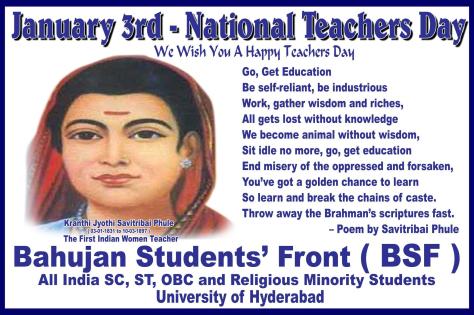
While the schools and educational institutions of the country have been observing September 5 as Teachers’ Day since 1962, on the birth anniversary of the first Vice-President and second President of independent India Dr. Sarvepalli Radhakrishnan (1888-1975), a section of Dalits, mostly students, activists and intellectuals at public universities, are increasingly denouncing its observance. They contend that the birthday of Radhakrishnan, a Brahmin, should no longer be held as Teachers’ Day because he had made no contribution to the educational uplift of lower castes and classes. Instead they exhort people to observe National Teachers’ Day on January 3, the birth anniversary of the nineteenth century social reformer, and teacher from backward caste, Savitribai Phule (1831-1897).

national_teachers_day

According to the biographer of Savitribai Phule, M. G. Mali (Krantijyoti Savitribai Phule, 2005), she was taught by her husband in a school run under the shade of a mango tree. Access to education enabled her to become aware about egalitarian movements at global level as she managed to read the biography of Thomas Clarkson (1760-1846), who fought for liberation of the Black. Later when she became a teacher, it was vehemently opposed by reactionary Brahmins who pelted stone and threw dung on her in order to “save” orthodox Hindu religion. When frustrated Brahmins were unable to deter the zeal of Phules about imparting education, they succeeded in reasoning with her father-in-law, Govinda Rao, to force them to leave home. She preferred eviction with her husband from home to giving up her mission on education. Despite the opposition, they continued to persuade parents to send their daughters to schools. As a result of their hard work, 18 schools were opened from 1848 to 1852. Her dedication to spread education, particularly among subalterns is self-evident from a few lines of her poem. ‘All gets lost without knowledge… We become animal without wisdom…So learn and break the chains of caste….Throw away the Brahman’s scriptures fast.’   Continue reading September 5 as Teachers’ Day – The Dalit Critique: Abhay Kumar →

Collective struggle strengthens autonomy: Saroj Giri

Guest post by SAROJ GIRI, continuing the discussion on roll-back of FYUP in Delhi University. 

Earlier posts on this issue are listed and linked to here.

Here is one way to make sense of the core issue at stake in Delhi University today – this piece by Nandini Sundar arguing that the UGC directive amounts to hampering institutional autonomy of DU.

But this is a flawed position in the present context. It conflates the autonomy of DU with the autonomy of the VC. It construes DU’s autonomy in narrow institutional terms, overlooking the larger movement of teachers and students which is also ‘DU’ and which has consistently opposed the FYUP.

Sundar suggests withdrawal of the UGC directive, the setting up of a DU committee to overhaul the programme, and deliberation in the Academic Council, this time taking proper heed of anti-FYUP views. But do we need a fresh round of discussion on the pros and cons of FYUP?

Absolutely not. For there have been tons of deliberations over the FYUP. Just go back to the minutes and records of the many different meetings and Committees, or recall the many demos and dharnas. There is ample evidence of deliberation where the members of the University have given sound reasons why the FYUP is bad.

Indeed, the picture presented that it is the Ministry or the UGC imposing its diktat from above is simply not true. It is not some committee in the UGC or Ministry which on their own have decided to stall the FYUP. For it is force of the movement against FYUP and the many, many voices active since the last few years who have prevailed now – it is this which is reflected in the UGC directive. Continue reading Collective struggle strengthens autonomy: Saroj Giri →

Autonomy for what, from whom, and for whom?

It seems the unthinkable has happened – the Vice Chancellor of Delhi University has resigned over the UGC’s pressure to withdraw the Four-Year Undergraduate Programme (FYUP). I won’t go into the debate on the FYUP, which has been covered extensively on Kafila and elsewhere [1]. See particularly this post by Professors at the University. I am only interested in two issues that arise from the news coverage of the event as it has unfolded through the day.

One, the question of autonomy. Prima facie, as Apoorvanand and Satish Deshpande have argued comprehensively on Kafila, the resignation of a VC over pressure from the UGC seems to be evidence of bureaucratic or ministerial over-reach. Questions have been raised (rightly) over the timing of this pressure, coming as it does on the heels of a political shift of colossal proportions at the national level. It doesn’t take a rocket scientist (I find myself in agreement with Congress spokesperson Manish Tewari’s language on this) to figure out that the change in Delhi University has political backing. For one, rollback of the FYUP was on the BJP’s agenda/manifesto – that is as political as it gets! Second, it was this very UGC that had been so coy about commenting on the FYUP for the past one and a half years, a coyness that amounted to tacit support. Only very recently had it moved its mammoth bureaucratic feet on the matter, constituting a committee to look into complaints from students and teachers that had finally reached its mammoth bureaucratic ears. The VC, being well acquainted with elephants, would be able to explain the mammoth temporality of this apex organisation better than any of us, having benefited from it for a goodly amount of time. Even after the constitution of the committee, the VC continued to be lauded by the UGC for his efforts at implementation of former HRD minister Kapil Sibal and his successor Pallam Raju’s efforts at radical educational reform. The committee met at a leisurely pace, no doubt fortified by several hundred samosas and robust air-conditioning in the UGC’s Bahadur Shah Zafar Marg office in central Delhi, while anti-FYUP protestors enjoyed the blazing sun or freezing cold outdoors, as they had been enjoying for a year and a half.

Continue reading Autonomy for what, from whom, and for whom? →

स्वायत्तता की फिक्र किसे है? अपूर्वानंद, सतीश देशपांडे

पिछला एक हफ्ता भारत के शैक्षणिक समुदाय के लिए, खासकर उनके लिए जो किसी न किसी रूप में दिल्ली विश्वविद्यालय और विश्वविद्यालय अनुदान आयोग से जुड़े रहे हैं, सामूहिक शर्म का समय रहा है. यह अकल्पनीय स्थिति है कि आयोग एक सार्वजनिक नोटिस जारी करके किसी विश्वविद्यालय के पाठ्यक्रम में दाखिले की प्रक्रिया के बारे में निर्देश जारी करे. आयोग ने दिल्ली विश्वविद्यालय के स्नातक पाठ्यक्रम में दाखिले के सिलसिले में अभ्यर्थियों को कहा है कि वे विश्वविद्यालय द्वारा विज्ञापित चार वर्षीय स्नातक पाठ्यक्रम में प्रवेश न लें. उसने विश्वविद्यालय प्रशासन को फौरन यह पाठ्यक्रम वापस लेने और 2013 के पहले के पाठ्यक्रम को बहाल करने का आदेश दिया है. उसने विश्वविद्यालय के सभी कॉलेजों को भी सीधे चेतावनी दी है कि उसका आदेश न मानने की सूरत में उन्हें अनुदान बंद किया जा सकता है. किसी विश्वविद्यालय को नज़रअंदाज कर उसकी इकाई से उससे सीधे बात करना अंतरसांस्थानिक व्यवहार के सारे स्वीकृत कायदों का उल्लंघन है. व्यावहारिक रूप से यह दिल्ली विश्वविद्यालय का अधिग्रहण है.यह भारत के विश्वविद्यालयीय शिक्षा के इतिहास में असाधारण घटना है और सांस्थानिक स्वायत्ता के संदर्भ में इसके अभिप्राय गंभीर हैं. Continue reading स्वायत्तता की फिक्र किसे है? अपूर्वानंद, सतीश देशपांडे →

History Scholars Write to UGC on Need to Radically Restructure NET

To:

The Chairman, University Grants Commission.

Dear Sir,

The University Grants Commission has mandated that an exam i.e. the National Eligibility Test, be passed as a requirement for the teaching of History at the undergraduate and post-graduate levels, except in the case where the candidate has a PhD. Those who score highly are given the Junior Research Fellowship which greatly strengthens their candidacy for the Ph.D. program.

We the undersigned, as teachers and researchers of History, believe that the NET exam as it exists does not measure competence in History as a discipline in any imaginable sense. The NET’s own understanding of History is fundamentally different from the practice of the discipline across the world. This understanding, as reflected in the question papers, holds History to lie solely in the memorization of facts. Therefore, in the NET’s version of History, the mechanical retention and retrieval of information appears to be the only competence required for the teaching of the subject.  Continue reading History Scholars Write to UGC on Need to Radically Restructure NET →

All Is Not Well at AUD: Natasha Narwal

Guest post by NATASHA NARWAL

Ambedkar University Delhi, a recently established State University in the NCR, has become the new buzz in the academic circles of the Capital. It is seen as space full of creative opportunities by an academic community exhausted by bureaucratic regimes and the sheer weight of established institutions stifling any real creativity and innovations in most central Universities. In a recent article in Economic and Political Weekly, Janaki Nair described AUD as a ‘viable, vibrant space of thinking and learning, striving to provide affordable and yet sustainable fee structures and encouraging creativity and non-hierarchical structures of learning.’ To be fair, such perceptions are not entirely baseless. As it is a recently established University, almost everything, from the various schools, courses, syllabus even physical infrastructure is in the making without very rigid contours. All this gives one a sense of an innovative and fluid space. Many of the faculty members indeed do strive hard to design courses in consultation with students and give them space to express themselves. But beneath this, on the grounds, all is not well at AUD. Continue reading All Is Not Well at AUD: Natasha Narwal →

Save the AP State Archives: Coalition of Concerned Citizens and Academics

This petition is being circulated by a coalition of concerned citizens, local and international academics and scholars

The historical collections at two major archives in Hyderabad, the Andhra Pradesh Government Oriental Manuscripts Library (APGOML) and the Andhra Pradesh State Archives and Research Institute (APSARI), are under threat in the bifurcation of Telangana and residuary Andhra Pradesh. The institutions’ collections are slated for division between the two new states. These collections have long suffered from neglect, and now face the likelihood of irreparable damage from arbitrary division, handling, and transfer.

Local and international scholars and activists have organized a petition to preserve these historical documents. Our primary concern is for the integrity of the collections and we seek to avoid entanglement in the Telangana/Andhra debates. The petition is aimed, in part, at demonstrating that there is a concerned audience of international scholars and interested parties who care about and use these collections. This wider expression of concern will help support the efforts of local citizens who plan to submit the petition to the Governor before the end of the month.

Please take a moment to add your voice:

http://www.ipetitions.com/petition/protect-the-andhra-pradesh-state-archives-and Continue reading Save the AP State Archives: Coalition of Concerned Citizens and Academics →