Category Archives: Everyday Life

Skin Deep – Narratives of Racism in Delhi University: Aashima Saberwal Bonojit Hussain Devika Narayan

Aashima Saberwal, Bonojit Hussain and Devika Narayan are activists associated with New Socialist Initiative (NSI). This article was published in the November 2010 issue of CRiTIQUE, an irregular magazine brought out by the New Socialist Initiative (NSI) – Delhi University Chapter. 

Kevin is from Kenya. He studies at the faculty of Law. We ask him whether he likes India (he doesn’t) and about the kinds of challenges he faces. He shrugs and shakes his head “I have don’t face any discrimination” He often repeats this sentence at various points of the discussion. After he tells us about shopkeepers who refuse to sell him milk or before narrating how not a single shop at Patel Chest area was willing to type his assignment. “When you go to buy things from a shop they refuse to sell. If you ask for milk they say ‘no milk’ but you can see the Indians buying milk.” Later he tells us a similar story “My mobile phone was stolen. For one week I was thinking how to get a new one. The shops here don’t sell to Africans.” Kevin doesn’t think much of these experiences and dismisses them as insignificant, the ordinary trials of living in a foreign country. A woman on the road provokes a dog, provoking it to bite him, which it does. At Hans Charitable Trust Hospital they ask him for 10,000 rupees for the anti-rabbis injection. This is a service which is provided free of cost, however the small print reads ‘unless you are black’. Our interviews starkly shows that this particular subtext is present everywhere. We don’t realize that for the most mundane of daily activities (like buying milk) there are conditions that apply. The condition that you are not black.

These interviews give us a glimpse of how these students experience classrooms, hostels, streets, the metro and other public spaces. “What does kala bandar mean?” Boniface asks. They point. They laugh. They don’t like sitting next to you in the metro. What must it feel like to enter a strange foreign country where people across the board categorise you as sub-human? Strangers call you black monkey. “When I go back from college to hostel people on the streets keep laughing and staring. It is humiliating” Boniface says.

Read the rest of this article here.

Somnath Bharti and the Terrible, Everyday Racism of a South Delhi Mohalla: Aastha Chauhan

This article by AASTHA CHAUHAN was originally published on the Yahoo! News India web site. It is being republished  here so that it reaches a different audience because there is an urgent necessity to widen the discussion on racism in India. 

In the decade that I’ve been working in Khirki Extension in south Delhi, I’ve known it as a neighborhood in a constant state of flux.

When I first began working at KHOJ, an international artists’ association located in Khirki Extension in 2004, the neighborhood was home to architects’ studios, a theatre studio and various offices, followed by a wave of musicians and artists. It was a locality comprised mainly of houses, some built by well-known architects such as Ramu Katakam and Ashok B Lall. Even Jaya Jaitly had a house there. Soon enough, these large plots were sold to builders, who put in apartments that could accommodate more people. But given the terrible infrastructure in the area, with its poor roads and drainage and its tendency to get flooded, many of its earlier residents moved out. Continue reading Somnath Bharti and the Terrible, Everyday Racism of a South Delhi Mohalla: Aastha Chauhan

The Savage Greed of The Civilized – AAP, Moral Posturing and Ordinary Racism

The savage greed of the civilized stripped naked its own unashamed inhumanity’

Africa, Rabindranath Tagore

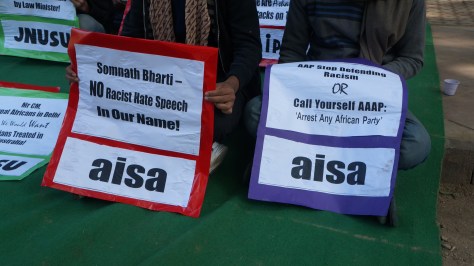
SIGNS AT ANTI RACISM PROTEST IN JANTAR MANTAR

Delhi Law Minister and Aam Aadmi Party leader Somnath Bharti’s midnight raid in Khirki village, during which he ordered policemen to search and enter houses, arrest people without warrants, and allegedly said that “black people, who are not like you and me, break laws” –  strips naked the unashamed inhumanity of the Aam Aadmi Party regime’s moral posturing. Underneath the holier-than-thou mask of that moral posture lies the unmistakably horrible sneer of the ordinary racist thug. This is the real face of Somnath Bharti. I hope it is a face that the Aam Aadmi Party can turn itself away from.

Continue reading The Savage Greed of The Civilized – AAP, Moral Posturing and Ordinary Racism

Protest Against Delhi Law Minister Somnath Bharti’s Racist Vigilantism in Delhi: Kavita Krishnan

Guest Post by KAVITA KRISHNAN

Many of us have felt disturbed by the implications of the incident involving the Delhi Law Minister’s attempted raid on African nationals in Khidki village.

The Minister, Somnath Bharti, (a member of the Aam Aadmii Party) insisted that the police conduct a raid minus a search warrant. Two African women have said, on record, that they were subjected to racist abuse (‘black people break laws’) and beaten by a mob of people (the Minister’s supporters), and that it was the Delhi police who protected them from the mob violence.

[ See Aditya Nigam’s post on the same issue in Kafila earlier ]

There are also reports that one of the women was forced to give a urine sample in public. The women were also subjected to cavity searches and tests – none of which yielded any sign of drugs. The violence against the women was defended in the name of anger against ‘prostitution’ and ‘drug peddling’, while no proof of the same has been presented as yet. In any case, the treatment meted out to the women cannot be justified even if they were indeed prostitutes! Continue reading Protest Against Delhi Law Minister Somnath Bharti’s Racist Vigilantism in Delhi: Kavita Krishnan

Enumerative Practices of the Indian State and the Disabled: Avinash Shahi

Guest post by AVINASH SHAHI

The 2011 Census release on disabled population in India is shocking, exposing the fallacious methodology and technique used by census enumerators while counting the disabled population in the country. According to census figures, the population of disabled people has gone up to 26.8 million in 2011. In the last decade the numbers have increased just below six million from 21.9 million in 2001. Surprisingly, these low numbers follow the collaboration between the Census Commission, NCPEPD and Diversity and Equal Opportunity Centre (DEOC) for sensitizing, and imparting training to census master trainers.

The idea was to frame questions on disability and include these in the Census questionnaire. Nonetheless, millions have yet again been rendered invisible.  In 2001, the Census Commission collected data on five categories of disability among different disabled groups, and found that visual disability emerged as the top category at 48.5%. The other disabilities population enumerated by the census were as follows in descending order: In movement (27.9%), Mental (10.3%), in speech (7.5%), and in hearing (5.8%). In contrast, the 2011 Census initial release percentage among different disabled categories has changed drastically. The persons with blindness now stand at third place.  Continue reading Enumerative Practices of the Indian State and the Disabled: Avinash Shahi

On A Prayer and a Petition: Babu Gogineni

This is a guest post by BABU GOGINENI

“What exactly happened, and what gave you the strength to fight your case, Mr. Salve?” I asked. “Your job as an English teacher was at risk, and your own colleagues shunned you. You are from the Dalit community, and you live in Maharashtra state where militant religion has frequently silenced dissenters – how could you hold out for 7 years?” Continue reading On A Prayer and a Petition: Babu Gogineni

Of Indians and Justice – The Khobragade Affair: Godfrey Pereira

Guest Post by GODFREY PEREIRA

Devyani Khobragade was arrested on December 12th on charges of visa fraud and misrepresentation. At the time of her arrest, she was functioning as deputy consul general at the Indian Consulate in New York.

Soon after her arrest, the Indian government hastily transferred Khobragade to the permanent mission of India to the United Nations (UN), hoping that that this would give her the necessary Diplomatic immunity from arrest. Diplomatically this move was a “by the book” maneuver.

Question: If she had Diplomatic Immunity, why was she transferred to the permanent mission?

Question: If she had Diplomatic Immunity, why was a formal official application forwarded to U.S. authorities for full Diplomatic immunity AFTER she was arrested? Legally the Indian government should have, could have stood their ground, if they really believed that she had diplomatic immunity in the first place; because that’s what they were shouting about through their malfunctioning megaphones from the beginning. Right…Yes…No….Maybe… Continue reading Of Indians and Justice – The Khobragade Affair: Godfrey Pereira

Why I prefer the company of homophobic people: Anonymous

Guest post by ANONYMOUS

It may be a strange thing for a gay man to say, but I welcome the Supreme Court judgement re-criminalising the sexual acts I feel naturally inclined to engage in.

As someone who chooses to admit to his sexuality only before other gay men, and that too very selectively, you could call me closeted. Which means that I don’t feel as unfortunate as the ‘out’ lot which feels as though Indian law is asking it to go back into the closet.

I personally welcome the Supreme Court judgement because it will drill some sense of reality into my straight liberal friends who keep pestering, taunting, hinting, trying to make me say, ‘I am gay’. They will realise that there’s enough homophobia out there, enough of it for the Indian Supreme Court, considered a liberal institution, to re-criminalise ‘unnatural sex’. That gives me some semblance of an excuse, or so I hope, to remain closeted. Continue reading Why I prefer the company of homophobic people: Anonymous

Azadi in the Lexicon of the Aam Admi: Gowhar Fazili

Guest Post by GOWHAR FAZILI

During the swearing in speech at Ram Leela Maidan, the word Azadi found its place of pride on Arvind Kejriwal’s symbolic cap. ‘ Mujhe Chahiye Poori Azadi’ it said.   The word Azadi has travelled from the freedom struggle in Kashmir, to the movement against gendered violence in Delhi and is now entering the lexicon of Aam Aadmi.  The Aam Aadmi’s historic ascension to power through a referendum resonates well with the long standing demand in Kashmir seeking to let the people decide their political future directly.

Continue reading Azadi in the Lexicon of the Aam Admi: Gowhar Fazili

In Tragic and Tough Times – Thoughts in the Wake of A Rape Charge and a Suicide: Sucheta De and Shivani Nag

Guest Post by SUCHETA DE and SHIVANI NAG

In Tragic and Tough Times, Let Us be True to Our Democratic and Gender-Just Principles.

We are confronted by a painful episode involving a rape charge and a suicide, that poses many tough and tangled questions to us – as the JNU community and also as individuals and activists committed to secularism, democracy and gender justice. Let us, for a moment, reiterate what one of the late Khurshid Anwar’s friends has said in his recent post on Kafila: the suicide does not prove him guilty of the charge of rape, and it does not prove his innocence either.

The suicide is a horrible, tragic occurrence – and it is a tragedy we should not compound with irresponsible utterances. A charge of rape does not necessarily turn the accused into a convicted rapist. True. And equally truly, it does not turn the woman making the charge, overnight, into a slut, a murderer, or a communal/political conspirator. Continue reading In Tragic and Tough Times – Thoughts in the Wake of A Rape Charge and a Suicide: Sucheta De and Shivani Nag

Hayaat-e-Azadi, The Life of Freedom: Suvaid Yaseen

Guest Post by SUVAID YASEEN

Ho Agar Khudnigar-o-Khudgar-o-Khudgeer Khudi
Ye Bhi Mumkin Hai Ke Tu Mout Se Bhi Mer Na Sake

[If the ‘ego’ is selfpreserving, selfcreating and selfsustaining, 
Then it is possible that even death may not kill you.]
— Allama Iqbal,  Hayaat-e-Abadi, Zarb-e-Kaleem

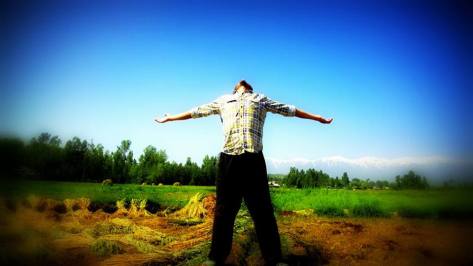
Hayaat / Life
Hayaat / Life

The News

On the evening of 14th July 2013, I received a text message from a friend saying Hayaat had been hit by pellets in the eyes. Both his eyes were damaged. As I read the text, I became numb. I was at loss how to respond, trying to sink in what had just happened.

Continue reading Hayaat-e-Azadi, The Life of Freedom: Suvaid Yaseen

Cultures of Servitude and the Khobragade-Richard Issue: Nissim Mannathukkaren

Guest Post by Nissim Mannathukkaren

When the great lord passes the wise peasant bows deeply and silently farts. (Ethiopian proverb)

When progressive politics finds itself in agreement with Arnab Goswami, then it is time for the alarm bells to ring. What has been unfolding over the last week has been nothing but spectacular: a wronged and humiliated ‘Third World’ nation (finally) standing up to the imperialist Satan over the Devyani Khobragade episode. A story supposedly fit for lore. But in reality it would have been comical only if it did not have serious consequences.

What is comical is a nation whose elites and middle classes are perfectly in sync with the American worldview (India is among the top America-loving nations in the world) and think that America is the epitome of democracy (a survey from a couple of years ago showed that Indians, more than any other people in the world, think that the United States is a multilateral rather than a unilateral actor), whose students and youth dream the American dream (the largest number of foreign students in America are from India), whose rulers salivate at the prospect of an eternal soiree with the American establishment (after all, the Indo-American strategic partnership has been called the ‘defining alliance of the 21st century’) have suddenly woken up to the rude reality that maybe the Americans do not think about us in the same way! Hence our petulant reactions – like a spurned lover.  Continue reading Cultures of Servitude and the Khobragade-Richard Issue: Nissim Mannathukkaren

Khobragade’s Arrest – Labour Law Violation Issue, Not Foreign Policy Issue: Gharelu Kaamgaar Sangathan and NTUI

Guest Post by GHARELU KAAMGAAR SANGATHAN, (GKS) Haryana & New Trade Union Initiative (NTUI)

We express strong outrage at the Indian government’s reaction to the case of visa fraud and exploitation of her domestic worker against Deputy Consul General Devyani Khobragade in the United States. In its dealing of the case, the Indian government is only seeking to protect the dignity and honour of Ms. Khobragade, and has shown a complete lack of respect for the underlying issue – that of the abuse and exploitation of a domestic worker by a senior official. Ms. Khobragade’s father, Mr. Uttam Khobragade, is a politician and has a played a harmful role in suppressing the facts of the case and in diverting attention from it.

Continue reading Khobragade’s Arrest – Labour Law Violation Issue, Not Foreign Policy Issue: Gharelu Kaamgaar Sangathan and NTUI

An Incomplete Reunion – Ruining the Post-Partition Party: Archit Guha

Guest post by ARCHIT GUHA

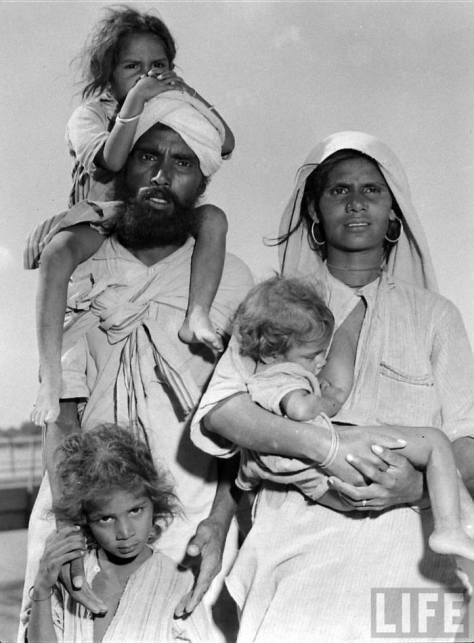
Reproduced without Permission from Life

By this point, every Indian, Pakistani, and their grandfathers has watched the Google Partition ad, tears welled up in their eyes. For the uninitiated, Google’s recent advertisement tugs at heartstrings, telling the tale of two chaddi buddies, separated by Partition, and reunited by their grandchildren nearly seventy years later. When the ad went viral via Facebook, sitting thousands of miles away in America, I bawled as I watched the granddaughter listening to her grandfather’s nostalgic retelling of the idyllic life he led in Lahore, eating jhajhariya, with his buddy Yusuf, and his granddaughter’s instant Google fixes to reunite him with Yusuf in Delhi. Continue reading An Incomplete Reunion – Ruining the Post-Partition Party: Archit Guha

People’s Participation in Planning Mumbai?: Hussain Indorewala and Shweta Wagh

This is a guest post by Hussain Indorewala and Shweta Wagh

Since the past six months in Mumbai, there has been an unusual convergence between urban activists, community groups, rights groups, unions, Non-Governmental Organizations and academics, who have come together to provide a theoretical critique of the city’s neoliberal development model, to formulate a more diverse and hopeful vision for the city than the one proclaimed by its power elite, and to present practical alternatives to plans and projects promulgated by faceless state bureaucracies and unaccountable private consultants.

On 22nd October 2013, more than 1500 people gathered at Azad Maidan to formally present “The People’s Vision Document for Mumbai’s Development Plan (2014-2034)” to the Municipal Corporation of Greater Mumbai (MCGM).[1] The People’s Vision Document (PVD)[2] is a remarkable collective vision statement, an outcome of discussions focused around specific issues in the city with more than a hundred grassroots and community groups, along with activists, experts and academics who participated in them. With this movement, the less advantaged residents of the city have announced and forced themselves into an exclusionary and secretive Development Plan process; refusing to be silent spectators, in a striking example of initiative, organizational ability and creative agency, they have asserted their right to the city’s future, whose owners and managers have done much to keep them out. To use the language of other social urban movements around the world, some of the most marginalized groups of the city are fighting for spatial justice, urban democracy, and have claimed their ‘right to be equal in diversity.’[3] Continue reading People’s Participation in Planning Mumbai?: Hussain Indorewala and Shweta Wagh

As a religious minority, I empathize with sexual minorities: M Reyaz

This is a guest post by M. REYAZ

The Apex Court judgment of December 11, putting aside the Delhi High Court order on decriminalisation of homosexuality, pertaining to Section 377 of the IPC has clearly divided into two ‘queer’ camps, where on one side besides LGBTS are those liberals extending their support to the LGBT cause, and on the other side, there are religious leaders and groups, who otherwise would not even see eye to eye with each other (what is ‘queer’ about this second camp is not so much its sexual orientation, as the strangeness of its banding together against queer people despite their antagonism toward each other).

Continue reading As a religious minority, I empathize with sexual minorities: M Reyaz

Ganguly Must Go – Chairs of Rights Bodies Must be Above Reproach

Statement from Women’s Groups Across India on 16 December 2013

Exactly one year ago, the gang-rape of a young woman triggered immense outrage across the board, putting freedom from rape and sexual assault at the forefront of public debate. From law reform to overhaul of institutions of justice delivery, from media sensitization to public awareness, women’s safety is now squarely on the public agenda, thanks to mass protests. Ironically, during those very protests, on 24 December 2012, a young lawyer revealed that a retired judge of the highest court in land had sexually harassed her while she was working with him as an intern, and that she was unable to speak about it only ten months later.

According to her statement, Justice (Retd) A.K. Ganguly currently the Chairman of the West Bengal Human Rights Commission said, “’You know that I’m attracted to you, don’t you? You must be thinking, what, this old man is getting drunk and saying such things. But I really like you, I love you’. When I tried to move away, he kissed my arm and repeated that he loved me.” This is not merely inappropriate behavior by a senior over junior staff or interns; it is not merely over-stepping of boundaries; it is not merely friendly overtures: such acts constitute a clear case of abuse of power and sexual harassment at the workplace.  Continue reading Ganguly Must Go – Chairs of Rights Bodies Must be Above Reproach

A hunt, the aftermath, angry Indian men and a tragedy: Rahul Roy

Guest Post by RAHUL ROY

Nivedita Menon ends her commentary on the unfolding Tehelka sexual assault case in Kafila by asserting – “the time has come. It is now”. It should be, but is it? Are we witnessing the end game of an old Indian patriarchal sport called sexual assault? The sport is akin to another old game called the royal hunt that was an important part of elite political culture of South Asia. The rules of the sport were then as now heavily loaded in favour of the royal huntsman – weapons, support teams, timing, everything required for the thrill of a kill were with powerful men out to conquer. The expeditions however were not just about the kill. The sport was also a means of asserting authority over tracts of the wild and those that lived there and were by some misfortune not aware of prevailing authority structures. The royal hunt was an event to showcase to subjects the might, prowess and authority of the elite rulers. It was the stamping of power over human as well as animal kingdom. The royal huntsman could not but win. He could not but kill.
Continue reading A hunt, the aftermath, angry Indian men and a tragedy: Rahul Roy

Protect the Privacy of the Tehelka Journalist: Report Responsibly

GUEST POST BY ‘REPORT RESPONSIBLY’
To all editors, journalists, bloggers, users of social media, and the public:

Some websites and blogs are posting the Tehelka journalist’s complaint to the magazine’s management or reproducing parts of it, perhaps with intent to expose a grave act of sexual assault by a man occupying a powerful position. However, in doing so, they are violating basic ethical and legal injunctions on the way cases of sexual assault must be reported.

The journalist’s complaint to her company is a private document and not a public one. While private documents can be leaked in the ‘public interest’, this principle is applicable to the emails of Tarun Tejpal and Shoma Chaudhury sent to Tehelka staffers, not to the journalist’s emailed complaint. In cases of sexual assault, it is a well established principle that the media can name the perpetrator, but not the victim. The identity and privacy of a victim must be protected at all costs.We are distressed that many people are circulating the journalist’s emails, and other journalists, bloggers and users of social media are publishing it in parts or whole.

Continue reading Protect the Privacy of the Tehelka Journalist: Report Responsibly

Sehwan in Monochrome: Farid Alvie

Guest post by FARID ALVIE

It could be other things. (It certainly was other things.) But it could quite as easily be its incomparable food and music that has drawn kings, foreign army generals, enlightened mystics and famous globe-trotters to ancient Sehwan. Standing on the west bank of the mighty Indus, Sehwan – or Siwasitan as Ibn Batuta describes it in his travel accounts – is most famous for being the place chosen by Hazrat Laal Shahbaz Qalandar to settle in in the 13th century. The shrine of the great sufi saint draws hundreds of thousands of people to its doors from all across Pakistan every year. The bazaar around the shrine plays host to a panoply of tongues and customs; the courtyard of the mazaar offering hospitality to visitors from out of town. The impressive gold dome of the shrine is the center from which all activity – cultural, social, religious, political – appears to emanate. Like many of Sindh’s other ancient towns, Sehwan is steeped in a history that continues to breathe.

Through the bazaar:
image

Inside Bodla Saeen’s shrine: Continue reading Sehwan in Monochrome: Farid Alvie

1984 and the Spectre of Narendra Modi: Ravinder Kaur

Guest Post by Ravinder Kaur 

As India begins the countdown to the 2014 general elections, a new discourse has started taking shape around its minority populations. It is called the ‘what about 1984’ argument. The supporters of Narendra Modi in a bid to deflect attention from his role in 2002 pogrom usually throw 1984 at his critics. The critics have lately begun responding by placing 1984 pogrom in  a less grave category in comparison to 2002. The difference we are told is the political ideology – Congress is inherently secular and 1984 an aberration whereas BJP is communal and 2002 symptomatic. This unfortunate comparison means that the ‘what about 1984’ argument has unintentionally turned 1984 pogrom into an exclusive Congress problem even when it sets out to call out Modi’s anti-minority stance. The role of Hindutava ideology has been airbrushed out of the history that led to 1984 pogrom as a consequence.

Continue reading 1984 and the Spectre of Narendra Modi: Ravinder Kaur