
This story of the birth of a new language raises some significant questions for our understanding of how bodies of knowledge are transformed. After the Sandinista revolution in 1979, for the first time in the history of Nicaragua, a huge nation-wide effort was made to educate deaf children. Hundreds of deaf students were enrolled in two schools. They had never been introduced to any of the world’s existing sign language systems, and came to the schools with only the simplest kind of gestural signs they had developed within their families. Their teachers were new and inexperienced, and found it difficult to communicate with their students, but the students themselves had no problem at all in “talking” to one another. With great rapidity they began to build on the common pool of signs, and a complex new language began to emerge, which has come now to be called Nicaraguan Sign Language (NSL). Some years down the line, an even more interesting development is noticed. As younger children enter the school system, they not only pick up the language their seniors had developed, but they confidently break the existing language rules. They invent new signs and deform old ones, and these new signs that do not obey the old rules filter back into the language, making it more complex, richer and more varied.
Category Archives: Everyday Life
Notes from a Metro (Pun Unintentionally Intentional)
Enter Delhi: The boy was about 13, perhaps less. He was riding a bike which was about three times his size. He swerved between the vehicles on the road at Karol Bagh, very much in the wrong in terms of which side of the road he ought to be on, and therefore also in terms of the traffic rules and regulations. But he could not care. I looked at him and wondered,
Dilli dilwalon ki hai – Delhi is a city of the large-hearted, of the daring, the bold and the courageous.
A few days later, one of the auto drivers remarked to me during a journey,
Kehte hai dilli dilwalon ki hoti hai. Lekin yeh jhoot hai. Sabhi log yahan paise ke peeche pade rehte hai aur har koi aapko lootne ki koshish karna chahta hai – It is a saying that Delhi is a city of the large-hearted. But this is false. Everyone here is behind money, and each person is out to loot/cheat you.
Continue reading Notes from a Metro (Pun Unintentionally Intentional)
The (‘Quotation’) Gangs of Kerala
The media in Kerala is in a tizzy these days over ‘quotation’ gangs and their influence on everyday life. Like evil spirits dancing upon the bodies of fallen heroes in abandoned epic battle-fields, ‘quotation gangs’, it seems, now dance upon the dead political heroism of the Malayalees. Suddenly, the media finds, they are everywhere, settling every kind of dispute. The institutions of law and order are turning, slowly, into adjuncts or versions of ‘quotation gangs’. The recent murder of the real-estate businessman Paul Muthoot, who was apparently traveling with two of the most notorious ‘quotation gang’ leaders in Kerala, has brought matters to a head. The papers are clogged these days with advertisements feeding Onam-time consumer-frenzy and news of the Paul Muthoot murder and they don’t see any connections between the two.
On Thinking Pakistan—Rambles and Recollections of an… upon Intezar Husain’s ‘Chiraghon ka Dhuvan’
Once it is granted that in India we practise a different kind of secularism, a secularism which is unique to us, it becomes very difficult not to grant the same status to Pakistan, Bangladesh, Sri Lanka and Nepal. This may seem bizarre given the fact that religion seems to pervade life in all these places, and a struggle over the definition of the state continues everywhere. However, defining oneself is different from the way one may be read. Many an avowed Muslim appears highly heretic to others. In fact the contemporary state, given the kinds of tasks of enumeration, surveillance, discipline and welfare that it is asked to command can only ever be secular, a fact that the Emory based legal scholar Abdullah Bin Naimi has been trying to hammer home to different kinds of Muslims over the last decade. For more of his works one can go to here and here.
The reason I bring this up in particular relates to the case of Pakistan. An avowed Islamic state, it has found it difficult to satisfy the urgings of different kinds of Islamists. And indeed it never can do so simply because protecting its citizens and assuring them equality is also one of its declared goals. The clash between the principle of treating each citizen as an individual, equal before the state, and the demands of different kinds of communities which may be ethnic, linguistic, regional or religious is precisely the playground of struggle that all South Asian, and now some European, states grapple with in their pursuit of secular goals. Continue reading On Thinking Pakistan—Rambles and Recollections of an… upon Intezar Husain’s ‘Chiraghon ka Dhuvan’
A Tale of Two Mosques

Ferozeshah Tughlaq (1351-1388), the last significant ruler of the Tughlaq Dynasty, built his capital of Ferozabad on the banks of the river Yamuna. The ruins of the city, that came to be called Ferozeshah Kotla in later centuries, are located behind the Indian Express building and the perpetually under-renovation Ferozeshah Kotla Cricket grounds that derive their name from this 5th capital at Delhi. Continue reading A Tale of Two Mosques
Expert Committee on Metadata and Data Standards for Personal Identification
There has been considerable debate on the politics of the Unique Identification. It is claimed that the ID card will not be a citizenship card, and the government expert committee has just released a document with the standards for identification. It would be good if we could have some people who could interpret this data for us and what it means for people concerned with the long term impact of the UID
Draft Person ID Codification
http://egovstandards.gov.in/public-review/egscontent.2008-09-04.3708808455/at_download/file
Generic Data Elements-
Go, Fly A Kite !
Dear all,
Here is the slightly longer, original version of a text by me on ‘Kite Flying’ (among other things) that appeared in the latest issue of Outlook, to mark the 15th of August. The version published in Outlook is titledFreedom on A String.
Apologies for cross posting on Reader List.
best
Shuddha
————————-
Go, Fly a Kite !
There is almost nothing about rituals of statehood that appeals to me. The speeches leave me cold and patriotic anthems are the worst, most ponderous form of music ever performed or invented. As for the pomp and circumstance of parades and other solemn but pathetic attempts at grandeur – they only repeat their lessons in how distant the apparatus of the state actually is from the lives of citizens. Continue reading Go, Fly A Kite !
Cancer I can’t Afford – Erica Rex
Finding out I had breast cancer came as a shock. But the really rude awakening was learning I’m not middle class anymore.
I found a lump in my breast last March. This wasn’t like the lumps of my youth. Those earlier iterations had been hard as pebbles, painful, nested between my sternum and the base of my breast. They had come and gone with my monthly cycle. This new lump, a lima bean in size and shape, lay recumbent, a half-inch south of my right nipple, just under the skin. And it didn’t hurt. At all. When I pressed on it, it seemed to dip, as though
bobbing on water.
Click here to read the rest of this article by the marvellous Erica Rex.
Rakhi Sawant Ka Swayamvar!
“Yeah yeah, take a good show and spoil it by theorizing” said my labour lawyer/bollywood-gossip-junkie flat mate. All I said was that I thought Rakhi Sawant Ka Swayamvar was an “Interesting phenomenon that comments on the articulations of the notion of marriage within the context of fixed notions of culture among upper middle class north Indian families and within that the tropes of gender, normativity and melodrama! And so I should write about it on Kafila”.
Her comment wasn’t entirely unjustified.
The way in which one watches these shows in itself raises a range of questions. The show has taken over my life as of now. The final decision of who she will marry will be made soon and the restlessness and anxiety about it is immense and requires effort to contain. Continue reading Rakhi Sawant Ka Swayamvar!
Of Bhoomiputra and Housing
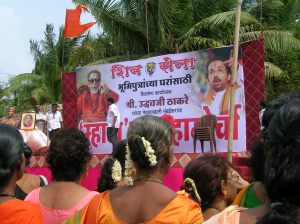 I was moving around Mumbai city on that weekend, mainly in the western suburbs. Several posters and banners were put up all over, announcing a call to a mass rally by Shiv Sena chief Uddhav Thackeray. Thackeray’s clarion call for that meeting was: “Housing for the bhoomiputra“. Bhoomiputra literally means son of the land. On an overt reading of the poster and slogan, one could conclude that the Sena is back to its advocacy of the sons of the soil theory which originally raised it to prominence in the 1960s. But when I attended the rally and noticed the people who attended it, I asked myself, so who exactly is this son of the soil that the Sena is talking about? Is it the Marathi manoos, the local underdog who the Sena argues has no social and economic space in his/her own city? If it is truly the Marathi manoos, then how do I interpret the presence of North Indian women, Bohra muslim women, perhaps even Dalit women, and many other women who I tried to mark but could not classify as either Hindu or Christian or any other particular else. Hmmm …. Continue reading Of Bhoomiputra and Housing
Teachers and Academics Against 377
University teachers, researchers and academics from all over India issued a strong statement in support of the recent Delhi High Court judgement decriminalizing consensual sex among adults and challenged the legitimacy of “religious leaders” to speak for the whole of society.
180 signatories from institutions and universities in Allahabad, Calicut, Peechi, Punalur, Thiruvananthapuram, Kottayam, Sonipat, Goa, Jammu, Nanded, Mumbai, Pune, Pondicherry, Kolkata, Ahmedabad, Baroda, Chennai, Chandigarh, Delhi, Bangalore, Hyderabad, Guwahati and Shillong endorsed a statement that said:
My son Jane: Moira McDonald
Guest post by MOIRA MCDONALD (Written three years ago).
“I want to be Jane,” repeats my two year old, this time bringing his face very close to mine for special emphasis. “He has to be Michael. Michael is the boy” says his nearly four year old sister Naomi who is oh-so aware of her budding gender identity. “Honey, you know in our family, anyone can pretend to be anything. Someday you may want to pretend to be boy, or a cow for that matter,” I explain. She shrugs agreeing to his choice as long as she can be Mary Poppins. I wish the contradictions surrounding gender identity were as easily resolved for the other adults in our lives.
A Month and a Half after Aila: Jadavpur Academics
This is guest post sent by DEEPTANIL RAY from Jadavpur University
Seven weeks after the cyclone Aila hit West Bengal, the situation in the Sunderbans remains alarming. Some of us, teachers, research scholars and students at JU, without any affiliation tags, have tried over the last month and are still trying to reach out to some of the remote areas with materials and distribute them first hand, though our efforts are feeble and insignificant compared to the magnitude of the crisis. Last weekend, we had gone to one of the remotest villages of the Hingalgunj island in the Sunderbans— with the forests on one side, and the Bangladesh border on the other.
As most of you know, Hingalgunj is a Sundarban island on the south-eastern tip of the North 24 Parganas District of West Bengal, with the Sundarban Tiger Reserve Forest on one side, and a small river separating this country from Bangladesh on the other. It is one of the block areas to suffer most from Aila— with over 28,000 families and more than 1,26,000 people affected, according to modest government reports.
Continue reading A Month and a Half after Aila: Jadavpur Academics
‘My friends have always urged me to come out’
These situations haven’t changed much. My identity is still a threat to me. It may effect my promotions, appraisals, friendships and relationships. I live every moment of my life in this fear. I feel that there will be many like me who will be leading such dual lives… we deceive ourselves, trying to hide our identities.
No, that’s not another post about 377 on Kafila. It’s about something else, on a fantastic new blog that you should immediately add to your feedreader.
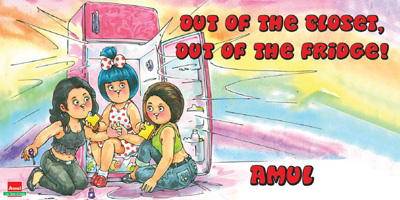
The Amul girl comes out of the closet
Home, house
I entered Yunus’s house. He was allotted 150 square meters of land to build his home. Parts of the house were done up with brick and cement. The roof was still kutcha, raw – in the process of construction. You could see the incompleteness of the roof from the opening around the right hand side from which rain likely comes into the house (as does sunshine). I asked Yunus,
Ghar mein barsaat ka pani aata hai kya? Baarish se pareshaani nahi hoti? Continue reading Home, house
“The Magic of the Human Spirit and of a Nation’s Passion”: Three Queers for the Delhi High Court!

So – here we are folks, in a historic judgement this morning, Delhi High Court has read down Section 377 of the Indian Penal Code to exclude consensual sex among adults. Congratulations to the group of tireless activists who have helped to bring this about, and congratulations to all of us who count ourselves as part of the queer community. Continue reading “The Magic of the Human Spirit and of a Nation’s Passion”: Three Queers for the Delhi High Court!
Gaon chodab nahin
Nandi’s divine wrath strikes BJP leader: Rukun Advani
This is a news flash from rainy Ranikhet, from RUKUN ADVANI of Permanent Black.
Balbir Punj owns a hotel called ‘Windsor Lodge’ on Ranikhet’s outskirts. (When it comes to personal money-making, BJP ideologues seem to have no problems naming their properties after the Queen of England.) Last week Punj came to his Lodge and went to the Kalika temple opposite the property. He did not notice a large bull there, but the bull noticed him: it charged straight for him and before Punj knew what was happening he had been thrown up in the air and gouged in the front. His arm is now in a sling. It being specially embarrassing for a BJP Hindu to be thus cast aside by a cow, Punj has been desperately downplaying his injuries. However, he asked Khanduri to immediately pen the bull, and the bull has been removed from the Kalika temple.
इतिहास से साक्षात्कार की घड़ी;
लालगढ़ मुक्त कराया जा रहा है. पिछले आठ महीने से जिस इलाके में पश्चिम बंगाल की मार्क्सवादी सरकार की पुलिस नही घुस पा रही थी , उस पर केन्द्र सरकार के सशस्त्र बल की सहायता से अब बंगाल की पुलिस धीरे–धीरे कब्जा कर रही है. केन्द्रीय गृह मंत्री पी. चिदंबरम ने कहा ज़रूर था कि यह कोई युद्ध नहीं हो रहा है क्योंकि कोई भी राज्य अपनी ही जनता से युद्ध नहीं करता लेकिन लालगढ़ में अभी चल रहे सैन्य अभियान की रिपोर्ट दे रहे पत्रकार लगातार यह बता रहे है कि वहां स्थिति किसी युद्ध क्षेत्र से कम नहीं है. गांव के गांव वीरान हो गए हैं.हजारों की तादाद में आदिवासी शरणार्थी शिविरों में पनाह ले रहे हैं. ध्यान देने की बात है कि ये शिविर भी राज्य सरकार नहीं चला रही है. पहले दो बडे शिविर तृणमूल कांग्रेस के द्वारा स्थापित किए गए. लालगढ़ की जनता के लिए शिविर स्थापित करने के बारे में बंगाल की सरकार अगर नहीं सोच पाई तो ताज्जुब नहीं क्योंकि उसके हिसाब से वह उसकी जनता नहीं है, वह तो शत्रु पक्ष की जनता है!दूसरे शब्दों में वह गलत जनता है. सही जनता वह है जो मार्क्सवादियों के साथ है.
लालगढ़ में पिछले आठ महीने से एक विलक्षण जन आंदोलन चल रहा था. बुद्धदेव भट्टाचार्य के काफिले पर हमले के बाद पुलिस ने जिस तरह लालगढ़ के आदिवासियों को प्रताड़ित किया, उसने साठ साल से भी ज़्यादा से असह्य गरीबी और अमानुषिक परिस्थितियों को झेल रही आदिवासी जनता के भीतर सुलग रही असंतोष की आग को भड़का दिया. लेकिन ध्यान दें, इन पिछड़े आदिवासियों ने कितनी राजनीतिक परिपक्वता का परिचय दिया! उन्होंने ‘पुलिस संत्रास विरोधी जनसाधारण समिति’ बनाई और लगभग हर संसदीय राजनीतिक दल से सहयोग मांगा. वह उन्हें मिला नहीं. लालगढ़ ने कहा , यहां हमारा अपमान करने वाली पुलिस और हमारी उपेक्षा करने वाले प्रशासन का स्वागत नहीं है. पुलिस और प्रशासन की उनके जीवन में अप्रासंगिकता का आलम यह है कि राज्य विहीन आठ महीनों में इस समिति ने ट्य़ूबवेल लगवाया जो बत्तीस साल के जनपक्षी वाम शासन में नहीं हो सका था, स्कूल चलाया, सड़क बनाई जो बत्तीस साल से नहीं थी और इस बीच अपराध की किसी घटना की कोई खबर नहीं मिली. एक तरह से यह जनता का स्वायत्त शासन था.
Continue reading इतिहास से साक्षात्कार की घड़ी;
The Snub
[Part of Series. Introduction: For Movement]
Tanger, Morroco, June 2009
Sometimes you just have to seek the travel moment. Yes, the best moments are unexpected, everyday, hidden. Sometimes though, the textbook travel guide moments, mass produced as they are, still work. Try this for a classic travel guide must-do: you drive down to the south of Spain, get to a ferry, put your car in the hold and cross the water in an hour long ride from Europe to Africa. West to.. well… not West. Continent to Continent. Universe to Universe. It’s a [good] travel writer’s worst nightmare and a travel publisher’s wet dream.

