Category Archives: Identities

Sedition is a Shade of Grey or, Bharat Mata’s Smothering Embrace: Ankur Tamuliphukan and Gaurav Rajkhowa

The dominant narrative around the recent JNU incident has been that the unwarranted police action and the concerted acts of violence, incitement and misinformation that followed are all part of a determined push by the saffron brigade. After love jihad and beef, the story has it, it is “sedition” and “Pakistani agent” this time—we are living in a state of undeclared emergency. A sense of disbelief and apocalyptic doom seem to underpin these sentiments, along with a nostalgic optimism for a quick return to harmony and normalcy. But such things have happened far too many times, and far too often for us to harbour such illusions. For what we are going through is in effect a recalibration of that normalcy.

To read political slogans literally is an absurdity. But in the hands of the present government, it is a calculated absurdity that reads “Bharat ki barbadi…” as armed conspiracy against the state. The variables are many—arrests, fake tweets, rampaging lawyers, patriotic house-owners and now, open calls for murder. But the calculus resolves itself into the same formula every time: national/anti-national.

At the outset, the opposition to the attack on the university campus seems to have coalesced around two points—first, maintaining a safe distance from the “anti-India” slogans raised at the meeting; and second, showing themselves as the real nationalists, standing against the saffron thugs in patriot’s disguise. Partly in response to a vicious media campaign, videos of “real nationalist” speeches at the protest venue are being posted on social media everyday. We are told at length about the “real” Indian behind the deshdrohi, his credentials, and how he wants his India to be. Things reached a disturbing pitch when spokespersons of the traditional Left went on record to express their displeasure at the real culprits not being caught. Without doubt, the saffron brigade cannot be allowed the prerogative of deciding what “the nation” means. But why do so from the flimsy ramparts of sedition? Continue reading Sedition is a Shade of Grey or, Bharat Mata’s Smothering Embrace: Ankur Tamuliphukan and Gaurav Rajkhowa

A Conversation about the Meaning of the word ‘Azadi’ (‘Freedom’) in the Wake of Events at JNU

Signal to Noise Ratio

There has been a lot of talk about what exactly ‘Azadi’ (freedom) means, especially in the wake of Kanhaiya Kumar’s post release midnight speech at JNU on the 4th of March. So lets talk some more. No harm talking. If there is noise, there must also be a signal, somewhere.

Kanhaiya Kumar clarified in his electrifying, riveting speech that his evocation of Azadi was a call for freedom ‘in’ India, not a demand, or even an endorsement of a demand for freedom ‘from’ India.

This may come as a sigh of relief to some, – Kanhaiya , the man of the moment, proves his ‘good’ patriotic credentials, leading to an airing of the by now familiar ‘good nationalist vs. bad nationalist’ trope. And everyone on television loves a nationalist, some love a good nationalist even more.

Perhaps this was a way of dealing with a bail order that was at the same time a gag order.

[ P.S. : Since writing this last night, a more careful reading of the bail order has suggested to me that the actual terms of bail are not so bad after all. Bail is in fact granted, as far as I can see, fairly unconditionally. Kanhaiya is not asked, for instance, to step down from his position in the students’ union, nor are restrictions placed on his movement and activity. So in technically legal sense, the bail provisions need not be interpreted in a tightly restricted manner. The egregious political hortations, the references to infection, antibiotics, amputation and gangrene, which are over and above the legal instructions, are indeed terrible, but operationally, they have no executive authority backing them.]

But to say just that the text of the bail order is what shaped Kanhaiya’s midnight speech would be ungenerous, and miserly, especially in response to the palpably real passion that someone like Kanhaiya has for a better world, and for a better future for the country he lives and believes in. I have no doubt about the fact that coming as he does from the most moderate section of the Indian Left (the CPI – well known for their long term affection for the ‘national bourgeoisie’ despite the national bourgeouisie’s long term indifference/indulgence towards them), Kanhaiya is a genuine populist nationalist patriot [I have corrected ‘nationalist’ to ‘patriot’ here in response to the criticism and suggestion held out by Virat Mehta’s comment – see below in the comments section] and a democrat moulded as he says, equally by Bhagat Singh and Dr. Ambedkar. There is a lot to admire in that vision, even in partial disagreement. And while some may not necessarily share his nationalism, this does not mean that one has to treat it with contempt either. I certainly don’t.

Continue reading A Conversation about the Meaning of the word ‘Azadi’ (‘Freedom’) in the Wake of Events at JNU

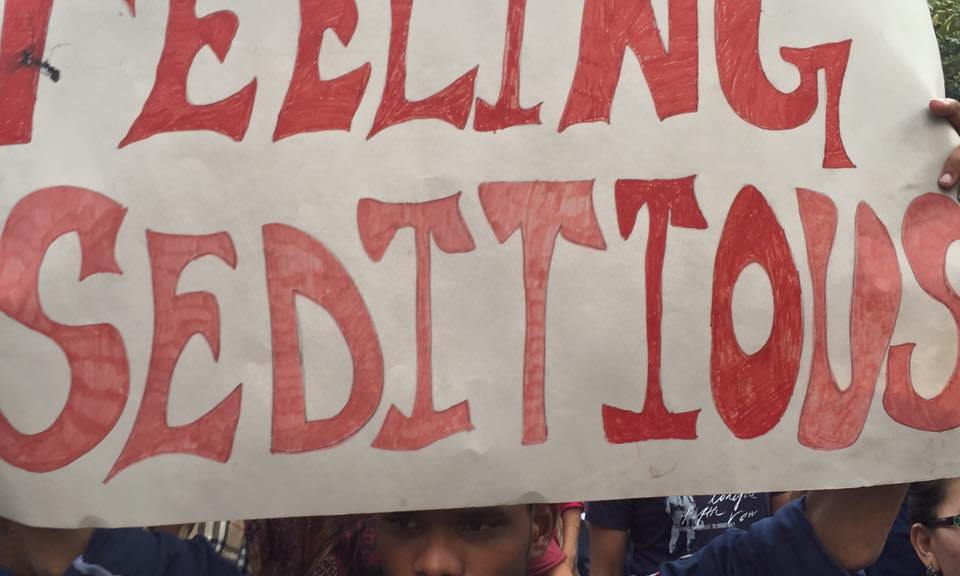
‘Feeling Seditious’: March on Parliament to #StandwithJNU

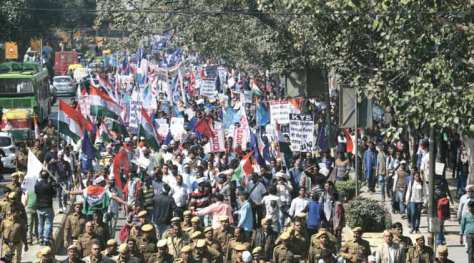
For the third time within a span of two weeks since the middle of February, thousands of people came out on the streets of Delhi to express their solidarity with the detained students of JNU (Kanhaiya Kumar, Umar Khalid and Anirban) and to voice their anger with the venal Modi regime.

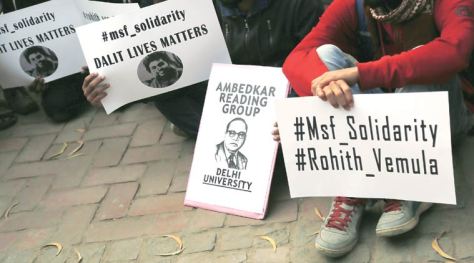
Protest demonstrations (at least in northern India) tend to have something of the monotonous in them, the same cadence, the same rhythm and the same wailing, complaining tone. They tend to have an air of events staged by the defeated, for the defeated. But if we take the last three big protests in the city, and the many gatherings in JNU in the last two weeks or so,  as any indicator of what the pulse of our time is, we will have to agree that there has been a qualitative transformation in the language, vocabulary and  affect of protests. This afternoon, like the afternoon of the 18th (the first big JNU solidarity march), and of the 23rd of February (the Justice for Rohith Vemula March), was as much about the joy of togetherness and friendship as it was about rage and anger.

Continue reading ‘Feeling Seditious’: March on Parliament to #StandwithJNU

Intolerance Tracker – A Community Curated Visual Storytelling Platform: Siddharth Peter de Souza and Saba Sharma

Guest post by SIDDHARTH PETER DE SOUZA and SABA SHARMA

In a world where breaking news cycles drive our imagination and interaction with events and incidents around us, it often becomes difficult to not to have a fragmented idea of trends because they evolve and develop so rapidly. Does this volume of information necessarily imply that we become unable to view similar types of stories because they are portrayed as isolated, anomalous and disconnected? Is this also because it is much more comfortable to forget, rather than remember and reflect on an accumulation of incidents that maybe unpleasant, inglorious and inconvenient. Amartya Sen recently stated that “The problem is not that Indians have turned intolerant. In fact to the contrary we have been much too tolerant of intolerance”. Is our numbness because we are overwhelmed by these incidents or because we perceive them to be isolated without an underlying systemic pattern?

Intolerance Tracker is a visual story telling and crowd-mapping platform that seeks to engage with some of these issues. The idea of using a map is because it provides a compelling medium through which information can be consolidated, and presented across temporal and spatial boundaries.

It aims to utilize the power of the community to identify, report and map instances of intolerance across South Asia, and organically create and curate a visual storytelling database. This initiative is primarily led by students at the University of Cambridge, and has been set up on an entirely voluntary basis by people who are passionate and committed to the cause of documenting intolerance across the region. Continue reading Intolerance Tracker – A Community Curated Visual Storytelling Platform: Siddharth Peter de Souza and Saba Sharma

जेनयू की सफाई पर स्मृति ईरानी की सफाई: नियति शर्मा

Guest post by NIYATI SHARMA

लोकसभा में स्मृति ईरानी जी की सफाई उर्फ़ भाषण बहुत भावुक, मनोरंजक और प्रभावशाली था। लोग उन्हें ‘आयरन लेडी’ का खिताब दे रहे हैं- यह उनके तर्क के लिए या उनके तेवर के लिए, या फिर उनके यह कहने के लिए की वो अपना सर काट के मायावती जी के चरणों में रख देंगी, पता लगाना थोड़ा मुश्किल है । सोचा था स्मृति जी कुछ सवालों का जवाब देंगी पर असल में मिली एक लम्बी, मेलोड्रामाटिक सफाई जिससे उन्होंने अपनी सरकार की सारी गलतियों पे पर्दा डाल दिया।ऐसी स्तिथि में हम मजबूर हो गए हैं की स्मृति जी से जो सवाल पूछे जाएँ वो तथ्य-सम्बंधित होने के साथ साथ अति भावनात्मक भी हों।

स्मृति जी के अभिनय के सारे सालों का अनुभव उनके भाषण में साफ़ दिखाए दिया। लोकसभा में स्मृति जी के हाव भाव से आक्रोश टपक रहा था पर क्या उन्हें इतना क्रोधित होने का हक़ है? स्मृति जी का यह मानना है की उनके ऊपर काफी बेबुनियादी आरोप लगे हैं, पर यह मामला स्मृति ईरानी जी के बारे में नहीं है, यह मामला उन मासूम छात्रों के बारे में है जिनकी ज़िन्दगी को उन्होंने दांव पर लगा दिया है। आखिर उन ‘बच्चों’ का क्या जिनके ऊपर उन्होंने और उनकी सरकार ने पिछले कुछ दिनों में अनगिनत आरोप लगाये हैं? स्मृति ईरानी जी तो मंत्री हैं, अगर आरोप लगे भी, तो उनकी ज़िन्दगी बर्बाद नहीं होगी, पर जिस क्रूरता से सरकार और मीडिया ने छात्रों का चरित्र-हनन किया, वह कभी भी इससे उभर नहीं पाएंगे। कन्हैया, उमर और अनिर्बान न ही मंत्री हैं जिनके पास कोई राजनैतिक सहारा है और न ही उनके परिवार इतने धनी हैं की वह अपना जीवन, अपनी इज़्ज़त पुननिर्मित कर पाएं। स्मृति जी, आप तो सिर्फ अपने बारे में सोच रही थीं की आप पर और आपकी परफॉरमेंस पर क्या क्या सवाल उठाये गए, क्या आपने एक बार भी सोचा की इन छात्रों के पास आगे ज़िन्दगी में सफाई देने का कोई मौका नहीं होगा? क्या आपने, माँ होने के नाते, यह सोचा की यह छात्र अब कभी भी साधारण जीवन नहीं जी पाएंगे?

Continue reading जेनयू की सफाई पर स्मृति ईरानी की सफाई: नियति शर्मा

Jat Quota Stir and Violence in Haryana: Satendra Kumar

This is a guest post by SATENDRA KUMAR


jaat-protest--_647_022016112612
IMAGE COURTESY: INDIA TODAY

There is an uncanny academic public silence over the Jat quota stir and the unjustified violence enacted during the stir in Haryana. The scale of violence and destruction is such that it competes for the worst instance of caste violence in Haryana’s post-Independence history. So far 30 people have lost their lives while over 200 people were injured in the nine-day violent Jat agitation demanding job quotas in Haryana. There is anger, fear and helplessness among those who lost their kin, homes, businesses and properties.At least 10 Haryana districts were severely affected by the violence. After such a huge loss, as if it was a routine, matter the Union Home Minister announced that a committee led by M Venkaiah Naidu will examine the demand by Jats for reservation in central government jobs.

In Haryana, the BJP’s government in the state has promised to bring a Bill granting OBC status to Jats in the upcoming assembly session. The Jats’ demand for reservations in the central OBC list is not new. Since 1995, Jats in Haryana have been demanding an OBC (Other Backward Class) status, which will help them secure the 27 per cent reservation in government jobs. Earlier in 1997, the Jats in Haryana, Uttar Pradesh and Madhya Pradesh had demanded themselves to be included in the central OBC list. It was rejected by the National Commission for Backward Classes. Subsequently UPA government’s decision to include Jats from 9 states in the OBC list was also rejected by the Supreme Court in March 2015. Despite all this, political parties such as Congress and BJP continue promising quota to Jats during election campaigns. These promises have encouraged the Jats to organize and agitate for quotas. However, their agitations for reservations have not been so violent. That is why the most pressing and important question that needs analyses is why has the current agitation by Jats been so violent? Perhaps three factors will help us to understand this severe violence and loss of property worth crores of rupees.

Continue reading Jat Quota Stir and Violence in Haryana: Satendra Kumar

स्मृति ईरानी को एक जे-एन-यू के छात्र की चिट्ठि: अनन्त प्रकाश नारायण

Guest Post by Anant Prakash Narayan

सेवा में,

श्रीमती स्मृति ईरानी जी

“राष्ट्रभक्त” मानव संसाधन विकास मंत्री,

भारत सरकार

संसद में दिए गए आपके भाषण को सुना. इससे पहले की मै अपनी बात रखूँ , यह स्पष्ट कर दूं की यह पत्र किसी “बच्चे” का किसी “ममतामयी” मंत्री के नाम नहीं है बल्कि यह पत्र एक खास विचारधारा की राजनीति करने वाले व्यक्ति का पत्र दूसरे राजनैतिक व्यक्ति को है. सबसे पहले मै यह स्पष्ट कर दूं कि मै किसी भी व्यक्ति की योग्यता का आकलन उसकी शैक्षणिक योग्यता के आधार पर नहीं करता हूँ बल्कि साफ़ साफ़ कहूं तो मै “योग्यता”(मेरिट) के पूरे कांसेप्ट को खारिज करता हूँ.

मानव संसाधन मंत्रालय का पद भार लेने के साथ ही यह अपेक्षा की जाती है कि आप इस देश के केंद्रीय विश्वविद्यालयों में उनकी ऑटोनोमी का सम्मान करते हुए उसके लिए उत्तरदायी होंगी. रोहित वेमुला के मामले में आपने क्या किया यह सबके सामने है कि किस तरह से वहाँ के प्रशासन पर आपने दबाव डाला जिसका नतीजा रोहित के institutional मर्डर के रूप में हमारे सामने आया. लेकिन मै इन सारी चीजो पर अभी बात नही करना चाहता. आप बार बार अपनी औरत होने की पहचान (आइडेंटिटी) को assert करतीं हैं और इसको करना भी चाहिए क्यूंकि नारी जाति उन ढेर सारे हाशिये पर किए गए लोगों में एक है जिनको सदियों से शोषित किया गया है. मै आपसे यह पूछना चाहता हूँ कि एक दलित स्त्री जो कि हर तकलीफ उठाते हुए अकेले अपने दम पर जब अपने बेटे बेटियों को इस समाज में एक सम्मानपूर्ण जगह देने के लिए संघर्ष कर रही थी तब एक नारी होने के कारण आप की क्या जिम्मेदारी बनती थी ? क्या आपको उस महिला के जज्बे को सलाम करते हुए उसकी बहादुरी के आगे सर झुकाते हुए उसके साथ नहीं खड़ा होना चाहिए था? हाँ, मै रोहित की माँ के बारे में बात कर रहा हूँ. जो महिला इस ब्रहामणवादी व पितृसत्तात्मक समाज से लड़ी जा रही थी, अपने बच्चों को अपने पहचान से जोड़ रही थी, उस महिला को आप व आपकी सरकार उसके पति की पहचान से क्यूँ जोड़ रहे थे? आपको भी अच्छा लगता होगा की आपकी अपनी एक स्वतंत्र पहचान है. लेकिन यह अधिकार आप उस महिला से क्यूँ छीन  रहीं थीं? क्या आप भी पितृसत्तात्मक व ब्रहामणवादी समाज के पक्ष में खड़ी होती हैं? अपना पूरा नाम बताते हुए अपनी जाति के बारे में आपने सवाल पूछा और आपका भाषण खत्म होने के पहले ही लोगों ने आपकी जाति निकाल दी. मै आपकी जाति के बारे में कोई दिलचस्पी नहीं रखता हूँ और मै यह बिलकुल नहीं मानता हूँ की अगर आप उच्च जाति के होते हैं तो आप जातिवादी ही होंगे लेकिन आपके विभाग/मंत्रालय के तरफ से जो चिट्ठियाँ लिखी गई उसमे रोहित और उसके साथियों को जातिवादी /caste-ist बताया. मैडम क्या आप caste-ism और  caste assertion का अन्तर समझती हैं? मै समझता हूँ की आप ये अन्तर भली – भाँति समझती हैं क्यूंकि आर एस एस जो आपकी सरकार और मंत्रालय को चलाता है, वह वर्ण व्यवस्था के नाम पर जाति व्यस्वस्था को भारतीय समाज की आत्मा समझता है और आर-एस-एस के एजेंडे को लागू करवाने की राजनैतिक दृढ़ता हमने समय समय पर आप में देखी हैं.

Continue reading स्मृति ईरानी को एक जे-एन-यू के छात्र की चिट्ठि: अनन्त प्रकाश नारायण

Chalo Dilli! Report on 23 Feb Protest March for Rohith Vemula: Saagar Tewari

This is a guest post by SAAGAR TEWARI

Rohith Protest 3

rohith-vemula-protest 4
IMAGES COURTESY: INDIAN EXPRESS

The call for a protest rally by the Joint Action Committee for Social Justice, constituted in the aftermath of Hyderabad Central University research student Rohith Vemula’s suicide galvanised large number of students and activists on 23rd February. On a bright sunny day, thousands descended on the streets of central Delhi marching from Ambedkar Bhawan to Jantar Mantar. The attendance was perhaps lower and the organization less cohesive than the JNU protest rally of 18th February. However, it trumped its predecessor in terms of attracting a far-wider political cross-section of the voices openly choosing to dissent against the current ruling establishment. The protestors proudly displayed anti-Brahmanism banners, flags, badges (featuring excerpts of Rohith’s suicide note) and even a radical inversion of Modi-style masks (featuring Rohith Vemula’s smiling face) thereby signaling that the same youth-brigade which was instrumental in BJP’s rise to political power in 2014 has started turning against it.

Continue reading Chalo Dilli! Report on 23 Feb Protest March for Rohith Vemula: Saagar Tewari

Confront the Rupa Subramanyas Within : A Note to a Nair-born Friend

Dear Kaviraj,

Just saw your post condemning The Telegraph’s representation of Smriti Irani as ‘Aunty’. I understand your indignation, though I am curious to know why few people like us stand up and protest when the people who supporte her, the sanghis, throw vile abuse at dissenters and feminists, label them prostitutes, and threaten them regularly with rape and disfigurement. My daughter was recently threatened in Delhi and warned not to behave like a ‘JNU randi’; senior women teachers from JNU were showered with similar abuse, shoved, groped, and hit at the Patiala House, and many of them have received direct and indirect threats. JNU women have been portrayed in the most despicable terms recently, before which Telegraphs’s characterisation of Irani as ‘Aunty’ is tame indeed even if unacceptable.

Continue reading Confront the Rupa Subramanyas Within : A Note to a Nair-born Friend

A Close Look at Certain Words Allegedly Shouted Recently in JNU and Their Impact on Our National Intelligence: Soumyabrata Choudhury

This is a guest post by Soumyabrata Choudhury

Polonius: “What is it you read, my lord?”

Hamlet in New Delhi, 2016: “India, Pakistan, security, sovereignty, nation, anti-national…words, words, words”

According to Sigmund Freud, when we dream, and when we suffer psychotic delusions, we treat words as pictures and things. A word’s meaning, in these conditions, becomes the shape of the word and its appearance is the same as feeling its physical impact, its blow. We cannot grasp anymore that a word refers to an object or idea outside in the world or that it can be used as a metaphor or an indirect analogy and image. We cannot even receive the rhetorical communication of words intended to persuade, exhort, transgress or insult. In each of these communications intended by an addresser we already feel physically, viscerally and as a consequence, mentally under the assault of the words of the addresser as if they are blows.

So in response we don’t persuade, exhort, transgress or insult back but instead, we curse (the upper limit of lucid  discourse in this state), punch, grab the addresser  by the throat, pull a knife or gun if we have any of these articles in our possession – or we cringe, weep, hold our heads in our hands and rock to and fro. Now it is very unlikely that in a real psychotic condition, we are able to invoke a particular law or clause of law in our favor, complain to the police and come up with a fluent image of language as justification for our actions. “We had no choice but to do what we did because the other(s) insulted our Mother India”. In a real psychotic condition, it is more likely we will be the ones to be taken away. Continue reading A Close Look at Certain Words Allegedly Shouted Recently in JNU and Their Impact on Our National Intelligence: Soumyabrata Choudhury

Come on man, be clear, what comes first—Nation, or Democracy? Bodhisattva Kar translated by Ahona Panda

Guest Post by Bodhisattva Kar and Ahona Panda

(Written by Bodhisattva Kar in Bengali, First published in on 18 February 2016 by the Ei Samay newspaper.Translated into English by Ahona Panda)

“To you I confess today—what you all call a patriot, I am not of that kind.” After this confession of sparkling clarity, should we not catch hold of that man as an anti-national? So what if he is dead? If the dead can be rewarded with the Bharat Ratna, why can’t we frame the dead with a few charges of sedition? For God’s sake, all you good people, how did you make a song written by this man the national anthem? The man who—without any obfuscation—speaks through the mouth of the protagonist of Char Adhyaya—“They who do not take cognizance of that which is greater than patriotism, their patriotism is like crossing on a crocodile’s back.” Where did he get the audacity to dream of something greater than patriotism? And, he did not even study at JNU. “By killing the very soul of the country, the country’s life can be resuscitated: this terrible untruth is being announced in beastly roars by nationalists around the world and it makes my heart revolt with intolerable intensity.” How can you not burn the books produced by such a treacherous son of Mother India, who said such terribly instigatory things? Why do you worship him instead? Can anyone put their hand on their hearts and say that he wasn’t a Pakistani spy, just because of the niggling detail that Pakistan did not exist at the time he was writing? Did we not shoot Dabholkar or Pansare for agonizing quite a bit less than he did? Continue reading Come on man, be clear, what comes first—Nation, or Democracy? Bodhisattva Kar translated by Ahona Panda

Apologise to the Nation, All of You.

You, who shout your nationalism from the rooftops; you whose blood runs hot for “Mother India”; you who turn red with rage when contradicted; you who set agendas like patriarchs drunk on father-right; you who refuse to let another speak, you! who don a suit every night on television to disguise your cheap tricks; you who abuse your guests if they happen to be young, powerless and honest; you who bloat on adrenaline while your viewers turn to idiotic jelly; you who abuse the highest offices of this land; you who give a bad name to khaki; you who wear lawyers’ robes to beat students and teachers; you who are protected by your political masters; you who strike deals in the privacy of your offices, chambers and boardrooms; you who live by ratings and upvotes; you who tell lies so long you forget the truth; you who form bands of cowards hiding in plain sight; you who roam the streets showing your fist to all; you for whom a martyred soldier is more valuable than a living citizen; you who abuse the power that history gave you; you who mistake that accident of history for a moral right; you whose imagination of revenge always involves rape; you who have brought this country to the brink of civil war; you who speak in the name of the mythical motherland while the actual children of that land are hungry, thirsty and unemployed; you who claim this moment, this nation, this public, this history, this land. Apologise.

Apologise to those who work everyday to make this country decent; who work for too little, and for too long; those whose deaths become statistics in the great churning pots of state economists; those whose parents taught them to keep their heads down and quit an ugly fight; those who argue, debate, disagree without the urge to kill or maim their opponents; those who understand when an argument becomes too heated; those who pull back from the brink every time because they know that to be alive is not always to be right; those who reclaim the streets to protest when it’s hard, when it’s inconvenient, and when it’s dangerous, because it’s the only way to disagree; those who see that an eye for an eye makes the whole world blind; those who understand and accept this land in all its confounding conflict; those who risk death to expose the powerful and corrupt; those who have no choice but to join the army to feed their families; those who laugh when there is nothing left; those who write, think and reason, and take time over all three; those who appreciate the beauty of the stars on a still night; those who make love like it’s a gift and not a right; those whose parents live after they died because they were on the wrong side at the wrong time.

Above all, you deranged “nationalists”, apologise to three fellow citizens – one born in a caste that could only speak from the protection of death; another who is languishing in jail for no crime at all; and perhaps most of all, a third who is on the run from a police none of us ever trusted. Apologise. These young people are the future of this country, not you with your bloodlust. WE are the nation, and we demand an apology from you.

Does the Nation Really Even Want to Know? Shweta Radhakrishnan

This is a guest post by SHWETA RADHAKRISHNAN

I noticed yesterday, a tweet from Anupam Kher where he compared state action over the events of the last few weeks, as a kind of “pest control” – required, of course to keep the house clean. His exact tweet is – “Gharon mein pest control hota hai to cockroach, keede makode ityadi bahar nikalte hain. ghar saaf hota hai. waise hi aajkal desh ka pest control chal raha hai.”

The similarity of this thought to Hitler’s on ethnic cleansing hasn’t gone unnoticed (look at Rajdeep Sardesai’s tweet and this article – http://www.jantakareporter.com/india/anupam-kher-hitler-modi/38514) and I’m sure much more will be written about it in the days to come. Anupam Kher’s inability to develop a logical argument or even notice the illogicality of his own actions has never ceased to surprise me, but the casualness with which he endorses state violence is interesting. But mere tweeting is not sedition. Do I find this tweet distasteful, offensive and also legitimizing state and mob violence? Yes, I do. Am I worried by the sentiment expressed in this tweet? Yes, I am. Am I additionally worried because this is not a man, sitting in an obscure corner somewhere, just airing his views, but a well known personality whose words seem to garner some weird kind of legitimacy because of his status as a Hindi film actor? Yes, I am. Do I think he should be arrested? No. Continue reading Does the Nation Really Even Want to Know? Shweta Radhakrishnan

In the Name of the ‘Nation’: Vidya K. Subramanian and C. J. Kuncheria

This is a guest post by VIDYA K S and C J KUNCHERIA

“Don’t you dare speak over me when I am speaking of Lance Naik Hanumanthapa! We’re proud of him and we’re ashamed of you!,” screamed Arnab Goswami at Umar Khalid, the JNU student at the centre of unfolding events at the university. Hundreds of thousands of self-proclaimed nationalists cheered at that instant, and many more did as the clip went viral over social media. The death of the soldier, one of the 869 who have been killed in the last four years by the punishing weather on Siachen, had been conveniently used to invoke a cathartic nationalism. Continue reading In the Name of the ‘Nation’: Vidya K. Subramanian and C. J. Kuncheria

Statement of Solidarity with JNU: University of Exeter (UK)

We, the undersigned, stand in solidarity with the students, faculty and staff of Jawaharlal Nehru University in New Delhi, India in their ongoing struggle against the anti-democratic incursions of the Indian state. We appeal to the elected Prime Minister Narendra Modi to uphold the Indian constitution, cease the repression of democratic protest across university campuses in India, and withdraw the spurious charges of ‘sedition’ against JNU Students’ Union President Kanhaiya Kumar. Continue reading Statement of Solidarity with JNU: University of Exeter (UK)

Statement of Solidarity with the JNU Community, from the Students and Faculty at Princeton University


We, the undersigned, condemn the undemocratic and unconstitutional actions of the BJP-ABVP-Delhi Police on the JNU campus. Continue reading Statement of Solidarity with the JNU Community, from the Students and Faculty at Princeton University

Statement in Support of Students and Faculty at JNU From Faculty and Affiliates of the American Uniersity of Beirut, Lebanon

February 23, 2016

We, the undersigned faculty, students, staff, and affiliates of the American University of Beirut are highly concerned over the recent repression of free speech and undue police and legal interventions at Jawaharlal Nehru University (JNU), New Delhi. Continue reading Statement in Support of Students and Faculty at JNU From Faculty and Affiliates of the American Uniersity of Beirut, Lebanon

The New School in Solidarity with JNU


We, the undersigned, students, faculty, alumni, and staff at the New School University, New York, stand in solidarity with the students, staff, and faculty at Jawaharlal Nehru University, New Delhi, in their protests against the militarization of the campus and suppression of dissent by anti-democratic and divisive Hindu nationalist groups allied with the Modi government. Continue reading The New School in Solidarity with JNU

University of Texas Students and Faculty stand with JNU


We, the undersigned, students, scholars, and faculty of the University of Texas at Austin, stand in solidarity with the students, faculty, and staff at Jawaharlal Nehru University, New Delhi against the illegal and unconscionable crackdown by police. We demand an immediate end to all police action on campus, a withdrawal of all frivolous charges against the President of JNU Students’ Union, Kanhaiya Kumar, and other students, as well as an end to the campaign of harassment and intimidation against students at the university. With them, we affirm the autonomy of the university as a non-militarized space for freedom of thought and expression. Accordingly, we condemn police presence on campus and the harassment of students on the basis of their political beliefs.  Continue reading University of Texas Students and Faculty stand with JNU

The India I Came Back To: Namrata Sharma

This is a guest post by NAMRATA SHARMA


I will start this piece with a painful but short flashback tirade about myself. I moved back to New Delhi in 2014, after six long years in New York and Singapore. My decision to move back to the motherland was predominantly attributed to issues that a twenty-something grapples with when he or she is away from home and family. However, familial ties and emotional reasons aside, there was one factor which deeply resonated with me and was the driving force behind my decision to move back. This factor was – the liberty to express my thoughts and views on a topic, any topic, in an indulgent and lenient space, which, by virtue of being an Indian citizen, was guaranteed to me in India and not in other places. In India, this liberty transcended predictable spaces like classrooms, newsrooms and sophisticated editorial pages of the morning newspaper and was very organically present in the form of arm-chair political banter amongst friends and political conversations with family over dinner. Continue reading The India I Came Back To: Namrata Sharma

#NoDissentNoCountry #StandWithJNU

Williams College Stands with JNU!


Kajri Jain, University of Toronto


Aarti Sethi, (JNU 2009), Columbia University

A complete Hindi transcript and video of Kanhaiya Kumar’s speech is available here.

A complete English translation may be accessed here.

Rohith Vemula’s last note may be accessed here.