
Twitter hash-tag doing the rounds, becoming a meme with thousands of tweets. Small selection for you only:
Category Archives: Identities
Speaking of Synthesis
Ask any first time visitor to Kashmir about their impressions and you will, in all likelihood, be inundated with superlatives about the landscape, the mountains, the greenery, the hospitality, the gardens, the lakes and what not, but there is one thing that both the first timer and the old Kashmir hand rarely talk about and that is the historical monuments of the valley. The mosques, shrines and ancient temples of the valley are rarely mentioned in all this recounting. I am as much guilty of this neglect as all the others that I have met, perhaps more guilty because I have been to Kashmir scores of times.
This piece is an attempt to make amends. The sites are far too many to cover in one article so I have decided to confine myself to a handful of structures and monuments that lie scattered in and around Srinagar. Hopefully there will be more occasions to write about the others soon. Before we commence this sight-seeing tour of Srinagar, let us start with a few words about the history of Srinagar and of Kashmir.
Seeking the Apadhasanchaarini/ The Malayalee Flâneuse
So, the moral police has struck again. The papers in Kerala have been full of news about how a young IT sector employee, Thasni Banu, was confronted by a group of goons while she was being dropped to work at night by a male friend, insulted, slapped several times, and warned that they will not allow Kerala to “become Bangalore”. She did not take it mildly and complained to the police, who rolled their eyes, hummed, and hawed, and as to be expected, went slower than usual. One of the goons who was apprehended was let off. The papers have indeed taken the issue very seriously — and so have the state government, which suspended the policeman who handled the affair shoddily. Continue reading Seeking the Apadhasanchaarini/ The Malayalee Flâneuse
‘Can someone be a Brahmin and not be acting as a Brahmin?’
 Over at the excellent India Site, Rahul Pandita asks a thought-provoking question:
As a Brahmin, does it make me less sensitive to the plight of the poor or the marginalised? Why is it such a big deal that I can wear my Janeu, recite my Hanuman Chalisa, and yet go to Bant Singh’s house in Bhurj Jabbar, thirstily gulp down a few glasses of water, and tell his story? Where is the contradiction? [‘A Brahmin Heart’]
 And the ever-sharp Kufr has the best answers there can be to that question:
when rahul pandita says he’s a brahmin, he’s making a claim on a lot of indian history. when bant singh rebels against his present, he is also rejecting pandita’s history, his claim on privilege. if pandita doesn’t see that, he shouldn’t have undertaken the trip to bant singh’s home. [why bant singh can’t go to rahul pandita]
Coke Studio India – the first six songs
So the unanimous verdict is that Coke Studio India (first aired on the Friday that went by) is no match for Coke Studio Pakistan [Wikipedia]. For some it’s been like an India-Pakistan match – I’ve seen Indian congratulate Pakistanis on Twitter for the ‘Coke Studio victory’ and others ask Indian musicians and singers to listen to Pakistani singers and hang themselves. For most, this was not surprising – Coke Studio Pakistan has showcased some of the best music you’ve heard in recent times and it raised the bar too high for Coke Studio India. There’s also the problem of Bollywoodisation of music in India, of dumbing down, producing music aimed at the marriage market and livening up the moods of those stuck in traffic. A celebrity culture has taken the passion out of music in India – it does not seem to come from deep within. New popular music in India leaves you with the kind of feeling that a mall does. Loud and empty.
Dr Khaleel Chishty will finally be free
This note comes from KAVITA SRIVASTAVA of the People’s Union for Civil Liberties

Dr. Khaleel Chishty, the 78 year old a renowned Virologist from Pakistan, will now go home very soon. A process that began on the 20th of April, 2011 will finally conclude at the Rajasthan end two months later precisely on the 20th of June, with the Governor signing the mercy petition that will let him go, once the MEA give their stamp. Continue reading Dr Khaleel Chishty will finally be free
Of Fakes, Duplicates and Originals – the Tale of Ration Cards and the Trail of Transparency in Governance
On 2nd May 2011, the front page of the Times of India (TOI) beamed and screamed: “Don’t pay a bribe, file an RTI application – Equally Effective in Ensuring Service”. Two doctoral candidates at Yale University’s political science department had conducted field experiments in the bastis in Delhi in the year 2007 regarding poor people’s experiences in making applications for ration cards. The researchers – Leonid V Peisakhin and Paul Pinto – found that persons who paid bribes had their ration cards processed faster. However, those who filed an RTI request to know about the status of their ration card application, were “almost as successful”, the TOI report claimed. (The details of the study and the outcomes can be accessed through Peisakhin and Pinto’s paper “Is transparency an effective anti-corruption strategy? Evidence from a field experiment in India.” The paper was published in 2010 in Regulation and Governance Journal, volume 4, pp 261-280.) The researchers had also put people in two other control groups – one which neither paid a bribe nor followed-up and a second group which had filed their applications along with a letter of recommendation from the local NGO. Both these groups were not as successful as the former two groups in obtaining their ration cards. The researchers’ analyses veered towards two conclusions: first, that the RTI Act serves the poor who are usually denied/deprived of information. Secondly, reforms/laws which give more ‘voice’ to citizens and allow them to scrutinize the functioning of officials and elected representatives are more effective in ensuring transparency and gaining access to public services. Continue reading Of Fakes, Duplicates and Originals – the Tale of Ration Cards and the Trail of Transparency in Governance
‘Locking up gods within caste’
This note comes via Malarvizhi Jayanth. Those in support can leave a comment saying so, and add their designations to their names, if they wish.
We call for all those who support democracy and free speech to express solidarity with Thirumavalavan, Meena Kandasamy and Samya.Kathavarayan and Madurai Veeran are among the gods who are acknowledged to be Dalit and are worshipped by many castes. Clearly, in the oral history of the people, the gods have castes and these castes are not determined by who worships them. The twin brothers Ponnar Shankar inhabit the realm between hero and deity. They have been fictionalised, recreated for the silver screen, and are worshipped across communities. Their origin myth remains contested territory – it is variously read as symbolic of the conflict between agriculturists/warriors and hunters, as part of founding tale of the land-owning agriculturist Kongu Vellala Gounder sub-caste and, in a textbook example of how Hindutva functions, have recently been claimed as reincarnations of the Pandavas. Like other deities of the people, they are firmly located in a historical imagination among a society of human beings, and not in a mythos of gods.
In a footnote in Uproot Hindutva: The Fiery Voice of the Liberation Panthers by Thirmavalavan, MeenaKandasamy describes Ponnar Shankar as dalit. M Loganathan, an advocate from Nanje Goundanpudur and Students Wing Convenor of the Kongu Nadu Munnetra Kazhagam (KMK), has been quoted in news reports as saying that there is evidence proving that Ponnar and Shankar are Kongu Vellala Gounders and claiming that depicting them as Dalits will lead to caste tension. Continue reading ‘Locking up gods within caste’
Of Mosques and Minars
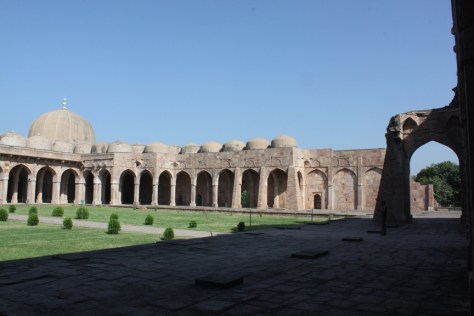
I can’t really say when I first heard the Aazan (the call for prayers given by the Muezzin, five times a day) it must have been in the early 50s when I was a little child and lived in Chabi Ganj, next to the Faseel (City wall) near Kashmiri Gate.
The sound of the Azan would have drifted in from one of the nearby Mosques, there were a few not too far away. The practice of using loudspeakers was not in vogue those days and yet the muezzin’s call for prayers travelled quite some distance, primarily because the horrible ambient sounds that assail our auditory nerves were almost non-existent at the time, in place of this cacophony there used to be other ambient sounds, the rustling of leaves, the chirping of birds and others, that have, it would seem, now been lost forever. Continue reading Of Mosques and Minars
Caste in Urdu Prose Literature: Ajmal Kamal

Guest post by AJMAL KAMAL
The historical division of society in South Asia on caste lines is now an acknowledged sociological, political and economic fact. However, caste as a literary or social discourse does not, for several reasons, form a part of the predominantly Muslim culture of Urdu. Nor has there been much academic exploration of the role caste plays in the life of South Asian Muslim communities as against others. As far as the Urdu literary writing is concerned, it has traditionally focused exclusively on the lives and concerns of conquerors, their cohorts and their descendants, who typically prided themselves on their real or perceived foreign origins. Even after modern, socially committed writing began in Urdu around the 1930s, caste as a variable for social exploration was largely ignored in favour of economic class. Continue reading Caste in Urdu Prose Literature: Ajmal Kamal
Corruption, the New Caste: Thomas Crowley
Guest post by THOMAS CROWLEY
In the mainstream coverage of the Ramdev hullabaloo, there has been, unsurprisingly, little substantive discussion about corruption itself: its fundamental causes; its widespread effects; the viability of different plans to combat it. Who would want a dry, intellectual discussion of the root causes of corruption when we can stare uneasily at pictures of Baba Ramdev holding a sword and wait with bated breath for his holy army to congregate?
But let’s – for the moment – take seriously Ramdev’s proposal that the death sentence be meted out to India’s corrupt. If the press is to be believed – especially the foreign press – this may just mean killing every Indian. For, implicit in many media reports is the assertion that corruption is part of the Indian psyche, an essential component of what it means to be Indian. In this sense, corruption serves the same conceptual role as caste: it essentializes an ever-changing historical phenomenon, freezing it in time and obscuring its economic and political roots. Much as the British taught Indians and foreigners alike to understand India predominantly in terms of caste, modern commentators are encouraging both desis and firangis to conceptualize India as the land of unending corruption. (Of course corruption has not replaced caste as a mode of understanding India; the fascination with caste still runs deep.)
Alvida, Maqbool Fida: M.F. Husain, Free at Last
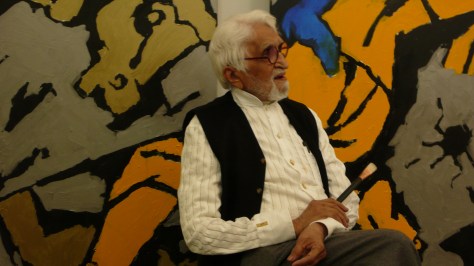
Like possibly several other children growing up in the kind of lower-middle class metropolitan households that attempted to reconcile their aspirations towards culture with their frugal habits in the 1970s and1980s in Delhi, my first introduction to the art of our time was the framed print of a Husain painting. We had no television. And my parents had no gods. The only icons in our modest house were two framed pictures – an inexpensive N.S. Bendre, (Lalit Kala Akademi) print of a few women at a well and the reproduction of a Husain painting, possibly detached lovingly and carefully from an Air India calendar, possibly featuring the kind of goddess image that incensed the zealots who made it impossible for M. F. Husain to live out his final years in India. Continue reading Alvida, Maqbool Fida: M.F. Husain, Free at Last
Growing Inequality and Deprivation in Telangana – Questions evaded by Srikrishna Committee: Bhim Reddy
Guest post by BHIM REDDY
[The movement for a separate Telangana state has been raging now for quite some time. At Kafila, we have not yet had the occasion for a discussion on the pros and cons of the issue. This post deals with one aspect – that of agricultural economy and its relationship to the perceptions of discrimination. We hope that this post will lead to some debate on a very important issue. AN]
Rural Telangana has experienced income declines for ninety percent of its population, increase in inequality and a drastic decrease in the class-size of cultivators accompanied by an increase in the class-size of agricultural labourers since early 1990s. This revealing evidence is presented in Srikrishna Committee (Committee for Consultations on the Situation in Andhra Pradesh, headed by Justice B.N. Srikrishna) Report based on NCAER (National Council of Applied Economic Research, New Delhi) surveys conducted once in the year 1993-94 and another in 2004-05. The Committee’s concern over this scenario, despite the purpose of its constitution being to study the situation in Andhra Pradesh state in the context of unrest in Telangana region, has not attracted any attention beyond its worry that the vulnerability of the deprived masses can be ‘used’ by political groups: “…most of the deprived communities in Telangana are facing hardship and therefore are vulnerable to mass mobilization on one pretext or the other, including political mobilization with promises which may or may not be met”. Beyond this shallow concern the Committee is indifferent to such evidence that any study characterised by objectivity and rigorous interrogation would be compelled to undertake a critical examination of the trajectory of economic development and state’s policy, and attempt to explain the cause of such deprivation and growing inequity.
Militant Rationalities: Ali Usman Qasmi
This is a guest post by ALI USMAN QASMI
Stark indifference of various religious organizations and scholars over suicide bombings and the recurrent target killing in Pakistan during the last few years is appalling. Woefully the mainstream print and electronic media deems it enough to issue the obligatory bland statements signifying absolutely nothing in condemnation of killings of innocent civilians. The act of terrorism in itself is relentlessly condoned, although the lost lives of civilians evoke some reaction which too is quite guarded to say the least. Even while expressing sympathy over the death of civilians, the ‘atrocities’ of the Western powers in general and USA in particular are invariably referred to as the catalyst resulting in all the mess that the Pakistani people find themselves in, at the moment. Thus, unequivocal condemnation of those responsible for all the mayhem in the country is conspicuously missing, which amounts to a tacit approval of these terrorist acts. Far more tormenting than the devil may care attitude of religious parties and their leadership, is the role played by writers of the right wing persuasion, particularly in the Urdu media. While the mass appeal of the religious parties is considerably thin, nevertheless, right-wing ideology is widely shared and adhered to. Continue reading Militant Rationalities: Ali Usman Qasmi
Beyond the Bluster-Equity and Justice in West Bengal: Abusaleh Shariff and Tanweer Fazal
Guest post by ABUSALEH SHARIFF AND TANWEER FAZAL
One of the key issues being keenly watched in the recently concluded assembly elections in West Bengal was the direction in which the Muslim vote was going. Muslims constitute 25 per cent of West Bengal’s population. Despite such high concentration, the near absence of Muslims from public arena—art, culture, literature, public service, education—is alarming and should cause consternation in any polity, especially one that claims its legitimacy in the name of the poor and the marginalized. However, any suggestion that the long Left Front rule had rendered Muslims of West Bengal poorer and deprived than other social groups was taken as an affront to the so-called ‘exceptional’ record of the Left Front. Figures were trotted out, statistics read out in support of this track record. However, there is a difference between sops, assurances and promises made in an election year and the actual performance of a regime that has ruled a state for more than 30 years.
Young Women in Kerala : Between Empowerment and Death? — Part II
[With inputs from Sudeep K S]
Are there honour killings in Kerala? No, perhaps. However, like in everything else, Kerala has a way of telling the world that things can be done differently. Well, it appears that we can continue to claim another kind of exceptionalism — in national evils. Kerala has its own special way of ‘doing’ caste and patriarchy as well, which researchers and activists have forcefully argued recently. It is possible that the deadly consequences of stepping out of community-ordained boundaries in love and marriage can visit Kerala in ways that we cannot really detect with our usual instruments.
Continue reading Young Women in Kerala : Between Empowerment and Death? — Part II
Punjabi Qissas and the Story of Urdu
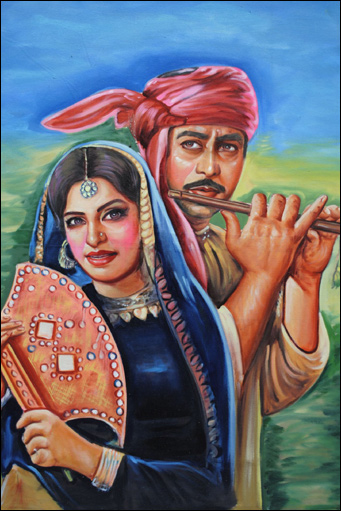
- Heer-Ranjha in a Pakistani film poster, circa 1970s
The Social Space of Language: Vernacular Literature in British Colonial Punjab
by Farina Mir
Permanent Black, Ranikhet, 2010.
ISBN-817824307-5
pp-277, price Rs 695
This book straddles several anomalies that are rather obvious once stated but are rarely formulated as such. How is it that the world of Urdu literature becomes so dominated by people from the Punjab in a span of fifty years, beginning circa 1900s, and in a sense, continues to remain so? Iqbal, Faiz, Meeraji, Rashid, Bedi, Manto, Krishan Chander and down to our times Mushtaq Ahmed and Zafar Iqbal, a top twenty or top fifty list of modern Urdu litterateurs would likely contain eighty percent Pubjabis. And how is it that Punjabi, which produced such a brilliant and varied repertoire of stories, epics and poems until the late medieval era by such extraordinary luminaries as Baba Farid, Bulle Shah, Waris Shah, Haridas Haria seems to drop out of our horizon in the modern era, where all we know of is an Amrita Pritam or, less likely, a Surjit Patar. Where such poverty after such riches, where such preponderance from such invisibility? And yet, how is it that Punjabi still continues to enjoy immediate and even aural connotations that transcend nationality, religion and, even as it defines a community, a specific ethnicity. What then is a Punjabi community and where and how has it existed specifically in the colonial era but, in many resilient ways, down to our times? Continue reading Punjabi Qissas and the Story of Urdu
Who Killed Jugni? Shiraz Hassan
Guest post by SHIRAZ HASSAN
It was many summers ago. I was visiting my village on the banks of the Jhelum. I saw the people of my village go towards the Eidgah, across the chappaD, or the pond. When I asked my grandfather about them, he said. “Ajj mela ay putter!” [Son, today is a fair!] The mela ground was bustling with makeshift shops and people thronging them. At one end of the mela a circus had come up. The mithai stalls were packed with customers and curious on-lookers, some of them were buying and eating. And that’s when I heard the sound of their music. There they were, surrounded by a circle of spectators. A couple of local artists sang a song I had not heard before. I couldn’t understand a word, other than ‘O mereya Jugni, O mereya Jugni’ – which they chorused, over and over again.
That was my introduction to Jugni. I had no idea who Jugni was, and for I long time I didn’t care. Continue reading Who Killed Jugni? Shiraz Hassan
The Death of Merit: A short film series by the Insight Foundation
From here.
This documentary is first in the series of our efforts to document caste-based discrimination prevalent in Indian higher education system resulting in large number of suicides of Dalit students in Indian campuses.
It is based on the testimonies of parents and family members. In next few days, we are coming up with few more documentaries to expose the kind of caste-based hostility and harassment Dalit and Adivasi students have to suffer from the faculties, fellow students and administration in some of the country’s premier educational institutions. These documentaries are part of our efforts to make Indian educational system inclusive in real sense and free from caste-discrimination.
Here’s more on The Death of Merit.
Brilliant Tutorials: Trisha Gupta reviews Siddharth Chowdhury’s “Day Scholar”
 Guest post by TRISHA GUPTA
On the face of it, Siddharth Chowdhury’s Day Scholar, is a coming of age novel. The book’s own inside cover actually describes it as a “crazed and profane coming of age tale”, whose plot is ostensibly about how Patna boy Hriday Thakur (“who hopes to be a writer some day”) is first “trapped… by a series of misjudgements” and later “saved from a terrible end”. But much like Chowdhury’s previous offering, Patna Roughcut (also billed as “a story of love, idealism and sexual awakening” that takes us to “the heart of an aching, throbbing youth”), Day Scholar – despite a self-referential moment when its protagonist is asked by his father about how his Bildugsroman is coming along – is not a book that seems containable within the neat boundaries of the coming-of-age genre. Continue reading Brilliant Tutorials: Trisha Gupta reviews Siddharth Chowdhury’s “Day Scholar”
The gospel according to a divine identifier – An essay on the biblical origins of UID: Taha Mehmood
Guest post by TAHA MEHMOOD

1.
Simon Bar Jona was a fisherman based in small town called Bethaida. They say one day Simon’s brother, Andrew, led him to a man who called himself Jesus. They say Simon and Andrew became disciples of Jesus.
One day Jesus asked his disciples, “Who do you think I am?”
His disciples looked at each other. They did not know anything about him. They did not know who he was. Some disciples said Jesus was actually John the Baptist: some said he was Elijah; and others though he was Jeremias. Jesus could have been any of these or none of these. But Jesus was not satisfied with the answer, so he asked again, “Who do you think I am?”
At that point Simon Bar Jona, the fisherman answered, “Are you not Christ, the Son of the living God?’“
Jesus was pleased, he replied, “Bless you, Simon Bar Jona: for flesh and blood has not revealed it to you, but my Father who is in heaven.” Continue reading The gospel according to a divine identifier – An essay on the biblical origins of UID: Taha Mehmood
 KAFILA - COLLECTIVE EXPLORATIONS SINCE 2006