Category Archives: Images

Delhi Police Tells Lies about Attacks on Protesting Students – #OccupyUGC

[ Video Footage, courtesy Akhil Kumar, taken from his Facebook Page ]

The ongoing movement to #OccupyUGC by students from all the universities in Delhi has so far seen two instances of vicious attack by the Delhi Police. Students were manhandled, abused and badly beaten with sticks and batons. Several had to be hospitalized and some are severely injured. However, police officers have been lying about their actions.

The Indian Express reported the lathi charge and also quoted a senior police officer – DCP (Central), Paramaditya as saying, “Around 45-50 protesters were detained. No one was lathicharged. Policemen did not have lathis… the protesters attacked and injured policewomen.”


Post on Akhil Kumar's Facebook Wall
Post on Akhil Kumar’s Facebook Wall

Here is a series of videos shot by Akhil Kumar, a young independent photo-journalist (who was himself severely beaten after this). This footage clearly shows up DCP (Central) Paramaditya as a liar.

Meanwhile, #OccupyUGC continues.

Statement by Artists, Curators and Critics Against Rising Intolerance in India

Text of a Statement by Artists, Curators and Critics in India against a Climate of Rising Intolerance in India

(Followed by Names of the 300 + Signatories, in Alphabetical Order)

The artist community of India stands in firm solidarity with the actions of our writers who have relinquished awards and positions, and spoken up in protest against the alarming rise of intolerance in the country. We condemn and mourn the murders of MM Kalburgi, Narendra Dabholkar and Govind Pansare, rationalists and free thinkers whose voices have been silenced by rightwing dogmatists but whose ‘presence’ must ignite our resistance to the conditions of hate being generated around us.

We will never forget the battle we fought for our pre-eminent artist M.F. Husain who was hounded out of the country and died in exile. We remember the rightwing invasion and dismantling of freedoms in one of the country’s best known art schools in Baroda. We witness the present government’s appointment of grossly unqualified persons to the FTII Society and its disregard of the ongoing strike by the students of this leading Institute. We see a writer like Perumal Murugan being intimidated into declaring his death as a writer, a matter of dire shame in any society.

While the Prime Minister of the country has been conspicuously reticent in his response to the recent events, the reactions of BJP ministers in his government reveal their ignorance and prejudice. Mahesh Sharma, Minister of State for Culture, has made abhorrent comments about mob lynching and murder. His remarks suggesting that writers should stop writing to prove their point are alarming – empowered as he is to take policy decisions in the domain of culture. Arun Jaitley, Minister of Finance, Information & Broadcasting, has mocked the actions of our respected writers as a manufactured ‘paper rebellion’. He asks for scrutiny of the political and ideological affiliations of those who are protesting.

To these and other such provocations there is a clear answer: while the actual affiliations of the protesting writers and artists, scholars and journalists may be many and varied, their individual and collective voices are gaining cumulative strength. It is this that the ruling party will have to reckon with: the protestors’ declared disaffiliation from a government that encourages marauding outfits to enforce a series of regressive commands in this culturally diverse country.

The scale of social violence and fatal assaults on ordinary citizens (as in Dadri, Uttar Pradesh; Udhampur, Jammu and Kashmir; Faridabad, Harayana) is escalating. The contemptuous comments about the religious minorities and Dalits made by those within the government confirm that there is little difference between the RSS-BJP mainstream and supposed ‘fringe’ elements. The perfunctory warnings and regrets issued by ruling party ideologues – to defend the agendas of ‘development’ and ‘governance’ advanced by Mr Narendra Modi – are merely expedient. The Sangh Parivar and its Hindutva forces operating through their goon brigades form the support base of this government; they are all complicit in the attempts to impose conformity of thought, belief and practice. Continue reading Statement by Artists, Curators and Critics Against Rising Intolerance in India
House of Cards


Courtesy Indian Express
Courtesy: Indian Express.

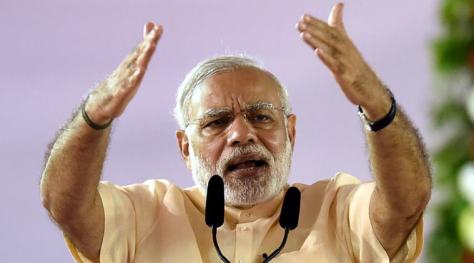
Anybody with a passing interest in consistency or coherence might be forgiven for being stumped at the political spectacle unfolding right now. Yesterday, Prime Minister Narendra Modi assured us that his government was committed to reservations. The statement was made at a ceremony to inaugurate the Ambedkar memorial at the Indu Mills compound in Mumbai. The fact that ordinary Dalits, in the habit of thronging any joyous celebration on Ambedkar in big numbers, were kept out of the ceremony, is possibly irrelevant. After all, officialese is officialese, and no political party – certainly not the BJP – has a monopoly on stiff-necked commemorations of people’s leaders that want nothing to do with the people. It is Modi’s commitment to reservations and the Indian constitution that is of interest. In some ways a statement of this nature made at the inauguration of an Ambedkar memorial, makes perfect sense. Apart from the occasion and locale, also not coincidental was the timing of Modi’s statement – one that he himself alluded to, when he referred to the bitterly fought Bihar elections now underway, “With a BJP government in power and polls getting under way, a malicious propaganda is being spread that the government is against reservation…”. The fact that the anti-BJP mahagathbandhan (grand alliance) in Bihar has made reservations one of their chief planks, with Lalu Prasad Yadav declaring in his inimitable style that he will kill himself if reservations are removed, is relevant.

Zooming back from the Ambedkar memorial event, the PM was clearly also responding to the threat to his Sabka Saath Sabka Vikas model begun a couple of months ago by the irrepressible Hardik Patel. Patel – erstwhile BJP supporter, self-styled Patidar-Patel revolutionary and a wild child in imminent danger of being silenced (or coopted) by the BJP – was temporarily subdued by the Gujarat administration following the wave of violence over his first call for reservation, but resurfaced a couple of days ago to be the nightmare Modi hadn’t dreamed yet – saying his aim was to expose the “Gujarat model of development”. This is for the current party nothing short of the youngest born of a rambling illustrious family running into the street from the family mansion saying our house is made of mud! our house is made of mud!

Continue reading House of Cards

Muzaffarnagar Baaqi Hai – Critical Readings Online and Offline: Akash Bhattacharya and Arif Hayat Nairang

These are guest posts by Akash Bhattacharya and Arif Hayat Nairang

The film Muzaffarnagar Baaqi Hai has been in the news recently, and not always for the right reasons, having attracted disruptive and abusive protest at some screenings. Following a day of counter-protest in which the film was screened all over the country, a friend teaching in a Delhi University college suggested screening it in her college, only to be told by the student representative that it would “cause trouble” (“bawwal mach jayega ma’am!!”). She asked what that meant and if he had seen the film, and he simply said, “nahin, bhaiyya logon ne kaha hai ki woh film bahut buri hai” (No, but our elder brothers have said it’s a bad film). 

In an atmosphere where political self-censoring comes as easily to the current generation of students as scouring the net for “blocked content” we present below two readings of the reception of the film, the first ruminating on whether the film addresses the complexities of communal mobilisation adequately; and the second inquiring in the context of social media and particularly Facebook, what constitutes the ‘liking’ of an image or idea. The idea of posting these comments is as much to give space to these arguments as it is to make a larger point that the ‘sickular left’ voices that are presumably behind the film love discussion, critique and disagreement. That to my mind is the way forward, not pre-empting the always-already hurt sentiments of the bhaiyya log whosoever they may be.

Continue reading Muzaffarnagar Baaqi Hai – Critical Readings Online and Offline: Akash Bhattacharya and Arif Hayat Nairang

‘Cities of Sleep’: Anirban Gupta-Nigam

Guest post by ANIRBAN GUPTA-NIGAM – A Preview of SHAUNAK SEN’S film ‘Cities of Sleep

A few days ago, on its Facebook page, Business Insider India shared a series of images of Bollywood stars who had gone—plainly speaking—from “zeroes to heroes”[1]. The yardstick for what constitutes success is another matter (Mithun Chakraborty, for example, is celebrated because he progressed from being a ‘Naxalite’ to ‘India’s highest tax payer’), but accompanying the post were the following words: ‘Every great dream begins with a dreamer. Always remember, you have within you the strength, the patience, and the passion to reach for the stars to change the world’. In another words, dare to dream and you shall become all you want to be.

This simple, inspiring message is possibly more complex than it first appears to be. It contains within it a contradiction that might well be worth attending to. Specifically, the images implicitly demand that we ask who (or what) is a ‘dreamer’ today.

The famous comedian George Carlin once said that ‘they call it the American dream because you have to be asleep to believe it’. A problem of a similar order is posed by the images in question here. Taken at face value, the mantra ‘every great dream begins with a dreamer’ not only propagates an all too familiar narrative of entrepreneurial success. It also comes with a qualifier—every great dream begins with a dreamer. Which is to say, not all dreams qualify for this honor. Continue reading ‘Cities of Sleep’: Anirban Gupta-Nigam

The Murky Fourth Estate: Asifa Zunaidha

This is a guest post by ASIFA ZUNAIDHA.

[Some time ago, I wrote on Kafila about my experience of attending a televised interaction with HRD Minister Smriti Irani. The audience, packed with supporters of the particular party Irani belongs to, was set up in that debate as the neutral ‘public’, thereby killing two birds with one stone – boosting the popularity of the Minister on news media, and legitimising the news channel as a site of punchy political debate. We have below a similar case of manipulation of the powerful medium of electronic news media, this time by another channel.] 

What is the role of the news media in a society if not to disseminate information and opinions as an impartial media(tor)? ‘Half truth is no truth’ is a popular aphorism, but ‘selective’ truth is also a lie and certainly does not befit the content of a news channel. It seems that in an age of corporate media, one would be foolish to expect impartial truths, let alone ‘undiluted or uncensored’ opinion of diverse groups. A recent episode inside the JNU campus shows how ‘news’ presented by News Channels can be easily manipulated and the opinion of a ‘select few’ is showcased as the ‘unanimous opinion’ emerging from the premier higher educational institute of the country.

Continue reading The Murky Fourth Estate: Asifa Zunaidha

For a Better FB: WomeninCampaign’s Press Release

August 26, 2015

Digital rights advocates demand a revision of Facebook’s policies that perpetuate violence against women in non-English speaking communities.

On July 28th a social activist, Preetha G, was brutally slut-shamed, harassed and abused in Facebook through a page which was in a native Indian language, Malayalam. The hate pages instigated a huge degree of violence, hurled abuses at her dignity and womanhood. It contained her morphed pictures with sexually explicit abuses, targetting even her autistic son. Preetha hailing from the state of Kerala in India, has around 22K followers on Facebook and uses the platform to to express her political opinions, her ideas on gender and other minority rights.

Many users including Preetha reported the hate pages (a total of 5 pages in a span of 3 weeks) to Facebook and also to the cyber crime wing of Kerala Police. Facebook replied with a generic message stating “The post doesn’t violate community standards”. The hate pages continued to update its content with threats and abuses to the women who publicly supported Preetha. Amidst all this, profiles of several supporters, especially women were suspended by Facebook. All these, including that of Preetha was blocked stating “violation of Real Name Policy” possibly due to reporting by those cyber-criminals who started the hate pages.

As the story of violence aided by Facebook policies spread, stories emerged from other countries as well. A recent incident occurred in Peshwar, Pakistan where a similar hate campaign was unleashed towards several young women through Facebook. When this was reported by users, Facebook responded in a similar fashion with the generic message that “no community standards were violated”. These young women’s lives were put to extreme risk and their own families did not protect them.

The women in countries like India and Pakistan do not get family support and Facebook refuses to understand the cultural complexities. With respect to this context, different individuals and organizations had several conversations with Facebook, but Facebook failed to take any measures until now to rectify these.

From the generic response that Facebook provides while hate pages in non-English language is reported, it is evident that the language experts that Facebook claims to have in place, is a myth. The actions or rather the lack of actions from Facebook, make it easier for several majoritarian forces to unleash violence against women and other marginalized sections. Facebook’s flimsy community policies are putting women’s lives in danger and this platform is used as a tool to silence women and bring forth more oppression.

It is high time we collectively inform Facebook about renegotiating its policies what adhere to majoritarian forces, and initiate a global mass campaign against those policies.

We, Women In Campaign, demand the following to Facebook:

a) Right to Privacy: To get rid of the real name policy and its associated proceedings.

b) Right for protection against hate crimes: A systemized responsive system or a set of language experts for assessing hate pages in non-English languages and a timely response and follow up in such situations.

c) Right to cultural diversity: Facebook needs to understand the complexity of non-English cultures and cannot impose its American corporate colonization into other societies. It urgently needs to appoint linguistic experts who can verify hate pages and understand regional languages and it nuances.

On Tuesday Aug 18th 2015, an online meeting was held with representatives from Facebook (India and US), Maya Leela and Inji Pennu (Women In Campaign) and members of a few other organisations who stand for Facebook policy revisions. We are waiting for a post-meeting response from Facebook. Depending on their response, we will disclose our future strategies.

We stand in solidarity against the invasion of Facebook into our right to privacy and political choices.

A Facebook page is started for the campaign: https://www.facebook.com/womenincampaign

hashtag for solidarity: #forabetterfb 

 Sincerely,

Women In Campaign, India

[Aswathy Senan, Inji Pennu, Jaseela Cheriyavalappil, Jina Dcruz, Kunjila Mascillamani, Maya Leela, Najma Jose, Preetha GP]

Digital Rights Foundation, Pakistan – Nighat Dad

Internet Democracy Project, India

Point of View, Bishakha – India

Phone Contact:Inji Pennu : (USA) +1-3212502484

Jaseela CV: (India) +91-9497550324

Email : forabetterfb@gmail.com 

Nighat

Kavita

chomsky

Askmebazar.com – Dystopian Hyper-Consumerism and Pushy Advertising : Adnan R. Amin

This is a guest post by ADNAN R AMIN

It was an entertaining skit.

It opens with an animated evangelist (played by a dashing Bollywood leading man) talking about the dangers of stress and how it drains us. To the applause of an enthralled, glazed-eyed audience, he presents a man quivering uncontrollably – tap-dancing even – from extreme work-related stress. With the uproarious consent of the crowd, the evangelist introduces the poor specimen to Askmebazar.com. Miraculously, the man stops shaking and starts browsing through shopping items. He is instantly relieved of his stress and bathed in a halo-like glow. As the plot winds up, he is seen drowning in a deluge of delivery crates and boxes.

“One Click Therapy.”

This is the comical, over-the-top television commercial from Askmebazar.com, an online marketplace. While undeniably funny, the positioning idea is discomforting, if not problematic. Once we get past the comedy and the antics, the message of the commercial is darkly dystopian. It seems to say: if earning gives you stress, spending will relieve that stress. Meanwhile, here’s an app just for that. Continue reading Askmebazar.com – Dystopian Hyper-Consumerism and Pushy Advertising : Adnan R. Amin

The Sociology of#SelfieWithDaughter : Saba M. Hussain

This is a guest post by SABA M. HUSSAIN

Many, many Indian fathers are tweeting selfies with their daughters making it one of the highest trending topics on twitter recently. These selfies are being posted in response to PM Modi’s appeals to his country during his monthly radio address to the nation as a part of theBetiBachao, BetiPadhao (Save the Daughter, Educate the Daughter) campaign.Many including several celebrities from the sports and movie business have lauded this initiative from the Prime Minister of India by posting touching father-daughter pictures. Continue reading The Sociology of#SelfieWithDaughter : Saba M. Hussain

बाक़ी चीज़ों की तरह इनका योग भी फ्रॉड है…

Dilip C Mandal's photo.
Dilip C Mandal के फेसबुक पोस्ट से साभार (तस्वीर और नीचे की टिप्पणी दोनों)

जो लोग कभी नहीं करते और फ़ोटो खिंचवाने के लिए नाटक करते हैं, वे सबसे आसान आसन- पद्मासन भी गलत करते हैं।

मोदी जी के पैरों की मुद्रा देखिए। सही पद्मासन में पीछे वाली लड़की बैठी है। देखिए, दोनों पैर ऊपर हैं। जो कभी नहीं करते हैं, वे नाटक के लिए भी नहीं कर सकते।

जब पद्मासन में बैठने को कहा गया है और सभी लोग वही कर रहे हैं, तो रेगुलर योग करने का दावा करने वाले को पद्मासन ही करना चाहिए। अर्ध नहीं पूर्ण।

56 इंच का सीना नहीं, 56 इंच का पेट है। रामसनेही को अब पूरा यकीन है कि सुनने में धोखा हुआ था।

बच्चों को इनसे शिक्षा नहीं लेनी चाहिए।

Appeal to Release Raif Badawi, a Saudi Blogger: Peoples Alliance for Democracy and Secularism

Guest Post by Peoples Alliance for Democracy and Secularism

To:

The Ambassador,
Embassy of Saudi Arabia at New Delhi,
2- Pachchimi Marg, VasantVihar,!
New Delhi-110057  Fax: 00911126144244

This is an appeal regarding Raif Badawi, a blogger and Saudi citizen, founder of the website ‘Free Saudi Liberals’. Mr Badawi has been under arrest since 2012 for insulting Islam and apostasy. He was sentenced to be punished with 10 years in prison along with 1000 lashes (50 lashes to be received on every Friday) and a fine of one million riyals. Though he was cleared of charges of apostasy in 2013, there are new reports that indicate he may be tried again under the same charge.

We are mindful that India and Saudi Arabia have long-standing friendly political and commercial relations and that large numbers of Indians live and work in your country. It is because of this that we feel constrained to convey to you our concerns. Raif Badawi is a public intellectual who communicated his thoughts to the public through a blog. We do not believe that any of its contents constituted a threat to the state. To the contrary, his advocacy for secularism and the separation of religion and state is a suggestion that would strengthen it.

Whether or not his ideas are pleasing to your government, the fact remains that as a member state of the United Nations, Saudi Arabia is presumed to be respectful of the freedom of speech that is provided for under Article 19 of Universal Declaration of Human Rights, 1948. This article states: ‘Everyone has the right to freedom of opinion and expression; this right includes freedom to hold opinions without interference and to seek, receive and impart information and ideas through any media and regardless of frontiers‘.

The sharing of information and ideas is a basic human practice and natural right that should be available to everyone regardless of their nationality or identity and (barring extremist incitement) should not be restricted by law. The state should protect and promote our rights instead of restricting them.

It has been reported that Raif Badawi received the first set of lashes on 9 January, after Friday prayers outside the Al-Juffali Mosque in Jeddah. The next round of punishment has been suspended on medical grounds to give his wounds time to heal prior to wounding him again. We consider this an example of barbaric cruelty, not befitting any member state of the UNO. Such practices are a travesty of justice and will bring you only disrepute.

We are Indian citizens who speak for human rights both within our own country and beyond. We are in solidarity with Raif Badawi and all those demanding freedom of speech in Saudi Arabia. We condemn the inhuman punishment being meted out to him as we condemn all measures that punish people for defending human rights and sharing their thoughts

We ask that Saudi Arabia:
•  Immediately suspend the punishment of Raif Badawi,
•  Release Raif Badawi and provide him security,
•  Take measures towards the provision of full freedom of expression in Saudi Arabia

Submitted by:

Ravi Nitesh, Peoples Alliance for Democracy and Secularism
, Dipak Dholakia
, Rajashri Dasgupta, 
Prithvi R Sharma, 
Rana P Behal, 
Shamsul Islam, 
Suman Keshari, 
Aseem Shrivastava, 
Viren Lobo
, Sabyasachi Bhattacharya, Kashif Ahmed Faraz, R.Sasankan, Journalist, Delhi , Rohit Sharma, Pilani, India
, Mandeep Singh from Revolutionary Youth Student Front
, Firoz Ahmad, Public School Teacher
, Chaman Lal, 
J.S.Bandukwala
, Devika Mittal (Mission Bhartiyam), 
Apoorvanand
, Sudha Vasan
, Dheeraj Gaba, 
Nawed Akhter, 
Dilip Simeon , Shabnam Hashmi, Rohini Hensman 
Ovais Sultan Khan, Ram Puniyani, Vinerjeet Kaur, Kiran Shaheen
, Battini Rao, Convener, Peoples Alliance for Democracy and Secularism (PADS)
, Javed Anand
, Harsh Kapoor
, Subash Mohapatra, Global Human Rights Communications, Bhubaneswar 
Sagar Rabari, Ahmedabad
, Nayanjyoti
, Shailendra Dhar, Journalist, Nihal Parashar
, Linus Ayangwoh 
Embe, Peter Marshall , Sudarshan Juyal
, Dhruv Singhal (Political Science student), 
Mohammad Imran, NRISAHI, Suresh Bhat
, Prof. S Ratnagar, Mumbai
, Ilma Iqbal
, Michael Karadjis
, Vasantharajan, Research Scholar , Rabin Chakraborty, 
Shruti Arora
, Hiren Gandhi, 
Anand Patwardhan, Dr. D. Gabriele, Mukul Mangalik, Neeraj Malik, academic, 
Suhas Borker
, Virginia Saldanha, Mumbai , Kasim Sait
, Waliullah Ahmed Laskar
, Kaveri Rajaraman, University of Hyderabad, 
Parth Sarthu
 Ram
, Mahesh Elkunchwar,  
Suman Kumar , Kamayani Bali Mahabal, 
Syed Ghazanfar Abbas, Jawad Mohammed
, Prof. Anil Sadgopal, Shiksha Adhikar Manch, Bhopal
Satya Pal, Secretary General – South Asian Fraternity 
Deepak Kabir / Veena Rana, Dastak, Lucknow 
Madhu Sarin
, Kavita Panjabi, Kolkata
, Xavier Dias Editor, Khan Kaneej aur ADHIKAR ,Jharkhand India , Muhammad Murad, from Pakistan, Sindh
, Sanjay Halder
, Gurpreet Singh, Ravi Tripathi, Francis Gonsalves
, Subhash Gatade, New Socialist Initiative, 
Shahid Siddiqui
, P.I. Jose, 
Ishwarbhai Prajapati, 
Deepak Kabir
, Fr. T.K.John , Professor 
Rohan Dandavate – TPI WORD, Daniel Varghese
, Sanjay T , Prasanth Menon
, Zakia Soman and Dr. Noorjehan SN from Bharatiya Muslim Mahila Andolan , Antony Aruloraj, New Delhi, India, 
Aarti Tikoo
, Ashish Biswas, Online Journalist, Dhaka, Bangladesh, 
Devaki Khanna, 
Alok Chadha
, Renu Singh, Samir Dholakia, Mushtaq Dar
, Narinder Singh Sandhu, 
P R Vaidya, Bombay
, Dr V Prasad
, Ameeque Jamei
, Padma Velaskar, Bhanu Bharti, Shuddhabrata Sengupta, Delhi
, M.Balanna, PADS, Andhra Pradesh
, Ajay Kumar, PADS Andhra Pradesh
, Roja Ramani Mahila Sravanti, Kurnool

Bread and Circuses? No sir, circuses alone will do.

Edited and updated version of the post.

I had the great fortune to be invited as an audience member to a live interaction with Union HRD Minister Smriti Irani last evening, televised live on Aaj Tak. I say “great fortune” because despite the fact that I walked out of this “interaction” in speechless disgust around an hour into the programme, I probably learned more about the state of politics and media in this country in one evening than I could have from years of academic study. And the irrelevance of academics was exactly what was on display last evening, never mind that the topic of the interaction was the state of higher education in the country.

I reached the venue – the auditorium of Khalsa College, Delhi University – at about 5.15 pm for a 5.30 pm programme. The mood was surprisingly charged, even electric for what I imagined would be a sober discussion on somewhat boring topics like syllabus formation, university infrastructure, promotions and pensions, the points system, and most importantly, the changes proposed under the Choice Based Credit System (CBCS). The auditorium was already packed – not so much with teachers and students – but with a large number of ABVP activists, BJP volunteers, and committed party supporters from within and outside the University. Nothing wrong with having a politically committed section dominating the audience of course. But if the resultant mix is innocently termed “the public” – the term the anchor used was “janta” – then that constitutes the first point of deception. I took a seat in the second row as instructed, surrounded by triumphant, pumped-up BJP supporters shaking hands with each other, suddenly feeling small and irrelevant, having come prepared with questions on Delhi University. At one point, turning to speak to the person next to me, I encountered a gentleman who introduced himself only as a “social worker” and asked me to elaborate on the problems with the university. As I began to list them however, he cut me short with a wave of a hand to say the government will prevail over all of them, and turned back to gaze admiringly at the life-sized posters of Modi all around us. I realised the person knew absolutely nothing about the University or teaching as a profession, and couldn’t care less.

Two anchors from Aaj Tak – Anjana Om Kashyap and Ashok Singhal – were on stage, interacting intermittently with the audience. At one point, Kashyap turned to the audience and said she was aware that there were many eminent professors in the first two rows who had been invited by Aaj Tak, but that she would begin the interaction with the Minister first with general questions on politics, and then move on to the topic of the evening – higher education. Nobody seemed happy with this, but having little choice, we vaguely nodded our assent. In walked Irani, striding up confidently on to the stage. Without so much as acknowledging the audience or making eye contact, she began to banter with the anchors, saying she only had half an hour and had not agreed to two hours, etc. While this time bargaining was going on, the crowd began to settle down somewhat, and the cameras began to roll. As planned and announced, Kashyap began with politics, asking Irani about her Twitter war with Rahul Gandhi and with her frequent visits to Amethi. As far as I or anybody who cares deeply about what is happening to Delhi University and other universities in the country was concerned, THAT WAS THE END OF THE EVENING.

Continue reading Bread and Circuses? No sir, circuses alone will do.

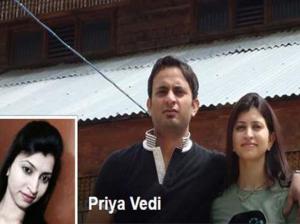
The Priya Vedi Suicide: Diwas Raja Kc and Alston D’Silva

This is a guest post by Diwas Raja Kc and Alston D’Silva

Image Courtesy: www.pardaphash.com
Image Courtesy: http://www.pardaphash.com

On the 18th of April this year, Dr. Priya Vedi of AIIMS tragically ended her life and left a Facebook note incriminating her husband—fellow doctor at AIIMS Dr. Kamal Vedi—for “torturing” her mentally, clearly implying that his homosexuality was the reason for her suicide. Her distress is apparent in the note as she recounts the lack of intimacy in her marriage and her discovery of the husband’s sexual activities as a gay man before and during the marriage. At the end she includes a plea to all gay men to not “marry to a girl to save yourself,” to not play with the emotions of a girl and her family. It should not be surprising that some condolent commentators have placed the blame specifically on Kamal Vedi’s alleged sexual orientation, even calling for legal action. Even within the LGBT community, the tendency has been to first put culpability on the man’s opportunistic participation in the institution of marriage. There is a sense that this incident ought to serve as a teaching moment for gay men, who are argued to require an ethical code, who need to fixate on the deliverance of their conscience, and whose rights—as Sandip Roy pointed out—”mean nothing without responsibility.” But despite Priya Vedi’s strongly felt sentiments, must we proceed as if the case of her fatal end is a logical and natural consequence of gay men’s irresponsible intrusions into the sanctum of marriage? After all, such intrusions are routine, and the ensuing heartbreaks are sometimes even known to be productive of powerful empathy between straight women and gay men.

Continue reading The Priya Vedi Suicide: Diwas Raja Kc and Alston D’Silva

Gajendra’s Tragic Death, Media Spins and the Indignation Industry

Gajendra, BJP and the Propaganda Machine

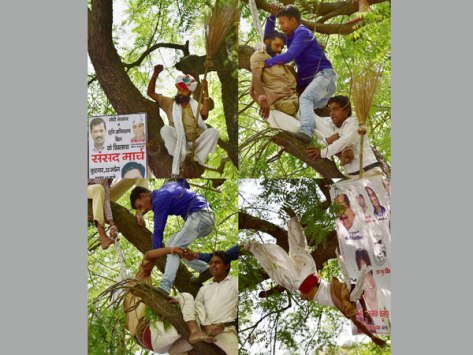
The tragic death of a farmer from Rajasthan occurs at a rally organized by the Aam Aadmi Party on 22 April 2015. The farmer, Gajendra Singh, hangs himself from a tree in full public view of the demonstrators, the media, the police. The electronic media had till then been barely covering the event, generally holding forth instead, in studio ‘debates’ among the opponents of AAP. Once this happened, the media spin doctors swung into action, and as Rajdeep Sardesai tweeted later, they seemed to work on an already decided script. Sardesai’s tweet said that there were clear instructions from the BJP to the media to focus only on the hung/ dying (or dead) man, and forget the rally. It seems, on a closer look, that the the second part of the instructions had perhaps already been given in advance – not to cover the rally and if at all, to attack it in sponsored studio debates. And of course, the BJP, which is the architect of the new Land Acquisition Ordinance, is an interested party in this game.

It is not entirely irrelevant to the overall politics of the media-BJP spin doctoring  of ‘reports’ that the AAP government in Delhi was perhaps the first in the country to announce what is without doubt the highest compensation to farmers suffering crop losses – Rs 50, 000/- per hectare for all farmers who have suffered damage. Nor is it entirely irrelevant that the Delhi government had lent full support to the anti-land acquisition struggles and Kejriwal had himself joined in the rally held by Anna Hazare and had now taken up the land issue in all seriousness.

Thus it happens that between the BJP and the big media propaganda machine, which has on at least two previous occasions completely blacked out AAP, the stage was set. Also at work in the media-AAP relationship over a longer term now, is the role of Mukesh Ambani’s media empire, given that on a range of issues AAP has directly challenged the latter. As an aside, let me add that a very senior journalist told a friend at the height of the Delhi election campaign, that in CNN-IBN/ IBN7, clear instructions had been issued to the staff not to give more than 20 seconds exposure to Arvind Kejriwal under any circumstances. If AAP swept the Delhi elections despite that, it must say something about the limits of the media game, at least as far as the majority of the population is concerned.

Gajendra singh being rescued, image courtesy Oneindia.com
Gajendra Singh being brought down. Image courtesy Oneindia.com

This time round, there was another constituency that was waiting to move into action – the Delhi elite, especially the radical elite whose hatred of Kejriwal is simply visceral, but which had been just about tempered by the presence in his team of People Like Themselves, darlings of the media. The latter had, to use an old Maoist expression, ‘wormed its way into the party’ and was intent on fighting an ‘ethical battle for inner party democracy’ against the ‘fascist Kejriwal’, a battle in which they were fully backed by the Ambani dominated media.

Continue reading Gajendra’s Tragic Death, Media Spins and the Indignation Industry

Being Empowered the Vogue Way – Is There Anything Left to be Said?

Really, nothing. It’s been more than a week since the Vogue Empower video directed by Homi Adajania and featuring Deepika Padukone amongst others, has appeared, been watched, digested, commented upon, counter-videoed, spoofed and counter-spoofed. And a week on the internet constitutes nothing less than a geological age of course, so there’s been a veritable melting Ice Age of responses. To list just some of the reactions to the video – the female fan responses, that say kudos to Deepika for “saying it like it is”. Uncritically starry-eyed as they are, they point to the real chord struck by the video with thousands of young women fighting, thinking, arguing and surviving their way through a breathtakingly conflicted urban India. This is an India that by all appearances works hard and parties hard, in the process occupying a fraught and frequently violent terrain of interaction between the sexes.

Continue reading Being Empowered the Vogue Way – Is There Anything Left to be Said?

CPDR Statement on Maharashtra Cow Slaughter Ban

Committee for the Protection of Democratic Rights, Mumbai
THE MAHARASHTRA ANIMAL PRESERVATION (AMENDMENT) ACT, 1995
18 March 2015

As if the 1976 Maharashtra Animal Preservation Act banning the slaughter of cows, including the male and female calf of the cow, enacted by the Shankarrao Chavan-led Congress government during the Emergency was not enough, the Devendra Fadnavis-led Bharatiya Janata Party-Shiv Sena government is elated that the 1995 Maharashtra Animal Preservation (Amendment) Act, enacted by a previous BJP-Sena led by Manohar Joshi, that extends the ban to include slaughter of bulls and bullocks, has now received presidential assent. Despite the BJP’s claims justifying the ban on agro-economic grounds, among others, the driving force behind the prohibition is the ideology of Hindutva, presented as “a way of life” rooted in the central beliefs of neo-Vedantic Hinduism, of which cow slaughter and beef eating are supposedly anathema.

Continue reading CPDR Statement on Maharashtra Cow Slaughter Ban

Kill it Before it Hatches, Attack it Before it Grows – On State Sanctioned Vandalism against Contemporary Art in Kashmir: Syed Mujtaba Rizvi

Guest Post by Syed Mujtaba Rizvi

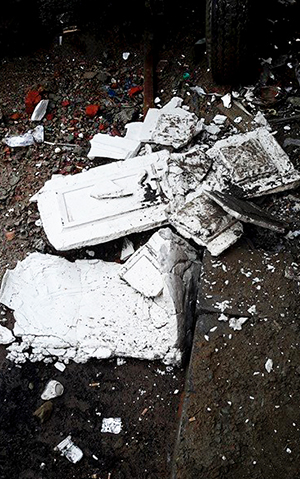
A Work of Art Vandalized at Gallerie One, Srinagar

On the opening day of Gallerie One, I was in a conversation with Rajendra Tickoo, Masood Hussain, Shabbir Mirza, M A Mehboob, Shaiqa Mohi and several other senior artists from Jammu and Kashmir. The opening of the first ever centre for contemporary arts and research in Kashmir was a dream come true for all of them. They told me that they had waited all their lives for such an initiative and how several great artists had died with the dream of having an art gallery in Kashmir. They were all very excited. They shook my hand again and again and hugged me before and after. Continue reading Kill it Before it Hatches, Attack it Before it Grows – On State Sanctioned Vandalism against Contemporary Art in Kashmir: Syed Mujtaba Rizvi

Widespread Protests in Dhaka Against Avijit Roy’s Killing by Muslim Extremists

Killing of Avijit Roy, image courtesy Sudin Chattopadhyay
Standing up to the killing of Avijit Roy, image courtesy Sudin Chattopadhyay


Soon after this brutal killing of the Bangladeshi-American atheist blogger, protests have begun across Dhaka. We extend our support to the struggle against the dangerous forces of religion-inspired extremism. See more detailed report in Al Jazeera here and The Guardian here.

B'desh protests against killing
B’desh protests against killing, image courtesy The Guardian

Zehn ki Loot – The Plunder of Reason in a Times Now TV Studio: Kavita Krishnan

Guest Post by Kavita Krishnan

“Phool shaakhon pe khilne lagey” tum kaho,
“Jaam rindon ko milne lagey” tum kaho,
“Chaak seenon kay silne lagey” tum kaho,
Iss khule jhooth ko,
Zehn ki loot ko,
Main nahin maanta,
Main nahin jaanta

“Branches are abloom with flowers” you say!

“The thirsty have got to drink” you say!

“Wounds of the heart are being sewn” you say!

This open lie…

A plunder of reason…

I shall not accept!

I shall not recognise!

(Habeeb Jalib, translated by Ghazala Jamil)

In Shakespeare’s Taming of the Shrew, Petrucchio declares the noontime sun to be the moon: “I say it is the moon,” to test his wife’s loyalty and obedience. As long as she stands by her reason and asserts “I know it is the sun”, she continues to be a ‘shrew’. Only when she consents to ‘zehn ki loot’ (plunder of reason), when she agrees to subordinate her own reason to the whim and diktat of her husband, and deny the self-evident truth, does she achieve approval as a suitable wife.

We, the people of India, are being similarly tamed of our ‘shrewish’ behaviour, with propaganda and public shaming in TV studios accomplishing the ‘zehn ki loot’. It is a process that seeks to bully us into declaring that the sun is the moon, that night is day, that ‘khula jhooth’ (open lie) is in fact the only truth. Refuse to part with your reason, and you are chastised for ‘bad behaviour’.

I would like to revisit the #GovtVsNGO News Hour show on Times Now, on 17th February, as a particularly glaring instance (Activism or Anti-nationalism, Parts 1 and 2 )

The topic of the show was the Government of India’s decision to deplane a Greenpeace activist Priya Pillai from a London-bound flight, because she was planning to depose before British MPs about the violation of India’s forest rights laws by a British mining company, Essar, in Mahan in Madhya Pradesh.

Continue reading Zehn ki Loot – The Plunder of Reason in a Times Now TV Studio: Kavita Krishnan

Are Jibran Nasir and his friends Game Changers in today’s Pakistan? Fawzia Naqvi

Guest Post by FAWZIA NAQVI

One cold Karachi Night

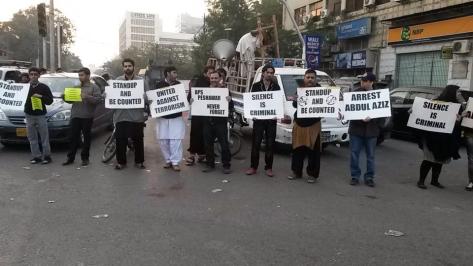
On the night of February 1st, Jibran Nasir Pakistan’s leading activist and a handful of peaceful protesters sat on a road in Karachi near the Sindh Chief Minister’s house for more than 24 hours, demanding the arrest of terrorists responsible for the January 30th Shikarpur attack which killed 65 Shias during Friday prayers, and demanding action against banned sectarian organizations. There were only 20 protesters, their average age 25, outnumbered it seemed by riot police with water cannon and batons at the ready.

Protest in Karachi against Terrorism and Secterian Violence

Continue reading Are Jibran Nasir and his friends Game Changers in today’s Pakistan? Fawzia Naqvi

‘Attica, Attica, You Put Them Guns Down!’ Ipsita Barik

On a day when we woke up to the seemingly incomprehensible barbarism of a woman being beheaded in Saudi Arabia, we may do well, apropos Nivedita Menon’s post on MLK, to remember the barbarism that hides in broad daylight within seemingly civilised societies. One such floodlit hideout, so bright it blinds us, is the state of our prisons. Before Guantanamo and Abu Ghraib inaugurated a new era of dehumanisation in the American “correctional system”, there was Attica, and hundreds others like it that continue in the U.S and around the world to this day. We may also remember Professor G.N Saibaba of Delhi University who, despite being 90% disabled, has been not only imprisoned but kept in solitary confinement for almost two years on mere suspicion in an Indian jail somewhere. Really, what more does it take these days?!

This is a guest post by Ipsita Barik

Attica 9

When Al Pacino’s character Sonny Wortzik yells and hollers “Attica – Attica” in the film Dog Day Afternoon, the cops and the FBI officers are left stunned & dumbfounded, but the civilian population collected at the scene, behind the police barricades began to cheer & applaud. The air is soon filled by the chants of the noun and Sonny in his soaked white shirt, flaying his arms and stomping on the ground, gestures at the cops and adds “you put them guns down; you put them down – “AATTICA aattica”. So what was happening here? Why were these people cheering and supporting a man who had come to rob a local bank and was holding hostages inside! And what was Attica all about?

Attica 5

Attica prison riots/uprisings happened at the Attica Correctional Facility, New York, United States; when the prison cells and yards were seized by the inmates, who also held hostages, on September 9th 1971, opening a series of negotiations and dialogues between the establishment and the inmates, which included civilian observers, Tom Wicker of the New York Times, Republican State Senator John Dunne, radical lawyer William Kunstler and Black Panther’s Bobby Seale, on the request of the inmates. The primary demands of the inmates were related to the inadequacies and brutalities within Attica, such as related to insufficient food and medical care, racial discrimination, physical abuse, restricted access to educational and training facilities, all a serious indictment of the prison rules and environment, as the New York State Special Commission on Attica/McKay Commission (set up by the state) subsequently went on to assert and highlight. Continue reading ‘Attica, Attica, You Put Them Guns Down!’ Ipsita Barik