Category Archives: Law

No your lordship, everybody opposing Aadhar is not following an“NGO line”: Baidik Bhattacharya

Guest post by BAIDIK BHATTACHARYA

We live in strange times. A judge in the country’s Supreme Court believes anyone challenging the government’s decision to impose Aadhar-based surveillance regime is following an “NGO line.” Another judge wonders in the court whether “one nation one identity” is not the necessary path forward. Soon, one wonders, if any opposition to surveillance, and any resistance to being spied upon by the state, will be deemed anti-national not only by the government but also by our top judiciary.

Since the hearings on the various anti-Aadhar pleas are being heard in the Supreme Court, and since such inconsiderate observations are being made regularly, let us look at a few problematic aspects of the biometry-based Aadhar idea itself—not only the technical glitches and possible misuses (of which there are many), but the central philosophy that underlines the state’s eagerness to bring every citizen under one biometric identity.

Continue reading No your lordship, everybody opposing Aadhar is not following an“NGO line”: Baidik Bhattacharya

The Festering Sore of the Caste-Wall at Vadayambady: T T Sreekumar

T T Sreekumar, an important commentator on contemporary politics in Kerala — a public intellectual who now qualifies to be an irritant in the eyes of the Kerala police, now that he has openly declared his allegiance to the dalit people fighting injustice and Vadayambady and inaugurated a protest-event there — writes about the issue and its historical origins:

When I visited Vadayambady the other day to express my solidarity with the cause of the agitation, what I witnessed there was an atmosphere of utmost fear and police terror. A big task force of police was stationed at the location. The team that included the special branch officers, had created a situation of terror at the peaceful site. Activists mentioned that a particular police officer continuously hurled abuses, including caste abuses, at the protesters that included Dalit women and children. When the protest began to draw national attention, the ruling dispensation of CPIM that had hitherto remained unconcerned has started to take up some damage control measures. However, when they finally arrived at the site of the agitation almost after a year since the agitation began, the CPIM leaders allegedly refused to address the caste question involved. Dalit activists, including women activists, surrounded them and raised several objections to this attitude pointing to their sheer hypocrisy and lack of integrity.

Read more at:

https://countercurrents.org/2018/02/02/fighting-peripheralization-dalit-movement-hindu-caste-wall-kerala/


Malayali Feminism 2018: In the Light of Vadayambady and Hadiya’s Struggle

The almost insoluble task is to let neither the power of others, not our own powerlessness, stupefy us.

Adorno.

As frightening spectres of untouchability and unseeability hover around the festering sore of the ‘caste-wall’ at Vadayambady in Kerala, as the so-called mainstream left-led government here continues to pour its energy and resources into aiding and abetting caste devils there, as most mainstream media turns a blind eye, as the Kerala police continues its mad-dog-left-loose act, many friends ask me: why have you not yet written about the struggle there of dalit people fighting of the demon of caste now completely, shamelessly ,in the public once more? Continue reading Malayali Feminism 2018: In the Light of Vadayambady and Hadiya’s Struggle

The Indian Constitution too was Demolished Along With Babri Masjid 25 Years Ago

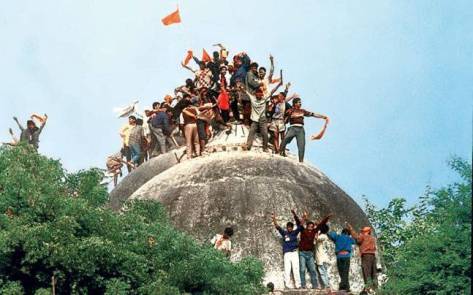
Twenty five years ago, on 6 December 1992, the structure of Babri Masjid was brought down by a mob of vandals, presided over by the top leadership of the BJP/RSS/VHP, as the Congress government led by prime minister Narasimha Rao looked on benignly. As did the Supreme Court before which a commitment was made by the Kalyan Singh (BJP) government in Uttar Pradesh – to the effect that nothing would be allowed to happen to the structure of the mosque.

Journalist Sajeda Momin, covering the demolition, recalls the scene thus,

I can still see the thousands of saffron-clad ‘kar sevaks’ clambering atop the 16th century mosque and pounding it with shovels, iron rods, pickaxes and anything they could lay their hands on. I can hear the screeching of Sadhvi Uma Bharti egging them on shouting “ek dhakka aur do, Babri Masjid tod do” through the microphones from atop the specially-built watchtower for the BJP/RSS/VHP leadership. I can visualize the three domes of the mosque collapsing inwards one by one at intervals of roughly an hour on that cold, wintery Sunday afternoon.

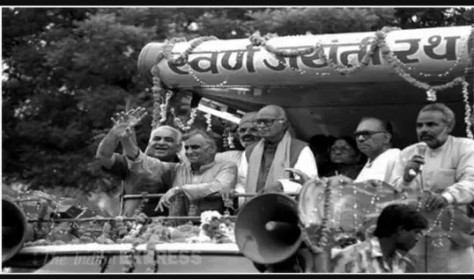
Everyone knew who were the dramatis personae at each level – and practically every bit of evidence that would ever have been required exists, captured in videos and photographs. Our present prime minister was said to be  one of the key organizers of the of the Rath Yatra that led up to the demolition and can be seen holding the microphone in his  hands in the photograph below.

Rath Yatra – precursor to the demolition, image courtesy Quora.com

Worse was to follow the demolition. The  demolition of the structure of the mosque was over that day but the process of the demolition of the Indian Constitution that had begun with what was called the ‘Ram janmabhoomi movement’ continued. By ‘Constitution’ I do not simply mean the book that embodies the law of the land but rather the very weave that came to constitute Indian society as a result of the new contract that the document called the Constitution embodied. Constitution, therefore in a triple sense. The document called the Constitution too was not merely a book of laws; it was rather, the only existing, largely agreed upon, vision of a modern India. It was a vision which was put in place through the long process of struggles, debates and contestations over the long decades of the anticolonial movement and finally given shape in, in the Constituent Assembly. There was nothing benign or innocuous about it – every bit of it had to be achieved through a fight. And yet, in the end, that was the document that embodied the vision of modern India. The only political current that stood far away from both the anticolonial struggle and had no role in the creation of this vision is the political force that rules India today.

The RSS and its numerous offshoots were neither fighting the British nor joining in the anti-caste and anti-untouchability struggles through the period since they came into existence in the mid-1920s. No wonder leaders of the Sangh combine think the anti-colonial/ national struggle was about cow-protection. That they neither subscribed to the anti-British agenda nor to the anti-caste agenda around which struggles of that period took shape, is not just a matter of historical record but is also visible in the way its leaders and ranks conduct their politics today. Every single step taken by the Sangh leaders is a step out of sync with the vision of the future spelt out by the social contract of modern India. That the Sangh attributes this vision to the Congress is an expression of its own illiteracy about the diverse forces in struggle throughout that period.

Even though it is conducted in the name of Hindus, there is nothing ‘Hindu’ about its agenda. Sangh and Sanghism is the name of a malignant political machine that seeks to destroy the very body of society in the name of an ancient past. That is the political machine we confront today. That is the political machine that we must fight today with all our vigour.

What’s in a Name? The Demolition of ‘Babri Masjid’, the Name and the Mosque: Hilal Ahmed

Babri-Masjid – Before the Demolition, image courtesy Tehelka.com

The gradual erasure of the words ‘Babri Masjid’ from our everyday memory actually began in 1986, when the Hindu community was granted the exclusive right to worship there. This happened without any regard ownership disputes the and illegal conversion of this mosque into a temple in 1949.

This story of the dispute itself is disputable. It is imperative to revisit three interesting moments, which no one talks of these days.

The 1949 moment

On the night of 23 December 1949, a group of local Hindus entered the mosque and installed the idols of Lord Ram inside it. Although the police filed an FIR in which the building is clearly defined as a functional mosque, the local administration took charge of the building, and without removing the idols from the mosque space, declared it a legally “disputed site”. Read the full article here


An open letter to Brinda Karat: why do female supporters of the Kerala CPIM spew such venom at Hadiya?

Dear Comrade

I can hardly describe the joy and relief I felt reading your piece on the Hadiya case in the Hindu yesterday. By now I am nearly deaf from the cacophony of misogyny, islamophobia, and sheer short-sighted rage that CPM supporters on Facebook are unleashing against this young woman.

Your voice of sanity, Comrade, is therefore a great restorative. If not for your writing, one could have well thought that the CPM was nothing more than a bunch of short sighted, power hungry, strategisers, whose total lack of ethics and values is covered up by a vapid, outdated rationalism and an equally problematic liberalism. You refuse to condemn Hadiya for choosing Islam. You acknowledge that she is brave. You unequivocally reject the father and other minions of patriarchy. You rightly criticise state patriarchy evident in the Supreme Court. Unlike many CPM supporters here, you have no illusions about the times we live in; you are clearly aware that the NIA is not something which will spare us if we stay good. Importantly, you put paid to the idea that the High Court judgement that sanctioned her illegal custody was justified — an idea assiduously nurtured by certain public figures allied with the CPM against religious Muslims. Comrade, thank you again for being so forthright and in the face of snarling islamophobes in your own ranks actually gunning for the voice you raised against her illegal custody long back.

Continue reading An open letter to Brinda Karat: why do female supporters of the Kerala CPIM spew such venom at Hadiya?

The Gates of Vaikuntam?

When Hadiya Shafin shouted to the crowd that she converted voluntarily, that Shafin was her chosen husband, and that she wished to spend her life with him, some leading rationalist liberal feminists in Kerala sniggered at her: be grateful for the Indian Constitution which allows you to make a choice. This statement hid a despicable insult to her choice of Islam, slyly implying that it would not permit her any choices.

Goodness knows where these puerile, vain, indurate minds live their everyday lives.  Maybe they are either still able to insulate themselves somehow from the onslaught of Hindutva violence, or find it useful to use the arms of this Hindutva hegemonised thuggish state to their narrow, shamefully narrow, ends.

Whatever, I could see no trace of the protective presence of the Indian Constitution when the Supreme Court heard Hadiya. I could see not the highest court of Justice of a vibrant democracy but I got a sense of how the Gates of Celestial Vaikuntam may look like:

Read more at : https://thewire.in/200701/hadiya-supreme-court-nia/


Hadiya’s Safety is the Kerala Government’s Responsibility: Rajathi Salma writes to the Chief Minister of Kerala

[This is the text of the open letter to the Chief Minister of Kerala from the celebrated Tamil poet Rajathi Salma, a leading literary and activist voice from South India whose writing has often revealed the pain and poignancy of women’s unfreedoms and the denial of a creative life of choice to them. This is about the never-ending agony that the confinement of a young woman, Hadiya, by her father, has become. Hadiya is to be heard by the Supreme Court of India on 27 November 2017, but the Kerala government refuses to take responsibility for her safe travel to Delhi, after many many pleas from civil society] Continue reading Hadiya’s Safety is the Kerala Government’s Responsibility: Rajathi Salma writes to the Chief Minister of Kerala

महाड़ सत्याग्रह के नब्बे साल

‘‘जब पानी में आग लगी थी’’
Inline image 1
प्रस्तावना
‘क्या पानी में आग लग सकती है ?’’
किसी भी संतुलित मस्तिष्क व्यक्ति के लिए यह सवाल विचित्र मालूम पड़ सकता है। अलबत्ता सामाजिक-राजनीतिक आंदोलनों पर निगाह रखनेवाला व्यक्ति बता सकता है कि जब लोग सदियों से जकड़ी गुलामी की बेड़ियों को तोड़ कर आगे बढ़ते हैं तो न केवल /बकौल शायर/ ‘आसमां में भी सुराख हो सकता है’ बल्कि ‘ पानी में भी आग लग सकती है।’
2017 का यह वर्ष पश्चिमी भारत की सरजमीं पर हुए एक ऐसे ही मौके की नब्बेवी सालगिरह है, जब सार्वजनिक स्थानों से छूआछूत समाप्त करने को लेकर महाड नामक जगह पर सार्वजनिक तालाब से पानी पीने के लिए डा अंबेडकर की अगुआई में हजारों की तादाद में लोग पहुंचे थे। /19-20 मार्च 2017/ कहने के लिए यह एक मामूली घटना थी, लेकिन जिस तरह नमक सत्याग्रह ने आज़ादी के आन्दोलन में एक नयी रवानी पैदा की थी, उसी तर्ज पर इस अनोखे सत्याग्रह ने देश के सामाजिक सांस्कृतिक पटल पर बग़ावत के नए सुरों को अभिव्यक्ति दी थी।

Continue reading महाड़ सत्याग्रह के नब्बे साल

Thoughts on the Continuing Assault on Women’s Rights and Progressivist Gaslighting in Kerala

After the atrocious indifference and trivialisation of domestic violence displayed by the sneering alpha-male brigade of the CPM during the discussion of the Hadiya Case, nothing surprises me. However, it appears important to point out how such callousness is indeed becoming normalised here alarmingly. It seems that the gains of women’s movement which made violence against women at home something beyond an intimate private affair, a ‘family quarrel’, are being steadily depleted. Of course, we did see how so many smooth-talking liberal CPM-oriented or purportedly-rationalist young male intellectuals went ballistic at the mere suggestion that they are blind to the domestic violence in Hadiya’s imprisonment. Also intriguing was their persistent defense of the father’s right to keep an adult, mentally fit, educated daughter immobile and imprisoned because he feared for her safety. Continue reading Thoughts on the Continuing Assault on Women’s Rights and Progressivist Gaslighting in Kerala

Revoke NSA Charges against Chandrashekhar of Bhim Army: Committee for the Defense of Bhim Army

The Committee for the Defense of Bhim Army has released the following statement against framing of Chandrashekhar Azad ‘Ravan’ under NSA

Committee for the Defense of Bhim Army


#StandWithChandrashekharAzad


PRESS RELEASE

4 November 2017

The Committee for the Defense of Bhim Army (CDBA) expresses it shock at the act of the Uttar Pradesh government and the Saharanpur district administration in slapping charges under the National Security Act on Bhim Army founder President Chandrashekhar.

It is telling that the NSA was slapped against Chandrashekhar after the Allahabad High Court gave him bail on 2 November after a long legal battle. The High Court had observed while granting bail to Chandrashekhar and three other Bhim Army activists that the charges were politically motivated.

It appears that the decision of the district administration to book Chandrashekhar under NSA was taken a long time back and the government and local administration were keeping their options open about when exactly to move in this direction. Around 6-7 September, Chandrashekhar had already written about this in a hand-written letter from prison, addressed to his comrades, friends and well wishers of the Bhim Army. He had mentioned that he had learnt from sources in the jail that the administration (and state government) did not want him to fight for his bail, and if he did, they would book him under NSA. This information and Chandrashekhar’s letter was shared by the CDBA in its press conference held in Press Club, in New Delhi on 12 September 2017.

The decision to invoke the NSA now, immediately after Chandrashekhar and others were granted bail by the High Court proves that the information put out by Chandrashekhar in early September was correct and that the decision is mala fide.

We consider that the UP government and the district administration is invoking the NSA to delay, if not actually circumvent the judicial process and thus keep Chandrashekhar in prison as long as possible – even though they know that these charges cannot be sustained in the court of law.

This step by the Yogi Adityanath government, we believe, is in keeping with its consistently anti-Dalit attitude and its attempts to keep its upper caste support intact. The increasing attacks on Dalits with complete impunity has, in fact, now become a hallmark of BJP governments everywhere in the country.

The Committee for the Defense of Bhim Army calls upon all democratic forces to raise their voice against this monstrous decision to frame Chandrashekhar. The attack on Bhim Army and Chandrashekhar and his comrades is an attack on the very principles of democracy and the rule of law and it is of utmost importance that voices across the board join in opposing this act of the UP government and its Saharanpur district administration.


Sanjeev Mathur                                Pradeep Narwal                    Praveen Verma

Coordinators, Committee for the Defense of Bhim Army

Sexual Harassment in the Academia – What the Hitlist Misses: Debaditya Bhattacharya and Rina Ramdev

This is a GUEST POST by DEBADITYA BHATTACHARYA and  RINA RAMDEV


The past few years have not allowed us the respite to prepare for a fight. We were perpetually donning our war-gear – often forced without necessary ammunition into a battle that raged through parliaments and streets and colleges and colonies and our doorsteps. There was no time to strategise, no time to theorize, no time to bargain and no time to compose ourselves for the next day’s onslaughts. And yet, the onslaughts never abated. The mundane was coupled with the spectacular, the anti-national with the terrorist, the intellectual with the condom-user, the dissenter with the stone-pelter, and the everyday with the genocidal. Continue reading Sexual Harassment in the Academia – What the Hitlist Misses: Debaditya Bhattacharya and Rina Ramdev

Violence against women – two patriarchal judgements: Gargi Mishra and Shreya Munoth

Guest post by GARGI MISHRA AND SHREYA MUNOTH 

Do a woman’s attire, appearance, sexual history or prior relationship with a perpetrator of sexual violence constitute a valid defence for a perpetrator of a sexual offence? Does the meaning of consent vary for educated women? The law, as it stands, doesn’t permit these factors to be taken into account while adjudicating crimes of violence against women nor does it prescribe varying standards. Unfortunately, however, deeply ingrained patriarchal mindsets rear their ugly heads ever so often flouting express statutory proscriptions, most recently demonstrated by two judgments delivered in the last fortnight dealing with rape.

The Punjab and Haryana High Court suspended the sentences of three students granted by the trial court for the rape of another student. The basis for this suspension, amongst others, was the victim’s “misadventures and experiments”, her “promiscuity” and the absence of brutal violence accompanying the sexual assault. Close on the heels of this, the Delhi High Court, on appeal, acquitted Mahmood Farooqui, a filmmaker, overturning the trial court’s verdict of finding him guilty of rape having performed forced oral sex on a visiting woman scholar.  While so doing, the Delhi High Court purposively misinterpreted the position of law on what constitutes consent and seems to have been largely influenced by the victim’s previous relationship with Farooqui, her being educated (a “woman of letters”), the supposed feebleness with which she said ‘no’ to the sexual act, and the fact of Farooqui’s bipolar disorder. Continue reading Violence against women – two patriarchal judgements: Gargi Mishra and Shreya Munoth

Defend the tradition of fighting for the oppressed: Sohail Hashmi writes to the Chief Minister of Kerala

(This is the text of the open letter written by the eminent left cultural activist Sohail Hashmi to Com. Pinarayi Vijayan on the Hadiya case)

Continue reading Defend the tradition of fighting for the oppressed: Sohail Hashmi writes to the Chief Minister of Kerala

Preserve Kerala as the Shining Example of Democracy for India : Prof. Satish Deshpande writes to the Chief Minister of Kerala

(This is the text of the open letter from Prof. Satish Deshpande to the Chief Minister of Kerala on the Hadiya issue. Satish’s work Contemporary India, translated as Samakalika India, has been hugely influential in shaping the progressive understanding of Hindutva nationalism and communal hatred in Kerala.)

<!–more–>

The Honourable Chief Minister of Kerala

Shri Pinarayi Vijayan

6th October, 2017

Respected Sir,

Ever since I first came to Kerala in 1981 to study at the Centre for Development Studies (CDS) at Thiruvanathapuram, I have been a committed supporter of everything that the left tradition of your great state has achieved by way of democratic innovations in governance and social practice. Even today, I believe that Kerala continues to be a shining example in many spheres where the rest of India lags far behind.

I was therefore shocked to read about the Hadiya case and the tacit and explicit state support that underwrite her virtual house arrest today. I am told that the man that Hadiya has chosen to marry and the organisation with which he is associated may have a questionable past. Whatever be the truth of this matter, the fact is that an adult citizen’s personal choices in matters like marriage cannot be undone by the state no matter how ill-considered that choice may appear to others. Moreover, in the current climate, it is surely not irrelevant that the religion in question is Islam – it is highly unlikely that this case would have attracted any attention if Hadiya had chosen to convert to some other religion.

It is highly embarrassing – to the say the least – that a government led by a party that can claim to have played a major role in transforming Kerala society for the better is today seen to be siding with the reactionary forces.

I appeal to you to use the power vested in you by the people of Kerala to end this travesty of justice and ensure that Hadiya is left free to live her life as she chooses.

With best wishes,

Satish Deshpande

(Professor of Sociology, Delhi University)

End the isolation and imprisonment of Hadiya: Feminists write to the Chief Minister of Kerala

[A version of this letter has also been sent to Com. MC Josephine, Chairperson, Kerala State Women’s Commission] Continue reading End the isolation and imprisonment of Hadiya: Feminists write to the Chief Minister of Kerala

Let us rise to the defense of the Indian Constitution: Letter to the Kerala Chief Minister from Prof. Amit Bhaduri

[This is the text of the open letter written by eminent economist and leading development activist Prof. Amit Bhaduri, to Com. Pinarayi Vijayan] Continue reading Let us rise to the defense of the Indian Constitution: Letter to the Kerala Chief Minister from Prof. Amit Bhaduri

The Gravity of Newton : Rituparna Sengupta

This is a guest post by RITUPARNA SENGUPTA


Amit V Masurkar’s recently-released film Newton explores facets of Indian democracy at its most vulnerable. For these times of ‘nationalist’ bravado, this is a courageous topic.  The film is so named because it adopts for the most part, the point of view of its protagonist, Newton (Nutan) Kumar (Rajkummar Rao, thank you once again!) who resists corruption and hypocrisy at home and work. Continue reading The Gravity of Newton : Rituparna Sengupta

Help us resist the Hindutva thought-machine: K Satchidanandan writes to the Chief Minister of Kerala

[This is the text of the open letter written by the eminent poet and public intellectual K Satchidanandan to Com. Pinarayi Vijayan] Continue reading Help us resist the Hindutva thought-machine: K Satchidanandan writes to the Chief Minister of Kerala

Restore Hadiya’s Dignity as an Adult: Prof. Samita Sen to the Chief Minister of Kerala

(This is the text of the open letter from leading women’s studies scholar and renowned feminist intellectual, Prof. Samita Sen, to the Chief Minister of Kerala on the Hadiya case) Continue reading Restore Hadiya’s Dignity as an Adult: Prof. Samita Sen to the Chief Minister of Kerala

Check Hindutva Patriarchy: Prof. Akeel Bilgrami writes to the Chief Minister of Kerala

 (This is the text of the open letter written by the eminent philosopher Prof. Bilgrami, who was honoured by the Government of Kerala a few years back, to Com. Pinarayi Vijayan, on the Hadiya case)
Dear Mr. Vijayan,

You may not remember me from a couple of years ago when you and Prof. Pannikar were kind enough to award me the Social Science Research Prize and attend my lecture on that occasion in Trivandrum. I write out of the blue now —an impertinent liberty— to urge you to intervene in the case of Hadiya where an important constitutional right to choose one’s religion is being violated since, as is well-known, there was absolutely no force exercised upon her in her conversion.   Both Hindutva mischief and patriarchal attitudes are at play in her plight and they need to be strongly resisted.  Moreover it seems to me that the NIA’s being allowed to play a role in this matter is a deplorable interference in the the state of Kerala’s autonomy in the federal system of governance to which our country is committed, and should also be resisted.
  Won’t you please lead the way on this  —your voice, speaking out on all these issues and your support of Hadiya from your position of authority as Chief Minister, will make all the difference.
With my very best wishes,
Akeel Bilgrami
Akeel Bilgrami
Sidney Morgenbesser Professor of Philosophy,
Professor, Committee on Global Thought,
Columbia University,
Tel: 212 316 3458
Fax 212 854 4986