Category Archives: Law

PUCL condemns those opposing Salman Rushdie’s visit to Jaipur

This release comes from the PEOPLE’ S UNION FOR CIVIL LIBERTIES, RAJASTHAN

16 January 2012, Jaipur: PUCL strongly condemns Muslim organisations, the Congress and the BJP for opposing Salman Rushdie’s proposed visit to Jaipur

Some Muslim organisations have opposed Salman Rusdie’s participation in the Jaipur Literature Festival. Leaders of the Congress and the Bhartiya Janta Party have also come out strongly in opposition to Rushdie’s visit. Some newspaper reports have carried announcements that Rushdie could be forcibly prevented from coming and attending the literary event.

The opposition is not merely ideological but is also by threatening to disturb law and order. The Rajasthan unit of the PUCL expresses deep concern at such announcements. Such regressive threats are not only an attack on the individual’s right to freedom of speech and expression and a violation of rights granted by the Constitution of India. Such threats also promote communal disharmony, if not deliberately seek to widen communal rifts.  Continue reading PUCL condemns those opposing Salman Rushdie’s visit to Jaipur

Paramakudi – Six Poems: Ravikumar

In September last year, the Tamil Nadu police killed six Dalits in a firing incident in Paramakudi town of Ramanathapuram district. This guest post by RAVIKUMAR is a set of six poems on the Paramakudi killings. The English translation by RAVISHANKER is followed by the Tamil original. For more on the incident, see articles in Kafila archives by V. Geetha and Bobby Kunhu and over at Atrocity News, a fact finding report (.pdf).

Continue reading Paramakudi – Six Poems: Ravikumar

Partition Revisited: 2 October 2011, Rudrapur

This is a film by RAJEEV YADAV and SHAHNAWAZ ALAM of the Uttar Pradesh unit of the PEOPLE’S UNION FOR CIVIL LIBERTIES

This is to introduce our documentary film ‘PARTITION REVISITED’ on the Rudrapur riot of 2nd October 2011, where four persons were killed. Policemen and mobs led by leaders of the Bhartiya Janta Party, the Congress and the Bahujan Samaj Party had ransacked shops and settlements of Muslims in their third successful attempt within two years to stoke communal violence. The riot, which took place on Gandhi Jayanti, led to a massive outmigration of the victimised community, reminding one of the days of the 1947 Partition. This film focuses on precisely this yet unnoticed phenomenon that we could trace out in this first-ever state-sponsored communal riot since the formation of the hill state of Uttarakhand, engineered by the Rashtriya Swayamsewak Sangh, which has been working for a long time in this area to arouse anti-Muslim sentiments in the Bengalis, Sikhs & Panjabi Hindus who settled in Rudrapur after the Partition to India. At a time when the state is going to polls this riot assumes an electoral importance.

Women’s groups stopped from meeting Soni Sori in Raipur

Press statement from Saheli, Delhi; Women Against Sexual Violence and State Repression (WSS), Delhi; WSS Orissa and Madhya Pradesh Mahila Manch, Bhopal.

A team of women representing various women’s groups from across the country were in Raipur on 12-13th January to meet Ms. Soni Sori, currently lodged in Raipur Central Jail. Ms Sori is a tribal school teacher who has been hounded by the Chhattisgarh Police as a Maoist conduit. She was arrested in October 2011 and was brutally assaulted sexually in police custody on the night of 8-9th October.

Even after applying for permission as per procedure and repeated requests to various concerned officials on 12th, the women were denied permission to meet her, despite already having an assurance from the Principal Secretary, Mr. Baijendra Kumar, during his visit to Delhi in October.For two whole days the team was shuttled from one authority to the other and back, with each and every official avoiding taking a decision or give in writing any denial or reasons for it. Finally, permission was denied on 13th citing `security’ concerns.

Read full statement here.

Invisible Censorship – How India Censors Without Being Seen: Pranesh Prakash

Guest post by PRANESH PRAKASH

The Indian government wants to censor the Internet without being seen to be censoring the Internet. This article by Pranesh Prakash shows how the government has been able to achieve this through the Information Technology Act and the Intermediary Guidelines Rules it passed in April 2011. It now wants methods of censorship that leave even fewer traces, which is why Mr. Kapil Sibal, Union Minister for Communications and Information Technology talks of Internet ‘self-regulation’, and has brought about an amendment of the Copyright Act that requires instant removal of content.

Power of the Internet and Freedom of Expression
The Internet, as anyone who has ever experienced the wonder of going online would know, is a very different communications platform from any that has existed before. It is the one medium where anybody can directly share their thoughts with billions of other people in an instant. People who would never have any chance of being published in a newspaper now have the opportunity to have a blog and provide their thoughts to the world. This also means that thoughts that many newspapers would decide not to publish can be published online since the Web does not, and more importantly cannot, have any editors to filter content. For many dictatorships, the right of people to freely express their thoughts is something that must be heavily regulated. Unfortunately, we are now faced with the situation where some democratic countries are also trying to do so by censoring the Internet. Continue reading Invisible Censorship – How India Censors Without Being Seen: Pranesh Prakash

The inter-connected destinies of strangers across an international border

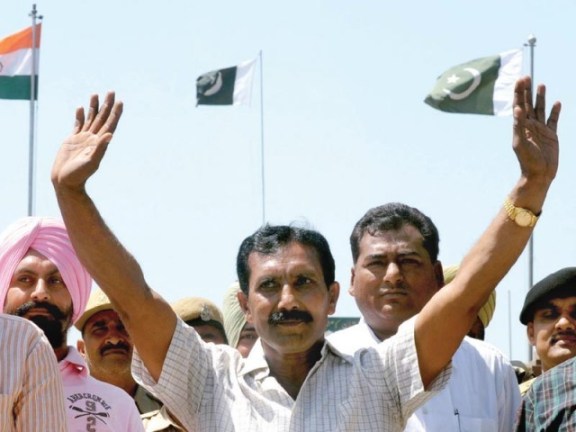
Gopal Das at Wagah border. AFP photo

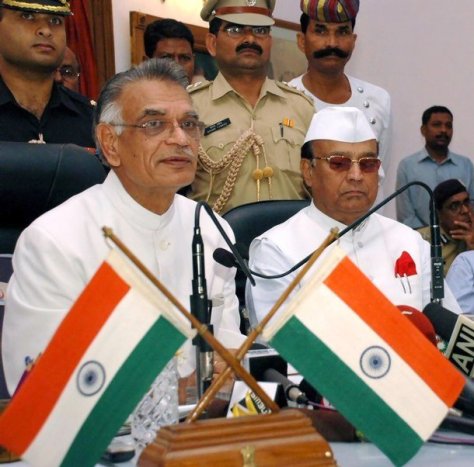
The central government wants him to do it, the Rajasthan government wants him to do it, but Rajasthan’s acting Governor Shivraj Patil wouldn’t sign on a file for several months now. His obstinacy could become a major hurdle for many Indians and Pakistanis lodged in each others’ prisons.

In an unusual order, the Supreme Court of India quoted William Shakespeare and Faiz Ahmed ‘Faiz’ to directly appeal to the government of Pakistan to pardon and release Indian prisoner Gopal Das. Pakistan President Asif Ali Zardari signed the papers within 16 days, ahead of Prime Minister Yusuf Raza Gilani’s visit to Mohali to witness the cricket world cup semi-final with his Indian counterpart. On 7 April, Gopal Das crossed into India. There were those in Pakistan who had opposed his release, arguing he had a few months left to complete his sentence, and that he should not be shown mercy because he had been found guilty in 1984 by a Pakistani military court on charges of being a an Indian spy. He and his family claimed this was not true, and wanted him pardoned because now 52, he had spent the last 27 years in several Pakistani prisons. Continue reading The inter-connected destinies of strangers across an international border

Human Rights Review – Jammu and Kashmir in 2011: JKCCS

This release comes from the JAMMU AND KASHMIR COALITION OF CIVIL SOCIETY, the Bund, Amira Kadal, Srinagar 190001, (www.jkccs.net)

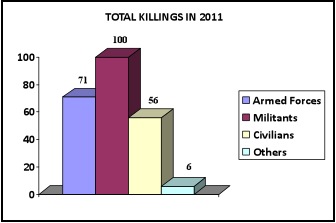
TOTAL KILLINGS

Year 2011 has just passed, and many have declared this year, a peaceful year in Jammu and Kashmir. Of course assertions of peace by various quarters are relative. Enforced silence cannot be construed as peace. Despite the hype of peace, people of Jammu and Kashmir have witnessed unabated violence, human rights abuses, denial of civil and political rights, absence of mechanisms of justice, heightened militarization and surveillance. The figures of violent incidents suggest that 2011 as usual has been the year of loss, victimization, mourning and pain for the people. Continue reading Human Rights Review – Jammu and Kashmir in 2011: JKCCS

‘Protests and Repression: Struggles in the Forests of India’

This note comes from the CAMPAIGN FOR SURVIVAL AND DIGNITY

The last few weeks have seen struggles over forest rights and forest control intensifying across the country. On the one hand there are larger and larger protests taking place, and on the other, the continued use of force by Central and State governments is combined with total silence and apathy on protecting people’s rights.  Continue reading ‘Protests and Repression: Struggles in the Forests of India’

‘NAPM condemns arrest and harassment of anti-dam protesters in Assam’

This press release was issued on 26 December by the NATIONAL ALLIANCE FOR PEOPLE’S MOVEMENTS

New Delhi, December 26 : Tonight at 2:15 am Assam Police in collusion with other security forces swooped down on the protesters at Ranganadi who have been blockading the Highway since December 16 and thwarting state’s attempt to carry turbines and dam materials to project site of Lower Subansiri Dam. Nearly 200 people have been arrested and earlier also security forces have been harassing the ptotestors. In past too, Krishak Mukti Sangram Samiti fighting against the big dams on Brhamaputra have faced government’s ire and often been attacked and jailed. NAPM stands in solidarity with KMSS and other students groups of the region who have been consistently opposed to the Big dams in highly sensitive seismic zone. We condemn the sustained action and harassment of KMSS and their activists and targeting of Akhil Gogoi for constantly opposing the destructive development policies and corruption of the government machinery. Continue reading ‘NAPM condemns arrest and harassment of anti-dam protesters in Assam’

Z for Zalim: Semiotics and the Occupation of Kashmir

Ours was the marsh country, down by the river, within, as the river wound, twenty miles of the sea. My first most vivid and broad impression of the identity of things, seems to me to have been gained on a memorable raw afternoon towards evening. At such a time I found out for certain, that this bleak place overgrown with nettles was the churchyard; and that Philip Pirrip, late of this parish, and also Georgiana wife of the above, were dead and buried; and that Alexander, Bartholomew, Abraham, Tobias, and Roger, infant children of the aforesaid, were also dead and buried; and that the dark flat wilderness beyond the churchyard, intersected with dykes and mounds and gates, with scattered cattle feeding on it, was the marshes; and that the low leaden line beyond, was the river; and that the distant savage lair from which the wind was rushing, was the sea; and that the small bundle of shivers growing afraid of it all and beginning to cry, was Pip. – Charles Dickens, Great Expectations

A for Apple and Z for Zebra. Children are taught the alphabet with the help of images. And the association of images with sound. It helps them associate the sound of A with the sound of Apple, and associate that in turn with the image of an apple. The alphabet book depends on images that may be familiar to children. The word Apple is a signifier, and the apple itself is the signified. This is, most simply, what semiotics or the study of signs and sign processes.

In a future world, if there are no zebras, alphabet books may have to replace the last entry with something else. What could it be? Zebra crossing? Zimbabwe?

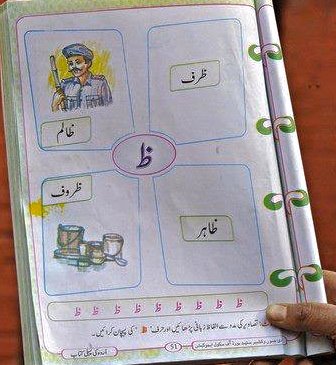
Last week, the Jammu and Kashmir Police registered a case of sedition, defamation and criminal conspiracy against six officials of BoSE, the government’s very own Board of School Education, for this:

This is a page from a book called Baharistaan-e-Urdu. This attempt to teach Kashmiri children the Urdu alphabet (note to self: this is what I need to learn Nastaliq!) makes them say, “Zoi se Zalim,” Z for Zalim, meaning cruel. That is only one of four examples. The other two are: zaroof (utensils), zahir (visible) and zarf (ornamental cup holder).

Continue reading Z for Zalim: Semiotics and the Occupation of Kashmir

Why ban just a Facebook page when you can erase a holy book or two (or more)?

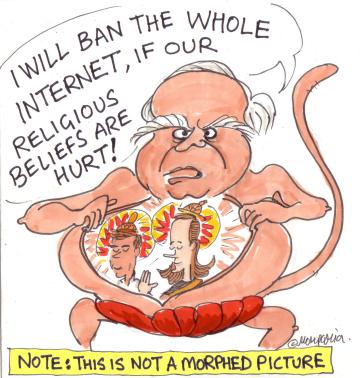
Following in the wake of the declarations of the well known Internet idiot, who doubles as the honorable minister of telecommunications of the Union of India, an esteemed additional civil judge of a Delhi court has also decided to issue an ex-parte order commanding Social Media networks, Facebook and Youtube to remove 21 (or is it 22?) ‘objectionable’ websites that ‘offend religious sentiments’.

This has been done in response to please entered by a ‘journalist’, a certain Mr. Vinay Rai, and a certain Mufti Aijaz Arshad Qasmi, who also delivers online fatwas on a variety of subjects, ranging from the very intimate to the magnificently cosmic. It is wonderful to behold the learned court acting with such sensitivity to the joint plea of two honorable Hindu-Muslim worthies. Hindu-Muslim-Sikh-Isai – busybodies of every stripe seem to have little other work to do than police and control what can and cannot be said online, shown in a film, performed in a play or depicted in an art work. And our ‘secular’ civil society, and the lower ranks of the judiciary faithfully acquiesce to their every demand. Continue reading Why ban just a Facebook page when you can erase a holy book or two (or more)?

The Absurd Tyranny of iSibal: Vrinda Gopinath

Guest post by VRINDA GOPINATH

by Hemant Morparia

Well, Information and Technology Minister Kapil Sibal’s prickly suggestion to pre-screen content on social networks like Google, Facebook and Twitter, has invited such derision from the internet world that it has given him a tag to his name – Idiot Sibal. For iSibal, it’s not his status on Facebook that should bother him, but the ruinous unmasking of the minister in status-anxiety New Delhi. Sibal, after all, prides himself in belonging to the elite movers and shakers of the Capital – educated, connected, and gold card holder of the Stephen’s Old Boys Network. For the status seekers, this is a world of privilege and entitlement, cosmopolitanism and tolerance.

Now you would wonder what came over the blue-stockinged Technology Minister to make such an ill-thought out statement. Sibal’s liberal snobbery is not always what it seems to be, for there is a lurking autocratic and despotic streak, even archaic at times, that has surfaced time and again. And it is this aspect that has largely been ignored in the bedlam over his latest decree to social network companies.

Continue reading The Absurd Tyranny of iSibal: Vrinda Gopinath

Nationwide opposition to the government’s refusal to a peaceful fast in support of Irom Sharmila: NAPM

Press release issued today by the NATIONAL ALLIANCE FOR PEOPLE’S MOVEMENTS

New Delhi, December 10 : For some months now, Save Sharmila Solidarity Campaign (SSSC) has been spreading the word about Irom Sharmila and her struggle across the nation and beyond.

Started only by few organizations, campaign has now received support over more than 80 organizations and movements and thousands of supporters. Campaign has reached in almost every state of India and even outside. Campaign has organized various programs including its famous Nationwide Signature Campaign, Sri Nagar- Imphal Save Sharmila Jan Karwan in October and Ahemdabad- Srinagar Jattha in November this year. Continue reading Nationwide opposition to the government’s refusal to a peaceful fast in support of Irom Sharmila: NAPM

Shivraj Patil hath no mercy! Why could he not pardon an old, ailing Ram Kumar?: PUCL

This statement has ben issued by the PEOPLE’S UNION FOR CIVIL LIBERTIES

Ram Kumar died of cancer in Jaipur Central Jail, waiting for the Governor to grant him mercy and Dr. Khalil Chishty waits in Ajmer Jail while his file sits with the Governor for several weeks now!

The Governor of Rajasthan Sh. Shivraj Patil’s attitude towards exercising his powers of granting mercy to convicted prisoners is absolutely negative. Article 161 of the Constitution of India confers “on the Governor of a State the right to grant pardons, remissions, reprieves or commute the sentence of any person convicted of any offence against any law relating to a matter to which the executive power of the State extends.” Continue reading Shivraj Patil hath no mercy! Why could he not pardon an old, ailing Ram Kumar?: PUCL

What Kapil Sibal does not understand: the internet

A  few days ago a friend asked me if I knew someone who had the ability and inclination to help out a certain department of the central government with using social media. My friend did not name who the prospective employer was, but clearly, with even Digvijay Singh on Twitter, the Congress party is worried about social media. No surprise that this should happen in a year when the UPA government’s popularity has taken a nose-dive.

The New York Times revealed on 5 December that Kapil Sibal summoned Facebook officials and showed them a Facebook page that allegedly maligned Congress president Sonia Gandhi and said that this was unacceptable. While HRD officials refused to reveal much in that NYT copy, they must have realised that shit has hit the fan, because the next morning’s Indian Express the spin doctoring was clear: there was now a mention of allegedly derogatory pictures of Prophet Mohammed along with the Prime Minister and the Congress President (who are no doubt as sacred in his books as Prophet Mohammed).By the time he held his press conference yesterday, it became about things that Hurt Our Religious Sentiments. On the 19th anniversary of the Babri Masjid demolition, it is very interesting to see a Congress minister using religion to cover up power politics.  Continue reading What Kapil Sibal does not understand: the internet

Transnational Torture by Jinee Lokaneeta reviewed with Prachi Patankar

There are few books as exhilarating as one by a comrade that is intellectually engaging and speaks to the current context. I was invited by 3rd i NY to a Conversation titled ‘Torturing Democracies: Past and Present’, where Jinee and I discussed her new book at Alwan for the Arts. The conversation came to life with the audience which included many of our comrades from the South Asia Solidarity Initiative (SASI) including Prachi. After that wonderful conversation, Prachi and I decided to delve further into the book and write a review. This was an exercise very different from what we normally engage with in SASI around our solidarity campaigns, but it was also a wonderful way to see another side of Jinee. That is the theoretically rich research of someone whom we relied on as a solid activist. I feel we should be doing more of reading, writing about and debating the work of our activist friends. A shorter version of this review has been published by Himal. Perhaps some of the themes in the book can be debated here with this longer review. Continue reading Transnational Torture by Jinee Lokaneeta reviewed with Prachi Patankar

Kapil Sibal is an Idiot

I urge you to write KAPIL SIBAL IS AN IDIOT as your Facebook status message, use the hashtag #IdiotKapilSibal on Twitter, and write a blog post with the above title, because there may soon be a day when he may prevent you from doing so.

The New York Times reports:

The Indian government has asked Internet companies and social media sites like Facebook to prescreen user content from India and to remove disparaging, inflammatory or defamatory content before it goes online, three executives in the information technology industry say.

Top officials from the Indian units of Google, Microsoft, Yahoo and Facebook are meeting with Kapil Sibal, India’s acting telecommunications minister, on Monday afternoon to discuss the issue, say two executives of Internet companies. The executives asked not to be identified because they are not authorized to speak to the media on the issue.

[…]

About six weeks ago, Mr. Sibal called legal representatives from the top Internet service providers and Facebook into his New Delhi office, said one of the executives who was briefed on the meeting.

At the meeting, Mr. Sibal showed attendees a Facebook page that maligned the Congress Party’s president, Sonia Gandhi.  “This is unacceptable,” he told attendees, the executive said, and he asked them to find a way to monitor what is posted on their sites. [Link]

Continue reading Kapil Sibal is an Idiot

When Openness is Unfreedom (alternatively, when data is unfreedom) – Part II

This is the second post in the series that I began in October. I want to thank Rasagy Sharma for prompting me to put down the second post in this series.

This evening, Rasagy raised a question on twitter about whether the effort of a developer to make the database of the Indian railways downloadable is ‘official’ or not? As Rasagy later explained, the downloadable database is a list of trains, stations and the railway timetable. This list has has been made available in various downloadable formats (such as .csv, .pdf, etc) to encourage developers/interested persons to make web/mobile based applications. Rasagy’s question was more in the nature of checking the legality of  the act of putting this information/database on another website when it is explicitly copyright of the Indian Railways (as declared on their website). He argued that cities such as New York and some countries across the world have made this information ‘open’, meaning available to the ‘public’. Hence, it is unreasonable for this government entity i.e., the Indian railways, to be ‘closed’ about reuse of this information by private entities and individuals.

Continue reading When Openness is Unfreedom (alternatively, when data is unfreedom) – Part II

A case for remission of punishment for Dr Khaleel Chishty under Article 161 of the Constitution of India: Kavita Srivastava

Guest post by KAVITA SRIVASTAVA

Pardon and or Remission of Punishment for Pakistani prisoner Dr. Khaleel Chishty under Article 161 of the Constitution of India by the Governor of Rajasthan

Continue reading A case for remission of punishment for Dr Khaleel Chishty under Article 161 of the Constitution of India: Kavita Srivastava

An open letter from a photojournalist assaulted by Indian security forces in Kashmir: Yawar Kabli

Guest post by YAWAR KABLI

AP photo by Yasin Dar: Local Kashmiri photographers Yawar Nazir, left, and Showket Shafi wait for treatment after they said they were assaulted by police and paramilitary forces during a protest in Srinagar, India, on Nov. 25. At least four journalists said they were assaulted by police and paramilitary forces Friday as they covered a protest in Indian-controlled Kashmir.

All freedoms enshrined in the Constitution of India are being violated or altogether thrown away by the Jammu and Kashmir Police. One could substantiate that with any number of examples. We were not the first pressmen to be thrashed by the police while covering the stone-hurling protests in the Kashmir. On Friday, 25 November 2011, without any rhyme or reason policemen along with the Central Reserve Police Force (CRPF) thrashed four of us, including me, and snatched away our expensive cameras. They did not even hesitate to bundle us into police vehicles while taking us to the Khanyar police station.

Continue reading An open letter from a photojournalist assaulted by Indian security forces in Kashmir: Yawar Kabli

Uthao, uthao video ab, won’t you make the video now?

This photograph shows photojournalist Shahid Tantray being assaulted by the Central Reserve Police Force in Srinagar on 25 November 2011

No tears will be shed for press freedom for attacks on journalists in Srinagar by the Central Reserve Police Force and the Jammu and Kashmir Police. Fahad Shah reports what happened in Srinagar yesterday:

Journalists were beaten up and one of them detained, today, when they were covering the post-Friday prayers protests in the Old City, here at Srinagar. Umar Mehraj, who works as video journalist for Associated Press says he, along with other journalists, was covering protests when Central Reserve Police Force (CRPF) and local policemen start beating. He said while beating, the forces were shouting, “Uthao, uthao video ab (Shoot, shoot the video now.).” Umar says his camera was broken and they were abused too.

Continue reading Uthao, uthao video ab, won’t you make the video now?