Category Archives: Law

Shame on G.K. Pillai: Women demand an apology for his sexist comments

Released by JAMIA TEACHERS’ SOLIDARITY ASSOCIATION

24 November 2011

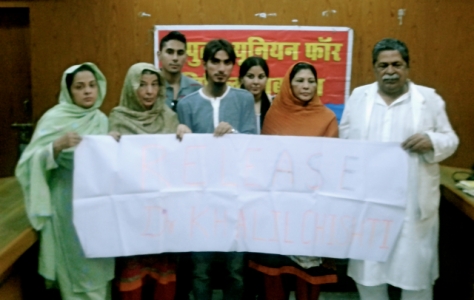
Stung by the SIT report which concluded that Ishrat Jahan was executed in cold blood, former Union Home Secretary G.K. Pillai—hard-pressed to defend his affidavit to the Supreme Court that Ishrat was a Lashkar operative—has stooped to now slandering the girl’s personal life suggesting that her checking into different hotels with “another man” was definitely suspicious. Perhaps, Mr. Pillai wishes us to believe that all those young women who travel and work independently are ‘suspicious’ and could have terrorist links. Continue reading Shame on G.K. Pillai: Women demand an apology for his sexist comments

Mobpublic vs. Counterpublic in Kerala

[with inputs from Baiju John]

Recent events in Kerala convince me that we need to think more closely about the ways in which our political public life is being slowly overwhelmed by something that is profoundly anti-public but somehow manages to resemble it — I’m tempted to call it the Mobpublic. I’m of course not referring to formal politics, where political parties and powerful communities continue to squabble without any serious difference in their programmes. Very little of either the political or the public survives in them; all one hears for most of the time are the tales of internal squabbling which is neither political (yes, despite all of V S Achuthanandan’s efforts to coopt oppositional civil social struggles) nor public. Perhaps the decline of the political is a condition for the rise of the mobpublic.

Continue reading Mobpublic vs. Counterpublic in Kerala

JTSA welcomes the SIT report on Ishrat Jahan, demands free and fair probe into Batla House ‘Encounter’

This release comes from the JAMIA TEACHERS’ SOLIDARITY ASSOCIATION

21 November 2011 

JTSA welcomes the SIT report which has concluded that the teenaged college girl Ishrat Jahan and her three companions were killed in cold blood—and were not terrorists on way to kill Narendra Modi. This has reinforced the findings of the Tamang Enquiry Report which had drawn similar conclusions in 2009, and which the Gujarat government had tried to suppress and discredit.  The SIT report has given credence to the allegation of civil rights activists that the officers in Gujarat police had executed several people through the last decade in collusion with the highest political authority in the state. The police officers gained medals and promotions and Modi built his image as the Hindutva hero by highlighting the alleged assassination attempts on him. Continue reading JTSA welcomes the SIT report on Ishrat Jahan, demands free and fair probe into Batla House ‘Encounter’

A few questions about a few thousand new auto-rickshaws in Delhi: Simon Harding

Guest post by SIMON HARDING

On Friday, Supreme Court judges KS Radhakrishnan and CK Prasad gave the go-ahead for 45,000 new auto rickshaw permits to be issued in Delhi. The move has the potential to drastically improve the city’s auto-rickshaw service for passengers and drivers alike, but many unanswered questions about distribution, implementation and numbers remain.
There are currently around 55,000 auto-rickshaws in the capital. The number of autos has not grown since the Supreme Court stopped the issuing of new auto permits in 1997 due to concern about the pollution emitted from the old dirty two-stroke petrol engines (now replaced with CNG).

The number has not remained frozen. Evidence suggests that it has actually fallen since 1997 because around 20,000 autos were lost during the CNG switchover as many drivers had their permits cancelled as they were too slow to convert their autos to the new fuel or simply could not afford the conversion. The fall in numbers contrasts with the growing demand for autos from Delhi’s population, which grew 21.6% in the period 2001-2011.

Continue reading A few questions about a few thousand new auto-rickshaws in Delhi: Simon Harding

Justice for Valsa John of Jharkhand, latest victim of the mining mafia

This press release was put out on 18 November 2011 by the NATIONAL ALLIANCE FOR PEOPLE’S MOVEMENTS (NAPM), the NATIONAL FISHWORKERS’ FORUM (NFF) and the NATIONAL FORUM OF FOREST PEOPLE AND FOREST WORKERS (NFFPFW)

Sr. Valsa, an activist of the Rajmahal Pahad Bachao Andolan (RPBA) and an ordained nun with the Sisters of Charity of Jesus & Mary, who had been working among Santhal Adivasis in the coal rich region of Dhumka, Jharkhand was brutally murdered by a group of about 40 armed men on the night of 15 November 2011. On behalf of Indian peoples’ movements and resistance struggles, NAPM, NFF and NFFPFW condemn this heinous and cowardly act, evidently conceived by the powerful mining mafia, aimed at essentially hunting down individuals and movements to silence the voices of resistance by people.  Continue reading Justice for Valsa John of Jharkhand, latest victim of the mining mafia

Dr Khaleel Chishty’s family in Ajmer to appeal for his release: Kavita Srivastava

This press release comes from KAVITA SRIVASTAVA of the People’s Union for Civil Liberties. It was released after a press conference in Ajmer on Friday, 18 November 2011

  • Family appeals to Governor Shivraj Patil to sign the mercy petition of Dr. Khalil Chishty pardoning him at the earliest
  • Government of Rajasthan grants perrmission to the family to meet Dr. Chishty in Jail

Clean Chit to Law-Breaker Lavasa, a Blot on India’s Democracy and Environmentalism: NAPM

This press release was put out by the NATIONAL ALLIANCE FOR PEOPLE’S MOVEMENTS on 14 November 2011

Post-facto Green signal to Phase-I of Lavasa by the Union Ministry of Environment and Forests (MoEF) given on the November 9th is a blot on the democratic process and a shockingly dangerous precedent in the history of environmental action in India. MoEF’s improper action has infact sent shock-waves to eco-activists within the country and also across the world. Although it is not the first time in the long history of Indian Environmental clearance regime that political highhandedness has been used to subvert rule of law and the ends of justice, this case is unique since the clearance has disregarded well established evidence based on facts collected by no other than the MoEF itself. It is surprising that the Ministry’s decision has come in the wake of the case filed by the Maharashtra government against 15 persons including promoters of Lavasa Corporation for alleged violations of the Environment Protection Act (EPA), while the Maharashtra Chief Minister on the other hand has recommended that Lavasa be considered for environmental clearance, exposes the double standards of the state government.  Continue reading Clean Chit to Law-Breaker Lavasa, a Blot on India’s Democracy and Environmentalism: NAPM

Bring Justice to ANM Bhanwri Devi: Women’s organisations protest in Jaipur

This press release was put out by KAVITA SRIVASTAVA on behalf of various women’s organisations in Rajasthan, on 11 November 2011. For a background to the case, see “A CD and a missing health worker“.

  • RAJASTHAN CONGRESS, STOP MISUSING AND EXPLOITING WOMEN IN POLITICS!
  • ARREST MAHILPAL MADERNA AND OTHER POLITICIANS INVOLVED IN THE DISAPPEARANCE BHANWARI DEVI!
  • ASHOK GEHLOT, PRODUCE BHANWRI DEVI DEAD OR ALIVE, OR ELSE RESIGN!
  • BJP WHERE ARE YOUR TEARS FOR BHANWRI DEVI!! STOP PLAYING THE CASTE CARD!
  • MAMTA SHARMA, NCW Chairperson, WHY THE SILENCE ON BHANWRI DEVI!

Raising the above slogans, Women, Dalit and Human Rights Organisation under the leadership of Dr. Pawan Surana ex-chairperson of the state women’s commission, protested today 11 November, 2011 condemning the Ashok Gehlot Government for the disappearance of one the workers of his Government ANM Bhanwri Devi and an aspirant of the Congress party.  Continue reading Bring Justice to ANM Bhanwri Devi: Women’s organisations protest in Jaipur

‘A Call for Rejecting 2011 Land Acquisition Bill’

This joint statement, signed and endorsed by various organisations and individuals from across India, named at the end, was put out on 12 November 2011. 

The 2011 Land Acquisition, Resettlement and Rehabilitation Bill is a dangerous exercise in doublespeak that will worsen the injustice and devastation caused by the present law. Below is a joint statement on this legislation from a number of organisations and individuals, calling for the rejection of the new Bill and raising the basic issues that need to be addressed by any legal framework.

The statement points out that:

Continue reading ‘A Call for Rejecting 2011 Land Acquisition Bill’

Govt must do more to protect minorities: Human Rights Commission of Pakistan

This press release was put out by the HUMAN RIGHTS COMMISSION OF PAKISTAN, Lahore, on 9 November 2011

The brazen murder of three brothers from the Hindu community in Shikarpur district on Eid day demonstrates that the perpetrators believe they can get away with murder simply because the victims are non-Muslim, the Human Rights Commission of Pakistan (HRCP) has said.

In a statement issued on Wednesday the Commission said: “HRCP is shocked at the brazen murder of the three Hindu citizens in Shikarpur and shares the sense of outrage of the Hindu community, not least because of the utter failure of the police to prevent the killings or arrest the killers even though threats of violence had been brought to their notice. Continue reading Govt must do more to protect minorities: Human Rights Commission of Pakistan

Rain, Eid and Geelani: Sameer Bhat

Guest post by SAMEER BHAT

A fine rain was falling as I disembarked the aircraft. Srinagar was shivering at 7 degrees centigrade. Rams and ewes, all set for slaughter on Eid, looked forlorn. Meat-market persons in untidy pherans haggled with locals for rates. Half the male population, I noticed, had not seen a shaving blade for weeks, a very Kashmiri trait most noticeable in winters. While it continued to drizzle, queues outside ATM machines got fretful. At least three people entered the cashpoint at one time to witness your transaction. The invasion of financial privacy has a very harmless ring to it, which is very indigenous. Continue reading Rain, Eid and Geelani: Sameer Bhat

Mistaken Identity: Arif Ayaz Parrey

Guest post by ARIF AYAZ PARREY

The Indian army in Kashmir must be reading a lot of Manto these days. Or Borges. Or Kundera. Or –and this is most likely, given the approaching winter season and their ‘hearts and minds’ programme– Kashmiri folklore.

Not three months have passed since they made a highly publicized acknowledgement of “mistaken identity” after they had killed a mentally “challenged” “Hindu” youth in Poonch and declared that he was a “fierce” “Pakistani terrorist Abu-Usman killed after a 12-hour long gunbattle” (such valour exhibited by the Indian security forces is the stuff of legends in Kashmir) that they have followed it with another announcement of a (dis)similar “mistaken indentity”.

This time, like always, the culprits are the Kashmiri people (whose synonym in the Indian army’s dictionary is “miscreants”) Apparently, people beat to pulp a “member of a covert team of the army and J&K police” who were “sent to Sopore Town on getting info of presence of terrorists in the public rally addressed  by SA Geelani”. The person was carrying a camcorder and his service pistol. The people thought he was the terrorist.

Democracy? History? Or “mishtake”? Choose your option.

Kundera writes, “When the institutions of a state no longer feel the need to make sense or to give plausible explanations, the state can only survive as long as people allow it to lie shamelessly.”

See also:

Previously in Kafila by Arif Ayaz Parrey:

An open letter to Tarun Tejpal: Hartman de Souza

On 27 October the Hindustan Times published an article by Hartman de Souza and on 30 October a response to it by Tarun Tejpal, editor of Tehelka newsmagazine. This guest post by HARTMAN DE SOUZA is his rejoinder

There are some of us in Goa who will know in about 20 days or so, thanks to two RTIs filed, whether Tarun Tejpal did in fact get all the necessary permissions and clearances needed to add to the lovely property he now owns in the village of Moira… or, as he more pointedly said of the village when he called me up in the Pune, “I mean, look at Moira man, it’s a dying Goan village” …emphasis on ‘dying’, and the implication being one suspects, that the Tejpals of the world can and will breathe life into it. I wonder if he remembers and can parse what I said to him in reply. Continue reading An open letter to Tarun Tejpal: Hartman de Souza

‘Who isn’t a Shabaab these days?’: Alia Allana reports from the Tunisia-Libya border

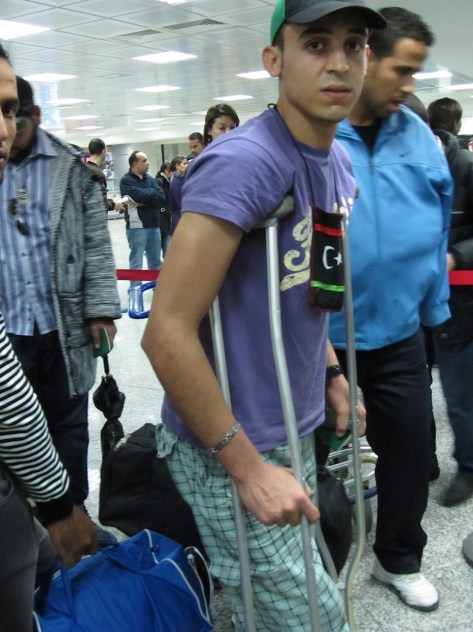
This guest post by ALIA ALLANA is part of a Kafila series of despatches from the Arab Spring

When does a boy become a shabaab?

Literally, in Arabic, shabaab means young men. Before the fever of the Arab Spring raged in the minds of the youth, back when boys used to gather in squares aimlessly, girls eyeing them would call them shabaab.

But that was then; before the political architecture of the Arab world was reconstructed.

Today the shabaab are the disenchanted youth, the angry boys of Benghazi with deathly toys devoid of opportunity, angry at their condition, aware of the world through the Internet and their mobiles, acting out their rebellion. Today the shabaab, the rebels of Libya, want what they think is theirs: the right to self-determination, a say in politics and freedom.

Continue reading ‘Who isn’t a Shabaab these days?’: Alia Allana reports from the Tunisia-Libya border

Kashmir’s Horcrux: Sameer Bhat

Guest post by SAMEER BHAT

Hectic parleys are on at the moment to jettison the dreaded AFSPA in the valley. By conservative estimates the army must have beaten about one in every five Kashmiris at one point or the other since this piece of horrible legislation was slapped on us. An unjust law, is no law at all, Martin Luther, the symbol of protestant reformation, verbalized the sentiment of St Augustine in the 15th century. Rings true to this day.

For more than twenty years people have been punched, thrown in the back of military trucks, knocked down by gun-butts, given kicks, pushed around as they got off a bus or simply slapped around for no apparent reason. Just for being themselves, perhaps. No you could not question the moral turpitude of a military-walla from Madras if he clubbed your aging father.  Continue reading Kashmir’s Horcrux: Sameer Bhat

Crime redefined in Bihar: Ibne Ali

Guest post by IBNE ALI

John Emerich Edward Dalberg Acton is said to have said in 1887, “Power tends to corrupt, and absolute power corrupts absolutely.” After 124 years it is being felt that Lord Acton could have added one more thing; Power gives you the exclusive right to define and redefine things according to your convenience. The ‘all-possible-awards-winner’ chief minister of Bihar Mr. Nitish Kumar could have prompted Lord Acton to enrich this famous quotation for a couple of reasons.

Continue reading Crime redefined in Bihar: Ibne Ali

AFSPA in Kashmir – “Armed Forces’ Say Prevails Anyway”: Gowhar Geelani

Guest post by GOWHAR GEELANI

There is a lot of noise in the media over AFSPA. Ask any senior Indian security official, a turn-coat politician or a retired Army General what AFSPA stands for. “Armed Forces Special Powers Act,” they will say. Now pose the same query to an ordinary Kashmiri living there in the hapless Vale for the past two decades. The answer perhaps would be: “Armed Forces’ Say Prevails Anyway”. Continue reading AFSPA in Kashmir – “Armed Forces’ Say Prevails Anyway”: Gowhar Geelani

End the culture of impunity, not just AFSPA: APDP

This is a press release from the ASSOCIATION OF PARENTS OF DISAPPEARED PERSONS

The Bund Amira Kadal, Srinagar – 190001, Jammu and Kashmir
28th October 2011

APDP feels that the recent announcement by the Chief Minister Omar Abdullah on the partial revocation of Armed Forces (Special Powers) Act (AFSPA) from some areas of Jammu and Kashmir would be insignificant for improving the human rights situation and also for providing justice to those affected by the mindless violence by armed forces.
Continue reading End the culture of impunity, not just AFSPA: APDP

Guardian Angelic Moral Police

[co-authored with Bobby Kunhu]


Of all the different kinds of moral police that inhabit the land of Kerala, the species that should be feared most must probably be the ‘Guardian Angelic Moral Police'(GAMP). The GAMP is just as potent as the Goonda-Activist Moral Police (G-AMP) but in striking contrast to the latter, the former thrives on the surface precisely on values dear to the Malayalee middle-class – the sanction of law, paternal concern, state protectionism of women as the ‘weaker sex’. This makes it much harder for victims of moral policing to fight off their intrusions all of which are couched in the language of benevolent concern. We just got a taste of that from the Hon. Justice V R Krishna Iyer with his controversial Women’s Code Bill, but since so much of his language is such antiquated hyperbole, it was impossible to take any of it seriously. However, it appears that the judiciary in Kerala has more sophisticated GAMP, and  recent orders passed by the bench consisting of Justices R Basant and M C Hari Rani of the Kerala High Court seem to leave no reason for scepticism. Continue reading Guardian Angelic Moral Police

“We are not like Iran here”: Alia Allana reports from Tunisia

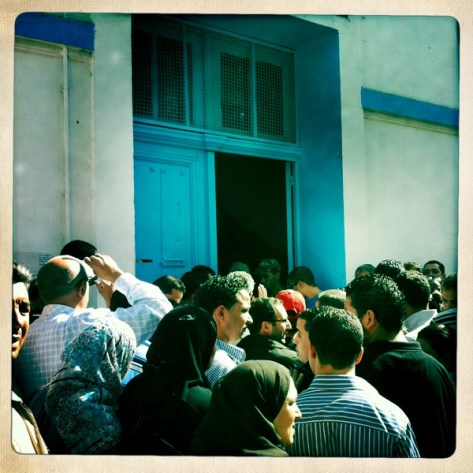
This guest post by ALIA ALLANA is an account of polling day in Tunisia

They had already waited so long, what was a few more hours? Continue reading “We are not like Iran here”: Alia Allana reports from Tunisia

Human Development and other Holy Cows: Sajan Venniyoor

Guest post by SAJAN VENNIYOOR

The press is full of the India Human Development Report 2011 released by the Centre recently, and Gujarat figures prominently in newspaper headlines for reasons Mr. Modi is unlikely to quote in self-congratulatory ads. As The Telegraph put in tortured prose, Gujarat has a ‘Gnawing record fasting Modi won’t flaunt‘.

Kerala once again topped the Human Development Index. One of the more charming images that accompanied the story is from Rediff, which showed a fairly archetypal Kerala landscape with paddy fields, coconut trees and a cow. No humans, though, developed or otherwise. It struck me, then, that part of Kerala’s high ranking in the health and nutrition stakes may come from its willingness to consume all three: rice, coconuts and the cow. And thereby hangs a tale. Continue reading Human Development and other Holy Cows: Sajan Venniyoor