
After the atrocious indifference and trivialisation of domestic violence displayed by the sneering alpha-male brigade of the CPM during the discussion of the Hadiya Case, nothing surprises me. However, it appears important to point out how such callousness is indeed becoming normalised here alarmingly. It seems that the gains of women’s movement which made violence against women at home something beyond an intimate private affair, a ‘family quarrel’, are being steadily depleted. Of course, we did see how so many smooth-talking liberal CPM-oriented or purportedly-rationalist young male intellectuals went ballistic at the mere suggestion that they are blind to the domestic violence in Hadiya’s imprisonment. Also intriguing was their persistent defense of the father’s right to keep an adult, mentally fit, educated daughter immobile and imprisoned because he feared for her safety. Continue reading Thoughts on the Continuing Assault on Women’s Rights and Progressivist Gaslighting in Kerala
Category Archives: Media politics
Cutting the nose to spite the face?
It looks like the CPM’s enmity towards the Muslim organizations is such that they do not mind sacrificing women’s human rights and reinforcing the patriarchal family just to teach them a lesson. So they are happy to stick with the Sanghi understanding of conversion as necessarily forced in some way, ideological or physical. Media One broke news yesterday about a Sanghi torture camp for Hindu women who marry Christians or Muslims concealed as a yoga center. A woman incarcerated there for marrying a Christian managed to escape and complain to the police. Sixty-five women were reportedly incarcerated there when she was an inmate (a later report, after the place was shut down today on the order of the High Court, said 22 women and 23 men were allegedly for reconversion) . The reconversion therapy includes physical assault and threats. This 28-year-old woman married a Christian man without converting and her family seems to have initially accepted it. However, she was taken to this yoga cum counseling center by her own family without her consent and they left her there to the mercy of the criminals who ran the place. She also confirms that a young woman, Athira from Kasaragod, who had chosen to convert to Islam on her own who recently ‘returned’ to ‘Sanatana dharma’ with much fanfare, was in this place for twenty-two days and that she had continued to insist on her preference for Islam.
This place is in Tripunithura, in the heart of urban Kerala quite near the High Court at Ernakulam, which damned Hadiya’s right to choose her faith and a partner. Apparently, it is the Sanghi gang from this place who visited Hadiya at her father’s house. Here is the story:
So it appears that the Sangh is clearly seeking to reverse what is an outcome of long-term social processes shaped by increasing access to higher education for most social groups in Kerala. Women entered higher education here in larger numbers in the 1980s and Muslims, men and women, since the 1990s till now. The expansion of the media and cellphones is such that young people are not influenced solely by their parents or community. In other words, there is a greater livelihood of women and men choosing partners actors communities. Even sensible people here whisper about how zealous Muslims are about conversion away from Islam but the discourse of Hindu tolerance is so pervasive that it lets concentration camp proliferate in secret. The response of the CPM participant is truly revealing — indeed, this is cutting the nose to spite the face. Whatever be their position about welfare and economic development, the CPM in Kerala seems appallingly on the side of the Hindutva security state. And the questions this raises for the fabled autonomy of women here that the CPM ideologues never ceases to claim credit for, are huge.
This is probably the calculation of utility that underlies the chilling indifference/ outright contempt of the CPM leadership towards the plight of the Muslims: the average CPM and CPI supporter is the middle-caste ex-avarna middle-aged male of the middle or lower middle class. This gentleman’s preferences are such that his utility is maximised by staying with the organized dominant left in matters related to securing public resources to private ends (because the mobilization for that, given Kerala’s demographics and history needs to be necessarily by a multi-community mix) and by sticking to community/caste organizations for family matters. This choice has always been detrimental to women’s personal rights, particularly personal choices. The community/caste organizations of the 20th century are becoming more of economic institutions than social — and they manage the vast community assets once secured from governments for public ends now securing mainly the interests of the community elite. The social, however, is undergoing rapid transformation, and indeed, sections of the young now even dare to define the social for themselves. Into this gap steps the Sangh, desperate to make an entry, now that their efforts to secure the ex-avarnas have failed (because of their own irremediable casteism). The above-mentioned gentleman finds it prudent to use their services in making sure that the young stay under his patriarchal thumb. Especially young women, for they have nobody to really defend their rights. Thus arise the thriving if silent business of reconversion, well-protected from public view by the pervasive Islamophobia of the Right and Left, believers and rationalists. Also remember that in a post-demographic society, children are few and they are more akin to trophies that future labour for the family. The dominant left sees that as long as they don’t disturb this gentleman’s efforts to secure his patriarchal authority through whatever means, however violent, crude, and abhorrent to democracy they may be, they retain influence. In other words, the tattered influence of the dominant left — no longer hegemonic — endures through, among other things, looking away from the social and the familial as hierarchical institutions and the abuses. This is why a sexual attack on a film actor elicits a huge response from the feminist supporters of the CPM, while the unlawful confinement of a far less privileged young woman is largely ignored or supported ‘personally’. The dominant left leadership reasons this to be its best strategy, since it loses nothing by letting the Sanghis handle family affairs. The presence of the Sangh works well for it too, since very many Muslims and Christians, who are sizeable in demographic and economic terms, will turn to it for protection from the Sangh!! This strategy has worked hitherto, and the sole risk lies in the gentleman ceasing to remain a Rational Agent and joining the ranks of the Indo-Gangetic barbarians, essentially irrational in the Kerala context (I keep urging them to leave for Haryana in pursuit of what must be their choices if they choose to become such barbarians). But this has been largely limited to the upper caste Hindus and some sections of elite Christians who regret the loss of traditional power and hope that the Sangh will restore it. They are not the growing power, demographically or economically. Meanwhile, the effete rationalists generate a ‘secularised’ Islamophobia that serves as a neutral-sounding justification for the government’s inactivity.
There are very few moments in which I have felt so lonely. Almost everyone I know seems to be a player, a rational agent, in this game, either participating or creating justifications for the strategy or participating by simply looking away and remaining silent. But this loneliness is so much more dignified — and indeed, more human. I stand with the six young women who braved the Sangh and the police trying to reach Hadiya; I condemn those who serve up her father’s sickening sentimental patriarchal shit in the public in a way that renders them vulnerable. Hadiya’s father who had not the slightest compunction in approaching the High Court and painting his own daughter a potential terrorist such that her entire life promises to be hell (even if she escapes his confinement), is showered with sympathy by our critical intellects for being a poor worried father. Meanwhile, a radical student who claims to be on Hadiya’s side flings abuse on me for wearing a sleeveless blouse, for leaving my hair untied – she does not even notice that her tirade is so like a Brahmanical patriarch’s diatribe against the well-known signs of Kali — immodest women with their hair open — such missiles seem convenient for all, radical Ambedkarites even, to use against those they dislike. The only silver lining in this mess is that it reveals with unprecedented and astounding clarity, the enormous risks, dangers, and material losses ahead of anyone who wants to remain human, and not what is substitutable with Artificial Intelligence. And that in order to be popular, you must swim with some tide or the other. But I’d rather be human than popular, still.
Shame on all of you — AIDWA leaders, Brinda Karat, M S Josephine, C K Asha, Geeta Nazir, Sreemathi teacher, Shylaja teacher — all of you women adherents of the CPM and CPI. If Hadiya dies in that horrible hell, her blood is on your hands. Her rights are already dead and you have done precious little.
An Anthem for Kerala: Mojitopaattu
In these days in which Indo-Gangetic barbarians seethe with rage against Kerala and unleash all sorts of false propaganda about the state of affairs here, I have been thinking about my own love for and quarrels with this place. My relation to it has been largely critical, as a Malayali woman born and raised here who has endured, and continue to endure, much second-rate treatment. More than anyone else, I realize, it is Malayalis who have criticized Kerala. Not surprising, then, is the fact that one of the most ardently-discussed themes in public politics here in the past decades has been the critique of the entrenched imagination of Kerala, and its exclusions. Not for nothing, too, have the struggles of marginalized people here demanded not just material gains, but the reimagining of Kerala in more expansive terms. And newer and newer groups of excluded people keep renewing it – most recently, the LGBTIQ+ people.
Our love for Kerala is a cursing, stumbling love – but love above all.
That’s why I think Anitha Thampi’s poem Mojitopaattu (The Mohito Song) ought to be our anthem. Anitha is undoubtedly one of Kerala’s most perceptive poets of the present, capable of delving into the depths of the present cultural moment and surfacing with inscrutable yet pervasive feelings and moods and weaving these into words. Our crazy love of Kerala which cannot be but critical is brilliantly caught in this poem. In it, this love comes alive as moonlight falling on this place which illuminates erratically, sways madly, and disappears without notice; this loving looks as hard and risky as a drunk’s faltering steps along a rough bylane through treacherous yet playful moonlight; this love eddies through the blood of two and a half generations and comes awake even as the whole world sleeps. Long before the Indo-Gangetic barbarians even noticed us have we felt this mad love, and it will take more than vituperative slander to kill it.
Below is my translation of Mojitopaattu – and I take Anitha’s suggestion that it a song, and a drunken one, seriously. I hope someone sets it to music and it becomes the anthem of crazy-lovers of Kerala.
Four-five sprigs fresh mint
Two spoons sugar
Juice of three limes
Vodka, two measures and a half
Soda
IceHey you, swayin’-shakin’-rollin’
on night-time alley that’s runnin’
all o’er earth that’s green and shinin’
Banana-leaf-like, straight and gleamin’*
Hey sweet moonlight,
who you be,
you be man or you be woman?Hey you, fallin’ easy-loose-y
You for real, or just a feelin’?
Hey you singin’ , spreadin’-creepin’
Who you be to sunshine beamin’?Hey you lurchin’, fallin’, stumblin’
on each an’ ev’ry greenly leafling
Hey bright moonshine, distilled-dried blood, bluish,
two and a half generations bleedin’
Who be you?You be me, or you be you?
*Kerala, that lies at the foot of mountains like a bright green banana leaf beside the sea.
( Anitha Thampi , ‘Mojitopattu’)
And here is the original, much more terse and controlled in its use of language, but a paattu all the same:
മൊഹീതോപ്പാട്ട്
നാലഞ്ച് തളിർപ്പുതിന
രണ്ടു സ്പൂൺ പഞ്ചസാര
മൂന്നു നാരങ്ങാ നീര്
രണ്ടര വോഡ്ക
സോഡ
ഐസ്
നാക്കിലമണ്ണിൻ∗
രാവൂടുവഴിയൂടെ
ആടിയാടിപ്പോകുന്ന പൂനിലാവേ നീ
ആണാണോ പെണ്ണാണോ?
അഴിഞ്ഞഴിഞ്ഞു തൂവുന്ന പൂനിലാവേ നീ
നേരാണോ പൊളിയാണോ?
പാടിപ്പാടിപ്പരക്കുന്ന പൂനിലാവേ നീ
വെയിലിൻറെ ആരാണോ?
പച്ചിലകൾ തോറും തപ്പിത്തടഞ്ഞു വീഴും
രണ്ടരത്തലമുറ നീലിച്ച വാറ്റുചോരപ്പൂന്തെളിനിലാവേ നീ
ഞാനാണോ നീയാണോ?
∗കേരളം
No Flag Large Enough – Jubilation in India and Collateral Damage in Kashmir
The recent incident of violence that led to the death of a police officer, DSP Ayub Pandith, was condemned by all kinds of people in Kashmir, as well as elsewhere. It prompted introspection, sadness and regret – like any tragedy of this nature should.
Yesterday two unarmed civilians, Tahira Begum, a forty three year old woman and a young man called Shahdab Ahmed Chopan of Brenty Batapora Village in Anantnag district in South Kashmir were killed along with two Kashmiri combatants (Bashir Ahmed Lashkari and another person who may or may not be called Abu Maz) in the course of a joint operation by the 19th Rasthriya Rifles of the Indian Army, CRPF and the Special Operations Group of Jammu & Kashmir police.
Continue reading No Flag Large Enough – Jubilation in India and Collateral Damage in Kashmir
Why Two Hundred Ordinary Hindus Did Not See A Dead Muslim Child On A Railway Station In North India
 On 22 June 2017 fifteen-year old Hafiz Junaid was stabbed to death on a Mathura-bound train from New Delhi. He was traveling home for Eid with his brothers and two friends. A dispute over seats resulted in a group of men repeatedly assaulting and stabbing Junaid and his companions. The assailants flung their bodies onto the Asoti railway platform. A crowd gathered. At some point an ambulance was called and two bodies were taken away. Junaid is dead. His companions are in critical condition. While one person has been arrested the police investigations are running into a wall of social opacity since they have been unable to find a single eye-witness to the incident. Of the 200 hundred strong crowd that assembled on Asoti railway platform on Thursday evening, the police cannot find one person who can say what they saw. The police cannot find a witness because something very peculiar seems to have happened to those present at Junaid’s death. A report by Kaunain Sherrif M in the Indian Express provides specific details. When asked if he had seen anything that evening, Ram Sharan a corn-vendor whose daily shift coincides with the killing, Sharan said he was not present at the time of the incident. Two staffers who were sent to investigate by the station master were unavailable for comment. Neither the station-master, the post-master or the railway guards saw the event they were present at.
In this startling piece the journalist reports how the public lynching of a Muslim child becomes a social non-event in contemporary India. He shows the reconfiguring, and splitting, of a social field of vision. He reports all the ways in which people – Hindus- did not see the body of a dead – Muslim – child that lay in front of them. The Hindus on the Asoti railway platform managed to collectively not see a 15 year old Muslim boy being stabbed to death. Then they collectively, and without prior agreement, continued to not see what they had seen after the event. This is the uniquely terrifying aspect of this incident on which this report reflects: the totalising force of an unspoken, but collectively binding, agreement between Hindus to not see the dead body of a Muslim child. Hindus on this railway platform in a small station in north India instantly produced a stranger sociality, a common social bond between people who do not otherwise know each other. By mutual recognition between strangers, Hindus at this platform agreed to abide by a code of silence by which the death of a Muslim child can not be seen by 200 people in full public view on a railway platform in today’s India. Continue reading Why Two Hundred Ordinary Hindus Did Not See A Dead Muslim Child On A Railway Station In North India
Boycott Republic TV – the hounding of S. P. Udayakumar
Is it not time for this channel that sets new lows with each programme, to be totally boycotted by all right-thinking people?
Don’t watch Republic TV, don’t participate in its programmes.
Dr SP Udayakumar’s complaint to the Press Council of India follows. He is
Coordinator, People’s Movement Against Nuclear Energy (PMANE) and
Pachai Tamizhagam Katchi (Green Tamil Nadu Party)
June 21, 2017
Hon’ble Mr. Justice Chandramauli Kumar Prasad
The Chairman, Press Council of India
Dear Sir:
Greetings! I write to bring your kind attention to the ongoing deceit and harassment of me and my family by Mr. Arnab Ranjan Goswami and a few of his colleagues such as Shweta and Sanjeev from the Republic TV.
On April 8, 2017, one “Shweta Sharma” (I later found out that her real name was Shweta Kothari) came to my home at Nagercoil and introduced herself as a “research scholar” from the Cardiff University in the UK. She asked for my help with her dissertation research. She had been accompanied by her “local friend” Sanjeev. I gave her several books and answered her questions.
On April 9, 2017 she requested me to stop by her hotel room as she had a few more questions. There she told me that “one of her British professors” was very keen on supporting our struggle against the Koodankulam nuclear power plant. I told her that we did not accept money from foreigners and our movement had no bank account also. She then asked me if there was any other way of donating money to us. I told her that my personal account was frozen and that even our party account could not receive foreign funds.
A Day Against Kalluri at IIMC, Delhi: Bastar Solidarity Network Delhi Chapter
Guest Post by Bastar Solidarity Network Delhi Chapter
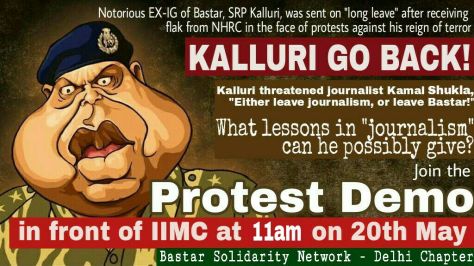
The democratic forces, organizations and the thinking minds of IIMC took part in a spirited protest today against the invitation extended to notorious ex-IG Kalluri by the IIMC administration to take part in a seminar. To start with, since last two days, there were several attempts on the part of the organizers to confuse/conceal Kalluri’s invitation. Immediately after the declaration of the protest, Kalluri’s name was dropped from the poster. There were also threats of counter-mobilisation by the BJP goons. But undeterred, as we reached the gates of IIMC at 11am, the site echoed with slogans of “Killer Kalluri Go Back”!
Continue reading A Day Against Kalluri at IIMC, Delhi: Bastar Solidarity Network Delhi Chapter
The Anti-Democratic ‘Republic’: Bobby Kunhu
Guest post by BOBBY KUNHU
English language television news in India nowadays is nothing more than exaggerated visual editorials. They pick two or three stories, sensationalize them, run them in a loop through the day, alongside panel discussions where the editorial ideology of the channel is forced down the throat of the panelists and the viewers. In short there is hardly little journalism left in these channels. Though they do have panel discussions, regional language channels – at least Malayalam and Tamil channels that I watch – have a wider and more diverse reportage than self-proclaimed national television.
It wasn’t always like this. When Prannoy Roy pioneered private television content for Murdoch – regardless of the ideological content – there was reportage. Editorial proselytizing and endless panel discussions were limited most often to when psephologists stepped in.
Continue reading The Anti-Democratic ‘Republic’: Bobby Kunhu
Erdogan Gets A Degree from Jamia Millia Islamia and Everyone Else’s Father is in Prison in Istanbul
Everyone else’s father is in prison in Istanbul,
they want to hang everyone else’s son
in the middle of the road, in broad daylight
People there are willing to risk the gallows
so that everyone else’s son won’t be hanged
so that everyone else’s father won’t die
and bring home a loaf of bread and a kite.
People, good people,
Call out from the four corners of the world,
say stop it,
Don’t let the executioner tighten the rope
[ Nazim Hikmet, 1954 ]
Its best to stay as far aways as possible when two mafia dons meet to talk business. Especially when their deep state security detail has a disturbing tendency to shoot first and ask questions after. Today, Delhi’s roads are emptier than usual, even on a Sunday. And I am reading Nazim Hikmet, because a thug is coming to town.
India owes answers to the world for Samjhauta blasts : Gurpreet Singh

( Photo Courtesy : Indian Express)
Guest Post by Gurpreet Singh
India which has always claimed to be a victim of terrorism for all these years owe answers for one of the worst terrorist incident that is hardly discussed by the anti terror activists across the world either due to silence over Hindutva violence or Islamophobia that continues to grow in the post 9/11 environment.
Ten years have passed as the families of the victims of Samjhauta blasts continue to wait for justice.
On February 18, 2007 explosions aboard Samjhauta rail express that connects India and Pakistan left 68 people dead and about 50 injured. At least 42 of the victims were Pakistani citizens most of them returning to their home country after visiting relatives in India. The rail service was started to connect the families divided by partition of India and Pakistan in 1947 and promote people to people contact between the neighbouring nations that have gone to two major wars in 1965 and 1971. Continue reading India owes answers to the world for Samjhauta blasts : Gurpreet Singh
Slimes Group Vice-Chairman Ameer Jain accused of molesting SOI employee Aaj Faker Shah? Breaking Faking News: Shehla Rashid
Guest Post by Shehla Rashid
Mar 21, Delhi: In a shocking revelation that has triggered panic amongst the media fraternity, renowned media tycoon, Ameer Jain, who is Vice-Chairman of the prestigious Parrot, Caveman & Co. Ltd, has been accused of sexual harassment by an employee of The Slimes of India newspaper, namely Aaj Faker Shah. Parrot, Caveman & Co. Ltd. (PCCL) is the group that owns Slimes of India, Slimes Now, Economic Slimes, Radio Tirchi, Movies Now and Then, Dhoom, Navbharat Slimes, Mumbai Broken Mirror and numerous other media outlets.
After the sexual harassment case filed by an employee of a major news magazine against its high profile editor some years ago, this is the most high-profile case of sexual harassment at the workplace in the media fraternity and is likely to result in a public spectacle, as the complainant, Aaj Faker Shah, has taken to Twitter to publicly make serious accusations of sexual assault against Jain. Normally, in cases of sexual harassment, the complainant must be accorded due anonymity. However, Shah reasons that he was forced to take this extreme step because the Slimes Group, in total violation of the norms prescribed by the Sexual Harassment at the Workplace Act (2013), sat on his complaint, victimised him for speaking out against Jain and even threatened to sack him. This reflects the state of implementation of the Workplace Harassment Law, rules for which were notified in 2014. Continue reading Slimes Group Vice-Chairman Ameer Jain accused of molesting SOI employee Aaj Faker Shah? Breaking Faking News: Shehla Rashid
Free the Maruti Workers: Maruti Suzuki Workers Union
Guest Post by Maruti Suzuki Workers’ Union

[This is a statement and an appeal by the Maruti Suzuki Workers Union condemning the unjust handing down of a life sentence to 13 workers of the Maruti Suzuki Manesar Factory for a ‘murder’ (of an HR Manager) that the prosecution could not prove that they had committed. Here too, the prosecution, and the judgement, relies on a chimera, ‘the reputation of make-in-india’ to justify a harsh punishment. Those who have watched this space will recognize that this recourse to figures of speech in the absence of evidence is a familiar move. It has happened before – to satisfy the hunger of a ‘collective conscience’ when a so-called ‘temple of democracy’ was attacked. This time it has been invoked to defend the ‘fake-in-India temple that houses the deity of a rising GDP’, which would of course otherwise be besieged by insurgent workers.
This text contains a hyperlink to a detailed reading and rebuttal of the prosecution’s arguments, which demonstrates how money and muscle power can always be an adequate replacement for legal acumen in the State of Haryana. Please do follow that link. For the further edification of our readers, we append a short video interview by Aman Sethi of the Hindustan Times of the special public prosecutor, which spins some imaginative legal theory and also radically updates our sense of class struggle. Please do have the patience to view that video. We promise that this will be rewarded. – Kafila Admin.]
Continue reading Free the Maruti Workers: Maruti Suzuki Workers Union
UAPA – A Video Dossier: Media Collective, Arun Ferreira &Vernon Gonsalves
Video by Media Collective, Article by Arun Ferreira and Vernon Fernandes
Fifty Years of Unreasonable Restrictions
Arun Ferreira & Vernon Gonsalves
Soon after its adoption, the Constitution of India was amended in 1951. At the time several progressive judgements[i] by the Judiciary held that laws which curb fundamental rights are essentially unconstitutional and fundamental freedoms could only be curbed in the most extreme of cases. The First Amendment, countered this by amending Article 19 to add the word ‘reasonable’ before restrictions and to add ‘public order’ as being one more ground for abridging Fundamental Rights.
The evolution of UAPA[ii] has to be seen in the background of this gradual but steady constriction of Article 19 which guarantees the fundamental freedoms of expression, assembly, association, etc. Continue reading UAPA – A Video Dossier: Media Collective, Arun Ferreira &Vernon Gonsalves
A Small Matter of Security – Holding the Guilty Accountable for What Happened in Ramjas College on the 22nd of February: Shafey Danish
This is a guest post by SHAFEY DANISH
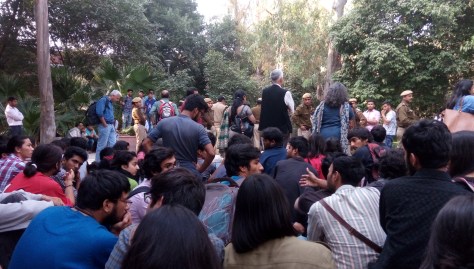
The violence that gripped Ramjas College on the 21st and 22nd of this month is now national news. We heard belligerent slogans by ABVP members of ‘chappal maro saalon ko’ (beat them with slippers), we saw students being chased on the campus, and we saw students being beaten up. All this culminated in a situation where students and teachers were held captive for over five hours within the campus premises. Let me emphasize that this violence was completely unprovoked.
On the 22nd of February, some of the students who were simply sitting with their friends were attacked. The police came and formed a cordon around them. Others joined the students in a gesture of solidarity. Teachers joined them to ensure that the students were not assaulted. The police cordon became their prison for the next five hours. And even then they were not safe.
They were repeatedly assaulted, threatened, and abused. All of this happened in front of their teachers and, more importantly, in front of the police, who, as is well known by now, did not do anything substantial. They could have maintained the cordon around the protesters, arrested those who were repeatedly carrying out the assaults, or – at the very least – prevented the attackers from coming back in (they had left for some time to attack the protest going on outside). But they did not. Whether this was because they were under pressure or because they were complicit is besides the point. The point is that students and teachers remained at the mercy of their attackers for over five hours.
But on the same day something far more ominous was also going on.
असहमतियाँ इस दौर में – प्रसंग जोधपुर विश्वविद्यालय : हिमांशु पंड्या
Guest post by HIMANSHU PANDYA
1-2 फरवरी को अंग्रेज़ी विभाग द्वारा आयोजित संगोष्ठी में प्रो. निवेदिता मेनन के व्याख्यान के बाद जयनारायण व्यास विश्वविद्यालय सुर्ख़ियों में है. विश्वविद्यालय में घट रहे विवाद को देखकर लग रहा है कि एक साल पहले की सारी कहानी ज्यों की त्यों दोहराई जा रही है. एक साल पहले उदयपुर में सुखाडिया विश्वविद्यालय में हुए व्याख्यान के बाद भी यही सब हुआ था. अफवाहें, तथ्यों का गलत सलत प्रस्तुतीकरण, मनगढ़ंत आरोप और तत्काल सजा. फ़र्क यह है कि इस बार हमले की तीव्रता और फैसले की हड़बड़ी ज्यादा है.
सबसे पहले उन बिन्दुओं पर चर्चा कर लें, जो आरोप की शक्ल में जोर जोर से दोहराए जा रहे हैं.
प्रो. मेनन के व्याख्यान पर मुख्य आरोप यह है कि उन्होंने देश का नक्शा ‘उल्टा’ दिखाकर राष्ट्र का अपमान किया. जिस बात को इतना बड़ा हौव्वा बनाकर पेश किया जा रहा है, वह एक सामान्य सा अकादमिक अभ्यास है, जो दुनिया भर में मान्य है. दुनिया गोल है और नक़्शे में उत्तर-दक्षिण-पूर्व-पश्चिम सिर्फ हमारी संकल्पनाएँ हैं. उत्तर आधुनिक विचारकों द्वारा पूर्व पश्चिम के द्वैत को बरसों पहले खारिज किया जा चुका है. उत्तर औपनिवेशिक इतिहास लेखन की एक सम्पूर्ण धारा है जो यूरोकेंद्रित इतिहास दृष्टि को खारिज करके नई सोच के साथ इतिहास को देखने की कोशिश करती आयी है. (और इस धारा में गैर मार्क्सवादी ही नहीं, दक्षिणपंथी रुझान वाले इतिहासकार भी शामिल हैं) इसी क्रम में नक्शों के यूरोकेंद्रित होने को चिह्नित करते हुए न मालूम कितने प्रयोग हुए हैं. आप एक लेख से इसकी झलक पा सकते हैं. (1) और तो और, आप चाहें तो उल्टा नक्शा अमेज़न पर जाकर खरीद भी सकते हैं. (2) सिर्फ उल्टा ही नहीं, ग्रीनविच रेखा की केन्द्रीय स्थिति (यानी यूरोप की केन्द्रीय स्थिति) को बदलकर या ध्रुवों के परिप्रेक्ष्य से दुनिया को देखकर या और भी अनेक तरीकों से भूगोलवेत्ता नक़्शे को बनाते और प्रदर्शित करते रहे हैं. उदाहरण के लिए यूनाइटेड नेशंस का लोगो जिस पद्धति का अनुसरण करता है वह सरल भाषा में ‘पोलर मैप’ कहा जा सकता है.

यू एन का लोगो
वैसे आपका नक्शा जैसा भी हो, जो चाहे उसे आयताकार फैला दे पर दुनिया गोल ही है और भारत के विश्वविद्यालय, मध्ययुगीन चर्च नहीं हैं.
सबसे मजेदार बात यह है कि जो विवादित चित्र प्रो. मेनन ने अपने व्याख्यान के दौरान दिखाया, वह NCERT की कक्षा 12 की किताब में एक दशक से है, अभी भी है और उसे देश भर के लाखों शिक्षक और विद्यार्थी रोज देखते हैं. और तो और एक साल पहले तक यही किताब हमारे अपने राजस्थान पाठ्य पुस्तक मंडल की किताब भी थी और इस तरह हमारे राज्य में भी लाखों शिक्षक-विद्यार्थी इस नक़्शे को देखते आये हैं. अंग्रेज़ी-हिन्दी दोनों पुस्तकों का पेज नं 150 देख लीजिये. अंग्रेज़ी वाला हमारे दोस्त ने उपलब्ध करवा दिया है. Continue reading असहमतियाँ इस दौर में – प्रसंग जोधपुर विश्वविद्यालय : हिमांशु पंड्या
Statement Against the Harassment of Dr Rajshree Ranawat
STOP HARASSMENT OF DR RAJSHREE RANAWAT, STOP MEDIA CAMPAIGN AGAINST HER AND REVOKE HER SUSPENSION
It is extremely disturbing that Dr. Rajashree Ranawat, Assistant Professor in the Department of English at the Jai Narain Vyas University, Jodhpur, has been suspended by her university for having supposedly “disobeyed” the orders of the university. The suspension letter does not mention which orders she has not obeyed.
It can therefore be concluded that Dr. Ranawat is being punished for having invited Prof. Nivedita Menon as a speaker in an academic conference which had academics and civil society workers from different disciplinary and ideological backgrounds participating in it. The conference was very successful with students and teachers interacting with outstation scholars in a free atmosphere. After its conclusion, a nasty campaign was launched by some newspapers that Prof Ranawat as organiser had provided a platform to a “controversial” person like Prof. Menon who used the occasion to malign the image of Indian soldiers, questioned the accession of Kashmir to India and insulted the integrity of India by inverting its map. Continue reading Statement Against the Harassment of Dr Rajshree Ranawat
CPM in Kerala = Caste-Gender Elitism Minus Cow
This is my Malayalam opinion piece for iemalayalam, on something despite the outcry against the CPM in the mess around Kerala Law Academy. The public discussion has been, not unexpectedly, on the line of Kerala’s well-entrenched scandal journalism, which has a history of a hundred years, at least. This is a form of journalism that highlights the sexual lives – proper or improper – of powerful male politicians which accompanies the attack on their public failings directly or indirectly- a very highly successful tactic, hitherto, to undermine even the seemingly unassailable. When women began to figure in this kind of journalism as something more than just passive sexual objects, as active agents of corruption and manipulation – most markedly, in the controversy over the businesswoman Sarita Nair – scandal journalism worked by highlighting the huge contrast between their ‘feminine-respectable’ names, sartorial styles, behaviour, and so on, and the despicable manipulations they indulged in. This is the case also with much media discussion of the principal of the Kerala Law Academy, Lekshmi Nair.
However, this tactic is not only misogynist, it also lets the elite-femininity that she represents escape critique. This is a very contemporary form of respectable femininity that presents itself as essentially domestic, but wields delegated masculine power to vicious ends, and it is almost all-pervasive in disciplinary institutions in Kerala now. Not surprisingly perhaps, the CPM’s mishandling of the issue has not just shown how poorly committed the party is to women’s rights, but also how soft it is on this elite-feminine power.
The full essay, in Malayalam:
https://www.iemalayalam.com/opinion/cpm-j-devika-law-academy-lekshmi-nair-gender-caste-women/
The Indian Newspaper Industry – Response to Times of India Editorial: JAC for Implementation of Majithia Wage Board
The following is a response by M J Pandey on behalf of the JOINT ACTION COMMITTEE FOR IMPLEMENTATION OF MAJITHIA WAGE BOARD, to a Times of India editorial calling for “reasonable tax and labour policies”.
With reference to the unsigned editorial ‘Indian Newspaper industry: Red Ink splashed across the bottom line’ (Times of India, Jan 19, 2017), a case is being made out for concessions to the newspaper industry on the grounds that it is in the doldrums and is beleaguered by various burdens, including that of wage board wages, GST, DAVP, etc.
Without mentioning the recent illegal closure of six editions of The Hindustan Times as the obvious peg for this, the editorial seeks a range of concessions – from a part-discontinuance of the wage board for newspaper employees, to subsidies on advertising and tax.
Clearly, what the newspaper industry has lost in judicial review, it is now seeking to stealthily recoup through administrative fiat.
Under the fig leaf of “freedom of speech”, the editorial makes a number of indefensible propositions. However, we will confine ourselves to the empiricial terrain of the Wage Boards and wish to make the following points:
That a three-judge bench of the Supreme Court headed by the then Chief Justice of India P Sathasivam had on Feb 7, 2014 (ABP Pvt Ltd and Anr vs Union of India and Ors), upheld ‘the constitutional validity of the Act and the Amendment Act, 1974’ (referring to the Working Journalists Act, 1955) and rejected the contention of improper constitution of the Wage Boards, irregularity in the procedure adopted by the Majithia Wage Board and that Majithia Wage Boards had overlooked the relevant aspects and considered extraneous factors while drafting the recommendations.
On Barak Valley Bandh on 16th December, 2016 – Some Nascent Observations: Arunima Chakraborty
This is a Guest Post by ARUNIMA CHAKRABORTY
Let’s begin with the usual: by ruing over Indian mainstream media’s overlooking of what could have been treated as more newsworthy. Today, that is, 16th of December, 2016 witnessed a bandh in southern Assam’s Barak valley protesting against the statement by the union minister of state for railways, Rajen Gohain that ‘Bengali…should be withdrawn from Barak valley as official language’ since ‘there cannot be two official languages’.[1] And a simple, layman-like google-news search reveals that there are just three entries on the issue/event.
This piece is aimed not at joining the state Congress and the local SUCI(Socialist Unity Centre of India) cadres who are decrying comment by Gohain, the union minister and a senior BJP leader in Assam but rather at attempting a delineation of the ominous portents which it seems to have unleashed. And of course, to trace the genealogy of the statement.
First of all, a rather facile fact: Mr. Gohain’s observation that there cannot be two official languages clashes with article 345 of the Indian constitution which allows for the adoption of one or more official languages by any state of the Indian union. Article 347 also allows for respecting the desire of a significant section of a populace of a state for the usage of a language of their choice.[2] A couple of months ago, while visiting Assam, I watched, or rather listened, on an Assamese news channel, a shrill voice issuing a caveat to its viewers, “…barak upatyakat asomiya bhasha nokoya hoiche”. ‘Assamese is no longer spoken in the Barak valley’. Anybody remotely familiar with the history of the region could have retorted back with the question, when was Assamese ever spoken in the region?
2 Weeks No #JusticeForNajeeb – A Few Thoughts on Yesterday’s March and the Way Forward: Shehla Rashid
Guest Post by Shehla Rashid.
Video and Photo Inputs from Naushad MK, Samim Asgor Ali and Amit Kumar
[ This post was written shortly after JNU students gathered in front of Vasant Vihar Police Station to articulate their concern and anger at the lax attitude taken so far by the Delhi Police and other concerned authorities in relation to the disappearance of Najeeb Ahmed almost two weeks ago. In this text, (originally uploaded as a note on Facebook and then sent to us to be posted at Kafila) Shehla Rashid, thinks aloud about what has happened so far and looks ahead at the possible way forward for the students of JNU and their supporters to focus on making sure that Najeeb Ahmed, wherever he is, returns safe and sound to the JNU campus. We hope that it will be widely read, and discussed to evolve strategies for the evolving future of the campaign to give justice to Najeeb. Kafila]
Shehla Rashid and Others Being Confronted by Delhi Police at the Vasant Vihar Chakka Jam on Oc. 26, 2016
First of all, I’d like to express my gratitude to all the students who joined the Chakka Jam at Vasant Vihar police station, where the ACP refused to even accept the paper with our demands and, instead, ordered a lathi-charge on us. Students marched as one and stayed together till the end, despite all differences, for one goal- justice for Najeeb, and his safe return to campus life. I salute this spirit of JNU students. Having said that, I must say that we need to do more. Students need to come out in even greater numbers, as the attack on us is of immense magnitude.
Resist the Draconian and Undemocratic Ban Order on the Kashmir Reader Newspaper: Junaid Nabi Bazaz
Guest Post by Junaid Nabi Bazaz. Photos by Abid Bhat and from Kashmir Reader Online

In a move unprecedented in the last three decades in the strife torn Kashmir valley, the Jammu and Kashmir government published an order in early October that stated that Kashmir Reader (KR), a vocal newspaper with circulation of less than10000 copies, contained material and content ‘which tends to incite violence and disturb public peace and tranquility.’ This was then used as a justification for placing a ban on the publication of KR. Today, on the 25th of October, Journalists assembled in Srinagar to protest this arbitrary ban.
 KAFILA - COLLECTIVE EXPLORATIONS SINCE 2006