Category Archives: Media politics

चुनाव दिल्ली का:बाज़ी मात नहीं!

अब यह बात नई नहीं रह गई है. लेकिन है इतनी निराली भारतीय चुनावी राजनीति में कि दुहराने में हर्ज नहीं. दिल्ली के आम जन ने अपना पक्ष चुन लिया है. उसके बारे में खुलकर बोलने में उसे झिझक भी नहीं. आम आदमी पार्टी या झाडू छाप .अब वह किसी छलावे और भुलावे में आने को तैयार नहीं. उसे राजनीति में असभ्यता बुरी लगी है.

उसे यह बात नागवार गुज़री है, जैसा मेट्रो स्टेशन ले जाते ऑटो वाले ने कहा, “दूसरे देश से बुला लिया 26 जनवरी को और केजरीवाल को न्योता नहीं दिया! फिर कहा कि अगर निमंत्रण चाहिए तो हमारी पार्टी में आओ.”

वह बहुत पढ़ा-लिखा नहीं, लेकिन इतना उसे पता है कि आज तक भारतीय संसदीय राजनीति में यह बदतमीजी नहीं की गई.

आपका हो तो 13 दिन का भी होकर भूतपूर्व प्रधानमंत्री हो जाता और दूसरा 49 दिन के बाद भी भूतपूर्व मुख्यमंत्री के लायक शिष्टाचार का हक़दार नहीं! Continue reading चुनाव दिल्ली का:बाज़ी मात नहीं!

Statement protesting arrest of Shirin Dalvi, Editor, Awadhnama

We, members of the Mumbai based human rights group Hum Azaadiyon Ke Haq Mein  are disturbed at reports of the multiple cases lodged against Shirin Dalvi, the editor of Awadhnama, Mumbai, and her arrest by Thane district police on January 28, for publishing a news-item on the Charlie Hebdo issue and one of the covers of the magazine on January 17, 2015. We are also shocked at the reports of the continual harassment of Shirin Dalvi.

Responding to readers’ views, she issued a clarification denying any intention to hurt religious sentiments and tendered a public clarification the very next day. However, cases have been registered against her in different police stations in Mumbra and Rabodi (Thane district), Malegaon and Mumbai on charges of violating Sec 295 of the Indian Penal Code (outraging religious feelings by insulting a religion with malicious intent).

While she has sought, and obtained, anticipatory bail in one set of cases from Mumbai Additional Sessions Court judge S D Tekale on January 23, she was arrested in Mumbra, Thane district, and granted bail the same day on Jan 28.

The Mumbai based human rights group Hum Azaadiyon Ke Haq Mein is disturbed at the attempts made to defame her character. Baseless statements appeared in several Urdu newspapers that a colleague had tried to dissuade her from using the Charlie Hebdo cover but the colleague identified was actually not even in office on that day and had resigned a few days ago. Other attempts to defame her included statements that she had joined the RSS women’s wing and was a ‘follower’ of Bangladeshi writer in exile Taslima Nasreen!

Shirin Dalvi is a respected journalist with more than 20 years of experience in Urdu journalism. She is perhaps the only woman editor in Urdu journalism in India, has written on issues concerning women’s rights and politics and is well-known for her literary skill and learning.

The manner in which she is being hounded bodes ill for free debate and discussion and for peaceful resolution of controversy. Besides, the incident is also being used as a pretext to ratchet up polarized public opinion, which is a dangerous game and detrimental to freedom of speech and expression in a democratic society, besides causing immense personal harm and a threat to her life and safety.

We request those who have filed cases against her to accept her clarification in the right spirit with which it has been given and to withdraw all the cases against her.

We also demand that Shirin Dalvi be provided necessary protection forthwith.

sd/-
Hasina Khan
Dr. Ram Puniyani
Adv.Irfan Engineer – Director, Centre for Study of Society and Secularism
Javed Anand – General Secretary, Muslims for Secular Democracy
Sukla Sen
Ammu Abraham
Sameera Khan
Nasreen Fazalbhoy
Mario D’Penha
Divya Taneja
Kamayani Mahabal
Geeta Seshu
Brinelle D’souza – Tata Institute of Social Science
Teesta Setalvad, Editor, Communalism Combat
Rukmini Sen, Hillele Combat TV
Veena Gowda
Anjali Kanitkar
Saaz Shaikh
Rohini Hensman
Chhaya Datar
Susan Abraham
and members and organisations of Hum Azaadiyon ke Haq Mein

Beware BJP’s Filthy Campaign and Desperate Bid to Steal the Elections!

Avam characters

As the AVAM drama unfolds and much more detective work remains to be done, some other disturbing news has also started trickling in. A journalist friend got a mail from an official yesterday, who confided to this journalist:

Dear Sir,
We would like to bring to your notice that our volunteer Mr. XYZ (name withheld for obvious reasons) has attended the preparation of Electronic Voting Machine on 31st January & 1st February and he noticed some discripencies in the EVMs of Booth No. 26, 47A, 75 & 87.
Whichever button he was pushing the vote was being casted in favour of BJP only.
However, after his objection the EVM machines were replaced.

We of course, do not know how many such machines there are.

Meanwhile, another friend – an academic – sent this mail, which tells us something of the sense he got from a tour around Delhi areas – along with his deep suspicion that once again, through some machinations, the elections may be stolen:

This is just to tell you that I accompanied two journalist friends to go on an election tour of Delhi (targetting trader bases with BJP support) and most of the people that we talked to openly supported AAP. Attitudes to Modi ranged from indifference to criticism for blabbering away and not doing anything to plain abuse. Many have started identifying the BJP as a “syndicate” party i.e. as a party of rich businessmen. Above all people think that the 49 day government was a period they felt empowered – and they compare it to the lack of any improvements under Modi for the last 8 months!

This still does not let me lose my belief in the worst: But it gives me a warm feeling when I keep my fingers crossed!

Continue reading Beware BJP’s Filthy Campaign and Desperate Bid to Steal the Elections!

Murdering Democracy in Kerala : the Latest

Secularism and socialism can be thrown out, so says the Hindutvavadi. Among those who protested against this suggestion were, of course, the Congress. But then, increasingly, many of us who live in  Congress-ruled Kerala are unable to tell the Congress from the BJP as they have thrown out not just secularism and socialism but even minimal forms of liberalism. For our rulers seem as adamant as the BJP in forcing down our throats at least a softer version of Hindutva, reinforced with protection to shameless plunder of public resources and repressive police measures. Now young people and activists in Kerala, many of who were active in many protests including the Kiss Protests, are being pursued and hounded by the police. Apparently, a few people who participated in the latest edition of the Kiss Protests, the Lovefest, were hounded by the police for having been seen in the vicinity of a police station repeatedly! The most convenient excuse is pursuing the Maoists, a fear that is easily excited in our fattened and lazy middle classes. By the way, I am actively considering saving some money by ending my subscriptions to newspapers. In fact it is not being on FB which makes me feel out of touch with the world these days. Two leading human rights activists, Thushar Sarathy and Jaison Cooper, have been arrested and the papers are busy covering that shameful and utterly criminal waste of our common resources, the opening ceremony of the National games.

I am not surprised at all, having been an observer of local politics. In Kerala, after the Left-Right differences in politics came to an end, what we have seen is the transformation of our politics into a neofeudal space inhabited by powerful male leaders and their craven followers vying for power. Because the discourse of social development still lingers and the oppositional civil society has not yet given up, entry of predatory capital from national or global sources has not been easy. However, a whole generation of NRI — Malayali –capitalists based in the Gulf countries who essentially manage the wealth of the rulers there have been able to enter Kerala unimpeded.It is this group which is increasingly taking over our resources in overt and covert ways, legally and illegally. These capitalists themselves are interesting — their transnational belonging needs to be studied. They have apparently managed to become part of the non-democratic political systems in the Gulf countries, entering the lower levels of the court there, as juniors who help manage the rulers’ wealth. And from that position of strength, they now work to systematically undermine everything that Malayalis hold dear : our welfarist democracy, social development achievements, our rich ecology. Continue reading Murdering Democracy in Kerala : the Latest

@NarendraModi, or how I learned to stop worrying and love the brand: Joyojeet Pal

Guest post by Joyojeet Pal

Political Social Media had a minor event this week. The world’s two most followed elected leaders on social media, shared the media centerstage. Barack Obama, with 45 million fans on Facebook and 54 million followers on Twitter, and his Indian counterpart Modi, with 27 million on Facebook and another 9.8 million on Twitter, together command the arguably most powerful political brands on social media. In a rare moment of realpolitik bromance, Narendra Modi sent Barack Obama a smiley for quoting Shah Rukh Khan in the Lok Sabha. A day later, Narendra Modi became the first Indian politician to use Twitter’s new video feature in a carefully cut 30-second monologue.

Modi campaign’s exceptional presence on social media is not news. He is India’s most “liked” person on Facebook. While he still trails actors Amitabh Bachchan the Khan troika and the Dalai Lama from among India’s resident Tweeters, his average of adding 20,000 followers daily for much of the last year should put him safely past his competition by the end of the year.

Continue reading @NarendraModi, or how I learned to stop worrying and love the brand: Joyojeet Pal

A Massacre is a Massacre and There is no Good Taliban: S. Akbar Zaidi

Guest post by S. AKBAR ZAIDI [This post was sent to us by our friend S. Akbar Zaidi. Though published earlier in The International News of Pakistan, we are reproducing it here because it represents a position that is felt by many inside Pakistan but which right-wingers in India would love not to see. Like right-wingers and Talibanis in Pakistan, our very own Hindutvavadis too thrive on presenting a monolithic picture of something called ‘Pakistan’.]

This was a massacre, nothing less. We should call it that, nothing less. We may want to call the children ‘shaheed’, but they were not engaged in any war against anyone. They were too innocent and blameless for this. They were victims. Let us call them that. They were victims of our politics, of our opportunism, of hiding in the dark, and especially of protecting the murderers. Do we simply pray for innocent victims, and absolve ourselves of the crimes that we have allowed to persist which resulted in this massacre? As Mohammad Hanif has so eloquently argued, Pakistan’s civil and military leadership needs to examine their own bloodstained hands when they raise their hands in prayer. It was the bloody Taliban butchers who killed these children, not militants or some obscure, unspecific category called ‘terrorists’. Let us name them for who they are. We cannot hide away from this reality and unless we name names, we will not alter our political economy, our direction. If we are waiting for the good Taliban to emerge and denounce this massacre, we need to stop hoping. We must stop differentiating between different types of killers. There is no good Taliban, just one ideology represented and manifest in different groups and forms. Continue reading A Massacre is a Massacre and There is no Good Taliban: S. Akbar Zaidi

Make in India – A critical examination of an economic strategy: Leila Gautham

This is a guest post by LEILA GAUTHAM

‘Make in India’ is now an all-pervasive catchphrase – every newspaper and television channel trumpeting the Modi’s ‘clarion call’ to investors – but surprisingly empty in terms of substance. The website is flashy and vastly different from the run-of-the-mill government-of-India websites one is used to – but one has a hard time imagining the ‘captains of industry’ who attended the Make in India launch on September 25th finding any use for it. One begins to wonder, who exactly is the campaign aimed at? Is it the Indian public? An impressive farce, an ad campaign, the neoliberal dream of the efficient state come true – Make in India is not some brilliant brainwave of Modi’s: it is the culmination of very intensive campaign of worldwide propaganda that has been launched by global corporate capital.

I tried to probe deeper, to tease out concrete details if any – and the following article reflects my understanding, incomplete though it may be.

Continue reading Make in India – A critical examination of an economic strategy: Leila Gautham

Why Should Adivasis Bear the Burden of ‘National Development’? Deba Ranjan

Guest post by DEBA RANJAN

On 25th August 2014 large number of armed police including CRPF with magisterial power reached at the top of the Baphlihill, where Utkal Alumina of Aditya Birla – Hindalco is continuously transporting bauxite through trucks to its Doraguda Alumina Plant. They started beating the villagers of Paikakupakhal. “They were in 25 four wheelers and one bus” Padman Nayak of the same village said. Many got the injured and three dalit villagers namely Mangaldan Nayak (30 years), Kalendra Nayak (30) and Ms Kiyabati Nayak got seriously injured. Kalendra got treatment outside but again was lifted from the Medical by the police so that he may not speak about such action of police to the outside world. Both print media and TV channels (except one newspaper) did not cover the incident. The local journalist of that newspaper later on was harassed by the goons not to write more on it.

I had been to Siju Mali few days before and went to the top of the Hill. It falls in Kashipur area of Odisha just behind the Niyamgiri hill. For last few months this Siju Mali and its adjacent Kutru Mali, two bauxite hill ranges, have been in news because the Vedanta International Limited (VIL) has kept its eyes on it.

After the Lok Sabha election, between April and November 2014, Anil Agrawal, director of VIL has met Odisha Chief Minister Naveen Patnaik thrice and every time he comes out with fully glowing remarks that the latter assured him of transferring the bauxite hills to the Company. It is quite possible too. Election experts have highlighted corporate funding behind Biju Janata Dal’s election campaign and the State Election Commission is unmoved on such complaints. Continue reading Why Should Adivasis Bear the Burden of ‘National Development’? Deba Ranjan

Statement on David Bergman Case in Bangladesh: Concerned South Asian Journalists and Others

Guest Post. Statement by Concerned South Asian Journalists, Writers, Historians and Activists

We, the undersigned journalists, writers, historians and activists from South Asia,  are deeply concerned about the use of ‘contempt of court’ law to curb freedom of expression. The conviction and sentencing on December 2, 2014, of Dhaka-based journalist David Bergman by the International Crimes Tribunal 2 on charges of “contempt of court” for citing published research on killings during the Bangladesh Liberation War of 1971, is a serious set-back to Bangladesh’s commitment to free speech and independent scholarship.

At the outset, we reiterate our belief that those responsible for genocide and international crimes during the Liberation War must be prosecuted and punished through an open and transparent process.

Continue reading Statement on David Bergman Case in Bangladesh: Concerned South Asian Journalists and Others

The deadly land policies planned by Modi’s advisers and the links to Ukraine and Honduras: Aditya Velivelli

This is a guest post by ADITYA VELIVELLI

One year after the Land Acquisition Act was passed in Parliament with bipartisan support, commerce minister Nirmala Sitharaman stated that changes will be made to the Act during the upcoming Winter Session of Parliament.

The earliest indication that this would happen, came from of all people, a first-time MP and microfinance lobbyist Jayant Sinha. Sinha had mentioned in a CNBC interview right after BJP’s win that land acquisition policy was the first priority. For those wondering why CNBC interviewed Sinha and allowed Sinha to lay out the new Government’s priorities, and why Sinha has been appointed junior finance minister, they should refer – Who is guiding Modi’s economic thinking and what is their background? Continue reading The deadly land policies planned by Modi’s advisers and the links to Ukraine and Honduras: Aditya Velivelli

The Class Politics of Blasphemy in Pakistan: Fatima Tassadiq

Guest Post by FATIMA TASSADIQ

The brutal murders of Shehzad and Shama, a Christian couple in the village of Kot Radha Kishan in Kasur district on 4th November, spawned predictable outrage in the press and social media. The rush of horror, the diagnoses and prescribed course of action against such violence involved the familiar paternalistic discourse of the ‘illiterate masses’ whose ‘ignorance’ evidently leaves them particularly vulnerable to the manipulation of the much maligned mullahs. Such a narrative serves the dual function of reducing religious violence to the faceless masses while at the same time reaffirming the educated urban upper class as the rightful custodian of Islam and Pakistan. This construction conveniently ignores the role played by the state and the elite in producing religious violence and feeds the class-based blind spots that exist in our understanding of what constitutes religious extremism.

Continue reading The Class Politics of Blasphemy in Pakistan: Fatima Tassadiq

From a Professor to a Showman: Kishen Pattnayak on Prannoy Roy

Translated from the original Hindi by Akhil Katyal

Kishen Pattnayak (1930-2004) was a socialist thinker and writer. He had been a member of the Indian parliament from Orissa. Pattanayak was the founding editor of a Hindi monthly periodical called ‘Samayik Varta’. In this Hindi essay ‘Professor Se Tamashgeer’ published in March, 1994, he understands Prannoy Roy as representative of a new class of intellectuals which came into being precisely with the changing economic policies of the Indian government in the early ’90s.

Those who do not know English in this country might not know Prannoy Roy. But knowing him is important because Prannoy Roy represents a new social phenomenon. Prannoy Roy’s fame has been sealed by the program “The World This Week” running every Friday on Doordarshan. Not unlike a magician putting on a show, it has lately become quite an art for Doordarshan to concentrate the attentions of the TV viewers and keep them spellbound with only select news and statements on the channel. Pritish Nandy’s show and Prannoy Roy’s weekly program etc. are prime examples of this art.

Among the country’s intellectuals, such folks must surely be rare, who apart from being immensely intelligent, can also put on a circus-show in the middle of a street. Television professionals are always on a hunt for such gifted intellectuals. Through them, the TV business gets some intellectual prestige, making it reputable to carry on showing several dreadful and obscene things. Continue reading From a Professor to a Showman: Kishen Pattnayak on Prannoy Roy

Hok Kolorob! A Strange Chatter in the Air – Ranabir Samaddar’s Fictofacts: Anindya Sengupta

This post continues the ongoing debate on Kafila occasioned by the charge made by Prof. Ranabir Samaddar in the DNA Newspaper about what he thinks is the ‘elitist’ character of the students movement that is continuing at Jadavpur University, Kolkata.

Guest Post by Anindya Sengupta

Now Ranabir Samaddar has done it. This charge of elitism – as evident in his article’s title ‘Elitist Protest in Jadavpur’ – is not new; it was in the air right from the onset of the movement, evident in numerous threads of comments in social networks. But when such labelling, as is regularly dished out by a Trinamul Congress backed Bengali daily like Khobor 365 Din, finds an echo in left-wing scholars, it hurts. It was almost a relief that Prof. Samaddar didn’t repeat the accusation that these rebelling students are a doped and debauched lot.

Looking up for the word ‘elite’ in the dictionaries yielded this among many: “A group or class of persons enjoying superior intellectual or social or economic status”.

Continue reading Hok Kolorob! A Strange Chatter in the Air – Ranabir Samaddar’s Fictofacts: Anindya Sengupta

The ‘new and improved’ Love Jihad formula, unethical media and ‘social science’ votaries

Caught on the back foot by the humiliating backfiring of their fantastical Meerut scenario of ‘gangrape and forcible conversion’, in which the role of the BJP as well as of sundry Hindutvavaadi organizations in breaking up a consensual Hindu-Muslim relationship have been thoroughly exposed, the Hindu Right appears to have arrived at a new formula. This formula has made its appearance in several spaces – in comments on Kafila (some of which have been passed, many more deleted; mostly pseudonymous or anonymous, and in varying degrees of abusiveness); on the social media and in personal blogs; and more respectably, in newspapers, in signed op-eds and articles, the most recent of them by the perennially amusing Madhu Kishwar.

The formula is patented across these sites and involves all or several of the following claims:

a) Hindutvavaadi groups are not the only ones to fear ‘Love Jihad’ – the Church in Kerala and the Akal Takht have also expressed their anxieties about this campaign. So there must be some fire generating all the smoke.

b) So real is the danger that the claims have been investigated by the police, as directed to do so by courts.

c) Hindutvavaadi groups have no objection to inter-faith marriage, what they object to is the cheating of Hindu women into marriage in a well orchestrated campaign by Muslim men who trap them in polygamous marriages only to convert them and produce several children, thus raising the Muslim population.

d) What is happening in India is only a small part of the Global Islamic Terror Machine’s global campaign to use non-Muslim women as sex slaves, to prostitute them, or to seduce them in order to convert them. The recent exposure of a pedophile ring in the UK run by Pakistani men is treated as proof of the existence of such a globally coordinated campaign in which all Muslims are suspect – from Al-Baghdadi of ISIS to your classmate.

e) As irrefutable proofs, three links are generally circulated: a) a programme of IBN7 that ‘exposes Love Jihad’, and b) two videos of young women who supposedly speak about being victims of Love Jihad.

Madhu Kishwar in her article asserts all of these claims produced by the RSS Myth Machine, although she is probably not yet aware of the last item – which I will address at length in conclusion. Continue reading The ‘new and improved’ Love Jihad formula, unethical media and ‘social science’ votaries

“Haider” – Hamlet in Kashmir: Suhas Munshi

This is a guest post by SUHAS MUNSHI

The challenge of telling stories of a conflict is its victims. Each, traumatized in their own way, needs their own story. The narrator is bound to fail not only those he didn’t include but those who didn’t see their stories recreated faithfully. Had Basharat Peer set himself the task of faithfully adapting the violence done to Kashmiris he would have had to script a pornographic narrative for the screen. Some of the bile directed at him from Kashmiris comes from a dissatisfaction of not depicting the true extent of the brutality of the Indian army and rendering its casualties adequately pitiful. An opinion piece written on the movie in ‘The Parallel Post’ titled ‘Setting the wrong precedent’ condemns torture scenes in the movie as having actually undermined the actual extent of army atrocity in Kashmir. The piece goes on to say, ‘army excesses wane out by the time movie reaches its climax.’

However, the only service that a story teller from Kashmir could do to art and to humanity is to depict the people living there, especially the victims, as humans; as people, just as they are found anywhere else in the world, and not continue to peddle the cliché of the valley being a dehumanized pastoral paradise. Accusations of betrayal, conceit and condescension are being hurled at Basharat Peer, the writer, when he has got, for the first time ever, the words ‘plebiscite’, ‘half-widows’ and the rousing call of ‘Azadi’ in a script, through a movie, on mainstream cinema. Continue reading “Haider” – Hamlet in Kashmir: Suhas Munshi

हैदर: नैतिक दुविधा का बम्बइया संस्करण


“एकतरफा,स्त्री विरोधी और अतिसरलीकृत सपाटदिमागी… रूपात्मक और सौन्दर्यात्मक दृष्टि से भी ‘हैदर’ एक लचर और बोरिंग मसाला फिल्म है जो बहुत लंबी खिंचती है.”

कायदे से दर्शन के युवा अध्येता ऋत्विक अग्रवाल की इस समीक्षा के बाद ‘हैदर’ के बारे में और कुछ  नहीं कहना चाहिए. लेकिन ‘हैदर’ देखकर चुप रहना भी तो ठीक  नहीं.

दिल्ली के पी.वी.आर रिवोली सिनेमा हाल में ‘हैदर’ देखना यंत्रणादायक अनुभव था. हाल में काफी  कम दर्शक थे. ज़्यादातर युवा थे. फिल्म शुरू हुई और कुछ देर आगे बढ़ी कि फुसफुसाहटें तेज़ होने लगीं.फिर वह दृश्य आया जिसमें हैदर का चाचा उसकी माँ के साथ ठिठोली कर रहा है.और किसी हास्यपूर्ण प्रसंग की प्रतीक्षा में बैठी जनता ने हँसना शुरू कर दिया. विशाल भारद्वाज ने सोचा होगा कि वे एक बहुत तनावपूर्ण दृश्य रच रहे हैं जिसमें हैदर में हैमलेट की आत्मा प्रवेश करती है.जनता ने इसमें ‘कॉमिक रिलीफ’ खोज लिया. ध्यान रखिए,फिल्म में अभी कुछ देर पहले इस औरत के पति को फौज उठा ले गई है और उसका घर उड़ा दिया गया है!फिर तो जगह-जगह हँसी का फौवारा फूट पड़ता था. चाहे सलमान खान के दीवाने दो सरकारी मुखबिरों का दृश्य हो या हैदर को प्यार करने वाली अर्शी का कश्मीरी उच्चारण हो! लोग जैसे हंसने के लिए तैयार बैठे थे और कोई मौक़ा हाथ से जाने न देना चाहते थे . मैंने सोचा कि फिल्म आगे चलकर दर्शकों को शर्मिन्दा कर देगी और खामोश भी. लेकिन वह न होना था,न हुआ. आख़िरी हिस्से में जहाँ बर्फ पर कब्र खोदते हुए बूढ़े नाटकीय ढंग से गा रहे हैं, फिर हँसी छूट पड़ी. बिलकुल अंत में जब इखवानियों और इन बूढों के बीच गोली-बारी हो रही है, एक बूढा उसी गीत को गाता है और हाल में हँसी तैरने लगती है. Continue reading हैदर: नैतिक दुविधा का बम्बइया संस्करण

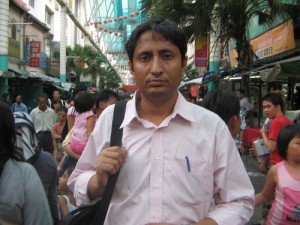
Media Landscape and the Making of an Unconventional Journalist: Monobina Gupta

Guest post by MONOBINA GUPTA

A profile of Ravish Kumar, this post tells the story of the media from a uniquely interesting vantage point – even as it presents before us a slice of contemporary social conflicts. 

I

Five days a week at 9 PM, Ravish Kumar begins his news programme, Prime Time, on NDTV India with “namashkaar, main Ravish Kumar…” At the same time when English news channel anchors scramble over each other for ratings, putting on display wild (often unsubstantial) discussions on the day’s events, Prime Time – in style and news content – strikes a very different note.

A journalist on the move
Journalist on the move

Ravish starts his programme with a 5-minute introduction, which is its unique selling point and also one of the highlights of the show. Packaging the topic of debate with a well-researched perspective, Ravish speaks in lucid, eloquent Hindi, interspersed with subtle and witty asides. Meticulously, he references the news reports, analyses, blog posts and opinion pieces he has swotted over during the day. In his mindful reference to every author whose work he has accessed through both mainstream and social media, Ravish has created a new media morality. The cutthroat universe of corporate media is more dedicated to grabbing information first rather than acknowledging sources or granting space to insights generated by others.

“Firstpost.com is our rival but whenever I take any news or analysis from the website, I acknowledge it. You could say this is NDTV India’s inherent culture. English channels don’t have that system. But they can have it if they want to. I do that consciously. I want viewers (a lot of them are students) to follow up these references,” Ravish told me. Continue reading Media Landscape and the Making of an Unconventional Journalist: Monobina Gupta

Happy to Disturb – RJ Sayan and The Jadavpur Police Station, Kolkata

The disgusting police violence and simple thuggery unleashed by the Vice Chancellor of Jadavpur University at the behest of his masters in the Trinamool Congress Party and the West Bengal Government has resulted in a counter-offensive that features rage mixed with humour, mirth, music and creativity. Nothing can be more lethal for the zombies in power than the laughter and music of the young.

Here is a brilliant radio clip – produced by RJ Sayan (Meter Down, 104 FM, Kolkata).

Thanks to Debjani Dutta for the translations and the English subtitles in the video.

Sailaab Nama – An Insider’s View of the Flood in Kashmir from the Outside: Gowhar Fazili

Guest Post by Gowhar Fazili

The floods in Kashmir can provide an outsider a momentary glimpse into the reality of Kashmir behind the corporate media propaganda smokescreen that is fumbling at the moment and like Truman Show (1998) exposing bits of the backstage. At the moment there are three key actors in Kashmir. There are the floods, the state and the people. Each one is on its own. One limb of the state—the state government was the first to crumble before the approaching waters.   The other limb—the mammoth military apparatus that has already inundated Kashmir since several decades, took two days to wake up to the crisis and when it finally did, its priority was to fish out the rich Indian tourists and the people close to the establishment out of the state. In the initial days, local people had to risk their own lives to get their marooned relatives to safety. Some hired local boats, some swam or waded through water, some made makeshift rafts out of anything that floats, including water tanks, car tubes, foam sheets, inflated baby bathtubs, so on and so forth to save their dear ones. The rest either drowned or kept moving up the floors of their houses as the waters kept rising until they reached their attics.

Continue reading Sailaab Nama – An Insider’s View of the Flood in Kashmir from the Outside: Gowhar Fazili

Need to re-enact Juvenile Justice Act – Myths and Realities: Kishore

This is a guest post by KISHORE

In a significant move, the Ministry of Women and Child Development has decided to repeal and re-enact Juvenile Justice (Care and Protection of Children) Act 2000. Along with its claims to streamline adoption and foster care procedures, it also proposes that juveniles above 16 years of age involved in heinous crimes should be tried as adults under the Indian Penal Code.

This is not first time that such an amendment has been advocated. One senior leader of ruling party had already gone to the Supreme Court last year with a petition for lowering the age under the law. However his petition was refused and the Supreme Court opined that there was no need for amendment as the present law (JJ act 2000) holds constitutional validity. Now this leader’s party is in power and they do not need to go to the judiciary for changes as they themselves can do it in Parliament. It is also believed that the government is not even waiting for the report of the expert committee appointed by the Law Commission of India to examine the issue. The proposal however, has always been contested by the premier child rights body NCPCR, which said there cannot be any “compromise” on the age of a child as defined by the UN and in other international conventions. We wonder if the governments’ desperation to change the law is based on popular “sentiments” and not on “facts”. Continue reading Need to re-enact Juvenile Justice Act – Myths and Realities: Kishore

Big media has become bigger – Media Diversity and Reliance’s takeover of Network 18: Smarika Kumar

Guest Post by Smarika Kumar

Big media has become bigger. The takeover of Network 18 by Reliance has consolidated news media in the country like nothing before. The Reliance-Network18 combination is, in fact, not exactly new. It was actually executed a couple of years ago in a very telling, roundabout fashion when Reliance lent money to Network18 through a trust called IMT, among other things, to buy all of its media properties. As a result of Network18’s debt, Reliance could then dictate to it the terms of repayment, which were agreed between the two entities in the form of debentures convertible to shares.

The resulting combination brings TV channels like CNBC-TV18, CNBC Awaaz, CNN-IBN, IBN7, IBN-Lokmat, ETV-Rajasthan, ETV-Bihar, ETV-Uttar Pradesh, ETV-Urdu, ETV-Marathi, ETV-Bangla, ETV-Gujarati, ETV-Kannada, ETV-Oriya, ETV-Telegu, ETV-2, Colors, MTV, VH1 and Nick; web content properties such as moneycontrol.com, ibnlive.com, and firstpost.com; as well as magazines like Forbes India under a single umbrella of ownership and control. (For a complete list of media properties held by Reliance currently, scroll to the end of this article.)

  Continue reading Big media has become bigger – Media Diversity and Reliance’s takeover of Network 18: Smarika Kumar