“Universal” is a tricky word. It has an enormous appeal, an unquestioned romance of taking every one along. Universal human rights, universal access to basic services, housing for all. It is the barometer of inclusion done right. The dark side of the romance is that it’s one of the hardest things to actually achieve. Often the “universal” is a vanishing horizon and, like all horizons, the mirage is what makes you lose sight of the very real trade-off’s and constraints in your way.
This week the Delhi Jal Board announced a new horizon towards the idea of universal access to a basic urban service and human need: water. The “Jal Adhikar Connection” (a Right to Water Connection) promises to let households within slums in Delhi apply for legal, metered water connections “irrespective of the status of their residence.” This move – following the Government of Delhi’s already given pledge to extend water and sanitation services to unauthorized colonies – implies that legal, public and metered water could (like electricity) actually cover the city as it exists rather than as it is imagined in plans and laws.
What exactly happened in Jamia Millia Islamia on 13th August?
The sequence of events:
Just two days before Independence Day, all the hostel residents were informed personally by the administrative authorities to be careful as there may be some raid by IB or CBI or Delhi Police. Students were instructed not to keep any non-resident student in the hostel.
While it is okay to instruct students not to keep any non-resident student in the hostel, what is problematic is the atmosphere of fear that was created among students. Many of the students were told to be careful regarding ‘KASHMIRI STUDENTS’ in particular.
The hostel authorities repeatedly instructed the students not to come out of their rooms and to be careful.
On the 13th of August, at around 3 p.m., two police constables in uniform and around 15-20 officials in plain clothes were seen sitting just outside the hostel gate. Two constables came inside the gate and started having conversation with the guards while around 10 officials were sitting in their cars inside the hostel campus. Continue reading What exactly happened in Jamia Millia Islamia on 13th August? Jamia Millia Islamia Students→
Guest Post by Jamia Millia Islamia Students, Delhi
At the stroke of midnight Jamia Students are leading a massive protest against the administration at Jamia Millia Islamia university and while the concerned authorities are no where to be seen. The protests erupted following the intrusion of Delhi police personnals and some unknown people in plainclothes within the hostel premises. The proctor and the provost of Boys hostel who visited the protesting students stated that they had no information about any such “surprise raid” as it is being reported by a section of media. However, the same media reports are categorically mentioning that the Jamia administration says it was a routine exercise. The students who reside in the hostels are contradicting the administrations claim of being in no knowledge of the so-called “surprise raids” as they were warned by their care-takers that there will be a raid or search soon.
The proctor and the Provost along with other university officials came and assured the students that they are writing a letter to the DCP of Delhi police urging him to take cognisance of the matter and inquire into it. The students demand that the university officials shall call a press conference and tell the media that how without their permission the Delhi police entered the hostel premise. The students have vowed not to disperse from the main gate of the university as a mark of protest until the administration acts on the demands of the protesting students.
The students are articulating this incident with the larger attacks by the cohorts of this government and its various institutions upon universities and students. This incident has raised a plethora of question among students of the university. This institution on account of being a minority institution has been a target of this government and the party in power. Why only Jamia comes under the scanner? Why not such “surprise raids” in the premises of Delhi University, Jawaharlal Nehru University, Ambedkar University and scores of private institutions located in the NCR region? What makes Jamia, its hostel and students so suspicious elements that Delhi police needs to intrude into the premise without taking prior permission?
We students of Jamia Millia Islamia do not wish to be misquoted or misrepresented into the media therefore we take the onus upon ourselves to spread our word and request all democratic and progressive forces to stand with us.
(A copy of this letter has been sent to Kafila, Wire, The Citizen and others)
What happened in Gurgaon two days ago is only a foretaste of what is going to befall Delhi. The same fate awaits all other regions surrounding Delhi in the broader National Capital Region, if we refuse to draw appropriate lessons from the deluge that short-circuited the virtual dreams of those who had bought the chimera of the Millennium City.
A short recap of what led to the deluge will help place the entire issue in perspective. The low-lying plains of the area receive precipitation run-off from the Aravalis and the Chhattarpur area of Delhi. All this run-off used to flow through the Badshahpur Nala.
Map: Shehla Hashmi Grewal Drainage pattern of Delhi
The number of unarmed civilians killed in instances of firing by the armed forces, police and paramilitaries enforcing the occupation of Kashmir by the Indian state in the latest wave of violence has crossed fifty. Many more have been blinded by pellet guns. Hundreds have been injured and hospitalized. Reports of protests are coming not only from the Kashmir valley, Kargil, Drass and Jammu, but also from many cities in India. From Delhi (where there has been a public protest at Jantar Mantar, a press conference at Gandhi Peace Foundation and a student protest at Jawaharlal Nehru University), from Kolkata, which saw a massive turn out in a public march, from Chennai, from Patna, and from Kochi and Tricky in Kerala.
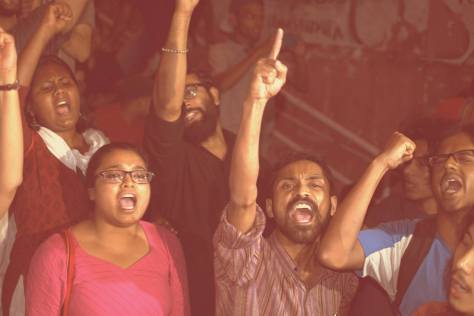
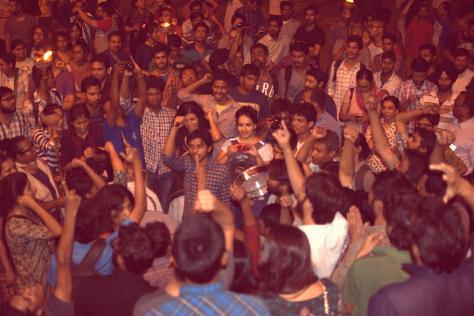
On Friday 22nd July, I went to a night protest march and public gathering by students at Jawaharlal Nehru University, Delhi. The march was called by Shehla Rashid, Vice President, JNUSU and Rama Naga, General Secretary, JNUSU (Both AISA activists) There were perhaps two hundred students gathered peacefully. The march began around 10:00 pm, made its way around the university campus and the protest continued well past midnight. Several student organizations, AISA, BASO, Hundred Flowers, Collective, DSU and individual students participated in the march. Shehla Rashid, Vice President, JNUSU and an AISA student activist, addressed the gathering before the march began, stating clearly, that this was going to be a peaceful expression of the democratic right to protest against the atrocities being enacted by the Indian state on the people of the part of Kashmir that is under Indian occupation. She asked the students to be vigilant in case any disruptive slogans were raised by planted agent-provocateurs. The entire march, and the protest meeting was documented by the students, so as to ensure that no ‘doctored videos’ would raise their ugly digital heads in the days to come. The students raised the demand for freedom for the people of Kashmir, and for people in all parts of South Asia. The slogans connected the realties of the people of Kashmir, the North East, Bastar, Jharkhand, with the experiences of Dalits, Workers, Peasants, Women, Students and Minorities. Slogans were raised against the killings and blindings by pellet guns in Kashmir. against torture, again rape, against draconian acts like AFSPA and PSA. The march made its way through the entire campus and culminated outside Chandrabhaga Hostel, where a meeting was held on the steps. The meeting lasted over two hours, was completely peaceful,and more than two hundred students listened to the speakers with close attention.
Police officers and campus security guards were present, and recorded everything. The students also recorded everything. And the indefatigable Shamim Asghor Ali made video recordings of several speeches, and uploaded them on to youtube, which we are lucky to be able to share here. We are also grateful for the still images uploaded by V. Arun, several others also took pictures and videos, which are now being shared on Facebook. Continue reading Students Protest in JNU Over Rising Civilian Casualties in Kashmir→
Guest Post by Greeshma Aruna Rai, with Women against Sexual Violence and State Repression (WSS), Peoples’ Union for Civil Liberties (PUCL) & Karnataka for Kashmir Forum.
Police has revoked the permission which they had given yesterday to hold a democratic protest in solidarity with Kashmiris in Bangalore by concerned citizens and activists. This is another way in which the State shows its true colours to all Indian citizens who are against State repression and State colonialism in Kashmir.
Permission for today’s protest condemning atrocities on the people of Kashmir has been revoked by the Karnataka State Police. They have threatened us with legal action if we proceed.
As organisers we have been bombarded by the police, demanding that we withdraw this demonstration.
As we publish this message, the 11th day of curfew continues and valley remains awash with the blood of Kashmiris.
Today’s protest is postponed. We, however, refuse to be stifled by the very same state that is ravaging Kashmir. We have resolved to move against the actions of the Police. We’ll be releasing a Press Note shortly while discussing other options to challenge this.
[ Shortly after this post was uploaded, the organizers of the protest held a press conference where they released the following statement.]
Close to five hundred people came out in a rally yesterday, 15th July, to protest the ongoing killings and mayhem in Kashmir by the Indian State. The overwhelming majority of participants were students, but they were joined in good numbers by feminists, queer-activists, trade union activists, writers, journalists, academics, human rights activists, dalit rights activists, cultural activists, with many among them not affiliated with any organisation. Student and youth activists carrying flags and placards of PDSF (Progressive Democratic Student Federation), USDF ( United Students Democratic Front), AISA (All India Students’ Association), Progressive Youth League (PYL) and many from other student-youth organisations were present in good numbers, so were human rights activists from APDR (Association for Protection of Democratic Rights) and those from Bastar Solidarity Network (BSN). Many carried with them their own banners and posters. Like the rally in Delhi, protesters carried with them hand-written, hand-painted and printed placards with the names of civilians recently killed in Kashmir inscribed on it, and through those posters a connection of shared pain and solidarity flowed from the streets of Kolkata to the turbulent and stormy blood-stained streets in Kashmir. Those posters were reaching out to the people of Kashmir with messages that they were not alone in their hour of sorrow, anguish and mourning. Some of the protesters had written verses by the Kashmiri poet Agha Shahid Ali on their posters. One of those many posters summed up the mood of the rally, ‘Kashmir belongs to Kashmiris’.
Last week I caught up with Shubhum Mishra, a cartographer/geographer/urban planner, in Sundar Nursery – a Mughal garden turned colonial green house spanning 70 acres in the heart of Delhi – that shall should be open to the public sometime next year.
Shubhum has just transliterated Intizar Husain’s famous book – Dilli Tha Jiska Naam – from the original Urdu/farsi script to devnagari, in the hope of making this incredible resource more accessible to north Indian readers. In this conversation he reads excerpts from the book and I asked him why modern Indian cities are so spectacularly ugly.
Listen in for a fascinating description of Chandini Chowk and “Old Delhi” – back from when “Old Delhi” was the only Delhi around. Shubhum will respond to comments on the site. His book is now available in most book stores around the city and you can buy it here
In an online documentary archive called Delhi Digest, Saleem Shakeel, founder of an e-waste recycling company in the city, speaks to the camera about e-waste. The setting is familiar. Mr Shakeel sits on the single chair in what looks like a small, partially built room of exposed red brick. There are piles of objects which, like the room itself, appear used or discarded. If you conjured up an image of “informal” and “waste,” this is pretty much what you think of. Ashish Nandy would perhaps describe an outsider’s view of it it as he once did for the way we see the “slum”: all that stubbornly refuses to bow out of modernity’s way. It’s hard to imagine technology here, let along big data or smart solutions.
Yet as Mr Shakeel speaks, it is precisely technology and data that flood your mind. He describes how e-waste circulates through circuits and geographies in the city that we rarely see. Sophisticated flows of work and labour are ready when the computer comes, each finely skilled and discerning. Different workers take the different parts – CPU goes one way, the keyboard another. They break further: mother boards, drives, power supply, wires, the iron, the gold chip. Every last bit is used, and its use is determined by the current market’s daily prices. No two days, says Mr Shakeel, are the same; you have to know, and you have to be ready to adjust. Information – that less glamourous cousin of “data” – flows quickly, endlessly, in many modes and forms. The circuits are opaque, but they work.
In summer, Delhi’s fancy turns grimly to thoughts of thirst.
How can a mega-city provide a safe and sustainable supply of water to its 24 million residents? How has it done so in the past? What do we lose when we turn our backs on a river, turn our streams into sewers and lay concrete over our ponds?
In this conversation, Sohail Hashmi summons the Delhi of history, and the Delhi of his childhood through recollections of the Yamuna, ponds, streams, and the Urdu Bazaar where everyone had a favourite well from where they drew their daily sustenance.
Like what you hear? Leave us comments on how we can expand our audio section
This is a guest post by Rina Ramdev and Debaditya Bhattacharya
Students of JNU have been on an indefinite hunger-strike for over 15 days now, and the administration’s only official response so far had been the Vice Chancellor’s May 4 statement invoking the vocabulary of the ‘lawful’ and the ‘constitutional’ — in ambivalences closer to threat than appeal. The subsequent May 10 Academic Council meeting has been historic, both for its 53 members’ overwhelming denunciation of the HLEC report, as also for the indelible image of a fleeing VC now forever etched in campus folklore. Further, the Delhi High Court’s stay on the fine imposed upon one of the students lends hope for similar stays with the remaining beleaguered students’ cases. The VC has consequently been referring to the enquiry mandate as being sub-judice, only to grant it an interim legitimacy that may symbolically defeat the stridency of student resistance. Letters have been sent out to the parents of striking students, in an attempt to re-route intimidation and pressure through other non-official means of paternalism. Given the conditions of duress being thus created, until the HLEC’s report is revoked in entirety, there is every reason to believe that the administration’s vindictive punitive designs will leech into the future of university freedoms and campus democracy irreversibly.
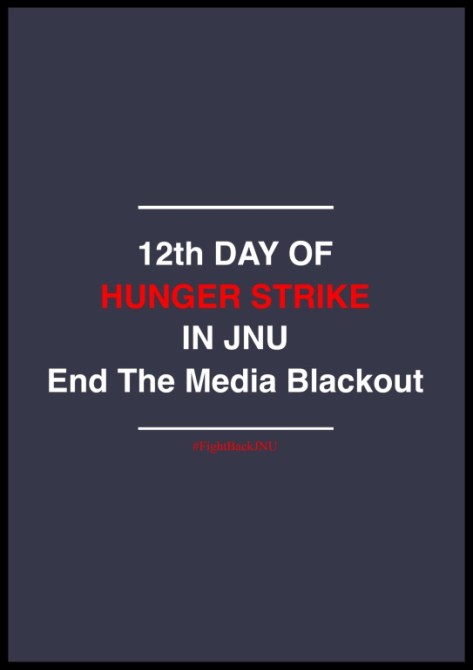
The JNU Students’ Hunger Strike Enters Day 12. Ketone counts go up, Weight goes down, Morale stays miles high. Media fatigue shows that crusading news anchors are no match to hunger striking students when it comes to stamina, and, may we say, courage. The university authorities, the JNU VC and his gang, the government, the RSS-ABVP, remain what they are – losers.
Spring has given way to the beginning of a turbulent summer. April, is a cruel month. Temperatures have risen, and so has the level of rage in university campuses. The JNU University Authorities (and their masters – in the Ministry of Human Resources Development, the Prime Minister’s Office and the RSS Citadels in Mahal, Nagpur and Jhandewalan, Delhi) thought that they could break the resolve of the students by enacting a series of harsh measures against them just before exams begin and the university term ends in summer vacations.
Chintu Kumari, Anirban Bhattacharya and other students give the call to protest against the HLEC and call for a Hunger Strike. Photo, Courtesy, Azhar Amim
This is a time, they must have thought, when students will be busy with preparations, and the rising heat will discourage the kind of mass mobilizations that the campus has seen since February. Students in JNU resolved a few hours ago to prove them wrong, and decided to fight back . A massive gathering stood its ground at the Administrative Block, aptly re-christened, ‘Freedom Square’.
Rama Naga, Gen.Sec. JNUSU, (Centre) and JNU Students Calling for Indefinite Hunger Strike on April 27, 2016. Photo, Courtesy, Azhar Amim
They have decided that a batch of students will sit on indefinite hunger strike – a ‘fast unto death’ – until the JNU authorities roll back the draconian measures listed in the HLEC Report.
There’s no looking back now. Whatever happens from now on wards, will be seen as a consequence of the cruel, evil mindset of the current regime, which truly treats the lives of the young as dispensable ballast. Its time to prove them wrong. This is a call that goes out to all students and teachers, and sensible individuals, not just in JNU, not just in Universities and Colleges all across India and all the territories administered by the Indian republic, but to everyone reading this post anywhere in the world, to stand by the courageous students of JNU. It is our responsibility to see that the JNU Authorities see reason and back down. If anything untoward happens to any student, the university authorities, and the regime backing them, will be clearly culpable.
Here is Umar Khalid, speaking just before commencing his Hunger Strike
Here is Chintu, former Gen. Sec. JNUSU, speaking at the Mashaal Juloos, (Torchlight Procession) just before beginning the Hunger Strike.
Listen to Kanhaiya Kumar, President of the JNUSU – restating the reasons for the continuation of the movement.
Thanks to the ‘We are JNU Media Group’ and the AISA Youtube Channel, for the videos.
[ The prurient fantasies contained in the ‘JNU Dossier’, produced by some right wing faculty members of JNU in or around October 2015, have been ‘outed’ by an excellent report by Ajoy Ashirwad Mahaprashasta in Wire.org. This comes exactly at the time when the JNU administration has shown its fangs by delivering a low blow by way of the measures outlined in the report of the ‘High Level Enquiry Committee’ appointed by the Vice Chancellor. An impartial examination of the HLEC document and the ‘Dossier’ in will reveal some startlingly resonant patterns. Clearly, the ‘Dossier’, which had been dismissed by the former Vice-Chanceller, Prof. Sopory, has been reincarnated at the express orders of the Nagpuri masters of the present dispensation. We are sharing below an excellent response to the ‘Dossier’ by Ayesha Kidwai, one of the professors – ‘named’ in the dossier. This is taken from Ayesha Kidwai’s status update on her Facebook Page.
Sanghi smut is in season again! For the authors of the Dirty Dossier, JNU nights are forever scented with musk, with couples draped on every bush, suitably fortified by free alcohol, thoughts of secession, and cash payments supplied by the Awesome Foursome. At its peak, the party can practically involve the whole university, because as per Shri Gyan Dev Ahuja’s estimates, the number of students frolicking this will be 7000 (3000 condom users X 2, plus 500 injectable walas X 2). (Assuming of course that the few hundred left over have gone to fieldwork, have exams, or are abstemious and/or abstinent in nature.)
Laugh as we may (and must) at these feverish imaginings, it’s also important to understand that the very notion of a free university challenges not only misogyny, but also the social apartheid produced by caste and exclusionary religion.
Guest Post by Shehla Rashid, (Vice President, Jawaharlal Nehru University Students’ Union)
Rise up against the proxy war on students by the Modi regime.
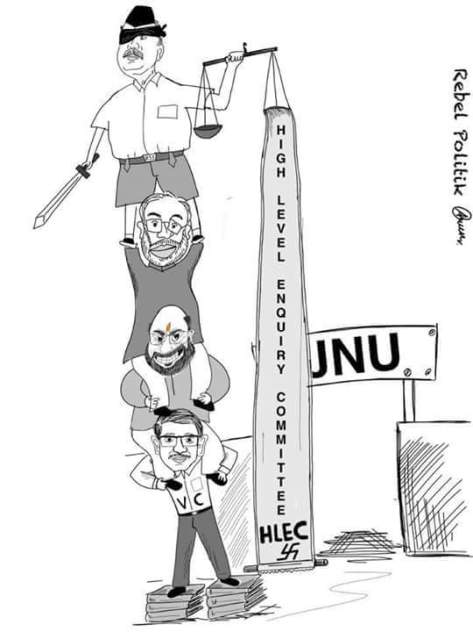
Cartoon by V. Arun Kumar
JNUSU rejects the report of the enquiry committee constituted by the Vice-Chancellor to look into the 9th of February incident. JNUSU also rejects its reports and any punishment handed out by it. The JNUSU and JNUTA had repeatedly asked the administration to democratise the enquiry committee, but this was not done. Now, when the holidays are here, the VC has made public the punishments, after one and a half months of submission of the HLEC (High Level Enquiry Committee) report. Continue reading Rise Up against the Proxy War on Students by the Modi Regime: Shehla Rashid→
Free speech cannot come with a price tag -10,000/- or 20,000/- or even a rupee!
Dissent cannot be evicted!
Ideas cannot be made out of bounds!
Reason cannot be rusticated!
Guest Post Compiled from Uploads by Student Videographers from UoH/HCU and their friends
“The only thing to fear is fear itself”
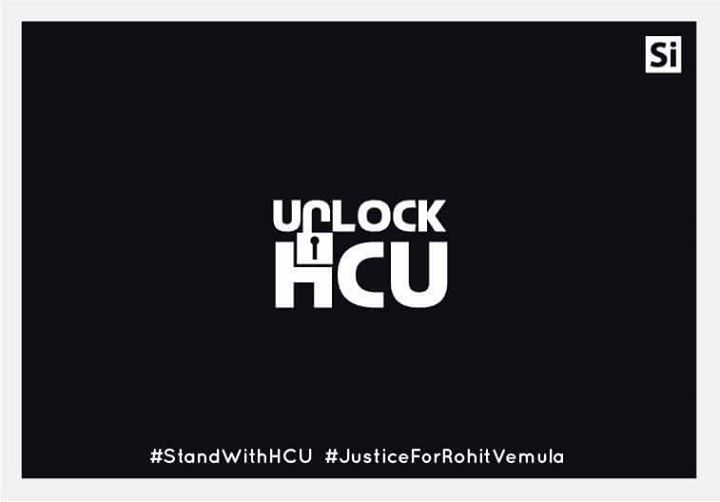
[ Since the mainstream media, particularly television channels, are steadfastly refusing to report the ‘undeclared emergency’ in the University of Hyderabad (also known as Hyderabad Central University – HCU), we at Kafila, (along with many other online platforms, such as Raiot.in, India Resists, Scroll.in, The Wire, RoundtableIndia.in and several youtube channels) are going to continue providing our readers with testimonies by students and faculty from the University of Hyderabad.
Venkaiah Naidu, Bandaru Dattatreya, Smriti Irani and Rajnath Singh (all senior ministers in the BJP government at the centre) and some of their chamchas have probably been on the phone all of the past few days with senior editors and media management to try and ensure that the situation remains unreported, un-commented upon. Or, is it just the ‘business as usual’ matter of Savarna (Hindu upper caste, usually, but not only, masculine) privilege (and insecurity) playing itself out in newsrooms and edit meetings when it comes to reporting an assertive, articulate, intelligent protest with a very large Dalit-Bahujan component in Hyderabad. Or is it a bit of both?
What other explanation can there be for the almost blanket ban on reportage, analysis and commentary on the extraordinary situation in Hyderabad in most national TV channels? Even the reporting in major newspapers, though better than what exists on TV channels, leaves a lot to be desired. Every major news organization has correspondents in Hyderabad, and even if they are not able to enter the university because of the VC’s orders, they can still definitely speak to the students if they want to, because the students regularly assemble outside the university gates. What prevents them from doing that? What exactly is going on?
After the rage that was sparked by Rohith Vemula’s institutional murder and the crackdown in JNU, the BJP government probably believes that the only way to continue repression is to do it under the cloak of silence. And so, the heavy breathing down the phone lines. And so, the reversion to the Savarna stiff upper lip code of silence – an ‘omertà’ which disables possibilities of translation, or even just transmission of what is going on in Hyderabad.
But this mistaken belief that the media’s silence can translate into public indifference and ignorance about the war that the Modi regime has unleashed on the young, will actually work to create a backlash. It is already destroying the little credibility that the regime has, and eroding a lot more confidence in its media backers.
Young people, in Hyderabad, in JNU, and in countless other campuses, factories and workplaces, are way smarter, way more media savvy than either the idiots who run the show in the BJP, or their mavens in the media can gauge. The young (and their friends amongst their teachers) will make sure that the airwaves resonate with their voices and accounts.
The first video in the series below, all taken from Youtube channels started by students and their friends, has a speaker saying something wonderfully generous – “The only thing to fear is fear itself”. Listen to her, listen to her friends and comrades. Share this post widely. Defeat the collaborative exercise of repression and censorship undertaken by the Modi regime and the mainstream media on this issue.
Jai Bhim, Lal Salaam, Inquilab Zindabad ! – Kafila ]
With thanks to the Justice for Rohith Youtube channel, from which these videos are taken.
Guest Post by HCU students (Taken from Youtube Uploads and Facebook Status Updates)
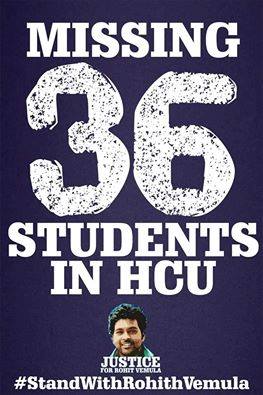
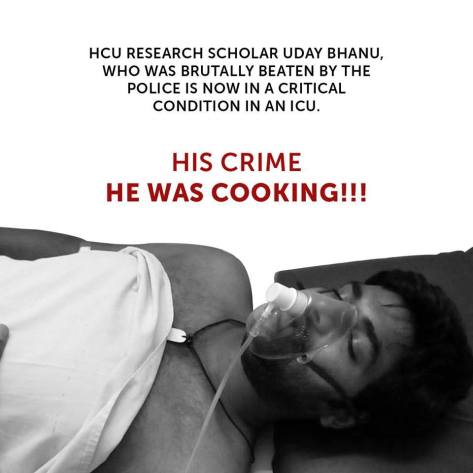
[Since there is a virtual media blackout of the situation in Hyderabad Central University we have decided to share video testimonies by students of the violence unleashed by CRPF (Central Reserve Police Force) and the RAF (Rapid Action Force) which were called in at the behest of the Vice Chancellor Appa Rao – who is already under a cloud for having created the circumstances that led to Rohith Vemula’s suicide, which many students consider to be an ‘institutional murder’. When Appa Rao returned to the University, students were enraged, and they started a ‘sit-in’ outside the Vice Chancellor’s lodge. It was then that the central forces were called in. Later, electricity, water and internet facilities were cut off. The debit card used by the students, linked to the State Bank of India branch on the campus, were blocked. The non teaching staff was persuaded not to give food in university hostel canteens to students. Some students who started a community kitchen were taken away by the police. One of them, a research scholar called Uday Bhanu was so badly beaten up that he has been admitted to intensive care at a local hospital. His condition remains critical.
For the fourth time since the early February, students, faculty and their friends marched in Delhi. Once again, there were thousands of people, walking from Mandi House to Jantar Mantar. This time, there was focused attention on the demand for the release of the detained JNU students – Umar Khalid and Anirban Bhattacharya, the DU Professor S.A.R Geelani, solidarity with JNU Prof. Nivedita Menon and the poet-scientist Gauhar Raza against their media trials, and a direct attack on the creeping fascism of the Modi regime. Here are some moments from this march.
(Thanks to Aniket Prantdarshi, Kavita Krishnan, Samim Asgor Ali and Anish Ahluwalia, ‘We are JNU’ for their photos and videos, which I have taken from their Facebook pages and Youtube Channels)
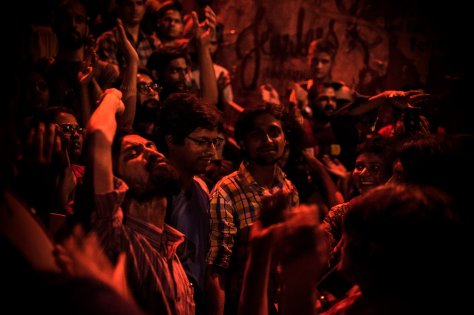
[ Here are five joyous excerpts of recordings from a recent night on the JNU campus – after Kanhaiya Kumar came back – recorded by a young person called Veer Vikram. We do not know who Veer Vikram is, but came across his Youtube Channel, and were struck by the raw freshness of the voices and of the footage. So we are sharing them with you, saluting the generosity of Veer Vikram, who recorded these and uploaded them on to Youtube for everyone to enjoy. May there be many long nights of joy, music, dancing and poetry – in campuses, factories and neighborhoods – everywhere Think so what a beautiful sight a ‘vishaal jan jagaran’ (as distinct from a ‘bhagawati’ jagaran) can make in different corners of Delhi, and in every city and town where young people can no longer take the rubbish offered by TV channels and the Modi regime. The revolution will be danced, sang, dreamt, recorded, uploaded, downloaded, shared and enjoyed. No more words necessary ]
Kafila posted a set of solidarity statements recently in support of the students, faculty and autonomy of JNU. We are posting another set, received from the following organisations:
First-Decade JNU Graduates and Other Graduates – 548 signatories.
Faculty, Staff and Students at the Indian Institute of Management, Bangalore.
California Students and Faculty. California, U.S.
Current Fellows of the Jawaharlal Nehru Institute of Advanced Study, JNU, Delhi.
Colorado College, Colorado, U.S.
Faculty at DePaul University, Chicago, U.S.
Faculty, Students and Staff, Brown University, Rhode Island School of Design (RISD) and University of Rhode Island, Providence, U.S.
McGill and Concordia Universities, Canada.
Canadian Academics from Various Universities.
Please click on Read More below for the statements and signatories:







 KAFILA - COLLECTIVE EXPLORATIONS SINCE 2006