Category Archives: Movements

On a Long Road to Justice: Simin Akhter

This is a Guest post by Simin Akhter, with inputs from Kamal Pant, Naina Singh and Vikas – 16 December Kranti

(Notes from the ongoing protests in the child sexual abuse case against Toddlers International Playschool, Rohini)

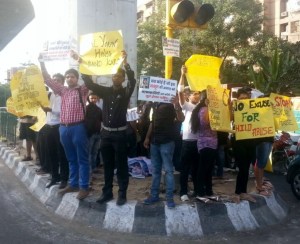
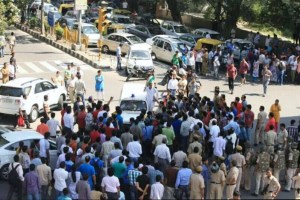
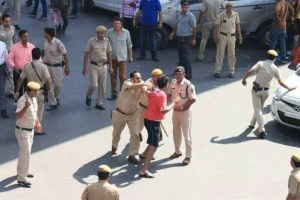
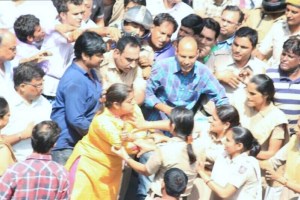
In a heinous and unfortunate show of power and violence, a two and a half year-old girl was raped by a male attendant at Toddlers International playschool (Rohini). Though the parents could manage to file an FIR, the management has threatened them with dire consequences. The principal has been openly shielding the accused, Amit Kumar, despite prior complaints of inappropriate behaviour by aggrieved parents and was allegedly shameless and audacious enough to tell the parents, ‘The police have been fed too well enough to open their mouths’! It also came to light during the protest yesterday that a similar FIR was filed two years back too but no police records could be found for the same; no wonder!

Almost 30 other girls have been detected with a certain strain of bacterial urinary infection, indicating the said two-year old is not the only victim. Many other children have been suffering from mouth-ulcers and a general loss of appetite too, reflecting also on the general lack of health and hygiene practices in the school. A group of parents, grandparents and concerned citizens, mostly young women and men, from in and around Rohini have got together for a relay protest but parents of other victims have not been forthcoming with formal complaints. Needless to say, the greater the delay in filing the complaints, the more legal intervention will get delayed.

Continue reading On a Long Road to Justice: Simin Akhter

A Reply to Ranabir Samaddar on Jadavpur: Uditi Sen

Guest Post by UDITI SEN

Prof. Ranabir Samaddar of the Calcutta Research Group has recently published a screed (in the DNA Newspaper) against the #Hokkolorob movement  initiated by the students of Jadavpur University which has found resonance with students and young people all over West Bengal and elsewhere in India. Samaddar, who seems to have lost the ability to recognize the many intersections of solidarity between students, young people in metropolitan as well as non-metropolitan contexts, women, young workers, accuses the movement of what he calls ‘elitism’ and a disconnect with realities on the ground.

Uditi Sen responds.

It is settled then. With this latest denunciation (by Ranabir Samaddar, in DNA, see link above) of the student movement at Jadavpur, we finally have a verdict we can trust. Student politics is not what it used to be. The glory days of the 60s are long gone and the protesting young today fail to live up to the authentic radicalism of their elders. Those were the days, indeed. Those were the days when student politics, organised under the banner of the organised left took up real issues, such as those of the peasants and workers and did not distract themselves with inequities closer to home. Such as, why women ‘comrades’ were expected to cook and clean and provide for their men, who led the vanguard. Such as why even the most progressive politics, when speaking of the rights of peasants, meant the rights of male peasants. Those indeed were the days of glory, which we should remember and seek to emulate, when the leaders, usually dadas, had no answers when a peasant woman asked, ‘“Why should my comrade beat me at home?” (See Samita Sen’s Toward a Feminist Politics: The Indian Women’s Movement in Historical Perspective)

Continue reading A Reply to Ranabir Samaddar on Jadavpur: Uditi Sen

I am a Muslim, an Atheist, an Anarchist: Salmaan Mohammed

Guest Post by Salmaan Mohammed

[ Salmaan Mohammed, a twenty five year old philosophy student was arrested in Thiruvananthapuram on 19 August 2014 for sedition, and for allegedly dishonouring the national flag and national anthem. The complaint against him originated as a response to his refusing to stand while the national anthem was played in a cinema during a screening. Salman is currently out on bail, but still faces the prospect of a life term in prison if he is found guilty of sedition by the judicial process. We at Kafila have been in touch with Salman and he has recently sent us a translation of an audio interview he did after coming out of prison on bail so that the world outside Kerala (and those who do not read or speak Malayalam) can understand what he has been thinking.]

Continue reading I am a Muslim, an Atheist, an Anarchist: Salmaan Mohammed

#Hokkolorob – The Politics of Making Noise: Rajarshi Dasgupta

Guest Post by RAJARSHI DASGUPTA

We must not celebrate every time we see a movement. Movements can be very popular without being very meaningful, disturbing only the surface of society. Some can be pretty and harmless like candle light vigils; others dangerous and ugly like ‘love jihad’. Some want efficient governance like Hazaare; others regime change like Nandigram. For those tired with political apathy, it is of course good news that a spate of new movements is emerging thanks to new technologies and media coverage. But it is equally true that they seem to be going indifferent directions, without any common end. The picture is not clear. Who knows better than us how ‘change’ can be purely rhetorical? It is not difficult to imagine why people are weary of dramatic social unrest. They hardly fail to bring yet more conservative and unscrupulous sections to power. If we don’t want to get carried away, it is because of repeated disillusionments with the promise of change that everybody makes but nobody keeps. Politics is not, we better understand, about promise but manipulation, bargaining for daily needs, livelihood and resources, and so it should be. Movements may come and go like fashion, they are incidental to reality, which changes very slowly if at all. There is an institutional process of elections we have put in place, and it has proven to be resilient and reliable.

Bandh Bhengey Dao – Break All Bonds –
Lyrics and Music – Rabindranath Tagore & Asian Dub Foundation
From the Original Sound Track of ‘Tasher Desh’ a film adaptation by Q
of Rabindranath Tagore’s Joyous Anarchist Opera

Continue reading #Hokkolorob – The Politics of Making Noise: Rajarshi Dasgupta

Prose of Power and the Poetry of Protest – An Outsider’s Attempt to Make Sense of the ‘Kolorob’ in Kolkata: Uditi Sen

Guest Post by UDITI SEN

51288650-29337-hokkolorob
#Hokkolorob – Embodied

It’s been more than a week since tens of thousands of students marched in a rain drenched Saturday in Kolkata, in solidarity with Jadavpur University students and their fight for justice. Much has happened since to delegitimise this mammoth, genuinely popular and student-led march. A counter-march, the co-optation of the victim’s father by the ruling party, adverse propaganda in the press and fatigue and confusion amongst the protestors have been some of the dampening developments that followed the unexpected show of student power. True to their clarion call, hok kolorob (let there be clamour), the marchers made a lot of noise. A week later, as the numbers of protestors on the streets have dissipated as fast as they had congregated, it is perhaps time to step back from the euphoria of the gathering and the intimidation and murky co-optation of protest that followed, to reflect on the political meanings and potential of this uprising.

The march was not organised by any single political party, though many with experience or background in student politics of one ilk or the other, marched. The vast majority, however, were students who had never marched before and had no experience of politics. The question therefore arises, what, if anything is the unifying ideology of this body of protestors? What goals motivate them? Above all, the question that is doing the rounds the most, on social media, on mainstream news and on the streets is what are the politics of the protestors? The question of politics is seldom posed directly. Its ubiquitous presence, however, can be clearly read in the answers provided regarding the nature of the march, the motivations of the protestors and the identity of the marchers. Unsurprisingly, diametrically opposite sets of answers emerge from members of the ruling party, inside and outside Jadavpur University; and the people who took to the streets on Saturday. From the Vice Chancellor, the Education Minister and officially ordained leaders of the ‘youth’, such as Abhishek Banerjee and Shankudeb Panda, characterisations emerge that focus on indiscipline on campus, presence of Maoist and other outsiders and deep conspiracies. From students of Jadavpur University and their sympathisers, assertions emerge that this protest is about justice and not about politics. Both characterisations fail to capture what is at stake.

Continue reading Prose of Power and the Poetry of Protest – An Outsider’s Attempt to Make Sense of the ‘Kolorob’ in Kolkata: Uditi Sen

#Hokkolorob – Images from a Jadavpur Solidarity Meeting in Jantar Mantar, Delhi

Here are some images from a  meeting held in solidarity with Jadavpur University Students at Jantar Mantar, New Delhi, on Thursday, September 2014. Students from Delhi University, Jawaharlal Nehru University, Jamia Millia Islamia, Indian Institute of Mass Communications, teachers and professors from different universities in Delhi, Jadavpur University Ex-Students, Workers and Professionals from the Delhi NCR Region spoke at the meeting. A signature campaign was undertaken, and the assembled people wrote their statements on to a scroll in support of their friends at Jadavpur.

All Photographs are by Akhil Kumar, Youth Ki Awaaz. 

This slideshow requires JavaScript.

Khushi Ram, a terminated worker from the Maruti Suzuki Factory at Manesar had come from Haryana to express the solidarity that the workers of the Delhi-NCR region have for the students of Jadavpur University. He read a poem at the gathering. Kafila caught up with him as the meeting was about to end. Here is a video of him reading his poem for the readers of Kafila, and a brief record of a conversation with him about solidarity between workers and students.

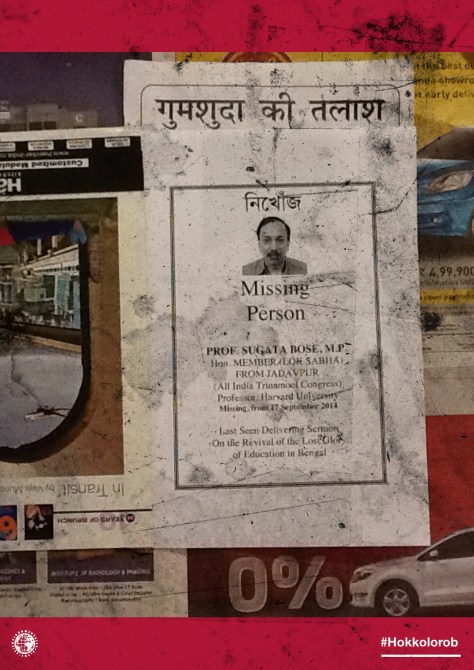
Missing Person Notice: Ben Zachariah

Guest Post by Benjamin Zachariah

Looking for Prof. Bose

It was not so long ago that Sugata Bose, now Lok Sabha Member for Jadavpur, made his way back from Harvard to serve his people. West Bengal had voted for ‘poriborton’, ‘change’, and as everybody assumed that Bengalis loved their fellow-men who had been anointed abroad, Sugata Bose returned to conquer the heights of Bengali higher education. The plan was to use a brand name within a brand name to shore up another brand name : Harvard, Netaji, Presidency. The Trinamul Congress, Bose was confident, would not interfere with his plans. Or so he said in public; his mother, Krishna Bose, had been the Trinamul Congress’s Presidential candidate, and long regarded as the force behind the attempted bhadramahilafication of Didi, apparently a prerequisite for political acceptability in West Bengal (otherwise known as Waste Bengal or Poschimbongobongo). It was therefore no surprise that his plans did not diverge from the plans of the TMC, although ‘internal differences’ were often heard of. It was also no surprise that, as the attempts to turn Presidency ‘University’ into the font of moral and intellectual legitimation for the TMC faltered, Bose took the mantle of his great-uncle upon himself and stood as a candidate for the TMC in the Lok Sabha elections, from the Jadavpur constituency. There was not even the pretence that Sugata Bose stood on his own credentials: his campaign marches were led by a child in Netaji uniform and Netaji glasses, prompting a complaint to the National Commission for Protection of Child Rights.

Now, in the Jadavpur constituency, duly won by Netaji’s heir, and not by a hair’s breadth, developments at Jadavpur University are cause for concern.

Continue reading Missing Person Notice: Ben Zachariah

Note of Solidarity with the Students of Jadavpur University: Jagriti

Guest Post from Jagriti, Women’s Development Cell, Bharati College, Delhi University

(The authors of this post sent it to us at Kafila saying –  “…since we don’t have any direct mean of contacting them (Students of Jadavpur University), we wish to do so through, if possible, your website”. Accordingly, we are uploading this post to honour their wishes and their sense of solidarity)

Dear students of Jadavpur University (JU),

We, members of Jagriti, the Women’s Development Cell of Bharati College, University of Delhi, pledge our support to your struggle for gender justice and administrative and pedagogical accountability. We are deeply disturbed to receive news of administrative indifference to sexual harassment and of the consequent police brutality in JU campus. We unanimously and unequivocally condemn JU administration and the West Bengal police for ignoring students’ valid demands and for orchestrating violence onto students.

In iterating our support to you, we iterate also the belief that the entire administrative mechanism of JU failed to protect its own students. We hold the Vice-Chancellor (VC) and the Dean of Students responsible for not ensuring that the students’ demands were satisfactorily addressed; we also hold the Internal Complaints Committee responsible for letting what could have been only a campus-specific issue escalate into a major humanitarian and academic crisis. This incident is a lesson not just for JU but for educational institutions and workplaces globally to comprehensively commit themselves to gender justice and to accountability. University administrations are in anyway obliged to engage with their students in healthy and open dialogues on each and every issue that the students, persons whom the university is supposed to service, feel pertinent, and to do the complete opposite, to break down all communication and instead call armed police personnel to violently disperse students is totally unacceptable. JU has been known nationally as well as internationally as a hub of free and liberal thinking, and this shocking attempt to choke dissent out of it attracts our unstinting condemnation.

We support your demand for the non-extension of the tenure of Mr. Chakrabarti, the current interim VC. This issue is political, but it does not belong to any political party, and we commend your transcending political barriers in pursuance of your struggle against the JU administration. We commend your courage, strength and commitment to gender justice and to human rights, and offer our condolences for the losses which you have suffered these past few days. Through this note, we also appeal to the Governor of West Bengal to initiate a magisterial enquiry into the police brutality on JU campus, and have all officials, JU as well as police, who ordered this dismissed from service and tried in a court of law for gross dereliction of duty and for grievous injury to innocent lives.

Jagriti unanimously stands in solidarity with the complainant and the students of Jadavpur University.

This post was sent to us by Pallavi Rohatgi on behalf of Jagriti at Bharati College, Delhi University.

Jadavpur’s Infectious Autumn Thunder Goes Viral: Kasturi

Guest post by Kasturi

One of the slogans churned out of the womb of turbulent Paris in the Maydays of 1968 was ‘Don’t trust anyone over 30’. The student uprising of May ‘68 with its audacity and exaggeration might have failed. Yet the mahamichhil (grand rally) called by students which took command over the heart and pulse of Kolkata on 20th September was a literal, vivid, living embodiment of this slogan. As I stood with a video camera on a spot on the Jawaharlal Nehru Road, with hope to capture the moments and 50,000 faces that made history with each footstep, all I could see was an ocean of people most of who had perhaps not even reached their twenty fifth year, and many of who were walking their very first rally. Those slightly older, those weathered yet young at heart paced alongside them in solidarity. ‘Such a student gathering – so huge, determined and disciplined – I have not seen in my life’, wrote poet Sankha Ghosh, ‘This really moved me. It’s very early to say if this will mark the beginning of a new era but I will reiterate this is one of the biggest student rallies I have seen in my life’.

The rally was replete with slogans reflecting basic demands of the movement, but there was a unifying chant, rather a call to action, that instantly bonded with and caught the fancy of the first timers that hit the street – Hok, Hok, Hok Kolorob (‘let there be clamour’). A call, ripped off from a popular song by Bangladeshi singer Ornob and used as hashtag on social media to mobilize – was surreal, refreshing, imaginative enough to break the deafening silence, stupor and suffocation strangling students’ aspirations for democracy, freedom of expression and association across education campuses of Bengal. The other interesting aspect of this call was that unlike regular slogans where someone leads and the rest follow, here there was no single lead but many voices all chanting the four words in unison, accompanied by clapping of hands. As a comrade observed, ‘the zeitgeist and slogan of the contemporary present is #hokkolorob’!’ (‘Kolorob’/ ‘kalrav’, roughly translated here as ‘clamour’, conveys the sense of a symphony of birdsong in many Indian languages.) Continue reading Jadavpur’s Infectious Autumn Thunder Goes Viral: Kasturi

A Letter to the Vice Chancellor of Jadavpur University, Kolkata: Ahona Panda

Guest Post by AHONA PANDA

[Ek Je Cchilo VC / Once There Was a VC – Thanks to Utsavdan, and to Manik-da of Bishop Lefroy Road]

To

The Vice Chancellor,
Jadavpur University,

and the Education System of West Bengal.

Respected Sir,

I would like to return to this university a gold medal that it awarded me, then a girl of 21, in the year 2009. I’ve never worn that medal since my convocation, and it lies in the box it was awarded in. I was a student of the English department in this university, and went on to study at Oxford and University of Chicago. Continue reading A Letter to the Vice Chancellor of Jadavpur University, Kolkata: Ahona Panda

From Jadavpur to Everywhere #Hokkolorob – Let There be Clamour

#HOKKOLOROB
#HOKKOLOROB

More then one hundred thousand students and their friends (according to Kolkata Police estimates) defied the rain to walk in protest yesterday against the assault on Jadavpur University by Kolkata Police, backed by an insensitive University Vice Chancellor and a cynical State Government. There were students, ex students, professors, students from Presidency University, and many other colleges in Kolkata and the neighborhood, there were many ordinary citizens, some who had never been university students, and many who had stopped being university students a long time ago.

Continue reading From Jadavpur to Everywhere #Hokkolorob – Let There be Clamour

Notes from Jadavpur: Ahona Panda

Guest Post by Ahona Panda

About eight years ago, while lounging about doing nothing much in the campus of Jadavpur University where I was a student of the English department, I came across some callously etched graffiti:

Jodi prem na dile praane
Tobe Jadavpure pathanor ki mane?
(If you haven’t given this life some love–
What is the point of sending one to Jadavpur?)

Eight years on I cannot imagine the luxury of lounging about doing nothing much. One moves on in life after graduating from Jadavpur University. Meanwhile, in home and the world, the complete freedom (some will persist in calling this anarchy) of the JU campus has made it a legend somewhat like Dirty Harry: either worship and put it in on a pedestal, or condemn it thoroughly. The reputation of JU since the infamous 1970s has been as a hub of constantly bubbling anarchism, where Naxalites are hatching their next program of action, where ignorant armies like SFI and other anti-SFI groups clash by night.

Continue reading Notes from Jadavpur: Ahona Panda

Happy to Disturb – RJ Sayan and The Jadavpur Police Station, Kolkata

The disgusting police violence and simple thuggery unleashed by the Vice Chancellor of Jadavpur University at the behest of his masters in the Trinamool Congress Party and the West Bengal Government has resulted in a counter-offensive that features rage mixed with humour, mirth, music and creativity. Nothing can be more lethal for the zombies in power than the laughter and music of the young.

Here is a brilliant radio clip – produced by RJ Sayan (Meter Down, 104 FM, Kolkata).

Thanks to Debjani Dutta for the translations and the English subtitles in the video.

http://youtu.be/8kqQLIPFY8Y

Long Years Ago We Made a Tryst, with…Mathematics

I thought it wasn’t that complicated. When you make a new nation, make sure everybody gets a place. A roughly equal place. When you undertake any development in that new nation, make sure the benefits equal the costs. These are easy equations, easy maths. Maa-tha-maa-tics, my school maths teacher would say portentously, full of meaning and threatening.

This summer, quietly, safe from the media’s attention, 17 more metres were added to the biggest dam of the Sardar Sarovar Project, a dam that was already 400-plus metres high. Being ‘weak at maths’, I hesitate to calculate the catchment area of this big big dam, only one of many big dams in the web of waterworks created by the Sardar Sarovar project. I am getting goosebumps writing these words – the Sardar Sarovar project. As I did way back in school, as a fifteen-year old with a mind like an occupation zone for textbooks. Nehru’s photo radiates in waves out from that mind, that iconic Bhakra Nangal photo with him pointing to something in the far distance. The blazing sun, the deep shadows, the monumental respectability of it all…now the photo is fused with a different, equally iconic image – that of Sunil Dutt’s youthful strides across a dam site in Hum Hindustani. Continue reading Long Years Ago We Made a Tryst, with…Mathematics

From Jadavpur University, Kolkata – ‘I am, one of those survivors, who has experienced a nightmare last night’: Tanumay Naskar 


Guest Post by TANUMAY NASKAR

[ This is an account of the events of last night in Jadavpur University, Kolkata, were students sitting in on a peaceful protest against university authorities inaction on a recent complaint of sexual harrassment. What followed (an attack from two fronts, by police and goons affiliated to the Trinamool Congress) brought back memories of the many times that students have been attacked mercilessly in JU. Currently, around 40 students have had to receive medical attention, and 38 are in police detention. Protests against this event are being organized today in Kolkata (at 4:00 in the afternoon, at Jadavpur University, and at 6:00 PM at JNU in Delhi, by the JNU Students Union]

Follow this link to read a detailed time-line of the events as they unfolded.

Follow this hashtag – ‪#‎hokkolorob‬ for details of how people are responding to the situation.


I am one of those survivors who has experienced a nightmare last night.
We were singing. We were dancing. We were peacefully protesting. 
When someone yelled, “Let’s make the barricades, the police is coming”. 
After that, we saw police (READ GOONS) of grade A, barred all the entrances and charged us with Lathis.

Continue reading From Jadavpur University, Kolkata – ‘I am, one of those survivors, who has experienced a nightmare last night’: Tanumay Naskar 


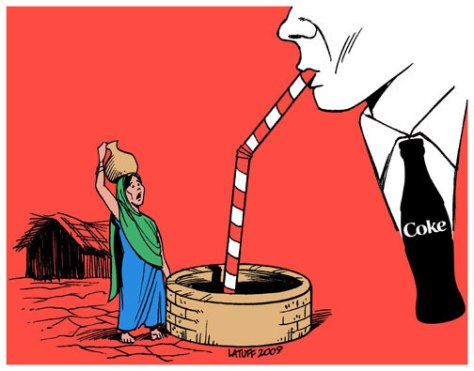
Narmada waters for Coca Cola – really, how much more development can we take?

cokeindiaFarmers who have for three decades non-violently protested the brutal ousting from their lands for the dam project on the Narmada river have been castigated for being anti-development. The dam would bring water to the thirsty, to the parched agricultural lands around it, we were told. Continue reading Narmada waters for Coca Cola – really, how much more development can we take?

‘My Heart says Yes, but the Head says No’: Economizing Politics in the Scottish Referendum: Akshaya Kumar

Guest post by AKSHAYA KUMAR

I

About two months ago, while walking by the roadside in Glasgow, a middle-aged man handed me out a pamphlet. In an endorsement of UKIP, the pamphlet declared ‘Our government pays GBP 55 million a day in fees to the EU’ (emphasis added). It went on to inform that in return, the EU gives ‘us’ accounts riddled with fraud, no control over ‘our’ own borders – putting pressure on our health, education and welfare services – and a super-government that makes more than 70% of ‘our’ laws. The pamphlet intrigued me a fair bit, not in the least because as an international student in the UK, I wondered if my case was a bigger or smaller burden on the UK defined thus – their UK. But who are they? One might rubbish them as a deviant community, or one might consider them a threat to yet another definition of us – the liberals or suchlike. But what intrigued me was not the neatness of these boundaries, or the speculations about how many of ‘us’ and ‘them’ there are. I was intrigued by the language of the starkly political proposition. Let us tentatively assume that in the pamphlet, ‘us’ meant the citizens of UK and it constructs an antagonistic position vis-à-vis other national citizens who are entitled to living and working within the UK. Surely the two are politically distinguishable? Or are there too many of them living next to us, so they cannot exactly be identified as such? Continue reading ‘My Heart says Yes, but the Head says No’: Economizing Politics in the Scottish Referendum: Akshaya Kumar

Reflections on Solidarity for Palestine in India: Urvashi Sarkar

Guest post by URVASHI SARKAR

Some sections of Indian civil society have reacted to Israel’s most recent brutalities in Gaza with outrage, and rightly so. In its pounding of Gaza which lasted over a month, Israel destroyed essential services and infrastructure, razed houses to debris and wiped out entire families.  Over 2000 Palestinians were killed, many of them civilians, and of which over 400 were children. On the Israeli side, sixty-four soldiers and four civilians died. A shaky ceasefire between Israel and Hamas, announced in early August, did not last, with hostilities resuming almost immediately.

It is not uncommon to hear Indian voices supporting Palestine even at a time when right wing forces hold sway in the country; yet there is more to this support than meets the eye. There are internal differences on the matter of Kashmir for instance, regarding the extent to which parallels can be drawn between the Palestine and Kashmir conflicts.  The actualization of both conflicts dates back to the 1940s.  Both regions are heavily militarized; its people suffer routine human rights violations and both are undergoing prolonged self-determination struggles. Each year, Kashmir joins different parts of the world to observe Al-Quds day, held on the last Friday of Ramzan, to observe solidarity with the Palestinian struggle.  Popular anti-India protest sites in Kashmir, such as Ramban Chowk and Maisuma, are referred to as ‘Gaza’ in local parlance.  A Kashmiri teenager lost his life during firing by security forces, in an anti-Israel protest in South Kashmir in July this year. Continue reading Reflections on Solidarity for Palestine in India: Urvashi Sarkar

Spring in Israel? Internal voices of dissent grow

3197080467

Over 150,000 social justice protesters took to the streets of 11 cities across Israel.These protests, which some are calling part of an “Israeli Spring”, began initially in response to the country’s housing crisis. But since as they began gaining momentum, they have spread to a host of social and economic complaints, including overlap with the struggling Israeli peace movement.

315563642_589779924e_428x321

Breaking the Silence about Gaza from Israel: Yehuda Shaul

Guest Post by YEHUDA SHAUL

In November 2012, Israel launched a military operation in the Gaza Strip called “Amud Anan”, the literal English translation of which is, “Pillar of Clouds”. Though, the official name in English was deemed, “Pillar of Defense”. A few days ago we launched another operation named, “Mighty Cliff”, which is officially called, “Protective Edge”. Both chosen titles are highly defensive in their essence. When I hear the names given to military operations in Gaza – especially the versions chosen for an international audience – I am reminded of my military service as a combatant in the Israeli army, whose full name (both in Hebrew and English) is: the “Israel Defense Forces” (IDF).

Continue reading Breaking the Silence about Gaza from Israel: Yehuda Shaul

Delhi Police Prevents Peaceful Protest in Front of Israeli Embassy – Students, Others, Injured and Detained

A Tale of Two Protests, On Two Days.

Protests against the situation in Gaza have been held in Delhi yesterday, (Sunday, 13th July, and today, 14th July, in the morning). Yesterday, on Sunday morning, there was a peaceful protest in front of the Israeli Embassy – this came out of a call for protest by individuals. Yesterday, about a hundred odd people, including many young people, had gathered. I was present at this gathering. Some people made statements condemning the Israeli state’s aggression against the Palestinian people. The Delhi Police was present, but did not try to disrupt or disturb the protest. The protest happened right in front of the Israeli Embassy gates on Aurungzeb Road.

Protestor in front of the Israeli Embassy in Delhi on Sunday, 13th July 2014
Protestors with Signs against Israeli State's Aggression on Gaza, in front of the Israeli Embassy in New Delhi, 13th July, 2014
Protestors with Signs against Israeli State’s Aggression on Gaza, in front of the Israeli Embassy in New Delhi, 13th July, 2014

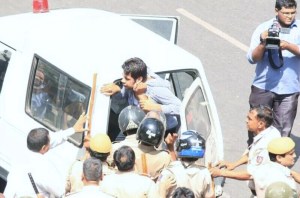
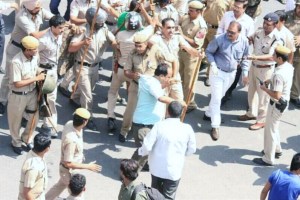
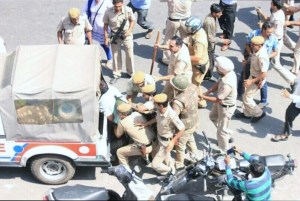
Continue reading Delhi Police Prevents Peaceful Protest in Front of Israeli Embassy – Students, Others, Injured and Detained