Category Archives: Movements

Do not let a university turn into a ‘shakha’ of a poisoned tree

Have the JNU students and faculty seriously considered taking legal action against the current Vice Chancellor? From every report that I have seen, all his actions in the recently concluded farcical Academic Council (AC) meeting seem to me to be instances of prima facie procedural violation. (Or am I incorrect in assuming this?)

From what I have heard, his conduct includes the deliberate misrepresentation of the minutes, pretending to consensual decisions where there were none, and disruptive and arrogant behavior towards Academic Council members. If this is indeed the case, could there not be strong legal grounds to ask for his removal on the grounds of his willful violation of institutional procedures and ethics? What do people with legal experience think of such a possibility? What do students and faculty think?

If recourse to legal action is not feasible or practical, what else can be done to remedy this situation? What kind of campaign can restore a semblance of sanity to JNU (and to universities, generally) that have been serially assaulted by university administrations acting at the behest of right-wing thugs.

It seems to me, that this man, Mamidala Jagadesh Kumar (the current JNU vice-chancellor) is acting like a criminal, and I think he should be treated as such from now on. Co-operating with his decisions, or even tacit acceptance of his manner of functioning, should now be seen as complicity with an agenda to destroy the university. Let us also not forget that this VC continues to protect those who assaulted Najeeb Ahmed before he disappeared from JNU. In the unfortunate possibility of anything untoward having happened to Najeeb Ahmed, this VC should be seen as being responsible. He creates the conditions of impunity that threaten the safety of each and every student. His decision to punish the students who protested yesterday with arbitrary and unjust suspension orders is exactly analogous to the authoritarian conduct of Podile Appa Rao, VC of HCU, that led to the tragic suicide of Rohith Vemula. The manner in which both Jagadesh Kumar and Appa Rao have acted suggests a pattern of the deliberate victimization of students on the basis of their caste identities. This only brings shame and disrepute to the institutions headed by them.

In my considered view, (and please view this only as a suggestion) the time has come for Faculty and Students of JNU to come together (irrespective of their political positions and postures) to demand the unconditional removal of Mamidala Jagadesh Kumar from the vice-chancellorship of JNU and from the university itself. I think that all limits have now been crossed by his conduct. His declarations about what the AC decided should be treated as null and void (also because they are violative of the principles of social justice and democratic education), and the suspension orders against the students who were targeted must be revoked. I hope that the present JNUSU and JNUTA will not fail in their responsibility to conduct a coherent and militant campaign to reverse this situation. If they vacillate, or, are unable to offer a coherent, well worked out strategy, they too will be seen as responsible for the mess that JNU is in today.

I hope that every student (and here I mean ‘common students’ as well as student activists within and outside organizations) and every teacher at JNU is able to rise above the temptation of negativism and needless point-scoring at this juncture. Just as the JNUSU crucially must not see itself as immune to criticism, or fail to act with militant resolve and clarity, and in resonance with the concerns of students, (including of those outside the union) so too, those outside the union could help matters by not falling to the temptation of adopting ‘holier than thou’ postures that impede practical unity. Let there be solidarity in struggle, and the kind of criticality that aids , rather than impedes, solidarity.

This time, this opportunity, this moment of necessity for thoughtful, militant, intelligent unity of all students, teachers and all friends of the idea or a free and open university is too precious to lose at the altar of either posturing or prevarication.

Restore freedom to freedom square! Do not let a university turn into a ‘shakha’ of a poisoned tree! Eject Mamidala Jagadesh Kumar! Reject Podile Appa Rao! Bring back life to our universities !

On Indian Exceptionalism and Kashmir: Dia Da Costa

This is a guest post by Dia Da Costa

‘If Trump is elected, I will move to Canada,’ many Americans noted in passing, in jest, and then in all seriousness once the results were out.

If it has taken this election result to make people recognize the pervasive racism in the US, that is because of the success of US exceptionalism and its ability to deflect attention from its ongoing colonization of indigenous land, relentless imperialism, Islamophobia, and ongoing brutalities against black people in the aftermath of abolition and the civil rights movement. If it has taken this election result to make people really want to move to Canada, that too is because of the success of Canadian multicultural exceptionalism. Apparently, Canadian exceptionalism is still able to pass as not-as-racist by deflecting attention from its ongoing colonization of indigenous land, relentless participation in imperialism cloaked all too often as humanitarian development, growing Islamophobia, and its self-congratulatory representation of itself as having no history of slavery even as its anti-Black violence pervades cities and small towns alike.

For those of us who can recognize these forms of exceptionalism, I want to ask if we acknowledge Indian exceptionalism, and its specific relation to Kashmir? ‘If Trump is elected, I will move back to India’, I saw many Indians say on social media. If it has taken this US election result to make Indians really want to move back to India, that is not just because of the apparent success of US exceptionalism among Indians, who could see racism but could ultimately deal with, and even love life in the US. It is also because of Indian exceptionalism. To be sure, Indian exceptionalism is nurtured by the caste and class privilege that allows some Indians to declare that they will simply up and leave when the going gets tough (whether it is in India or in the US), or joke about the same.

But there is more to it. Indian exceptionalism is a state projected discourse turned commonsense perception of India as a complicated and diverse nation that is ultimately unified against all odds by the absolute commitment of its people to democracy. Whether we believe it at face value or we critique the many excesses of the Indian state, ultimately something draws us to this idea of India as the world’s largest democracy. Continue reading On Indian Exceptionalism and Kashmir: Dia Da Costa

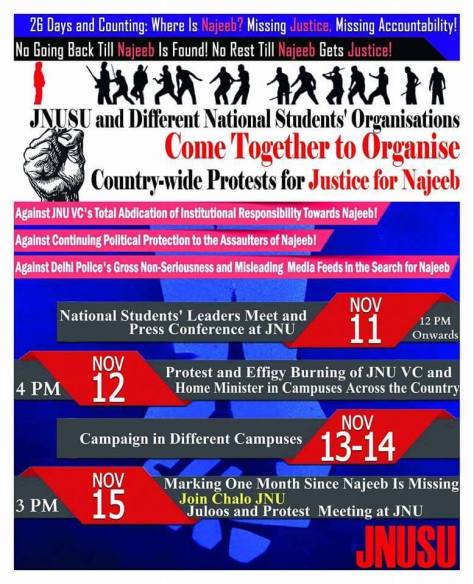
Appeal to Join “JNU Chalo” on 15 Nov Marking One Month of Najeeb’s Disappearance: JNUSU

Guest Post by JNUSU (Jawaharlal Nehru University Students Union)

15036279_10209603262232786_2873516424910911795_n

Friends, on 14th October night, Najeeb Ahmed, a student of M.Sc. Biotechnology, JNU was brutally assaulted and violently threatened by a group of ABVP students. From 15th October morning, Najeeb went missing from the campus. The disappearance of a student from a central university in the national capital after assault and intimidation of right wing lumpens is no doubt an ominous reflection of the dark times we are living in. For past four weeks, students, teachers, staff members of JNU, and citizens of Delhi have been coming out on the streets demanding institutional accountability to bring back Najeeb.

Continue reading Appeal to Join “JNU Chalo” on 15 Nov Marking One Month of Najeeb’s Disappearance: JNUSU

The Anatomy of a Disappearance: Shehla Rashid

Guest Post by Shehla Rashid. Videos by Haider Saif and Samim Asgor Ali

Students Gathering in a Vigil for Najeeb Ahmed at JNU


Think of the person closest to you, and the place that they hold in your daily life, the bittersweet memories that they create each day in your life, the daily fights and the moments of affection. At times, you fight and simply want to go away from one another, seeking a temporary calm from each other’s absence. You resolve never to call him/her again, or to speak to her/him anymore. However, by the time dusk falls, you realise the emptiness of your time without them, and you make a phone call, speaking reservedly, trying not to sound desperate or sappy. You tell them that you are coming home, and ask whether you need them to get anything- as if that were the reason for the phone call. This person could be you sister, your partner, or your best friend. Continue reading The Anatomy of a Disappearance: Shehla Rashid

The Importance of Being Makarand Paranjape: Anirban Bhattacharya

Guest Post by ANIRBAN BHATTACHARYA

A few days back, drawing from Oscar Wilde’s classic, Makarand Paranjape wrote a piece titled The importance of being Narendra Modi. He urged his readers to ensure a second term for Modi saying “If Narendra Modi gets a second term, he will certainly change India in a lasting and significant way.” That he is going to change India, and is doing so already is not that far from truth, but the question is which way is this change taking us. Given the track record of Modi Ji(o) so far, the change is surely going to be for the worse. But this piece is not on Modi Ji(o). This one is on the Makarand Paranjapes of the world. Yes, they are not one. They are in fact a particular breed not new in history, and they have a particular role. Specifically, we would evaluate this role of theirs in the light of a recent piece of his on the gherao of the JNU VC.

Some would say that the piece was on the issue of Najeeb. But no, it wasn’t. Najeeb, a new student pursuing M.Sc in Bio-Tech living in Mahi-Mandavi hostel was publicly assaulted by identified ABVP goons in front of students as well as wardens on the night of 14th October. He was showered with dire consequences of which too there are multiple witnesses including again the hostel wardens. A vicious communal slur-campaign was set in motion by the sanghis writing “Muslims are terrorists” within the hostel premises. Amidst all of this and in the given context Najeeb “disappeared” on 15th October from his hostel. He had called his mother last, who, as it appears, had reached Anand Vihar and was on her way to meet her son in distress. But, by the time she was here, Najeeb went “missing” mysteriously and is yet to be found. After five days of entreating an unresponsive university administration to be proactive in creating conditions for Najee’s safe return, JNU students undertook an all night vigil on the 19th of October.

Continue reading The Importance of Being Makarand Paranjape: Anirban Bhattacharya

It Is About Women: Debating the Violence of the Uniform Civil Code – Kartik Maini

This is a guest post by KARTIK MAINI

The performative art of choice, like most habitations of discourse, is deeply political. To oppose the mythical creature of the Uniform Civil Code (UCC), as heralded by the Bhartiya Janata Party (BJP) and its parent votaries, is to find oneself in the august company of the All India Muslim Personal Law Board (AIMLB); both part, or so I must argue, of the same physics of power. Once again, if one does indeed trace the history of debating the suttee in what is now called the ‘colonial’ period, the spectre of representation (or lack of) haunts us: women are merely the grounds of debate, and the female body a site of contestation in the name of faith. As creatures of active agency, the figure of the woman disappears – not into a pristine nothingness, as Gayatri Spivak cautioned us, but into a violent shuttling of displaced figuration. It is, therefore, time to ask of ourselves the fundamentality of thought. What is the politics of rendering unintelligible the variegated nature of religious traditions and their pronouncements unto ‘uniformity,’ particularly so through the rationale of national integrity in a time when supposed dangers to the same are declared seditious? Is it not our collective responsibility to be virulently against the employment of the expressed and expressive agony of women to insidious political ends? What, finally, of those who lie at the interstices of ‘men,’ ‘women,’ and the compulsory heterosexual matrix?

Even in precluding Shayara Bano’s infamous claim on the immediate necessity of all, especially Muslims, to say ‘Bharat Mata ki Jai,’ the communal in the demand for the Uniform Civil Code is an effortless inscription. For one, the Hindu Code, which seeks the creation of uniform laws governing all Hindus, is itself not so – embedded in its semblance of pervasive homogeneity is heterogeneous pliability to the customs and traditions of different communities, as also the restriction in its uniform applicability to social groups that are now designated as the Scheduled Tribes. While Article 44 of the Indian Constitution exhorts the nation state to create a ‘uniform civil code’ for all, the Constituent Assembly had no perspectival clarity on what it would look like; B.R. Ambedkar elucidates that such a code ‘need not necessarily be mandatory.’ In fact, beyond the obvious ambiguity of Article 44, the glorious prospect of the Uniform Civil Code only finds silence, and in not being addressed in specificity, is subsequently regaled with the obstructions of political autonomy, detailed as they are in the articles and schedules on Kashmir, Nagaland, Mizoram, Assam, Tripura, and Meghalaya. In other words, the binary between the Uniform Civil Code and communalism, between Hindutva and the mythical uniformity that must now be forged against this ‘problem’ of diversity is a fundamentally false one – there is no independent discursive existence of the Uniform Civil Code, if the circular ruins of its debate are to tell us anything, besides its violent deployment against the personal laws of the Muslim community, Muslims in particular, and as it may now be said, against the idea of India in general. The indivisibility of the undivided Hindu family, tangential, if not absent, as it has been to the contention on the Uniform Civil Code, is a loud, almost resounding declaration of its essential purpose; to collapse unto its exercise the subjective agency of the patriarchal paradigm of ‘women’ collapses its very structure.

In a strongly worded missive, Noorjehan Safia Niaz of the Bharatiya Muslim Mahila Andolan (BMMA) expounds, ‘We condemn the attempt to politicize the debate by mixing up of the abolition of triple talaq – the demand for whose abolition we strongly reiterate, with the move by the Law Commission seeking views from the public on the Uniform Civil Code. These are two separate issues, and should not be treated as similar.’ Of the many meanings that azaadi has now taken, this statement of the BMMA is instructive in the difficulty of politics: as Muslim women today stand at the altar of the supposedly emancipatory modern state, complete with its accompanying structures of governmentality, their courageous struggle against the maulana-headed jamaats has reached a befitting crescendo. ‘The court is our jamaat,’ they declare, in Jyoti Punwani’s eloquent piece. Truly, the progressive thrust of judgements as Shamim Ara v. State of U.P.(2002) has faltered in its promise of remedying the inscription of subordination in the Muslim personal law, and revolution, as we know it, is in the offing. It is not my case, or, for that matter, of progressive groups that are now in the line of fire for having ‘lost the plot,’ to stand against this calling, indeed, this making of history. But history is replete with its uncomfortable lessons. It tells us tales of progression hindered by violent appropriation, of causes obfuscated by the malevolent reasons of statecraft, and of representation that fails to present its subjects. To struggle against the patriarchy of laws, then, is a struggle of its own, and therein is the opposition to the Uniform Civil Code. Historians are forgiving. History, and we need not search too arduously, is not.

Yet, appreciating the struggle that asks of the state must not presuppose an unproblematic depiction of the state itself. Indeed, if the state legitimises, then it must also render illegitimate. Such has been the case of a people who are, in a very particular expression of otherness, called the queer. Even as the Indian state, in all its time of being a modern, independent republic, debates the realm of the personal, it is our collective ignominy that what is debated as the personal eludes the queer. It is a denial, not merely of recognition, but of personhood. As the queer have sought to enter state registers of legitimation, they have had to confront the always already heterosexual nature of kinship; the governmentality manifest in personal laws and cultural politics, a totalising pontification of the compulsory heterosexual matrix, the violent institution of marriage, and, invariably, of monogamy. To queer the question of personal laws, even of the infamous Uniform Civil Code, is thus to challenge their fundamental premise: the systematic, seamless reproduction of heterosexuality, patriarchal relations, and above all, of violence. Is not, then, the making of queerness a simultaneous unmaking of how we debate the personal?

[Kartik Maini is at St Stephen’s College, Delhi]

2 Weeks No #JusticeForNajeeb – A Few Thoughts on Yesterday’s March and the Way Forward: Shehla Rashid

Guest Post by Shehla Rashid.

Video and Photo Inputs from Naushad MK, Samim Asgor Ali and Amit Kumar

[ This post was written shortly after JNU students gathered in front of Vasant Vihar Police Station to articulate their concern and anger at the lax attitude taken so far by the Delhi Police and other concerned authorities in relation to the disappearance of Najeeb Ahmed almost two weeks ago. In this text, (originally uploaded as a note on Facebook and then sent to us to be posted at Kafila) Shehla Rashid, thinks aloud about what has happened so far and looks ahead at the possible way forward for the students of JNU and their supporters to focus on making sure that Najeeb Ahmed, wherever he is, returns safe and sound to the JNU campus. We hope that it will be widely read, and discussed to evolve strategies for the evolving future of the campaign to give justice to Najeeb. Kafila]

Shehla Rashid and Others Being Confronted by Delhi Police at the Vasant Vihar Chakka Jam on Oc. 26, 2016


First of all, I’d like to express my gratitude to all the students who joined the Chakka Jam at Vasant Vihar police station, where the ACP refused to even accept the paper with our demands and, instead, ordered a lathi-charge on us. Students marched as one and stayed together till the end, despite all differences, for one goal- justice for Najeeb, and his safe return to campus life. I salute this spirit of JNU students. Having said that, I must say that we need to do more. Students need to come out in even greater numbers, as the attack on us is of immense magnitude.

Continue reading 2 Weeks No #JusticeForNajeeb – A Few Thoughts on Yesterday’s March and the Way Forward: Shehla Rashid

Requiem for the Undead: On Kerala’s Sixtieth Birthday

[The title is a tribute to Johnny Miranda’s exquisite Malayalam novel, Requiem for the Living (Jeevichirikkunnavarkku Vendiyulla Opees in Malayalam)

As Kerala’s sixtieth birthday – a year which was inevitably one of celebration for many Malayalis as the culmination of life, until the increasing life expectancy here rendered it redundant – approaches, evaluations on the health and well-being of the region (and not just the people, or individual Malayalis) are being offered. They do not bode well. There is a sense in which we feel that the magic that has somehow protected the region, placed a shining cloak around its shoulders once, has departed. This magic is none other than that which is captured by the term ‘Kerala Model’ – which, in our popular imagination, always exceeded being just social science shorthand for the complex array of historical factors that led to high social indicators in a society characterized by low economic growth once associated with us. The idea of the Kerala Model somehow represented the fairy godmother who had transformed Kerala from being the Cinderella in India, to a shining princess fit to be raised to the heights of the UN’s international development-circles in the 1970s. Continue reading Requiem for the Undead: On Kerala’s Sixtieth Birthday

The Twitter Gherao of Mamidala90 on the 10th Day of Najeeb Ahmed’s Disappearance from JNU: Shehla Rashid

Guest Post by Shehla Rashid

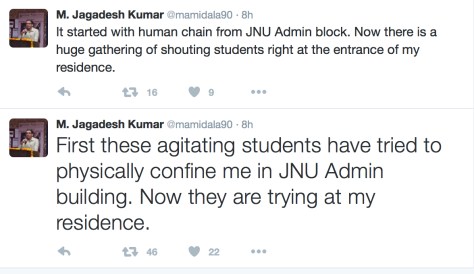
[ Between the 9th and 1oth day of the disappearance of Najeeb Ahmed from the JNU campus, the JNU Vice Chancellor, Mamidala Jagadesh Kumar decided to salvage his reputation on twitter, even as he squandered it on the grounds of the campus of the university he presides over. And so he let forth a volley of tweets, while sitting inside his office and his residence, even as he refused to meet or listen to the JNU students who have grown increasingly concerned and anxious at the university administrations callous laxity about the fate of Najeeb Ahmed, the missing students.

While students marched down the campus, forming a human chain that culminated at the gates of the VC’s residence near the university’s east gate, Mamidala90 (the handle with which the VC distinguishes himself in twitsville) began getting extremely active. While the students were peacefully assembled at the gates of the VC’s residence, very much not in ‘gherao’ or ‘blockade’ mode, Mamidala90 whined about being ‘blockaded’.

A Sample of Mamidala90's tweets while students gathered peacefully outside his residence. Is this what it felt like to hear Nero fiddle while Rome burnt?
A Sample of Mamidala90’s tweets while students gathered peacefully outside his residence. Is this what it felt like to hear Nero fiddle while Rome burnt?

Continue reading The Twitter Gherao of Mamidala90 on the 10th Day of Najeeb Ahmed’s Disappearance from JNU: Shehla Rashid

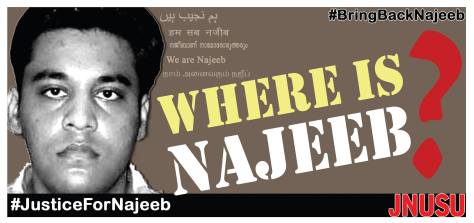
Bring Back Najeeb Ahmed to JNU: A Call to Resist Terror in Universities

14615765_679911288839993_8711625822412574391_o-1

It is now more than a week since Najeeb Ahmed, an MSc (first year) student of Biotechnology at Jawaharlal Nehru University, Delhi has been reported missing, after an altercation with members of the RSS affiliated ABVP student organization, which reportedly left him injured and severely traumatized.

Continue reading Bring Back Najeeb Ahmed to JNU: A Call to Resist Terror in Universities

Ezhuka Tamil – A Conversation about Democracy :Dharsha Jegatheeswaran and Gajen Mahendra

This is a guest post by DHARSHA JEGATHEESWARAN AND GAJEN MAHENDRA


On Saturday September 24, 2016, Ezhuka Tamil, organized by the Tamil People’s Council, became the largest rally to happen since the end of the war in the North-East of Sri Lanka. Over 10,000 people took to the streets to demand an end to ongoing human rights violations, particularly militarization and Sinhala-Buddhisization of the North-East,reiterate their demand for genuine accountability and justice and voice their expectations regarding the ongoing political processes. The political elite in Colombo and their supporters elsewhere have however chosen to read Ezhuka Tamil as an expression of ‘Tamil extremism’. This response requires us to critically interrogate the nature of democratic spaces in post-war Sri Lanka available to the numerically smaller communities and more largely what our understanding of democracy is. This is very necessary if we believe in the need for public participation in the constitutional and transitional justice process currently underway. Continue reading Ezhuka Tamil – A Conversation about Democracy :Dharsha Jegatheeswaran and Gajen Mahendra

A Fast That Ended in Hunger- Thoughts on Irom Sharmila and Hunger Strikes: Anirban Bhattacharya

Guest Post by Anirban Bhattacharya

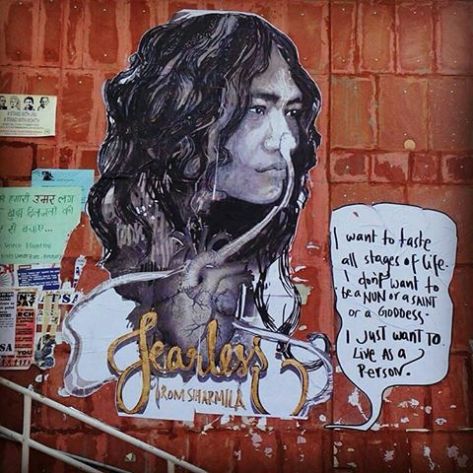
Iram Sharmila Mural at ‘Freedom Square’ JNU. Art by Shijo Suleman and the Fearless Collective. Photograph by Rebecca John. Image, courtesy, ‘The Great Walls of India’ blog on Graffiti and Wall Art

We may have differences in our political approach as to the way and means of the struggle, but what must be stated at the outset is the fact that Irom Sharmila has certainly been an icon of resistance and inspiration in the struggle against AFSPA.

Her 16 year long hunger strike has been a grim reminder of the crimes against the Manipuri people – rape, torture, fake encounters and massacres – committed by the armed forces with impunity under such draconian Acts like AFSPA. But her abrupt decision to end her fast accompanied with her willingness to contest elections in the upcoming assembly elections have met with a mixture of shock, scepticism, disappointment, puzzlement and even anger amongst her people in Manipur and even her close associates. There also seems to be a resentment against her being in a relationship and her plan to marry. Such scrutiny/dragging of her personal life are, however, quite deplorable. But overall, the disappointment with the decision of Irom to quit fasting and contest elections is so strong that, after breaking her fast in the hospital, when she tried to go to a local activist’s shelter, the locals disapproved. She had to seek temporary shelter in an ISKCON temple along with her police guards and then was shifted to a police station and finally she was forced to retreat to the same hospital that housed her for last 16 years. Now, this is telling. But what does it tell? The answer to this question would take us away from criticisms about any particular individual, but to the evaluation of the very method of struggle that she had been a part of, its scope, effectivity and limitations.

Continue reading A Fast That Ended in Hunger- Thoughts on Irom Sharmila and Hunger Strikes: Anirban Bhattacharya

Statement against the Kaziranga Police Killings : Delhi Action Committee Against Kaziranga Police Killings

Guest Post by Delhi Action Committee Against Kaziranga Police Killings


Protest Demonstration

 Against  Kaziranga Police Killings

2pm, 23rd September, Assam Bhawan, Sardar Patel Marg,


After the BJP came to power in Assam in May 2016, the state government has unleashed a reign of terror to execute its fascistic agendas. Within 2 months into power, the government opened fire and killed a 25 year old man Mintu Deuri, during a protest organized in Raha against the transfer of the site for a proposed AIIMS in the state on 15th July 2016. Now on 19 September 2016, just 34 days after the Raha incident, the police has again opened fire and killed two people – Anjuma Khatun and Fakhruddin, at a demonstration led by the Krishak Mukti Sangram Samiti (KMSS) and All Assam Minority Students’ Union (AAMSU) at Banderdubi revenue village near the Kaziranga National Park. The protestors were demanding resettlement and adequate compensation against an eviction drive carried out by the mandate of the Gauhati High Court order dated 9 October 2015 which was supposed to happen two days later, i.e. on 21 September 2016 but had been preponed to avoid protests. The villagers, belonging mainly to the Muslim community of erstwhile East Bengal origin, have been residing in the village for more than half a century.

Continue reading Statement against the Kaziranga Police Killings : Delhi Action Committee Against Kaziranga Police Killings

Statement in Support of Khurram Parvez from Groups and Individuals in Karnataka

Over the past 70 days, there have been over 84 deaths, hundreds have lost their eyesight to pellet wounds and thousands have been injured in Kashmir. As news reports of the death of 11 year old Nasir Shafi, son of Muhammad Shafi, a resident of New Theed Harwan in Srinagar emerge, we also hear about Showkat Ahmed Misger, a person with mental disabilities from Safa Kadal who was admitted in hospital in a critical condition with pellet wounds. Though the people of Chandpora were told by the police that Nasir Shafi was mauled by a bear, pictures of his body with pellet wounds and torture marks stand in contradiction to this official version of events. The violence unleashed by the armed forces continue unabated in Kashmir inspite of extensive social media outrage and mass protests in  Indian cities like Patna, Kolkatta, Chennai, Bangalore, Delhi etc.

Continue reading Statement in Support of Khurram Parvez from Groups and Individuals in Karnataka

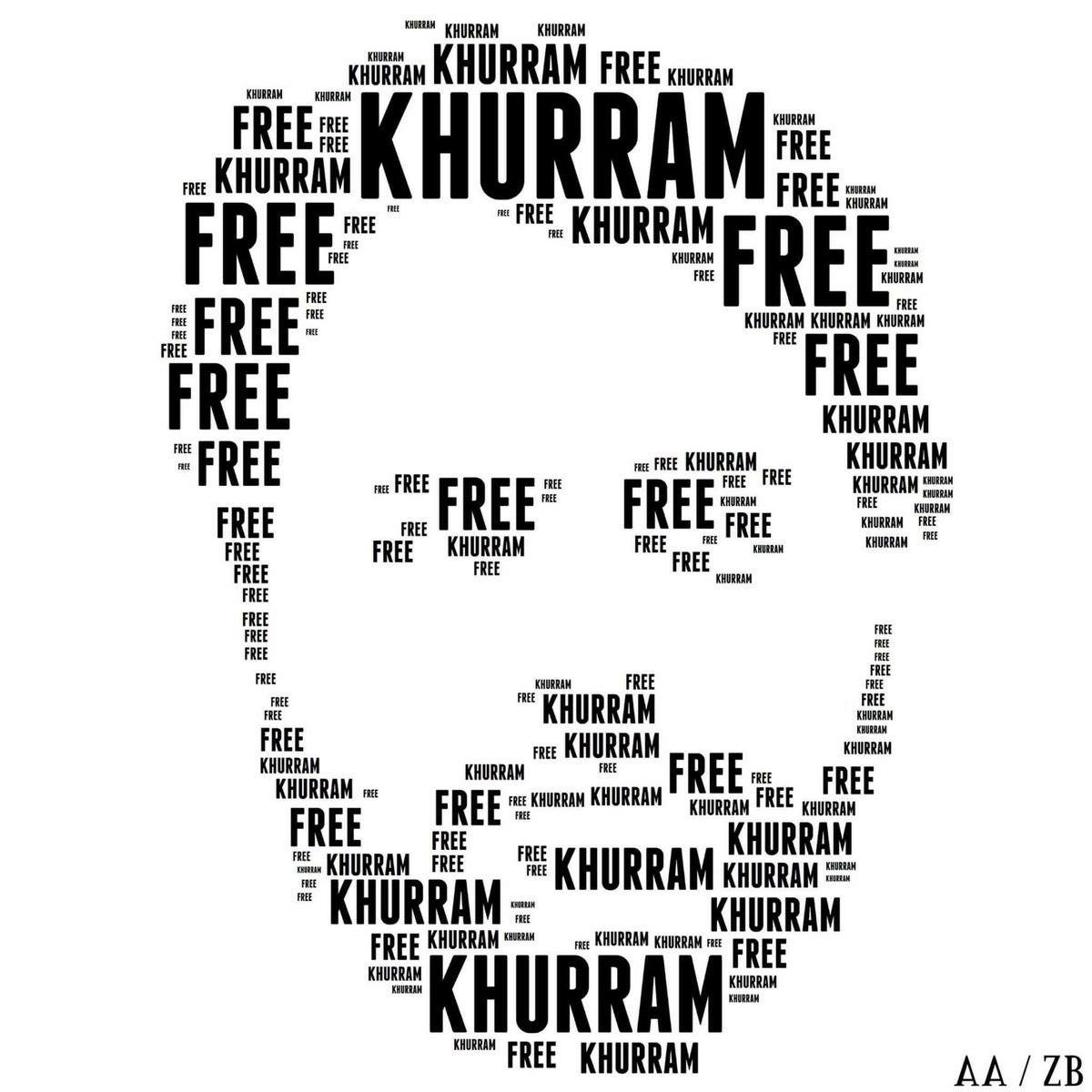
Free Khurram Parvez – An Open Letter to Civil Society: JKCCS

Guest Post by Jammu and Kashmir Coalition for Civil Society on behalf of the signatories of the statement in support of Khurram Parvez

14355569_670864076420404_7479719579066415935_n
Khurram Parve, Image, courtesy JKCCS

We, the undersigned, call for the immediate release of Khurram Parvez, a distinguished and courageous human rights defender, and write in support of the enclosed statements issued by Advocate Parvez Imroz

As we write this, Khurram Parvez has been remanded to preventive custody in a sub-jail in the highly militarized Kupwara District of Kashmir. He is expected to be produced before the court on 21 September 2016.

An executive magistrate in Srinagar issued the order against Khurram Parvez, invoking Sections 107 and 151 of the Code of Criminal Procedure (CrPC) (pertaining to detention for breach of peace and design to commit a cognizable offence).

The actions against Mr. Parvez are symptomatic of the escalated repression in Kashmir by institutions of state since July 8.

We note with horror that since July 2016, over 80 persons have been killed, over 11,000 persons have been injured, over 1,000 persons have been arrested and over 100 ambulances have been attacked. For 70 days now, curfew has been imposed in various parts of Kashmir. Continue reading Free Khurram Parvez – An Open Letter to Civil Society: JKCCS

State Violence against Peaceful Assemblies in Kashmir: JKCCS

Guest Post by Jammu & Kashmir Coalition for Civil Society (JKCCS)

Over the last week – August 29 to 5 September, of uninterrupted curfew in Kashmir, the government’s unbridled use of force on peaceful public meetings/rallies, which are either funeral processions of the civilians killed by government forces or peaceful political rallies where people demand their right to self determination, across Kashmir valley has resulted in injuries to 1215+ people, many of whom are injured by pellets shot guns. The violence used by government forces against un-armed peaceful rallies deflates its claims that its forces only resort to violence when they are pelted with stones. Contrary to government claims, the use of force against the peaceful demonstrators acts as a provocation to people and youth in particular who then retaliate by stone throwing on Indian forces. The sheer number of peaceful pro-freedom rallies held in the last week alone symbolizes the nature of the current anti-India uprising which has seen lakhs of Kashmiris on streets to voice their demand for right to self-determination. Such attacks are against the internationally, and domestically, recognized fundamental rights of peoples to peaceful assembly and association, and freedom of opinion and expression, including India’s obligation under the ICCPR. Continue reading State Violence against Peaceful Assemblies in Kashmir: JKCCS

Kashmir Scholars Action Group Letter to the UN High Commission for Human Rights on the Situation in Jammu&Kashmir: KSAG

Guest Post by Kashmir Scholars Action Group

To Mr. Zeid Ra’ad Al Hussein

UN High Commissioner for Human Rights

Re: Urgent action needed to end state violence in Indian-controlled Kashmir

We are writing to you to express our concern about the situation in Indian-controlled Kashmir where the already subjected population is currently living in a state of siege due to the massive violence unleashed by the Indian forces. We appreciate your decision to create a fact-finding mission and deplore the refusal of the Indian government to allow access to UN human rights monitors (1). In the absence of such a mission, we feel it incumbent upon civil society groups to provide regular updates on the situation.

We, the Kashmir Scholars Action Group, are an interdisciplinary group of scholars of various nationalities engaged in research on the region of Kashmir. Our research on Kashmir, its history, its consequences for the region and beyond, and its possible resolution, delves into the implications for an internationally mediated political solution, and is of relevance to policy makers. Based on our long and active engagement with civil society groups in Indian-controlled Kashmir, we have undertaken to document and communicate the situation on ground since the Indian state’s violence against civilians has continued to mount from July 7th, 2016 onwards. Each of us has written about Kashmiri history, society and politics; and we are particularly concerned about the present conditions of violence. We write to you now as part of our urgent efforts to check the brutality of the state’s response to Kashmiris, scores of whom have mobilized in support of their demand for azadi (freedom). Even as we will go on to list some of the details of the humanitarian crisis, we wish to make clear that we are calling not only for the resumption of basic civil services, the rule of law, and the restoration of human rights in Kashmir, but, most importantly, for an internationally mediated political solution for this ongoing crisis. Continue reading Kashmir Scholars Action Group Letter to the UN High Commission for Human Rights on the Situation in Jammu&Kashmir: KSAG

Dalit Uprising and After …

Why Hindutva Would Not Be The Same Again ?

Image result for una struggle

(Photo Courtesy : newsclick.in)

When I was born I was not a child
I was a dream, a dream of revolt
that my mother, oppressed for thousands of years ,
dreamt.
Still it is untouched in my eyes
Covered with wrinkles of thousand years, her face
her eyes, two lakes overflowing with tears
have watered my body…..

– Sahil Parmar*

Well known Gujarati poet Sahil Parmar’s poem ‘When I Was Born’ perhaps reverberates these days in Gujarat when we are witnessing a Dalit Upsurge- a first of its kind at least in that regions history. It will be a talk of folklore for times to come how flogging of dalits in a village in Saurashtra by Hindutva fanatics suddenly erupted into a mass movement of dalits which could catch imagination of the people cutting across different sections of society. An attempt is being made here to understand the dynamics of the movement and its likely impact on the future trajectory of Hindutva.

Continue reading Dalit Uprising and After …

Adventures in Creepland: An Open Letter to the District Collector, Calicut, Kerala

This letter is jointly written by the signatories.


Dear Mr Prasanth Nair

We, the undersigned participants of the 7th Queer Pride March held on 12 August 2016 in Calicut, would like to bring to your attention the unforgivably irresponsible attitude of the Kozhikode police towards the rights of young people who identify themselves as queer, and their allies. In what should have been a completely joyous event, their attitude cast a dark shadow, for sure. Continue reading Adventures in Creepland: An Open Letter to the District Collector, Calicut, Kerala

What exactly happened in Jamia Millia Islamia on 13th August? Jamia Millia Islamia Students

Guest Post by Jamia Millia Islamia Students

What exactly happened in Jamia Millia Islamia on 13th August?

The sequence of events:

Just two days before Independence Day, all the hostel residents were informed personally by the administrative authorities to be careful as there may be some raid by IB or CBI or Delhi Police. Students were instructed not to keep any non-resident student in the hostel.

While it is okay to instruct students not to keep any non-resident student in the hostel, what is problematic is the atmosphere of fear that was created among students. Many of the students were told to be careful regarding ‘KASHMIRI STUDENTS’ in particular.

The hostel authorities repeatedly instructed the students not to come out of their rooms and to be careful.

On the 13th of August, at around 3 p.m., two police constables in uniform and around 15-20 officials in plain clothes were seen sitting just outside the hostel gate. Two constables came inside the gate and started having conversation with the guards while around 10 officials were sitting in their cars inside the hostel campus.
Continue reading What exactly happened in Jamia Millia Islamia on 13th August? Jamia Millia Islamia Students

एक विद्रोहिणी का अकेलापन

इरोम हम जैसा होना चाहती है ?
Image result for irom sharmila
(Photo Courtesy : Times of India)
कुछ कुछ तस्वीरें ताउम्र आप के मनमस्तिष्क पर अंकित हो जाती हैं।
चंद रोज पहले टीवी के पर्दे पर नज़र आयी और बाद में प्रिन्ट मीडिया में भी छायी उस तस्वीर के बारे में यह बात दावे के साथ कही जा सकती है। इस फोटोग्राफ में इरोम शर्मिला – जो आज़ाद भारत के सबसे खतरनाक दमनकारी कानून सशस्त्र बल विशेष अधिकार अधिनियम (Armed Forces Special Powers Act) के खिलाफ संघर्ष की एक प्रतीक बनी रही हैं – अपना सोलह साल से चल रहा अनशन तोड़ती दिख रही हैं। उन्हें एक चम्मच में शहद आफर किया जाता है और वह बेहद भावुक हो जाती हैं, महज एक बंूद लेकर उसे लौटा देती हैं।
ईमानदारी की बात है कि इस तस्वीर को कई कोणों से पढ़ा जा सकता है – एक कोण हो सकता है कि एक किस्म का हताशाबोध कि दुनिया के पैमाने पर ऐतिहासिक कही जा रही इतनी लम्बी भूख हड़ताल के बावजूद इस खतरनाक कानून को टस से मस नहीं किया जा सका, एक अन्य कोण हो सकता है इस एहसास का कि यह सरकार इस कदर संवेदनाशून्य हो चुकी है कि उससे लड़ने के लिए एक नयी किस्म की रणनीति की जरूरत है – बेकार में जान देने के बजाय, अपनी उर्जा को नए सिरेसे एक नए किस्म के संघर्ष मंे लगाने का – तीसरा कोण यह भी हो सकता है कि  महामानव या महामानवी घोषित किए गए किसी व्यक्ति का उस आरोपित प्रतिमा से तौबा करते हुए यह बताने का कि वह भी एक साधारण मानवी है, जिसके अन्दर बाकी लोगों जैसा जीवन जीने की हसरत है।

Continue reading एक विद्रोहिणी का अकेलापन