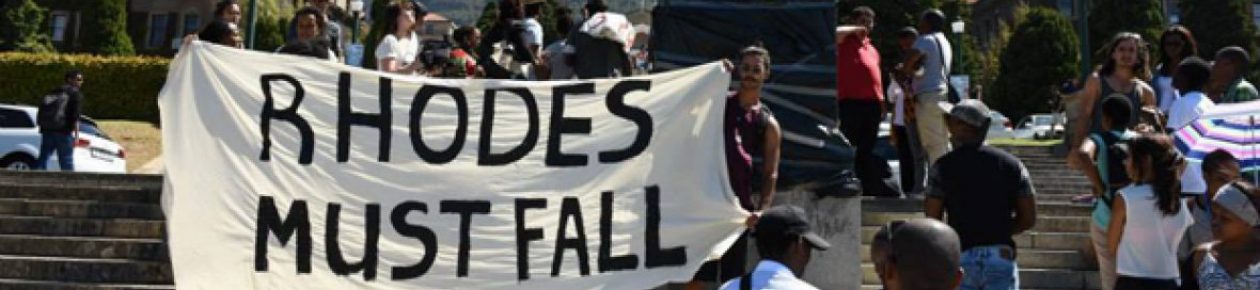
(This is the text of the open letter written by the eminent left cultural activist Sohail Hashmi to Com. Pinarayi Vijayan on the Hadiya case)
Category Archives: Movements
Preserve Kerala as the Shining Example of Democracy for India : Prof. Satish Deshpande writes to the Chief Minister of Kerala
End the isolation and imprisonment of Hadiya: Feminists write to the Chief Minister of Kerala
[A version of this letter has also been sent to Com. MC Josephine, Chairperson, Kerala State Women’s Commission] Continue reading End the isolation and imprisonment of Hadiya: Feminists write to the Chief Minister of Kerala
Let us rise to the defense of the Indian Constitution: Letter to the Kerala Chief Minister from Prof. Amit Bhaduri
[This is the text of the open letter written by eminent economist and leading development activist Prof. Amit Bhaduri, to Com. Pinarayi Vijayan] Continue reading Let us rise to the defense of the Indian Constitution: Letter to the Kerala Chief Minister from Prof. Amit Bhaduri
The Gravity of Newton : Rituparna Sengupta
This is a guest post by RITUPARNA SENGUPTA
Amit V Masurkar’s recently-released film Newton explores facets of Indian democracy at its most vulnerable. For these times of ‘nationalist’ bravado, this is a courageous topic. The film is so named because it adopts for the most part, the point of view of its protagonist, Newton (Nutan) Kumar (Rajkummar Rao, thank you once again!) who resists corruption and hypocrisy at home and work. Continue reading The Gravity of Newton : Rituparna Sengupta
Help us resist the Hindutva thought-machine: K Satchidanandan writes to the Chief Minister of Kerala
[This is the text of the open letter written by the eminent poet and public intellectual K Satchidanandan to Com. Pinarayi Vijayan] Continue reading Help us resist the Hindutva thought-machine: K Satchidanandan writes to the Chief Minister of Kerala
Restore Hadiya’s Dignity as an Adult: Prof. Samita Sen to the Chief Minister of Kerala
(This is the text of the open letter from leading women’s studies scholar and renowned feminist intellectual, Prof. Samita Sen, to the Chief Minister of Kerala on the Hadiya case) Continue reading Restore Hadiya’s Dignity as an Adult: Prof. Samita Sen to the Chief Minister of Kerala
Statement Against Genocide and Deportation of Rohingya Muslims
Violence is sweeping Myanmar and in a short span of two weeks lakhs of ethnic Rohingya refugees have fled to Bangladesh and thousands have lost their lives. Satellite data shows, large parts of the Rakhine state, home to most of the Burmese Rohingya population have been set on fire, and murders, rape, arson, loot and forced displacement of the Rohingya population is taking place on a scale, that should be alarming for all humanity. Even the UN secretary general has called out to Mayanmar to end violence against the Rohingya and Nobel laureate Desmond Tutu has urged Mayanmar state Councillor Aung San Suu Kyi to speak out against the persecution of the Rohingya. The tragedy facing the Rohingya is of an unprecedented scale and needs to be addressed with a sense of utmost urgency.
As Indian citizens, we need to break the silence on ethnic violence against the Rohingya and the unconstitutional proposed deportation of a wide and long-residing Rohingya community from India, to certain death that awaits them in Myanmar. The Rohingyas have been living as a peaceful refugee community in various parts of India since the 1970s, with no criminal records or history of crime. Let us not be a part of this genocide. Let us stand up for justice and humanity, and raise our voice against the killings, displacement and deportation of the Rohingya!
Continue reading Statement Against Genocide and Deportation of Rohingya Muslims
पाकिस्तान का वर्तमान अब भारत का भविष्य नज़र आने लगा है
शब्द और विचार हर किस्म के कठमुल्लों को बहुत डराते हैं. विचारों से आतंकित लोगों ने अब शब्दों और विचारों के ख़िलाफ़ बंदूक उठा ली है.

Gauri, you are more than a memory
You are a direction
For a world that should not be!
– K P Sasi
1
कुछ लोग जीते जी किवदंती बन जाते हैं. कन्नड़ भाषा के अग्रणी हस्ताक्षर पी लंकेश (जन्म 8 मार्च, 1935) ऐसे ही शख़्सियतों में शुमार किए जा सकते हैं. समाजवादी आंदोलन से ताउम्र सम्बद्ध रहे लंकेश, जो कुछ समय तक अंग्रेज़ी के प्रोफेसर भी रहे.
आज भी उनकी अपनी साप्ताहिक पत्रिका ‘लंकेश पत्रिके’ के लिए याद किए जाते हैं, जो उत्पीड़ितों, दलितों, स्त्रियों और समाज में हाशिये के तबकों का एक मंच बनी थी, जिसने कन्नड़ भाषा में आज सक्रिय कई नाम जोड़े, जो उसूल के तहत विज्ञापन नहीं लेती थी और एक समय था जब उसकी खपत हज़ारों में थी और उसके पाठकों की संख्या लाखों में.
लंकेश के बारे में मालूम है कि 25 जनवरी, 2000 को अपने साप्ताहिक का संपादकीय लिख कर सोने चले गए तो फिर जगे ही नहीं. कर्नाटक का समूचा विचारजगत स्तब्ध था. इसे विचित्र संयोग कहा जाना चाहिए कि दिल का दौरा पड़ने से हुई उनकी मौत के सत्रह साल आठ महीने और दस दिन बाद महज कर्नाटक ही नहीं, पूरे देश का विचारजगत स्तब्ध है, जब उनकी बड़ी बेटी गौरी लंकेश की मौत की ख़बर लोगों ने सुनी है, जो हत्यारों की गोलियों का शिकार हुईं.
( Read the full text of the article here : http://thewirehindi.com/18088/gauri-lankesh-murder-fundamentalist-dissent/)
A letter to Kummanam-ji, but also to all Pujya/Poojya/Poo Hindutva fanatics from Kerala, in the wake of revolution in the prasad-giving practices in Haryana
Dear Kummanamji
This is to let you know how the events presently unfolding in Dharmakshetra- kurukshetra (or at least its vicinity) are making even me, a lapsed sudrathy from Kerala, more and more creative about convincing your masters in Delhi that Hindutva fanatics in Kerala are no less worthy of kind consideration than their own home-grown fanatics. Actually, is this not the time you should be making a splash? Alas, despite your earnest efforts, these days, the Kerala police (and even your arch-enemies in Kerala, though they seem to be a bit less enthusiastic these days), take all the credit of minority-bashing and gender-criminalising. And the best you can do is go home to home telling Hindu women to cover up etc. and shout at Muslim groups doing the same, accusing them of nearly the same acts.
My ex-sudra blood boils perhaps when I notice how in the course of post-independence history, Kerala politicians in Delhi with the exception of a few of the likes of AK Gopalan, have performed mostly sudravritti especially after the 1980s even when they were in powerful posts (often clearing the shit your predecessors have made according to the instructions from above and to the extent to which they permit). Now is your chance, I think, to rise, or at least put your head above the ground. Continue reading A letter to Kummanam-ji, but also to all Pujya/Poojya/Poo Hindutva fanatics from Kerala, in the wake of revolution in the prasad-giving practices in Haryana
Academic Community stands firmly with JNUSU President; 100+ academicians, activists, writers issue statement of solidarity
Guest Post by Shehla Rashid on behalf of the signatories
We, the undersigned, are deeply shocked by the shameful attempts by JNU Administration to crush dissent in the University through imposition of arbitrary fines on student activists, denial of registration to students engaged in protests against the administration, including the elected President of the Students’ Union, Mohit Pandey. We stand in solidarity with the JNUSU President who has decided not to pay the arbitrarily imposed fine of 20,000. Many more Students’ Representatives and activists of JNU campus are facing 5-6 inquiries and false FIRs for raising students’ issues.
It is also shocking that a duly elected representatives of the students is being fined such massive amounts for merely raising students’ issues. Several other students have paid the fines, in order to be allowed to register, being forced to succumb under the threat of having their registration held up. Several students with pending inquires are not getting their degree- mark sheets and unable to continue their studies further. This amounts to imposition of a tax/fee on dissent, thereby creating a chilling effect on freedom of expression in the University. This is unacceptable in a University where knowledge creation is contingent upon freedom of ideas.
We call upon the JNU administration to display maturity and stop penalising alternative viewpoints. The current fine of Rs. 20,000 that the JNUSU President is being asked to pay for restoration of his studentship pertains to an instance of anti-administration protests led by the students’ union against the complicity of the JNU Administration in the disappearance of an M.Sc. Biotechnology student named Najeeb Ahmed following a mob assault on him by members of a students’ group affiliated to the ruling party – who were indicted for the assault by a report of the Proctor’s Office, but shielded by the higher ups in the administration, leading the then Proctor to resign from office.
So, the students guilty of leading the lynch mob against Najeeb Ahmed were given no punishment at all, whereas students protesting against his disappearance – who were demanding that the JNU Administration should file a police complaint in the matter – were fined Rs. 20,000 each! Ever since the JNU VC has been appointed by the present government, students not belonging to the ruling party student group have been systematically targeted and penalised for speaking out. There is no record of similar fines upon right-wing groups which routinely engage in vandalism on campus. This clearly amounts to blatant viewpoint discrimination and also serves as a green signal to lynch mobs on campus.
The JNU Administration is using an archaic statute in the book to ban protests at the Administration Block. However, JNU has always had a healthy culture of dissent and protest. Protests against the administration have always been held outside the administration block itself. That the protests disturb the working of the administration is the most dubious pretext for crushing dissent, as there have been historic student movements on JNU campus which have only made the University stronger, its academic traditions more robust and its intellectual environment more egalitarian.
We, therefore, demand that
1) the JNU administration must end its petty tactics of penalising dissent;
2) JNUSU President, Mohit Pandey, must be allowed to register for the next academic semester, unconditionally;
3) all fines against students being imposed for the mere act of protest must be revoked unconditionally;
4) JNU Administration must stop trying to deprive students of the right to protest at the Administration Block, and engage, instead in dialogue with the elected students’ body without bias against the ideology held by the student union representatives;
5) JNU Administration must punish the students who assaulted Najeeb Ahmed, resulting in his disappearance.
Sd/-
Prof. Anand Teltumbde, Senior Professor, Goa Institute of Management
Prof. Anil Sadgopal, Former Dean, Faculty of Education, University of Delhi; Member, Presidium, All India Forum for Right to Education
Dr. Rohan D’Souza, Associate Professor, Kyoto University, Japan
Prof. Chaman Lal, Retired Professor, JNU; Former President, JNUTA
Prof. Nivedita Menon, Professor, Centre for Comparative Politics and Political Theory, School of International Studies, JNU, New Delhi
Jairus Banaji, Research Professor, SOAS, University of London
Prof. Laxman Gaddam, Professor of Commerce, Osmania University
Anwesha Sengupta, Assistant Professor, Institute of Development Studies, Kolkata
Arvind, Professor, IISER Mohali
Rana Partap Behal, Associate Professor (Retd.), Deshbandhu College, University of Delhi. Association of Indian Labour Historians.
Madhu Kushwaha, Professor, BHU
Brinda Bose, Associate Professor, JNU
Debaditya Bhattacharya, Assistant Professor, Nivedita College, University of Calcutta
Dr. Rohini Hensman, Writer and Independent Scholar
Anand Mathew, Director, Prerana Kala Manch, Varanasi
Mary E John, Researcher, Centre for Women’s Development Studies
Padma Velaskar, Professor (Retd.), Tata Institute of Social Sciences
Ravi Kumar, Associate Professor, South Asian University
Ritajyoti Bandyopadhyay, Assistant Professor, IISER Mohali
R. Nandakumar, Art Historian, IGNCA
Madhu Prasad, Associate Professor (Retd.), Zakir Hussain College, DU
K. Laxminarayana, Professor, Hyderabad Central University
Jean Chapman, Adjunct Professor, Concordia University, Montreal, Quebec, Canada
T K Arun, Editor, Opinion, The Economic Times
John Cherian, Journalist, Frontline
Teesta Setalvad, Journalist, Activist, Educationist; Citizens for Peace and Justice; Sabrang India
Ravindra Tomar, Senior Researcher, Parliament of Australia
Manorama Sharma, Retired Professor, NEHU
Dr. Sushmita Sengupta, Associate Professor, NEHU
Prof. K. Chakradhar Rao, Member, Presidium, All India Forum for Right To Education
Perumal Vijayan, Research Associate, University of Saskatchew
Sangeeta Chatterji, Doctoral Candidate, Rutgers, The State University of New Jersey
Mohd Mushtaq, Assistant Professor, Govt. Degree College, Baramulla, J&K
Hiren Gohain, Retired University Teacher
Nandini Rao, Social Activist, JNU Alumnus
Devyani Borkataki, Activist, Northeast Network
Kiran Shaheen, Director, Media Action Group
Wilfred Dcosta, Convenor, Indian Social Action Forum (INSAF)
Firoz Ahmed, Teacher, Lok Shikshak Manch
Manoj Chahal, Research Scholar, University of Delhi
Manuj Mukherjee, Ph.D. Scholar, Indian Institute of Science
Sanjay Palshikar, Professor, University of Hyderabad
Dr Navneet Sharma, Assistant Professor, Central University of Himachal Pradesh
Bhangya Bhukya, Associate Professor, University of Hyderabad
Abani K Bhuyan, Professor, University of Hyderabad; President of the University of Hyderabad Teachers’ Association
Dr. G. Vijay, Assistant Professor, University of Hyderabad
Sohail Hashmi, Freelance Writer, Filmmaker, JNU Alumnus
Nikhil Kumar, Policy Analyst
Roger Alexander, Independent Journalist, Pink City Press Club
Saeed Haider, Associate Editor, Saudi Gazette
Rajesh, Activist, Lok Shikshak Manch
N.D. Jayaprakash, JNU Alumnus
Anjal Lele, Travel Consultant; former JNU Student
Dr. Vikas Bajpai, Assistant Professor, Centre for Social Medicine and Community Health, Jawaharlal Nehru University
Indira C, Public Health Researcher; Consultant
Rashmi Kumari, Ph. D., Jawaharlal Nehru Univerity
Dr. C. Sadasiva, Associate Professor, Deptt. of Botany, Dyal Singh College, University of Delhi
Sajid, National Vice-President, Campus Front of India; Ph.D. Scholar, JNU
Shehla Rashid Shora, Research Scholar, JNU
Mohit P Gandhi, Ph.D. Scholar, CSMCH, JNU
Vasanthi Gupta, Academician; JNU Alumnus
Apurba K. Baruah, Retired Professor, North Eastern Hill University, Shillong
K. Laxminarayana, Professor, University of Hyderabad
Dayaram Yadav, Former General Secretary
Dr. M. Gangadhar, Chief Editor, Adhyapaka Jwala; Democratic Teachers’ Federation, Telangana
Avinash Chandra Jha, former Associate Professor; former JNU student
Mohan Rao, Professor, JNU
Shashwati Goswami, Research Scholar, CSMCH, JNU
Joby Joseph, Associate Professor, University of Hyderabad
Sumegha, student, JNU
Caroline C. Netto, Ph.D. Scholar, JNU
Ramesh Patnaik, Former General Secretary, JNUSU
Sri Raghunath Joshi, Professor (Retd.)
Thokchom Surjit Singh, Social Activist; All India forum for Right to Education
Ratan Kumar, Ph.D. Scholar, Centre for Historical Studies, JNU
Susmit Isfaq, Student, NLU Assam; Students’ Federation of India
Roobala, Ressearch Scholar, Indian Institute of Science
Himangshu Baruah, student
D N Reddy, Professor of Economics (Retd.), University of Hyderabad
Akshay Pathak, General Secretary, AIRSO
K Venugopal, Chief Editor, Upadhyaya Dharshini
B Sudha, Retird Teacher, TPTF
M. Raghushankerreddy, State President, Democratic Teachers’ Federation; All India Forum for Right to Education
Aviroop Sengupta, Ph.D. Scholar, Centre for Historical Studies, JNU
M. Balakumar, Headmaster; DTF
Arunank, State General Secretary, Democratic Students’ Union, Telangana
V. Raji Reddy, HM, Democratic Teachers’ Federation
Manjari Gupta, Post Doctoral Fellow, HRI
M. Somaiah, Teacher; State Vice-President, DTF
Vijay Kumar, Central Committee Member, CPI(ML) Red Star
Somasekharasarma, Retd. English Lecturer; AIFRTE
Kalyani Menon Sen, JNU Alumnus, (1977 batch)
T. Sobha Rani, Associate Professor, University of Hyderabad
Shephali Frost, Writer, Poet, Musician
Srinivas Reddy A., Teacher, Democratic Teachers’ Federation
Bittu Karthik, Associate Professor, Ashoka University
Shuddhabrata Sengupta, Artist / Writer, Raqs Media Collective, Delhi
Madhu, State Secretary, Democratic Teachers’ Federation
Suraj Beri, Doctoral Candidate, Centre for the Study of Social Systems, JNU
Vijay Shankwe Choudhary, Producer/Director Films and Television, former JNU Student (1972-81 batch)
Shilpa Shital, Research Scholar, IIT Delhi
Partho Sarothi Ray, Assistant Professor, IISER Kolkata
Nupur, Research Scholar, JNU
Susie Tharu, Retired Professor, EFLU
Sarwat Ali, Associate Professor, IASE (Jamia Millia Islamia)
Dyuti, Researcher and Activist
P. S. Mukherjee, Founder Member, Friends of Latin America-India
D. M. Diwakar, Professor, A N Sinha Institute of Social Sciences, Patna, Bihar
Muzaffar Ahmad Dar, Research Scholar, Centre for Historical Studies, JNU
Aishik Gupta, Activist
Aijaz Ahmed, Lecturer, Shinas College of Technology, Ministry of Manpower, Oman
Vandana Mahajan, Independent Development Practitioner, Feminist Movement for Equality, Justice and Non-discrimination
Afzal Hussain, Masters Student, CAAS, JNU
Masood Ahmed Azhar, Research Scholar, JNU; NSUI
Harshad Tayade, Engineering Student, Pune University
Shivam, Student, University of Hyderabad
Dharti Putra, Student, BIT Sindri, Dhanbad, Jharkhand
No to ‘Geri Route’, Bekhauf Azadi/ Reclaim the Night in Chandigarh: Janaki Srinivasan
Guest post by JANAKI SRINIVASAN

If you are a resident of Chandigarh and came across pictures of the Bekhauf Azaadi Reclaim the Night and the Streets march of August 11 in the newspapers, it is most likely that you assumed it to be just another routine protest. Protests in ‘the city beautiful’ do tend to follow a standard template. A small number gather in the Sector 17 plaza, banners are held, a few speeches made, photographs taken and a brief news report gets generated for the inner pages of the city supplement. In a small city, finding a mention in the newspapers is no indicator of the importance of one cause or one protest over others. Over the past decade, the administration has ensured this indifference, by physically redirecting political rallies- any event with the potential for large numbers- away from both government offices and public spaces to the outer perimeter of a severely gridlined map. The ‘Rally Ground’ neighbours the crematorium and the garbage landfill. Yet just as Le Corbusier’s monotonous plan and strict guidelines have been subverted by its residents to infuse vitality and uniqueness to the city, the protest template too sees a rare upheaval. Continue reading No to ‘Geri Route’, Bekhauf Azadi/ Reclaim the Night in Chandigarh: Janaki Srinivasan
No Flag Large Enough – Jubilation in India and Collateral Damage in Kashmir
The recent incident of violence that led to the death of a police officer, DSP Ayub Pandith, was condemned by all kinds of people in Kashmir, as well as elsewhere. It prompted introspection, sadness and regret – like any tragedy of this nature should.
Yesterday two unarmed civilians, Tahira Begum, a forty three year old woman and a young man called Shahdab Ahmed Chopan of Brenty Batapora Village in Anantnag district in South Kashmir were killed along with two Kashmiri combatants (Bashir Ahmed Lashkari and another person who may or may not be called Abu Maz) in the course of a joint operation by the 19th Rasthriya Rifles of the Indian Army, CRPF and the Special Operations Group of Jammu & Kashmir police.
Continue reading No Flag Large Enough – Jubilation in India and Collateral Damage in Kashmir
After #NotinMyName at Jantar Mantar on June 28: Sanjay Kak for NotinMyName, Delhi
Guest Post by Sanjay Kak, for #Notinmyname / Statement from Not In My Name, Delhi
Last evening’s (June 28th) spirited protest at Jantar Mantar, New Delhi, under the banner of Not In My Name, was an autonomous citizens protest against the recent spate of targeted lynchings of Muslims in India – the most recent of 16 year old Junaid, stabbed to death on 23 June 2017 in Delhi (NCR).
For an audience that was estimated to be 3500 strong, the torrential downpour at a little past 8 pm may have rained out a part of the programme. But something remarkable had already been achieved: the evening had washed away, even if temporarily, an almost overwhelming sense of despondency, of hopelessness, and of fear.
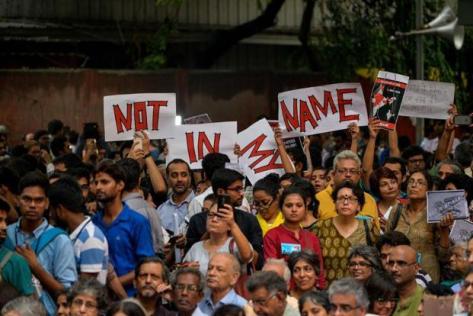
Since the Not In My Name protest had announced that the platform was not meant for political parties, and their banners and slogans, the stage saw the marked absence of the speeches (and faces) of routine protest meetings at Jantar Mantar. Rhetoric was displaced by feeling, and it was left to the poets and musicians to carry the sharp political messages of the day. On an evening that was often very emotional, the most difficult moments came when a group of young men from Junaid and Pehlu Khan’s extended families (and residents from their respective villages) came on stage and spoke to the audience.
When the call for a protest meeting went out last Sunday we were hoping that a few hundred people would gather to express their outrage at what is happening around us. For the attacks on Muslims are part of a pattern of incidents that targets Dalits, Adivasis, and other disadvantaged and minority groups across the country. In almost all these incidents the possibilities of justice seem remote, as the families of the victims are dragged into procedures they are ill-equipped to handle. Through all these heinous crimes the Government has maintained a silence, a gesture that is being read as the acquiescence of all Indians.
Not In My Name aimed to break that silence. But the scale and spirit of the protest meeting at Jantar Mantar became amplified many times over, as similar gatherings were spontaneously announced all over the country. As word spread through social media, groups in 19 other locations announced Not In My Name protests, and this phenomenal synergy inevitably drew media attention to all the events, and gave the protest a solidarity and scale that was truly unprecedented – there were at least 4 protests in cities abroad too. (And more protests have been announced for later this week…) The protest meeting ran on the shoulders of a group of volunteers who managed to put together everything in less than four days. No funds were received (or solicited) for the expenses from any political party, NGO, or institution. Instead volunteers worked the crowd and our donation boxes received everything – from Rs 10 coins to currency notes of Rs 2000, and everything in between.
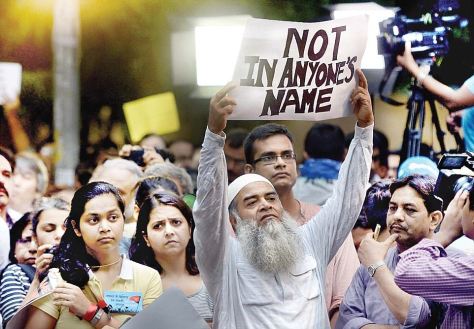
The impact of the Not In My Name protest at Jantar Mantar yesterday only points to the importance of a focused politics to deal with the crisis this country seems to be enveloped by. Less than a day after the protests Prime Minister Modi broke his silence on the matter of lynchings. It could not have been a coincidence: speaking in Ahmedabad he said killing in the name of gau bhakti is unacceptable. But to protect the life of a 16 year old being brutalised in a train needs more than a tweet, and we all wait and watch.
This fight has just begun. In the days to come the exceptional solidarity attracted by the protest in New Delhi will have to become less exceptional, and more everyday.
Sanjay Kak is a filmmaker and writer based in Delhi.
The #NotinMyName protests, which began in a response to a Facebook post uploaded by Delhi filmmaker Saba Dewan, have since taken place in more than twelve cities in India, and also in the UK, USA and Pakistan. More protests, under the #NotinMyName tag, as well as independently of it are being planned by citizens groups, organizations and individuals in many places.
Tomorrow, July 2nd, 2017 will see a sit in at Jantar Mantar from 11 in the morning, at Jantar Mantar, New Delhi called by families, individuals and panchayats from Nuh, Ballabhgarh and Faridabad, they will be joined by students, activists and other individuals.
उना कांड की पहली बरसी पर राष्ट्रीय आह्वान, गुजरात में होगा ‘आज़ादी कूच’ : जिग्नेश मेवाणी
On the First Anniversary of the Una Floggings – Call from JIGNESH MEWANI and RASHTRIYA DALIT ADHIKAR MANCH
उना से आई फिर आवाज़,नहीं सहेंगे हिंदु राष्ट्र, भगवा आतंकवाद और पूंजीवाद!
दलित, मुस्लिम, मज़दूर और किसान साथ मिलकर मांगेगे तीन साल का हिसाब
बहुजन,मज़दूर और किसान साथ मिल फिर ललकारेंगे ‘गाय की पूंछ तुम रखो, हमें हमारी जमीन दो’
साथियों,
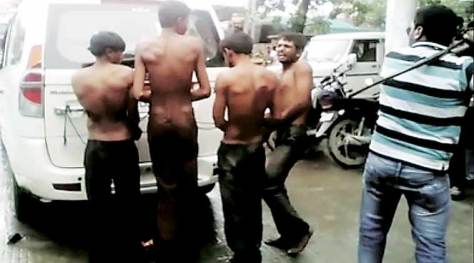
आप जानते हैं, 11 जुलाई को उना के दलितों के उत्पीड़न की जगानेवाली घटना को एक वर्ष होने जा रहा है. जिस तरह पिछले वर्ष 11 जुलाई को गुजरात के गिर सोमनाथ जिले के मोटा-समधियाला गांव के बालू भाई सरवैया और उनके चार बेगुनाह लड़कों को दिन दहाड़े, भरे बाजार गाड़ी के साथ बांधकर पुलिस थाने के सामने बेरहमी के साथ मारा गया और जिस तरह इस कारनामे को अंजाम देने वाले इन तथाकथित गौ रक्षकों ने खुद ही अपने इस कारनामे को सोशल मीडिया पे वायरल किया, उससे पूरा देश हिल गया था.
इस अमानवीय कारनामे को अंजाम देने वाले लोग खुद ही अपनी इस घिनौनी हरकत को सोशल मीडिया पे वायरल करे उससे पता चल जाता है कि यह तथाकथित गौ रक्षक कितना बेखौफ महसूस करते और उनको राजसत्ता की कितना संरक्षण मिला हुआ है.
Photo Story on Bhim Army Rally in Delhi: Debalin Roy
Guest post by DEBALIN ROY
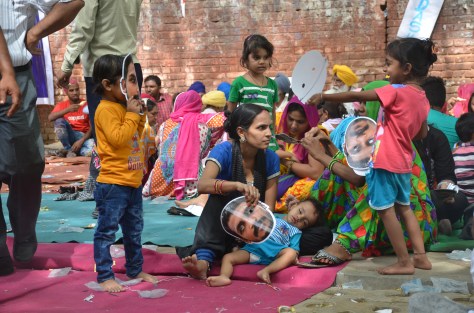
Debalin Roy takes us to some specific moments in the rally, aside from the bird’s eye view of the massive rally that we have already seen.
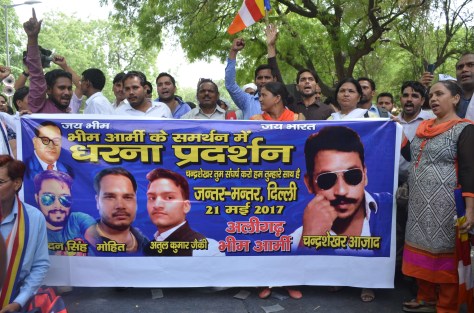
Dalits from all over northern India gathered at Jantar Mantar, Delhi on the 21st of May to protest the Saharanpur violence and increasing atrocities on Dalits across the country.
Although there were representatives from various states, especially from Haryana, U.P. and Rajasthan, Bhim Army took the center stage, with their blue flags waving like a giant dark blue field of tall grass, shaking and waving with every chant of Jai Bhim.

Continue reading Photo Story on Bhim Army Rally in Delhi: Debalin Roy
A Day Against Kalluri at IIMC, Delhi: Bastar Solidarity Network Delhi Chapter
Guest Post by Bastar Solidarity Network Delhi Chapter
The democratic forces, organizations and the thinking minds of IIMC took part in a spirited protest today against the invitation extended to notorious ex-IG Kalluri by the IIMC administration to take part in a seminar. To start with, since last two days, there were several attempts on the part of the organizers to confuse/conceal Kalluri’s invitation. Immediately after the declaration of the protest, Kalluri’s name was dropped from the poster. There were also threats of counter-mobilisation by the BJP goons. But undeterred, as we reached the gates of IIMC at 11am, the site echoed with slogans of “Killer Kalluri Go Back”!
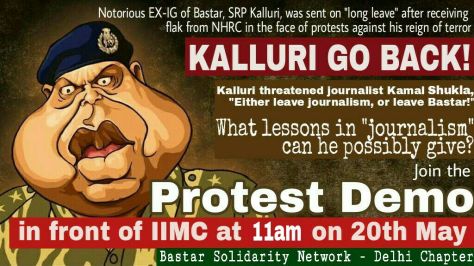
Continue reading A Day Against Kalluri at IIMC, Delhi: Bastar Solidarity Network Delhi Chapter
Violence against Dalits in Saharanpur, UP : A Report by CPI-ML (Liberation) & AISA Team that Visited Saharanpur
Guest Post by Sucheta De
CPI-ML- AISA Team’s Visit to Saharanpur – A Report
“Sarkar Hamari Hai, Police-Prashashan Bhi Hamara Hai”- Yogi Government Boosts Up Morale of Casteist Feudal Goons Who Burnt Dalit Village in Shabbirpur!
Casteist Goons from Dominant Rajput Community Enjoy Complete Impunity while Bhim Army Activists Continue to Face Witch-Hunt!
CPI-ML-AISA Appeal Everyone to Join Hands with the Dalits of Saharanpur in their Struggle for Justice!
Saharanpur Carnage: Teaching a Lesson to Politically Assertive, Self-Reliant Dalits Who Refuse to be Foot Soldiers of Hindutva’s Hate Politics
When BJP gains electoral majority, Saharanpur happens.
For last several years the belt of western Uttar Pradesh has been made the laboratory of the RSS-BJP’s sinister design of communal polarization and violence against Muslims. The 2013 Muzaffarnagar riots was a planned design by the RSS-BJP to polarize the belt on communal lines and reap electoral benefits. And now, after that design had delivered ‘electoral success’ for the RSS and BJP, upper caste feudal forces have started celebration of their ‘victory’ by unleashing attack on Dalits.
LBJ, Kashmir, and Indian Liberals: Rajive Kumar
Guest Post by RAJIVE KUMAR
Towards the end of his presidency, Lyndon B Johnson, the 36th President of the United States of America, had been reduced to a figure of universal scorn and derision. His escalation of the Vietnam War to a point from which it became impossible to extricate the US ended up in becoming one of the defining human tragedies of twentieth century. This was war fought on the basis of pretexts that did not actually exist. The slur “Hey, hey, LBJ, how many kids did you kill today?” which became an anthem of sorts for protestors eventually compelled him to forgo running for a second term in office in 1968. Those protesting against the war, those who eventually forced Lyndon Johnson to leave the political arena were Americans who were overcome with images of atrocities and the rising count of civilian deaths in a mindless war.
Continue reading LBJ, Kashmir, and Indian Liberals: Rajive Kumar
Worship Cow, Despise Humanity!
How cow vigilantes are being projected as ‘modern day freedom fighters.’

( Photo Courtesy : https://www.sciencenewsforstudents.org)
Cow vigilantes attacked six people, including a 9-year-old girl in the Reasi district of Jammu and Kashmir on Friday and fled away with their flock. The vigilantes beat up the nomad community blue and black and the minor girl has suffered multiple fractures when the community was en route to Talwara area…
(http://www.timesnow.tv/india/video/cow-vigilantes-attack-6-including-9-year-old-in-jammu/59745)
In yet another chilling instance of self-styled gau rakshaks targeting cattle traders — and mob mentality thriving undeterred — three men transporting buffaloes were attacked by “cow vigilantes” in south Delhi’s Kalkaji late Saturday, a Hindustan Times report said.
“Cow protectionism was the spirit behind India’s freedom movement”(http://www.thehindu.com/news/national/cow-protectionism-was-spirit-behind-freedom-movement-minister/article17831763.ece) The innocuous looking statement by Ms Nirmala Sitharaman on the floor of the house when she defended the shutting of illegal slaughter houses in UP had not raised any debate then. Continue reading Worship Cow, Despise Humanity!
Who will get the hot roti in the Delhi assembly elections?
My friend Guddi has a great story about a Gujjar wedding she attended recently in Ghaziabad. It was a typically chaotic event, marked accurately by the swirling crowds around the dinner stalls. If Gujjar weddings are chaotic and the dinner doubly so, the scene around the tandoor is triply compounded chaos. Barely concealed competition amongst overmuscled Gujjar men in overtight pants for that precious hot roti ensures that none but the most Hobbesian men remain, circling the tandoor like hungry wolves, periodically thrusting their plate forward like fencing champions and shouting obscenities at the harried servers. In such a heart-stopping scenario, a young server had as Guddi recounts, figured out the formula to keep everybody from killing each other (or him). As soon as the roti would be pulled out of the tandoor, seductively golden brown and sizzling, this man would hold it high up with his tongs so everybody could see, then in an elaborate dance-like ritual, touch each of the empty extended plates in front of him with the roti, and finally, in a mysterious but authoritative decision, place it respectfully on a randomly selected plate. Repeat with every single roti that emerged from the tandoor. A hushed silence followed by nervous laughter followed every such flourish.
Continue reading Who will get the hot roti in the Delhi assembly elections?

