Category Archives: Politics
Stepping Back/Stepping Forward – Thinking Past the BJP Victory in UP: Biju Mathew
Guest post by BIJU MATHEW
The BJP’s appointment of Adityanath to the post of UP CM once electoral victory was secured has left many angry, sad and frightened. Already the ominous signs of inhuman mass violence are accelerating across UP. A more brazen Sangh will pivot off UP to spread terror and hatred across the country. And yet, we must guard against an excessive pessimism and guide the anger and the sadness in productive directions. The 2014 Lok Sabha, 2015 Delhi and Bihar and 2017 UP elections together are indicative of an evolving structural logic in Indian politics and show telltale signs of irresolvable contradictions that the Sangh is faced with. Modi and the BJP are riding a wave that is not entirely of their own making – a wave that will necessarily crest, break and crash in the not too distant future. How soon this wave can be interrupted, and what happens after that, does not depend on them, but on the rest of us.
So here then is the puzzle: Why do so many people support what is both an absurd and an unrealizable ideology? Absurd, because poverty, caste discrimination, corruption and government failures are not due to “enemies” or “enemy communities”- Muslims or Leftists, LoveJihadis or Beef eaters; and unrealizable because with over 400 million minorities and oppressed castes who will not fit into Hindu Rashtra, the saffron brigade can only deliver a horrific civil war. Does UP mean that, despite all this absurdity, this ideology has nevertheless triumphed in the Indian mind? Continue reading Stepping Back/Stepping Forward – Thinking Past the BJP Victory in UP: Biju Mathew
मारूति-सुजुकि मज़दूरों को उम्र कैद व अन्य नाजायज सजाओं के खिलाफ़ पंजाब में उठी जोरदार आवाज़: लखविन्दर
अतिथि post: लखविन्दर
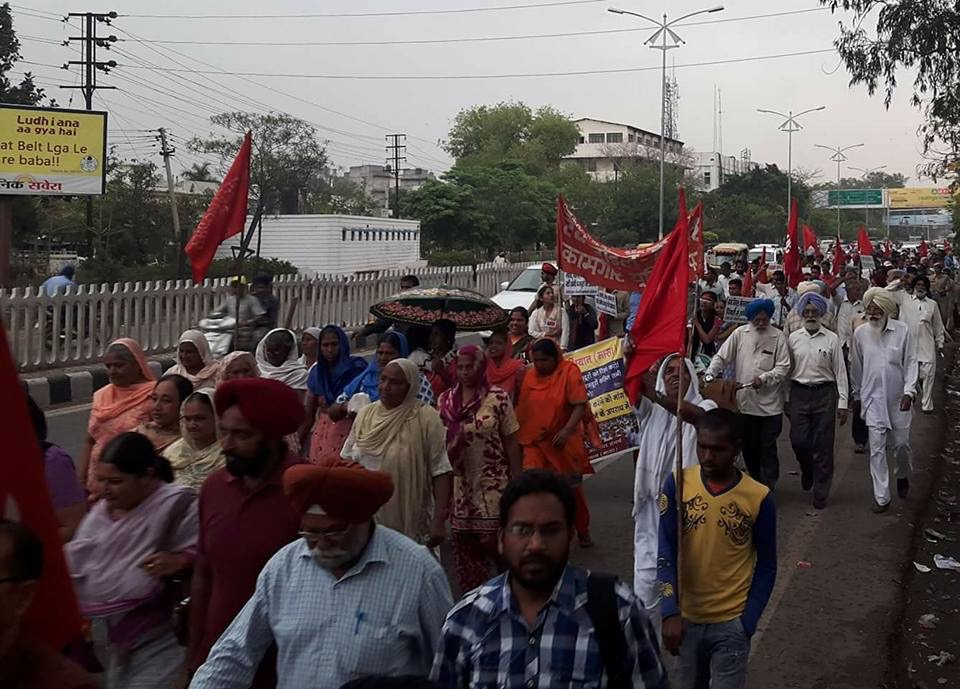
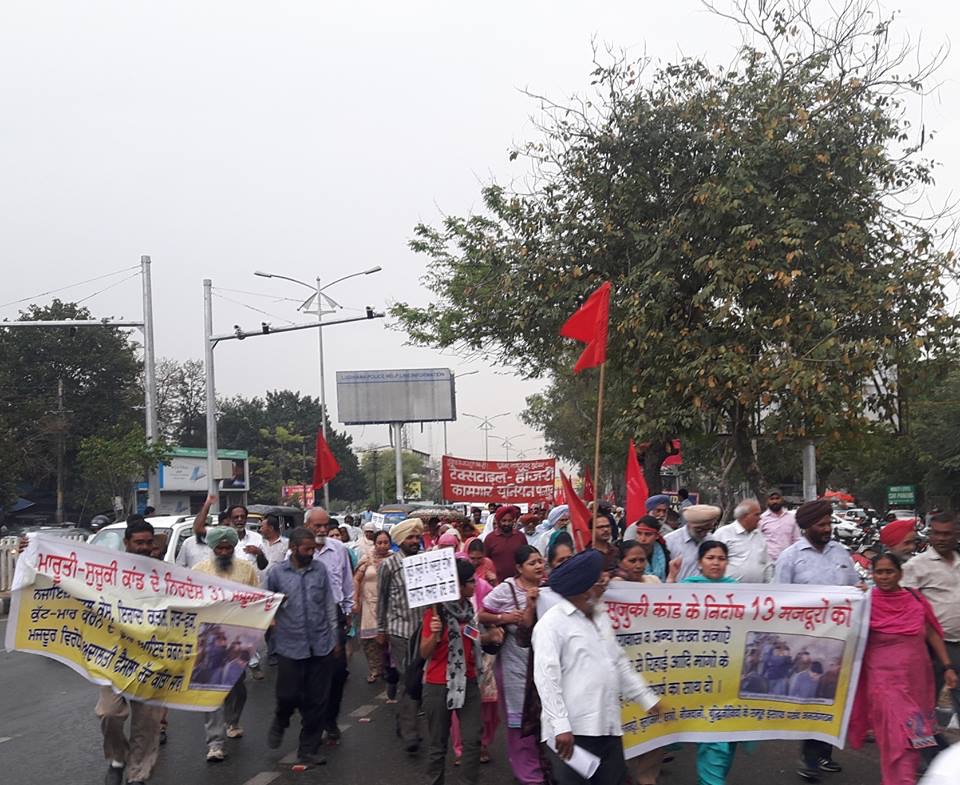
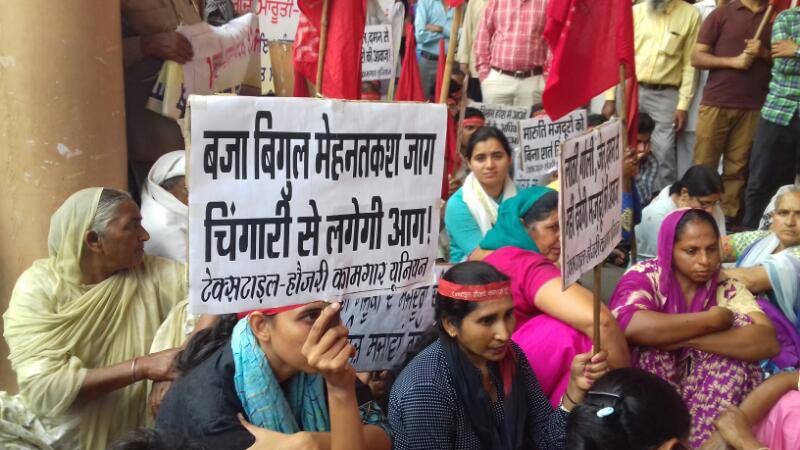
मारूति-सुजुकि मज़दूरों को उम्र कैद व अन्य नाजायज सजाओं के गुड़गांव अदालत के फैसले को घोर पूँजीपरस्त, पूरे मज़दूर वर्ग व मेहनतकश जनता पर बड़ा हमला मानते हुए पंजाब के मज़दूरों, किसानों, नौजवानों, छात्रों, सरकारी मुलाजिमों, जनवादी अधिकारों के पक्ष में आवाज उठाने वाले बुद्धिजीवियों व अन्य नागरिकों के संगठनों ने व्यापक स्तर पर आवाज़ बुलन्द की है। 4 और 5 अप्रैल को देश व्यापी प्रदर्शनों में पंजाब के जनसंगठनों ने भी व्यापक शमूलियत की है। विभिन्न संगठनों ने व्यापक स्तर पर पर्चा वितरण किया, फेसबुक, वट्सएप पर प्रचार मुहिम चलाई। अखबारों, सोशल मीडिया आदि से इन गतिविधियों की कुछ जानकारी प्राप्त हुई है।
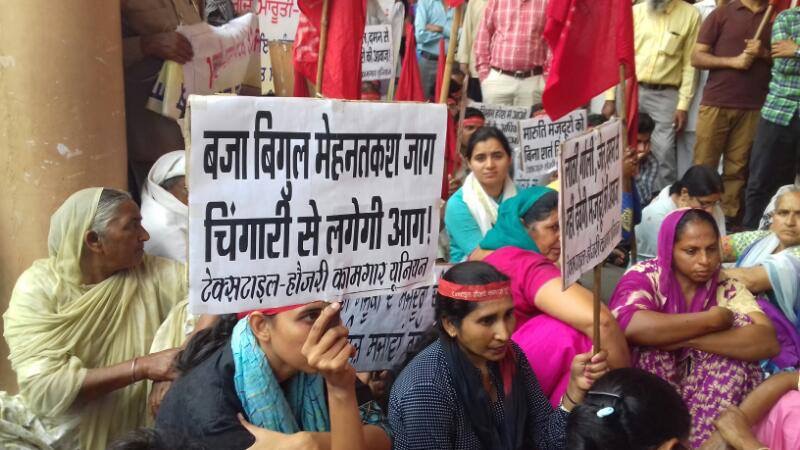
5 अप्रैल को लुधियाना में लघु सचिवालय पर डीसी कार्यालय पर टेक्सटाईल-हौजऱी कामगार यूनियन, मोल्डर एण्ड स्टील वर्कर्ज यूनियनें, मज़दूर अधिकार संघर्ष अभियान, नौजवान भारत सभा, पी.एस.यू., एटक, सीटू, एस.एस.ए.-रमसा यूनियन, पेंडू मज़दूर यूनियन, डी.टी.एफ., रेलवे पेन्शनर्ज वेल्फेयर ऐसोसिएशन, जमहूरी अधिकार सभा, आँगनवाड़ी मिड डे मील आशा वर्कर्ज यूनियन, कामागाटा मारू यादगारी कमेटी, स्त्री मज़दूर संगठन, कारखाना मज़दूर यूनियन, पेंडू मज़दूर यूनियन (मशाल), कुल हिन्द निर्माण मज़दूर यूनियन आदि संगठनों के नेतृत्व में जोरदार प्रदर्शन हुआ और राष्ट्रपति के नाम माँग पत्र सौंपा गया जिसमें माँग की गई कि सभी मारूति-सुजुकि के सभी मज़दूरों को बिना शर्त रिहा किया जाए. उनपर नाजायज-झूठे मुकद्दमे रद्द हो, काम से निकाले गए सभी मज़दूरों को कम्पनी में वापिस लिया जाए।

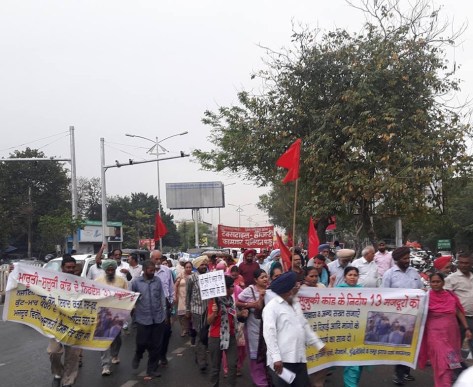


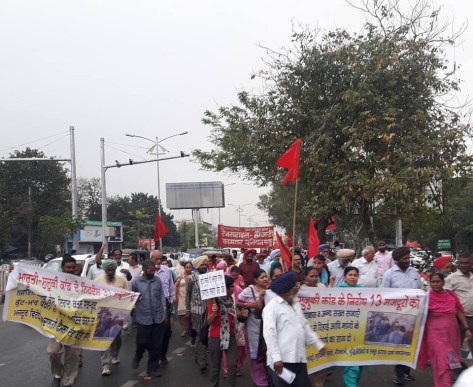
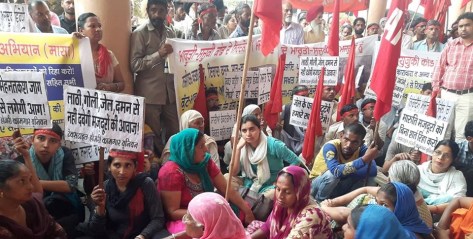

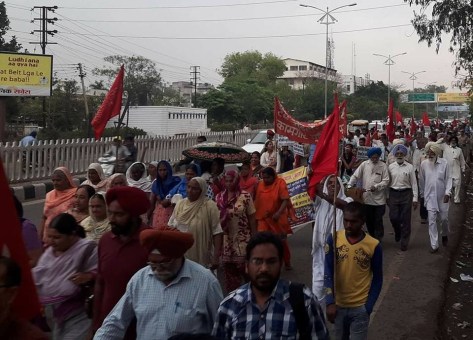
लुधियाना में 5 अप्रैल के प्रदर्शन की तैयारी के लिए हिन्दी और पंजाबी पर्चा वितरण भी किया गया जिसके जरिए लोगों को मारूति-सुजुकि मज़दूरों के संघर्ष, उनके साथ हुए अन्याय, न्यायपालिका-सरकार-पुलिस के पूँजीपरस्त और मज़दूर विरोधी-जनविरोधी चरित्र से परिचित कराया गया और प्रदर्शन में पहुँचने की अपील की गई। लुधियाना में 16 मार्च को भी बिगुल मज़ूदर दस्ता, मोल्डर एण्ड स्टील वर्कर्ज यूनियनों, मज़दूर अधिकार संघर्ष अभियान, आदि संगठनों द्वारा रोषपूर्ण प्रदर्शन किया गया था।
जमहूरी अधिकार सभा, पंजाब द्वारा बठिण्डा व संगरूर में 4 अप्रैल, बरनाला में 8 अप्रैल को, लुधियाना में 1 अप्रैल को पिछले दिनों देश की अदालतों द्वारा हुए तीन जनविरोधी फैसलों मारूति-सुजुकि के मज़दूरों को उम्र कैद व अन्य सजाएँ, जनवादी अधिकारों के लिए आवाज उठाने वाले दिल्ली विश्वविद्यालय के प्रो. साईबाबा सहित अन्य बेगुनाह लोगों को उम्र कैद की सजाओं, और हिन्दुत्वी आतन्कवादी असीमानन्द को बरी करने के मुद्दों पर कन्वेंशनें, सेमिनार, प्रदर्शन, मीटिंगें आदि आयोजित किए गए जिनमें अन्य जनसंगठनों नें भी भागीदारी की। जमहूरी अधिकार सभा ने इन मुद्दों पर एक पर्चा भी प्रकाशित किया जो बड़े स्तर पर पंजाब में बाँटा गया।
पटियाला में 4 अप्रैल को मज़दूरों, छात्रों, किसानों के विभिन्न संगठनों द्वारा रोष प्रदर्शन किया गया। बिजली मुलाजिमों ने भी टेक्नीकल सर्विसज़ यूनियन के नेतृत्व में 4 अप्रैल को अनेकों जगहों पर प्रदर्शन किए। लहरा थरमल पलांट के ठेका मज़दूरों ने 4 अप्रैल को रोष रैली के जरिए मारूति-सुजुकि मज़दूरों के साथ एकजुटता जाहिर करते हुए उनके समर्थन में आवाज़ उठाई। मारूति-सुजुकि मज़दूरों के समर्थन में पंजाब में उठी आवाज़ की कड़ी में लोक मोर्चा पंजाब ने 8 अप्रैल को लम्बी (जिला बठिण्डा) में रैली और रोष प्रदर्शन किया। लम्बी में आर.एम.पी. चिकित्सकों द्वारा भी प्रदर्शन किया गया। अनेकों गाँवों में मज़दूर-किसान-नौजवान संगठनों ने अर्थी फूँक प्रदर्शन भी किए हैं। आप्रेशन ग्रीन हण्ट विरोधी जमहूरी फ्रण्ट, पंजाब ने मोगा में 12 अप्रैल को कान्फ्रेंस और प्रदर्शन आयोजित किया।
मारूति-सुजुकि मज़दूरों का जिस स्तर पर कम्पनी में शोषण हो रहा था और इसके खिलाफ़ उठी आवाज़ को जिस घृणित बर्बर ढंग से कुचलने की कोशिश की गई है उसके खिलाफ़ आवाज़ उठनी स्वाभाविक और लाजिमी थी। पंजाब के इंसाफपसंद लोगों का हक, सच, इंसाफ के लिए जुझारू संघर्षों का पुराना और शानदार इतिहास रहा है। अधिकारों के जूझ रहे मारूति-सुजुकि मज़दूरों का साथ वे हमेशा निभाते रहेंगे।
पूरे देश में मज़दूरों का देशी-विदेशी पूँजीपतियों द्वारा भयानक शोषण हो रहा है। जब मज़दूर आवाज़ उठाते हैं तो पूँजीपति और उनका सेवादार पूरा सरकारी तंत्र दमन के लिए टूट पड़ता है। ऐसा ही मारूति-सुजुकी, मानेसर (जिला गुडग़ांव, हरियाणा) के संघर्षरत
मज़दूरों के साथ हुआ है। एक बहुत बड़ी साजिश के तहत कत्ल, इरादा कत्ल जैसे पूरी तरह झूठे केसों में फँसाकर पहले तो 148 मज़दूरों को चार वर्ष से अधिक समय तक, बिना जमानत दिए, जेल में बन्द रखा गया और अब गुडग़ाँव की अदालत ने नाज़ायज ढंग से 13 मज़दूरों को उम्र कैद और चार को 5-5 वर्ष की कैद की कठोर सजा सुनाई है। 14 अन्य मज़दूरों को चार-चार साल की सजा सुनाई गई है लेकिन क्योंकि वे पहले ही लगभग साढे वर्ष जेल में रह चुके हैं इसलिए उन्हें रिहा कर दिया गया है। 117 मज़दूरों को, जिन्हें बाकी मज़दूरों के साथ इतने सालों तक जेलों में ठूँस कर रखा गया उन्हें बरी करना पड़ा है। सबूत तो बाकी मज़दूरों के खिलाफ़ भी नहीं है लेकिन फिर भी उन्हें जेल में बन्द रखने का बर्बर हुक्म सुनाया गया है।
जापानी कम्पनी मारूति-सुजुकि के खिलाफ़ मज़दूरों ने श्रम अधिकारों के उलण्घन, कमरतोड़ मेहनत करवाने, कम वेतन, लंच, चाय, आदि की ब्रेक के बाद एक मिनट के देरी के लिए भी आधे दिन का वेतन काटने, छुट्टी करने के लिए हजारों रूपए वेतन से काटने जैसे भारी जुर्माने लगाने, आदि के खिलाफ़ कुछ वर्ष पहले संघर्ष का बिगुल बजाया था। कम्पनी की दलाल तथाकथित मज़दूर यूनियन की जगह उन्होंने अपनी यूनियन बनाई। नई यूनियन के पंजीकरण में कम्पनी ने ढेरों रूकावटें खड़ी कीं। उस समय हरियाणा में कांग्रेस की सरकार के मुख्यमंत्री भूपेन्द्र हुड्डा ने सरेआम पूँजीपतियों की दलाली का प्रदर्शन करते हुए कहा था कि कारखाने में नई यूनियन नहीं बनने दी जाएगी। मज़दूरों ने लम्बी-लम्बी हड़तालें लड़ीं, अपने अथक संघर्ष से यूनियन का पंजीकरण कराके जीत हासिल की। मज़दूर संघर्ष कम्पनी और समूचे सरकारी तंत्र की आँख की किरकरी बना हुआ था। संघर्ष कुचलने के लिए साजिश रची गई। 18 जुलाई 2012 को कारखाने के भीतर पुलीस की हाजिरी में सैंकड़ों हथियारबन्द गुण्डों से मज़दूरों पर हमला करवाया गया। बड़ी संख्या मज़दूर जख्मी हुए। कारखाने में आग लगवा दी गई। एक मज़दूर पक्षधर मैनेजर की इस दौरान मौत हो गई। साजिश के तहत इसका दोष मज़दूरों पर मढ़ दिया गया। बड़े स्तर पर गिरफतारियाँ की गईं, यातनाएँ दी गईं। ढाई हज़ार मज़दूरों को गैरकानूनी रूप से नौकरी से निकाल दिया गया। 148 मज़दूरों को जेल में ठूँस दिया गया। जमानत की अर्जी पर पंजाब-हरियाणा हाईकोर्ट ने टिप्पणी की कि अगर जमानत दी गई तो भारत में विदेशी पूँजी का निवेश रुकेगा। जिन 13 मज़दूरों को उम्र कैद की सजा सुनाई गई है उनमें 12 लोग यूनियन नेतृत्व का हिस्सा थे। इससे इस झूठे मुकद्दमे का मकसद समझना मुश्किल नहीं है।
अदालत का फैसला कितना अन्यायपूर्ण है इसका अन्दाजा लगाने के लिए सिर्फ कुछ तथ्य ही काफ़ी हैं। कम्पनी में चप्पे-चप्पे पर कैमरे लगे हुए हैं लेकिन अदालत में कहा कि उसके पास 18 जुलाई काण्ड की कोई वीडियो है ही नहीं! कम्पनी के गवाहों के ब्यानों से साफ पता चल रहा था कि झूठ बोल रहे हैं। वो तो मज़दूरों को पहचान तक न सके। गुण्डों व उनका साथ देने वाले मैनेजरों व अन्य स्टाफ के मैंबरों से कहीं अधिक संख्या में मज़दूर जख्मी हुए थे। पोस्ट मार्टम में पाया गया कि मैनेजर अवनीश कुमार की मौत दम घुटने से हुई है न कि जलाए जाने से जिससे साफ़ है कि यह हत्या का मामला है ही नहीं। और भी बहुत सारे तथ्य स्पष्ट तौर मज़दूरों का बेगुनाह होना साबित कर रहे थे लेकिन इन्हें अदालत ने नजरान्दाज कर मज़दूरों को ही दोषी करार दे दिया क्योंकि पूँजी निवेश को बढ़ावा जो देना है! वास्तव में मारूति-सुजुकी घटनाक्रम के जरिए लुटेरे हुक्मरानों ने ऐलान किया है कि अगर कोई लूट-शोषण के खिलाफ़ बोलेगा वो कुचला जाएगा।
ये फैसला तब आया है जब असीमानन्द और अन्य संघी आतन्कवादियों के खिलाफ ठोस सबूत होने, असीमानन्द द्वारा जुर्म कबूल कर लेने के बावजूद भी बरी कर दिया जाता है। दंगे भड़काने वाले, बेगुनाहों का कत्लेआम करने वाले न सिर्फ आज़ाद घूम रहे हैं बल्कि मुख्य मंत्री, प्रधान मंत्री जैसे पदों पर पहुँच रहे हैं !
आज देशी-विदेशी कम्पनियों, लुटेरे धन्नासेठों को खुश करने के लिए सरकारें मज़दूरों से सारे श्रम अधिकार छीन रही हैं। न्यूनतम वेतन, फण्ड, बोनस, हादसों से सुरक्षा के इंतजाम तक लागू न करने वाले पूँजीपतियों पर कोई कार्रवाई नहीं होती, उन्हें कभी जेल में नहीं ठूँसा जाता। उलटा भाजपा, कांग्रेस से लेकर तमाम पार्टियों की सरकारें कानूनी श्रम अधिकारों में मज़दूर विरोधी बदलाव करके पूँजीपतियों को मज़दूरों की बर्बर लूट की और भी खुली छूट दे रही हैं। किसानों, छात्रों, नौजवानों, आदिवासियों, सरकारी कर्मचारियों के अधिकार कुचले जा रहे हैं। भोजन, स्वास्थ्य, शिक्षा, बिजली, पानी, आदि तमाम सरकारी सहूलतें छीनी जा रही हैं। इसके खिलाफ़ उठी हर आवाज को दबाने के लिए पूरा राज्य तंत्र अत्याधिक हमलावर हो चुका है। काले कानून बनाकर एकजुट संघर्ष के जनवादी अधिकार छीने जा रहे हैं। जनपक्षधर बुद्धिजीवियों, पत्रकारों, कलाकारों तक का दमन हो रहा है, जेलों में ठूँसा जा रहा है। जन एकजुटता को तोडऩे के लिए धर्म, जाति, क्षेत्र के नाम पर बाँटने की साजिशें पहले किसी भी समय से कहीं अधिक तेज़ हो चुकी हैं। जहाँ जनता को बाँटा न सके, जहाँ लोगों का ध्यान असल मुद्दों से भटकाया न जा सके, वहाँ जेल, लाठी, गोली से कुचला जा रहा है। यही मारूति-सुजुकी मज़दूरों के साथ हुआ है। लेकिन बर्बर हुक्मरानों को दीवार पर लिखा पढ़ लेना चाहिए। इतिसाह गवाह है- जेल, लाठी, गोली, बर्बर दमन जनता की अवाज़ न कभी दबी है न कभी देबेगी।
For A New Rendezvous With Dr Ambedkar – Focus on Last Decade of his Life

..Everybody would agree that it is a challenging task to encapsulate a great wo/man’s vision in a few words- who as a public figure has impacted not only her/his generation but future generations, initiated or channelised debates in the society, led struggles, mobilised people, wrote thousands of pages and left a legacy for all of us to carry forward. …
To save time one can focus more on the last decade of his life – the most tumultuous period in his as well as the newly independent nation’s life – to know the important concerns which bothered his mind and how he envisioned the future trajectory of the movement he led and how he tried to chart a roadmap for the nascent nation with due support/cooperation and at times resistance from leading stalwarts of his time… Continue reading For A New Rendezvous With Dr Ambedkar – Focus on Last Decade of his Life
Take back the Poison-Rain: Ambikasutan Mangad’s Swarga
When I first encountered Enmakaje, it was already much praised in Kerala as the powerful little book that aroused the Malayali’s moral conscience towards the unspeakable tragedy wrought by the unbelievably-callous aerial spraying of the insecticide Endosulphan in north Kerala, over some of the most lush, verdant areas of the State. It was criticised by some for what I thought was a very interesting experiment with form: it begins as fiction, slowly shades into a historical account of the beginnings of the anti-Endosulphan struggle in north Kerala, and then shades back, in the end, to fiction again. For me, Enmakaje was much more than an activist tale. It was a determined effort to renew the Malayali self, through a prayerful weaving and imaginative retelling of the many stories that have shaped us. Reading of Neelakantan’s and Devayani’s stories, one remembers these stories, but differently. For example, what if Raman and Seetha left Ayodhya forever, renouncing its sickening power games? What if Adam and Eve voluntarily renounced Paradise? What if Vararuchi’s wife had rebelled in the origin-story of Kerala, of the Parayi petta panthirukulam?
Juggernaut has just published my translation of this gem of a book, and the title of the English version is Swarga: A Posthuman Tale . Below is an excerpt from the book.
It was past midnight.
Jayarajan started from his sleep and sharpened his ears for sounds from outside.
He shook Neelakantan, who was fast asleep, awake. Neelakantan woke to darkness assailing his open eyes. He was frightened.
‘What is it?’
In a trembling voice, Jayarajan said, ‘Something is happening outside. I can hear noises.’
Neelakantan’s throat was parched. He asked in a loud voice, ‘Who is there outside?’
Jayarajan noticed his fear in the dim light of the lantern.
‘Not human beings. Something like a storm and strong winds . . . I can’t make out much . . .’
Neelakantan’s breath returned.
‘Oh, that! Must be the wind . . . I’ve been scared ever since you came in . . . it’s just that I didn’t show it. You lie down, I’ll see you off tomorrow morning; put you on the first bus back. It is not at all safe for you to come and stay here again.’
Jayarajan got up.
‘Come, let’s go out for a bit.’
Neelakantan yawned. His voice was lazy. ‘The rain and wind will go their own way. You should lie down.’
Jayarajan took his hand and made him get up.
‘I’ve seen quite a bit of rain and wind too . . . but something extraordinary is happening outside.’
Neelakantan began to listen, alert now. There was a whole symphony of unpleasant sounds rising outside.
Taking care not to wake Devayani, they opened the door and stepped out.
They saw the most unbelievable sights on top of the Jadadhari Hill.
The huge trees were shaking hard, writhing, in the wind. From the clouds above, golden-coloured lightning-snakes descended, falling on the tops of the massive trees and enveloping them. As if from the impact of the lightning, the tall trees bowed as low as the ground, seeking to shake off the golden serpents . . .
In the next moment, the wind came hurtling like a demon’s hand, swooping up the trees. The branches clung and cleaved to each other as if in a paroxysm of desire, and shivered as though in the throes of an orgasm. And then, the lightning-serpents returned, and the whole cycle began again.
Startled, Jayarajan asked, ‘What is happening up there?’
For a few moments, Neelakantan had no words. He kept watching the hill’s frenzied dance and then said, ‘Terrible thunder and lightning. And the wind and rain besides. All of it together, that’s all.’
But even as he said those words, he knew how inadequate they were. Human language was too limited to describe this miraculous phenomenon. It was too vast to be comprehended by puny human consciousness.
‘Look, it is raining on top of the hill,’ Jayarajan pointed out. ‘Some of it is falling here too. But just see – there is not even a sign of rain or wind anywhere near here. Here the trees are still as if they have stopped breathing. It is a miracle . . . let me call chechi.’
‘No, she will be scared.’
Jayarajan remembered Devappa’s words. ‘On the night of the Kozhikkettu in Bhagyathimaarkandam, no one goes out!’
‘Two years ago, on a night like this, I heard the jungle sway like this around midnight. I thought it was a storm and did not go out.’
‘I think,’ Jayarajan said and stopped.
‘What?’
‘Is this really Siva’s dance of destruction, the thandava? Isn’t this the Jadadhari Hill?’
Neelakantan asked, ‘Are you a believer?’
‘No. What about you?’
‘I haven’t been to temples or shrines after I began to see things differently . . . In my view, Siva is Nature itself. Siva exists in every leaf, every flower. The thandava that you mentioned–’
‘The dance of destruction of Siva, who swallowed the divine serpent Vasuki’s deadly venom! This is it! Is this thandava- Jadadhari Hill’s, Nature’s – that means Siva’s – own attempt to shake off the terrible chemical poison, so like Vasuki’s venom, the Kalakoota?’
‘You tie up everything to your consciousness of the environment!’
Jayarajan pointed out: ‘See, the wind’s grasping fist now eases. The lightning retreats. The rain and thunder depart. The trees stand up straight once again.’
Neelakantan nodded, his eyes wide open and filled with the magic in the air. Yes, the dance of destruction was now ebbing.
Remembering M. Rasheed – A Grandchild’s Political Farewell: Bobby Kunhu
Guest post by BOBBY KUNHU
Rasheed, a political activist, award winning journalist and activist was one of the founders of the Trotskyite movement in India and the RSP in Kerala. He passed away on the 6th of January, 2017

It is very unusual for a grandchild to write public obituaries for grandparents – but Comrade M. Rasheed was a person of unusual politics and his death definitely warrants an unusual response requiring the obituary also to be unusual. Given that the significance of Comrade Rasheed’s life was his unwavering integrity to ideals that he fell into the bad books of his father and walked out of the political party he co-founded, given that he never shied from expressing his opinion on anyone – it would only be right in writing this as a critique of the human being he was – and I am sure he would not have expected anything less from me. Continue reading Remembering M. Rasheed – A Grandchild’s Political Farewell: Bobby Kunhu
Solidarity with Africans in India: Students’ organisations and Unions from North East India
The undersigned students’ organisations and unions from North East India, would like to extend solidarity with people of African origin living in India and particularly those who were attacked in Greater Noida recently. We empathise with the violence, ordeals, and humiliation faced by Africans in India. We are distressed to learn of the ongoing situation, and denial of the Indian government to term the incident as racist is worrying. Various incidents of racism against people of African origin in India from the past are not isolated incidents, they stemmed from the deep rooted prejudice mindset of the majority of Indians. We condemn racial discrimination against anyone (particularly people of African origin) and caricatures people make by creating stereotypes like cannibalism and drug users/peddlers. These stereotypes are reflection of racist mindset which we, people from North East India are also at receiving end over and over again.
Caste Based Feudal Oppression in the Feudal Badlands of Bihar: Vikas Bajpai & Ish Mishra
Guest Post by Vikas Bajpai and Ish Mishra (on behalf of ‘Janhastakshep’)
A Report on the Ghastly Beating up of Two Youth of Extremely Backward Castes by Kurmi Landlords in Nauva Village of Kochas Block of Rohtas District in Bihar.
Prelude
On the 29th of January an incident happened in Nauva village of Kochas block of Rohtas district in south Bihar which reportedly involved two youth of extremely backward castes and the Kurmi landlords (belonging to the dominant among ‘Other Backward Castes’). Janhastakshep came to know of the incident through a short video of the incident that was brought to our attention by some activists of All India Kisan Mazdoor Sabha (AIKMS) who have proactively taken up this issue in Rohtas.
In the video we could see two youth who had been stripped naked, with their hands tied behind their back being beaten up mercilessly. It was also reported to us that these youth were branded on various parts of their bodies with hot iron rods. The video looked scary and on first impression made the video of beating up of Dalit youth in Una town of Gujarat for having committed the crime of skinning a dead cow; appear much milder in comparison. Judging the seriousness of the issue Janhastakshep decided to send a team for investigation of the case. A two member team comprising of Prof Ish Mishra of Hindu College, Delhi University and Dr Vikas Bajpai of the Centre for Social Medicine and Community Health at Jawaharlal Nehru University, left for Sasaram (district headquarter of Rohtas) on the 16th of February, 2017.
This report seeks to go into the details and analysis of the case with a hope that the larger issues involved there in shall ultimately see the light of the day and would be deliberated upon in the society.
Victory of Anti-Posco Struggle
People United Shall Always Be Victorious !

(Photo Courtesy : The Hindu)
Big news – at times – go completely unnoticed.
(Thanks to the mediatised times we are passing through)
And thus it did not appear surprising that the decision by Posco, the South Korean steelmaker, the fourth biggest in the world, to exit the proposed 12 million-tonnes a year steel plant in Odisha did not cause much flutter. Yes, newspapers duly reported POSCO India’s ‘request to the Odisha government to take back the land provided to it near Paradip’ where it was supposed to invest 52,000 crore Rs.’ The letter stated company’s ‘failure to start work on the proposed plant’.
Perhaps none from the media wanted to showcase a negative example which is at variance with the efforts by the powers that be to project the idea of ‘ease of doing business’ here. Undoubtedly at a time when the government is keen to attract foreign capital and inducing it in very many ways, the way in which a Corporate Major – supposed to be one of the leading in the steel sector – had to exit from its project can easily shake their confidence about investing here. Continue reading Victory of Anti-Posco Struggle
Hail the Students’ Struggle for its Victory in the Battle against Corporate Publishers : New Socialist Initiative
Guest Post by New Socialist Initiative (Delhi Chapter)

Deendayal in Government Schools : Neglecting Education, Indoctrinating Exclusion

(Photo courtesy : livehindustan.com, From left to right – Golwalkar, Deendayal Upadhyay and Atal Bihari Vajpayee, . Photo taken in Mathura during Goraksha/Cow Protection movement, 1965)
“DEENDAYAL UPADHYAYA is to the BJP [Bharatiya Janata Party] what Mohandas Karamchand Gandhi was to Congress” opined R. Balashankar, former editor of the Rashtriya Swayamsewak Sangh’s (RSS) organ Organiser and now a member of the BJP’s central committee, on Prasikhshan Maha Abhiyan
(The Indian Express,; September 24, 2016).
Cows inhale, exhale oxygen, says Rajasthan education minister Vasudev Devnani
Rajaram (name changed) Principal of a school near Jaipur, Rajasthan is a worried man.
An honest teacher all his life, is not able to comprehend the rationale behind the recent order by the state education ministry asking every secondary and senior secondary school to purchase collected works of Deendayal Upadhyay Continue reading Deendayal in Government Schools : Neglecting Education, Indoctrinating Exclusion
Looking ‘Right’, Talking ‘Liberal’ – The Twists and Turns of Makarand Paranjape: Anirban Bhattacharya
Guest Post by ANIRBAN BHATTACHARYA
[This missive to Makarand Paranjape, who is a professor at Jawaharlal Nehru University, comes in response to his recent op-ed piece in the Indian Express where he comments on the events at Ramjas College, Delhi University on the 21st of February and in their wake, in Delhi University, on the 22nd of February]
Mr. Makarand Paranjape. In your analysis of the post-Ramjas fallout in Delhi University in Indian Express on the 4th of March, one can see that you have donned a “liberal” cloak. But there were way too many holes in that cloak to go without a counter and hence this response.
Statements of Solidarity for Ramjas and DU: A Collation
Please find below a collation of statements of solidarity received by Kafila over the past fortnight since the shameful incidents of violence by the ABVP occurred on the 21st and 22nd of February 2017. These are from: Ramjas Alumna, Ambedkar University Delhi Faculty Association, O.P Jindal Teachers: Students and Durham University Politics and International Relations Society, U.S.A; and students and faculty at the University of Minnesota, U.S.A.

The statements are preceded by a short write-up on what Ramjas College has meant to its alumna, by ANUBHAV PRADHAN.
Nostalgia is made of more than just happiness. It is sulphurous too.
To many who spent three or more years of their life in Ramjas College, visuals of violence in and around it on 21 and 22 February 2017 have been a source of deep, personal shock. The footpath and the areas adjoining the college gate were often sites of lingering conversations between friends, offering moments of respite from studies, tensions accruing from impending exams, or relief to those who had just accomplished a hectic ECA festival and were there catching up their breath or exhaling smoke.
The ABVP struck twice, once attacking the college Seminar Room and then coming back the second day to attack students. In the hundredth year of Ramjas’ establishment, a college founded at a time when protest was an active ideal for most Indians, this singular episode of planned, institutional violence against students and teachers is a grim reminder of the brute silencing of interrogation, peaceful protest, dialogue and dissent being normalised across our colleges and universities, and in our society at large. The audacity with which these perpetrators and their ideologues brand entire institutions and diverse communities of students and academics as anti-national—and therefore fit recipients for their brute censure—also gives the lie to the intellectual and affective bankruptcy of a rapidly emergent cultural orientation premised on simplistic binaries of good and bad, right and wrong, national and anti-national. In a society—and nation—whose ideals are peace, dialogue, and inclusion, these attacks on students and teachers point to the deep ideological rot in the perpetrators’ conception of nation, nationality and nationalism.
As an alumnus of Ramjas College, I cherish the right to self-determination and open debate. I feel outraged that the students’ and faculties’ right to decide what discussion to hold and whom to invite for it within college premises was usurped in this manner. It is disturbing that this violence rippled across the campus as it were, with students being followed, identified and harassed in their personal spaces for having asserted their right to listen to discussions on Bastar and for not bowing down to bodily attacks perpetrated through stones and fisticuffs by members of the ABVP and their affiliates.
Most alumni like me are invested in our respective professions, but the foundations of study and work were laid for us by Ramjas’ teachers and the college’s vibrant culture of extra-curricular instruction. This experience has proved fundamental to our engagement with our immediate workspaces, surroundings, power structures, and our nation. Denying current and future students their right to freely and openly debate issues of their choice in fora of their choice is tantamount to denial of a basic academic right. Threatening and manhandling academicians guided by the spirit of enquiry towards generation of dialogue will prove detrimental to the quality of collegiate education in our nation. We collectively issue the following statement of solidarity with Ramjas’ students and teachers in this moment of crisis:
Statement by Ramjas Alumna
Continue reading Statements of Solidarity for Ramjas and DU: A Collation
“Karenge politics, karenge pyar” – New slogan and new politics: Baidik Bhattacharya
Guest post by BAIDIK BHATTACHARYA
[While the media worked overtime to present the developments in Ramjas College and Delhi University as a clash between two student organizations and two political formations, Baidik Bhattacharya here reflects on the new kinds of politics, rooted in the everyday and in love, that found expression in the University.- AN]
On 28 February, 2017, thousands of students and teachers of Delhi University and other academic institutions of the NCR region marched across the North Campus, protesting against the recent acts of vandalism and violence at Ramjas College. As the march progressed through the winding roads, touching various colleges and departments of the university, feisty students raised several slogans to oppose the perpetrators of such violence, the student organization of the RSS—the Akhil Bharatiya Vidyarthi Parishad or ABVP. Some of these slogans were well-known, some predictable, but some were really creative. I want to briefly discuss one such creative slogan, and its implications: “Karenge politics karenge pyar, ABVP hoshiyar.” Chanted primarily by groups of women and queer activists, this innovative rendering of one’s rights across the university campuses captured some of the pressing issues that have surfaced in the last couple of years in student politics.
Continue reading “Karenge politics, karenge pyar” – New slogan and new politics: Baidik Bhattacharya
Longing for the Future – Two Days with Penkoottu and AMTU at Kozhikode, Kerala
Kozhikode, Hotel Alakapuri, 4-5 March, 2017.
Kozhikode has always upturned my feelings about the male gaze. It is of course a cheerful, bustling, place, full of fabulously good-looking people of all genders. The cheeriness has a certain effortlessly defiant quality – already evident when you look out of the window as the train from the south pulls into the railway station, and see bright, healthy, merrily-swaying wild flowers raise their heads undefeated by the ferocious summer sun– wild sunflowers in hundreds, magnificent vines of kulamariyan flowers ( literally, ‘over-the-top’ flowers, but known here also, interestingly enough, as Antigone vines), creepers happily, constantly, and untiringly winding over little piles of rubbish and covering them with short-lived if emphatic trumpets of mauve, lavender, red, yellow, and white. You pass this eternal artwork-in-progress of the flowers and vines and city trash and enter Kozhikode, but realise that it actually tells you a bit about the men there only when you meet them. Continue reading Longing for the Future – Two Days with Penkoottu and AMTU at Kozhikode, Kerala
A Tale of Two and a Half Marches – Two for Azadi and a Half for Ghulami.
[Videos of song by Shehla Rashid and of speeches by Nivedita Menon, Kavita Krishnan, Umar Khalid and Jignesh Mevani, courtesy, Samim Asgor Ali]
February gives way to March and spring returns to Delhi. And what a spring it is. The right wing thugs of the ABVP choose the wrong time to attack, once again. They must really get themselves a better astrologer, or at least a better class of charlatan who can tell them if there ever is a right time to stage their goon show. I suspect there isn’t.

Continue reading A Tale of Two and a Half Marches – Two for Azadi and a Half for Ghulami.
Hard Ways of Lucidity – Thinking About the Crisis in the University: Prasanta Chakravarty
Guest Post by Prasanta Chakravarty
As I see it, university spaces are being assaulted at least from two sides; though it seems as if the two sides are antagonistic to each other, in practice they come dangerously close to each other. How and why is this happening, and what can be done about it?

A Small Matter of Security – Holding the Guilty Accountable for What Happened in Ramjas College on the 22nd of February: Shafey Danish
This is a guest post by SHAFEY DANISH

The violence that gripped Ramjas College on the 21st and 22nd of this month is now national news. We heard belligerent slogans by ABVP members of ‘chappal maro saalon ko’ (beat them with slippers), we saw students being chased on the campus, and we saw students being beaten up. All this culminated in a situation where students and teachers were held captive for over five hours within the campus premises. Let me emphasize that this violence was completely unprovoked.
On the 22nd of February, some of the students who were simply sitting with their friends were attacked. The police came and formed a cordon around them. Others joined the students in a gesture of solidarity. Teachers joined them to ensure that the students were not assaulted. The police cordon became their prison for the next five hours. And even then they were not safe.
They were repeatedly assaulted, threatened, and abused. All of this happened in front of their teachers and, more importantly, in front of the police, who, as is well known by now, did not do anything substantial. They could have maintained the cordon around the protesters, arrested those who were repeatedly carrying out the assaults, or – at the very least – prevented the attackers from coming back in (they had left for some time to attack the protest going on outside). But they did not. Whether this was because they were under pressure or because they were complicit is besides the point. The point is that students and teachers remained at the mercy of their attackers for over five hours.
But on the same day something far more ominous was also going on.
The story of the Indian budget: Where the camera failed? Muhammed Shafeeque CM
Despite the controversies of demonetization, the central government has again succeeded in deftly hijacking the minds of Indian citizens through a riveting speech made by Finance Minister Arun Jaitley. The budget seemed to be especially important given third quarter statistics which are filled with drawbacks of the demonetization policy. Thus we had a budget speech completely focused on digitalization of a country where the ‘digital divide’ stubbornly persists. As the budget theme (Transform, Energize, and Clean) attempted to glorify existing conditions, there were unsurprisingly no transformations in the overall economic framework except the expected tax reduction. In the zeal for “energizing”, the budget had clean forgotten the needs of the informal sector including agricultural sector. Even though the government provocatively claimed that it had cleaned up black money, it revealed no data regarding the amount of black money actually mopped up from the market.
Continue reading The story of the Indian budget: Where the camera failed? Muhammed Shafeeque CM
ABVP Riots in Delhi University with Police Protection
For the second successive day, goons affiliated to the RSS-BJP backed right wing student mafia gang called ABVP (Akhil Bharatiya Vidyarthi Parishad) pelted stones and violently attacked peaceful assemblies of students and teachers in Delhi University. Journalists who were present were also beaten up. Phones and cameras and filming equipment were destroyed. An attempt was made to strangle a professor with his own scarf. He, and some other students who were injured had to be hospitalized. Luckily, they are shaken, but out of immediate danger. The incidents have been characterized as ‘clashes’ between right wing and left wing student groups by some sections of the media. Nothing can be further from the truth. These were not ‘clashes’. They were straight-forward one sided attacks by a mob intent on violence. A riot is not a clash. Continue reading ABVP Riots in Delhi University with Police Protection
Feminists Condemn Opposition To Women’s Reservation In Nagaland Municipal Councils
We, the undersigned women’s organisations and concerned individuals take serious note of the fierce opposition to women’s reservation of 33% seats in Nagaland Municipal Councils by male dominated tribal bodies in Nagaland in the name of protecting their tradition and customary practices that bar women from participating in decision-making bodies. We strongly condemn this anti-woman position of Nagaland Tribes Action Committee (NTAC) that has been formed supposedly to “protect” Naga tribal practices. While NTAC quotes Article 371(A) of the Constitution to assert that they are empowered to make their own laws, they choose to ignore Constitutional principle of equality before law, thus denying the Naga women their electoral rights.
Time and again women’s movements in India have confronted issues of community identity vs the rights of women. In almost every instance, communities and their leaders have chosen to sacrifice the rights of women to safeguard patriarchal practices in the name of tradition and custom. In the present imbroglio NTAC has used threats and violence to prevent women from filing their nominations, or even to withdraw their papers. Through all this, the State government has remained silent spectator and tried to wash its hands off on the issue of women’s representation in local bodies by cancelling the elections to local bodies under pressure from these tribal bodies by merely citing law and order concerns. In the process, the State has become complicit in protecting patriarchal traditions to the detriment of principles of gender equality. What is not being asserted is that Urban Local Bodies are not traditional Naga institutions recognised by Article 371(A) of the Constitution but rather, Constitutional bodies under Part IX of the Constitution over which the traditional Naga bodies have no mandate. Continue reading Feminists Condemn Opposition To Women’s Reservation In Nagaland Municipal Councils