
The undersigned students’ organisations and unions from North East India, would like to extend solidarity with people of African origin living in India and particularly those who were attacked in Greater Noida recently. We empathise with the violence, ordeals, and humiliation faced by Africans in India. We are distressed to learn of the ongoing situation, and denial of the Indian government to term the incident as racist is worrying. Various incidents of racism against people of African origin in India from the past are not isolated incidents, they stemmed from the deep rooted prejudice mindset of the majority of Indians. We condemn racial discrimination against anyone (particularly people of African origin) and caricatures people make by creating stereotypes like cannibalism and drug users/peddlers. These stereotypes are reflection of racist mindset which we, people from North East India are also at receiving end over and over again.
Category Archives: Politics
Caste Based Feudal Oppression in the Feudal Badlands of Bihar: Vikas Bajpai & Ish Mishra
Guest Post by Vikas Bajpai and Ish Mishra (on behalf of ‘Janhastakshep’)
A Report on the Ghastly Beating up of Two Youth of Extremely Backward Castes by Kurmi Landlords in Nauva Village of Kochas Block of Rohtas District in Bihar.
Prelude
On the 29th of January an incident happened in Nauva village of Kochas block of Rohtas district in south Bihar which reportedly involved two youth of extremely backward castes and the Kurmi landlords (belonging to the dominant among ‘Other Backward Castes’). Janhastakshep came to know of the incident through a short video of the incident that was brought to our attention by some activists of All India Kisan Mazdoor Sabha (AIKMS) who have proactively taken up this issue in Rohtas.
In the video we could see two youth who had been stripped naked, with their hands tied behind their back being beaten up mercilessly. It was also reported to us that these youth were branded on various parts of their bodies with hot iron rods. The video looked scary and on first impression made the video of beating up of Dalit youth in Una town of Gujarat for having committed the crime of skinning a dead cow; appear much milder in comparison. Judging the seriousness of the issue Janhastakshep decided to send a team for investigation of the case. A two member team comprising of Prof Ish Mishra of Hindu College, Delhi University and Dr Vikas Bajpai of the Centre for Social Medicine and Community Health at Jawaharlal Nehru University, left for Sasaram (district headquarter of Rohtas) on the 16th of February, 2017.
This report seeks to go into the details and analysis of the case with a hope that the larger issues involved there in shall ultimately see the light of the day and would be deliberated upon in the society.
Victory of Anti-Posco Struggle
People United Shall Always Be Victorious !

(Photo Courtesy : The Hindu)
Big news – at times – go completely unnoticed.
(Thanks to the mediatised times we are passing through)
And thus it did not appear surprising that the decision by Posco, the South Korean steelmaker, the fourth biggest in the world, to exit the proposed 12 million-tonnes a year steel plant in Odisha did not cause much flutter. Yes, newspapers duly reported POSCO India’s ‘request to the Odisha government to take back the land provided to it near Paradip’ where it was supposed to invest 52,000 crore Rs.’ The letter stated company’s ‘failure to start work on the proposed plant’.
Perhaps none from the media wanted to showcase a negative example which is at variance with the efforts by the powers that be to project the idea of ‘ease of doing business’ here. Undoubtedly at a time when the government is keen to attract foreign capital and inducing it in very many ways, the way in which a Corporate Major – supposed to be one of the leading in the steel sector – had to exit from its project can easily shake their confidence about investing here. Continue reading Victory of Anti-Posco Struggle
Hail the Students’ Struggle for its Victory in the Battle against Corporate Publishers : New Socialist Initiative
Guest Post by New Socialist Initiative (Delhi Chapter)

On 9 March 2017 three well-established academic corporate publishing houses, Oxford University Press, Cambridge University Press and Taylor and Francis withdrew their copyright suit filed in the High Court against Delhi University and Rameshwari Photocopy Shop, a shop stationed at the Delhi School of Economics campus in Delhi University licensed by the University to carry out photocopying work. The suit that was filed in August 2012 on the grounds that photocopying material from books published by the above three publishers by university students, particularly in the compilation of coursepacks, constituted copyright infringement and revenue loss to the publishers. Right from the beginning it was clear this case was treated as a test case to instate a licensing regime, much like one that exists in the US and other First World countries.
Being the absolute primary constituency to be impacted by such a case and its possible outcomes, students of Delhi University were amongst the first to take up the battle against some of the most powerful publishing houses in academia. The ‘Campaign to Save D.School Photocopy Shop’ soon became the ‘Association of Students for Equitable Access to Knowledge’ (ASEAK), reflecting the growing politicisation of the student community on the issue of the knowledge commons in order to resist an increasing attempt across the world to create a market out of it where it didn’t as yet exist. This can be seen in the case of Costa Rica as well where there was an attempt to make photocopying illegal, a move that was successfully opposed on a massive scale by students.
The students of Delhi University, organised as ASEAK, opposed the move through a range of mechanisms, mobilising students from class to class, organising public meetings, taking out protest rallies, campaigning against these publishers at the annual World Book Fair held in New Delhi, influencing public opinion through writing in newspapers, and last but not the least, taking up the legal battle in the courts. NSI hails the struggle of the students that brought to the centre of the debate questions of equity and justice within the arena of production and distribution of knowledge resources, challenging the private property regime sought to be implemented in the sphere of knowledge production by these big academic corporate publishing houses.
For the last few years the primary site of the battle has been in the High Court at New Delhi. The publishers have received repeated blow after blow in this process as well, leading to their final withdrawal of the suit altogether. The win is a big victory and testament to the struggle of the students, backed by a legal team that has been seminal to the victory, along with support from the academic community. The case, that attempted to strike a ‘balance’ between private profits of the publishers and the rights of students to access materials in the pursuit of their education, has dealt a blow to precisely such a misconception that the two ‘interests’ are in fact of equal concern.
Along with students, who assert their right over the materials they access as part of their fundamental right to education, scholars, often the authors of these materials, have equally come out to state that there is no better reward for their work as intellectuals, as to be read by as many students as can get hold of their work, photocopied or otherwise. The emphasis of the corporate publishers in asserting absolute ownership over the works they publish, in a rare instance where the labour of writing a book is provided at no cost to the publishers, borne by universities, students’ fees and taxpayers’ money instead, is shameful and needs to be rejected at all cost.
NSI congratulates the students, lawyers, academics and concerned citizens who persisted in their resistance against the bullying tactics of big academic corporate publishing houses and calls on the academic community to engage with new ways of producing and sharing knowledge so as to create equitable, just and democratic structures of knowledge production.
EDUCATION OVER COPYRIGHT! KNOWLEDGE OVER PROFIT!
Deendayal in Government Schools : Neglecting Education, Indoctrinating Exclusion

(Photo courtesy : livehindustan.com, From left to right – Golwalkar, Deendayal Upadhyay and Atal Bihari Vajpayee, . Photo taken in Mathura during Goraksha/Cow Protection movement, 1965)
“DEENDAYAL UPADHYAYA is to the BJP [Bharatiya Janata Party] what Mohandas Karamchand Gandhi was to Congress” opined R. Balashankar, former editor of the Rashtriya Swayamsewak Sangh’s (RSS) organ Organiser and now a member of the BJP’s central committee, on Prasikhshan Maha Abhiyan
(The Indian Express,; September 24, 2016).
Cows inhale, exhale oxygen, says Rajasthan education minister Vasudev Devnani
Rajaram (name changed) Principal of a school near Jaipur, Rajasthan is a worried man.
An honest teacher all his life, is not able to comprehend the rationale behind the recent order by the state education ministry asking every secondary and senior secondary school to purchase collected works of Deendayal Upadhyay Continue reading Deendayal in Government Schools : Neglecting Education, Indoctrinating Exclusion
Looking ‘Right’, Talking ‘Liberal’ – The Twists and Turns of Makarand Paranjape: Anirban Bhattacharya
Guest Post by ANIRBAN BHATTACHARYA
[This missive to Makarand Paranjape, who is a professor at Jawaharlal Nehru University, comes in response to his recent op-ed piece in the Indian Express where he comments on the events at Ramjas College, Delhi University on the 21st of February and in their wake, in Delhi University, on the 22nd of February]
Mr. Makarand Paranjape. In your analysis of the post-Ramjas fallout in Delhi University in Indian Express on the 4th of March, one can see that you have donned a “liberal” cloak. But there were way too many holes in that cloak to go without a counter and hence this response.
Statements of Solidarity for Ramjas and DU: A Collation
Please find below a collation of statements of solidarity received by Kafila over the past fortnight since the shameful incidents of violence by the ABVP occurred on the 21st and 22nd of February 2017. These are from: Ramjas Alumna, Ambedkar University Delhi Faculty Association, O.P Jindal Teachers: Students and Durham University Politics and International Relations Society, U.S.A; and students and faculty at the University of Minnesota, U.S.A.

The statements are preceded by a short write-up on what Ramjas College has meant to its alumna, by ANUBHAV PRADHAN.
Nostalgia is made of more than just happiness. It is sulphurous too.
To many who spent three or more years of their life in Ramjas College, visuals of violence in and around it on 21 and 22 February 2017 have been a source of deep, personal shock. The footpath and the areas adjoining the college gate were often sites of lingering conversations between friends, offering moments of respite from studies, tensions accruing from impending exams, or relief to those who had just accomplished a hectic ECA festival and were there catching up their breath or exhaling smoke.
The ABVP struck twice, once attacking the college Seminar Room and then coming back the second day to attack students. In the hundredth year of Ramjas’ establishment, a college founded at a time when protest was an active ideal for most Indians, this singular episode of planned, institutional violence against students and teachers is a grim reminder of the brute silencing of interrogation, peaceful protest, dialogue and dissent being normalised across our colleges and universities, and in our society at large. The audacity with which these perpetrators and their ideologues brand entire institutions and diverse communities of students and academics as anti-national—and therefore fit recipients for their brute censure—also gives the lie to the intellectual and affective bankruptcy of a rapidly emergent cultural orientation premised on simplistic binaries of good and bad, right and wrong, national and anti-national. In a society—and nation—whose ideals are peace, dialogue, and inclusion, these attacks on students and teachers point to the deep ideological rot in the perpetrators’ conception of nation, nationality and nationalism.
As an alumnus of Ramjas College, I cherish the right to self-determination and open debate. I feel outraged that the students’ and faculties’ right to decide what discussion to hold and whom to invite for it within college premises was usurped in this manner. It is disturbing that this violence rippled across the campus as it were, with students being followed, identified and harassed in their personal spaces for having asserted their right to listen to discussions on Bastar and for not bowing down to bodily attacks perpetrated through stones and fisticuffs by members of the ABVP and their affiliates.
Most alumni like me are invested in our respective professions, but the foundations of study and work were laid for us by Ramjas’ teachers and the college’s vibrant culture of extra-curricular instruction. This experience has proved fundamental to our engagement with our immediate workspaces, surroundings, power structures, and our nation. Denying current and future students their right to freely and openly debate issues of their choice in fora of their choice is tantamount to denial of a basic academic right. Threatening and manhandling academicians guided by the spirit of enquiry towards generation of dialogue will prove detrimental to the quality of collegiate education in our nation. We collectively issue the following statement of solidarity with Ramjas’ students and teachers in this moment of crisis:
Statement by Ramjas Alumna
Continue reading Statements of Solidarity for Ramjas and DU: A Collation
“Karenge politics, karenge pyar” – New slogan and new politics: Baidik Bhattacharya
Guest post by BAIDIK BHATTACHARYA
[While the media worked overtime to present the developments in Ramjas College and Delhi University as a clash between two student organizations and two political formations, Baidik Bhattacharya here reflects on the new kinds of politics, rooted in the everyday and in love, that found expression in the University.- AN]
On 28 February, 2017, thousands of students and teachers of Delhi University and other academic institutions of the NCR region marched across the North Campus, protesting against the recent acts of vandalism and violence at Ramjas College. As the march progressed through the winding roads, touching various colleges and departments of the university, feisty students raised several slogans to oppose the perpetrators of such violence, the student organization of the RSS—the Akhil Bharatiya Vidyarthi Parishad or ABVP. Some of these slogans were well-known, some predictable, but some were really creative. I want to briefly discuss one such creative slogan, and its implications: “Karenge politics karenge pyar, ABVP hoshiyar.” Chanted primarily by groups of women and queer activists, this innovative rendering of one’s rights across the university campuses captured some of the pressing issues that have surfaced in the last couple of years in student politics.
Continue reading “Karenge politics, karenge pyar” – New slogan and new politics: Baidik Bhattacharya
Longing for the Future – Two Days with Penkoottu and AMTU at Kozhikode, Kerala
Kozhikode, Hotel Alakapuri, 4-5 March, 2017.
Kozhikode has always upturned my feelings about the male gaze. It is of course a cheerful, bustling, place, full of fabulously good-looking people of all genders. The cheeriness has a certain effortlessly defiant quality – already evident when you look out of the window as the train from the south pulls into the railway station, and see bright, healthy, merrily-swaying wild flowers raise their heads undefeated by the ferocious summer sun– wild sunflowers in hundreds, magnificent vines of kulamariyan flowers ( literally, ‘over-the-top’ flowers, but known here also, interestingly enough, as Antigone vines), creepers happily, constantly, and untiringly winding over little piles of rubbish and covering them with short-lived if emphatic trumpets of mauve, lavender, red, yellow, and white. You pass this eternal artwork-in-progress of the flowers and vines and city trash and enter Kozhikode, but realise that it actually tells you a bit about the men there only when you meet them. Continue reading Longing for the Future – Two Days with Penkoottu and AMTU at Kozhikode, Kerala
A Tale of Two and a Half Marches – Two for Azadi and a Half for Ghulami.
[Videos of song by Shehla Rashid and of speeches by Nivedita Menon, Kavita Krishnan, Umar Khalid and Jignesh Mevani, courtesy, Samim Asgor Ali]
February gives way to March and spring returns to Delhi. And what a spring it is. The right wing thugs of the ABVP choose the wrong time to attack, once again. They must really get themselves a better astrologer, or at least a better class of charlatan who can tell them if there ever is a right time to stage their goon show. I suspect there isn’t.

Continue reading A Tale of Two and a Half Marches – Two for Azadi and a Half for Ghulami.
Hard Ways of Lucidity – Thinking About the Crisis in the University: Prasanta Chakravarty
Guest Post by Prasanta Chakravarty
As I see it, university spaces are being assaulted at least from two sides; though it seems as if the two sides are antagonistic to each other, in practice they come dangerously close to each other. How and why is this happening, and what can be done about it?
A Small Matter of Security – Holding the Guilty Accountable for What Happened in Ramjas College on the 22nd of February: Shafey Danish
This is a guest post by SHAFEY DANISH
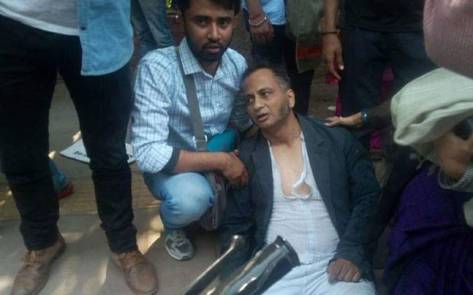
The violence that gripped Ramjas College on the 21st and 22nd of this month is now national news. We heard belligerent slogans by ABVP members of ‘chappal maro saalon ko’ (beat them with slippers), we saw students being chased on the campus, and we saw students being beaten up. All this culminated in a situation where students and teachers were held captive for over five hours within the campus premises. Let me emphasize that this violence was completely unprovoked.
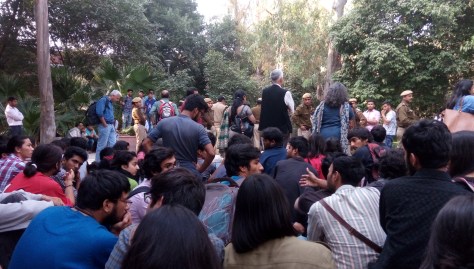
On the 22nd of February, some of the students who were simply sitting with their friends were attacked. The police came and formed a cordon around them. Others joined the students in a gesture of solidarity. Teachers joined them to ensure that the students were not assaulted. The police cordon became their prison for the next five hours. And even then they were not safe.
They were repeatedly assaulted, threatened, and abused. All of this happened in front of their teachers and, more importantly, in front of the police, who, as is well known by now, did not do anything substantial. They could have maintained the cordon around the protesters, arrested those who were repeatedly carrying out the assaults, or – at the very least – prevented the attackers from coming back in (they had left for some time to attack the protest going on outside). But they did not. Whether this was because they were under pressure or because they were complicit is besides the point. The point is that students and teachers remained at the mercy of their attackers for over five hours.
But on the same day something far more ominous was also going on.
The story of the Indian budget: Where the camera failed? Muhammed Shafeeque CM
Despite the controversies of demonetization, the central government has again succeeded in deftly hijacking the minds of Indian citizens through a riveting speech made by Finance Minister Arun Jaitley. The budget seemed to be especially important given third quarter statistics which are filled with drawbacks of the demonetization policy. Thus we had a budget speech completely focused on digitalization of a country where the ‘digital divide’ stubbornly persists. As the budget theme (Transform, Energize, and Clean) attempted to glorify existing conditions, there were unsurprisingly no transformations in the overall economic framework except the expected tax reduction. In the zeal for “energizing”, the budget had clean forgotten the needs of the informal sector including agricultural sector. Even though the government provocatively claimed that it had cleaned up black money, it revealed no data regarding the amount of black money actually mopped up from the market.
Continue reading The story of the Indian budget: Where the camera failed? Muhammed Shafeeque CM
ABVP Riots in Delhi University with Police Protection
For the second successive day, goons affiliated to the RSS-BJP backed right wing student mafia gang called ABVP (Akhil Bharatiya Vidyarthi Parishad) pelted stones and violently attacked peaceful assemblies of students and teachers in Delhi University. Journalists who were present were also beaten up. Phones and cameras and filming equipment were destroyed. An attempt was made to strangle a professor with his own scarf. He, and some other students who were injured had to be hospitalized. Luckily, they are shaken, but out of immediate danger. The incidents have been characterized as ‘clashes’ between right wing and left wing student groups by some sections of the media. Nothing can be further from the truth. These were not ‘clashes’. They were straight-forward one sided attacks by a mob intent on violence. A riot is not a clash. Continue reading ABVP Riots in Delhi University with Police Protection
Feminists Condemn Opposition To Women’s Reservation In Nagaland Municipal Councils
We, the undersigned women’s organisations and concerned individuals take serious note of the fierce opposition to women’s reservation of 33% seats in Nagaland Municipal Councils by male dominated tribal bodies in Nagaland in the name of protecting their tradition and customary practices that bar women from participating in decision-making bodies. We strongly condemn this anti-woman position of Nagaland Tribes Action Committee (NTAC) that has been formed supposedly to “protect” Naga tribal practices. While NTAC quotes Article 371(A) of the Constitution to assert that they are empowered to make their own laws, they choose to ignore Constitutional principle of equality before law, thus denying the Naga women their electoral rights.
Time and again women’s movements in India have confronted issues of community identity vs the rights of women. In almost every instance, communities and their leaders have chosen to sacrifice the rights of women to safeguard patriarchal practices in the name of tradition and custom. In the present imbroglio NTAC has used threats and violence to prevent women from filing their nominations, or even to withdraw their papers. Through all this, the State government has remained silent spectator and tried to wash its hands off on the issue of women’s representation in local bodies by cancelling the elections to local bodies under pressure from these tribal bodies by merely citing law and order concerns. In the process, the State has become complicit in protecting patriarchal traditions to the detriment of principles of gender equality. What is not being asserted is that Urban Local Bodies are not traditional Naga institutions recognised by Article 371(A) of the Constitution but rather, Constitutional bodies under Part IX of the Constitution over which the traditional Naga bodies have no mandate. Continue reading Feminists Condemn Opposition To Women’s Reservation In Nagaland Municipal Councils
‘नफरत के गुरूजी’
गोलवलकर के महिमामंडन से उठते प्रश्न

संघ के सुप्रीमो जनाब मोहन भागवत की सूबा मध्य प्रदेश की बैतुल की यात्रा पिछले दिनों सूर्खियों में रही, जहां वह हिन्दू सम्मेलन को संबोधित करने पहुंचे थे। सूर्खियों की असली वजह रही बैतुल जेल की उनकी भेंट जहां वह उस बैरक में विशेष तौर पर गए, जहां संघ के सुप्रीमो गोलवलकर कुछ माह तक बन्द रहे। इस यात्रा की चन्द तस्वीरें भी शाया हुई हैं। इसमें वह दीवार पर टंगी गोलवलकर की तस्वीर का अभिवादन करते दिखे हैं। फोटो यह भी उजागर करता है कि भागवत के अगल बगल जेल के अधिकारी बैठै हैं।
विपक्षी पार्टियों ने – खासकर कांग्रेस ने – इस बात पर भी सवाल उठाया था कि आखिर किस हैसियत से उन्हें जेल के अन्दर जाने दिया गया। उनके मुताबिक यह उस गोलवलकर को महिमामंडित करने का प्रयास है, जिसे ‘एक प्रतिबंधित संगठन के सदस्य होने के नाते गिरफ्तार किया गया था। यह जेल मैनुअल का उल्लंघन भी है। केवल कैदी के ही परिजन एवं दोस्त ही जेल परिसर में जा सकते हैं और वह भी वहां जाने से पहले जेल प्रबंधन की अनुमति लेने जरूरी है।’
गौरतलब है कि संघ के तत्कालीन सुप्रीमो गोलवलकर की यह पहली तथा अंतिम गिरफतारी आज़ाद हिन्दोस्तां में गांधी हत्या के बाद हुई थी, जब संघ पर पाबन्दी लगायी गयी थी। प्रश्न उठता है कि आखिर गोलवलकर के इस कारावास प्रवास को महिमामंडित करके जनाब भागवत ने क्या संदेश देना चाहा।
( For full text of the article click here :https://hindi.sabrangindia.in/article/nafrat-ke-guruji-subhash-gathade
After a Nuit Debout (night standing up), We Wake Up with a Political Strike: Charles Reeve
Guest post by CHARLES REEVE
[Note from Livia Bocadacce: During 2016, social movements in France and in India have been huge and tough. In both countries, youth, workers, students, oppressed people fought against governments who disregarded their desires of freedom and decent life, and have faced violent repression. But in France, we don’t hear about Indian struggles such as Una Dalits’ movement or Hyderabad and JNU students’ protests. In India, the very strong French movement of last spring, called “Nuits Debout”, has aroused very poor coverage. Because we believe we have to learn from the crossed experiences of fighting, because we refuse a globalization only based on trade and forced migrations, because we hope a globalization that could encourage the circulation of critical thinking and collective–action repertoire, we proposed this article on the Nuits debout to Kafila. Hoping it will generate debates and further interests. ]

After a Nuit debout (night standing up), we wake up with a political strike (1)
Living in a moment is always pleasanter than writing about it— it’s always risky to draw conclusions about situations still evolving or to speculate about what they will become. Going on for now over three months [when this post was written – AN], Nuit debout is a new kind of spontaneous, social movement along the lines of « Occupy » and Spain’s « M15 » movement. It has taken on an unanticipated size and importance, all the while developing characteristic features of French society. I won’t go back over its development or its collective spirit. The two texts already published in the May and June issues of the Brooklyn Rail, the first by Anouk Colombani and the second by Ferdinand Cazalis et Emilien Bernard (CQFD, n°143, mai 2016) have provided sufficient detail and clarity to let us grasp the essence and dynamism of these mobilizations.
Ex-ABVP Activists Reflect on How the ABVP Orchestrated 9th of February in JNU Last Year: Jatin Goraya and Pradeep Narwal
Guest Post by JATIN GORAYA and PRADEEP NARWAL
ABVP ARE THE FOOT-SOLDIERS OF THIS FASCIST GOVERNMENT WHO ORCHESTRATED THE ATTACK ON JNU POST 9TH FEB LAST YEAR!
APPEAL TO EVERYONE TO REJECT AND ISOLATE THE KILLERS OF ROHITH AND THOSE WHO ORCHESTRATED THE #SHUTDOWNJNU CAMPAIGN!
As JNU is still recovering from the aftershocks of last year sangh parivar’s attack on our university post 9th of February we are again facing an unprecedented attack on our university – its democratic space, progressive admission policy, its inclusive character. The latter has been the heart and soul of JNU which the student movement has built over the last four decades. Last year’s attack was an attack on our right to dissent, to curb our democratic spaces and to implement the fascist Hindutva agenda on our universities. This year, in the name of “academic quality” and “excellence”, by reducing the seat intake & closing admission they want to ensure that none is able to access higher education in JNU.
We were members of ABVP previous to the events of Feb 9 last year, and we subsequently resigned because of our differences with this fascist, casteist, Brahmanical and patriarchal organisation. These differences, as we have earlier said, had been long standing ones. But after the orchestrated attack on JNU, we felt a limit had been crossed and we could no longer associate with ABVP. Continue reading Ex-ABVP Activists Reflect on How the ABVP Orchestrated 9th of February in JNU Last Year: Jatin Goraya and Pradeep Narwal
Students In Solidarity With Professor Nivedita Menon and Rajshree Ranawat – A Statement – UPDATED SIGNATORIES.
We, the undersigned, condemn the repeated attacks on Professor Nivedita Menon, the most recent of which being the police complaint lodged against her on the 3rd of February, 2017 (as also against Professor Rajshree Ranawat) for allegedly making ‘anti-national’ remarks during a seminar organised by the Department of English, Jai Narain Vyas University. This incident, we believe, is continuous with the spate of attacks that Professor Menon has had to face for taking an astute stand against the RashtriyaSwayamsevakSangh (RSS), its student-wing the Akhil Bharatiya Vidyarthi Parishad (ABVP), and the nefarious politics of Hindutva in general. We refuse the rationale of dissent against Hindutva as dissent against the nation, because our idea of the nation is not of the Hindu Rashtra but of secularism, democracy, and social justice. Both as a voice of dissent and a formidable scholar of politics, Professor Nivedita Menon is an inspirational figure. She is a consistent articulation of conscience and an abiding commitment to the ideals that our freedom fighters envisioned for our nation. It is our conviction that patriotism is not only love for the abstract entity of the nation but also for its people, regardless of class, caste, religion, gender, sexual orientation, ability, or any other marker that is used to advantage or disadvantage groups. The ‘patriotism’ that the RSS and its henchmen claim to champion is hateful, divisive, and truly anti-national.
It is our concern as students, therefore, that the ABVP claims to speak for the student community. This petition is a rejection of that assertion, and a statement in solidarity with Professor Nivedita Menon. We hope for and demand the cessation of attacks on Professor Nivedita Menon and the protection of her inalienable freedom and right to oppose the politics of division and communalism. Continue reading Students In Solidarity With Professor Nivedita Menon and Rajshree Ranawat – A Statement – UPDATED SIGNATORIES.
Taming the Brat? Thoughts on the Kerala Law Academy Imbroglio
Reports of exploitation, humiliation, violence, and rampant nepotism are still flowing out of the private-sector law college popularly known as the Law Academy, in Thiruvananthapuram twenty whole days after the commencement of the students’ struggle there. At the centre of the controversy is the principal, Lekshmi Nair, who seems to have ‘inherited’ that position in the institution owned by her family: clearly, the students are determined to teach her a good lesson. Rarely have we seen all student organizations, from the far-right to the far-left, rally against one person with equal determination; but from the complaints of students – subsequently confirmed by the University of Kerala to which this college is affiliated – it appears that there is no reason to be surprised.
But the irony of utter lawlessness and blatantly feudal despotism perpetuated in an institution devoted to legal education in a democratic nation itself seems lost, for the authorities’ commonsense about liberal education in Kerala has been that it should be neither liberal nor education nor anything to do even remotely with the practice of democracy. I have been saying this over and over again, and really, feel utterly breathless at this. Continue reading Taming the Brat? Thoughts on the Kerala Law Academy Imbroglio
In Solidarity with Adivasis in Bastar, Human Rights Defenders and Bela Bhatia in Bastar: Concerned Students in TISS, Mumbai
Guest Post by CONCERNED STUDENTS OF TATA INSTITUTE OF SOCIAL SCIENCES, MUMBAI
We, the concerned students of Tata Institute of Social Sciences (TISS), Mumbai condemn the continuing state repression of adivasis and recent attack on human rights activist Bela Bhatia in Bastar, Chhattisgarh.
On the 23rd of January, 2017, a group of 30-odd men attacked Bela where they barged into her house in Parpa, near Jagdalpur violently and threatened to burn the building down if she did not leave immediately. The mob also attacked her landlords and their children, threatening them with dire consequences if Bela was not evicted immediately. Despite Bela’s assurances that she would leave, the mob continued to be belligerent, in the presence of the police, and the Sarpanch. The mob has been identified with the right-wing vigilante group Action Group for National Integrity (AGNI). Continue reading In Solidarity with Adivasis in Bastar, Human Rights Defenders and Bela Bhatia in Bastar: Concerned Students in TISS, Mumbai

