Category Archives: Politics

Bihar Needs a Corbyn Moment: Sushil Chandra

Guest post by SUSHIL CHANDRA

If the media discourse on Bihar elections has any semblance of truth, this election is a choice between Pepsi and Coke. Whatever you choose, you get a cola of casteism, corruption and gangsters. On one hand we have winning combination of intermediate castes, the assured Muslim vote, the great legacy of fodder scam and kidnapping rings with added glitter of so called good governance and on the other hand the return of feudal dominance, the guaranteed promise of a theocracy and another band of gangsters. It is difficult to fathom from the media coverage that there is a third alternative available in shape of left which is free from all these attractions and offering a principled platform. You can see on television Upendra Kushwahas and Pappu Yadavs holding forth on their great vision for Bihar, the daily tantrums of Majhi and Paswan for their tug-of-war on seats but talk of the left and even Ravish Kumar forgets to mention them on his daily shouting matches on Bihar election. Is it because of our corporate media is not willing to invest in those not willing to invest on caste and religion? Continue reading Bihar Needs a Corbyn Moment: Sushil Chandra

Workers right to unionize being trampled upon in yet another factory in Manesar: Report

Report on the protest by automobile workers in Manesar by BIGUL MAZDOOR DASTA AND AUTOMOBILE INDUSTRY CONTRACT WORKERS UNION


IMG-20150921-WA0005

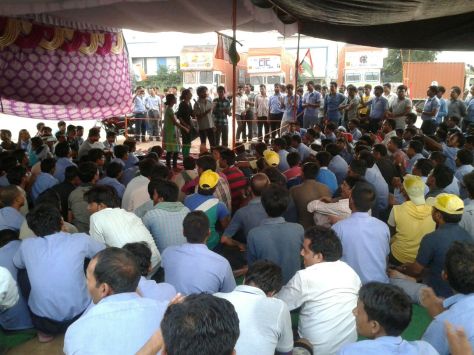
On the morning of 18 September 2015 when the workers employed in the Bridgestone company reached their factory gates they were met with Police officers and hired bouncers at the gate. When the workers tried to enter the factory premises they were resisted by the uniformed and the non-uniformed goons of the Factory Management. The Police beat up the workers and prevented them from entering the premises of the factory in spite of having a court order for tool down and without any prior notice the workers were sacked by the company. More than 400 workers employed in Bridgestone Factory in Manesar have been unlawfully sacked by the Company authorities after the workers demanded to get their Union registered. The workers are currently protesting outside the factory and have gathered there to raise their voice against the injustice and oppression that they are facing at the hands of the factory management.

Continue reading Workers right to unionize being trampled upon in yet another factory in Manesar: Report

A Contested line – Implementation of Inner Line Permit in Manipur: Deepak Naorem

This is a guest post by DEEPAK NAOREM

Violence and the accompanying disruption of everyday life in Manipur is not a recent phenomenon. This year too, the state was plunged into a spiral of violence following demands for the implementation of Inner Permit Line, a law originating in the colonial period. This demand is based on real or imagined fears that Manipur, like Sikkim and Tripura, would be overwhelmed by the ‘outsiders’ and that the ‘indigenous people’ of Manipur would become a minority in their homeland. Such demands are neither new nor surprising in this part of the world, where a nearly-unfathomable ethnic, demographic and political jigsaw puzzle was created by British colonialism; one that was deepened by even more myopic and inconsistent policy in the post-colonial years. However, this year, following the death of a young student by police firing during a student protest in Imphal, the movement demanding the Inner Line Permit (ILP) gained considerable momentum in Manipur. Subsequently, the legislature was forced to introduce three bills in the Manipur State Legislative Assembly on 28th August, 2015, ensuring the implementation of Inner Line Permit in the state. This in turn triggered another wave of violence with the ‘tribals’ and tribal organizations opposing the three bills, eventually bringing life to a standstill in the state.

Continue reading A Contested line – Implementation of Inner Line Permit in Manipur: Deepak Naorem

Scramble for Muslim Votes as Owaisi Jumps into Bihar Polls: Abhay Kumar

Guest post by ABHAY KUMAR

Ever since Asaduddin Owaisi, president of the All India Majlis-e-Ittehadul Muslimeen (henceforth MIM), addressed a well-attended public meeting in Kishanganj  on August 17, speculation about his party contesting election in Bihar has been rife. Three weeks after the rally, Owaisi, eventually, decided that he would field candidates in Muslim-dominated Seemanchal region of Kishanganj, Araria, Purnia and Katihar. “MIM will put up candidates in Bihar’s Seemanchal region, which is not only backward but also has a lot of problems. There has to be over all development,” Owaisi told media, giving the leaders of anti-Hindutva Grand Alliance jitters.

Contrary to Owaisi’s latest move, some political observers had held the view that given the weak organisational structure of the MIM in Bihar and late entry in the state, Owaisi was unlikely to jump into assembly election. For example, senior journalist and political commentator, Khurshid Hashmi said that if Owaisi had been serious about Bihar election, he would have launched his campaign much earlier as he did in UP. Continue reading Scramble for Muslim Votes as Owaisi Jumps into Bihar Polls: Abhay Kumar

An Attempt to Make Sense of Culture in Islam: Raoof Mir

Guest post by RAOOF MIR

Purity and corruption has remained one of the recurrent themes in the entire history of Islam. The arrival of Islam in Arabia did not mean a radical departure from the past. Wael B. Hallaq, a noted scholar on Islamic law and Islamic intellectual history establishes through his commendable work that “much of Arabian law continued to occupy a place in the Shari’ah, but not without modification.” Prophet Mohammed, who founded this new faith by introducing new nomos, also let several old customs and institutions to remain unchallenged. Despite his critical attitude toward the local social and moral environment, Prophet Muhammad was very much part of this environment and was deeply rooted in the traditions of Arabia.

Though the new converts to Islam entered into a new cosmological order, they at the same time, continued to adhere to the practices of old pagan culture. Since the arrival of Islam many individual reformists or reform movements have intended to reform Islam and decontaminate it from its ‘accretional’ aspects. These reformative endeavours envisaged a Muslim community that is not only socially distinct but also repudiates the pre-existing cosmological order. However, so far, there has been no end to this conflict. This conflict between the formal ideology of reformists (Textual Islam) and functional behaviour of the majority of the Muslims (Lived Islam) continues till today. Continue reading An Attempt to Make Sense of Culture in Islam: Raoof Mir

Old Age Culture Homes and other Cultural Pollutants – Lessons in Toxicity from the Minister of Culture

The world’s largest ‘cultural’ organization, the Rashtriya Swayamsevak Sangh (National Volunteer Organization) recently met with the minister responsible for what is probably, in real terms, the world’s smallest ‘culture’ ministry, the Ministry of Culture, Government of India. Under Khaki shorts, size does matter. The big tell the small, what’s what.

Continue reading Old Age Culture Homes and other Cultural Pollutants – Lessons in Toxicity from the Minister of Culture

Muzaffarnagar Baaqi Hai – Critical Readings Online and Offline: Akash Bhattacharya and Arif Hayat Nairang

These are guest posts by Akash Bhattacharya and Arif Hayat Nairang

The film Muzaffarnagar Baaqi Hai has been in the news recently, and not always for the right reasons, having attracted disruptive and abusive protest at some screenings. Following a day of counter-protest in which the film was screened all over the country, a friend teaching in a Delhi University college suggested screening it in her college, only to be told by the student representative that it would “cause trouble” (“bawwal mach jayega ma’am!!”). She asked what that meant and if he had seen the film, and he simply said, “nahin, bhaiyya logon ne kaha hai ki woh film bahut buri hai” (No, but our elder brothers have said it’s a bad film). 

In an atmosphere where political self-censoring comes as easily to the current generation of students as scouring the net for “blocked content” we present below two readings of the reception of the film, the first ruminating on whether the film addresses the complexities of communal mobilisation adequately; and the second inquiring in the context of social media and particularly Facebook, what constitutes the ‘liking’ of an image or idea. The idea of posting these comments is as much to give space to these arguments as it is to make a larger point that the ‘sickular left’ voices that are presumably behind the film love discussion, critique and disagreement. That to my mind is the way forward, not pre-empting the always-already hurt sentiments of the bhaiyya log whosoever they may be.

Continue reading Muzaffarnagar Baaqi Hai – Critical Readings Online and Offline: Akash Bhattacharya and Arif Hayat Nairang

Hindutva: A Political Theory of Nationhood?: Aman Verma

Guest post by Aman Verma

It is disheartening to see amongst supporters of Hindutva these days a silent acquiescence and at times even active support for extra-constitutional techniques being adopted by organizations like the RSS and its offshoots towards attaining the goal of Ram Rajya. An assessment is necessary of what would ultimately entail on the social, political and economic fronts if such a policy that envisages a supposedly ‘Hindu’ cultural and linguistic hegemony over cultures and languages represented by minority communities becomes reality. However, being a student of law what disturbs me more is the absence of any socio-political entity or civil society movement rooted in values of democracy that can effectively counter the impact of Hindutva organizations on the Indian social fabric. While the BJP has its RSS, every other political party claiming to be the upholder of secularism lacks its equivalent, or at the very least an effective social protégé.

Further, my personal interactions with supporters of BJP reveals that there is some deep sense of hurt and helplessness, part valid for the sake of argument, but for the most part carefully manufactured by Hindutva propaganda, which manifests itself in questions a friend recently put to me, “What are the other ways in which the Hindus can also claim their rights and send out a message that they have been too tolerant for too long?” and another which sounded like “How else to keep our dignity and identity alive in our land?”. These questions, based upon presumptions like those of “Hindu tolerance” of acts perpetrated by other communities supposedly only against Hindus and, protection of a completely vague concept of “Hindu identity” are clearly an outcome of a campaign strategy that relies upon upping the antics on the romantic-nationalist front.

Continue reading Hindutva: A Political Theory of Nationhood?: Aman Verma

Cheralam to Keralam to Ketta-idam – A Report on ‘Development’ from Trivandrum, Kerala: Sriranjini R

This is a guest post by Sriranjini R.

Cheralam Sriranjani

ISIS in Syria, Al Qaeda in Afghanistan, Taliban in Pakistan, Boko Haram in Nigeria, ecological problems, climate change … the list of the world’s ‘security’ problems seems endless. India has its own share of course – the India-Pakistan conflict, India-China problems, Maoism and so on. In Kerala, police have been desperate to find ‘security threats’ of their own. They first tried hunting down a ‘druglord’ whose picture was found on T-shirts of young people suspected of drug use. His name is Bob Marley. Please give the man up if you find him anywhere. Then they tried looking for Maoists. Every state has some, how come we have so few, was their complaint. After going after thin, dark-skinned, bearded fellows, Kiss of Love activists, and sundry others, hoping that one of these will be a Maoist, finally they caught one. And he didn’t look like any threat to most Malayalis.

Continue reading Cheralam to Keralam to Ketta-idam – A Report on ‘Development’ from Trivandrum, Kerala: Sriranjini R

Allahabad High Court Order on Government Schools in U.P: Devanik Saha

This is a guest post by Devanik Saha

The judiciary in India can be highly unpredictable. Either it is accused of not doing enough to provide justice to victims or it is hailed for giving landmark judgments. In a recent controversial decision, the Allahabad High Court ordered that all children of government servants and elected representatives in Uttar Pradesh should mandatorily send their wards to government schools. It noted that “Only then would they be serious enough to look into the requirements of these schools and ensure that they are run in good condition”.

While the decision has evoked sharp reactions from UP legislators, it has been fiercely debated in the media fraternity, with mixed responses. The wretched condition of government schools (in every state) in India isn’t a hidden fact. While India has achieved impressive rates of school enrolment – the quality of education and learning outcomes – have been extremely dismal.

An analysis by data journalism portal IndiaSpend revealed that Rs 5,86,085 crore has been spent on primary education in the past 10 years and 80% of the expenditure on education is spent on teachers, but the state of affairs continue to be dreary, which has led to the mushrooming of low income private schools. The number of students enrolled in private schools in UP has risen from 32.2% in 2006 to 52.8% in 2014, according to the Annual Survey Education Report (ASER) by Pratham, an education NGO.

Continue reading Allahabad High Court Order on Government Schools in U.P: Devanik Saha

P.A.D.S. Statement on the killing of Prof MM Kalburgi – a sane voice against communalism and superstition

People’s Alliance for Democracy and Secularism (PADS)

Murder of another rational voice against communalism and superstition

The respected and loved Kannada scholar and writer MM Kalburgi was murdered by two unidentified men on August 30 at his home in Dharwad. The seventy seven year scholar was actively researching Vachanas literature of early Kannada and literature produced during the Adil Shahi period in Northern Karnataka. He was a source of wisdom for many students and scholars, and his killers gained access posing as students. He was also a vocal critic of religious superstitions and had been targeted by fundamentalists within his own Lingayat community and by Hindutva organisations. He had received many threats and his house had been attacked with stones and bottles. He was given police protection, which was withdrawn only days before his murder.

Professor Kalburgi’s cold-blooded murder has caused widespread shock and dismay in the literary and intellectual circles of Karnataka. Many protests involving ordinary citizens have been held in Bangalore and Dharwad. At least one Hindutva Bajrang dal activist has publicly welcomed the assassination, warned another rationalist of Karnataka, Prof KS Bhagwan of the same fate.

Prof Kalburgi’s killing comes after the murders of two other prominent critics of religious superstitions. Dr Narender Dabholkar was killed in 2013 in Pune. Trade Unionist and Communist Govind Pansare was killed in Kolhapur in February this year. There are uncanny similarities in the modus operandi of all three cases. It is likely that as in the earlier cases, the police will fail to solve Prof Kalburgi’s murder. Continue reading P.A.D.S. Statement on the killing of Prof MM Kalburgi – a sane voice against communalism and superstition

A Consummate Hanging Bares Gaping Holes in Nation State’s Democratic Facade : Sanjay Kumar

Guest Post by Sanjay Kumar

At 7AM on 30 July, 2015, the Republic of India hanged a man named Yakub Memon. By all means, though without anyone’s planning, the hanging turned out to be the endpoint of a consummate exercise. Three judges of the highest court of the land sat through the night, right up to two hours before the execution to decide on the last petition of the condemned convict. The highest law official of the central government came to put forth arguments against the petition at two thirty in the morning, while some of the most respected and best legal minds of the country argued for it. Even before this post mid night hearing, the case of Mr Memon had been through more than one round of curative and review petitions in the Supreme Court, and mercy petitions with the President of the Republic. Much earlier, in fact more than twenty years ago, the Mumbai police had carried out perhaps the most painstaking, and detailed investigation of independent India into the 12 March, 1993 blasts; cracking the case within two days and filing a 10,000 page charge sheet within eight months. The trial involving 123 accused, 684 witnesses and voluminous material evidence ran for ten years. After Mr Memon’s guilt and conviction were established by the trial court, his appeals had gone on in the Supreme Court for nearly a decade. Two years ago the then Government of India had hanged Afzal Guru, a Kashmiri convicted in the Parliament attack case, without informing his family, and refused to hand his dead body to them. Nothing of that shameful behaviour was repeated this time. What more could the criminal justice system of the country have done in the case of Mr Memon! Yet, his execution has left behind more questions on the institutional biases, and ideological underpinnings of the Indian state, than perhaps any other execution. Continue reading A Consummate Hanging Bares Gaping Holes in Nation State’s Democratic Facade : Sanjay Kumar

Saving ‘Development’ From Dangerous Women Activists: Kamal Nayan Choubey

Guest Post by  KAMAL NAYAN CHOUBEY

The inclination of the Indian State to suppress any movement related to the just demands of marginalized sections has increased immensely in recent times. There is no question of dialogue. Coercive methods are generally employed to contain these movements. This is what has happened with the movement of tribal people are struggling against the Kanhar Dam in the Sonbhadra district of Uttar Pradesh. In this movement, women activists play a crucial role, and in order to contain it, the UP Police arrested two key women activists Roma and Sukalo, and six other women activists from the Robertsganj office of All India Union for Forest Working People (AIUFWP) on 30th June 2015.

DSC00028

Roma is the General Secretary of the AIUFWP.

The UP police has registered cases of inciting rioting against the women activists and it has also reopened old cases against them, particularly against Roma. Apart from them, another tribal woman activist Rajkumari was arrested on 21st April.

DSC00115

Sukalo

Continue reading Saving ‘Development’ From Dangerous Women Activists: Kamal Nayan Choubey

The Murky Fourth Estate: Asifa Zunaidha

This is a guest post by ASIFA ZUNAIDHA.

[Some time ago, I wrote on Kafila about my experience of attending a televised interaction with HRD Minister Smriti Irani. The audience, packed with supporters of the particular party Irani belongs to, was set up in that debate as the neutral ‘public’, thereby killing two birds with one stone – boosting the popularity of the Minister on news media, and legitimising the news channel as a site of punchy political debate. We have below a similar case of manipulation of the powerful medium of electronic news media, this time by another channel.] 

What is the role of the news media in a society if not to disseminate information and opinions as an impartial media(tor)? ‘Half truth is no truth’ is a popular aphorism, but ‘selective’ truth is also a lie and certainly does not befit the content of a news channel. It seems that in an age of corporate media, one would be foolish to expect impartial truths, let alone ‘undiluted or uncensored’ opinion of diverse groups. A recent episode inside the JNU campus shows how ‘news’ presented by News Channels can be easily manipulated and the opinion of a ‘select few’ is showcased as the ‘unanimous opinion’ emerging from the premier higher educational institute of the country.

Continue reading The Murky Fourth Estate: Asifa Zunaidha

Open Letter to Odisha CM Re False Charges Against GASS Activist Debaranjan

 WITHDRAW FALSE CHARGES AGAINST DEBARANJAN OF GASS, ODISHA

To:

Mr Naveen Patnaik
Chief Minister,
Government of Odisha

22 August 2015

 We, the undersigned, unequivocally condemn the foisting of a false case on Debaranjan, member of the Ganatantrik Adhikar Surakhya Sangathan (GASS) in Odisha.

Debaranjan has for several years now been deeply involved with people’s struggles in Odisha, first as a full-time activist in Kashipur, Rayagada district, then as film-maker, and most recently also as a member of the democratic rights group GASS. His has been among the consistent voices in Odisha for over twenty years against state repression on people’s struggles, atrocities faced by adivasis, dalits and other underprivileged communities, and against communalization of the polity and in society. This is the political context in which he is being targeted.

Last week, Debaranjan was sought to be interrogated by the Special Branch of the Intelligence Department while he was engaged in work on a documentary film in Malkangari district. Subsequently, a number of false charges were filed against him by the Malkangiri Police, including charges pertaining to molestation under Section 354 (b) of the IPC, and under sections 354 and 323. We believe these charges to be patently false and absurd, and constitute nothing other than harassment and part of the continued persecution of democratic voices in this country. Continue reading Open Letter to Odisha CM Re False Charges Against GASS Activist Debaranjan

Public Secrets Now Proven – Ranveer Sena Terrorists Caught on Camera by Cobrapost: Kavita Krishnan

Guest Post by Kavita Krishnan

The ‘Operation Black Rain’ film released by the web portal Cobrapost, based on secretly filmed boasts of the Ranveer Sena terrorists with detailed accounts of massacres of Dalit and oppressed caste labourers in the 1990s, has only confirmed public secrets that everyone in Bihar already knew.

Continue reading Public Secrets Now Proven – Ranveer Sena Terrorists Caught on Camera by Cobrapost: Kavita Krishnan

Two Or Three Things I Know About My Country: Pradeep Jeganathan

As the people of Sri Lanka complete the voting process for the Parliamentary elections of 2015, PRADEEP JEGANATHAN  reflects on his country’s history and politics.

We’ve never really had a father. We like to think we did, of course, be it D.S. Senanayake, S.W.R.D. Bandaranaike or S.J.V. Chelvanayagam. But they never had a vision for Lanka that made sense, in the end. Unlike a Mahathir, Nehru or a Mandela, their vision was partisan, and the results plain to see. Senanayake’s great contribution was to disenfranchise the up country Tamils, and ignore the vernacular language question. Bandaranaike and Chelvanayagam were his children, fighting for the house that he never finished building.

We’ve gone along since, fatherless children that we are. So many have been killed, and so many have killed. Maimed. Seen the essence of inhumanity, lived with it, so it has become ordinary. Many of us like to think Rajapakse is our father, since it is said he rescued us from all this, took us over the mountains to the valley of peace. Certainly, he’s proclaimed himself father and king, and his sons princes. And he’s had his moments.

Read the rest of this piece in Colombo Telegraph.

The penultimate paragraph refers to a song by Nanda Malini:

We’ve always had our mother. She is Lanka. That is the third thing I know about my country, and when I say, our mother is Lanka, or Ilankai or Eelam (for that too is a name for Lanka), I do not mean it in the sense of an inanimate goddess that is to be adored, appropriated and used as a cover for racism, violence and inequality. No, I mean it in the sense of Lanka’s lament, in the great songstress’ lyric, “Deddahas Pansiya Vasarak. (For 2,500 years).” In this beautiful song, Nanda Malini sings Lanka’s lament, her almost helpless sadness and deep grief, at the robbers and killers she has given birth to, who have then become big men and women, clinging to power by selling her name.

Here is the song:

Pradeep Jeganathan is currently Professor, School of Humanities and Social Sciences, Shiv Nadar University.

Response to ‘Open letter by a Cop’ on Yakub Memon: Ishani Cordeiro

Guest post by ISHANI CORDEIRO

A reply to ‘An Open Letter By A Cop To Those Opposing Death Penalty To Yakub Memon’ by ‘ A Thulla’.

Dear ‘Thulla’

Let me begin by stating, for the record, that a lot of people who have raised their voice against death penalty (and not just Yakub Memon’s) are not necessarily sitting in ‘plush AC offices’ or writing ‘editorials seeking clemency for a murderer’ or visiting TV studios and shouting themselves hoarse. A lot of them are activists and lawyers and the aam aadmi – working on the ground. Having said that, let’s not disregard the voices of the public based merely on where they decide to park their backside! Also, I would like to bring to your notice that terms like human rights, due process and fake encounter are not ‘ramifications’ of pulling a trigger per se. The term ‘ramification’ implies an unwelcome consequence of an action. Human rights and due process are pillars of a democracy and fake encounters are constitutional infringements. The fact that ‘terrorists’ don’t consider these of much value but you have to consider these burdensome terms before taking any action also implies that the law (read constitution) considers you to be ‘reasonable person’ and not the ‘terrorist’. Continue reading Response to ‘Open letter by a Cop’ on Yakub Memon: Ishani Cordeiro

Teesta, Yakub and Hijab – The Triple Tests of Nationalism: Saif Mahmood

Guest post by SAIF MAHMOOD

If you are Indian but not a supporter of the present Government, on social media your loyalty to your country will be tested on the following touchstones :

  1. Have you said anything against the CBI’s palpably malicious agenda against Teesta Setalvad or even hinted that, even if the CBI’s allegations are taken on their face value, she is entitled to anticipatory bail ?
  2. Do you think that the decision to hang Yakub Memon deserves one last re-look ?
  3. Have you criticised the manner in which female Muslim and Christian PMT aspirants were told to take off their hijabs and scarfs if they wished to take the test and / or the intemperate language in which the Supreme Court refused to interfere in the matter?

If the answer to any of the above questions is in the affirmative, you have just failed the loyalty test; and failed you have, irrespective of the reasons that you may have for your answers. Continue reading Teesta, Yakub and Hijab – The Triple Tests of Nationalism: Saif Mahmood

CBI Mis-reporting on Search: Teesta Setalvad

We reproduce below the full statement (partially reported in the newspapers) from Teesta Setalvad on the CBI search at her office premises regarding the continuous misreporting that was going on during the search: 

As I write this, the search is still not concluded. It is shocking that while over a dozen members of the CBI are still in our premises conducting the search, Delhi spokesperson is misleading the public and our vast supporters by a series of misinformations and official tweets.

In our view, and we repeat no laws have been broken by us. This is a continuation of the persecution and witchhunt first launched by the Gujarat police in 2014 then under the dispensation that rules Delhi. The CBI has taken the same documents that we had voluntarily on inspection given the MHA (FCRA dept). Over 25,000 pages of documentary evidence has been given to the Gujarat Police. When they could not succeed with the bizarre and desperate attempts to gain custody (February 2015), it was the Gujarat Government Home Department that wrote to the MHA and the current round of the persecutions began.

Its is shameful political vendetta. The Zakia Jafri case begins its final hearings on July 27 2015. The Naroda Patiya appeals (Kodnani and Bajrangi) are being heard in the Gujarat High Court tomorrow. This is nothing but a bid to subvert the cause of public justice and ensure that no justice happens in these cases. Continue reading CBI Mis-reporting on Search: Teesta Setalvad

Hindutva Media – An Online Upheaval: Saif Ahmad Khan

Guest Post by SAIF AHMAD KHAN

The year 2004 saw the Indian electorate defying the verdict of psephologists by voting out the incumbent Bharatiya Janata Party led National Democratic Alliance government at the Centre. The fundamental reason behind the defeat of Atal Bihari Vajpayee’s government was the slogan of “India Shining” which was perceived by the voters to be nothing more than a poll gimmick as millions of ordinary Indians were trapped in the vicious cycle of poverty and struggling due to high inflation.

However, a decade after 2004, one has reason to believe that “India Shining” was a blessing in disguise for the BJP. Traditionally, BJP was an anti-technology party owing to its Swadeshi leanings. When computer technology was being introduced by the Rajiv Gandhi government during the 1980s, the socialist parties opposed the move and argued that mechanization would lead to unemployment. The Sang Parivar echoed similar sentiments.

The general elections held in 2004 brought about a paradigm shift in BJP’s approach towards technology as the saffron party ran India’s first computer-centric, Hollywood-style electoral campaign. The most talked about thing of the 2004 elections was the “Indian Shining” slogan of the incumbent government. Prathap Suthan, National Creative Director of Grey Worldwide, was the man responsible for coning the term. India Shining was originally an initiative of the Central Government which sought to promote the country’s economic achievements and industrial progress on a global scale.

Continue reading Hindutva Media – An Online Upheaval: Saif Ahmad Khan