Category Archives: Politics

A Consummate Hanging Bares Gaping Holes in Nation State’s Democratic Facade : Sanjay Kumar

Guest Post by Sanjay Kumar

At 7AM on 30 July, 2015, the Republic of India hanged a man named Yakub Memon. By all means, though without anyone’s planning, the hanging turned out to be the endpoint of a consummate exercise. Three judges of the highest court of the land sat through the night, right up to two hours before the execution to decide on the last petition of the condemned convict. The highest law official of the central government came to put forth arguments against the petition at two thirty in the morning, while some of the most respected and best legal minds of the country argued for it. Even before this post mid night hearing, the case of Mr Memon had been through more than one round of curative and review petitions in the Supreme Court, and mercy petitions with the President of the Republic. Much earlier, in fact more than twenty years ago, the Mumbai police had carried out perhaps the most painstaking, and detailed investigation of independent India into the 12 March, 1993 blasts; cracking the case within two days and filing a 10,000 page charge sheet within eight months. The trial involving 123 accused, 684 witnesses and voluminous material evidence ran for ten years. After Mr Memon’s guilt and conviction were established by the trial court, his appeals had gone on in the Supreme Court for nearly a decade. Two years ago the then Government of India had hanged Afzal Guru, a Kashmiri convicted in the Parliament attack case, without informing his family, and refused to hand his dead body to them. Nothing of that shameful behaviour was repeated this time. What more could the criminal justice system of the country have done in the case of Mr Memon! Yet, his execution has left behind more questions on the institutional biases, and ideological underpinnings of the Indian state, than perhaps any other execution. Continue reading A Consummate Hanging Bares Gaping Holes in Nation State’s Democratic Facade : Sanjay Kumar

Saving ‘Development’ From Dangerous Women Activists: Kamal Nayan Choubey

Guest Post by  KAMAL NAYAN CHOUBEY

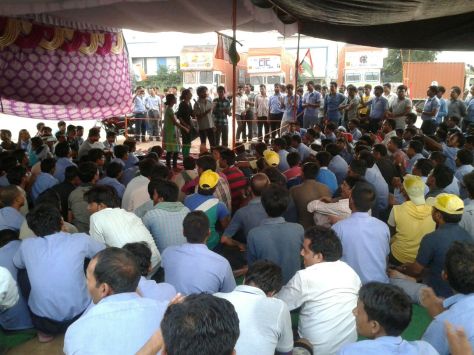
The inclination of the Indian State to suppress any movement related to the just demands of marginalized sections has increased immensely in recent times. There is no question of dialogue. Coercive methods are generally employed to contain these movements. This is what has happened with the movement of tribal people are struggling against the Kanhar Dam in the Sonbhadra district of Uttar Pradesh. In this movement, women activists play a crucial role, and in order to contain it, the UP Police arrested two key women activists Roma and Sukalo, and six other women activists from the Robertsganj office of All India Union for Forest Working People (AIUFWP) on 30th June 2015.

DSC00028

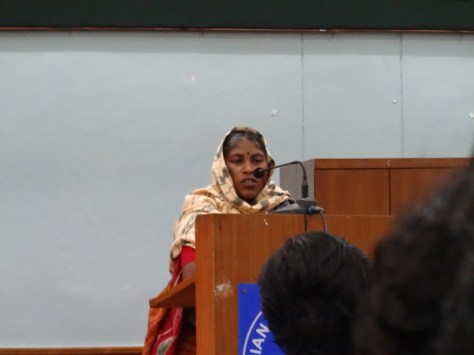
Roma is the General Secretary of the AIUFWP.

The UP police has registered cases of inciting rioting against the women activists and it has also reopened old cases against them, particularly against Roma. Apart from them, another tribal woman activist Rajkumari was arrested on 21st April.

DSC00115

Sukalo

Continue reading Saving ‘Development’ From Dangerous Women Activists: Kamal Nayan Choubey

The Murky Fourth Estate: Asifa Zunaidha

This is a guest post by ASIFA ZUNAIDHA.

[Some time ago, I wrote on Kafila about my experience of attending a televised interaction with HRD Minister Smriti Irani. The audience, packed with supporters of the particular party Irani belongs to, was set up in that debate as the neutral ‘public’, thereby killing two birds with one stone – boosting the popularity of the Minister on news media, and legitimising the news channel as a site of punchy political debate. We have below a similar case of manipulation of the powerful medium of electronic news media, this time by another channel.] 

What is the role of the news media in a society if not to disseminate information and opinions as an impartial media(tor)? ‘Half truth is no truth’ is a popular aphorism, but ‘selective’ truth is also a lie and certainly does not befit the content of a news channel. It seems that in an age of corporate media, one would be foolish to expect impartial truths, let alone ‘undiluted or uncensored’ opinion of diverse groups. A recent episode inside the JNU campus shows how ‘news’ presented by News Channels can be easily manipulated and the opinion of a ‘select few’ is showcased as the ‘unanimous opinion’ emerging from the premier higher educational institute of the country.

Continue reading The Murky Fourth Estate: Asifa Zunaidha

Open Letter to Odisha CM Re False Charges Against GASS Activist Debaranjan

 WITHDRAW FALSE CHARGES AGAINST DEBARANJAN OF GASS, ODISHA

To:

Mr Naveen Patnaik
Chief Minister,
Government of Odisha

22 August 2015

 We, the undersigned, unequivocally condemn the foisting of a false case on Debaranjan, member of the Ganatantrik Adhikar Surakhya Sangathan (GASS) in Odisha.

Debaranjan has for several years now been deeply involved with people’s struggles in Odisha, first as a full-time activist in Kashipur, Rayagada district, then as film-maker, and most recently also as a member of the democratic rights group GASS. His has been among the consistent voices in Odisha for over twenty years against state repression on people’s struggles, atrocities faced by adivasis, dalits and other underprivileged communities, and against communalization of the polity and in society. This is the political context in which he is being targeted.

Last week, Debaranjan was sought to be interrogated by the Special Branch of the Intelligence Department while he was engaged in work on a documentary film in Malkangari district. Subsequently, a number of false charges were filed against him by the Malkangiri Police, including charges pertaining to molestation under Section 354 (b) of the IPC, and under sections 354 and 323. We believe these charges to be patently false and absurd, and constitute nothing other than harassment and part of the continued persecution of democratic voices in this country. Continue reading Open Letter to Odisha CM Re False Charges Against GASS Activist Debaranjan

Public Secrets Now Proven – Ranveer Sena Terrorists Caught on Camera by Cobrapost: Kavita Krishnan

Guest Post by Kavita Krishnan

The ‘Operation Black Rain’ film released by the web portal Cobrapost, based on secretly filmed boasts of the Ranveer Sena terrorists with detailed accounts of massacres of Dalit and oppressed caste labourers in the 1990s, has only confirmed public secrets that everyone in Bihar already knew.

Continue reading Public Secrets Now Proven – Ranveer Sena Terrorists Caught on Camera by Cobrapost: Kavita Krishnan

Two Or Three Things I Know About My Country: Pradeep Jeganathan

As the people of Sri Lanka complete the voting process for the Parliamentary elections of 2015, PRADEEP JEGANATHAN  reflects on his country’s history and politics.

We’ve never really had a father. We like to think we did, of course, be it D.S. Senanayake, S.W.R.D. Bandaranaike or S.J.V. Chelvanayagam. But they never had a vision for Lanka that made sense, in the end. Unlike a Mahathir, Nehru or a Mandela, their vision was partisan, and the results plain to see. Senanayake’s great contribution was to disenfranchise the up country Tamils, and ignore the vernacular language question. Bandaranaike and Chelvanayagam were his children, fighting for the house that he never finished building.

We’ve gone along since, fatherless children that we are. So many have been killed, and so many have killed. Maimed. Seen the essence of inhumanity, lived with it, so it has become ordinary. Many of us like to think Rajapakse is our father, since it is said he rescued us from all this, took us over the mountains to the valley of peace. Certainly, he’s proclaimed himself father and king, and his sons princes. And he’s had his moments.

Read the rest of this piece in Colombo Telegraph.

The penultimate paragraph refers to a song by Nanda Malini:

We’ve always had our mother. She is Lanka. That is the third thing I know about my country, and when I say, our mother is Lanka, or Ilankai or Eelam (for that too is a name for Lanka), I do not mean it in the sense of an inanimate goddess that is to be adored, appropriated and used as a cover for racism, violence and inequality. No, I mean it in the sense of Lanka’s lament, in the great songstress’ lyric, “Deddahas Pansiya Vasarak. (For 2,500 years).” In this beautiful song, Nanda Malini sings Lanka’s lament, her almost helpless sadness and deep grief, at the robbers and killers she has given birth to, who have then become big men and women, clinging to power by selling her name.

Here is the song:

Pradeep Jeganathan is currently Professor, School of Humanities and Social Sciences, Shiv Nadar University.

Response to ‘Open letter by a Cop’ on Yakub Memon: Ishani Cordeiro

Guest post by ISHANI CORDEIRO

A reply to ‘An Open Letter By A Cop To Those Opposing Death Penalty To Yakub Memon’ by ‘ A Thulla’.

Dear ‘Thulla’

Let me begin by stating, for the record, that a lot of people who have raised their voice against death penalty (and not just Yakub Memon’s) are not necessarily sitting in ‘plush AC offices’ or writing ‘editorials seeking clemency for a murderer’ or visiting TV studios and shouting themselves hoarse. A lot of them are activists and lawyers and the aam aadmi – working on the ground. Having said that, let’s not disregard the voices of the public based merely on where they decide to park their backside! Also, I would like to bring to your notice that terms like human rights, due process and fake encounter are not ‘ramifications’ of pulling a trigger per se. The term ‘ramification’ implies an unwelcome consequence of an action. Human rights and due process are pillars of a democracy and fake encounters are constitutional infringements. The fact that ‘terrorists’ don’t consider these of much value but you have to consider these burdensome terms before taking any action also implies that the law (read constitution) considers you to be ‘reasonable person’ and not the ‘terrorist’. Continue reading Response to ‘Open letter by a Cop’ on Yakub Memon: Ishani Cordeiro

Teesta, Yakub and Hijab – The Triple Tests of Nationalism: Saif Mahmood

Guest post by SAIF MAHMOOD

If you are Indian but not a supporter of the present Government, on social media your loyalty to your country will be tested on the following touchstones :

  1. Have you said anything against the CBI’s palpably malicious agenda against Teesta Setalvad or even hinted that, even if the CBI’s allegations are taken on their face value, she is entitled to anticipatory bail ?
  2. Do you think that the decision to hang Yakub Memon deserves one last re-look ?
  3. Have you criticised the manner in which female Muslim and Christian PMT aspirants were told to take off their hijabs and scarfs if they wished to take the test and / or the intemperate language in which the Supreme Court refused to interfere in the matter?

If the answer to any of the above questions is in the affirmative, you have just failed the loyalty test; and failed you have, irrespective of the reasons that you may have for your answers. Continue reading Teesta, Yakub and Hijab – The Triple Tests of Nationalism: Saif Mahmood

CBI Mis-reporting on Search: Teesta Setalvad

We reproduce below the full statement (partially reported in the newspapers) from Teesta Setalvad on the CBI search at her office premises regarding the continuous misreporting that was going on during the search: 

As I write this, the search is still not concluded. It is shocking that while over a dozen members of the CBI are still in our premises conducting the search, Delhi spokesperson is misleading the public and our vast supporters by a series of misinformations and official tweets.

In our view, and we repeat no laws have been broken by us. This is a continuation of the persecution and witchhunt first launched by the Gujarat police in 2014 then under the dispensation that rules Delhi. The CBI has taken the same documents that we had voluntarily on inspection given the MHA (FCRA dept). Over 25,000 pages of documentary evidence has been given to the Gujarat Police. When they could not succeed with the bizarre and desperate attempts to gain custody (February 2015), it was the Gujarat Government Home Department that wrote to the MHA and the current round of the persecutions began.

Its is shameful political vendetta. The Zakia Jafri case begins its final hearings on July 27 2015. The Naroda Patiya appeals (Kodnani and Bajrangi) are being heard in the Gujarat High Court tomorrow. This is nothing but a bid to subvert the cause of public justice and ensure that no justice happens in these cases. Continue reading CBI Mis-reporting on Search: Teesta Setalvad

Hindutva Media – An Online Upheaval: Saif Ahmad Khan

Guest Post by SAIF AHMAD KHAN

The year 2004 saw the Indian electorate defying the verdict of psephologists by voting out the incumbent Bharatiya Janata Party led National Democratic Alliance government at the Centre. The fundamental reason behind the defeat of Atal Bihari Vajpayee’s government was the slogan of “India Shining” which was perceived by the voters to be nothing more than a poll gimmick as millions of ordinary Indians were trapped in the vicious cycle of poverty and struggling due to high inflation.

However, a decade after 2004, one has reason to believe that “India Shining” was a blessing in disguise for the BJP. Traditionally, BJP was an anti-technology party owing to its Swadeshi leanings. When computer technology was being introduced by the Rajiv Gandhi government during the 1980s, the socialist parties opposed the move and argued that mechanization would lead to unemployment. The Sang Parivar echoed similar sentiments.

The general elections held in 2004 brought about a paradigm shift in BJP’s approach towards technology as the saffron party ran India’s first computer-centric, Hollywood-style electoral campaign. The most talked about thing of the 2004 elections was the “Indian Shining” slogan of the incumbent government. Prathap Suthan, National Creative Director of Grey Worldwide, was the man responsible for coning the term. India Shining was originally an initiative of the Central Government which sought to promote the country’s economic achievements and industrial progress on a global scale.

Continue reading Hindutva Media – An Online Upheaval: Saif Ahmad Khan

Who cares about the environment? Some notes on the ecological crisis in India: Shashank Kela

Guest post by SHASHANK KELA

The past few months have been exceptional, in one respect at least, for the Indian press: a serious structural problem has actually been given the attention it deserves. The Economic Times continues to play a prominent part in discussing air pollution in Delhi – there is no other city in the world where it is so bad. Nor is this all: including Delhi, India now boasts thirteen out of twenty cities with the worst air. More recently, the uproar over supposedly high levels of lead in a brand of junk food led to a (very) few articles on groundwater contamination: after all, the reason why lead and other poisons get into food is because they are present in the soil in which crops grow. Another piece, in the Guardian this time, speculated that the recent Sahelian heat wave in the Deccan might be a symptom of climate change (an “extreme” climate event of the kind likely to become all too common).[1]

These stories are only a tiny fraction of those that could be reported, for we are already in the throes of an unprecedented environmental crisis. Large swathes of our agricultural soils are contaminated or saline. Pesticide residues and heavy metals form part of our food. The air of our major cities is unfit to breathe. Freshwater availability is declining; most rivers, especially in the south, do not flow at all, or only seasonally, since their runoff is impounded in dams and used for irrigation (with very high rates of seepage and evaporation loss). Groundwater tables are falling as a consequence of over extraction and the disappearance of vegetative cover enabling percolation. The pattern of weather is being reset with gaps and lags – the available evidence indicates that the onset of the monsoon is changing and precipitation becoming more uneven. Our offshore seas are denuded of marine life thanks to trawler fishing at ever greater distances. Himalayan glaciers are shrinking with obvious long-term consequences for the hydrology of river systems dependent upon snow-melt. Sudden, destructive floods, exacerbated by embankments and dams, the building over of river valleys and floodplains, have become a regular occurrence. Continue reading Who cares about the environment? Some notes on the ecological crisis in India: Shashank Kela

Remember the Indian commitment to Palestine! Palestine Solidarity Committee in India

Personally, it’s reached a point where there isn’t one single thing done in the name of ‘India’ that doesn’t make me deeply ashamed…(NM)

Statement from Palestine Solidarity Committee in India

The Palestine Solidarity Committee, the All India Peace and Solidarity Organisation and Indian Campaign for the Cultural and Academic Boycott of Israel condemns the government of India’s abstention from a UN Human Rights Council (UNHRC) vote for adoption of a UN Inquiry Commission report on Israel’s attack on Gaza, Palestine, last year. This is a blatant reversal of India’s longstanding policy of support to the Palestinians against Israel’s occupation of the West Bank and Gaza. The vote in the 47-member Council was overwhelmingly against Israel; 41 countries vote in favor of the resolution, only one – the U.S. – voted against it; India was one of the 5 countries who abstained.

This is the first time India has abstained on such a resolution in the UNHRC. Even in July last year, New Delhi voted in favour of a UNHRC resolution criticizing Israel for the Gaza war.

Continue reading Remember the Indian commitment to Palestine! Palestine Solidarity Committee in India

Greece says OXI! Some resources

g4

Chomsky in March 2015 on Europe’s “savage response” to Greek push-backs on austerity (Democracy Now!)

“Democracy Cannot Be Blackmailed”: Greek Voters Overwhelmingly Reject Creditors’ Austerity Demand (Amy Goodman in Democracy Now!)

What was good for Germany in 1953 is good for Greece in 2015 (Larry Elliott in The Guardian)

The Greeks Have Spoken: What Happens Next? (Kavaljit Singh in Madhyam)

Three Rarely –If Ever– Mentioned Facts In The Greek Tragedy (Saskia Sassen in Analyze Greece!)


ADMIN NOTICE: KAFILA COLLECTIVE

STATEMENT BY KAFILA COLLECTIVE

The Kafila collective takes serious note of the accusation of sexual assault/rape against one of our members, Mahmood Farooqi. We stand by the rights of both the complainant and the accused to a fair investigation and hope for a speedy and just resolution to the issue. Until then, Mahmood Farooqui is suspended from Kafila and will not be writing in it.

Appeal to Release Raif Badawi, a Saudi Blogger: Peoples Alliance for Democracy and Secularism

Guest Post by Peoples Alliance for Democracy and Secularism

To:

The Ambassador,
Embassy of Saudi Arabia at New Delhi,
2- Pachchimi Marg, VasantVihar,!
New Delhi-110057  Fax: 00911126144244

This is an appeal regarding Raif Badawi, a blogger and Saudi citizen, founder of the website ‘Free Saudi Liberals’. Mr Badawi has been under arrest since 2012 for insulting Islam and apostasy. He was sentenced to be punished with 10 years in prison along with 1000 lashes (50 lashes to be received on every Friday) and a fine of one million riyals. Though he was cleared of charges of apostasy in 2013, there are new reports that indicate he may be tried again under the same charge.

We are mindful that India and Saudi Arabia have long-standing friendly political and commercial relations and that large numbers of Indians live and work in your country. It is because of this that we feel constrained to convey to you our concerns. Raif Badawi is a public intellectual who communicated his thoughts to the public through a blog. We do not believe that any of its contents constituted a threat to the state. To the contrary, his advocacy for secularism and the separation of religion and state is a suggestion that would strengthen it.

Whether or not his ideas are pleasing to your government, the fact remains that as a member state of the United Nations, Saudi Arabia is presumed to be respectful of the freedom of speech that is provided for under Article 19 of Universal Declaration of Human Rights, 1948. This article states: ‘Everyone has the right to freedom of opinion and expression; this right includes freedom to hold opinions without interference and to seek, receive and impart information and ideas through any media and regardless of frontiers‘.

The sharing of information and ideas is a basic human practice and natural right that should be available to everyone regardless of their nationality or identity and (barring extremist incitement) should not be restricted by law. The state should protect and promote our rights instead of restricting them.

It has been reported that Raif Badawi received the first set of lashes on 9 January, after Friday prayers outside the Al-Juffali Mosque in Jeddah. The next round of punishment has been suspended on medical grounds to give his wounds time to heal prior to wounding him again. We consider this an example of barbaric cruelty, not befitting any member state of the UNO. Such practices are a travesty of justice and will bring you only disrepute.

We are Indian citizens who speak for human rights both within our own country and beyond. We are in solidarity with Raif Badawi and all those demanding freedom of speech in Saudi Arabia. We condemn the inhuman punishment being meted out to him as we condemn all measures that punish people for defending human rights and sharing their thoughts

We ask that Saudi Arabia:
•  Immediately suspend the punishment of Raif Badawi,
•  Release Raif Badawi and provide him security,
•  Take measures towards the provision of full freedom of expression in Saudi Arabia

Submitted by:

Ravi Nitesh, Peoples Alliance for Democracy and Secularism
, Dipak Dholakia
, Rajashri Dasgupta, 
Prithvi R Sharma, 
Rana P Behal, 
Shamsul Islam, 
Suman Keshari, 
Aseem Shrivastava, 
Viren Lobo
, Sabyasachi Bhattacharya, Kashif Ahmed Faraz, R.Sasankan, Journalist, Delhi , Rohit Sharma, Pilani, India
, Mandeep Singh from Revolutionary Youth Student Front
, Firoz Ahmad, Public School Teacher
, Chaman Lal, 
J.S.Bandukwala
, Devika Mittal (Mission Bhartiyam), 
Apoorvanand
, Sudha Vasan
, Dheeraj Gaba, 
Nawed Akhter, 
Dilip Simeon , Shabnam Hashmi, Rohini Hensman 
Ovais Sultan Khan, Ram Puniyani, Vinerjeet Kaur, Kiran Shaheen
, Battini Rao, Convener, Peoples Alliance for Democracy and Secularism (PADS)
, Javed Anand
, Harsh Kapoor
, Subash Mohapatra, Global Human Rights Communications, Bhubaneswar 
Sagar Rabari, Ahmedabad
, Nayanjyoti
, Shailendra Dhar, Journalist, Nihal Parashar
, Linus Ayangwoh 
Embe, Peter Marshall , Sudarshan Juyal
, Dhruv Singhal (Political Science student), 
Mohammad Imran, NRISAHI, Suresh Bhat
, Prof. S Ratnagar, Mumbai
, Ilma Iqbal
, Michael Karadjis
, Vasantharajan, Research Scholar , Rabin Chakraborty, 
Shruti Arora
, Hiren Gandhi, 
Anand Patwardhan, Dr. D. Gabriele, Mukul Mangalik, Neeraj Malik, academic, 
Suhas Borker
, Virginia Saldanha, Mumbai , Kasim Sait
, Waliullah Ahmed Laskar
, Kaveri Rajaraman, University of Hyderabad, 
Parth Sarthu
 Ram
, Mahesh Elkunchwar,  
Suman Kumar , Kamayani Bali Mahabal, 
Syed Ghazanfar Abbas, Jawad Mohammed
, Prof. Anil Sadgopal, Shiksha Adhikar Manch, Bhopal
Satya Pal, Secretary General – South Asian Fraternity 
Deepak Kabir / Veena Rana, Dastak, Lucknow 
Madhu Sarin
, Kavita Panjabi, Kolkata
, Xavier Dias Editor, Khan Kaneej aur ADHIKAR ,Jharkhand India , Muhammad Murad, from Pakistan, Sindh
, Sanjay Halder
, Gurpreet Singh, Ravi Tripathi, Francis Gonsalves
, Subhash Gatade, New Socialist Initiative, 
Shahid Siddiqui
, P.I. Jose, 
Ishwarbhai Prajapati, 
Deepak Kabir
, Fr. T.K.John , Professor 
Rohan Dandavate – TPI WORD, Daniel Varghese
, Sanjay T , Prasanth Menon
, Zakia Soman and Dr. Noorjehan SN from Bharatiya Muslim Mahila Andolan , Antony Aruloraj, New Delhi, India, 
Aarti Tikoo
, Ashish Biswas, Online Journalist, Dhaka, Bangladesh, 
Devaki Khanna, 
Alok Chadha
, Renu Singh, Samir Dholakia, Mushtaq Dar
, Narinder Singh Sandhu, 
P R Vaidya, Bombay
, Dr V Prasad
, Ameeque Jamei
, Padma Velaskar, Bhanu Bharti, Shuddhabrata Sengupta, Delhi
, M.Balanna, PADS, Andhra Pradesh
, Ajay Kumar, PADS Andhra Pradesh
, Roja Ramani Mahila Sravanti, Kurnool

June 1984 – 31 Years Later, Sikhs Are Mapping Their Stories: Ravleen Kaur

Guest post by RAVLEEN KAUR

When June 1984 comes up in conversation, the same talking points invariably arise – “it was the state’s burden to attack; they had no choice”, “Bhindranwale had to be taken down”, or “Punjab was already bleeding”.

What these oft-repeated phrases – a product of the tight PR messaging campaign on the part of the government – glide over is the scope of human suffering that occurred in June 1984 – and most glaringly, suffering that was perpetrated by those in power, by those who had been elected in a democracy to uphold the rights and dignity of the people who they killed in 1984.

Anthropologist Talal Asad has noted the “notorious tactic of political power to deny a distinct unity to populations it seeks to govern, to treat them as contingent and indeterminate.”

With the belief that every Sikhs who was alive in 1984 has a story to tell, the 1984 Living History Project is depicting the unity in trauma of a people, who, in 1984, felt attacked as a people. The 1984 Living History Project is working to give a platform to ordinary people who lived through the massacres of both June and November. The project was initiated in 2012 by Sikh millennials.  Realizing that the generation who experienced 1984 firsthand was getting older and that time was running out to capture their stories, they began a grassroots effort to capture as many stories and testimonies from Sikhs worldwide, one video narrative at a time. The first videos were their own parents and grandparents, recorded on smart phones and edited and shared rather seamlessly. The Project’s web platform allows easy Steps to make and share videos; something other Sikhs around the world have been doing through the 30th and 31st anniversary years of 1984.  Continue reading June 1984 – 31 Years Later, Sikhs Are Mapping Their Stories: Ravleen Kaur

A Response to the Fading Queerness: Navadeep

NAVADEEP writes in Gaylaxy on the responses around the matrimonial advertisement for a gay man placed by his mother, in which she specified “Caste no bar, (though Iyer preferred)”.

It has been a few days since the first gay-matrimonial ad of the country has been out, and as expected, it has gathered a great deal of attention both from gay and straight people. Lack of available information would keep me from commenting on the reactions among the straight crowd. But being a part of the gay community, I have witnessed two different arguments emerging:

1. It is a great progressive step from a loving mother for her gay son and is also a potentially visible statement of the gay community in mainstream society.

2. While appreciating the aforementioned, a section of people in the community are extremely agitated about how the matrimonial ad mentions a preference of caste. This has lead to the debate of contesting the regressive part of the ad (where, of course, I find my place)….

Where does one’s choice start and where does it end? How absolute and independent an identity can this choice and preference claim? Is this choice/preference free from conditioning? Is it just an individual’s sole conscious choice/preference or product of the society he is part of? Do personal choices and preferences have no social and political connotations? Do they not have any historical and cultural context?

Read the rest of this thought-provoking piece here, and do read the comments section too, for an interesting debate.

Bread and Circuses? No sir, circuses alone will do.

Edited and updated version of the post.

I had the great fortune to be invited as an audience member to a live interaction with Union HRD Minister Smriti Irani last evening, televised live on Aaj Tak. I say “great fortune” because despite the fact that I walked out of this “interaction” in speechless disgust around an hour into the programme, I probably learned more about the state of politics and media in this country in one evening than I could have from years of academic study. And the irrelevance of academics was exactly what was on display last evening, never mind that the topic of the interaction was the state of higher education in the country.

I reached the venue – the auditorium of Khalsa College, Delhi University – at about 5.15 pm for a 5.30 pm programme. The mood was surprisingly charged, even electric for what I imagined would be a sober discussion on somewhat boring topics like syllabus formation, university infrastructure, promotions and pensions, the points system, and most importantly, the changes proposed under the Choice Based Credit System (CBCS). The auditorium was already packed – not so much with teachers and students – but with a large number of ABVP activists, BJP volunteers, and committed party supporters from within and outside the University. Nothing wrong with having a politically committed section dominating the audience of course. But if the resultant mix is innocently termed “the public” – the term the anchor used was “janta” – then that constitutes the first point of deception. I took a seat in the second row as instructed, surrounded by triumphant, pumped-up BJP supporters shaking hands with each other, suddenly feeling small and irrelevant, having come prepared with questions on Delhi University. At one point, turning to speak to the person next to me, I encountered a gentleman who introduced himself only as a “social worker” and asked me to elaborate on the problems with the university. As I began to list them however, he cut me short with a wave of a hand to say the government will prevail over all of them, and turned back to gaze admiringly at the life-sized posters of Modi all around us. I realised the person knew absolutely nothing about the University or teaching as a profession, and couldn’t care less.

Two anchors from Aaj Tak – Anjana Om Kashyap and Ashok Singhal – were on stage, interacting intermittently with the audience. At one point, Kashyap turned to the audience and said she was aware that there were many eminent professors in the first two rows who had been invited by Aaj Tak, but that she would begin the interaction with the Minister first with general questions on politics, and then move on to the topic of the evening – higher education. Nobody seemed happy with this, but having little choice, we vaguely nodded our assent. In walked Irani, striding up confidently on to the stage. Without so much as acknowledging the audience or making eye contact, she began to banter with the anchors, saying she only had half an hour and had not agreed to two hours, etc. While this time bargaining was going on, the crowd began to settle down somewhat, and the cameras began to roll. As planned and announced, Kashyap began with politics, asking Irani about her Twitter war with Rahul Gandhi and with her frequent visits to Amethi. As far as I or anybody who cares deeply about what is happening to Delhi University and other universities in the country was concerned, THAT WAS THE END OF THE EVENING.

Continue reading Bread and Circuses? No sir, circuses alone will do.

Remembering People’s Historian Amalendu Guha (1924-2015): Bonojit Hussain and Mayur Chetia

Guest post by BONOJIT HUSSAIN and MAYUR CHETIA

A Tribute and a Bibliography

স্বৰ্গত ৰুচি নাই, যাওঁ মই ভাটিখানালৈ

জুৱাৰী-মদপী-বেশ্যা-সিহঁতকো মেলত গোটাই

মনৰ চিতাৰ ছাই উৰুৱাই গাওঁ আশাবৰী :

আকাশত উৰা মাৰে জাকে জাকে ফিনিক্স চৰাই !

Amalendu Guha
Amalendu Guha

I have no desire for heaven,

Instead I go to the brewhouse,

Gamblers, drunkards, prostitutes – bringing them together

I sing of hope, sprinkling ashes from my soul’s pyre:

In flocks the phoenix flies to the sky.

  • “মোৰ কবিতা / My Poetry” Amalendu Guha 1960

Continue reading Remembering People’s Historian Amalendu Guha (1924-2015): Bonojit Hussain and Mayur Chetia

The Arrest of G. N. Sai Baba – Insane, Inhuman: Nirmalangshu Mukherji

Guest post by NIRMALANGSHU MUKHERJI

N. Sai Baba, an Assistant Professor of English in Ramlal Anand College of Delhi University was arrested by Maharashtra Police in opaque circumstances in May 2014. For the past year, there has been a small but sustained protest against Sai Baba’s arrest. Most recently, a day-long fast was held by some activists and university teachers in front of the Art’s Faculty in Delhi University. Despite impressive campaign in the social media by a group of dedicated individuals, just a few dozen well-known protestors showed up for the fast. The event was barely reported in the mainstream. In staying away from the event, the wider left-liberal fraternity in Delhi, and the rest of the country, has once again failed a vital democratic cause.

Sai Baba is one of those rare individuals in the current Indian academia—otherwise marked by its unconcealed opportunism and abject surrender to the establishment—who is at once a serious scholar, a dedicated and widely-popular teacher, and a death-defying political activist.

Sai Baba believes that Indian society must undergo an armed proletarian revolution along Maoist lines to usher in a new democratic republic as a step toward a classless egalitarian society. He has strengthened his beliefs with a deep study of Marxism-Leninism-Maoism and has advocated them in a variety of public forums. Continue reading The Arrest of G. N. Sai Baba – Insane, Inhuman: Nirmalangshu Mukherji

Position Paper on Higher Education: Academics for Creative Reform

“The manner in which the state is intervening in higher education is causing concern and even alarm in the academic community. Both the unlamented UPA—II regime and the current NDA government have been remarkably similar in their authoritarian impatience to introduce wholesale changes without adequate or careful preparation. This position paper is the collective product of roughly six months of discussion among teachers of several central universities in Delhi. It is an attempt to participate in the process of critical self evaluation of the university system as it is today. It is also our considered response to the many policy statements and directives issued by the MHRD and the UGC recently”

Please click on the link below for the complete position paper on proposed reforms in higher education, prepared by Delhi-based Academics for Creative Reform and released at a press conference today:

PositionPaper12May2015