Category Archives: Politics

The unbearable lightness of drowning in your own myth: Tamer Söyler

This guest post by TAMER SÖYLER is the third of a three-part series on Istanbul’s Taksim Square protests.

 995434-130611-turkey-protests

This is the final segment of a three-part account of the unrest in Turkey. The first part of the commentary discussed the unrest from the perspective of the political life course of Erdoğan. According to the protestors it was the Prime Minister as the key political figure who set the cat among the pigeons. Neither the opponents and nor the supporters of Erdoğan can make sense of Erdoğan’s turn to authoritarianism on the eve of critical election season. There are two possibilities: First, Erdoğan could have lost his emotional equilibrium and started to react to the events carelessly. Since the Prime Minister surrounded himself with advisors and party members who cannot dare to challenge him, he lost his bearings. Second, as an experienced politician Erdoğan must have a political strategy. Even if he is emotional his emotions are closely related to the concrete problems he faces. Continue reading The unbearable lightness of drowning in your own myth: Tamer Söyler

Killing it softly over two decades: Agrima Bhasin

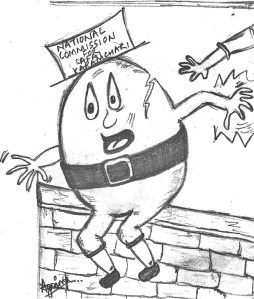
NCSK cartoon for Kafila

This is a guest post by AGRIMA BHASIN: No different from the caste hierarchy in India, the National Commission for Safai Karamcharis (NCSK) enjoys a marginal status, at the bottom, in the power hierarchy of commissions. “Why,” asked Former Prime Minister Narasimha Rao, “is it that the Commission for Safai Karamcharis is being subjected to the same discrimination as the safai karamcharis themselves? This is not something to be proud of.” He minced no words at the Conference of Welfare Ministers of States in 1996, to guilt the august gathering into recognising their culpability in deliberately weakening a competent commission. Continue reading Killing it softly over two decades: Agrima Bhasin

São Paulo: The City and its Protests: Teresa Caldeira

Guest post by TERESA CALDEIRA

In June 2013, a series of large demonstrations throughout Brazil have shaken up its main cities and political landscape.  They have also perplexed politicians and analysts alike, many of whom found themselves without solid references to interpret the novelty and oscillated between silence and old discourses.  It is always risky to interpret emerging processes. Minimally, we risk following secondary paths or, even worst, framing new events with the vocabulary made available by old interpretative models, exactly the ones that the new events are trying to displace. However, in order to reveal what is emerging it is necessary to risk, search for new hints, and follow signs already available.  Several references that can guide us to interpret the June events have been around for quite a while; others are new, but we can trace their lineage and contextualize them.

SP Batata 17 june
17th June, 2013

Continue reading São Paulo: The City and its Protests: Teresa Caldeira

The curious case of the Tamil Nadu police preventing ex-Maoists’ return to electoral path!

Guest post. A statement by Prof A. MARX and other rights activists

We, the undersigned, wish to bring to the public’s notice a curious case of doublespeak by the state. The central and state governments constantly advise Maoists to give up arms and join the mainstream. But, in Tamil Nadu, the government in collusion with the police is torturing a group of ex-Maoists who have joined the mainstream. These comrades have given up armed struggle and have come out to function in the open under a party named People’s Democratic Republic Party (PDRP). They have also accepted the electoral path to pursue their mass line. It is clear from their case that the intention of the state is not to mainstream the armed fighters but to incapacitate anyone who dares to criticize the state’s policies, without any compromise.

Background

Earlier, many PDRP members were part of CPI (Maoist). Some of them were arrested and imprisoned under POTA in 2002, on charges of undergoing arms training in Uthangarai, Tamil Nadu. They eventually came out of the prison with women getting bail in 2005 and men in 2007. Many of the comrades who came out criticized the armed struggle line of CPI (Maoist) and stressed for a mass line. The CPI (Maoist) reacted to this by dismissing them from the party towards the end of 2007. Continue reading The curious case of the Tamil Nadu police preventing ex-Maoists’ return to electoral path!

For Erdoğan, you are with him or against him: Tamer Söyler

This guest post by TAMER SÖYLER is the second of a three-part series on Istanbul’s Taksim Square protests for Kafila.

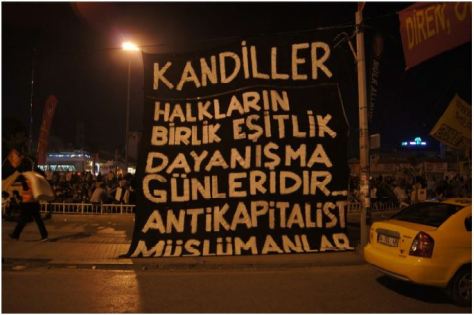
“Kandils (Islamic holy nights) are the times for equality, unity and solidarity.” Anticapitalist Muslims   Note: “Kandil” refers to the celebration of one of the five Islamic holy nights. While Erdoğan was accusing the protestors to be drinking beer and having some kind of a youth festival, anticapitalist muslims who were against the Taksim project from the very early on, wanted to give their support to the protestors. It was an interesting thing to witness. Socialists and communists were creating space for the members of the Anticapitalist Muslims to perform a public prayer in the square. This is already evidence enough that this is not secularists vs. pious.
“Kandils are the times for equality, unity and solidarity – Anti-capitalist Muslims,” this banner reads.
Kandil refers to the celebration of one of the five Islamic holy nights. While Erdoğan was accusing the protestors to be drinking beer and having some kind of a youth festival, anti-capitalist Muslims who were against the Taksim project from the very early on, wanted to give their support to the protestors. It was an interesting thing to witness. Socialists and communists were creating space for the members of the Anti-capitalist Muslims to perform a public prayer in the square. Clearly,the Taksim protests were not about secular vs. religious.

The first part of this commentary argued that as a part of his political strategy early Erdoğan had embraced a kaleidoscopic approach in governance by including various perspectives coming from citizens situated in different milieus. Erdoğan had given the impression to the citizens that his government was willing to hear the views of the citizens situated in all kinds of milieus. A simple strategy of inclusion proved to be extremely efficient for Erdoğan. Citizens who were not ideologically close to Erdoğan were quick to feel flattered by the symbolic gesture and did not hesitate to support Erdoğan. Continue reading For Erdoğan, you are with him or against him: Tamer Söyler

मोदी: तिलिस्म और हक़ीकत

– सुभाष गाताडे

जुल्म

तशद्दुद

झूठ

बग़ावत

आगजनी

खूं

कर्फ्यू

फायर ….

हमने इन्हें बिरसे में दिए हैं

ये बच्चे

क्या देंगे हमको ???

(कविता: बच्चे – मुसाफि़र पालनपुरी,

‘कुछ तो कहो यारों!’ सम्पादन: आयशा खान)

1

नूरा कुश्ती की समाप्ति के बाद


सियासत में आपसी सत्ता-संघर्ष अक्सर व्यक्तियों के इर्दगिर्द सिमटते दिखते हैं। Continue reading मोदी: तिलिस्म और हक़ीकत

Can late Erdoğan learn from early Erdoğan?: Tamer Söyler

This guest post by TAMER SÖYLER is the first of a three-part series on Istanbul’s Taksim Square protests for Kafila.

taksim8
Photographs by Tamer Söyler

The 42nd President of the United States, Bill Clinton, is said to have remarked: being President is like running a cemetery; you have got a lot of people under you and nobody is listening. As is the case with any good politician, Clinton is known for his bamboo-like character. During his presidency whenever he looked the weakest, he proved to come stronger out of the chaos. Clinton’s remarkable flexibility provided him the ability to bend as much as he needed to achieve his goals without breaking. The Prime Minister of Turkey, Recep Tayyip Erdoğan, proved again that he does not have Clinton’s sense of humour, his presidency or his flexibility.

Turkey is a parliamentary representative democracy. Erdoğan has been expressing his intention to transform the country into a presidential system and become the first president of the country. The government plans to put the question of a constitutional referendum to a vote in the year 2014. The people of Turkey are suffering from a great anxiety related to a fear of finding themselves in an authoritarian, charismatic presidential system. Protestors worry that without adequate mechanisms to enforce the separation of powers in the constitution, Erdoğan can easily transform Turkey into an authoritarian regime.
Continue reading Can late Erdoğan learn from early Erdoğan?: Tamer Söyler

The Military and ‘Peripheral’ Violence in Naya Pakistan

Guest post by ZEHRA HASHMI

It has been many months now since the Hazaras in Quetta were attacked. They were targeted during the month of January in 2013 and then only 36 days later in February, both times on Alamdar road where most Hazaras live – an area that has been termed an “open air jail”. Both times the banned Sunni organization Lashkar-e-Jhangvi claimed responsibility. In recent years, as many as 2000 Hazaras have lost their lives to similar acts of targeted violence in Balochistan. As power has been handed over from one civilian government to another for the first time in Pakistan’s history, the systemic nature of this kind of violence should be central to the concerns of Pakistanis – maybe even more than electricity, dare I argue? As Pakistanis think long and hard about what democratic change could mean, I write about the Hazaras now in order to point to the seemingly peripheral minorities as central to Pakistan’s issues. These attacks speak to the complex ways in which violence embeds itself into the everyday lives of some Pakistanis. In other words, the kind of structural issues that trying to wish a ‘naya Pakistan’ into existence will not assuage. Continue reading The Military and ‘Peripheral’ Violence in Naya Pakistan

Madhu Mausi, Namo Mamu and the Ghost of Uncle Pepper

I’ve been thinking a lot about magic lately. The kind of magic that gets pulled at fairgrounds and birthday parties, or on stage, where the impossible is made to appear possible, where material objects dematerialize and specters appear, tantalizing us into suspending our disbelief. Some magicians, including those I would like to think of as friends, do what they can with consummate skill, so that we attain a state of wonder while they effect transformations using ordinary things for extraordinary purposes. They make us inhabit parallel universes on a table top. There is a kind of poetry and grace in that kind of magic. That is the kind of magic that makes men out of god-men, and re-affirms even a non-patriot’s faith in the ‘waters of India’.

There is another kind of magic, a bag of tricks that relies on the cheapening of our impulses, on our addictions to false premises, on our giving in to our basest instincts. And because sometimes old cliches are useful, we could call this kind black magic. The greatest practitioner of this art, at this moment, seems to me to  be none other than the man who is setting himself up as the caudillo of the future, the chief minister of Gujarat, our prime-minister in waiting, Narendrabhai Damodardas Modi. We,a stunned would be electorate, are the rabbit he is aiming to pull out of his hat.
Continue reading Madhu Mausi, Namo Mamu and the Ghost of Uncle Pepper

दलाल स्ट्रीट और जे. एन. यू. : अपूर्वानंद

क्या जे.एन. यू.( जवाहर लाल नेहरू विश्वविद्यालय ) दरिद्रता या दरिद्र्तावाद की दलाल स्ट्रीट है? अगर एक प्रभावशाली संपादक और एक लोकप्रिय दलित चिन्तक की मानें तो यही उसका डी.एन.ए. है. वह लोगों के आत्म- निर्भर होने के खयाल के खिलाफ है. आत्मनिर्भरता का अर्थ क्या है? क्यों सारे दलित बराबरी के लिए पूंजीवाद नामक रामबाण को नहीं अपना लेते और क्यों वे बराबरी को जितना आर्थिक, उतना ही राजनीतिक और सांस्कृतिक मसला समझते हैं, इस पर बात कभी और की जा सकती है. इस पर भी कि क्यों ऐसा मानना खराब अर्थों में मार्क्सवादी होना है. भारत के मार्क्सवादी ही नहीं अनेक उदार लोकतांत्रिक विचारों वाले लोगों को पूंजी की शक्ति पर जो भरोसा था, उससे उबारने के लिए उन्हें दया पवार , नामदेव ढसाल, कुमुद पावड़े, शरण कुमार लिम्बाले, ओमप्रकाश वाल्मीकि जैसे लेखकों को अपनी कहानी सुनानी पड़ी. वह कहानी कितनी लंबी है, यह रोज़ ऐसे लेखकों की आमद से पता चलता है जो खुद को लेखक नहीं, दलित लेखक ही कहलाना चाहते हैं. अलग-अलग भाषाओं में कही जा रही यह कहानी पाठकों को ‘एक-सी’ लगती है. इन्हें पढ़ते हुए वे ‘दुहराव’ और ‘ऊब’ की शिकायत भी करते हैं. इन आख्यानों में ‘सर्जनात्मकता और कल्पनाशीलता की कमी’ मालूम पड़ती है. लेखक के अपने विशिष्ट व्यक्तित्व के दर्शन उन्हें नहीं हो पाते. Continue reading दलाल स्ट्रीट और जे. एन. यू. : अपूर्वानंद

Interview with Amalia Ziv – queer, feminist and anti-occupation in Israel

KveesaShchora020403CWPsm

On April 3rd, 2002, Israeli peace organizations led by women activists tried to enter Palestine, but were violently rebuffed by Israeli soldiers – 21 required hospitalization when it was all over. The picture shows seven members (six women and one man) of the organization Kveesa Shchora – Lesbians and Gay Men Against the Occupation – as they set out that morning.

It was through Amalia Ziv ‘s work that I came to know about ‘Kvisa Shchora’ (Black Laundry), an Israeli anti-Occupation queer group, which positions itself against both Israeli Zionist queer politics and the Israeli Left, against whose universalist understanding Black Laundry poses its queer identity as a platform for critique. Ziv suggests that Black Laundry tied together ‘sexual deviance’ and ‘national deviance’ with slogans like ‘Free Condoms, Free Palestine’, ‘Bull Dykes, Not Missile Strikes’, ‘Transgender not Transfer’ (that is, forced deportation of Palestinians)  – which break down the hierarchies of Nation and Sex, challenging queer politics in Israel with anti-occupation politics and Left anti-occupation politics with the queer gaze. Ziv argues that through the ‘twin strategies of national betrayal and sexual depravity’, Black Laundry deliberately situated itself outside both  discursive communities – that of Israel/Palestine as well as of hetero/homosexual.

Read this wonderful interview by  TSAFI SAAR with Amalia Ziv in which she talks about queer parenting, pornography, masochistic fantasies, her envy of people who have the capacity to be polyamorous, how tolerance in Israel for queer politics  ‘runs out when queer politics melds with politics against the occupation,’ and about her crush as an adolescent for Woody Allen. ‘Eros is blind’, she says unrepentantly. Continue reading Interview with Amalia Ziv – queer, feminist and anti-occupation in Israel

Three questions for Madhu Kishwar: Dilip D’Souza

Guest post by DILIP D’SOUZA

Dear Madhu,

20+ years ago, I picked you up at the airport in Austin and you stayed at my home there for a few days. You had come there to deliver a lecture, as I’m sure you remember. We developed a friendship based on a degree of mutual respect and liking. I think you’ll agree? Several years after that I remember a stimulating afternoon sitting with you in Panchgani, catching up on many things and discussing various issues threadbare.

We haven’t met in some years now, but I’m going to call on the privilege of our 20+ years of friendship as I write these lines.

I have no problem at all with your desire to learn about Gujarat and Narendra Modi for yourself. Nor with your desire to see beyond what you’ve called the “targeting” of Modi. Nor with your speaking in support of Modi: if there are people who criticize Modi, I understand and accept that there are those who support him — it’s a democracy we live in after all. Nor with your speaking your mind: you have always done so and it’s the least I expect from you. (In turn, it’s the least you should expect from me). Continue reading Three questions for Madhu Kishwar: Dilip D’Souza

Welcome the Two-Year Under Undergraduate Programme at Delhi University

Harish Kumar Trivedi’s article on the proposed four-year undergraduate programme at Delhi University, “Is Delhi University Dying?” (TOI May 29th 2013), for all its rhetorical flourishes, makes in fact a single point – the need for change. He is not alone in this belief; who could possibly be against reform? Who would want to stick their necks out in these breathless times and say, “Stop, why so fast?”

Many, many right-thinking people, actually, as the absolute barrage of criticism against the FYUP has shown. From the ordinary undergraduate teacher to academic and executive councils, committees of courses, and internationally renowned scholars, writers and academics. Now, there can be two responses to the range and variety of criticism that has been expressed. One would be to engage with it, based on the reasonable assumption that so many people involved with a profession cannot be entirely wrong. The other response is of the kind Professor Trivedi makes – to make an a priori argument for “change”. I say a priori because in fact there is only one, short paragraph in the article that discusses the possible advantages of the new system. One, that the new system ends the distinction between pass and honours courses. Two, that even if students exit after two years, they will still earn a “university qualification”. Three, it allows college teachers to frame a course in the fourth year.

Continue reading Welcome the Two-Year Under Undergraduate Programme at Delhi University

Disinformation and Journalistic Ethics: A Letter from Harsh Mander

We are publishing below a communication received from Harsh Mander, a former member of the National Advisory Council, regarding misrepresentation of his position and his politics by no less a person than the editor-in-chief of the Indian Express. The misrepresentation could easily have been corrected, had the mistake been really a mistake but by not publishing the letter or even an editorial correction, newspaper and the editor seem to be acknowledging that the error was in fact, intended. In the language of the Cold War, acts such as these were called ‘disinformation’. 
Response to Mr Shekhar Gupta’s article ‘The Bleeding Heartless’ in the Indian Express, June 1 2013
 

In response to an article by Mr Shekhar Gupta ‘The Bleeding Heartless’ in the Indian Express, June 1 2013, I sent the letter reproduced below on 3 June 2013, which has not yet been carried by Indian Express. I try not to respond polemically to articles which disagree with my views on public policy or other issues, as these differences are perfectly legitimate in a democracy. And who is to be sure that I am right, and my critics are wrong? But this was different, because it utterly falsely described my ideological position on Maoism as sympathetic, whereas I have always been passionately and publicly opposed to all forms of violence, including Maoist violence. Moreover it linked this to my membership in the NAC, and through that by implication to the many pro-poor agendas I sought to bring into and support within the NAC in the two years that I was a member. Finally Indian Express did not check with me the full facts reported in the opinion piece. I therefore felt I should respond formally to the report. But since this response has not been carried, and on the other hand it is being publicly referred to by others as well, I felt it would be best to place this reply in the public domain. – Harsh Mander Continue reading Disinformation and Journalistic Ethics: A Letter from Harsh Mander

Pakistan beyond liberal and conservative: Ayesha Siddiqa

Guest post by AYESHA SIDDIQA

As Pakistan battles with militancy, part of the war is also being fought in the arena of ideas.

In order to fight militancy, some argue, Pakistani society has to win hearts and minds back from extremists. It is the ‘fundamentalist’ thinking in our midst that prevents us from confronting militants wholeheartedly. On the other side of the talking divide stand those who feel that ‘liberals’ are forcing the state to declare a war on its own people under the guise of fighting militancy.

There is, however, at least one way in which both camps are similar. Regardless of who is right or wrong, the two sides view each other as being incompatible binaries with nothing in common. This is a flawed approach. No society, and especially not one as complex as Pakistan, can be divided so cleanly into two groups that do not overlap. Continue reading Pakistan beyond liberal and conservative: Ayesha Siddiqa

The Jamhuriyat Road to Taksim Square: Shilpi Suneja

Guest post by SHILPI SUNEJA

Istanbul, 4 June

istanbul11

The evening of 3 June, 2013 was the first time I’d experienced the sting of pepper spray. I was walking on Cumhuriyet Caddesi near Taksim Square in central Istanbul, where, for the past five days, civilians and the Turkish police have been clashing over what the international media has called “a matter of a few trees”. Certainly, the spark of what is now a huge mass protest spanning multiple cities with over 1,000 injured, was the issue over Gezi Park, an area in central Istanbul where the Prime Minister, Tayyip Erdogan has proposed to build a shopping complex. The plan was to graze the green space and create a shopping complex. This in an area that already boasts of a Hyatt, a Hilton, a Swiss hotel and shopping centers with national and international brands. “There’s already so many shopping malls here,” said a Turkish friend speaking about the government’s decision. “Why build another?” The grazing of the park was supposed to start on Thursday, May 30th. By that time, hundreds of people gathered and occupied the park, bringing tents, books, and children. The police, in response, burned their tents and dispersed the protesters using pepper spray and tear gas. Continue reading The Jamhuriyat Road to Taksim Square: Shilpi Suneja

PUCL statement condemning the Maoist massacre in Darbha Valley

This statement was put outby the PEOPLE’S UNION FOR CIVIL LIBERTIES on 26 May, and the one below it on 25 May by PUCL’s Chhattisgarh unit

PUCL Condemns Killings of Congress Party leaders, their PSOs and Ordinary Villagers by Maoists in Dharba Ghati of Sukma District, Chhattisgarh

The PUCL strongly condemns the ambush of a Congress party election cavalcade by the dalam of the CPI(Maoist) party at Dharba Ghati area in Sukma district of Chhattisgarh on Saturday, 25th May, 2013, resulting in the death of 28 people including Congress party leaders, their personal security officers and ordinary villagers of the area. PUCL denounces as totally unacceptable, the abduction, kidnapping and subsequent killing in cold blood of the Congress party President of Chhattisgarh, NK Patel, and his son Dinesh. The Maoists also killed Mahendra Karma, the founder of the dreaded Salwa Judum, and his security guards. Continue reading PUCL statement condemning the Maoist massacre in Darbha Valley

Manifesto of a New Initiative: Statement by New Path

This guest post is a statement by NEW PATHa collective of people, mostly from backgrounds in social movements and mass organisations, who have been discussing how the work of people’s struggle and revolutionary transformation can be taken forward in the Indian context. Those discussions led to the decision to found a new organisation, tentatively called “New Path”.

Below is the draft manifesto, sent to us by friends associated with the initiative. It is being circulated for comments, criticism, suggestions and observations. New Path does not aim to be a traditional revolutionary party. Rather, it seeks to be a political formation that seeks out opportunities, through struggle, to weaken bourgeois hegemony in this country.
Continue reading Manifesto of a New Initiative: Statement by New Path

End of Postcolonialism and the Challenge for ‘Non-European’ Thought

A lively debate has been going on lately in Al Jazeera, following the question posed by Hamid Dabashi in an article provocatively titled “Can Non-Europeans Think“? Dabashi’s piece, published earlier in January this year was a response to an article by Santiago Zabala, Research Professor of Philosophy at the University of Barcelona. Zabala’s article, entitled “Slavoj Zizek and the Role of the Philosopher”, was actually on an entirely different issue, as will be evident from the title. Zabala attempts, in this article, to read in Zizek’s persona and oeuvre, the possible implications for the philosopher as such. He dwells on Zizek as a figure who is at once a philosopher and a public intellectual – a role not very easily available, according to him, to academic philosophers.

If most significant philosophers become points of reference within the philosophical community, he says, “few have managed to overcome its boundaries and become public intellectuals intensely engaged in our cultural and political life as did Hannah Arendt (with the Eichmann trial), Jean-Paul Sartre (in the protests of May 1968) and Michel Foucault (with the Iranian revolution).” Zabala explains this rare ability/ possibility by invoking Edward Said on the ‘outsider’ status of the intellectual and by underlining the direct engagement of the thought of such philosophers with contemporary events. He says:

These philosophers became public intellectuals not simply because of their original philosophical projects or the exceptional political events of their epochs, but rather because their thoughts were drawn by these events. But how can an intellectual respond to the events of his epoch in order to contribute in a productive manner?

In order to respond, as Edward Said once said, the intellectual has to be “an outsider, living in self-imposed exile, and on the margins of society”, that is, free from academic, religious and political establishments; otherwise, he or she will simply submit to the inevitability of events.

Read the full essay here at Critical Encounters.

India needs a third imagination

In a brilliant column in the The Indian Express, Pratap Bhanu Mehta (with whom I have much to disagree about reservations) calls the bluff of the “national” parties who want Indian voters to be wary of the ‘instability’ and impossibility of a third front coalition government. This argument, strangely posing itself in a nationalist tone, is unfortunately also bought by too many left-liberal intellectuals and activists who don’t want us to get out the non-choice of the BJP-Congress binary. Mehta writes:

Sometimes an ordered instability can be more productive than a comatose stability. It is said that a third front leadership is unlikely to have a national perspective. But the cringingly desperate way in which the leadership of the national parties have put their own survival above any principle makes you wonder what the charge of not having a national perspective is all about. The third front will make foreign policy hostage to regional interests. In a way, it already is. But the source of the problem is deeper. Even a supposedly national party like the BJP cannot get its act together on the enclaves agreement with Bangladesh. Why blame regional parties? The third front will be fiscally irresponsible. It is a risk, but no more than a risk with any political party. The Congress squandered the best of economic opportunities in a fiscally irresponsible way. It is something of an irony that the only Chidambaram budget described as a “dream budget” came under Deve Gowda. And many states have shown innovation in a kind of pro-business entrepreneurial capitalism and in social sector schemes. Many of the regional leaders who would make up the third front are autocrats. Indeed, many of them are. But that autocracy is more visible because the national parties can use the state structure in a very sophisticated way to further their ends. But they are articulate and engage with their constituents. In short, the constituents of the third front are as much India and Indian interests as anyone else. [Full article]

India needs a third imagination, and by constantly being told that it is not possible we are told not to imagine it. This is the argument of, as Mehta puts it, the ‘entrenched elites’, to save their privileges. The fear of the third front, of the ‘regional’, needs to be fought and defeated. We see this poverty of imagination thrown at us whether we’re talking of Nitish Kumar or Arvind Kejriwal or Mayawati by people who will do not think it necessary to subject the Congress and the BJP to similar scrutiny. This bias against the “regional” is remarkably shared amongst a lot of people across the ideological spectrum. Their bluff needs to be called.

Of Education and Democracy in India: Preeti Chauhan

This is a guest post by Preeti Chauhan Now that the cat is out of the bag and the four year undergraduate programme(FYUP) is being criticized and thereby being discussed threadbare by some of the leading scholars of the country, one needs to also think of its relationship with the current state of democracy in India. The manner in which FYUP is being pushed through crushes the very idea of a university and with it the ideals and ideas of democracy.

Even if one assumes and believes that the “Academic Congress” held last year in the University gave a go ahead to change the existing three year undergraduate programme to FYUP and frame courses accordingly, then also the way the University administration has functioned goes against the very values that the University of Delhi or for that matter any university is supposed to promote. Continue reading Of Education and Democracy in India: Preeti Chauhan