Category Archives: Politics

Bootlegging Education – Four Strategies for Fighting Back

Yes, this is what we must do now on a large scale – bootleg education.

Thanks to the conjunction of new heights of intellectual bankruptcy with new regimes of intellectual property, a large scale attack on equitable access to education is upon us. A longer discussion on  ‘Intellectual property’ is required, but the immediate provocation for this post is of course the Delhi University photocopying case. Elsewhere on Kafila, there is a post that links to a petition by authors and academics on this issue. The case, very simply is this: three big corporate publishers, namely Oxford University Press, Cambridge University Press and Taylor and Francis have filed a petition in the Delhi High Court, claiming infringement of copyright with regard to course packs used by students. The offender against these giant publishers is a small photocopy shop in Delhi School of Economics. As many legal experts on intellectual property and the Indian copyright law have stated, this kind of photocopying is well within the framework of the law (See some of the discussion here and here).

At the moment, however, I am not concerned with the pure legality of the issue. The question of ‘course packs’ concerns the vital interests of our society as a whole. For there was a time when teaching at the college and university level was  conducted largely through substandard kunjis, or guidebooks – honourable exceptions apart, of course.  Even today we have at least one of the corporate giants (that happens to be among those suing the little Rameshwari photocopier), producing slightly upmarket versions of such guidebooks. University professors willing to write a substandard book a month that fits into some course or the other, are also published by  publishers like these now, euphemistically called ‘textbooks’. In an earlier time, such books of barely passable scholarship (largely plagiarized cut-and-paste jobs) would be published only by dubious publishers.

Continue reading Bootlegging Education – Four Strategies for Fighting Back

The (Ir)resistible Rise of Arvind Kejriwal – Enter The ‘Outsider’

The tide is clearly turning. You know this when former critics and lampooners start talking of him as a ‘game changer’; you know this when weather-cocks turn away from the corridors of power where once they had been ensconced. You know this when rats start deserting the sinking ship.

Suddenly, everybody is talking favourably about the man from the ‘outside’ who is refusing to respect any of the established protocols of protest and politics. More startling perhaps, is the fact that in the past two days we have had senior journalists and political analysts suddenly telling us that they had known all along that there was a ‘post 1980 contract’, a secret code of silence, that never would the dynasty be attacked – indeed never would any apsiring dynasty be attacked. Everybody knew, says Dipankar Gupta in the Times of India, that the issue came up one and a half years ago – and we all do know that. Robert Vadra’s doings had already  been known. A senior BJP leader is even reported to have told a senior journalist that his party had indeed been in possession of the very same documents that Arvind Kejriwal brandished at his press conference. But, this leader went to say, “after an intense discussion, the leadership decided not to rake up the issue in Parliament even after submitting a motion in each House asking for a discussion.” Everybody knew – the parties, their leaders, the media persons, political analysts. And yet, nobody spoke out. All of them colluded, in other words, in suppressing the issue. Politicians kept silent for an understandable reason – aspiring dynasties that they are, after all. But the others? Mediapersons? Any guesses?

As someone who has been trying to understand Indian politics over the decades, I have often wondered at what I have referred to as the ‘implosion of the political’ – that is to say, the destruction of politics in the formal political domain. What is called a noora kushti in Hindustani, had come to mark our parliamentary-political grammar. Farcical walk-outs after equally farcical fire-spouting rhetorical speeches in parliament, and a happy bonhomie away from the glare of the media – that was what our politics had been reduced to.

Continue reading The (Ir)resistible Rise of Arvind Kejriwal – Enter The ‘Outsider’

To Build A Bridge in Kashmir: A fable by Abhijit Dutta

Guest post by ABHIJIT DUTTA

Once upon a time, a young politician – young enough to have a ‘baba’ appended to his name – came to Kashmir to build a bridge in Srinagar. Now as anyone who knows Srinagar knows, the city is filled with bridges. Some are famous, like Gawkadal, some are pretty, like Zero Bridge, and some are simply without charm, like the Abdullah Bridge that goes from fountain square to Rajbagh. There are several others too, each with their own unique character, their own unique relation to the Jhelum.

When he was told about the many bridges in Srinagar, the politician shouted, “I want to build a bridge.”

“But we don’t need a bridge,” said a man softly to him, wanting not to embarrass this well-meaning man who had come to Kashmir from aafar. In response, the young politician turned around and shouted once again: “I want to build a bridge.” Continue reading To Build A Bridge in Kashmir: A fable by Abhijit Dutta

Stuck Between Gandhi and Cultural Crap: Papilio Buddha Reveals Much

Sometimes a minor cut on the surface of the skin will do to reveal the rot beneath. This is precisely what the film Papilio Buddha, made by the New York-based Malayalee film-maker Jayan Cherian, which draws broadly upon contemporary caste politics in Kerala, has achieved for us. In fact, its achievement on this count is simply amazing. At a single stroke, it has brought to light several stinking sores above which Malayalees, especially many Malayalee intellectuals who  occasionally don the garb of public intellectuals, strut. Continue reading Stuck Between Gandhi and Cultural Crap: Papilio Buddha Reveals Much

‘Big Ticket’ Reforms and Bigger Deceptions: Shankar Gopalakrishnan

Guest post by SHANKAR GOPALAKRISHNAN

When the country’s rulers have to tell barefaced lies to get their policies through, you know that there’s something wrong. Consider the recent “big-ticket reforms,” of which the two biggest (in terms of direct impact) have been the diesel price hike and the opening of the retail sector to FDI. The diesel hike, we’re told, was a “tough decision” necessary to “prune subsidies.” Except that diesel isn’t subsidised in this country. To repeat: there is no subsidy on diesel in India. As for FDI in retail, the Cabinet statement on the policy cites four justifications, accompanied by a “Studies show…” claim. Except that the data in the government’s sole study on the issue does not support three of these four justifications. As for their much touted “safeguards”, at least one has been said to be illegal by the Commerce Ministry itself, while the very same CCEA meeting diluted a similar safeguard for single brand retailers. Continue reading ‘Big Ticket’ Reforms and Bigger Deceptions: Shankar Gopalakrishnan

Zero tolerance for democracy – Kudankulam, Omkareshwar, Aseem Trivedi

Which of these three images brings dishonour to India?

This one?

The full coercive force of the state slams down on villagers who have been so far peacefully protesting the location of a nuclear power plant in Kudankulam, Tamil Nadu.

Charges of sedition have been laid on hundreds of protesters in Kudankulam.

The women of Kudankulam wrote recently in a moving message to their fellow citizens:

When we carried the dead body of democracy and burnt it in the outskirts of our village on Aug 15th, 2012, little did we realize that so soon we would witness the real death of democracy. As this last nail is being tightened on our lives, we realize how insignificant has been our voice. But this has only strengthened our vow to be together.

(Read the latest update from Kudankulam below)

Continue reading Zero tolerance for democracy – Kudankulam, Omkareshwar, Aseem Trivedi

If speaking the truth is sedition then I am guilty of sedition: Aseem Trivedi writes from jail

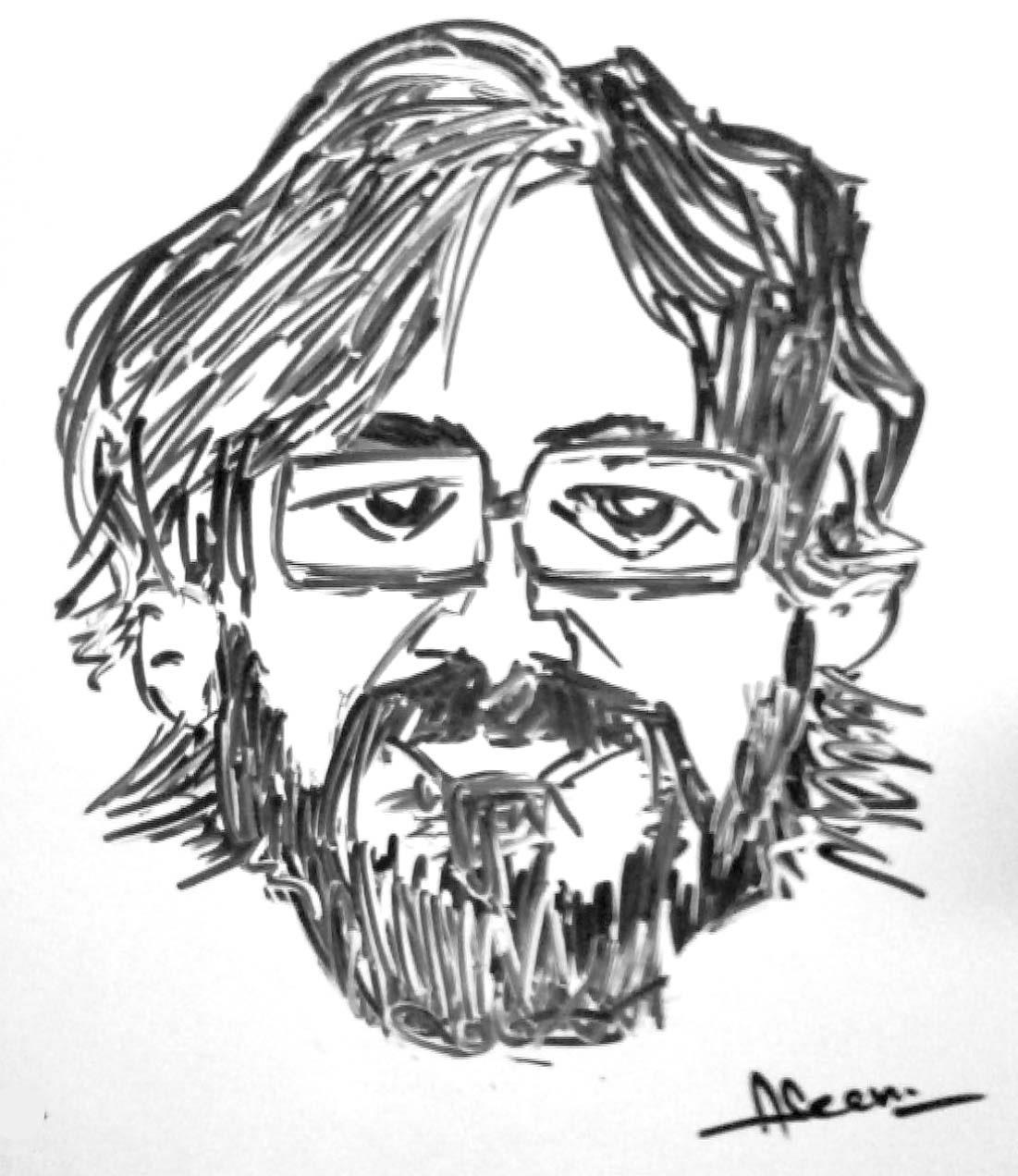
Aseem Trivedi: self-portrait

This is the text of a statement issued by ASEEM TRIVEDI from inside a jail in Mumbai. Trivedi has been remanded to judicial custody till 24 September for displaying and publishing cartoons that are allegedly seditious, insult national honour and, under the IT Act, are “grossly offensive” and of “menacing character”. An English translation of his letter is followed by the Hindi original.

Friends,

I am a true citizen of this country, not someone who has committed sedition.

If speaking the truth is sedition, then I am indeed guilty of sedition. If raising one’s voice against injustice is sedition, then I am guilty of sedition. If patriotism and the definition of patriotism have changed, then you could say I am guilty of sedition. If Gandhi, Bhagat Singh and Azad were guilty of sedition, so am I.

Even a small child of this country can understand my motive. I oppose the insulting of the people and the Constitution of India. I have been opposing the insulting of the people and the Constitution of India through my cartoons. Continue reading If speaking the truth is sedition then I am guilty of sedition: Aseem Trivedi writes from jail

Muslim youths launch peace forum in Assam

This press release was put out by MY-FACTS, Guwahati, on 3 September 2012

As a response and being aggrieved over the communalisation of the recent violence and mass displacement in BTAD (Bodoland Territorial Autonomous Districts) area and in order to analyse the situation, on 2 September, 2012 about 60 highly educated, secular and liberal Muslim youths from all over Assam assembled at the Bhagabhati Prashad Baruah Bhaban, Guwahati, Assam, to brainstorm about a peaceful solution for the present scenario of hatred and violence prevailing in Assam that is spreading all over the country. The meeting was convened under the aegis of a newly formed platform named MY-FACTS (Muslim Youths: Forum Against Communalism, Terrorism and Sedition). Continue reading Muslim youths launch peace forum in Assam

Protesting the Forced Repatriation of Visiting Sports persons and Others from Sri Lanka

Previously posted on dbsjeyaraj.com

We the undersigned are aghast and anguished by the recent decision of the government of Tamil Nadu, acting on the Chief Minister’s orders, to send back two sports teams from Sri Lanka that were in Chennai to play matches against local school teams.

Two days after the Chief Minister issued her orders, members of a Tamil nationalist group, Naam Tamizhar Iyakkam protested against a group of pilgrims from Sri Lanka visiting a church near Thanjavur.

There have been similar protests in the past against visiting teams – by members of the Periyar Dravidar Kazhagam. Continue reading Protesting the Forced Repatriation of Visiting Sports persons and Others from Sri Lanka

When the pseudo-sentiments of the pseudo-religious are pseudo-hurt

In neighbouring Pakistan, an Islamic cleric recently accused a young Christian girl, Rimsha Masih, of blasphemy, a charge punishable by life imprisonment. He said she had burnt some pages that contained verses from the Quran. The 14 year old girl hails from a poor family and suffers from Down’s Syndrome. An eyewitness to the event showed courage and told a magistrate the truth: it was the Muslim cleric who had put those burnt pages in Rimsha’s bag. The cleric has been arrested and is set, in turn, to be charged with blasphemy.

I have been thinking about the incident. Insulting somebody’s religion is bad. It may cause offence. Often it is intended to cause offence. If somebody insults Islam, by doing things like burning pages containing verses from the Quran, it is bound to outrage a Muslim. Continue reading When the pseudo-sentiments of the pseudo-religious are pseudo-hurt

Are We Not Alive: Women’s Voices from Kudankulam

Guest post by ANITHA. S

As I sit here in my home village of Idinthikara watching the hot sun light up the waves rolling onto the shores, I think of the news that has hit the world today about the Koodankulam Nuclear Power Plant. All of you must have seen the news that Madras High Court has given the go-ahead for the KKNPP.

When we carried the dead body of democracy and burnt it in the outskirts of our village on Aug15th, 2012, little did we realize that so soon we would witness the real death of democracy. As this last nail is being tightened on our lives, we realize how insignificant has been our voice. But this has only strengthened our vow to be together. Continue reading Are We Not Alive: Women’s Voices from Kudankulam

Strangers in a Place They Call Home: Lawrence Liang

Publishing a post for Lawrence Liang who is unable to do so himself at the moment. This piece also appeared in the Hindu this morning. I flew in myself from Bangalore last night and scenes of departure, though not nearly similar to those at the train stations, were palpable at the airport as well. Let me add to Lawrence’s words below three more thoughts that are still forming in my head. The first is the weakness of the word of public institutions and officers in our cities and how little solace they seem to offer or reliability they seem to have, particularly for “minority” residents — (how that word seems to have lost all other meaning other than identifying targets). Panic is also evidence of the fragility of structures that are meant to protect difference rather than just tolerate it. As Lawrence says below, the empirics do not negate how real the fear itself is.

The second is the limits to ideas of “tolerance” in response to diversity versus a more affirmative and protective inclusion — what would it take for the space between rumour and panic to be wider, deeper and further so it is not so easy to bridge?  Here a range of global experiences on cities and their attempts to hold difference are well worth looking at — we are not the first and nor will we be the last to fight this battle which is, in a sense, as old as cities themselves. But, to take one example, would we tell a different story today if public services in Bangalore were framed in response to the diversity of the residents — where they were offered, in all the languages really spoken by residents including the hundreds and thousands of residents from the states of the Northeast? Would the word of the Law minister have more power then? Would panic hesitate? 

The third is a reminder of how Indian cities still belong to states. The supposed linguistic and ethnic organisation of our federal structure has scripted a different urban future for many of our cities — how can Lawrence’s desired anonymity and cosmopolitanism take root if Bangalore still belongs not to its residents but to the idea of Karnataka?  Onto Lawrence’s much more articulate thoughts.

Strangers in a Place They Call Home

Lawrence Liang

One of the underrated pleasures of living in a city is anonymity —guaranteed not by the fact that you look the same as everyone else but that no one really cares that you look different. And a truly cosmopolitan city is one in which everyone looks different. I have been fortunate that for the 30 or so years that I have lived in Bangalore I have not had to deal with the fact that I look different. Save for occasional reminders of my Chineseness, the city has given me enough space to be who I am — cinephile, bibliophile, foodie — without having to bother too much about questions of identity. It is therefore disconcerting to suddenly step out into public spaces self-conscious of my Mongoloid features. Paranoia is not a grand sensation and it manifests itself in the myriad minute gestures and encounters. It seems unbelievable that the experience of a city can change so rapidly because it is clear to me that the last few days in Bangalore have been precisely about that. A miasma of fear, doubt and anxiety has descended on the city. It is possible that much of this has been fuelled by rumours and hearsay; and while the rumours may be false the fear sadly isn’t.

Continue reading Strangers in a Place They Call Home: Lawrence Liang

MSS Pandian Responds to S K Thorat

Following the submission of the report by the Committee to Review NCERT Textbooks, we had posted the full text of the Report in Kafila, along with Prof MSS Pandian’s Note of Dissent. The controversy has since continued over the report as well as Pandian’s Note of Dissent, many questioning the very term ‘note of dissent’ on the ground that he had not participated in the proceedings of the Committee. Recently Prof Sukhdeo Thorat, head of the Committee has further put this point of view in print in The Hindu which has been followed by a response by MSS Pandian.

Since we have had a long and lively debate on the matter of the ‘Ambedkar cartoon’ in Kafila and the controversy seems to be continuing now in a different form, we reproduce here the links to the articles by Sukhdeo Thorat and MSS Pandian. In his piece, Sukhdeo Thorat defends the Committee’s work and presents his opinion on Pandian’s non-participation. Pandian responds in his piece raising serious questions about the way the work of the Committee proceeded from its early stages by excluding members. We present the links to these two pieces here so that readers can form their own judgement on the Committee’s work.

Rejoinder to story on Soni Sori in Indian Express: International Alliance for Defence of Human Rights in India

The  International Alliance for Defence of Human Rights in India (IADHRI) is based in the US and has participated in the campaigns for the release of Dr. Binayak Sen, Kopa Kunjam and now more recently Soni Sori and Lingaram Kodopi.

On August 5th, The Indian Express published a disturbing, supposedly investigative story on Soni Sori, implying both that she was guilty of the charge of being a Maoist as well as casting doubt on the activists in India and outside who support her, and who are mainly responsible for bringing into the open the fact that she was and continues to be tortured in prison.

The IADHRI has written this response to the story, rebutting it point by point.

That the media often compromises its integrity for corporate interests and the political elite is not news any more. The recent Sunday Express report titled ‘Soni’s Story’ is symptomatic of a belief that if a lie is repeated often, it becomes the accepted truth.  The report talks of Soni Sori, the Adivasi school teacher from Dantewada, Chhattisgarh, who has been arrested and accused of being a Maoist conduit. With a clever sprinkling of truth, a report can seem unbiased- the reporter appears to be the warrior fighting to find facts and settling for nothing less. It is, however, imperative that fallacies be broken down, and the casual picking and choosing of facts be exposed for what it is. Let us use the same structure that the story uses. Continue reading Rejoinder to story on Soni Sori in Indian Express: International Alliance for Defence of Human Rights in India

National contestation, not religion, responsible for the plight of Myanmar’s Rohingyas: Ayesha Siddiqa

Guest post by AYESHA SIDDIQA

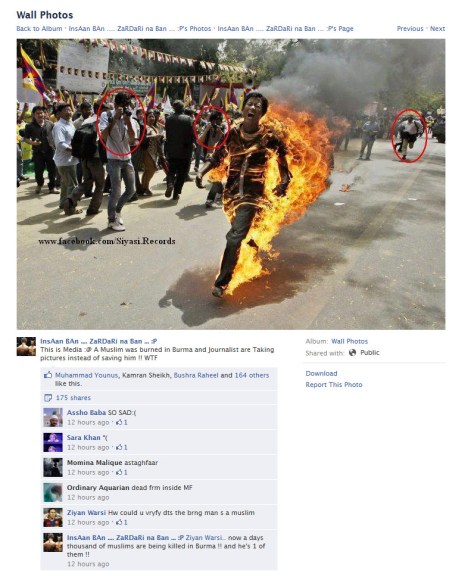
This photo is a screenshot of a Facebook page that incorrectly shows the self-immolation of a Tibetan activist in Delhi as an image of Rohingya persecution in Myanmar. This is one of countless such images circulated in social media. Image credit: Express Tribune, Pakistan.

These days, the social media is abuzz with discussion on Myanmar. Interestingly, it is not even a constructive discussion but one which is meant for point scoring. The nature of the discourse has complicated the issue even more and thus calls for at least a couple of articles: one on the issue and another one meant to be an analysis of the situation of Burmese Muslims. It is important at this stage to disentangle the two dimensions to make sense of what is actually happening. Continue reading National contestation, not religion, responsible for the plight of Myanmar’s Rohingyas: Ayesha Siddiqa

Molecular Socialism – A Possible Future for Left Politics

The end of the twentieth century saw the collapse of soviet-style state-socialism and the beginning of neo-liberalism’s triumphal march, which has ravaged the planet in a little over two decades. The destruction of the earth has proceeded with renewed vigour since, as has the dispossession of the poor. Cities have been re-made for the luxury living of the rich and the upwardly mobile middle classes. And for their luxury, for their ‘free movement’ across the city and beyond, settlements of the poor have had to make way, as shopping malls, freeways and expressways began defining the new imagination of the city.

If it took soviet-style socialism close to six-seven decades to finally face mass rejection, the neoliberal order has taken far less time. Faced with major opposition movements across the Western world, from the Occupy Wall Street movement to the Indignados in Spain and Greece and powerful new political formations in many parts of South America, the neoliberal order no longer seems as unchallengeable as it used to till just some time ago. Its advent on the horizon came as a new kind of theology that brooked no dissent. It came to us apparently telling us some elementary truths about ourselves and the world we inhabit. And it was quite amazing to see the speed with which the new religion gained converts in those early years. Continue reading Molecular Socialism – A Possible Future for Left Politics

On the ongoing ethnic violence in Assam: A Statement

The following is the text of a Statement issued in Delhi on 27 July 2012, endorsed by a number of concerned organizations and individuals

We the people from various parts of northeast residing in Delhi, along with concerned individuals, university members, various students’, teachers’, trade union, women’s, civil and human rights organisations from Delhi, strongly condemn the ongoing ethnic conflict with serious communal undertone that has erupted in four districts (Kokrajhar, Dhubri, Chirang and Bongaigaon) of Lower Assam. This has been the most widespread and alarming conflict in the recent history of Assam.

In the last one week we have witnessed the tragedy of nearly 200,000 people belonging to the Bodo and the Muslim communities, being forced to flee from their homes and villages. Currently they stand internally displaced, and are scarred and traumatized. Official figures state that around 41 people have lost their lives so far, while unofficial estimates from the grounds are much higher. More than 400 villages have been torched down until now. Continue reading On the ongoing ethnic violence in Assam: A Statement

Resisting Caste Violence – Facing Brutal Repression: NTUI on Maruti-Suzuki

Statement issued by NEW TRADE UNION INITIATIVE on the incidents at Maruti-Suzuki’s Manesar Plant

Dated 19 July, 2012, New Delhi

The present spate of violence at the Manesar plant of Maruti Suzuki as a fallout of a protest by workers against a casteist comment made by a supervisor at a dalit worker reflects the continuing use of ‘caste’ as a method of subordination and oppression reflecting the persistence of deeply rooted primordial structures of society that complement capitalist exploitation. When co-workers protested, the management suspended the abused worker and refused to re-instate him and instead resorted to brutal violence, orchestrated by goons, against the workers and targeting the union leaders.

It is important to note that the Maruti Suzuki management is yet to constitute the Grievance Redressal Committee and the Welfare Committee at its Manesar plant which was agreed upon after the last dispute in October 2011. The present dispute is a well planned instigation by the management to systematically derail the ongoing negotiations on the Charter of Demands submitted by the Maruti Suzuki Workers Union in April 2012 and to discredit the sustained and united struggle of the workers at the Manesar plant. Continue reading Resisting Caste Violence – Facing Brutal Repression: NTUI on Maruti-Suzuki

Some Reflections on Capital and the Workers’ Movement After Manesar

Workers’ Violence and Corporate Violations of Law

It has been a long time in the making. The violence at Maruti-Suzuki’s Manesar plant on 19 July 2012, that led to the ghastly killing of the general manager, Awanish Kumar Dev was waiting to happen. While the killing was gruesome, I believe this is merely a ‘freeze shot’ of a larger film that has been playing for a very long time now. While it is the media’s wont to focus only on these moments of spectacular violence and then dish out reports from handouts provided by managements and the police, sometimes, such moments of conflagration do illuminate what has been in the dark for so long.

What follows below is an attempt to think through some of the issues that seem to me to lie at the bottom of the violent event. The ‘violent event’ here is not simply what took place in Maruti-Suzuki’s Manesar plant now; it is rather a shorthand for the whole series of such conflagrations that have been taking place over the past few years in the National Capital Region (NCR) – starting with Honda Motors and Scooters 2005,  Graziano Trasmissioni 2008, and many others since – Rico Auto Industries, Pricol Ltd and so on. The struggle in Honda Motors that had been brewing for a long time had eventually spilled over into a series of public protests with severe police violence in the full glare of the media. Things have never been the same in the entire belt since. Rico Auto Industries incident in September-October 2009 subsequently became an important milestone – galvanizing as it did a number of other workers’ strikes. There it had started when the workers struck work after 17 of their colleagues had been dismissed ‘on disciplinary grounds’. Actually, the workers rightly felt that this was to quash their attempt to form a union. And while the workers were protesting at the gate, a group of hired goons attacked them, killing one of the workers and injuring many others. In the Graziano Trasmissioni the issue of contention was the reinstatement of 136 dismissed workers which led to a massive unrest in the unit in Greater NOIDA, leading eventually to an incident not very different from the present one. Continue reading Some Reflections on Capital and the Workers’ Movement After Manesar

Maruti Suzuki Manesar Workers – Casteist Attack and Repression

The following is a statement issued by the Maruti Suzuki Workers’ Union (MSWU) on 19 July following violence and repression at the Manesar plant yesterday.

The Manesar factory of Maruti Suzuki

The Maruti Suzuki Workers Union (MSWU) is anguished at the recent developments in Maruti Suzuki plant, IMT Manesar where the management has resorted to anti-worker and anti-Union activities in a pre-planned manner leading to violence and the closure of the factory yesterday.

We have had a long tough struggle with the strong unity of our permanent and contract workers to establish and register our Union last year, and had recently as of April 2012 submitted our Charter of Demands to the management of Maruti Suzuki, and the process of negotiation for wages and other demands was underway. However the management has done its utmost to derail the process since long and is trying to break the back of the spirit of unity of the workers and the legitimacy of the Union.

Continue reading Maruti Suzuki Manesar Workers – Casteist Attack and Repression

Of Peace and Other Illusions

This week I reviewed War and Peace in Jangal Mahal, edited by Biswajit Roy, for The Hindu. Kafila readers will be familiar with at least two of the essays in the compilation – by Nivedita Menon and Aditya Nigam and will remember our hectic debates on the subject.

The collected letters of correspondence between the Communist Party of India (Maoist) and the Indian state is an archive of corpses: policemen and guerrillas, commanders and comrades, police informers and Maoist sympathisers. The body count racked up by each serves as a signalling mechanism for the other.

Except for the police and Maoist commanders, the dead usually don’t get to choose sides; their identities are written in reverse, a teleological narration that details seemingly insignificant decisions that end in death.

In June this year, the CRPF, state police and CoBRA battalion killed 19 men, women and children in an anti-Maoist operation, claiming those killed were hardened Maoists. When newspapers reported that villagers said they were conducting a public meeting when they were surrounded by police and shot, the police pointed to six troopers injured in the encounter and asked why villagers were holding a meeting in the middle of the night.

The Maoists have an explanation for their violence as well. “The notion of just principle in a normal situation is different from that [in] a war-like situation,” wrote Maoist commander Kishenji in a letter to the Bengali daily, Dainik Statesman , in which he explained his party’s policy of killing police informers, “During war, freedom of thought, consciousness, initiative and innovation is much limited in scope.”

Read the rest of the review here