
If you click on it, you can also see the rest 3 parts of the show with Veena Malik and a maulvi on Pakistan’s Express TV.
Category Archives: Politics
The New Cellu-lar Jail: Madhumita Dutta & Venkatachandrika Radhakrishnan
Guest post by MADHUMITA DUTTA and VENKATACHANDRIKA RADHAKRISHNAN
The writers are activists based in Chennai working on issues of land, labour, industry and SEZs.
Sriperumbudur grabbed media attention in 1991 when former Prime Minister Mr Rajiv Gandhi was assassinated during an election rally. Since then, this nondescript little village-town in west Chennai, dotted with paddy fields and large expanses of natural water-bodies, has transformed itself into a little ‘Shenzen’- world’s largest special economic zone in Southern China, which churns out one out of every eight mobile handsets sold anywhere in the world. Slated to attract investments worth $4 billion in electronics and automobile manufacturing, Sriperumbudur is now home to the largest mobile handset making factory of Nokia, a Finnish company that can churn out 7.5 lakhs handsets a day. This town and its neighbouring region is also known as the Detroit of India, churning around 12,80,000 cars every year. With a booming manufacturing industry and a promise of 2 lakhs jobs, Sriperumbudur is touted as the jewel in the industrial crown of Tamil Nadu. But of recent this seemingly success story has turned a little sour. Continue reading The New Cellu-lar Jail: Madhumita Dutta & Venkatachandrika Radhakrishnan
Ambika’s Death: Madhumita Dutta & Venkatachandrika Radhakrishnan
Guest post by MADHUMITA DUTTA and VENKATACHANDRIKA RADHAKRISHNAN
The writers are activists based in Chennai working on issues of land, labour, industry and SEZs.

S Ambika, a 22 year old woman factory-worker, died in the middle of the night in a posh hospital in Chennai on 31st Oct. She was a permanent employee of Nokia Telecom Special Economic Zone (SEZ) in Sriperumbadur in Kancheepuram district of Tamil Nadu. Her agonising death was due to a fatal accident at a panel loading machine in the factory.
Continue reading Ambika’s Death: Madhumita Dutta & Venkatachandrika Radhakrishnan
Un-Indianizing Kerala: How to defend K K Shahina
Like the unseasonal and tenebrous rain clouds that are hovering over Thiruvananthapuram in what should be a sunny, light-mist-adorned January, a pall of gloom, of impending danger, hangs around my everyday life in Kerala. This is not a general feeling. It is however shared by many of us who write and speak critically about the powers that be. The space to speak and write thus has been shrinking for a while now, but now there is a sense of dangerously teetering on the edge: the Indian state seems to be upon us, and with a vengeance. Continue reading Un-Indianizing Kerala: How to defend K K Shahina
Taking Back Pakistan: Beena Sarwar
Text of article by BEENA SARWAR
Reproduced from Viewpoint, January 14, Issue 33; courtesy South Asia Citizens’ Web
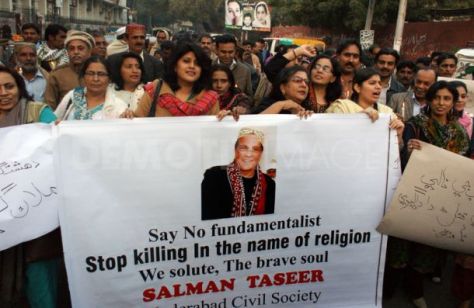
“There are no less than 24 groups as of now supporting Qadri on FB and 1 against what he did, that says it all.”
So went a tweet from a fellow Pakistani early morning on Jan 5, the day after the assassination of Salmaan Taseer, the governor of Punjab who took a courageous stand against religious extremists in Pakistan.
‘Islamic secularism’ in Bangladesh: Jyoti Rahman

Guest post by JYOTI RAHMAN
Bangladesh will mark its 40th year of independence in 2011. The celebrations have already begun, and will continue until next December. The TV channels are already playing patriotic tunes. One such tune is Shona shona shona. The song says the land, mati, of Bangladesh is better than gold, and under this land sleeps many heroes: Rafiq, Shafiq, Barkat, Titu Mir and Isa Khan.
Who are these heroes? Rafiq, Shafiq and Barkat were killed by the Pakistani authorities during the language uprising of 1952 — a milestone moment in Bangladesh’s nationalism. Titu Mir defied the East India Company and organised a peasant revolt in the 19th century. Isa Khan was a Bengali chieftain who resisted the Mughals in the 16th century.
Notice how all of these heroes are Bengali Muslim men?
Continue reading ‘Islamic secularism’ in Bangladesh: Jyoti Rahman
Celebrating Faiz
 2011 marks the birth anniversary of one of Southasia’s greatest poets, Faiz Ahmed Faiz. Centenary celebrations are planned in Pakistan, India and Bangladesh throughout this year. The Southasian magazine Himal has brought out in its January 2011 issue a set of six articles on Faiz. A note accompanying the issue reads:
Over the course of human history, intellectuals and artists have helped broaden the scope of citizenship and the nebulous contours of citizen rights. Southasia is no exception. Despite its colonial past and internal fault-lines, it can boast of extraordinary individuals who have stood up against tyranny and reaffirmed the innate strength of the human spirit. Continue reading Celebrating Faiz
लोकतंत्र के बुझते चिराग़: अनिल
Guest post by ANIL [freelance journalist and researcher, Mahatma Gandhi Antarrashtriya Hindi Vishwavidyalay, Wardha]
इक्कीसवीं सदी का पहला दशक ख़त्म हो गया है. 1991 में उदारवाद के अभियान की बुनावट जिन आकर्षक शब्दजालों से शुरू हुई थी अब उसके परिणाम सतह पर स्पष्ट दिखने लगे हैं. इन दो दशकों में इज़ारेदारी ने सियासत से लोकतंत्र के मूल्यों के पालन की उम्मीद को तो पहले ही दफ़्न कर दिया था लेकिन इस क्रम में जो हालिया प्रगति हुई है वह और ख़तरनाक संकेत दे रही है. Continue reading लोकतंत्र के बुझते चिराग़: अनिल
Ayodhya for Buddhists: All India Confederation of SC/ST Organisations
Press release from the ALL INDIA CONFEDERATION OF SC/ST ORGANISATIONS
Neither Hindus nor Muslims are entitled to the disputed land at Ayodhya. SLP filed in Supreme Court claming the title for the Buddhists.
New Delhi, 7th January, 2011
Dr. Udit Raj, Chairman of Buddha Education Foundation and the All India Confederation of SC/ST Organisations, told the press that Special Leave Petition (SLP) no. DC 466/2011 has been filed in the Supreme Court against the judgment of Allahabad High Court, Lucknow Bench in the much disputed matter of Ayodhya.
Continue reading Ayodhya for Buddhists: All India Confederation of SC/ST Organisations
A Critique of Binayak Sen’s Judgment
This note critiquing the judgement that setences Binayak Sen for life has been written by ILINIA SEN, SUDHA BHARADWAJ and KAVITA SRIVASTAVA
Raipur, 26 December, 2010
As you are aware the Second Additional District and Sessions Judge of Raipur Sh. B. P. Verma convicted Binayak Sen, Pijush Guha and Narayan Sanyal for rigorous life imprisonment on the 24 December, 2010. A ninety two page judgement was delivered by Judge BP Verma on the 24 December, 2010. What follows is a quick analysis of the facts of the case and the judgement that has finally been delivered. Continue reading A Critique of Binayak Sen’s Judgment
Villain in Life, Hero in Death: Hindutva’s New found Love for Hemant Karkare
…sources who were close to Karkare have said there was indeed a threat perception at that time and the former ATS chief was disturbed over allegations against his family after the Malegaon probe was made public.
However, they said “Karkare was not scared” and that “he was very practical and took adequate measures to ensure his family was safe”. According to sources, Karkare had raised the wall around his house just a week before his death and also brought home a dog. “The wall was raised around the garage-end of the house, as it faced the road outside,” sources said.
An officer, who did not wish to be identified, said, “Soon after the probe, there were news reports alleging various things about his family which disturbed him. He was not scared for his life nor was he the kind to be afraid of consequences of an honest probe. …It was the allegations against his family that disturbed him and he took practical measures to ensure their safety.”
(Indian Express, Posted: Tue Dec 14 2010, 03:31 hrs Mumbai) Continue reading Villain in Life, Hero in Death: Hindutva’s New found Love for Hemant Karkare
Conditions of contract labourers in JNU: Rashmi Singh
This is a guest post by RASHMI SINGH. This article is based on the research conducted by the author on informal labour, for AMAN Trust.
The recently concluded Commonwealth Games have exposed the government’s contempt towards the working class in Delhi.Even though some sections of the media did highlight the terrible working conditions of the labourers, much of it got lost in the noise about corruption scandals and nationalist jingoism. In the aftermath of the games, the so-called fourth estate continues to focus its energies on the question of corruption, while everyone seems to have forgotten about the lakhs of construction workers who built the very edifice of the Games. Indeed, the dusty secrets of labour code violations during the Games have been relegated to just that – the dust of the city.
Continue reading Conditions of contract labourers in JNU: Rashmi Singh
Gift the CBI a sheet for their next cover-up!

CALL FOR ACTION on CBI COVER-UP!
Let us Protest against CBI cover up report on Shopian Rape and Murder case
DEMAND JUSTICE FOR NEELOFAR AND ASIYA!
A Public Event in New Delhi on 13th December, 2010 at 4 pm in front of CBI office, Delhi.
Come and participate with one white bed sheet with the words ‘TO THE CBI – FOR YOUR NEXT COVER-UP!!!’ written in huge letters across it with the name of the organisation/individual below.
Issued by: Women against Sexual violence and State repression (WSS), Delhi
For more details contact saheliwomen at gmail dot com
Continue reading Gift the CBI a sheet for their next cover-up!
Uphold Freedom of Expression: Statement in support of KK Shahina
We the following organizations express our strong concern on the charges framed by Karnataka police against journalist Shahina KK for her investigative report on Bangalore bomb blast case. Her recent article which showed that witnesses in the Bangalore blast case were fragile, false and forced has led her to be implicated under charges of IPC 506 which can lead to seven years of imprisonment.
The accusation of Karnataka police is that she ‘ intimidated the key witnesses’ in the Bangalore bomb blast case during the course of her article. The accusations of the police were also carried by the local news papers as “suspicious” visit by a “group of Muslims” to the place. The newspapers said that police were not sure about the identity of the woman, though she had showed a TEHELKA identity card! Continue reading Uphold Freedom of Expression: Statement in support of KK Shahina
Kitne aadmi the? We are all seditious now
Here is a very short, utterly incomplete, hastily compiled list of people charged under Section 124 A in the last two years alone.
Our very own Shuddhabrata Sengupta figures in this roll of honour.
(Incidentally, KK Shahina, who has guest posted with us, faces charges from the Karnataka Police under IPC 506 for intimidating witnesses. Her expose in Tehelka showed how the police case against Abdul Nasar Madani, head of the People’s Democratic Front (PDP), accused in 2008 Bengaluru blasts, was fragile and based on non-existent and false testimonies.)
There would be hundreds more, not named here, charged with sedition for “criticizing” the government, for exposing corruption and police nexus with mafias, or for expressing views that run counter to official wisdom on the “integrity” of India.
As if “integrity” is something pre-existing and eternal rather than something that has to be produced at every point. The existence of a nation is a daily plebiscite, said even historian Ernst Renan, a staunch supporter of the nation form. Not so Rabindranath Tagore, who was highly suspicious of the “fetish of nationalism”. He called the Nation nothing but the “the organization of politics and commerce” and warned that when this Nation “becomes all-powerful at the cost of the harmony of the higher social life, then it is an evil day for humanity.” (In his lectures on nationalism, published by Rupa and Co. 1994) Continue reading Kitne aadmi the? We are all seditious now
Public statement condemning the recent incidents of sexual assault on women from North East India
The endorsements are still coming in. Protest demonstration at Jantar Mantar, Delhi at 5 pm tomorrow, December 1, 2010. Please send endorsements to:
nirantar.mail@gmail.com
As women’s groups, child rights groups, sexual rights groups, Lesbian, Gay, Bisexual, Transgender and Queer rights groups and other progressive groups, academicians and concerned individuals, we are shocked by the repeated incidents of sexual assault on women from the North East in the capital of India in recent months. The incident of rape of a 30-year-old woman in Dhaula Kuan on 23rdNovember has again pointed to the failure of the Delhi government to ensure safety of women and especially of women from the North East. Continue reading Public statement condemning the recent incidents of sexual assault on women from North East India
Will the Insecure Male at the News Desk Please Stand Up?
K.K. Shahina, of the Tehelka, some feel, may be a terrorist. No prizes for guessing who. After all, Shahina has been working, despite pressures of all sorts, to unravel the impossible web of lies that the police, the media, and political parties have been weaving around the figure of Abdul Nasar Madani, who was arrested again as an accused in the 2008 Bangalore blast case and denied bail. Madani, as is well-known, had already suffered enormous injustice at the hands of the Indian state but to the chagrin of the Hindutva ‘nationalists’, he re-entered the political arena. Whether one agrees with him on Islam or other matters, or about his choice of alliances, is a different matter. Choosing to demand space in the political public, he exercised his right as a citizen, and thereby indicated a preliminary implicit willingness to place his views before a critical public. Continue reading Will the Insecure Male at the News Desk Please Stand Up?
The Media Barons and the Radia Tapes: Monobina Gupta
Guest post by MONOBINA GUPTA
The first formal discussion on the Radia-Media nexus by a section of top media professionals this Friday revealed the media’s general reluctance to put themselves through the same wringer of criticality that they so love to put others through. Barring Manu Joseph, editor of Open Magazine, which put out in the public domain the tapes which had been lying for days in the ‘safe’ custody of most media organizations, majority of the speakers argued that the controversy was not about Vir Sanghvi and Barkha Dutt; that there was no proof whether Sanghvi had actually written his ‘most read’ column as he had assured Nira Radia; that we do not know if Barkha Dutt had kept her word to Radia and passed on the message of the DMK’s internal dissensions to the Congress; that pressured by the minute-by-minute demands of 24/7 TV channels, journalists have to make random promises (which they do not intend to honour!); that they have to play along with their sources to extract news etc. The list of extenuating circumstances offered by the media, now getting a taste of its own treatment, was quite revolting.
Continue reading The Media Barons and the Radia Tapes: Monobina Gupta
25,000 Maheshwar dam oustees march in Madleshwar: Narmada Bachao Andolan

Thousands demand revoking of clearance and scrapping of dam
Press note from NBA
The Mandleshwar town resounded with the voices of 20,000 to 25,000 people (over 50% of them women) affected by the Maheshwar dam who marched through the town today, in defence of their rights despite the heavy rain, asking for rehabilitation and land, or scrapping of the dam. After marching through the main roads of Mandleshwar town, the oustees reached the Narmada River and after affirming and renewing their resolve to struggle against all odds, the people congregated in a huge public meeting at the local “Krishi Upaj mandi” in Mandleshwar. Continue reading 25,000 Maheshwar dam oustees march in Madleshwar: Narmada Bachao Andolan
On the November Massacres in Assam: Aruni Kashyap
This is a guest post by ARUNI KASHYAP
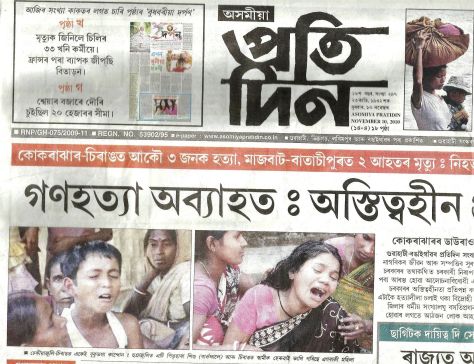
In the beginning of this month, the anti-talks faction of NDFB carried out a state-wide massacre of non-Bodos, mostly Hindi speaking settlers in Assam in a revenge-killing spree after Mahesh Basumatary, who allegedly was a cadre of NDFB, was killed by the Indian security forces in Assam’s Sonitpur district. The Bodo militant organisation claimed that the person was an innocent civilian and wasn’t linked to their organisation in any way while the security forces claimed otherwise. A recent report aired in a local television news channel DY365 records the victim’s family and his resident village’s viewpoint that matches with the claims of the NDFB. Continue reading On the November Massacres in Assam: Aruni Kashyap
Anti-National Thoughts
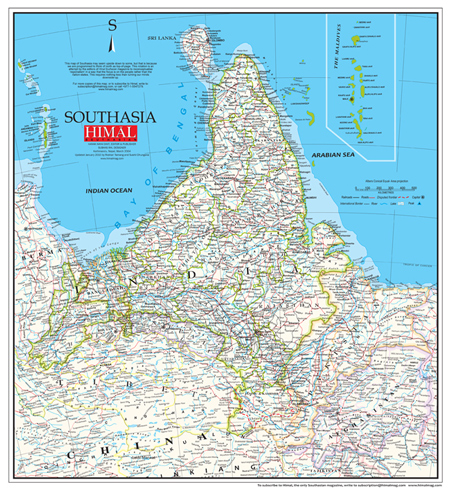
Nation-states have a logic of their own. So insidiously is this logic purveyed through the state’s institutions that it becomes common-sense, particularly among the educated. Perspectives that differ from this common-sense are then easily seen as signs of illiteracy, or more dangerously, treachery.
A woman employed for housework by a Pakistani living for a while in Delhi, could never quite understand where her employer was from. “Bahar se?” she would ask, “Amreeka se?” No, would come the patient reply: from outside, yes, but not from America, from Pakistan. Where is that? ‘Well, you know that “here”, yahan is Bharat? India? Hindustan? I am from vahan, there, Pakistan, another country’. But yet again, the domestic help’s bewildered response – yahan matlab Dilli? Here, meaning Delhi?
 KAFILA - COLLECTIVE EXPLORATIONS SINCE 2006