Category Archives: Politics

हिंसा की राजनीति के पैरोकार

२००९ के लोकसभा  चुनाव की अगर इसके पहले दो चरणों के आधार पर कोई खासियत बतानी हो तो कहना पडेगा कि समाज के पारम्परिक शक्ति संतुलन में विचलन के भय से तथाकथित ऊंची जातियों के द्वारा पहले  जो हिंसा होती थी, वह नहीं दिखी. बिहार और अन्य स्थानों पर चुनाव के वक्त बूथ पर होनेवाला खूनखराबा इस बार नहीं हुआ. फिर भी इस बार हत्याएं हुईं. और ये हत्याएं हिंसक वर्ग-युद्ध में विश्वास रखनेवाले माओवादी समूहों ने कीं. बिहार, झारखंड, ओडीसा, छत्तीसगढ और महाराष्ट्र में इन समूहों के द्वारा हत्याएं की गईं, सार्वजनिक स्थलों को जलाया गया और दहशत फैलाई गई. पूरी ट्रेन का अपहरण कर लिया गया और अपना शक्ति प्रदर्शन करके फिर उसे छोड़ दिया गया. इस बीच उसके यात्रियों को जो भयंकर मानसिक यंत्रणा हुई होगी उसके लिए माओवादियों के पास कोई सहानुभूति का शब्द नहीं है. बंगाल में   सी.पी.एम. ने अपने हिंसक अहंकार में सिंगुर और नांदीग्राम और  उनके बाद लालगढ में जो कुछ किया उसने माओवादी समूहों को बंगाल में अपनी पकड मजबूत करने का मौका दिया. अब ये खबरें आम हैं कि बंगाल के गांवों और कस्बों में लोगों को सी.पी.एम. की सदस्यता छोड्ने को मजबूर किया जा रहा है और बात न मानने पर उनकी हत्या तक की जा रही है. ऐसी ही हत्याएं पिछले  साल बिहार  और झारखण्ड में की गयी थी. क्योकि माओवादी मारे गए लोगों  को ‘गलत पार्टियों’ में रहने नहीं देना चाहते थे. बंगाल में सी.पी.एम. की हिंसा का विरोध करनेवालों को शायद सी.पी. एम. के कार्यकर्ताओं की हत्या में  एक प्रकार का प्राकृतिक न्याय होता दीख रहा हो, वरना क्या वजह है कि अब तक इन हत्याओं की और दल छोडने को बाध्य करने की इस तरह की घटनाओं की कहीं से कोई भर्त्सना नहीं सुनाई पडी है !

“हिंसा को किसी भी तरह जायज नहीं ठहराया जा सकता ,चाहे  उसका औचित्य कुछ भी क्यों न दिया जाए.” पिछ्ले दो साल से माओवादियों को मदद पहुंचाने के आरोप में जेल में बंद बिनायक सेन ने हाल में एक पत्रकार को यह कहा जब उसने माओवादी हिंसा के बारे में उनसे सवाल किया. बिनायक जब यह बातचीत कर रहे थे, उनके चेहरे पर वह दाढी नहीं थी  जिसने उन्हें एक रूमानी शक्ल दे रखी थी. दाढीविहीन  होकर भी बिनायक उतने ही आकर्षक लग रहे  थे, हालांकि उसके होने से जो एक रहस्य की आभा उनके इर्द-गिर्द थी, वह नहीं रह गयी थी.
Continue reading हिंसा की राजनीति के पैरोकार

Lalgarh, Media and the Maoists: Monobina Gupta

Guest Post by MONOBINA GUPTA

[As this report is filed, reports have come in that the CPI-M has finally managed to enter Lalgarh and hold its first public meeting since 2 November 2008, when the police first arrested seven young students from Lalgarh, sparking off a revolt. No machine guns were fired, no mines were blasted – even though we are supposed to believe that the area is a ‘liberated area’ of the Maoists. See our earlier report, written soon after the revolt began. Even as we post this, more reports – mostly from West Bengal government and police sources, are being suddenly being published of ‘unrest’ spreading to ‘more Maoist areas’, and an atmosphere is sought to be created for an eventual justification of government and party sponsored violence.]
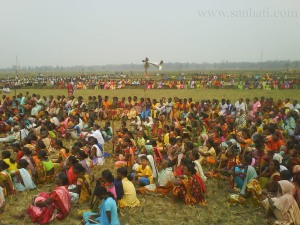
Assembly in Lalgarh - Armed Maoists? Photo, courtesy sanhati.com
Assembly in Lalgarh – Armed Maoists? Photo: courtesy sanhati.com

For five months now Lalgarh has been practicing a unique form of democratic politics. To the ruling CPI-M in West Bengal and the big media however, it has been nothing but a Maoist-sponsored agitation with portents of Maoist style violence. Except Bengal media, national print and television, have by and large kept Lalgarh out of their ambit of coverage. If at all news has trickled in, it has come tagged with ‘Maoists’ and ‘violence’; as if tribals in this forgotten part of Medinipur, the past five months, have been stocking up arms and laying ambushes to wage a war against the state.

A front-page article in the Times of India (TOI) today (April 22, 2009) sticks to this format describing Lalgarh as “Nandigram II, a liberated zone” where an explosive situation is building up with elections scheduled for April 30 and the Pulishi Santrash Birodhi Janashadharaner Committee (People’s Committee against Police Atrocities) refusing to allow the police to enter Lalgarh. “The police can’t enter here. Nor are other government officials welcome. This has been the situation for the last six months.”

Continue reading Lalgarh, Media and the Maoists: Monobina Gupta

The Art of Not Writing: Shubhranshu Choudhary

Shubhranshu Choudhary from Chhattisgarh:

How does the media in Chhattisgarh report the conflict between the Naxalites and the Salwa Judum, or the conflict between local communities and corporations? Quite simply, it doesn’t. The pressures on journalists in Chhattisgarh are unique. They are paid not to report stories that are critical of the powers-that-be, whether they are industrial lobbies or state authorities.

Posted on Free Binayak Sen Campaign

51% = legitimacy

With the elections around the corner, the First-Past-The-Post (FPTP) election system used in India is being blamed for most of the ills in the Indian political system. This post is the outcome of some of the discussions and conversations that Barun Mitra of the Liberty Institute and I have been having regarding the FPTP system.

Briefly, the FPTP system is based on the principle of  “winner-takes-it-all” i.e., the candidate who gets majority of the votes is declared victorious. One of the most common criticisms made against the FPTP system is that candidates win by very narrow margins.  It has been suggested that candidates must get at least 51% of the votes in order for their victory to be deemed as legitimate. It is interesting to note that so far in the history of elections in India, not a single candidate has been dismantled or at least challenged on the grounds that s/he won by 20% of the votes in  the constituency. Therefore, is the criticism misplaced?

Both Barun and I want to suggest that narrow victory margins are in fact the strength of the Indian electoral system. This is because:

Typically, only 50% of the population in the constituency votes in any election. If the victorious candidate has won by 20% of the votes, he has actually received 40% of the votes (given that only 50% of the people are voting).

  1. The narrow victory margins keep the threshold of entry naturally low. This encourages aspirants to enter the electoral fray. If candidates won by 51% of the total votes, it would mean that political parties would have to field heavyweights and stalwarts and it would also discourage novices and independents from contesting the elections.
  2. The narrow victory margins intensifies political competition and keeps candidates and parties on their toes. New aspirants can cut into the vote bases of popular candidates and parties. Moreover, the narrow margins makes it imperative for candidates and parties to attract voters from various backgrounds and widen their appeal instead of confining themselves to gathering votes on the basis of identity and particularistic appeals.

Is Desh Ka Kuch Nahin Ho Sakta

Of the many excitements on offer at election time are the pious ads by luminaries of the film fraternity exhorting the peoples of India to vote. This one is my favourite…

“Parties come and parties go”, smiles Isha Koppikar,

“But the rubbish on the roads,” says a glum Ritesh,

“Is still there,” notes Farhan astutely.

“Why?”

“Why?”

“Why?” ask Shahid, Priyanka, and Sonam in anguished tones. The answer my friend, as the bard and Kareena said is, “Kyonke Kuch Nahin Ho Sakta Is Desh Ka”. Bhaiiyon aur behenon! Ungli uthao aur button dabao! Ah! TV! But the disastrous acting and terrible scripting aside, there are few things more hilarious than watching Abhishek Bacchan, who distinguished himself by declaring himself a farmer and stealing land from farmers in Barabanki, waxing eleoquent on criminalization of politics. Truly, after watching this ad, I am forced to concur: Is Desh Ka Kuch Nahin Ho Sakta…

April 13 a Day of Ignominious Capitulation in Pakistan: HRCP

[The following is the text of a press release issued by Asma Jahangir, Chairperson of the Human Rights Commission of Pakistan on April 14, 2009. The formal adoption of the Nizam-e-Adl is widely perceived in Pakistan as a surrender to the Taliban and a way of imposing the Shariat Laws in the region. And for good reason. As it went up for approval to the National Assembly, the Taliban and the Tanzim Nifaz Shariat-e-Muhammadi (TNSM) warned parliamentarians against opposing the Nizam-e-Adl Regulation. Meanwhile, Jamaat-e-Islami Naib Amir Senator Prof. Khurshid Ahmad has criticized the liberal secular lobby for debunking the introduction of Nizam-e-Adl in Malakand Area.]

Lahore: The way the National Assembly resolved to back the Nizam-e-Adl Regulation for Malakand Division on Monday does no credit to the House, and the day will be remembered for the state’s humiliating submission to blind force, a statement by HRCP said on Tuesday.

Continue reading April 13 a Day of Ignominious Capitulation in Pakistan: HRCP

Unfair Wealth and Fair Elections

Poverty talk is common; wealth is taboo — even when crorepati candidates (millionaires, billionaires) are on the rise in elections today. There is no doubt whatsoever that our elections are conditioned by wealth, and the rich are thriving on the benefits drawn from their money power. Ironically however, in our people’s democracy, no calls for fair elections are considered credible unless they are accompanied by cries for reforms in the role of wealth and wealthy candidates in the elections. Chances are that the Indian elections of 2009 might get caught up in this credibility trap.

In the first phase of elections, data (affidavits) available of 1440 candidates out of a total of 1715, compiled and analysed by the National Election Watch, is revealing: There are 193 crorepatis contesting elections in this phase; they have increased from 9 percent in 2004 to 14 percent in 2009. Congress has 45, followed by BJP and BSP, with 30 and 22 respectively. All parties, including independents, share this burden. Andhra Pradesh, Uttar Pradesh, Maharashtra, Bihar, Jharkhand and Chhatisgarh have a majority of them. Their total assets go as high as 173, 125, 89, 72, 56, 45, 30 crores. Neither the earth, nor the sky is the limit. And the declared assets may just reveal a partial picture, considering the fact that most of them (979 candidates) do not even bother to have a permanent account number (PAN), which is necessary for filing annual income tax returns.

Continue reading Unfair Wealth and Fair Elections

Why you should Caste your vote

Someone called “Dr Known” has sent Kafila, via our Contact page, this interesting email. I’m posting this here only because I found it interesting; posting does not necessarily constitute agreement. Or disagreement :)

Since Hinduism is based on CASTE hierarchies, it intrinsically breeds HATRED among Indians.

Hence,

* You must VOTE for candidates from your CASTE only.

* Only he can and will UNDERSTAND your culture and IMPROVE your socio-economic status.

* And do not worry if he is CORRUPT.

* You must vote him till 85% of all registered marriages in India are INTER-CASTE or INTER-FAITH.

This is the only way to STOP dis-integration of India.

Mayawati’s India

1
(Largely ignored by the media, the BSP recently released a tract that says what the BSP’s India would be like should Mayawati become prime minister. Considering that there is such wide interest and curiosity about the BSP and its politics these days, I am posting the full text of this “appeal”. Disclaimer: I am posting this here for information, debate and discussion and the act of posting this here should not be construed as my endorsement or otherwise of this manifesto-but-not-manifesto. – Shivam Vij)

Jai Bhim !                                                                               Jai Bharat !!

Bahujan Samaj Party

” APPEAL”

For

Lok Sabha General Elections -2009


Brothers and Sisters,  Continue reading Mayawati’s India

The Tragedy of Politics in Sri Lanka

I am posting below an article that I wrote with Cenan Pirani.  The shorter version of this article is in Combat Law. The longer version below delves into the history of left politics in Sri Lanka and attempts at a political solution.  Another article by me reflecting some of these concerns and raising questions of solidarity titled ‘The Challenges of Solidarity’ was published in Red Pepper.

The Tragedy of Politics in Sri Lanka

By AHILAN KADIRGAMAR and CENAN PIRANI

In the last few months, the Sri Lankan security forces have managed to ruthlessly push the LTTE into a 40 square km strip of land in the North of the island, and along with the LTTE leadership and its cadres, a sizable civilian population, anywhere from seventy thousand to one hundred and fifty thousand, have also been cordoned off in this area.  As the security forces continue their offensives purporting to rid Sri Lanka of the LTTE, they also claim the lives of these civilians daily. Continue reading The Tragedy of Politics in Sri Lanka

Closed minds

The Constituent Assembly’s ‘Committee to protect and preserve National Interests’ has suggested that a passport regime be introduced at the Nepal-India border. Committee Chair Amik Sherchan has said this is necessary to ‘protect waning Nepali nationalism’ and ‘to treat both China and India equally’. Sherchan claimed that ‘majority of the Nepali people share this view’, an assertion hard to believe.

The clamour to end the open border relationship comes from three different quarters of the Kathmandu (and yes this is confined to the capital) political spectrum. The first is the nationalists who borrow the Westphalian notion of absolutely sovereign nation states. In this version, the Nepali state has never been totally independent because it has not controlled the movement of people across its boundaries. The act of walking across unchallenged is seen as an attack on state authority. Continue reading Closed minds

Apocalyse Now: A Swamp Rises to Swallow the Rock of the Faith

From the outside it is hard to tell. The glory of Kerala’s mighty Catholic Church, it appears, has weathered many a tsunami. The communists tried in 1958; they tried in 2006-07 too. Each time, the Church brushed off the challenge, transmogrifying itself, almost miraculously, into a murderous majoritarian tsunami in defense of theism that swept away the Unbelievers into the depths of hell. Again, the Church proved that the malicious schemes of Syrian Christian dissenters, puny individuals, Education Ministers in communist-led ministries — Joseph Mundassery then, M.A.Baby now — shall be foiled by the hand of God. Thus in 2006-07 too, the power of Faith burgeoned, once again, into a tremendous cyclone which swept the Unbelievers’ dastardly designs off the face of our Fair and Promised Land,  Kerala. Continue reading Apocalyse Now: A Swamp Rises to Swallow the Rock of the Faith

Cultural Policing in Dakshina Kannada: Vigilante Attacks on Women and Minorities

[This summary comes to us from ARVIND NARRAIN (ALF) of a report brought out by the People’s Union for Civil Liberties, Karnataka (PUCL-K) in the wake of the attacks on women in Mangalore by cadres of the Hindu right-wing Sri Ram Sene.]

It was only after the continuous telecast of the images of the women who were subjected to an horrific assault by cadres of the Sri Ram Sene in a pub in Mangalore on January 24, 2009, that public attention gravitated towards what was happening in Mangalore. Self styled vigilante groups in Dakshina Kannada have begun to police social interactions between members of different religious communities such as boys and girls drinking juice together or sitting together on a bus merely because they come from different religious communities. Cultural policing also targets women in particular and lays down norms with respect to public spaces they can occupy and the clothes which they can wear. Cultural policing has as its primary target, young people. From Shefantunde (16) who was attacked for talking to a Hindu girl to a college student Shruti and Shabeeb for talking on a bus to Anishwita (23), Akeel Mohammmad (24) and Pramilla(22) for drinking a juice together, its the young which has come under vicious attack. Perhaps we also need to think of the young not just as victims but indeed as agents of social transformation who through their everyday acts of fraternal living are fulfilling the promise of the Indian Constitution and thereby imperiling the ideological agenda of those who see India differently. Cultural policing aims to punish all those who try to live out the meaning of the Preamble’s promise of ‘fraternity’ and is a fundamental attack on the very Constitutional order. The promise of fraternity held out in the Preamble is what is contested at its very roots by cultural policing. What cultural policing wants to produce are monolithic self-enclosed communities with no form of social interaction between them. It is antithetical to the idea of ‘We, the people of India’ and insists that India is no more one nation, but rather a collection of separate peoples. This Report documents how sixty years after independence, the vision of the framers of the Constitution is sought to be so completely repudiated by organizations which are bent on ripping out the heart of Indian Constitutionalism.

The full report is available on the Alternative Law Forum website and can be accessed here.

Fighter for a Great Yesterday

Brand Advani: Perils of Rebranding

[It is for the first time in his nearly five year old tenure as PM that Prime Minister Manmohan Singh made a stinging attack on L. K. Advani – PM in waiting as far as the Sangh Parivar is concerned. Prime Minister was candid enough to remind about the “prominent role” played by Mr Advani in the Babri Masjid demolition, or how he presided over Gujarat riots and failed to prevent terror attacks on Parliament and Red Fort as Home Minister.]

1.

L.K. Advani, the ‘Swayamsevak’ from across the border, the hawk of the nineties or the rediscoverer of Jinnah wants to do a makeover. Not a day passes when we are presented with a new look of the old man who has already crossed eighties. Sudheendra Kulkarni, his speechwriter shared the understanding behind LKA’s rebranding mission. ‘Man of Eighties, Vision of Twenties’. If one day he is presented as an emotional patriarch who has no qualms in shading tears after seeing a movie the next day he is packaged as the man in his energetic twenties and shown raising dumbells at a gymnasium or the next day he is with a family in hospital which tried to committ suicide because of financial problems. Continue reading Fighter for a Great Yesterday

Exclusive TV tamasha at Ashoka Road

I was in Delhi for a few days last week to cover, among other issues, the pre-election mood for a few Nepali publications.

Now, it is not as if I am totally unfamiliar with the Indian media scene. We watch Indian news channels here in Kathmandu and know the nature of the beast. I have friends in the Indian TV business who had come to cover Nepal elections last year but ended up reporting on adventure sports despite the huge Maoist win. “Boss, no one is interested in Nepali politics. Rafting will sell,” they had said. And we saw India TV go hysterical when the Maoist government appointed Nepali priests in the Pashupati Temple to replaces the ones from Karnataka – the media induced pressure forced ‘secularists’ like Mulayam Singh and Amar Singh, on a visit to Kathmandu, to force the government to retract and got venom spewing Ram Yatris like L K Advani to make calls to Prachanda to convey his ‘disappointment’. Continue reading Exclusive TV tamasha at Ashoka Road

Silencing Social Activists

An escalating wave of attacks on social activists has been sweeping the country. Several recent incidents indicate an increase in the number of cases alleging grave human rights abuses against social activists, and a shift from low-level targeting, such as intimidation and harassment, to more serious violations, such as detention, prosecution, imprisonment and threats to their physical integrity. The authorities are also trying to silence them through unfair trial, denial of bail and long prison terms. There is excessive use of force, torture and other ill-treatment by the police. Women social activists are facing further violations, as women and as human rights defenders, including sexist verbal abuse and derogatory accusations. Continue reading Silencing Social Activists

The Arrest of Shamim Modi at Industrialists’ Behest

Activist Working for Rights of Tribal People Arrested

Ms Shamim (nee Meghani) Modi, a law graduate working among the tribals in Betul district, Madhya Pradesh, has had to pay a heavy price for taking up the cause of tribal people and other industrial workers. Shamim, who works with the Samajwadi Jan Parishad (an organization of socialist-Gandhian orientation) has been put behind bars in Hoshangabad jail for exposing the corrupt nexus between politicians and the mining mafia.  She was arrested in gross violation of democratic rights on 10th February 2009 from her residence at Harda, M.P. The process of attempting to secure bail from M.P High Court is now on.

The arrest was made on false charges, one of instigating tribals to ‘attack forest officials’ and another of ‘kidnapping with the intention to kill’ these officials! These charges were brought against her (and her husband) two years ago in 2007. Subsequently no enquiries were conducted, and no follow-up was done but the fact that these charges hung over their heads was presumably meant to cow them down. These charges have suddenly been resurrected because the administration has been under pressure from industrialist lobbies. Earlier, the trial court had rejected her bail plea despite the fact that the person supposed to have been ‘kidnapped’ was said to be present in court and denied any such thing. Another evidence, if any was still required, of the deep nexuses of power that operate at these levels. Continue reading The Arrest of Shamim Modi at Industrialists’ Behest

A Fragile Peace in Nepal

In the six months that Maoist chairman Pushpa Kamal Dahal ‘Prachanda’ has been Prime Minister, he has realised that running a state is more complex than waging a war.

Since mid-August when he took charge, the PM has had to deal with multiple challenges – an intense ideological debate within his party; a deadlock in the peace process; breakdown of consensus with the G P Koirala led Nepali Congress (NC); acrimony between the defence ministry and Nepal Army (NA); opposition from sections of civil society suspicious of Maoist commitment to democratic norms; rampant lawlessness in the eastern Tarai and ethnic assertion in eastern hills; the collapse of basic services with 16 hour power cuts; and the impact of the global meltdown with remittances dipping. Continue reading A Fragile Peace in Nepal

Healthy Debate

Our disclaimer page reads:

1. Personal attacks are not okay! Passionate, even angry critiques are great, but you want to hold off on the invective. This is an online forum, not a prize contest on the bad words we are sure everyone knows.

2. We want Kafila to be a forum in which we can explore complex ideas together. Polarised for/against debates or WWF-type slanging matches help nobody.

3. All of us who write here have an investment in the issues posed in Kafila. So for us these exchanges are not merely academic or for point-scoring.

In line with that, a public service message about trolls, as much for ourselves as anyone else!

please_do_not_feed_the_troll

From here.

Valentine’s day and protest in Bangalore, 2009

A friend said that last week in Bangalore and the drama(s) around Valentine’s Day would make a wonderful PhD thesis if one had the time and the distance. Two things are of relevance here.

One, the spread of communal politics that is inherently violent and divisive is not new to our country. Moral policing forming a major part of it and translating primarily into the control of the everyday lives of women, control over the institutions that could keep the regressive ideas around religion and caste in place such as marriage have been the standard points of attack in many parts of the world and in India. To maintain the notion of the ‘other’ that these divisive forces base their politics and everyday activities, we should never meet or get to know the ‘other’. And thus the attacks on young people who had friends across communities. It is these incidents that have sometimes spiraled into well-planned, thoroughly executed, state-sponsored carnage of people from certain communities, namely the imaginary ‘other’. Continue reading Valentine’s day and protest in Bangalore, 2009

Caste/gender in a poem by Varavara Rao

I’m posting below a poem by Varavara Rao and a response to it by Rochelle Pinto. Comments and debate welcome, but trolls will strictly not be allowed regardless of caste and gender! Comments are regulated here by a disclaimer to maintain sanity. Not repeating your position ad nauseum helps, unless you desperately want to have the last word.

Merit

by VARAVARA RAO

Lucky
You are born rich
To say in your language
“Born with silver spoon in the mouth”

Your agitation sounds creative
Our agony looks violent
Continue reading Caste/gender in a poem by Varavara Rao