Guest Post by Ravi Sinha
[I must begin with a “thank you” to the Indian Diaspora of Washington DC* and to Razi Saheb for letting me say a few words here. It is an honour for me to share the dais, even if virtually, with Gauhar Raza and Pervez Hoodbhoy. I was stressed about Razi Saheb being a stern time-keeper. So, I decided to jot down what I have to say. But the flip side is that I did not know at the time of preparing these notes what Gauhar and Pervez would say. Please bear with me if what I say turns out to be redundant in the light of what has already been said, or if it appears tangential to the concerns of the organizers or of the other two speakers.]
Let me first get some elementary considerations out of the way. The title refers to the land of Bose, Raman and Salam, which might betray an assumption that a scientist is guaranteed to possess scientific temper and he is influential enough to leave an imprint on the society. In an ideal world, perhaps, that ought to be the case. But even scientists do not live in an ideal world.
Take the example of Sir Isaac Newton, the greatest icon of science, whose genius did put its final and authoritative seal on the Scientific Revolution. Running away from plague in Cambridge to his native village, the young and solitary scholar single-handedly laid the foundation of modern science. He accomplished this during a mere 18 months of his anni mirabiles of 1665-66 when he formulated his laws of motion and his theory of gravitation. In addition, he also invented calculus during the same months. But, after that, he devoted a large part of his long life to the practice of alchemy and to the theological labours of interpreting the Bible. He denounced what he thought were corruptions of Christianity – such as trinitarianism – and adopted a radically puritanical version of Arianism that considered the Bible as an exact Revelation about the future. Nothing in Newton was of normal proportions – neither his scientific genius nor his rigid dogmatism and confident superstitions.
If you think I am being unfair to Newton – after all he could only be a product of his times – you are already conceding part of the point I am driving at. But let me cite a few examples from more recent times before I try to peep into the relationship between Science and Scientific Temper. Pascual Jordan, a pioneer of Quantum Mechanics, was an active Nazi who continued to hold his fascist views even after his rehabilitation in post-war Germany. Physics Nobel laureates Philipp Lenard and Johannes Stark too were active Nazis and confirmed anti-Semites. A little earlier, the great mathematician, Emmy Noether, had been prevented from becoming a faculty in the mathematics department of the University of Gottingen just because she was a woman. An exasperated David Hilbert famously said, “I do not see that the sex of the candidate is an argument against her admission as a privatdozent. After all, we are a university, not a bathhouse.” And a scientist friend of mine reminded me the other day that our own Sir C V Raman, one in the title of this program, was opposed to a woman being admitted as a Ph.D. student, because, in his views, women were unfit to do science.
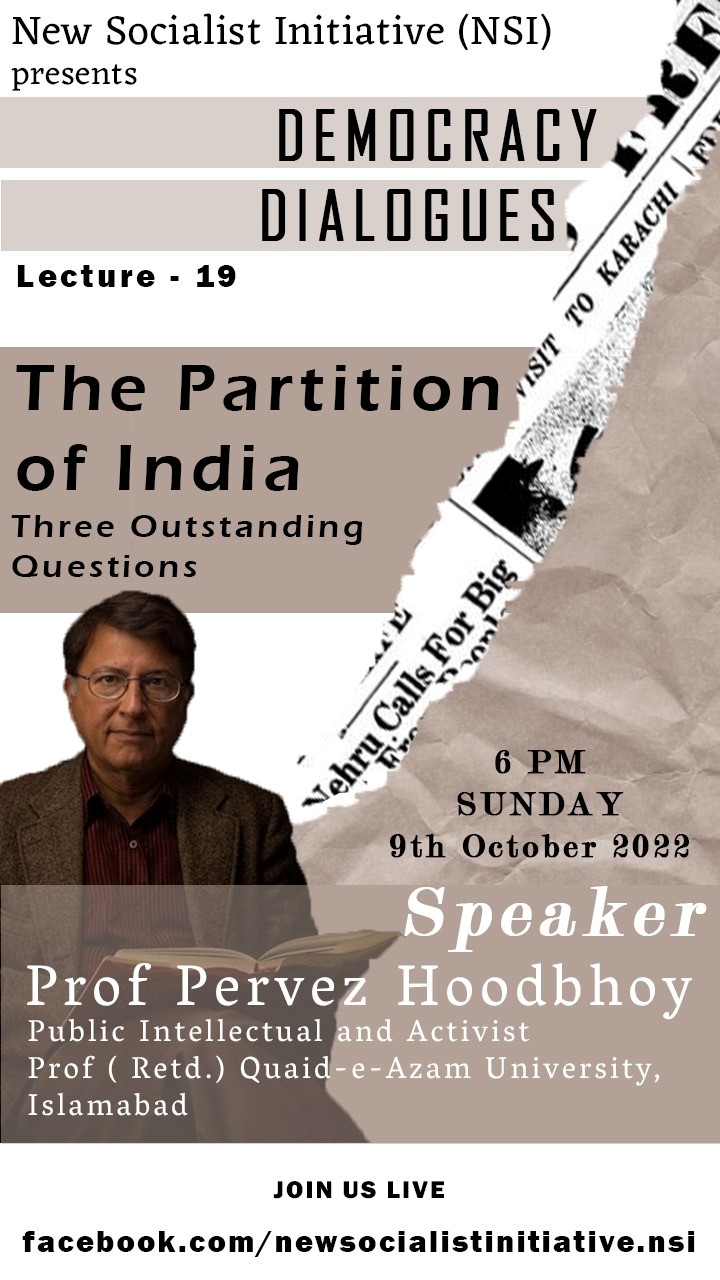
I am not here to withhold the certificate of scientific temper from being awarded to eminent scientists. My purpose is to examine whether lack of scientific temper comes in the way of doing good science. Pervez Hoodbhoy wrote a book some thirty years ago. The book is called “Islam and Science”, and the subtitle is “Religious Orthodoxy and the Battle for Rationality”. In the book he cites a telling example. Steven Weinberg and Abdus Salam – the same Salam who too is in the title of this program – came up with one of the greatest physical theories of 20th century – the unified quantum theory of electromagnetism and the weak nuclear force. They invented this theory independently of each other and shared the Nobel Prize for it. Weinberg was an avowed atheist; Salam was self-confessedly a believer. Salam wrote the foreword to Pervez’s book in which he concurs with the author that being a believer made no difference, one way or the other, to his coming up with the theory. There you have it from the horse’s mouth. What, then, is the relationship between science and scientific temper?
The scientist does not live by science alone. Even a scientist’s mind is not entirely colonised by Scientific Reason. I do not know if, like the brain, the mind too has two separate but interconnected lobes. But allow me to use a simple-minded metaphor. Scientific temper, it seems to me, has something to do with the rational side of the mind trying to influence the emotional side. This may give rise to a reasonable and cultivated individual, but it can also result in disaster. With the rational side meddling too much with the emotional side, it may give rise to a rather childish adult, if not a veritable Dr Strangelove.
Scientific temper is a tricky business. It involves a very intricate game between Reason and Culture. Neither side of the game we understand very well. There are those who think that Reason is transparent, whereas Culture harbours dark corners. The opposing side points out that this is a false picture. It labours to show that Reason has murky origins – it did not result from an immaculate conception. And, it is not at all self-aware – it does not know that it is inextricably entangled in structures of power.
Which side is more important for a successful and at the same time a meaningful life? Which side should sit in judgement? It is a debate that is hard to settle. There are funny episodes, for example, of scientists sitting in judgment over poetry. Paul Dirac, one of the greatest scientific minds of the 20th century once told J R Oppenheimer, another great scientist and a polymath, “I don’t see how you can work on physics and write poetry at the same time. In science, you want to say something nobody knew before, in words everyone can understand. In poetry, you are bound to say something that everybody knows already, in words that nobody can understand.” The judgements of poets about science, on the other hand, are usually not so funny. They are often much darker – prone to denouncing the supposed soullessness of science or mocking it as one mocks the childishness of a grown-up.
With this much as a background, let me now come to the topic of the day. I do agree with the assertion that scientific temper is largely missing from the societies and cultures that form a distinct civilisation on the subcontinent. But, I am less surprised that it is missing despite scientists likes of Bose, Raman and Salam. I am more surprised that it is missing despite someone like Jawaharlal Nehru. To my mind, Nehru was the best and the wisest proponent of the desirability of scientific temper. Let me quote a passage from The Discovery of India even if it consumes a precious minute,
“Science deals with the domain of positive knowledge but the temper which it should produce goes beyond that domain. The ultimate purposes of man may be said to be to gain knowledge, to realize truth, to appreciate goodness and beauty. The scientific method of objective inquiry is not applicable to all these, and much that is vital in life seems to lie beyond its scope – the sensitiveness to art and poetry, the emotion that beauty produces, the inner recognition of goodness. The botanist and the zoologist may never experience the charm and beauty of nature; the sociologist may be wholly lacking in love for humanity. But even when we visit the mountain tops where philosophy dwells and high emotions fill us, or gaze at the immensity beyond, that approach and temper are still necessary.”
I might also add that the Indian Constitution is the only Constitution in the world which prescribes developing “scientific temper, humanism and the spirit of inquiry and reform” as a fundamental duty of every citizen.
All this, however, may sound too philosophical and too idealistic. How can one be sure that scientific temper really matters to a society or a civilisation? I think history has provided a very real example. Let me dwell on it for a minute.
Pervez’s book that I have already mentioned opens with a parable of “a team of Martian anthropologists visiting Earth sometime between the 9th and 13th centuries”. They find that “the civilization with greatest promise is the Islamic civilization with its Bait-ul-Hikmah, astronomical observatories, hospitals and schools”. Then they visit again towards the end of 20th century and find that “their earlier prediction had turned out to be wrong. The part of humanity which once seemed to offer the greatest promise now appears inescapably trapped in a state of frozen medievalism, rejecting the new and clinging desperately to the old. On the other hand, the former retrogrades have climbed the evolutionary ladder and are now aiming for the stars. Was this stunning reversal of roles, ask the visitors, the mere misfortune of one and the good fortune of the other? Was it due to invasions and military defeats? Or was it the result of a fundamental shift in outlook and attitudes?”
With minor variations the parable may apply equally well to the fate of the subcontinent. If the Martians were to visit here sometime during the 17th century, they would be dazzled by the Navratnas (nine jewels) in Akbar’s court and they would marvel at the fact that the subcontinent accounted for nearly one third of the total world production. However, on their second visit at the turn of the millennium, they would be equally disappointed with this civilisation.
Perhaps the real question to ask is: why and how did the West pull ahead? That may shed easy light on why everyone else got left behind. The answer is obvious, but, like the case of the elephant in the room, there have been reasons for ignoring the obvious. Looking for deeper causalities behind the long trajectories of history may no longer be the intellectual flavour of the day. After all, this is the era of suspicions about grand narratives. We who got left behind can derive satisfaction from the all-round denunciations of colonialism and imperialism and attribute all that we suffer from to their crimes. We may rejoice that those in the high chairs of western academia are raising an intellectual storm against science and modernity which, supposedly, have been nothing but handmaidens of capitalism, colonialism and imperialism. The postcolonial theorist may continue to uncover sinister doings of the long dead colonialism. But someday we will have to ask – what is in it for us on the subcontinent? These critics are definitely making the western societies better, more cultivated, more democratic and more multicultural. But they already had science and modernity; they had already pulled ahead. How should we find our path out of poverty and superstition? What kind of future should we visualize for ourselves?
Explanations about why and how did the West pull ahead fill entire libraries. But, in some ways, the answer is too obvious: West did it with the help of science and modernity. Of course, both were born along with capitalism and colonialism. But one should not throw the baby with the bathwater. It is truly astonishing that there exist high theories declaring that all claims of science about universal truths, objectivity and uniqueness of scientific method are false; that all cultures and communities in all ages had equally valid claims to knowledge and method. In India a simple way has been found to support such theories – all one has to do is to claim that everything that modern science has accomplished, and will ever accomplish, is already there in the Vedas.
In any case, West did not accomplish the miracle of Great Divergence only through capitalism and industrial revolution. Enlightenment and Modernity played an equally important role. I have already referred to the complex interaction between Science and Culture. In 18th century Western Europe this imparted an added acceleration to history. And it took nearly two centuries after the advent of modern science for scientific temper to seep into western culture. Enlightenment was the name given to this process of seeping in.
Enlightenment and Modernity cannot just be imported or imitated. This is because of the fact that science is one but cultures are many. All cultures must find their own ways to imbibe science and animate modernity. Among those who were left behind, there have been a few successful examples of catching up with the West. Soviet Union used to be one such example but it collapsed. Russia, in any case, was too close to the European civilisation to count as a distinctive example. In the East, Japan earlier and China now have been such examples. What has stopped the subcontinent from being another such example?
This too is an enormous subject and an extraordinarily complex one. It is said that fools rush in where angels fear to tread. But let me rush in nevertheless. Among many millennial historical processes that have gone into the making a distinct civilisation on the subcontinent, one is special and unique. Elements of it may be found in other lands but on the subcontinent it has played role like no other place on the planet. This, in my opinion, has been the single largest obstacle to scientific temper seeping into our culture. Let me conclude by pointing a finger at it.
I am alluding to the fact that nearly all religions on the subcontinent took, in varying degrees, a mystical-devotional form, comprising of numerous sects led by gurus, pirs, mahatmas and other god-men – all engaged in the task of paving a plebeian road for a direct access to God without the mediation of priests or books or other intermediaries. On the Hindu side it emerged in the South as the Bhakti Movement and spread to the North in the second millennium. On the Muslim side it made its way through Afghanistan to the north-west of India and spread through sufis, dervishes and pirs. The phenomenon also gave rise to a new religion – Sikhism. It is this phenomenon of Bhakti, Sufism, Sikhism and assorted mystical-devotional movements that is at the heart of a distinct civilisation on the subcontinent.
This phenomenon has been judged favourably by nearly everyone. It has won praises from the religious and the non-religious, from traditionalists and modernists, from the right-wing as well as the left-wing. Nearly everyone prefers heterodoxy to orthodoxy. There is no denying that in many ways it has contributed positively to the culture and civilization on the subcontinent. And yet, there is a very large negative fall-out that has been largely ignored.
This phenomenon triggers processes that obstruct the advance of scientific temper and modernity. It encourages blind faith at the cost of a genuine sense of wonder; prevents religiosity from turning genuinely spiritual and becoming philosophical; prevents the philosophical from becoming reasoned; prevents Reason from seeping into Culture. It has been the principal vehicle of unreason, blind faith and superstition in our part of the world. George Orwell once said, “Saints should always be judged guilty until proven innocent”. An ironical meaning has been added to Orwell by today’s India where god-men do not lose followers even after being convicted as rapists and murderers.
Even Nehru fails to grapple with the civilizational consequences of Bhakti Movement. He harbours contradictions. He admires Vivekanand, Rabindranath Tagore, Gandhi, Bhagat Singh and Einstein – all at the same time. He was a great man – a visionary, a leader, a thinker, a statesman. Like Whitman he could perhaps say, “I am large, I contain multitudes”. He failed because the weight of the past was too heavy. He could not speak bare truths because he had to carry his people along. That is why, sometimes, you need to listen to small men too. They can speak the bare truth as they are spared the onerous task of carrying Nehru’s burden.
This is where I will stop.
——————————————-
Dr Ravi Sinha, Theoretical Physicist, Activist, Scholar, associated with Progressive Movements and Writer
[* The Indian Diaspora Washington DC Metro, USA organised an online panel discussion on the theme ‘Absence of Scientific Temper in the Lands of Scientists Raman, Bose, Abdus Salaam on 19 th November 2022.
Professor Pervez Hoodbhoy, Eminent Physicist, Prominent Public Intellectual, Civil Rights Activist, Author, Columnist from Pakistan ; Dr Ravi Sinha, Theoretical Physicist, Activist, Scholar, associated with Progressive Movements and Writer ; Mr Gauhar Raza, Former Chief Scientist, Council of Scientific and Industrial Research, Civil Rights Activist, Poet, Documentary Filmmaker both from India shared their ideas at the programme which was followed by discussion.
Prof Razi Raziuddin, Scientist, Founder, Indian Diaspora, Washington DC Metro, USA shared welcoming remarks. ]