Category Archives: Right watch

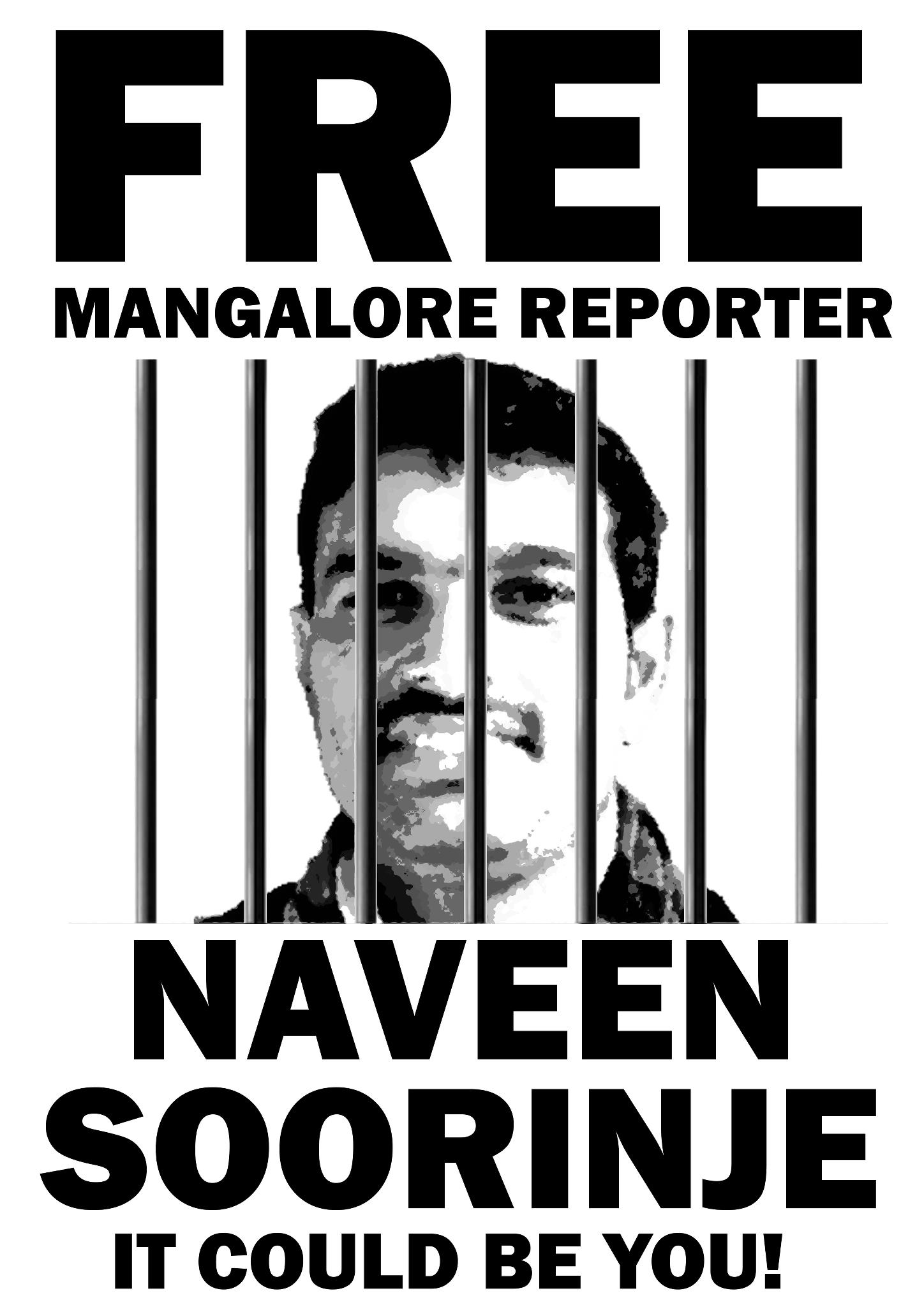
Free Naveen Soorinje

This is a public statement; names of signatories given at the end.

As editors and senior journalists representing a cross-section of the print, television and online media, we wish to bring to your notice a matter of serious professional concern for the journalist fraternity.

Naveen Soorinje, a district reporter with the Kannada channel Kasturi Newz 24, was arrested by the Karnataka police on 7 November 2012 for the role he played in covering the 28 July 2012 attack by Hindutva vigilantes on innocent boys and girls who were celebrating a birthday at a homestay in Mangalore. In the two months that Naveen Soorinje has been in judicial custody in Mangalore, his mental and physical health has deteriorated drastically. He was recently discharged from the jail ward of the district hospital after suffering a bout of chickenpox. Continue reading Free Naveen Soorinje

Who is afraid of Tipu Sultan?

Ravi said the state government is not ready to name the university after Tipu Sultan. If they are going to set up a non-religious university then the name should be non-controversial…. Like British, Tipu is also a foreigner for us and we will not accept his name.

CT Ravi, higher education minister, Karnataka, Jan 25, 2013, 16:38 IST , DNA)

The fast changing political developments in Karnataka has rather overshadowed the manner in which Tipu Sultan- who died fighting the Britishers at Srirangapatna (4 th May 1799) – is being denigrated by people owing allegiance to Sangh Parivar. The latest in series happens to be the higher education minister of Karnataka Mr C T Ravi, who claimed that for them ‘Tipu is also a foreigner’ like the British.

The immediate context of this Tipu bashing is the decision by the central ministry of minority affairs to set up ‘Tipu Sultan University’ at Srirangapatna. Continue reading Who is afraid of Tipu Sultan?

The Verma Committee: Alchemizing anger to hope: Arvind Narrain

ARVIND NARRAIN has an op-ed in today’s Hindu about the Justice Verma Committee. This is a longer version of the article

The public discourse post the brutal rape of Nirbhaya has witnessed a persistent degrading of the public discourse. Having been subjected to crudely offensive remarks by members of the political establishment, right from belittling a serious movement for equality as led by  ‘painted and dented ladies’ to ostensibly sympathetic responses which belittle women who have suffered a serious violation of their bodily integrity as nothing  more than ‘zinda laash’, we finally have a document authored by a Committee set up by the state which honours Nirbhaya.

The Verma Committee Report most fundamentally alters the public discourse on crimes against women by placing these crimes within the framework of the Indian Constitution and treating these offences as nothing less than an egregious violation of the right to live with dignity of all women. What is particularly moving and inspiring about the Report is that it does so by placing the autonomy and indeed the sexual autonomy of women at the very centre of its discourse.

Continue reading The Verma Committee: Alchemizing anger to hope: Arvind Narrain

On the Karnataka Police’s charges against KK Shahina: IFJ

This release was put out by the INTERNATIONAL FEDERATION OF JOURNALISTS on 15 January 2012

The International Federation of Journalists (IFJ) is extremely concerned to learn of the criminal charges filed against investigative reporter K.K. Shahina by police in the southern Indian state of Karnataka.

Shahina, who currently works with the weekly magazine Open, faces charges under various sections of the Indian Penal Code, including criminal conspiracy and intimidation of witnesses with intent to commit a crime. The chargesheet filed in the sessions court in the district of Kodagu in Karnataka state, also indicts her under sections of the Unlawful Activities (Prevention) Act, which is most commonly invoked to deal with terrorist offences.

These charges stem from a story published under Shahina’s byline in the weekly magazine Tehelka in December 2010, which appeared to cast doubt on the prosecution of a prominent Islamic cleric and political figure on terrorism charges. Continue reading On the Karnataka Police’s charges against KK Shahina: IFJ

Now that Owaisi is in jail, how about Praveen Togadia?: Mahtab Alam

Guest post by MAHTAB ALAM

Akbaruddin Owaisi, an MLA of Andhra Pradesh Legislative Assembly, who belongs to a Hyderabad-based political party All India Majlis-e-Ittihad al-Muslimin, better known as MIM, and its floor leader in the Assembly made an inflammatory speech against Hindus on 24 December 2012 at a public meeting in Adilabad District. The speech attracted widespread condemnation by Muslim activists, rightly so, apart from left, liberal individuals and organizations. Dr. Zafarul Islam Khan, President, All India Muslim Majlis e Mushawarat (AIMMM), an umbrella body of prominent Indian Muslim organizations termed it ‘a hate and rash speech’ arguing, ‘words that should never have been uttered by a responsible person, let alone a political leader, were used’.

Shabnam Hashmi, a prominent social activist and who has been relentlessly working on the issue of minority rights registered an FIR in Delhi against Owaisi stating, ‘the whole speech is highly objectionable, inflammatory and against the values of our constitution, democracy and secular values’. Similarly, FIRs were also registered in the State invoking section 295 A (for deliberate and malicious acts intended to outrage religious feelings) and 153 A (promoting enmity between different groups) of Indian Penal Code (IPC). Owaisi was arrested finally arrested on Tuesday (8th January) and sent to 14-day judicial custody. Continue reading Now that Owaisi is in jail, how about Praveen Togadia?: Mahtab Alam

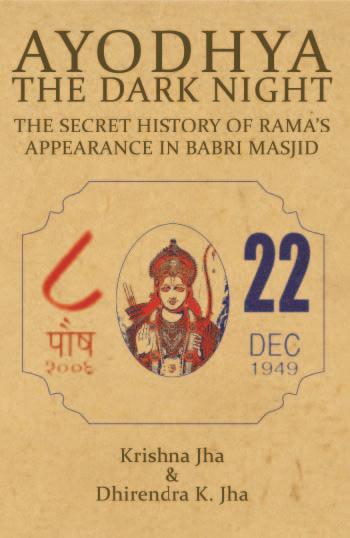
The muezzin’s last call at Babri Masjid: Krishna Jha and Dhirendra K Jha

This guest post by KRISHNA JHA and DHIRENDRA K JHA is an excerpt from their book, Ayodhya: The Dark Night, about the original Ayodhya conspiracy of 22 December 1949

Published December 2011 by HarperCollins India;Rs 499; Pages 232
Published December 2011 by HarperCollins India; Rs 499; Pages 232

The sound of a thud reverberated through the medieval precincts of the Babri Masjid like that of a powerful drum and jolted Muhammad Ismael, the muezzin, out of his deep slumber. He sat up, confused and scared, since the course of events outside the mosque for the last couple of weeks had not been very reassuring. For a few moments, the muezzin waited, standing still in a dark corner of the mosque, studying the shadows the way a child stares at the box-front illustration of a jigsaw puzzle before trying to join the pieces together. Continue reading The muezzin’s last call at Babri Masjid: Krishna Jha and Dhirendra K Jha

Akbaruddin Owaisi – You are an Enemy of Muslims (and Hindus)

Guest post by IRSHADUL HAQUE
Translated from Hindi by Shuddhabrata Sengupta

Akbaruddin Owaisi, you are an enemy of Muslims. You are the kind of adversary who lurks like a snake in the grass, ready to strike at the person who cares for that patch. Your desire to provoke a confrontation between India’s 25 crore Muslims and 100 crore Hindus reminds us of Muhammad Ali Jinnah. This is why Javed Akhtar has gone to the extent of calling you ‘the greatest enemy of Muslims’. I know that I am not alone when I find myself agreeing with this view. Many other Indian Muslims will be in agreement with me. Continue reading Akbaruddin Owaisi – You are an Enemy of Muslims (and Hindus)

RSS Supremo Mohan Bhagwat’s Thoughts on Rape

The RSS supremo Mohan Bhagwat (or to call him out in the way he is referred to in the Sangh – Sarsanghchalak Param Pujya Shri Mohan-ji Bhagwat-ji) has now joined the pavilion of eminent Bharatiya moustachioed misogynists. In a breathtakingly revealing statement, he has told us that rapes happen in India, not in Bharat. What he means is that rape only occurs in urban areas where the influence of Paschatya Sanskriti (western culture) leads women astray into being raped by men unable to help or control themselves in the face of the assault of women, out and about, by day and night, defying Mohan Bhageat’s Sangh-mandated Lakshman Rekha.

When an upper-caste landlord in a village claims his ‘droit de seigneur’ (land-owner’s claim) with a Dalit woman, it is not rape, it is a yagya, a time honoured shastric ritual. When husbands persuade minor wives on their ‘suhaag raat’ with a few disciplinary measures that leave them with black eyes and sore limbs, it is not rape, it is the carrying out of an Upanishadic injunction. When swamijis, babajis, acharyas and prachaks have their way with ignorant and nabalik shishyas, it is not rape, it is the partaking of the naivedyam of a woman’s body. It is the realisation of a ‘pushp ki abhilasha’, even if the pushp gets pushed around a little bit in the process. Continue reading RSS Supremo Mohan Bhagwat’s Thoughts on Rape

Fettering the fourth estate: Free Speech in 2012

Fettering the Fourth Estate: Free Speech in 2012

A report of the Free Speech Hub of the Hoot.org

The year 2012 ended with a Kannada TV reporter, Naveen Soorinje, in jail for more than fifty days after the Karnataka High Court denied him bail. Mangalore-based Soorinje, was incarcerated from November 7, 2012 after police charged him under the UAPA and under the Indian Penal Code (IPC) for reporting on the raid on a homestay party by a Hindu fundamentalist group in July. Soorinje’s bail application was rejected on December 26.

The same month, a television journalist, Nanao Singh, was shot dead in a police firing in Manipur.

In 2012, India was a grim place for free speech. It recorded the death of five journalists. Another 38 were assaulted, harassed or threatened.    There were 43 instances of curbs on the Internet, 14 instances of censorship in the film and music industry, and eight instances of censorship of content in the print medium. Continue reading Fettering the fourth estate: Free Speech in 2012

A Government in Hiding

Protestors from Raisina Hill began to be forcibly removed late last night. The police action continued in the foggy cold of this December morning. Aghast at the violence on a completely peaceful gathering of students – some of them just school children – many of us too felt compelled to join the demonstrations. A number of left-wing student groups who have been part of the protests had called for collecting at the Neel Gumbaz at Nizamuddin. At 11 am, we all started collecting there – many of us older folk going there in solidarity with what has been one of the most unprecedented student-youth mobilizations in the city. Yesterday, there had been repeated rounds of  water cannons, tear-gas and brutal lathi-charge by the police of a government that has gone into hiding.

Finally, some 600-700 of us began moving in a procession from Nizamuddin to India Gate. When we reached there, we discovered that already large numbers of people had begun recongregating at ‘Rajpath’ – the Power Avenue where every January the Republic displays its military might to the world. The numbers were continuously swelling. A group of supporters of Arvind Kejriwal’s AAP – inclduing Kejriwal and other leaders – were squatting on one side, towards Hyderabad House. This was virtually on the margins of the area where the main crowds were. Apart from the group of people we had come with, there were hundreds who seemed to us to be completely unaffiliated ordinary students, contrary to some claims floating around in Facebook that these were ‘RSS crowds’. At one end a human chain had been erected and slogan shouting for justice continued. Around the Amar Jawan Jyoti, there were processsions of students still coming in. We were there till about 2 pm and there was no question of any violence at all – except for three unprovoked tear gas shells that had been lobbed by the police into the crowd. There had been some minor commotion as the police occassionally tried to push back students with a lathi charge of sorts.

By this time, however, it was apparent that the police was preparing for the offensive. Police briefings were taking place in different groups and gradually the crowd was being surrounded from all sides. And yet, till about 2.50 pm, despite twenty rounds of tear gas being fired by the police, as well as periodic lathi charges  – they did not manage to provoke violence from the crowd to justify a crackdown. But the crackdown had to take place. And lo and behold, the justifications for it materialized, suspiciously, very soon. Continue reading A Government in Hiding

Free Naveen Soorinje

333487_10152333238225258_544394853_o

It is a matter of shame that instead of being celebrated, Naveen Soorinje, who followed journalism’s best traditions in reporting the attack by Hindutva vigilantes in Mangalore earlier this year, is now languishing in jail.

अकोट में साम्‍प्रदायिक हिंसा: एक पूर्व नियोजित साजिश

Guest post by Sharad Jaiswal, Amir Ajani and others

DSC0036223 नवम्‍बर, वर्धा से गये एक जांचदल, जिसमें महात्‍मा गांधी अंतरराष्‍ट्रीय हिंदी विश्‍वविद्यालय के अध्‍यापक, छात्र, वर्धा के सामाजिक कार्यकर्ता और पत्रकार सम्मिलित थे, ने अकोट (जिला अकोला) का दौरा किया। पिछले 23 अक्‍टूबर को अकोट ताल्‍लुका में साम्‍प्रदायिक हिंसा की घटना हुई थी जिसमें 4 लोग मारे गये थे एवं कई लोग घायल हुए थे। मुस्लिम समुदाय के 22 घरों को आग के हवाले कर दिया गया था और लगभग 25 दुकानों को जलाया गया था। मरने वालों में सभी निम्‍नमध्‍यवर्गीय पृष्‍ठभूमि से थे।

साम्‍प्रदायिक हिंसा की पृष्‍ठभूमि :

साम्‍प्रदायिक हिंसा की पृष्‍ठभूमि 19 अक्‍टूबर को तैयार की जाती है। पूरे अकोट ताल्‍लुके में 65 मंडल देवी के लगाये गये थे। प्रत्‍येक मंडल का संबंध किसी न किसी जातीय समाज से रहता है। मसलन माली समाज, कुनबी समाज, धोबी समाज आदि। धोबी और भोई समाज के एक मंडल, जिसके कर्ताधर्ता बजरंग दल, शिवसेना, विश्‍व हिंदू परिषद के लोग थे, के पास से निकलते हुए एक मुस्लिम बच्‍चे ने गलती से वहाँ पर थूक दिया। उसके साथ उसका हमउम्र दोस्‍त भी था। उसका थूक देवी की प्रतिमा को छुआ तक नहीं लेकिन पर्दे पर उसके कुछ छींटे जरूर पड़े। उस बच्‍चे को मंडल के लोगों ने पकड़ लिया और उसकी पिटाई करने के बाद वहीं पर बैठा लिया। इतनी देर में जब कुछ शोर-शराबा हुआ तो लोगों की भीड़ वहाँ पर एकत्र हुई और मामले को समझने के लिए शोएब नाम का व्‍यक्ति भी वहाँ पर पहुँचा और उसने कुछ हस्‍तक्षेप भी किया और मंडल के लोगों को समझाने की भी कोशिश की। उसने बच्‍चे की उम्र का भी हवाला दिया। बच्‍चे की उम्र 7-8 साल की थी। मंडल के लोगों की तरफ से यह भी कहा गया कि आज ये देवी की प्रतिमा पर थूक रहे हैं कल हमारे मुँह पर थूकेंगे। बहरहाल शोएब ने किसी तरह से मामले को शांत कराया और बच्‍चे को मंडल के लोगों से मुक्‍त कराया। इस घटना की चर्चा लगभग आधे घण्‍टे के बाद आस-पास के इलाके में फैल चुकी थी। एजाज नामक टेलर जिसकी घटना स्‍थल से कुछ दूर पर ही दुकान थी मंडल के लोगों के पास आया और उसने जानना चाहा कि मामला क्‍या है और उसके बाद वह भी लौटकर अपनी दुकान पर वापस आ गया। Continue reading अकोट में साम्‍प्रदायिक हिंसा: एक पूर्व नियोजित साजिश

Shield of Barbarism by Nagarjun

Nagarjun was an avant-garde poet of Resistance in Hindi. His poem, in Tarun Bhartiya‘s translation along with the original, can be read as an obituary 42 years after it was written.

Bal Thackeray ! Bal Thackeray!

At his fascist gods’

Beck and call Thackeray

O be careful, here he comes Bal Thackeray

All agreeing, how shall we crawl Thackeray

Hide, don’t you dare look away

In smart Shiv Sena Uniform – making music hall Thackeray Continue reading Shield of Barbarism by Nagarjun

Can the Love of Justice be Assassinated?: Arvind Narrain and Saumya Uma remember Shahid Azmi

Guest post by ARVIND NARRAIN and SAUMYA UMA

Progressive lawyers, social activists and academics have invested much time in trying to puzzle out what is the progressive potential of law. Sometimes, answers to deep philosophical questions emerge from a single life. Shahid Azmi’s life   (1977-2010) exemplifies one answer to this perennial question. It was a life which took to the legal profession with the objective of using  law as a shield and tool in the quest for justice. It was also a life which was tragically cut short, when Shahid Azmi was assassinated  at the  age of thirty three.

Continue reading Can the Love of Justice be Assassinated?: Arvind Narrain and Saumya Uma remember Shahid Azmi

Why I was saddened by Kasab’s execution

Rejoice, fellow Indians. Ajmal Kasab has been hanged. But please excuse me, I am not joining you. Your cheering and hooting and hurrahs feel like a medieval lynch mob celebrating the death of the sinner and not the sin. Barbaric is the word that comes to mind.

This isn’t merely about the morality or aesthetic of capital punishment. I want to ask you: what did we just achieve? Ten terrorists had come to kill and be killed, to cause maximum damage of the sort that they surely knew they’d be killed. Nine of them were killed in direct encounter. Did we hail their deaths? Do we say their deaths were justice? So if we killed Ajmal Kasab four years later- “with due process” – what exactly have we achieved? Continue reading Why I was saddened by Kasab’s execution

Ek Tha Tiger: Death and Bal K. Thackeray

We have reasons to be grateful that Bal K. Thackeray has died, a normal, natural death. Several of those whom he admired, didn’t. Adolf Hitler, the fellow ‘artist’ he often invoked, killed himself, his mistress and his dog. Indira Gandhi, and her son Sanjay, the mother and son firm of despots that Bal Thackeray endorsed, didn’t go gently into the night either. Sanjay Gandhi, the ‘bold young man’ whom Thackeray recognized as a fellow spirit came spiraling down in his own airplane, demonstrating that the indifferent sky does occasionally listen  to the prayers of the earth to alleviate its burden. Indira Gandhi and her son Rajiv both fell to the forces that their own ruling dispensation had nurtured, Khalistani zealots and the LTTE.  Bal Thackeray was lucky to have lived as long as he did, sipping his lukewarm beer, spitting out his bile. Very lucky. As for us, we are fortunate that Thackeray did not get to go down as a Maratha martyr, just as a lapsed cartoonist, a would-be caudillo and a has-been demagogue. Continue reading Ek Tha Tiger: Death and Bal K. Thackeray

A dangerous idea

For easy sharing, you can find this image on Twitter and Facebook.

Social Media Regulation vs. Suppression of Freedom of Speech: Pranesh Prakash

Guest post by PRANESH PRAKASH

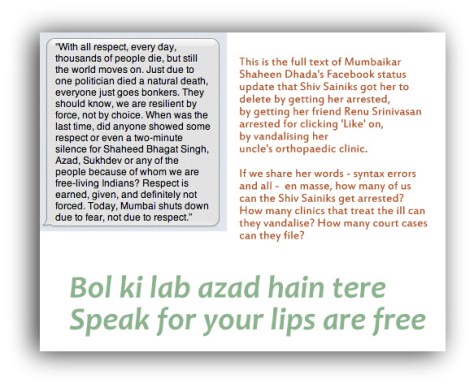
This morning, there was a short report in the Mumbai Mirror about two girls having been arrested for comments one of them made, and the other ‘liked’, on Facebook about Bal Thackeray:

Police on Sunday arrested a 21-year-old girl for questioning the total shutdown in the city for Bal Thackeray’s funeral on her Facebook account. Another girl who ‘liked’ the comment was also arrested.

The duo were booked under Section 295 (a) of the IPC (for hurting religious sentiments) and Section 64 (a) of the Information Technology Act, 2000. Though the girl withdrew her comment and apologised, a mob of some 2,000 Shiv Sena workers attacked and ransacked her uncle’s orthopaedic clinic at Palghar.

“Her comment said people like Thackeray are born and die daily and one should not observe a bandh for that,” said PI Uttam Sonawane.

What provisions of law were used?

There’s a small mistake in Mumbai Mirror‘s reportage as there is no section “64(a)”1 in the Information Technology (IT) Act, nor a section “295(a)” in the Indian Penal Code (IPC). They must have meant section 295A of the IPC (“outraging religious feelings of any class”) and section 66A of the IT Act (“sending offensive messages through communication service, etc.”). The Wall Street Journal’s Shreya Shah has confirmed that the second provision was section 66A of the IT Act.

Section 295A of the IPC is cognizable and non-bailable, and hence the police have the powers to arrest a person accused of this without a warrant.2 Section 66A of the IT Act is cognizable and bailable. Some news sources claim that section 505(2) of the IPC (“Statements creating or promoting enmity, hatred or ill-will between classes”) has also been invoked.

This is clearly a case of misapplication of s.295A of the IPC.3 This provision has been frivolously used numerous times in Maharashtra. Even the banning of James Laine’s book Shivaji: Hindu King in Islamic India happened under s.295A, and the ban was subsequently held to have been unlawful by both the Bombay High Court as well as the Supreme Court. Indeed, s.295A has not been applied in cases where it is more apparent, making this seem like a parody news report. Continue reading Social Media Regulation vs. Suppression of Freedom of Speech: Pranesh Prakash

The Uttar Pradesh administration has a prominent role in the burning of Bhadarsa: Rihai Manch

This release was put out by the RIHAI MANCH on 9 November

Jannatunisa, a victim of violence in Bhadarsa

Faizabad 9 November 2012: An investigation team of Rihai Manch visited the Bhadarsa village which was affected by communal violence during Dussehra celebrations. The team found out that the violence was well planned and was executed by communal elements in connivance with the administration. The role of the media in this incident is also suspicious. The team also found that the administration is forcing the affected families to erase any evidence of the incident and they have not even been compensated. No FIR has yet been registered yet. The team has also requested the Sheetla Singh Investigation Commission (constituted by the Press Council of India) to visit the area. Continue reading The Uttar Pradesh administration has a prominent role in the burning of Bhadarsa: Rihai Manch

भदरसा के जलने में प्रशासन की अहम भूमिका: रिहाई मंच

This release in Hindi about recent communal violence in the Bhadarsa area of Faizabad district of Uttar Pradesh comes to us from the RIHAI MANCH. Please help us translate this into English by translating just one paragraph in the comments

Jannatunisa

फैजाबाद, 9 नवम्बर 2012। रिहाई मंच के जांचदल ने दशहरा के दौरान हुयी साम्प्रदायिक हिंसा से प्रभावित भदरसा गांव का दौरा किया। जांच दल ने पाया कि भदरसा में हुयी हिंसा पूरी तरह सुनियोजित थी जिसे साम्प्रदायिक तत्वों और प्रशासन की मिलीभगत से अंजाम दिया गया जिसमें मीडिया की भूमिका भी संदिग्ध थी। जांच दल ने यह भी पाया कि प्रशासन की तरफ से आगजनी से पीडित परिवारों से घटना के साक्ष्य जबरन मिटवाए जा रहे हैं जबकि पीडि़तों को न तो उचित मुआवजा मिला है और ना ही एफआईआर दर्ज किये गये हैं। जांच दल ने प्रेस काउंसिल द्वारा गठित शीतला सिंह जांच आयोग से भी भदरसा जाने की मांग की है। Continue reading भदरसा के जलने में प्रशासन की अहम भूमिका: रिहाई मंच

“We may weep but we will stay”: Women resist evictions in Palestine: Kalyani Menon Sen

Guest post by KALYANI MENON SEN

Umm Nabil’s settler-occupied house is painted with Israeli symbols. (Photo: Aruna Rao)

Umm Nabil al Kurd is 82 years old. She is tiny and frail – her hands tremble as she takes the mike. But her voice is steady as she describes how she lost her home.

“We came to Jerusalem from Haifa as refugees in 1948” she says. “The Jordanians allotted us our house. We have lived there for 60 years – my children were born there. It was small and broken when we moved in – we extended it and improved it as our family grew. We planted a garden. When my son got married and the grandchildren came, we built a separate unit for him at the back of the main house. We built with our own money, with our own hands. Then, two years ago, the Israelis came with the police and told us to leave. They said the house was theirs. They pushed me to the ground, called me filthy names, turned their dogs on me. They threw out our furniture and moved into the house. We went to court but the judge said we were occupying the house illegally – he told us to pay 100,000 shekels as rent for the years that we had lived in the house. We had to pay – my husband would have been imprisoned if we did not. We are still fighting the case – the next hearing is in July but I don’t know if we will ever get the house back.” Continue reading “We may weep but we will stay”: Women resist evictions in Palestine: Kalyani Menon Sen