Category Archives: Theory

A Twist in the Tale, Or, the New Copernican Revolution

Even as the rejection of Vedanta’s application to mine in Niyamgiri is being widely hailed as a victory for tribal rights, there is of course one set of very predictable voices, which has leapt in to start damage control for their corporate heroes. Thus one such cheerleader of Capital tells us that the ‘real twist’ in the script is that the ‘denial of bauxite mining in Niyamgiri’ can mean disaster for the future of a poor region and a poor state!

On the other hand, a statement by the Campaign for Survival and Dignity – a platform of tribal and forest dwellers’ organizations from all over the country has hailed the decision, arguing that: “The project’s main problem was that it violated the Forest Rights Act’s provisions requiring ‘recognition of habitat and community forest rights’ and the consent of the gram sabha prior to taking forest land. This sounds like technical legalisms. But the basic point is that, under the law, the Dongria Kondhs have the power to protect and manage their forests and lands. Simple, but unprecedented; it has never happened before.”

For our scribe however, the “really nuanced” stories of Niyamgiri are not those of the tribals and forest dwellers. They come from “the likes of Raju Sahu who came from Bihar to Kalahandi 10 years ago and runs four tea/food stalls on the state highway that links Lanjigarh – where Niyamgiri and the Vedanta factory are situated – to Bhawanipatna, the district HQ”.  Sahu apparently told our journalist-investigator that his business has more than trebled in the last four years since Vedanta started operations there. This is true for any big economic enterprise that gets set up – a large number of small businesses sprout up around it. There would be as many stories about poor people who benefited from the life that grew up around say, giant public sector units – the end of which is celebrated by these cheerleaders of Capital.  Will the perishing of those small businesses as a fall-out of the closure of PSU’s be accepted by our nuanced story-teller as a justification for the continuation of PSU’s? Never. For we know that there are always different standards for judging the merits of corporate marauders. You can tell even before you start reading a column by a Shekhar Gupta or a Tavleen Singh or a Saubhik Chakrabarti, what is coming – be it Niyamgiri, Bhopal and Union Carbide, the loot of the Commonwealth Games or the studied silence on matters relating to DIAL and GMR. And sometimes, just sometimes, we happen to know why…

Continue reading A Twist in the Tale, Or, the New Copernican Revolution

Socialism of the New Century: Sunil

Guest post by SUNIL

[Sunil is the national vice-president of Samajwadi Jan Parishad. This  article was written for a special issue of Janata weekly. The essay is an important statement from one of the leading activist-theorists of the socialist movement (i.e. non-Marxist socialism) which does not simply disavow the marxist legacy but engages with that experience as an essential component of socialist practice. AN]

The tussle between capitalism and socialism as alternative visions of human society is not yet over. It is like the old fable of the race between a hare and a tortoise. At times one seems to be the winner. At other times the other seems to be leading. Capitalism is like the hare of the story. It looks fast, impressive and dynamic but after some time it is tired and resting with its own contradictions. In the end, we know it is the tortoise of socialism which will prevail. But that end is yet to be arrived at.

Capitalism looked supreme and unchallengeable in the later decades of the past century. With the disintegration of USSR, reverting of China, Vietnam and many other communist countries to the path of capitalism, and downfall of social democracy in Europe, there was no challenge to capitalism. Thus ‘end of history’ was arrogantly announced. Market fundamentalism of Reagan and Thatcher varieties started ruling over the world. But soon many crises arrived. Ecological crisis with the dangers of climate change and global warming on the one hand, and the global financial crisis with the worst recession since the thirties on the other, shook the faith in the supremacy and immortality of capitalist civilization. Added to these were the growing crises of hunger, malnutrition, homelessness, violence and war. The number of hungry people in the world kept growing and crossed the figure of 100 cores in the first decade of the twenty first century i.e. every sixth person on the earth today remains underfed and starved. This is perhaps the biggest and the most glaring failure of capitalism. Even after more than two centuries of the industrial revolution and miraculous progress of science and technology, it is unable to fulfill even the most basic need of the humankind.

Continue reading Socialism of the New Century: Sunil

The Rumour of Maoism

This essay has been published in the current issue of Seminar (No. 607, March 2010).

In his classic Elementary Aspects of Peasant Insurgency in Colonial India, Ranajit Guha outlines a certain methodological imperative for the historian who wanted to ‘get in touch with the consciousness of [peasant] insurgency’ when access to it is barred by the discourse of counter-insurgency that structures official records. How does one look beyond this discourse of the state that frames the archives in order to gain access to the voice of the rebels? Guha’s solution was relatively simple: Counter-insurgency, he argued, derives directly from insurgency and is so determined by the latter that ‘it can hardly afford a discourse that is not fully and compulsively involved with the rebel and his activities.’1

Unlike British Marxist historian E.J. Hobsbawm who had tried to track the story of ‘social bandits’ through a somewhat problematic reading of folklore,2 Guha warned that ‘folklore relating to peasant militancy can be elitist too’, for many singers and balladeers belonged to upper-caste families who had fallen on hard times and were, therefore, often suspicious of the revolt of the lower castes or tribals. Guha underlined that though the records of the colonial state and its police officials registered the voice of those hostile to the insurgents – including landlords and usurers – they could not avoid being shaped by the will of the insurgents. His conclusion therefore was that the presence of rebel consciousness could be read in the body of evidence produced by the discourse of counter-insurgency itself.

The burden of Guha’s argument was that in order to decode the language of counter-insurgency, it was often enough to simply reverse the values in the terms used by the official discourse: thus ‘badmashes’ simply meant peasant militants and not ‘bad characters’; ‘dacoit village’ would indicate an entire village involved in the resistance and ‘contagion’ would most likely refer to the solidarity generated by the uprising.

Those were happier days from the historian’s point of view. For the peasant and tribal insurgencies that Guha was discussing were organic struggles which drew their leadership from amidst the peasants or tribal communities themselves. Whether it was Sidhu Kanoo, Birsa Munda or Titu Mir – the leadership of the movements and their ‘ideologies’ derived directly from the world of the tribals. The context of colonial India was also, in a significant sense, quite clearly polarized and the possibility of written records being produced from a multiplicity of sources was simply out of the question. It may, therefore, be possible to follow Guha’s suggestion and merely reverse the values in order to get a sense of that other discourse. Continue reading The Rumour of Maoism

Democracy and the Communist Party: Aniket Alam

This is a guest post by ANIKET ALAM

This paper, rather preliminary note towards a full paper, attempts to look at the troubled history of democracy (both as a concept as well as a practice) and parties claiming affiliation to Marxism-Leninism. It tries to understand the historical paradox of parties and movements influenced by Marxism being among the more important contributors to democratising our world, but States ruled by parties owing allegiance to Marxism denying democratic rights to their own citizens. It then tries to identify some of the reasons for this large democratic deficit.

But before I begin, two short points about the structure of the paper may be in order. First, I have been fairly hesitant to write on this topic. I can hardly lay any claim to expertise on theoretical debates among Marxists as well as on the details of the history of countries ruled by communist parties. That apart, I am also conscious of my weakness in political theory, specially that relating to democracy and related ideas of liberty and representation. Therefore, the stress will remain more on the historical experience rather than the theoretical arguments. Second, and following from my hesitation laid out above, this paper is basically structured around three writings by two Marxists: Karl Marx himself , and Rosa Luxemburg. You may say I am merely paraphrasing them, or you may say that they are the burqa I wear during this excursion into unfamiliar territory.

Continue reading Democracy and the Communist Party: Aniket Alam

Of SubTerrains and Seismology: Notes on the Contemporaneous in India

Guest post by MOHD. SABIH AHMED

Of SubTerrains and Seismology: Notes on the Contemporaneous in India [1]

If the starting point of an enquiry is to investigate into the larger ambit of cultural production in which a notional unity of ‘contemporary art’ is one formation, the study of alternative systems/networks/formations would not suffice merely as mapping them as ‘alternative art’ in the same field. Instead, the demand would be to trace the contexts that give rise to a necessity for peculiar and disparate kinds of alternatives, and how certain cases instigate the field, maybe even risk rearranging the very conceptual and pragmatic constituents of that field.

This paper is a series of ponderings, questions, and a hesitant proposition regarding the above-mentioned, as much as it is an exposition on the state of affairs of that notional unity that is ‘Contemporary Art in India’. Continue reading Of SubTerrains and Seismology: Notes on the Contemporaneous in India

The Two Zizeks

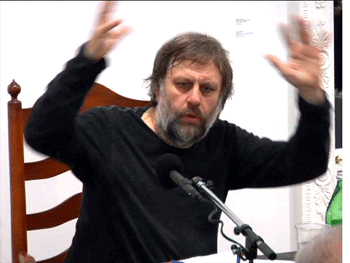
Slavoj Zizek spoke on Tragedy and Farce in Delhi on January 5, 2010. He spoke for about an hour and a half, then I responded for about 18 minutes, then he came back spiritedly for about forty-five minutes. This post is in two parts. The first part is the brief intervention I made at Stein Auditorium. In the second part of this post, I expand on my critique in the light of his response. I could not of course, speak after he had spoken the second time, so I’m doing it here.

I

A jinn appeared to a man and granted him three wishes. First, said the man excitedly, I want to be Slavoj Zizek. You idiot, said the jinn. You are Slavoj Zizek.

This is one of the many stories that the internet throws up on the eminent Slovenian Lacanian whom it has been our pleasure to listen to today. His own jokes and anecdotes are of course legendary, the medium through which he makes complex theoretical points. It thus becomes the burden of every unfortunate person writing about him or commenting on his work, to tell a few jokes themselves. Often Profesor Zizek’s own.

So. It struck me that the truth of the joke with which I began is that Slavoj Zizek longs to be Slavoj Zizek. He never quite makes it, though, because Zizek keeps escaping himself. In an interview to The Guardian a couple of years ago, he was asked – What do you most dislike about your appearance? And he replied – That it makes me appear the way I really am.

Having followed Professor Zizek’s work for a while now in growing bewilderment, I understand his predicament There are at least two Zizeks in there, and whichever one manifests himself, Slavoj is taken aback and rather dissatisfied. This is me? He seems to ask.

Continue reading The Two Zizeks

The Žižekian Counter-Revolution

[Slovenian Lacanian-Marxist-Hegelian philosopher and cultural theorist, Slavoj Žižek is visiting India currently and will be delivering a few lectures here. This post is prompted by his visit. Interested Delhi-ites can catch him speak on

4 Jan 2010. 5 p.m. on
“Ideology in the Post-ideological World: The Case of Hollywood”
at Sarai-CSDS. 29 Rajpur Road, Civil Lines, Delhi
and
5 Jan 2010. 7 p.m.
“Tragedy and Farce”
Stein Auditorium, India Habitat Centre, New Delhi]


imaaN mujhe roke hai jo khiNche hai mujhe kufr
ka’aba mere peeche hai kaleesa mere aage

[Faith holds me back when infidelity beckons/
Behind me, the Kaaba; before me, the Church]

It is difficult to miss the immense subversiveness of the  dilemma encapsulated in Ghalib’s couplet above.  This dilemma of the believer is produced by the constant threat of corruption – the Kaaba behind the believing Muslim holds him back from indulging in, or falling prey to, the infidelities and temptations that always lie in wait.

Substitute Marxism for Kaaba  and ‘postmodernism’ for Church, and you have the perfect Žižekian incarnation of this classic Ghalibian dilemma: Not quite at home in the Faith (Lacan, jouissance, surplus-enjoyment, the Real…) and yet, not able to leave it either, for the fear of what might befall one deserting the Order. Faith is the anchor that holds one back from committing all kinds of blasphemies. Nevertheless, the seductions of infidelity force our philosopher to turn for sustenance precisely to the philosophers and ideas he mistrusts: unlike most members of the Marxist faith, he repeatedly returns to Nietzsche, Heidegger, to Derrida, Foucault, Laclau and Deleuze. He takes over their language and makes himself at home in it. Is there a hidden jouissance in thus frequenting this forbidden territory?

Continue reading The Žižekian Counter-Revolution

Data, and its relationship with Accountability and Transparency

Cross-posted from http://accountabilityindia.blogspot.com/2009/10/on-data-and-relationship-with.html

Notions of transparency and accountability have been evolving since late 1980s. It was advocated that people must be given information about budgets, especially details of heads where money was allocated and how it was spent. This would aid in enforcing transparency, accountability and participation. In the late 1990s, as cities developed, pressure on urban infrastructure increased and municipalities became unable to respond to people’s expectations owing to a variety of reasons. The prevalent view was that municipalities and local politicians are inefficient. Elected representatives were criticized for being corrupt and favouring their vote-banks by distributing city resources to them. It was also believed that use of discretionary powers perpetuates corruption. Contemporary accountability-transparency paradigm is aimed at making transparent to the public how and why discretion is exercised in different circumstances. This (presumably) will curb discretion as much as possible and tighten decision-making.

Publishing data in public domains as a way to enforce and enhance transparency and accountability has gained greater momentum in the current decade owing to the Right to Information (RTI) Act through which various kinds of information can be acquired. In this post, I am interested in exploring the concept of data to understand how accountability and transparency are reified by using data as a primary tool. With the help of examples, I will put forward the contention that what is presented as data is in fact produced through multiple histories and contexts. Organizing /interpreting data without an understanding of some of these histories can only enforce existing stereotypes and/or lead to oversight. Continue reading Data, and its relationship with Accountability and Transparency

And this song is dedicated to Buddhababu

CM Buddhadeb back, denies quit rumours

sar par paaon rakh kar bhaago
katne waala patta hai
suno ji ye kalkatta hai
hurr..

The Ghost of Jinnah, Advani and Jaswant Singh

[That the BJP expelled Jaswant Singh for writing a book on Jinnah is hardly surprising, even if it represents really the most rotten part of contemporary India’s political culture from the Right to the Left: intolerance of intellectual differences. What is intriguing is that Jaswant Singh wrote the bookknowing well that this would be the end of his political career; even LK Advani could not survive his praise of Jinnah and even though he came back, he remains a pale shadow of his former self. So Jaswant never really had a chance. I have not yet read the book but have tried to follow those who have. While a more detailed analysis will have to wait, I am posting a piece I had written sometime ago as part of a larger academic paper which deals with Advani’s Jinnah episode and the seductions of secularism. – AN ]

Advani Meets the Ghost of Jinnah
On 5 June 2005, Bharatiya Janata Party leader and former Deputy Prime Minister, Lal Krishna Advani unleashed a storm within his party and its allied organizations of the Hindu Right. On that day, speaking at a function organized by the Karachi Council on Foreign Relations, Economic Affairs and Law (KCFREAL), Advani referred to Mohammed Ali Jinnah’s speech in the Pakistan Constituent Assembly on 11 August 1947 and described it as ‘a classic exposition of a Secular State’ and Jinnah as a genuine secularist (Advani 2005). In this speech, sections of which Advani read out at length, Jinnah, the founder of the ‘Islamic state of Pakistan’ had said: ‘You are free, you are free to go to your temples. You are free to go to your mosques or any other places of worship in this State of Pakistan. You may belong to any religion or caste or creed; that has nothing to do with the business of the State…You will find that in the course of time Hindus will cease to be Hindus and Muslims would cease to be Muslims, not in the religious sense, because that is the personal faith of each individual, but in the political sense as citizens of the State’ (Jinnah 2005).

On the previous day, Advani had already fired his first salvo. He had visited the Qaid-e-Azam mausoleum where he made the following entry in the visitor’s book: ‘There are many people who leave an inerasable stamp on history. There are very few who actually create history. Qaid-e-Azam Mohammed Ali Jinnah was one such rare individual.’ And further, recalling Sarojini Naidu, underlined: ‘Sarojini Naidu, a leading luminary of India’s freedom struggle, described him as an ambassador of Hindu Muslim unity. His address to the Constituent Assembly of Pakistan on August 11, 1947, is really a classic, a forceful espousal of a secular state…’ (Sarwar 2005, Kapoor 2005). If there was any doubt in anybody’s mind that this was not just a polite entry in a visitor’s book, made in a formalistic way, Advani hastened to clear it in the speech that followed the next day.
Continue reading The Ghost of Jinnah, Advani and Jaswant Singh

Rakhi Sawant Ka Swayamvar!

“Yeah yeah, take a good show and spoil it by theorizing” said my labour lawyer/bollywood-gossip-junkie flat mate. All I said was that I thought Rakhi Sawant Ka Swayamvar was an “Interesting phenomenon that comments on the articulations of the notion of marriage within the context of fixed notions of culture among upper middle class north Indian families and within that the tropes of gender, normativity and melodrama! And so I should write about it on Kafila”.

Her comment wasn’t entirely unjustified.

The way in which one watches these shows in itself raises a range of questions. The show has taken over my life as of now. The final decision of who she will marry will be made soon and the restlessness and anxiety about it is immense and requires effort to contain. Continue reading Rakhi Sawant Ka Swayamvar!

Reservations for Women: ‘Am I That Name?’

[I am posting here the chapter from my book – Recovering Subversion. Feminist Politics Beyond the Law – that I referred to in response to demands for references on my previous post on the WRB.  I do apologize to those (including fellow-kafilaites!) who may rightly feel I have said enough on the topic.

The title of this chapter is a tribute to Denise Riley’s question “Am I that name?” referring to the label “Woman.” Am I That Name? Feminism and the Category of ‘Women’ in History Minneapolis, University of Minnesota Press, 1988].

When the Women’s Reservation Bill (WRB) first appeared as the 81st Amendment Bill in 1996, proposing to reserve 33% of seats in Parliament for women, it burst into public discourse full-blown as a “women’s” (indeed, a feminist) issue, and continues to be debated largely in terms of women’s rights. It is becoming increasingly clear however, that the questions thrown up by the timing of the Bill and the responses to it cannot be understood solely within the framework of women’s rights. This chapter attempts to relocate these questions in a complex matrix of political identities in order to realize their full significance. I also argue that the debates around the Bill reveal a more fundamental set of questions about the issues of citizenship, representation, and the subject of feminist politics.

Continue reading Reservations for Women: ‘Am I That Name?’

The Picnic Managers: Prasanta Chakravarty

This is a guest post by PRASANTA CHAKRAVARTY.

Writing in the Encounter, September 1961, Edward Shils characterizes the Indian student in the following terms:

“Your curiosity, idle or ordered, takes you to an Indian university or college. You walk across the dusty sun-stuck grounds or through damp, dark corridors and past malodorous lavatories; and you see clumps of boys, chirruping like birds, an occasional pair walking hand in hand, sometimes a little knot of girls in pigtails. They look extraordinarily childlike, with all the melting tenderness of children, terribly shy, soft-eyed, gentle, fragile, and very quick to smile…Their voices are low and soft, their movements light, elastic, lamb-like. If one of them, darting about in the suddenly ignited outburst of a boyish prank, nearly collides with you, he aplogises with timorous embarrassment. If you ask one of them where to find a certain professor or the head of a particular department, he will go far out of his way to lead you to the right place, and you will be impressed by his shyness and deferentiality. When he has delivered you to your destination, and you thank him, he will say something like ‘Not to mention’ and will turn and dash off as light-footedly as a young deer.”

Continue reading The Picnic Managers: Prasanta Chakravarty

Evangelist Zizek and the End of Philosophy – II

Idea of communism? Courtesy Oscar's global blog
Idea of communism? Courtesy Oscar’s global blog

Today was the third and final day of the ‘Idea of Communism’ conference and it was the truly most bizarre experience – bizarre philosophical experience, I should say – of my life. Let me start backwards today.

The preacher from Ljubliana was in full form and he closed his own hour-long (or was it 55 minutes) presentation ‘To Begin from the Beginning, Over and Over Again’ with the following: “If the rumour that Gilles Deleuze was writing a book on Marx before he died, is true then this should be seen as a sign that after having spent a life time away from the Church he wanted to come back to its fold…We welcome all those anti-communist Leftists who have spent their lifetimes attacking us to come and join us.” Continue reading Evangelist Zizek and the End of Philosophy – II

Re-booting Communism Or Slavoj Zizek and the End of Philosophy – I

Zizek - the postmodern Lenin?

Today, 13 March, a whole galaxy of philosophers and theorists got together for a three-day conference “On The Idea of Communism” under the auspices of the Birkbeck Institute for the Humanities, London University. The Conference opened to a jam-packed hall where all tickets had sold out (no jokes, this was a ticketed show where the likes of Alain Badiou, Slavoj Zizek, Jean Luc-Nancy, Toni Negri, Jacques Ranciere, Terry Eagleton and many many others are to perform on the ‘idea of communism’). The huge Logan hall with a capacity of about 800-900 was so packed that the organizers had made arrangements for video streaming in another neighbouring hall – and that too was half full! Very encouraging in these bleak days.

The conference began in the afternoon with brief opening remarks by Alain Badiou and Slavoj Zizek. Badiou made his general point (see below) about the continuing relevance of the ‘communist hypothesis’. Staid and philosopherly. Continue reading Re-booting Communism Or Slavoj Zizek and the End of Philosophy – I

Child prodigies and television news scripts… aaaw!

Guest post by KISHORE BUDHA

Continue reading Child prodigies and television news scripts… aaaw!

John Milton Takes a Stand? Prasanta Chakravarty

This is a guest post by PRASANTA CHAKRAVARTY

[Dissidence comes along with responsibility. If that sounds an utter sell out, one has to look back no further than the career and oeuvre of John Milton, whose 400th Anniversary is being celebrated around the world.]

Students of English literature usually do not prefer meddling too much with politics, especially if that comes in the way of appreciating the hermeneutics of the text, the lyricism set aside for the work of art. Sophisticated scholars have learnt to deftly negotiate and work with Marxism, new historicism and cultural criticism, without compromising on the finer points of close reading. They have also welcomed areas like textual studies and performance and newer genres like memoirs, broadsheets, travelogues, petitions, graphic fiction and so forth within the critical ambit with a careful eye that such forays do not destabilize the Great Book tradition. Students of politics and the political, on the other hand, have a certain distrust for soft aesthetic options. In one interesting recent interview, James Scott, who routinely uses Zola and Tolstoy in his classes and works, lamented in jest on his status at the Yale Political Science Department as an outlier, blaming it onto the ascendancy and monopoly of formal and rational choice models in the discipline.

Continue reading John Milton Takes a Stand? Prasanta Chakravarty

Mumbai terror, the revolt of the elites and Life itself

You have said everything there is to say, and felt everything there is to feel. You have shouted angrily or reflected seriously or stated in the calm tone of conviction that terrorists are as authoritarian as the states they target, that terrorists have no religion, that terrorists are cowards who target soft civilian populations. You have despaired at the carnage wreaked on a city sick and tired of having to be “resilient”; of having faced one disaster after the other – from floods to targeted attacks on specific communities to bomb blasts – and “emerged with its spirit intact”. Your heart has clenched painfully at the inconsolable tears of baby Moshe; at the blood-spattered, newly motherless one-year old Viraj in an exhausted Head Constable Salunkhe’s arms, entrusted to him by his father, a utensil seller wounded by bullets at CST. You have gazed numbly at the image of Maharashtra ATS Chief Hemant Karkare’s young son with drawn countenance bearing the ritual paraphernalia of his father’s cremation ceremonies. Despite yourself you felt a sudden glimmer of hope steal into you at the stony dignity in Kavita Karkare’s dry-eyed grief at her husband’s funeral, at her steadfast bindi and her coloured sari. You have hated yourself for being relieved that those you know in that poor torn city are safe, when hundreds you did not know were not.

In fear and foreboding the feeling has overcome you – “What lies ahead of us now?”

But after all of that, after all of the sorrow and the grieving, in the midst of absolute despair, when you start to think again – STOP. Continue reading Mumbai terror, the revolt of the elites and Life itself

The Fascist Mind: Reading Mein Kampf Today

NOTES ON THE THEORY OF IDEOLOGY

It is highly instructive to go through the range of comments that some of our recent posts on terrorism and violence have elicited. Apart from some of the more mindless ones, there have also been some that raise supposedly substantive questions but in a manner that presupposes the answers. The very manner of raising the ‘questions’ is such that any answer but the one contained in the ‘question’ is bound to bring forth a volley of charges to which the comments themselves stand witness.

Continue reading The Fascist Mind: Reading Mein Kampf Today

Ecstatic Archaisms of Aurobindo Ghose – Prasanta Chakravarty

Guest post by PRASANTA CHAKRAVARTY

In Reflections on Revolutionary Violence Aditya Nigam makes some nuanced points about the nature of Maoist violence and by contrast, comments on the bedrock character of democracy itself. Can we trace the sublime cult of blood and gore further down, to the founding principles of Forward Bloc, for instance? Or espy it in the millennial longings of a few Gita wielding swadeshis, for that matter? One may begin to see a pattern.

Continue reading Ecstatic Archaisms of Aurobindo Ghose – Prasanta Chakravarty

Reflections on Revolutionary Violence

In the last one year, I have often found myself going back to a conversation I had had with a Maoist ideologue. As it happened, it was he who started interrogating me about my stand on violence. ‘So, you have become a Gandhian?’ he demanded. I must confess I was a bit taken aback, not quite able to figure out the context of this poser. ‘What do you mean by Gandhian’, I kind of mumbled. Pat came his reply: ‘Well you have been making some noises lately about Maoist violence, haven’t you?’ Suddenly it all became clear. Through this ridicule, he was trying to appeal to that part of me that still remained marxist – presumably now buried in some remote past – and to resurrect it against my ostensible ‘non-marxist’, ‘liberal’ present (for which ‘Gandhian’ was some kind of a short hand code). I found myself at a loss of words. Does a criticism of the mindless and nihilistic violence of the Maoists make one a Gandhian? Is there no space left between these two polar positions? The conversation did not go very far that day but has kept coming back to me ever since.

Continue reading Reflections on Revolutionary Violence