Report prepared by Association for Protection of Civil Rights
Although the BJP came back with a much reduced majority (or perhaps because of that) the agenda of anti Muslim violence has been ramped up. We, the people of India, who restored the dignity of the Constitution, must continue to bear witness, continue to fight against the hate filled politics of Hindu Rashtra, continue to assert – Not in My Name.
We will remember these names, and the names of thousands of Muslims killed by lynch mobs, who have had their livelihoods destroyed, whose faith has been insulted, who suffer imprisonment without any basis till today.
Sab yaad rakha jayega.
There has been total of eight lynching incidents after the results of the General Elections were announced on June 4, 2024.
Twenty-three-year-old Salman Vohra, who had gone to watch a cricket tournament match in Chikhodra, Gujarat on 22 June, was mercilessly beaten to death by a group of men.
Three Muslim men, residents of Uttar Pradesh, were brutally attacked by a Hindutva mob in Chattisgarh’s Raipur on 7 June. Saddam Qureshi and his cousin Chand Miya Khan (23), both from Saharanpur district, and Guddu Khan (35) from Shamli district, were transporting cattle when they were allegedly chased by a mob in Raipur; two died on the spot, while one died after 10 days.
A Statement by Academics Worldwide on the Arrest of Hebrew University Professor Nadera Shalhoub-Kevorkian
Around 5 pm on Thursday, April 18, 2024, Hebrew University professor and internationally renowned feminist scholar Nadera Shalhoub-Kevorkian was arrested by Israeli police at her home in the Old City of Jerusalem on the charge of incitement to violence. The police raided and searched her home and she is currently undergoing harsh and dehumanizing interrogation. Her lawyer said the charges against her are serious. Information about her release is unknown. Palestinians in Israeli detention suffer physical, emotional, and mental violence. Professor Shalhoub-Kevorkian, who holds both Israeli and U.S. citizenship, has been subjected to violent repression and harassment by the Hebrew University for speaking out against the ongoing genocide in Gaza. Furthermore, she was suspended from her teaching duties in March, though later reinstated once it became clear that there is no basis for the allegations against her.
How the policy of PPP (Public Private Partnership) Model in Sainik Schools is counter to all Constitutional principles and values
Representation Image
In a controversial and much reviled decision, the union government under prime minister, Narendra Modi “decided” to hand over “67 per cent of Sainik Schools to the Sangh Parivar (and its allied organisations who are self-acclaimed majoritarian and unconstitutional), BJP Politicians and allies. This investigation was undertaken by meticulous examination by the Reporter’s Collective and became public on April 3, 2024. This piece looks at the gross implications of this move.
“It’s the day of resurrection…”:
Swami Avdheshanand Giri after Pran Pratishtha ceremony in Ayodhya[1]
It was October 2020 when a Sainik School for boys was inaugurated in Shikarpur Tehsil of Bulandshahr District.[2] Right from Indresh Kumar, or Ram Lal, to Mahant of Junagarh Avadheshanand Giri, a seer supposed to be close to the proponents of Hindutva, many leading lights of the RSS and its frontal organisations or co-travellers of their ideology attended the high profile function.
The event made headlines for several reasons:
One, it was called the ‘first Sainik School of RSS’.
Two, a whooping sum of Rs 40 crores was supposed to be spent over it – thanks to the largesse extended by the union (Modi) government.
Thirdly, it was one of those rare occasions when RSS had moved beyond its founder member Dr Hedgewar to build memorials. Remember Rajendra Singh alias Rajju Bhaiya (1922-2003) was the first non-Brahmin and non-Maharashtrian Supremo of RSS from 1994-2000. This Sainik School is located in the same place where he (Raju Bhaiya) was born.
Normally, an idea to start a school is met with jubilation. This one however had the opposite effect. There were voices of concern raised by educationists, social activists as well as political leaders,
The added concern was that Vidya Bharati, the education wing of the RSS – which already runs 20,000 schools across India – would now also be running this military school although there was a clarification that this Army School will follow the CBSE curriculum and will have classes running from Class 6 to Class 12.
The same Vidya Bharatii (of the RSS’) whose stated mission is
“To develop a National System of Education which would help building a generation of young men and women that is committed to Hindutva and infused with patriotic fervour”. [3]
Questioning the whooping sum of Rs 40 crores which would be spent over it, Akhilesh Yadav, leader of the Samajwadi {arty (SP) and former Chief Minister of UP, had, at the time, underlined that since we already have enough such institutions “[r]un by the government so where is the need for RSS to run its own army school,”[4]
He did not hide his apprehensions about what curriculum be taught there.
“RSS apparently wanted to serve its political purpose by opening the army school where the students will “probably be taught lessons in mob lynching and disrupting social harmony”.[5]
The concern expressed by many about this project could not be brushed aside easily. It is a different matter that in today’s mediatised world, things move with such a speed that the issue of a RSS run military school , the RBSVM – Rajju Bhaiya Sainik Vidya Mandir – and the attendant furore soon died down. Little did anyone carry the premonition that the founding of RBSVM was just a trailer of what lay in store: asli film abhi baaki thi‘.
‘It was Norwegian far-right terrorist Anders Breivik, who killed over seventy people in a car bombing and mass shooting of children in 2011, who first brought the term “Cultural Marxism” to the world’s attention in his thousand-some paged statement of belief, which focused almost entirely on the concept.’ (Joan Braune, ‘Who’s Afraid of the Frankfurt School – “Cultural Marxism” as an Antisemitic Conspiracy Theory’, Journal of Social Justice, Vol. 9, 2019: 2)
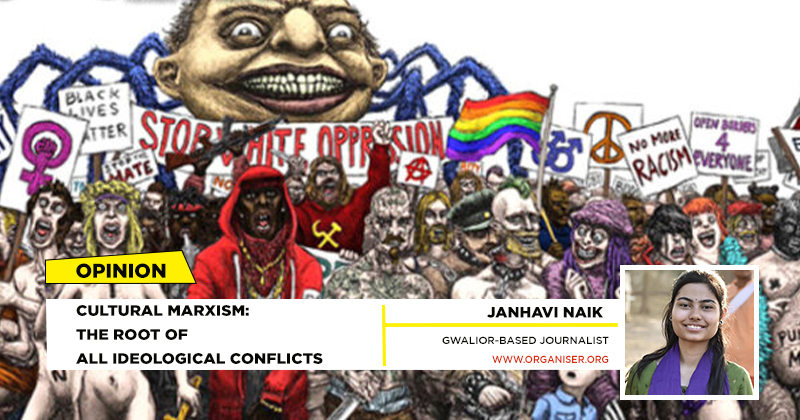
Image from RSS mouthpiece Organizer on ‘Cultural Marxism’
The ideology of Hindu supremacism is going global. Last Vijaya Dashami the RSS supremo Mohan Bhagwat had waxed eloquent on a new enemy, imported directly from White supremacist terrorist discourse, namely ‘Cultural Marxism’. The term is a New Right invention that has nothing to do with any specific tendency, Marxist or otherwise. It is the name of a right-wing conspiracy theory that blames all the different claims being made today as threatening to ‘traditional family values’ (read patriarchy) and to ‘traditional ways of living’ of the Whites, now threatened by growing demands of equality and multiculturalism from various quarters. As the quote above states, this term was first brought to the world’s attention by a mass murderer who killed 77 people in Norway some thirteen years ago. According to Paul Rosenberg, Brevik had used the term ‘cultural Marxists’ or ‘cultural Marxism’ 600 times in his 1500-plus page manifesto.
We publish below a statement circulated by Lalit Kala Kendra(Gurukul) alumni, art educators, visiting faculty and theatre/cine artistes regarding the recent attack on the students making an examination presentation of a play woven around a Ram Leela rehearsal, where routinely men play women’s roles. This attack took place on 2 February. This incident was preceded by an attack on FTII students on 23 January by a group of right-wing goons. We also present in this post, for the record, a statement on the previous incident by the FTII Students’ Association and a solidarity statement by FTII Alumni.
Statement from Lalit Kala Kendra(Gurukul) alumni, art educators, visiting faculty and theatre/cine artistes
We would like to begin by saying that despite our diverse ideological, cultural, social, religious and geographical backgrounds and identities, we write this note together as informed and sensitive artists, and citizens of India. We would like to strongly emphasise that we have great respect for all religions, castes, creeds, sects etc. We are proud of and value our rich Indian culture and traditions.
I’m relieved that you aren’t around these days. But I miss the sort of discussions we would have had if you were. Hence this letter, this sort of talking to you, this helpless and possibly meaningless, speaking into the ether because some things must just be said, remembered, felt, resisted, and held on to, even if everything around is telling you to move on, to get into the spirit of things and join the festivities, as it were.
I remember your reaction when you first saw my documentary film, Ayodhya Gatha. ‘Did you have to make our arguments about religion so public? If you get any recognition for this film, remember it’s thanks to me – like all your debating prizes!’ you said, loud enough for all to hear, both embarrassed and proud at the same time. We had a good laugh and a hug together. But in truth, over the years, religion was a topic on which we went from heated, impassioned arguments to considered, more careful discussions. You, tip toeing around my atheism (and asserting that deep down inside I was a believer) and me trying to be sensitive around your faith, even as we talked a lot about everything that’s been happening over the last four decades in the name of that religion.
यह पोस्ट सोशल मीडिया पर कई लोगों ने साझा की थी । बताया जा रहा था कि इसके लेखक सरोज मिश्र हैं। इस बीच इसके असल लेखक से हमारा संपर्क हुआ है जिनका नाम विवेक कुमार उर्फ़ विवेक असरी है। मूल लेख 2010 में छपा था जिसे यहाँ पढ़ा का सकता है।
अयोध्या का यह 300 साल पुराना जन्मस्थान मंदिर था जिसके लिए ज़मीन एक मुसलमान ज़मींदार के दान की थी। नए राम मंदिर के विस्तार के लिए अगस्त 2020 में इसे ढहा दिया गया। (छवि साभार द वायर)
कहते हैं अयोध्या में राम जन्मे, वहीं खेले-कूदे, बड़े हुए, बनवास भेजे गये, लौटकर आये तो वहाँ राज भी किया। उनकी ज़िंदगी के हर पल को याद करने के लिए एक मंदिर बनाया गया। जहाँ खेले, वहाँ गुलेला मंदिर है। जहाँ पढ़ाई की, वहाँ वशिष्ठ मंदिर हैं। जहाँ बैठकर राज किया, वहाँ मंदिर है। जहाँ खाना खाया, वहाँ सीता रसोई है। जहाँ भरत रहे, वहाँ मंदिर है। हनुमान मंदिर है, कोप भवन है। सुमित्रा मंदिर है, दशरथ भवन है। ऐसे बीसियों मंदिर हैं, और इन सबकी उम्र 400-500 साल है। यानी ये मंदिर तब बने, जब हिंदुस्तान पर मुगल या मुसलमानों का राज रहा।
Herodotus, widely considered as the father of history, mentioned the existence of Palaistinê between Phoenicia and Egypt, and still failed to condemn Hamas. Damn all historians! – An Anonymous Disappointed Liberal
But you are neither a Palestinian nor a Muslim. Why put yourself out there in this climate? – An Anonymous Sanctimonious Liberal
When I look at the partition of Palestine in 1947 and 1967, the ghost of India and Pakistan rise like smoke from charred buildings of Karachi and Kolkata. – Tithi Bhattacharya (A historian from partitioned Bengal)
The solidarity that is needed today will have to be built primarily by the peoples themselves. Only then can hope be reborn…– Samir Amin (Egyptian-French economist of Marxist persuasion)
On 7 October 2023, the Hamas led an attack on the Gaza envelope, which is part of the southern district of Israel, killing reportedly 1200 people. The Hamas is a political and military organization governing the Gaza Strip of Palestinian territories that are under occupation by Israel. Many considered the military incursions of 7 October as an outright terrorist attack on civilians. Yet, others called this a ‘jail-break’ in terms of a reaction to Palestinian people bearing the burden of around seventy-five years of displacement, apartheid, surveillance, and endless other atrocities. Majority of inhabitants in the Gaza Strip are descendants of refugees who were displaced from the region which became Israel after the 1948 Arab–Israeli War. Nearly two million Palestinians have been notoriously cornered into this densely populated enclave where their movement has been severely restricted, and food, water and electricity supply has been controlled by the Israeli government; making such habitation the largest open-air jail in the world. After this attack, the Israeli military has launched a disproportionately brutal retaliation, resulting in massive suffering and a mounting death toll.
Some, of course, seek to rationalize the ensuing Israeli-Palestinian conflict by drawing on the belief that Israelis are the original inhabitants of this region and have suffered two millennia of exodus, and that they have the right to return and settle in what is considered as the ‘promised land’ as per the Biblical belief. Others consider that Israel is a settlers colony, and that Palestinians have all the rights to recover their country. Not so long back, the compromises of the Oslo Accords were thought to be a way forward in settling the crisis by creating two states, within which Israelis and Palestinians would achieve the long-lost peace in the region. Yet, such peace has failed to materialize. In the context of rising Islamophobia, conservative popular opinion asserts that the lack of peace in the region is due to a longer history of religious strife and supposed Muslim bigotry. Needless to say, history is more complex.
This post is based on a presentation at a panel discussion on “Israeli war against Palestinian people in Gaza” organised by Janhastakshep in Delhi on October 20, 2023.
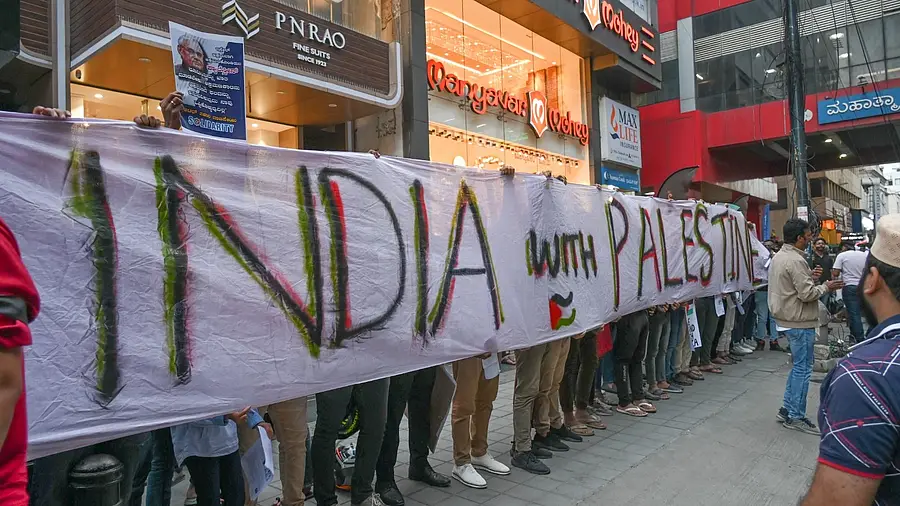
Palestine solidarity protest in Bangalore
But do you condemn…
We are expected to begin every discussion on the latest phase of the ferocious 75 year old war Israel has been waging on the Palestinian people, by answering the question – “But do you condemn the Hamas action?”
Sometimes, because stronger words are needed, they say “dastardly” Hamas action, as a television anchor recently did, trying to push Palestinian writer Susan Abul Hawa to place on Hamas the responsibility for the ongoing “humanitarian crisis” She did not. Nor did she accept the banal term humanitarian crisis, terming it instead, an intentional genocidal war.
This belligerent question comes from beginning with “secondly”, as the Palestinian poet Mourid Barghouti said –
“If you want to dispossess a people, the simplest way to do it is to tell their story, starting with ‘secondly’ “.
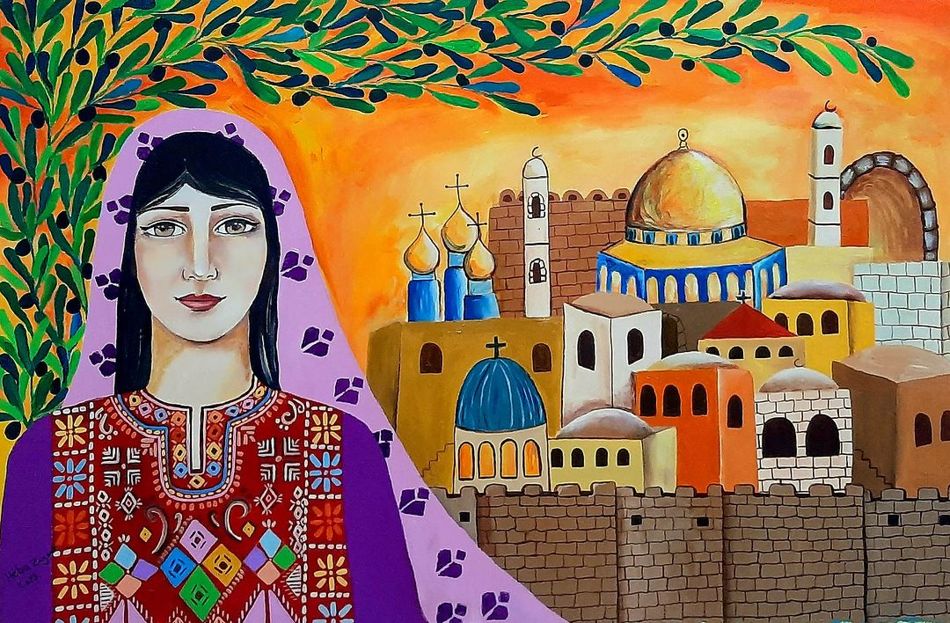
“Jerusalem is my city” by the artist Heba Zagout, killed by Israeli bombardment in Gaza along with two of her children, in October 2023
A team of Janhastakshep toured areas of Palwal, Sohna and Gurugram, as also spoke with other people from Nuh district on 3rd August 2023 to do a fact finding regarding the incidents of communal violence that hit Nuh town and subsequently areas of adjoining Palwal and Gurugram districts. The impact of this violence however was not limited to just these three districts. Tension and alarm pervaded many more districts of Haryana as also districts of adjoining states of Rajasthan (Alwar and Bharatpur) and Mathura in Uttar Pradesh which have pockets of Muslim Meo population.
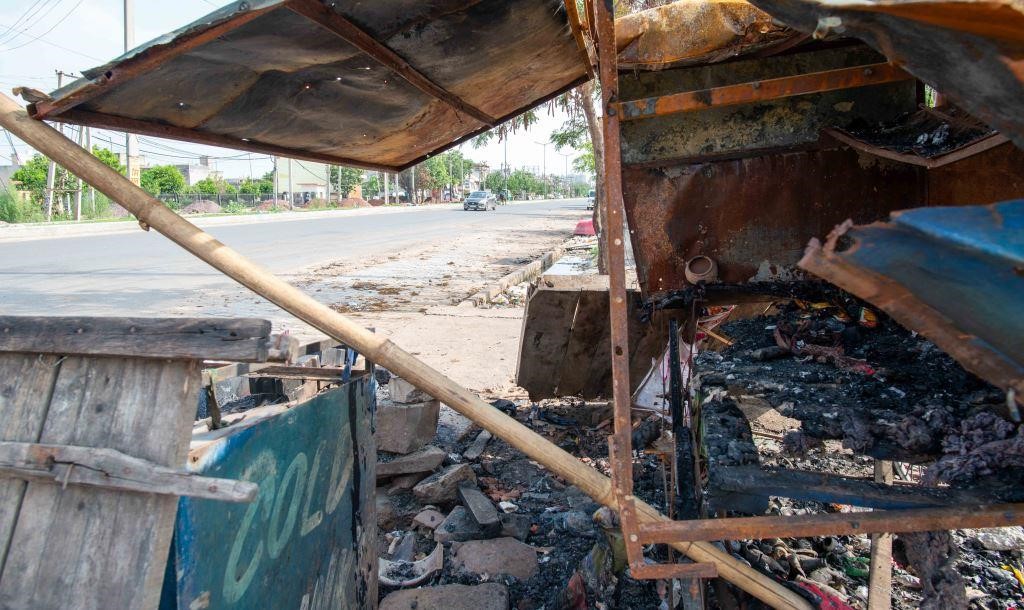
Gurugram, Haryana, India – 2023/08/03: General view of vandalized and burnt street shops along the streets of Ambedkar chowk in Sohna after the communal violence
By the time of our visit many details of the incidents along with evidence by way of eyewitness accounts, photographs and videos was available on various media platforms and the same has been used to guide our fact finding effort. Janhastakshep team set three fold objectives for our visit:
Bebaak Collective (‘Voices of the Fearless’) was founded in 2013 as an informal association of grassroots activists to advocate for the rights of Muslim women and community. It is a platform for engaging with feminist thought and practice, human rights issues, and the anti-discrimination struggle. It has been working in Uttar Pradesh, Gujarat, Maharashtra, and Rajasthan. With the rising onslaught against marginalised communities, the Collective has evolved into an advocacy group that strongly adheres to constitutional values and believes that the rights and principles enshrined in our constitution are inalienable from every Indian citizen, irrespective of their caste, gender, sexuality or religion.
Relatives of a victim of the Delhi pogrom 2020 in mourning. Source: The Guardian
Foreword
Mental health and its socio-political determinants are beginning to emerge from a shroud of silence and stigma into public discourse. There are several possible reasons for this, the most visible being the pandemic and the many narratives of suffering it brought to the fore from among the most vulnerable sections of society. Even before the pandemic, the relationship between social disadvantage and the mental health of certain communities and groups (some more than others) has been studied in the Indian context. Some examples of these include the mental health of women, homeless persons, Dalit, Bahujan, and Adivasi communities, and queer and trans persons. However, the mental health of Indian Muslims has been severely underrepresented and almost invisible within the mental health or development literature in India. Continue reading Social Suffering in a World without Support – Report on the Mental Health of Indian Muslims: Bebaak Collective→
यह लेख इंडियन एक्सप्रेस में मई दिवस 2023 पर लिखे गए लघु लेख का हिन्दी रूपान्तरण है।
वो दिन ज़रूर आएगा जब हमारी खामोशी उन आवाज़ों से ज्यादा ताकतवर होगी जिनको आज तुम दबा रहे हो।
अमर शहीद अगस्त स्पाइज़ का हेमार्केट शहीद स्मारक पर उद्धृत कथन, अनुवाद हमारा
हर दिन मैं खुद को यह याद दिलाता हूँ कि मेरा अंदरूनी और बाहरी जीवन मृत और जीवित लोगों के श्रम पर आधारित है, और जो मुझे मिला है और मिल रहा है उसको उसी मात्रा में देने के लिए मुझे पुरज़ोर मेहनत करनी होगी।
अल्बर्ट आइंस्टीन, द वर्ल्ड एज़ आई सी इट (दुनिया मेरी नज़र में), अनुवाद हमारा
मई दिवस 2023 के साथ भारत में मई दिवस मनाए जाने के 100 साल पूरे हुए हैं। सिंगारावेलु चेट्टियार, जो कि भारत के स्वतंत्रता आंदोलन की बड़ी शख़्सियतों और जाति-विरोधी आंदोलन से जुड़े शुरुआती कम्युनिस्ट नेताओं में से एक थे, उनको भारत में सबसे पहले मद्रास शहर में 1 मई, 1923 को मई दिवस मनाने का श्रेय दिया जाता है। सिंगारावेलु ने भारत में मई दिवस की शुरुआत कर कोशिश की कि भारतीय मजदूरों के संघर्षों को वैश्विक-स्तर के मज़दूरों के प्रतिरोध के साथ जोड़ा जाए। शिकागो में मई 1886 में मजदूरों की रैली से शुरू हुए मई दिवस की तीव्र तरंगें जो भारतीय तट तक 1923 में पहुँचीं, उस संवेग को आज भी दुनिया के विभिन्न हिस्सों में महसूस किया जा रहा है।
Someone just asked me why I would ‘still be soft on’ the Dalit Human Rights Movement — why I would speak at their meetings. For those who have not heard of them, the DHRM is a mass movement against casteist oppression in Kerala that fought very hard to break out of the liberal and statist imagination of dalit liberation — and continue to do so, despite having to face the most horrifying state violence.
Today someone who is an absolute darling of the post-socialist oligarchy in Kerala and their army of hanger-ons told me, without a tinge of irony, with the most endearing innocence, that they were not celebrated at all in Kerala. That they were excluded from circles that praised and glorified the work of many other authors. It was most intriguing, to say the least. I think it reveals a lot about how the present dispensation manages intellectuals and minimises critical thinking.
You can be a rebel without any serious losses in present-day Kerala if you desist from any serious criticism of the establishment and its acolytes. You can spout feminism, dalit politics, espousals of the solidarity economy, liberal Muslim thought, queer thinking, soft Hindutva– literally anything except Islamism if you keep your mouth shut about the establishment and the post-socialist oligarchy, or at least limit yourself to weak, occasional noises. You can also present yourself in combinations of the above laced with hints of your slant towards the establishment and reap much success in classrooms and academic fora, and much applause on the social media. If you have connections with the Nair deep state and ‘deep intellectual elite’, you can pornify, sell, any kind of abuse of women.
Around two weeks back, just about a week after the ritual of Women’s Day celebrations in Thiruvananthapuram, a 49-year-old woman decided to go get herself some pain medication at 10 30 at night, after all home remedies failed against her persistent body ache. She lives in the beating heart of the city of Thiruvananthapuram in a rented house. This house is in a leading middle-class residential locality, full of houses, usually very quiet. She is , however, not a typical owner-resident. An employee at a local firm earning a very modest salary, she has lived alone for years in rented accommodation, raising her young daughter. The daughter is now a confident young woman who has worked for some years and now seeks to expand her career options. The rent takes up nearly half of her income, but mother and daughter have struggled together to protect each other.
The Delhi Durbar of 1911 has great significance in the history of India in terms of hosting King George V, along with the Queen and other guests. Undoubtedly, the entire occasion was recorded as a grand event and moreover, the decoration used on the way to Coronation Park to make it aesthetically beautiful, was magnificent. However, along with the preparations for the amplified royal visit, another incident that catches attention here is the hiding of an entire village, the ‘Dhakka village’.
People living near Dhakka village, 1911 (see source below)
The villagers of Dhakka were asked to evacuate the area as their dwellings were not up to the beauty expectations of British officials. The Dhakka village then, represented a strong site of resistance, as the villagers in Dhakka refused to vacate the region for the King’s visit. Thus in response to the recalcitrance of the villagers, the British officials decided to hide the entire village by using huge cloth sheets.. And that is how the village got its name ‘Dhakka’ from the hindi word dhaka which means hidden. The incident portrays to what extent the colonial state could go to welcome its guests. It mulled relocating an entire village and finally covered it out of sight.
[यह लेख The India Forum में अंग्रेज़ी में छपा और उसके हिंदी अनुवाद का एक संक्षिप्त संस्करण सत्य हिंदी में छपा. यहाँ हिंदी में लेख को पूरा (बिना काट-छांट के) पढ़ा जा सकता है. हिंदी अनुवाद के लिए डॉ कविता नंदन सूर्य (सम्पादक, www.debateonline.in) को शुक्रिया.]
बहुध्रुवीयता अंतर्राष्ट्रीय संबंधों की वामपंथी समझ को दिशा देने वाला कम्पास है. भारत और वैश्विक वामपंथ की सभी धाराओं ने लम्बे समय से साम्राज्यवादी अमेरिकी वर्चस्व वाली ‘एकध्रुवीय’ दुनिया की अवधारणा के खिलाफ ‘बहुध्रुवीय’ विश्व की वकालत की है.
दूसरी ओर, ‘बहुध्रुवीयता’ वैश्विक फासीवाद और तानाशाही की साझी भाषा का मूल आधार बन गई है. यह निरंकुश शासकों के लिए एकजुटता का ऐसा आह्वान है, जो लोकतंत्र पर उनके हमले को साम्राज्यवाद के खिलाफ जंग की शक्ल में पेश करती है. अंतर्राष्ट्रीय संबंधों के साम्राज्यवाद-विरोधी लोकतंत्रीकरण के नाम पर बहुध्रुवीयता को वैश्विक वामपंथ के गुंजायमान समर्थन ने, निरंकुशता का भेस बदलने और उसे वैधता दिलाने के लिए ‘बहुध्रुवीयता’ के इस्तेमाल को असीमित शक्ति प्रदान कर दी है.
राष्ट्र राज्यों के आतंरिक अथवा आपसी राजनैतिक टकरावों पर रुख तय करने लिए कितने आधार उपलब्ध हैं? इस प्रश्न के जवाब में वामपन्थ सिर्फ़ दो विकल्पों – या तो “बहुध्रुवीयता” या “एकध्रुवीयता” – को प्रस्तुत करती है. अगर आपने “बहुध्रुवीयता” को अपना मूल आधार नहीं बनाया तो वामपन्थ मानेगी कि आप ज़रूर अमेरिका/नाटो की दादागिरी वाले “एकध्रुवीयता” के पक्ष में हैं. पर “बहुध्रुवीयता” या “एकध्रुवीयता” के बीच यह कल्पित बाईनरी हमेशा भ्रामक थी. लेकिन आज “बहुध्रुवीयता” बनाम “एकध्रुवीयता” के बीच संघर्ष की मनगढ़ंत कहानी भ्रामक ही नहीं, खतरनाक है क्योंकि इस कहानी में फासीवादी और तानाशाह नेताओं को “बहुध्रुवीयता” बनाए रखने वाले नायकों का पात्र दिया गया है.
[Names and publications of cited authors are listed at the end of the essay.]
The sophists taught, rather publicly, the view that the summit of happiness is to combine the appearance of justice with actual injustice: Gregory McBrayer (2015), p 44
To speak of justice has always been to plunge into a metaphysical abyss, especially as the issue has been intractable since (at least) Plato’s most famous work, The Republic was written some twenty-five centuries ago. Not least has been the permanently contentious issue – named the theological-political problem by Leo Strauss – of whether we should live according to divine or human guidance. But to speak of justice in India is confront our deeply divided souls; and in the most horrendous cases, to stare evil in the eye.
If Mrs Indira Gandhi dreamt of a ‘committed bureaucracy,’ our current rulers appear to be bent upon the complete domestication of civil society by their ideological enterprise. This requires a committed judiciary too, for which aspiration clues are ample, because they conspire in broad daylight. It was inevitable that some members of the judiciary were and continue to be complicit in this totalitarian project. We should be grateful that there are men and women of courage and conscience within. One of them was named Judge Loya.
Below, I share a write-up byJohnson Jament, an academic researcher from the coast of the Thiruvananthapuram district, where an intense struggle against the Adani Port Project has been unfolding. Arrayed on opposing sides are the fisher people who have inhabited the coast since the past 500 years (according to historical record) and more, whose livelihoods are at stake, and the Adani Port Project, supported by the combination of natural resource predators and the CPM-led government of Kerala. The leadership of the CPM (though not the ranks, or at least all of the ranks) can be quite fairly described as a ‘post-socialist oligarchy’, and hence their support of Adani Ports is pretty understandable. The battle has been equally one of wits too, with the Kerala government pulling out all their progressive aces, including the longtime literary-cultural acolytes of the CPM but also some of the (former) stars of Kerala’s oppositional civil society — notably, the poet and critic, K Satchidanandan! Questioned about his stance, this early teacher of Euro-Marxism of a whole generation claimed that the conflict was because of ‘binary thinking’ that supporters and opponents of the Port project both equally indulge in, forgetting notably, that something like ‘structural contradiction’ may be becoming evident in and through this struggle. Perceiving it, of course, is not indulging in binary thinking.
Following is the text of an open letter sent by the Bisthapan Birodhi Jana Andolon Mancha, a coalition of people’s organizations, activists, journalists and citizens to the Governor of the Odisha. It was released in Bhubaneswar yesterday the 3rd of December 2022.
Respected Sir,
We as concerned citizens, social activists, political and human rights activists, environmentalists and journalists and the leaders of twelve mass organizations on behalf of Bisthapan Birodhi Jana Andolon Mancha, Odisha appeal for the protection of natural resources and an immediate end to the continuous forceful displacement of people from their lands and dwelling places.
We express our protest and dissent against the Odisha government’s Make-in-Odisha Conclave in Bhubaneswar. Inviting more investments in the name of development will uproot the lives and livelihoods of people dependent on these land, forests and coasts. We appeal to your conscience to intervene and prevent the exploration and exploitation of natural resources through unmindful and unwanted mining of bauxite, iron ore, chromite, coal, river sand, china clay and other resources in the name of development. People are struggling against all odds and hardships to protect the same for future generations even as they remain deprived of access to basic needs like education, health and nutritional food security.
The following letter, signed by over 300 individuals from different national and regional organisations was handed over at the Iranian Consulate in Mumbai by six representatives on September 29, 2022. It was received politely and acknowledged.
Mr. Abolfazi Mohammad Alikhani
Consul General,
Iran Consulate, Mumbai.
Sir,
We, women and women’s organization from India, are writing this letter to register our horror at the brutal attacks on the women and citizens of Iran as they protest the killing of Mahsa Amini at the hands of the Gasht-e-Ershad. These brutal attacks have resulted in and continue to result in further deaths and imprisonments.
These brave women of Iran are demanding freedom from the Morality Police and the State imposing upon them what they must or must not wear and how to wear it; what they must and must not do, or act, or behave. They are rejecting this control. The men of Iran are giving full support and putting their bodies on the line alongside them. The resulting violent repression is heinous and inhuman.



 KAFILA - COLLECTIVE EXPLORATIONS SINCE 2006