Category Archives: Violence/Conflict

On The Recent Communal Disturbances in Trilokpuri: People’s Alliance for Democracy and Secularism

Guest Post by People’s Alliance for Democracy and Secularism (P.A.D.S)

NOVEMBER 2, 2014

(Members of P.A.D.S. have been interacting with and visiting residents of Trilokpuri ever since the communal disturbances started on Oct 23. Along with many other citizens we are involved in efforts to re-establish peace and in providing legal aid to those wrongfully arrested. This statement is based on the experiences of P.A.D.S members.)

The inhabitants of Trilokpuri, a densely populated neighbourhood of working people in Delhi, went through a harrowing week after Diwali night on 23 October. A brawl around two places of worship that night proved to be the first event. Although the situation appears to have settled down that night, some motivated planning and mobilisation must have taken place that night itself, because the next day it was a full scale communal clash. Armed mobs from outside the locality are reported to have joined the rioting that involved brick throwing. Firearms were also used and two boys suffered critical bullet injuries.  Inhabitants are emphatic that the police fired into the crowd. The police first denied firing at all. Its latest claim is that it fired only in self defense. One apparel show room owned by a Muslim resident was gutted. Police intervened in force only two days after the clashes started. It turned the neighbourhood into an occupied war-zone. More than fifty men and minor boys were arrested randomly, many picked up forcibly from their houses amid verbal abuse and physical violence. Road intersections were barricaded and entry and exit points were closely monitored. Drones were used in surveillance and houses systematically searched. Essential supplies were in short supply. Daily wage earners, contract workers, and self employed who could not go out lost their source of livelihood. Seriously wounded and ill had no access to medical aid. While the entire neighbourhood suffered in one form or another, inhabitants of three blocks in particular, nos 15, 27 and 28, and attached  jhuggi clusters, mainly occupied by citizens who are Muslims bore the brunt of police action.

Communal Hatred the Mahapanchayat Way – A Report From Bawana, Delhi: Mohit Pandey

Guest Post by MOHIT PANDEY

An All India Students Association  team visited Bawana on Sunday (November 2, 2014), met local people, witnessed the Mahapanchayat and the developments around it. This report is based on that visit.

Long standing communal tension in Bawana (at the outskirts of Delhi) took a vicious inflammatory turn, when a Mahapanchayat was called on 2nd November to provoke hatred against the Taziya (Moharram procession) in Bawana. Since Bakrid, the blatant lie of ‘cow slaughter’ in the JJ Colony (nearby Bawana) was used as a pretext to mobilize the whole Hindu community against Muslims. India’s ruling party BJP, as well as an entire battery of RSS backed Hindutva outfits were involved in the campaign to divide Hindus and Muslims of the poorest classes.

Our observations about the Mahapanchayat are as follows :

  • People were mobilized from Bawana and many places close to Bawana, from both Haryana and Delhi.
  • The agenda of Mahapanchayat was to prevent the Taziya procession in Bawana. But residents of the JJ Colony told us that the Muslims of the colony had already agreed, in a meeting on 28th October where leaders from both communities and the ACP were present, to limit their procession to the JJ Colony itself. If the issue of the route of the Taziya procession had already been settled, why did the police even allow the mahapanchayat to be held? Continue reading Communal Hatred the Mahapanchayat Way – A Report From Bawana, Delhi: Mohit Pandey

Thirty Years On (from November, 1984): Jaspreet Singh

Kafila normally never publishes poems. But sometimes, we make an exception. Because poetry give voice to memory in ways that prose can’t always. And because we must never forget November, 1984.

Guest Post by Jaspreet Singh

30 YEARS ON

One hears that the grass has grown again

and old domes have been plated

with gold. Children of ashened fathers

have acquired autos and crystals, and Lutyens’

stones have bloomed

Continue reading Thirty Years On (from November, 1984): Jaspreet Singh

Organized Fundamentalist Hindutva Forces trying to Instigate Communal Tension in Bawana, Delhi

Pressurize the Administration to immediately intervene and stop the communal Mahapanchayat on 2nd November!

Organized Hindutva forces are again trying to instigate communal polarization and spread terror in Bawana area of North-West Delhi in the last few days. They have called for a ‘Mahapanchayat’ at 4 pm on Sunday, 2nd November 2014 to oppose the Taziya procession taken out for Moharram in the area, calling it supposedly a ‘terror procession’.

Only three-four policemen loiter in the area tonight on 1st November, while the administration, including the Lt. Governor and Police Commissioner, has been alerted in the afternoon itself  by various pro-people forces and local people on the rabidly communal ‘parcha’ that has been circulated in the area. This parcha explicitly gives a ‘call for Bawana’ to stop the supposed terror procession and ‘show of arms’, ‘display of strength’, disruption of peace and other baseless allegations on the Muslim community.

The situation of communal tension in Bawana is not spontaneous, but is being instigated by organized Hindutva forces, much like Trilokpuri in the past week. Earlier, on 2nd-6th October, just before Eid celebrations, the ‘Hindu Krantikari Sena’ outfit of the RSS tried to make a case out of imaginary ‘cow slaughter’ and instigate terror and communal tension among residents of Bawana JJ Colony and nearby Bawana village. They had also put up communal posters then calling for a gathering in Bawana Gaushala on 5th October. Continue reading Organized Fundamentalist Hindutva Forces trying to Instigate Communal Tension in Bawana, Delhi

Sophie Joseph’s Sikh Neighbours: John Dayal

Guest Post by JOHN DAYAL

My aunt and God-mother Sophie Joseph had lived in Delhi a long time, and as a young woman, was witness to the communal frenzy art the 1947 Partition of India.

She would also tell stories of heroism, and greed. Many Hindus saved lives, in return for all the cash they could carry, or for rights over the house that would soon be vacated. Others saved their neighbours out of love. Many lived to cross the borders not because the Armymen protected them, but because the neighbours risked their lives to save them from other marauding neighbours. Sophie, then in her teens, remembered all this. She was no heroine and her lower middle class family was not the stuff of which role models are made, but they were happy they connived in the saving of lives.

That lives could be saved if there was courage of conviction was a lesson she learnt. Her lesson would come in handy almost thirty five years later, save many more lives of other neighbours.

Continue reading Sophie Joseph’s Sikh Neighbours: John Dayal

Boycott the Israeli embassy sponsored performance of the Maria Kong Dance Company in Delhi: INCACBI

Statement from The Indian Campaign for the Academic and Cultural Boycott of Israel 

Don’t let apartheid onstage!

Protest against the ‘Israel in India’ initiative!

Boycott the Israeli embassy sponsored performance of the Maria Kong Dance Company at Kamani Auditorium, New Delhi, November 4, 2014

On 4th November, 2014, the Maria Kong Dance Company will perform at the Kamani Auditorium as part of the “Israel in India” initiative, with support from the Israeli embassy in India. This is part of the 8th Delhi International Arts Festival, organised by the Prasiddha Foundation with the support of organisations including the ICCR.

The festival aims to “serve as a significant platform for cultural diplomacy” and “provide a common ground for interaction between the artists and the mass audience”. Is a common ground possible between the Israel and Indians of conscience, whether artists or citizens? Is “cultural diplomacy” possible with Israel when it has attacked Gaza so brutally earlier this year, and held its people to ransom for years? Since Israel does not respect international law and recognize the Palestinian people’s right to freedom, equality and justice, the Indian Campaign for the Academic and Cultural Boycott of Israel (InCACBI) demands that Israel be boycotted from the Indian cultural arena.

Continue reading Boycott the Israeli embassy sponsored performance of the Maria Kong Dance Company in Delhi: INCACBI

Jis tann lãgé soee jãné – Delhi, November 1984, 30 Years After: Gauri Gill

Guest Post and Photographs by Gauri Gill

[30 Years ago today, Delhi, and some other cities in India saw the beginning of days of organized massacre of Sikhs, ostensibly as a response to the assasination of Indira Gandhi. In memory of that dark time, we present a documentary text-photographic project by Gauri Gill. Gauri revisits the survivors of the 1984 violence in Delhi, and invites artsits, writers, and others to consider their memories of that dark time. An earlier version of this project by Gauri Gill was uploaded on Kafila in April 2013 by Shivam Vij. We are posting an updated version of the project, with fresh material, on the occasion of the 30th anniversary of the November Pogrom. ]

In 2005, when I heard Nirpreet Kaur relate her story, she had to have a psychologist present in the room. For us, it was too much to fully absorb. I did not know what to do with the weight of her words. We urged her to write a book, I hope she does someday.

Continue reading Jis tann lãgé soee jãné – Delhi, November 1984, 30 Years After: Gauri Gill

Witness Account of the Trilokpuri Clashes on October 25, 2014: A.M

AM, a journalist,  writes on Sabrang. Excerpts below and link to the whole piece at the end.

I with a colleague of mine reached East Delhi’s Trilokpuri by 12:00 pm on Saturday. News about alleged clashes had reached us late on Friday night. We were told that the clashes had broken out at around 8:00 pm on Friday but no one was visibly injured. Bricks and empty beer bottles were hurled to and fro interspersed with occasional gunshots. The police reached the area and restored calm. Heavy police presence in the area restored confidence and sent people back into their homes. This is what we had heard.

When we reached the spot on Saturday afternoon at around 12:00 pm, both of us happened to walk right into a mob which had assembled on the main road. Then they started hurling bricks into the air, upped with roaring jubilation and thrill. All at a physical enemy that was not visible. Terrified and taken by surprise, we ducked and ran over to a nearby car parked by the curb. We crouched behind it for over five minutes till we could run farther down to a relatively deserted and safer stretch next to a mother dairy kiosk. That was only one of the many such walk-ins we had and had walked in and out of…

This senseless and directionless fury, we realised, was being whipped up for the fun of it. And, as journalists, we sensed individual families had gathered ammunition, mainly bricks and beer bottles, over the night for a final showdown on Saturday morning. A couple of hours later, my colleague followed a rag picker collecting in a sack bricks strewn over various roads. He saw the rag picker climb into a house and he heard him saying, “Chalo bhai, aaj ke raat ka intezaam ho gaya hai.”…

The atrocities started when policemen began arbitrarily searching houses and rounding perpetrators in the absence of clean evidence or proof. Almost 1000 persons were actively involved in the stone throwing and no one knows which blocks they belonged to and where they had walked to to participate in the violence. Police, clueless and worked up, therefore, randomly began banging on closed doors and shoving their lathis into houses to drive fear and establish control over residents. Most of these houses, however, happened to be in Muslim dominated areas especially in Blocks 14 and 27. The Indian Express reported that “the police have arrested 44 people — 32 Muslims and 12 Hindus” on charges of rioting as listed in the FIRs. This despite Trilokpuri comprising 80 per cent Hindus ( Balmikis) and 20 per cent Muslims. Lopsided statistics and arrests say much about what was happening on the ground…

I was witness to how the Delhi police, had brazenly, in view of  journalists, albeit without cameras employed anarchic, illegal arrests, communal and extrajudicial tactics to impose what they call ‘law and order’- a phrase which constantly equivocates with us, we who lie on the “clean” side of law and those who live outside its underbelly.

READ THE WHOLE ACCOUNT HERE.

On a Long Road to Justice: Simin Akhter

This is a Guest post by Simin Akhter, with inputs from Kamal Pant, Naina Singh and Vikas – 16 December Kranti

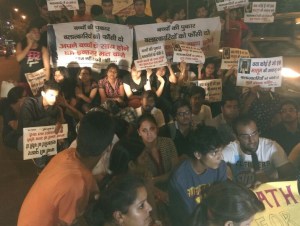
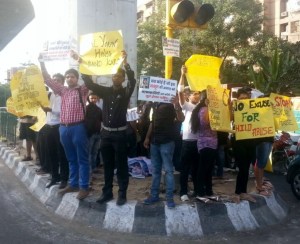
(Notes from the ongoing protests in the child sexual abuse case against Toddlers International Playschool, Rohini)

In a heinous and unfortunate show of power and violence, a two and a half year-old girl was raped by a male attendant at Toddlers International playschool (Rohini). Though the parents could manage to file an FIR, the management has threatened them with dire consequences. The principal has been openly shielding the accused, Amit Kumar, despite prior complaints of inappropriate behaviour by aggrieved parents and was allegedly shameless and audacious enough to tell the parents, ‘The police have been fed too well enough to open their mouths’! It also came to light during the protest yesterday that a similar FIR was filed two years back too but no police records could be found for the same; no wonder!

Almost 30 other girls have been detected with a certain strain of bacterial urinary infection, indicating the said two-year old is not the only victim. Many other children have been suffering from mouth-ulcers and a general loss of appetite too, reflecting also on the general lack of health and hygiene practices in the school. A group of parents, grandparents and concerned citizens, mostly young women and men, from in and around Rohini have got together for a relay protest but parents of other victims have not been forthcoming with formal complaints. Needless to say, the greater the delay in filing the complaints, the more legal intervention will get delayed.

Continue reading On a Long Road to Justice: Simin Akhter

The ‘new and improved’ Love Jihad formula, unethical media and ‘social science’ votaries

Caught on the back foot by the humiliating backfiring of their fantastical Meerut scenario of ‘gangrape and forcible conversion’, in which the role of the BJP as well as of sundry Hindutvavaadi organizations in breaking up a consensual Hindu-Muslim relationship have been thoroughly exposed, the Hindu Right appears to have arrived at a new formula. This formula has made its appearance in several spaces – in comments on Kafila (some of which have been passed, many more deleted; mostly pseudonymous or anonymous, and in varying degrees of abusiveness); on the social media and in personal blogs; and more respectably, in newspapers, in signed op-eds and articles, the most recent of them by the perennially amusing Madhu Kishwar.

The formula is patented across these sites and involves all or several of the following claims:

a) Hindutvavaadi groups are not the only ones to fear ‘Love Jihad’ – the Church in Kerala and the Akal Takht have also expressed their anxieties about this campaign. So there must be some fire generating all the smoke.

b) So real is the danger that the claims have been investigated by the police, as directed to do so by courts.

c) Hindutvavaadi groups have no objection to inter-faith marriage, what they object to is the cheating of Hindu women into marriage in a well orchestrated campaign by Muslim men who trap them in polygamous marriages only to convert them and produce several children, thus raising the Muslim population.

d) What is happening in India is only a small part of the Global Islamic Terror Machine’s global campaign to use non-Muslim women as sex slaves, to prostitute them, or to seduce them in order to convert them. The recent exposure of a pedophile ring in the UK run by Pakistani men is treated as proof of the existence of such a globally coordinated campaign in which all Muslims are suspect – from Al-Baghdadi of ISIS to your classmate.

e) As irrefutable proofs, three links are generally circulated: a) a programme of IBN7 that ‘exposes Love Jihad’, and b) two videos of young women who supposedly speak about being victims of Love Jihad.

Madhu Kishwar in her article asserts all of these claims produced by the RSS Myth Machine, although she is probably not yet aware of the last item – which I will address at length in conclusion. Continue reading The ‘new and improved’ Love Jihad formula, unethical media and ‘social science’ votaries

A Reply to Ranabir Samaddar on Jadavpur: Uditi Sen

Guest Post by UDITI SEN

Prof. Ranabir Samaddar of the Calcutta Research Group has recently published a screed (in the DNA Newspaper) against the #Hokkolorob movement  initiated by the students of Jadavpur University which has found resonance with students and young people all over West Bengal and elsewhere in India. Samaddar, who seems to have lost the ability to recognize the many intersections of solidarity between students, young people in metropolitan as well as non-metropolitan contexts, women, young workers, accuses the movement of what he calls ‘elitism’ and a disconnect with realities on the ground.

Uditi Sen responds.

It is settled then. With this latest denunciation (by Ranabir Samaddar, in DNA, see link above) of the student movement at Jadavpur, we finally have a verdict we can trust. Student politics is not what it used to be. The glory days of the 60s are long gone and the protesting young today fail to live up to the authentic radicalism of their elders. Those were the days, indeed. Those were the days when student politics, organised under the banner of the organised left took up real issues, such as those of the peasants and workers and did not distract themselves with inequities closer to home. Such as, why women ‘comrades’ were expected to cook and clean and provide for their men, who led the vanguard. Such as why even the most progressive politics, when speaking of the rights of peasants, meant the rights of male peasants. Those indeed were the days of glory, which we should remember and seek to emulate, when the leaders, usually dadas, had no answers when a peasant woman asked, ‘“Why should my comrade beat me at home?” (See Samita Sen’s Toward a Feminist Politics: The Indian Women’s Movement in Historical Perspective)

Continue reading A Reply to Ranabir Samaddar on Jadavpur: Uditi Sen

“Haider” – Hamlet in Kashmir: Suhas Munshi

This is a guest post by SUHAS MUNSHI

The challenge of telling stories of a conflict is its victims. Each, traumatized in their own way, needs their own story. The narrator is bound to fail not only those he didn’t include but those who didn’t see their stories recreated faithfully. Had Basharat Peer set himself the task of faithfully adapting the violence done to Kashmiris he would have had to script a pornographic narrative for the screen. Some of the bile directed at him from Kashmiris comes from a dissatisfaction of not depicting the true extent of the brutality of the Indian army and rendering its casualties adequately pitiful. An opinion piece written on the movie in ‘The Parallel Post’ titled ‘Setting the wrong precedent’ condemns torture scenes in the movie as having actually undermined the actual extent of army atrocity in Kashmir. The piece goes on to say, ‘army excesses wane out by the time movie reaches its climax.’

However, the only service that a story teller from Kashmir could do to art and to humanity is to depict the people living there, especially the victims, as humans; as people, just as they are found anywhere else in the world, and not continue to peddle the cliché of the valley being a dehumanized pastoral paradise. Accusations of betrayal, conceit and condescension are being hurled at Basharat Peer, the writer, when he has got, for the first time ever, the words ‘plebiscite’, ‘half-widows’ and the rousing call of ‘Azadi’ in a script, through a movie, on mainstream cinema. Continue reading “Haider” – Hamlet in Kashmir: Suhas Munshi

I am a Muslim, an Atheist, an Anarchist: Salmaan Mohammed

Guest Post by Salmaan Mohammed

[ Salmaan Mohammed, a twenty five year old philosophy student was arrested in Thiruvananthapuram on 19 August 2014 for sedition, and for allegedly dishonouring the national flag and national anthem. The complaint against him originated as a response to his refusing to stand while the national anthem was played in a cinema during a screening. Salman is currently out on bail, but still faces the prospect of a life term in prison if he is found guilty of sedition by the judicial process. We at Kafila have been in touch with Salman and he has recently sent us a translation of an audio interview he did after coming out of prison on bail so that the world outside Kerala (and those who do not read or speak Malayalam) can understand what he has been thinking.]

Continue reading I am a Muslim, an Atheist, an Anarchist: Salmaan Mohammed

Letter to the Chancellor of Jadavpur University: Concerned Citizens and Academics

To
Sri Keshari Nath Tripathi, Governor, West Bengal.
Dear Shri Tripathi,
We, the undersigned academics and concerned citizens, are writing to you with grave concern, about the situation in Jadavpur University, as you are also the Chancellor of the University.We have read in newspapers, seen on television, or read through social media posts, enough to understand that the following serious problems occurred.

First, in late August, a young woman, a student of Jadavpur University, brought in a charge of sexual harassment against some hostel students. This was handled extremely badly by the Vice Chancellor of Jadavpur University, who seems to have advised her to stay at home, and to have rebuffed attempts by the victim and her friends to get speedy justice.

Marginalized Sections Living Under Fear – A Letter to NHRC

[We are reproducing below a letter to the NHRC Chairperson by Teesta Setalvad, Secretary, Citizens for Justice and Peace, Mumbai]

October 6, 2014
To the Chairperson Mr Balakrishnan, National Human Rights Commission.

Dear Sir,

There are extremely disturbing reports about the climate of abject fear that the poor and marginalised communitoies of JJ Colony, Bawana are living in, following recent incidents. Prominent residents of Delhi have carried out an independent fact finding into allegations of cow slaughter and the systematic intimidation of local Muslims. The team consisting of Dr. Mrigank (Delhi Committee, Indian Federation of Trade Unions, IFTU), Poonam Kaushik (Gen. Secy. Pragatisheel Mahila Sangathan, PMS), Rajeev (Convener, Progressive Democratic Students’ Union, PDSU) visited JJ Colony Bawana.

This report available here.

We urge Sir that the National Human Rights Commission carries out a suo moto inquiry into the incident and especially inquires into the following;-

From the above Report (see below) the observations made are :

1. That the allegations that there is plan of cow slaughter is bogus. There is no possibility of hiding the cows. And no cows were found.

2. That there is intimidation of Muslims and they are living amidst fear. The police protection is not enough.

3. That the organizations like Hindu Krantikari Sena are not spontaneous organizations. It is clears from the fact that among the main organizer was the nephew of BJP MLA. Also total inactivity of BJP MP is a clear indication.

4. That there is total communal harmony in JJ Colony and even today they are together. Continue reading Marginalized Sections Living Under Fear – A Letter to NHRC

Towards a Rational Literacy – Education and Beyond: Shivali Tukdeo

[Anyone who is familiar with the writings and positions of various Kafila authors will see, we do not subscribe to or share many of the views expressed by Shivali Tukdeo in this essay. Several of us have our own fairly strong critiques of the processes of colonial and post-colonial knowledge formation which condemned a whole host of practices, and the lifeworlds in which they were located, as “andhvishwas”. However there is also a simultaneous extremely interesting history of efforts at the inculcation of a “rational temperament” that used emergent discourses of science and modernity to question traditional hierarchies of caste and so on. Maharashtra is an especially vibrant locale for such experiments and their location within long histories of oppressed caste mobilizations. Recent violent assertions by the Hindu Right on the grounds of “tradition”, as evidenced in the tragic murder of Dr. Dabholkar, further complicate the terrain within which these questions arise. So we are carrying this essay as an offering and opening to what we hope will be a spirited conversation around reason, science and faith of all varieties – andh, kana and trilochan. AS]

This is a guest post by SHIVALI TUKDEO

In what can only be termed as an ultimate irony and deep embarrassment, the Maharashtra police allegedly resorted to relying on planchet tricks of a self-claimed god-man to investigate the brutal murder of Dr. Narendra Dabholkar, a rationalist and organiser of Andhashraddha Nirmoolan Samiti (ANS)—Committee against Eradication of Blind Faith[i]. The ‘supernatural intervention’ in this high-profile murder case is painfully damaging, no doubt; however, it is neither an isolated instance nor is it confined to the police department alone. As reportage in the aftermath of the case reveals, police departments routinely subscribe to such practices. Moreover, the widespread practice of offering prayers to Thirupathi before a space launch or the decision to conduct excavation based on a Sadhu’s dream aptly illustrate the powerful hold superstitions have. Such instances also point to the deep and long standing crisis in India’s education. Continue reading Towards a Rational Literacy – Education and Beyond: Shivali Tukdeo

On Hasan Suroor’s “Islam and Its Interpretations”: Zeeshan Reshamwala

Guest post by ZEESHAN RESHAMWALA

Many Interpretations are Still Better Than One

[Hasan Suroor suggests in an op-ed that one of the causes of Islamist violence is the ambiguity of the Quran and the hadith, adding that perhaps it is time to develop an “authorised” version of the Islamic tradition. This article critiques Suroor’s assumption that it is possible to achieve a “pure” interpretation of a text, whether it be from a religious tradition or otherwise. In addition, it argues against Suroor’s tendency to imagine violence as a “medieval” phenomenon, and world-history as a deterministic forward-moving arrow.]

Hasan Suroor suggests that the problem of Islamist fundamentalism and the violence that follows in its wake can be solved by untangling the multiple interpretations of ambiguous Islamic texts. In his op-ed in The Hindu (29 September), “Islam and its Interpretations,”  Suroor points out this apparent paradox: that although on the one hand Muslims cite verses and hadith that provide injunctions against violence, on the other hand a more violent strain of believers (such as the Taliban) are also able to cite Quranic verses and hadith that justify their violence. The problem, he claims, does not lie completely with the manner in which Islamic texts are interpreted, but instead with the fact that the Quran is an extremely ambiguous text, arranged athematically, and whose meaning is often dependent on the context of each individual revelation. More so the hadiths, written down from the sayings of Mohammed, are of variable authenticity. The lack of a single authoritative version of Islamic texts, says Suroor, leaves the tradition “open for fanatics to distort at will.” Continue reading On Hasan Suroor’s “Islam and Its Interpretations”: Zeeshan Reshamwala

Unwrapping the Soldier from the Flag – Kashmir after the Flood: Chirag Thakkar

Guest Post by Chirag Thakkar

Witnessing a culture of wounds trying to put itself together in times of a grave catastrophe is a difficult pursuit. For the archivist of State violence, the horror with which TRP-hungry television studios build a spectacle that is acutely wedded to a deep-rooted, pungent nationalism around catastrophe and relief in Kashmir, is frustrating. The insensitivity with which the Indian media has rubbed salt in the wounds of a people is appalling. One wonders if ours is a culture of calculated amnesia or of sightless apathy.
There is something very unique about the way in which we relate with the pain of the other. What is unique is the precision with which we reproduce perceptions about the masculine, hardened sons of soil – the security forces – and yet, at the same time, remain unmoved in failing to recognise the state of exception Kashmir has been in. What is also unique is how measured and stingy we are with our sympathy. Continue reading Unwrapping the Soldier from the Flag – Kashmir after the Flood: Chirag Thakkar

Urgent demand to bring Normalcy to Vadodara: Letter to Commissioner of Police by concerned citizens

To Mr. E. Radhakrishan, Commissioner of Police, Vadodara.

Take concrete steps to bring normalcy in the city of Vadodara and take immediate action in the cases of assault on women by police.

Sir,

A team of social activists visited some of the affected areas on 27th September 2014 on the request of affected people.  A detailed report of our visit is under process  but after visiting the area we have personally discussed with you and informed you about the role of Police, (particularly plain clothes police, also known as D Staff). The police should prevent violence and arrest those who undertake violence. Instead many people particularly women, complained about the verbal abuse and physical assault on them by police. The marks of injury were visible on their bodies. You had promised to look in to the matter and assured us that this will not be repeated.

We are shocked to know that brutal police attacks continued on the night of 27th September 2014.

Continue reading Urgent demand to bring Normalcy to Vadodara: Letter to Commissioner of Police by concerned citizens

Freedom and the University – Reflections from a Teacher: Rimi.B.Chatterjee

Guest Post by RIMI B.CHATTERJEE. Photographs by RONNY SEN.

Graffiti on Jadavpur University Walls. Photograph by Ronny Sen

There has been a lot of noise about the recent agitation at Jadavpur University, and a lot of slanted media coverage. Allow me to set the record straight on a number of points.

Continue reading Freedom and the University – Reflections from a Teacher: Rimi.B.Chatterjee

Prose of Power and the Poetry of Protest – An Outsider’s Attempt to Make Sense of the ‘Kolorob’ in Kolkata: Uditi Sen

Guest Post by UDITI SEN

51288650-29337-hokkolorob
#Hokkolorob – Embodied

It’s been more than a week since tens of thousands of students marched in a rain drenched Saturday in Kolkata, in solidarity with Jadavpur University students and their fight for justice. Much has happened since to delegitimise this mammoth, genuinely popular and student-led march. A counter-march, the co-optation of the victim’s father by the ruling party, adverse propaganda in the press and fatigue and confusion amongst the protestors have been some of the dampening developments that followed the unexpected show of student power. True to their clarion call, hok kolorob (let there be clamour), the marchers made a lot of noise. A week later, as the numbers of protestors on the streets have dissipated as fast as they had congregated, it is perhaps time to step back from the euphoria of the gathering and the intimidation and murky co-optation of protest that followed, to reflect on the political meanings and potential of this uprising.

The march was not organised by any single political party, though many with experience or background in student politics of one ilk or the other, marched. The vast majority, however, were students who had never marched before and had no experience of politics. The question therefore arises, what, if anything is the unifying ideology of this body of protestors? What goals motivate them? Above all, the question that is doing the rounds the most, on social media, on mainstream news and on the streets is what are the politics of the protestors? The question of politics is seldom posed directly. Its ubiquitous presence, however, can be clearly read in the answers provided regarding the nature of the march, the motivations of the protestors and the identity of the marchers. Unsurprisingly, diametrically opposite sets of answers emerge from members of the ruling party, inside and outside Jadavpur University; and the people who took to the streets on Saturday. From the Vice Chancellor, the Education Minister and officially ordained leaders of the ‘youth’, such as Abhishek Banerjee and Shankudeb Panda, characterisations emerge that focus on indiscipline on campus, presence of Maoist and other outsiders and deep conspiracies. From students of Jadavpur University and their sympathisers, assertions emerge that this protest is about justice and not about politics. Both characterisations fail to capture what is at stake.

Continue reading Prose of Power and the Poetry of Protest – An Outsider’s Attempt to Make Sense of the ‘Kolorob’ in Kolkata: Uditi Sen