People’s Union for Democratic Rights Condemns Bans on Cow Slaughter

Statement by People’s Union for Democratic Rights 
On March 16th 2015, the Haryana Government unanimously passed Haryana Gauvansh Sanrakshan and Gausamvardhan Bill with main opposition parties INLD and Congress supporting the Bill. The new bill passed by the Haryana Government bans cow slaughter and sale of beef and imposes a punishment of rigorous imprisonment of not less than three years extending up to 10 years and fines ranging from Rs. 30,000 to Rs. one lakh. The Haryana Government’s move comes just days after the President’s assent to Maharashtra Animal Preservation (Amendment) Bill 1995 early this month. Maharashtra Animal Preservation (Amendment) Bill 1995 not only banned beef but also extended the prohibition to slaughter of bulls and oxen. There was already a ban on slaughter of cows in Maharashtra since 1976.  The new amended act imposes a fine of Rs. 10,000 and a maximum prison term of five years for selling or even possessing beef.
What needs to be underlined here is that these bans on cow slaughter are not new; they were in existence in many of the states for many-many years. For example in Delhi, Bihar, Andhra Pradesh, slaughter of cows and calves is totally prohibited. In Goa and Andhra Pradesh, ‘cow’ is defined to include heifer, or a male or female calf of a cow under the Goa, Daman and Diu Prevention of Cow Slaughter Act 1978 and Andhra Pradesh Prohibition of Cow Slaughter and Animal Preservation Act 1977, respectively. In some states like Karnataka, Andhra Pradesh, Goa and Madhya Pradesh slaughter of bulls, bullocks and adult buffalos is permitted on ‘fit for slaughter’ certificate if the cattle is over 12 or 15 years of age, is not likely to become economical for draught, breeding or milk. Assam and West Bengal provides for slaughter of all cattle which includes bull, bullocks, calves, cows and buffalo on ‘fit for slaughter’ certificate. Meghalaya and Nagaland have no legislation to this effect.

Continue reading People’s Union for Democratic Rights Condemns Bans on Cow Slaughter
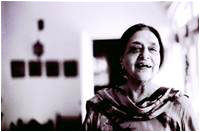
Tribute to Tahira Mazhar Ali: Kavita Panjabi

Guest Post by KAVITA PANJABI

Kavita Panjabi honours the memory of a South Asian feminist from Pakistan who effortlessly produced an ” ‘us’ across generations, contexts and movements”, an ‘us’ across “Kolkata, Dhaka and Delhi, Lahore, Peshawar and Karachi.”

Begum Tahira Mazhar Ali Khan

Just read about Tahira Mazhar Ali passing away, feeling really sad, hence this short piece.

I met her only thrice, and it was like I carried her within me all these years.

The first time was in 2001 at a seminar organized by ASR in Lahore on the 30th anniversary of the genocide in Bangladesh. She came up to chat after my presentation on the Mahila Atma Raksha Samity (MARS) and the Tebhaga women’s movement, excited. It had taken her on a nostalgia trip, and she said she remembered the MARS on a collection drive for the Bengal Famine in Lahore too; many, including she, had taken off the gold bangles they were wearing and contributed on the spot.  Continue reading Tribute to Tahira Mazhar Ali: Kavita Panjabi

An Open Letter by the Protestors at National Law University, Delhi

An open letter from students at National Law University

Abish Mathew, comedian of the AIB Roast fame, performed at NLU Delhi on the 22nd of March for our annual fest, Kairos. Early in the show, Matthew cracked a joke on domestic violence, at which point, two women students who found the jokes to be extremely misogynistic, walked out, showing him the middle finger. The audience reacted with some tittering, and Abish Mathew fumbled momentarily, before resuming. The audience asked him to carry on and to ignore the protesters. In the mean time, a group of female students marched into the auditorium holding placards reading “Get Out, Sexist Pig”, and also used expletives such as ‘fuck off’.

The auditorium erupted in shouts of “fuck you guys” and the protesters were booed and heckled by the audience members who demanded that the protestors either leave or move to the side. They eventually did move to the side of the auditorium, where they continued to hold their placards up and attempted to interrupt him. Abish was greeted by a standing ovation when he stated that he was an artist and recognized the right of the protesters, and subsequently when he ended his show by stating he had overstayed his welcome.

Continue reading An Open Letter by the Protestors at National Law University, Delhi

Dealing with ‘sexist pigs’? Reflections on the feminist protest against AIB’s Avish Mathew at National Law University, Delhi: A Statement

A statement from concerned students and teachers

What does one do sitting in the middle of an audience roaring with laughter at jokes that one might find downright humiliating? Laugh along, retire hurt, or ask people to stop? It’s a dilemma that many of us on the ‘wrong’ side of various lines of privilege (caste, class, gender, race) and those sensitive to these divisions often find ourselves in. Some students at the National Law University, Delhi seem to have been put in a similar situation when during their annual college fest, comedian Avish Mathew of AIB Roast fame would not stop amusing his audience with one offensive joke after another. They first decided to walk out and then came back with a placard saying, “Get out you sexist pig!”

Continue reading Dealing with ‘sexist pigs’? Reflections on the feminist protest against AIB’s Avish Mathew at National Law University, Delhi: A Statement

Communist, Scientist, Activist and Dreamer Daya Varma (August 23, 1929 – March 22, 2015) : Harsh Kapoor

Guest Post by Harsh Kapoor

Dr. Daya Varma, life-long communist, scientist, activist, dreamer, pharmacologist, professor emeritus at McGill University, Montreal, passed away on 22 March 2015 in St. John’s Newfoundland, Canada. Former member of the undivided Communist Party of India, founder of Indian People’s Association in North America (IPANA) and the International South Asia Forum, founding member of CERAS (Centre d’Étude et Ressources d’Asie Sud) and was on the board of of Alternatives, a progressive think tank in Canada, He also founded and edited the INSAF bulletin. Many in India remember how when the 1984 Bhopal Union Carbide industrial disaster struck,where thousands died, Dr. Varma spearheaded a study to monitor the effects of MIC on pregnant women whilst participating in activities aimed at supporting their compensation claims.

(Read the complete text here : http://www.sacw.net/article10894.html)

The Death of 66A and The Dawn of a New Era of Free Speech Jurisprudence: Siddharth Narrain

Guest Post by  SIDDHARTH NARRAIN

It’s not often that India’s Supreme Court strikes down a law in its entirety as a violation of the free speech. But when it does, boy do you want to stand up and cheer. Before a packed courtroom, Justices Rohinton Nariman and G. Chelameswar, pronounced their judgment in Shreya Singhal & Ors. v. Union of India,, striking down, in its entirety, the controversial section 66A of the Information Technology Act in its entirety. The full text of the decision is not available yet. But Justice Nariman read out parts of the court decision, enough to give us a sense of what is to come.

Continue reading The Death of 66A and The Dawn of a New Era of Free Speech Jurisprudence: Siddharth Narrain

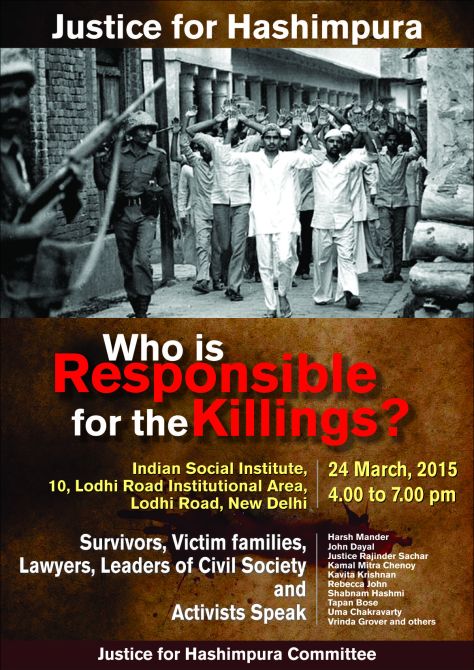
Justice for Hashimpura!

hashmipura killing Poster (1)

Hashimpura : Who will Guard the Guards Themselves ?

India lost, not victims, in Hashimpura massacre case: Victims' lawyer

Picture : Courtesy http://www.indiatomorrow.net

Wait for justice to victims of Hashimpura has become much longer.

After around 28 years of the gruesome massacre allegedly by the personnel of the much feared PAC ( Provincial Armed Constabulary) for its biased approach , the Delhi court acquitted all 16 accused on ‘benefit of doubt due to insufficient evidence, particularly on the identification of the accused’.

There have been very few massacres in post-independent India which have shaken the civil society to the core and have propelled it to come forward and raise its voice. And the Hashimpura killings happen to be one such episode. One still remembers the words of the well-known journalist Nikhil Chakravarty who had visited the place along with few likeminded individuals and in his scathing write-up condemning the incident had compared the event with

“Nazi Pogrom against the Jews, to strike terror and nothing but terror in a whole minority Community”.

Continue reading Hashimpura : Who will Guard the Guards Themselves ?

While “Exposing 300 days of Modi’s Rule”, Let us not fall into the Trappings of Old Congress Style Politics: Nayan Jyoti

Guest Post by Nayan Jyoti

SOME QUESTIONS IN THE CONTEXT OF MASS ORGANISATIONS OF CPI(ML)LIBERATION, CPI, CPI(M) & OTHERS INVITING CONGRESS, RJD, JD(U) TO DEFEND ‘SECULARISM, INDIAN CONSTITUTION, INDIAN NATIONALISM’

Janta Dal (United) leader Ali Anwar, in an ‘united’ program in Jantar Mantar on 19th March had a frank admission to make in the first 15 minutes of his speech: “Elections ki hi baat se shuru kare, to haan, hum sab milkar Modi ko harayenge” (“If we begin with the question of elections, yes, we will unite to defeat Modi together”). He was indicating a plain and simple ‘unity’ of convenience for elections, of a converging pole in Indian politics. He indicated: “Bihar assembly elections are waiting to happen.” He of course, remembered the theme of ‘secularism’ for the event and said, “now I will say a few ideological things” and did utter a few lines against the BJP-RSS.

Delhi’s Jantar Mantar on 19th March thus saw a (not very?) strange unity. Various “civil society and secular political parties, victims, artists, intellectuals” came together to organize an Exposing 300 days of Modi’s Rule program. Many of the organizers included mass organisations of the Left like AISA, AICCTU, AIPWA connected with CPI(ML)Liberation, and SFI, AIDWA, CITU, DYFI, AILU connected with CPI(M), and AITUC, NFIW, PWA related to CPI, among others. In these dark times of achhe din, where unity and collaboration of various left, democratic and progressive forces has come up with renewed necessity to fight the present regime, it becomes important for us to interrogate such attempts without any sectarianism. An important question that requires asking here is the basis of these ‘Unities’ and Forums being variously attempted. ‘Unity’ is definitely required in these times of combined attack of brutal neoliberal and communal attack, but standing on what ground, and in what direction? Continue reading While “Exposing 300 days of Modi’s Rule”, Let us not fall into the Trappings of Old Congress Style Politics: Nayan Jyoti

Remembering Nishith Bhattacharya, unsung revolutionary hero: Basu Acharya

Guest pots by BASU ACHARYA

The morning of February 15th this year was exceptionally grim. The sun looked pale, its rays mangled, as if somebody had scratched its face with a scalpel blade of tempered steel. Ramakrishna Naskar lane, an obscure by-lane in Beleghata area of Kolkata, was suddenly bustling with unusual activity. A number of people, quite a few in fact, irrespective of the nature of the red flags they carry, had gathered before a modest dwelling; assembled to bid adieu (with clenched fists and the ‘Internationale’ on their lips) to an old man, an octogenarian, wrapped in a crimson cloth with a crossed hammer and sickle in white. Prof. NB, our very own Nishith-da, Comrade Nishith Bhattacharya was no more. Leaving his mortal remains for the pyre to consume and his comrades to weep over, he had left for the final voyage—journey ‘to the undiscovered country from whose bourn no traveller returns’.

My association with Nishith-da dates back to the early years of the past decade when India, like many other ‘developing countries’ of the world, was passing through the initial days of the second information revolution. I, then an activist of a tiny student-youth organisation, met him on the book-fair ground at Maidan and asked scores of questions about Naxalbari and related topics. Most surprisingly, he, without a slightest mark of impatience on his face, answered each question with brutal accuracy and won my heart. From then onwards I was his admirer, also his disciple, who could even dispose of his own thumb—if asked. There are so many fond memories such as this, and as I scribble this piece, old thoughts crowd my mind and the panorama of our decade-long association appear before my eyes. But honestly speaking, it will be absolutely criminal if we limit a man of Nishith-da’s stature to any personal reminiscence. Rather, it is better to tell the story of his life and time in considerable length and as dispassionately as possible, for history should be impartial nay objective.

Continue reading Remembering Nishith Bhattacharya, unsung revolutionary hero: Basu Acharya

Kill it Before it Hatches, Attack it Before it Grows – On State Sanctioned Vandalism against Contemporary Art in Kashmir: Syed Mujtaba Rizvi

Guest Post by Syed Mujtaba Rizvi

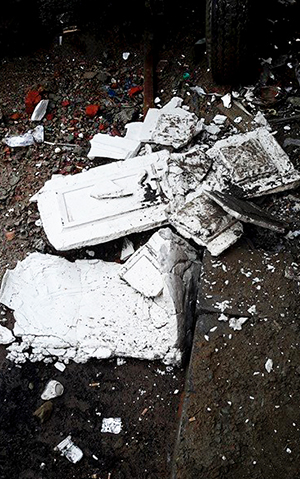
A Work of Art Vandalized at Gallerie One, Srinagar

On the opening day of Gallerie One, I was in a conversation with Rajendra Tickoo, Masood Hussain, Shabbir Mirza, M A Mehboob, Shaiqa Mohi and several other senior artists from Jammu and Kashmir. The opening of the first ever centre for contemporary arts and research in Kashmir was a dream come true for all of them. They told me that they had waited all their lives for such an initiative and how several great artists had died with the dream of having an art gallery in Kashmir. They were all very excited. They shook my hand again and again and hugged me before and after. Continue reading Kill it Before it Hatches, Attack it Before it Grows – On State Sanctioned Vandalism against Contemporary Art in Kashmir: Syed Mujtaba Rizvi

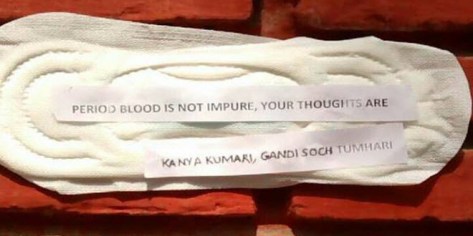
#PadsAgainstSexism campaign at Jamia Milia, Delhi

padsagainstsexism-3

Sanitary pad with message against sexism on Jamia campus

19-year-old Elona Kastrati started the #PadsAgainstSexism campaign in her hometown of Karlsruhe, Germany.

“I thought about how society gets offended by a normal pad. I thought about it so much, the idea came to me to write quotes on them,” she says. So she did.

c5a546f0-cd6d-11e4-93da-f5c367e4b24e_Pads-Against-Sexism-Elona-

Continue reading #PadsAgainstSexism campaign at Jamia Milia, Delhi

On The Interrelationship between Bovine and Human Beings

”in our religious scriptures ( Puranas) life of a cow is more important than any number of people” ( Puranon me insaan se jyada gay ko mahtv diya jata hai)

– Giriraj Kishore, Vice President of VHP,

On the public lynching of five dalits, October 2002

BJP Haryana chief Ram Bilas Sharma has promised to treat cow slaughter as a crime as heinous as murder. If elected, he said at the manifesto release function…

 TNN | Oct 3, 2014, 05.06AM IST

There is a competition of sorts between BJP ruled states to fulfil what a Haryana leader said ‘ to fulfil Modiji’s dream’. Close on the heels of Maharashtra government’s getting clearance to ban cow slaughter, there is news in a section of the press that the government in Haryana would table a similar bill in the assembly.

Sharing few snippets of the bill and comparing it with punishment of other offences, a newspaper report tells us that if the offence is insult to modesty of women the maximum jail sentence would be one year or fine, if it is molestation then it would be two years or fine, for theft the maximum jail term would be three years, for assault it would be 3 months or fine,  and for causing grievous hurt it would be maximum seven years. (Times of India, 14 th March 2015) and if it is beef in any form then it would be punishable by upto ten years in jail. Continue reading On The Interrelationship between Bovine and Human Beings

Politicians Say the Darndest Things: The Ladies Finger

THE LADIES FINGER gives the finger to politicians and their charming attitudes towards women.

Yesterday in Parliament, Sharad Yadav, head of the Janata Dal (United) and member of the Rajya Sabha, tried to prove he was cool. During a debate on the Insurance Bill, he broke off to talk about south Indian women. What this had to do with the matter at hand is questionable, but here’s what the Indian Express reported from Parliament:

The women of the south are dark but they are… their bodies…”
At this point members sitting around him tried to bring him back to the topic at hand with cries of “Sharadji Bill”. But, Yadav was not finished yet and talked about the “dancing skills” of south India women.

Soon, Trinamool Congress’s Derek O’Brien frantically waved at Yadav to stop.

Want to bet that when he spoke of “dancing skills”, this is what he had in mind?

sridevi-206x300

But it didn’t end there.

Read the rest of this devastating take down at The Ladies Finger.

AAP’s Divide & Rule: Satya Sagar

Guest post by Satya Sagar

While the Indian media goes ballistic over the possibility of a split in the Aam Aadmi Party and ardent supporters stand demoralised, for me this is probably the best news I have heard since the party’s historic win in the recent Delhi assembly elections. I love anything with ‘splittist tendencies’.

The reason is simple. For anyone even vaguely familiar with the nature of living systems, particularly microbial life (and this is a bacterial planet we live on) one of its fundamental characteristics is ‘divide and rule’. Let me explain in more detail, before Markandeya Katju accuses me of being a ‘British agent’.

Basically, anything that possesses life, propagates and spreads its influence only through the process of splitting itself repeatedly till it finds its true balance within the larger ecosystem. All of evolution is possible only because of the constant churning, that results in repeated mutation of basic genetic structures, from which the most durable and relevant ones survive.

Lifeless, inanimate objects on the other hand, by definition, do not possess any internal contradictions and can move around only when pushed by external forces. In political terms it is simple to understand this point – when was the last time the Congress, BJP or for that matter CPI or CPM split anywhere?  If there is no opinion at all, there can’t be a ‘difference of opinion’ too. Continue reading AAP’s Divide & Rule: Satya Sagar

Goodbye Secularism ! Enter Theocracy !!

Understanding the yet unfolding ‘Dietary Fascism’

Image : Courtesy – bollypedia.in

To the question whether the Hindus ever ate beef, every Touchable Hindu, whether he is a Brahmin or a non-Brahmin, will say ‘no, never’. In a certain sense, he is right. From times no Hindu has eaten beef. If this is all that the Touchable Hindu wants to convey by his answer there need be no quarrel over it. But when the learned Brahmins argue that the Hindus not only never ate beef but they always held the cow to be sacred and were always opposed to the killing of the cow, it is impossible to accept their view…

B. R. Ambedkar 1

“Did the Hindus never eat Beef?” Dr Ambedkar has dealt with this specific issue holistically in his various writings and has also tried to link it with emergence of ‘untouchable’ castes.

At a time when the saffrons are keen to appropriate Ambedkar  – who had time and again cautioned his followers about the dangers of Hindu Raj 2 and appealed to them to fight the twin enemies of  Brahminism and Capitalism – and present him as someone who not only endorsed the Hindutva project but also opposed beef eating as cow was sacred to Hinduism, it would be opportune to pose this question afresh before them. Continue reading Goodbye Secularism ! Enter Theocracy !!

We Need You More Than Ever Today – A Tribute to Mukul Sinha: Harsh Mander

Guest post by HARSH MANDER

Two events altered his life forever. The first was when he witnessed a supervisor disrespectfully berating and kick a junior employee, which transformed a young apolitical physicist, who was passionately devoted to fundamental scientific research, into a tireless trade-unionist. The second – seeing his beloved adopted city Ahmedabad burn with tumultuous hate violence for many weeks in 2002 – thrust him into the heart of many battles against state power malevolently exercised against people of minority faiths. When Mukul Sinha succumbed to a particularly deadly stream of cancer in the summer of 2014, just weeks before Narendra Modi was swept to power, the country lost one if its bravest, most forthright voices for justice.

Raised in the railway enclave of the small district town of Bilaspur in Chhattisgarh where his father served, the young man had clearly worked out his chosen career as a scientist. After graduating in physics from IIT Kanpur, his elected life pathway seemed neatly laid out for him when, in 1973, he was accepted for his doctoral studies in plasma physics in the prestigious Physical Research Laboratory (PRL) in Ahmedabad. Founded in 1947 by the legendary Vikram Sarabhai, this apex space research institute undertakes fundamental research in physics, space and atmospheric sciences, astronomy, solar physics and planetary geo-sciences. This was where India’s first space satellite was born. It was a cloistered intellectual world, separated it seemed by light years from the turbulent life of fighting injustice which Mukul was to ultimately choose. Continue reading We Need You More Than Ever Today – A Tribute to Mukul Sinha: Harsh Mander

Nation’s Honour, ‘IBIs’ and the Dimapur lynching : Bonojit Hussain

Guest Post by BONOJIT HUSSAIN

naga

Photo courtesy: ABPLive

On 5th of March a mob of few thousands stormed the Dimapur central jail and after having dragged jail inmate Syed Sarif Uddin Khan, brutally lynched him while a gleeful lot clicked photographs of the lynching with mobile phone cameras.

Since the night of 5th March photographs of the brutalized dead body and a video of the lynching has gone viral on social media and activists across the country has rightfully condemned this horrific act of mob lynching. But most activists are under the impression that the outrage and subsequent lynching was because a Sumi Naga woman was allegedly raped by Syed Sarif Uddin Khan on the night of 23rd February. But one needs to understand that the outrage and the lynching of Khan wasn’t primarily about rape of a woman, it was more about how an outsider, more so a ‘lowly’ IBI (a very popular acronym for Illegal Bangladeshi Immigrant), has violated  the Naga nation’s honour reposited in the bodies of its women by raping one of its ‘daughters’. Continue reading Nation’s Honour, ‘IBIs’ and the Dimapur lynching : Bonojit Hussain

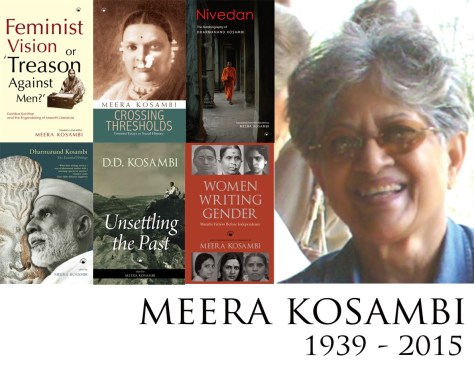
Paying tribute to Meera Kosambi: Uma Chakravarty

kosambiobit

Image courtesy Permanent Black

Meera Kosambi, best known for her scholarship on Pandita Ramabai, passed away at the end of February. Uma Chakravarty, feminist historian, writes on FeministsIndia about the work of Meeratai, as she sternly admonished me to address her, when I casually called her Meera! I met her only once, a few years ago, and was enthralled through the lovely Maharashtrian dinner she had prepared, by her personal warmth and sharp intellect. ‘I dont like these Western ways of addressing older people’, she had said, ‘We have such lovely words of respect and affection, why not use them?’

Meeratai, you will live through your work. Salaam.

And here is Uma Chakravarty: 

Many years ago, before Meera Kosambi began to write on women in 19th Century Western India, a region that I wrote on in my work on Pandita Ramabai, the only Kosambi on my intellectual horizon was D.D. Kosambi, her father, who towered over the history writing scene.

So it was not surprising that when I first met her sometime in the 1990s, a lot of our conversation was about her father and also about her grandfather Dharmanand Kosambi because of my interest in Buddhism. Belonging to such an illustrious family it would have been difficult to carve a distinctive space for herself as Meera Kosambi certainly did.

Read the rest of this tribute here.

Indian feminists, ‘India’s daughter’, and sexual violence: The issues at stake*

International-women-s-day

Today, on International Women’s Day I am proud to acknowledge the deeply contested terrain that we call feminism in India, in which no claim goes unchallenged, no issue is undisputed (and some might say, no good deed goes unpunished!) In which over the decades, every stand and every understanding on practically every issue, has been painfully rethought and reformulated in the face of intense questioning from newer claims and voices.

In the clamour of feminist responses both to Leslee Udwin’s documentary ‘India’s Daughter’, as well  as to the Indian state’s crackdown on it, some themes have emerged that reflect profound fault lines in our (feminist) understanding – not so much of sexual violence itself – but of what to do about it; how to act upon the knowledge of widespread misogyny and pervasive masculinist violence; how to acknowledge that sexual violence cannot be understood except as refracted through prisms of caste, class, Indian state militarism and… a list that will inevitably end in ‘etc’ regardless of how long it is; and in this particular case, above all, what sorts of representations of sex and sexual violence will further our ethical ambitions, and what others will undo decades of work.

In what follows, I will try to uncover some of these themes, on the explicit understanding that I do not claim to have resolved any of the debates, nor even to have highlighted all of them. This is a partial, personal attempt to make sense of the recurring ideas in a tumult of intelligent, concerned and strongly articulated opinions, in the course of which I will of course, make my own views explicit too.

First, perhaps I should state immediately that I saw ‘India’s Daughter’ and liked it very much. This is just to get it out of the way, because my opinion on the film is irrelevant to my belief that freedom of speech and expression ought to be a value that feminists defend at all costs. I did not hold such a strong view on freedom of expression in an earlier decade, but I do now, at the beginning of the 21st century, when it has become increasingly clear that the silencing of uncomfortable voices, even unto murder, has become the preferred mode of snuffing out debate globally.

Continue reading Indian feminists, ‘India’s daughter’, and sexual violence: The issues at stake*

Bread and Roses in Kerala today – the Kalyan Sarees Women Workers’ Struggle, and an Appeal on Women’s Day-Eve: Malavika Narayan

This is a Guest post by MALAVIKA NARAYAN

Drive through any road in Kerala, one sees enormous showrooms of silks and jewellery, glittering with all the riches they contain.

Who says that the Kerala model of development is slow on growth and only high on human indicators? The most literate ‘progressive’ state is evidently doing well enough in business and investment too it would seem. We are also an expanding consumer market now, willing to finally shed some of that humility and simplicity once perceived to be characteristic of us. We have what claims to be Asia’s biggest mall, and other international chains setting shop here. In Maveli’s land, there really appear to be no poor or oppressed who would destroy this image of perfection. Continue reading Bread and Roses in Kerala today – the Kalyan Sarees Women Workers’ Struggle, and an Appeal on Women’s Day-Eve: Malavika Narayan

DISSENT, DEBATE, CREATE