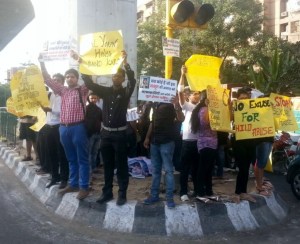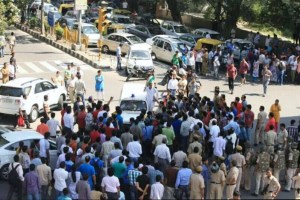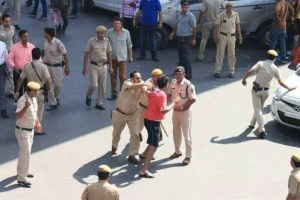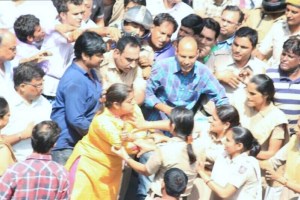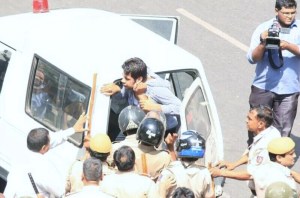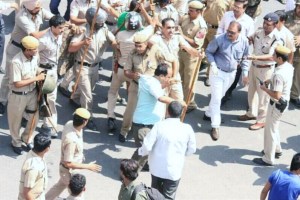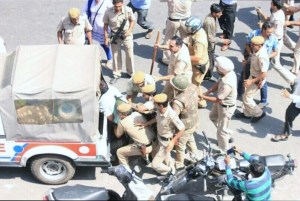
Organized Fundamentalist Hindutva Forces trying to Instigate Communal Tension in Bawana, Delhi

Pressurize the Administration to immediately intervene and stop the communal Mahapanchayat on 2nd November!

Organized Hindutva forces are again trying to instigate communal polarization and spread terror in Bawana area of North-West Delhi in the last few days. They have called for a ‘Mahapanchayat’ at 4 pm on Sunday, 2nd November 2014 to oppose the Taziya procession taken out for Moharram in the area, calling it supposedly a ‘terror procession’.

Only three-four policemen loiter in the area tonight on 1st November, while the administration, including the Lt. Governor and Police Commissioner, has been alerted in the afternoon itself  by various pro-people forces and local people on the rabidly communal ‘parcha’ that has been circulated in the area. This parcha explicitly gives a ‘call for Bawana’ to stop the supposed terror procession and ‘show of arms’, ‘display of strength’, disruption of peace and other baseless allegations on the Muslim community.

The situation of communal tension in Bawana is not spontaneous, but is being instigated by organized Hindutva forces, much like Trilokpuri in the past week. Earlier, on 2nd-6th October, just before Eid celebrations, the ‘Hindu Krantikari Sena’ outfit of the RSS tried to make a case out of imaginary ‘cow slaughter’ and instigate terror and communal tension among residents of Bawana JJ Colony and nearby Bawana village. They had also put up communal posters then calling for a gathering in Bawana Gaushala on 5th October. Continue reading Organized Fundamentalist Hindutva Forces trying to Instigate Communal Tension in Bawana, Delhi
MNREGA’s Swan Song – Not everyone’s idea of ‘achche din’: Amitava Gupta

Guest Post by AMITAVA GUPTA

Concerned about the approach of the central government toward the Mahatma Gandhi National Rural Employment Guarantee Act (MNREGA), 28  development economists wrote a letter to the PM, urging him to stop tampering with the scheme. The letter, as one might have suspected, did not go down well with Jagdish Bhagwati. He, along with his Man Friday Arvind Panagariya, was quick to put forward a rebuttal. Though Bhagwati’s credentials as a trade theorist cannot but be acknowledged even by his bitterest critics, he is hitherto not known for his contribution toward development economics. Panagariya would merit even lesser mention. But, that should not ideally deny their argument a fair scrutiny.

The central government announced a set of measures over the last couple of months or so. Those include restricting the scheme to the poorest 200 districts; reducing the labour to material ratio from 60:40 to 51:49; freezing the real wage rate; imposing cap to state expenditure on the scheme.  Put together, those measures deliver a lethal blow to MNREGA. Bhagwati and Panagariya extend unconditional support to this rather brutal amputation. What they essentially do is to summarize the standard arguments against the scheme. The arguments can be clubbed under two heads— i) the scheme is marred in corruption; ii) it does not generate revenue to justify the spending from the exchequer and hence, it should be done away with. It is worthwhile to check whether any of these arguments has some merit or these are just political salvos packaged as economic wisdom.

Continue reading MNREGA’s Swan Song – Not everyone’s idea of ‘achche din’: Amitava Gupta

The Majestic Parvati Valley – Paradise Lost: Ujithra Ponniah

Guest Post by UJITHRA PONNIAH  

In what is known as the heart of Shiva, the majestic Parvati Valley in Himachal Pradesh, a trekker writes about a chance encounter with a Russian man and the impending destruction of the valley. 

My growing alienation with Delhi and city life in general has been buttressed by my frequent, life breathing trips to the mountains. One such getaway took me on a week long trek to the beautiful Parvati valley in the Kullu district of Himachal Pradesh along with a friend. The valley is home to majestic waterfalls tucked away at every turn, lush green forests with the promise of thriving wildlife, unique flowers and a well marked trekking trail. The waterfalls are generous and since we went in the rainy season every shade of green was visible in the forest. The forests are generously sprinkled with their share of marijuana plants that provides a living to many locals and keeps the travellers, especially a large number of Israelis in states of bliss.

Untitled

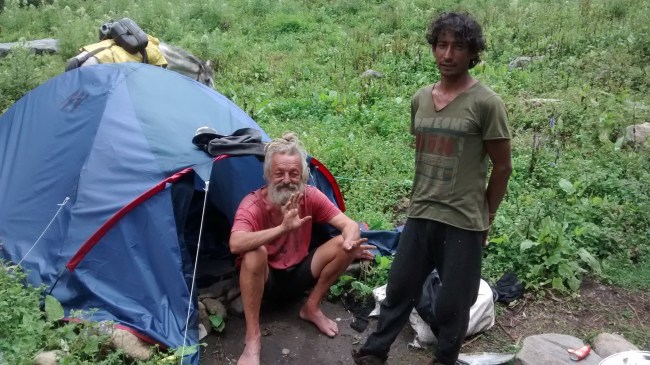
Russian Baba with Prem

The trek to Kheerganga begins from Barshani village, which is the last motorable point. It is a 14km uphill trek through the forest.  The forest is alive and buzzing with life and the Parvati River accompanies you through your walk. Having recuperated from our long trek to Kheerganga and enjoyed the dip in the hot spring and rejuvenating sight of the first layer of snow on the surrounding mountains, we trekked further with the hope of reaching Tunda Bhuj, a place adorned with a wide variety of sub-alpine forests. About half way into our journey it began to get dark and started pouring. The mist was setting in impeding our vision and we were happy to see a couple of tents in the middle of the forest, next to a small brook. When we stopped by we were warmly greeted to join in for a cup of hot tea. This is where we met a foreigner, in his late 60s and his two companions – Prem and Mansingh (both from Nepal). The initial round of niceties revealed that the foreigner was from Russia and I realised this is the ‘Russian baba’, we had heard about in Kheerganga. He had dreadlocks in his hair, a pair of torn shoes, a torn t-shirt and a bundle of beedi that he constantly drew on. He could not hear too well and retained a thick Russian accent. Continue reading The Majestic Parvati Valley – Paradise Lost: Ujithra Ponniah

Sophie Joseph’s Sikh Neighbours: John Dayal

Guest Post by JOHN DAYAL

My aunt and God-mother Sophie Joseph had lived in Delhi a long time, and as a young woman, was witness to the communal frenzy art the 1947 Partition of India.

She would also tell stories of heroism, and greed. Many Hindus saved lives, in return for all the cash they could carry, or for rights over the house that would soon be vacated. Others saved their neighbours out of love. Many lived to cross the borders not because the Armymen protected them, but because the neighbours risked their lives to save them from other marauding neighbours. Sophie, then in her teens, remembered all this. She was no heroine and her lower middle class family was not the stuff of which role models are made, but they were happy they connived in the saving of lives.

That lives could be saved if there was courage of conviction was a lesson she learnt. Her lesson would come in handy almost thirty five years later, save many more lives of other neighbours.

Continue reading Sophie Joseph’s Sikh Neighbours: John Dayal

Boycott the Israeli embassy sponsored performance of the Maria Kong Dance Company in Delhi: INCACBI

Statement from The Indian Campaign for the Academic and Cultural Boycott of Israel 

Don’t let apartheid onstage!

Protest against the ‘Israel in India’ initiative!

Boycott the Israeli embassy sponsored performance of the Maria Kong Dance Company at Kamani Auditorium, New Delhi, November 4, 2014

On 4th November, 2014, the Maria Kong Dance Company will perform at the Kamani Auditorium as part of the “Israel in India” initiative, with support from the Israeli embassy in India. This is part of the 8th Delhi International Arts Festival, organised by the Prasiddha Foundation with the support of organisations including the ICCR.

The festival aims to “serve as a significant platform for cultural diplomacy” and “provide a common ground for interaction between the artists and the mass audience”. Is a common ground possible between the Israel and Indians of conscience, whether artists or citizens? Is “cultural diplomacy” possible with Israel when it has attacked Gaza so brutally earlier this year, and held its people to ransom for years? Since Israel does not respect international law and recognize the Palestinian people’s right to freedom, equality and justice, the Indian Campaign for the Academic and Cultural Boycott of Israel (InCACBI) demands that Israel be boycotted from the Indian cultural arena.

Continue reading Boycott the Israeli embassy sponsored performance of the Maria Kong Dance Company in Delhi: INCACBI

Jis tann lãgé soee jãné – Delhi, November 1984, 30 Years After: Gauri Gill

Guest Post and Photographs by Gauri Gill

[30 Years ago today, Delhi, and some other cities in India saw the beginning of days of organized massacre of Sikhs, ostensibly as a response to the assasination of Indira Gandhi. In memory of that dark time, we present a documentary text-photographic project by Gauri Gill. Gauri revisits the survivors of the 1984 violence in Delhi, and invites artsits, writers, and others to consider their memories of that dark time. An earlier version of this project by Gauri Gill was uploaded on Kafila in April 2013 by Shivam Vij. We are posting an updated version of the project, with fresh material, on the occasion of the 30th anniversary of the November Pogrom. ]

In 2005, when I heard Nirpreet Kaur relate her story, she had to have a psychologist present in the room. For us, it was too much to fully absorb. I did not know what to do with the weight of her words. We urged her to write a book, I hope she does someday.

Continue reading Jis tann lãgé soee jãné – Delhi, November 1984, 30 Years After: Gauri Gill

Letter to PM about US-India Bilateral Relations on Intellectual Property

Dear Prime Minister Modi ji,

We, the undersigned, wish to share with you some of our concerns on India’s position on intellectual property (IP), particularly in the context of bilateral relations between the United States of America and India. We gather from the US-India Joint Statement dated 30 September 2014 that the Indian Government

(a)greeing on the need to foster innovation in a manner that promotes economic growth and job creation…committed to establish an annual high-level Intellectual Property (IP) Working Group with appropriate decision-making and technical-level meetings as part of the Trade Policy Forum. 

The necessity for setting up the joint Indo-US IP Working Group is not entirely clear. As the Department of Industrial Policy & Promotion (DIPP)‘s press release of 3 October 2014 mentions, there is already in operation an Indo-US Trade Policy Forum since 2010. Therefore, we request your Government to kindly make the specific purpose of this joint Working Group publicly known. Continue reading Letter to PM about US-India Bilateral Relations on Intellectual Property

Witness Account of the Trilokpuri Clashes on October 25, 2014: A.M

AM, a journalist,  writes on Sabrang. Excerpts below and link to the whole piece at the end.

I with a colleague of mine reached East Delhi’s Trilokpuri by 12:00 pm on Saturday. News about alleged clashes had reached us late on Friday night. We were told that the clashes had broken out at around 8:00 pm on Friday but no one was visibly injured. Bricks and empty beer bottles were hurled to and fro interspersed with occasional gunshots. The police reached the area and restored calm. Heavy police presence in the area restored confidence and sent people back into their homes. This is what we had heard.

When we reached the spot on Saturday afternoon at around 12:00 pm, both of us happened to walk right into a mob which had assembled on the main road. Then they started hurling bricks into the air, upped with roaring jubilation and thrill. All at a physical enemy that was not visible. Terrified and taken by surprise, we ducked and ran over to a nearby car parked by the curb. We crouched behind it for over five minutes till we could run farther down to a relatively deserted and safer stretch next to a mother dairy kiosk. That was only one of the many such walk-ins we had and had walked in and out of…

This senseless and directionless fury, we realised, was being whipped up for the fun of it. And, as journalists, we sensed individual families had gathered ammunition, mainly bricks and beer bottles, over the night for a final showdown on Saturday morning. A couple of hours later, my colleague followed a rag picker collecting in a sack bricks strewn over various roads. He saw the rag picker climb into a house and he heard him saying, “Chalo bhai, aaj ke raat ka intezaam ho gaya hai.”…

The atrocities started when policemen began arbitrarily searching houses and rounding perpetrators in the absence of clean evidence or proof. Almost 1000 persons were actively involved in the stone throwing and no one knows which blocks they belonged to and where they had walked to to participate in the violence. Police, clueless and worked up, therefore, randomly began banging on closed doors and shoving their lathis into houses to drive fear and establish control over residents. Most of these houses, however, happened to be in Muslim dominated areas especially in Blocks 14 and 27. The Indian Express reported that “the police have arrested 44 people — 32 Muslims and 12 Hindus” on charges of rioting as listed in the FIRs. This despite Trilokpuri comprising 80 per cent Hindus ( Balmikis) and 20 per cent Muslims. Lopsided statistics and arrests say much about what was happening on the ground…

I was witness to how the Delhi police, had brazenly, in view of  journalists, albeit without cameras employed anarchic, illegal arrests, communal and extrajudicial tactics to impose what they call ‘law and order’- a phrase which constantly equivocates with us, we who lie on the “clean” side of law and those who live outside its underbelly.

READ THE WHOLE ACCOUNT HERE.

त्रिलोकपुरी के कुछ सवाल

त्रिलोकपुरी की हिंसा की व्याख्या तरह-तरह से करने की कोशिश हो रही है. जो बात साफ है, वह यह कि हिंसा रोकी जा सकती थी, अगर प्रशासन ने वक्त पर सख्ती की होती. लेकिन दिल्ली में दीपावली के आस-पास जैसे कोई प्रशासन नहीं था.गनीमत यह थी कि त्रिलोकपुरी में रोड़ेबाजी तक ही हिंसा सीमित रही और दूसरे हथियारों का इस्तेमाल नहीं हुआ. शायद उसका इरादा भी न था. मकसद एक सीमा तक तनाव और तापमान बढ़ा देना था जो उस इलाके के हिन्दुओं और मुसलमानों में शक और नफरत भर दे और दोनों को एक-दूसरे से दूर-दूर कर दे.

तरकीब जानी पहचानी थी. दो लोगों के बीच झगड़े की खबर आगे बढ़ते-बढ़ते तरह-तरह की शक्लें अख्तियार करती है और फिर एक बार हमला होता है.अगर झगड़ा बीस नंबर ब्लॉक का था तो वहाँ से दूर पंद्रह नंबर ब्लॉक या सताईस नंबर ब्लॉक में रोड़ेबाजी क्यों हुई.मोबाईल और व्हाट्स ऐप पर अफवाहें कौन उड़ा रहा था?

सवाल और भी हैं .इस तनाव में स्थानीय विधायक और सांसद की क्या भूमिका थी? विधायक दृश्य पटल से गायब थे. वे आम आदमी पार्टी के हैं.उनसे बार-बार संपर्क की कोशिशों के बावजूद वे सक्रिय नहीं हुए. सांसद भारतीय जनता पार्टी के हैं.उन्होंने जो बयान दिया, उसमें इशारे से हिंसा के लिए मुसलमानों को दोषी ठहराया गया था. उनके पूर्व विधायक का रोल तो आग लगाने का था.कुल मिला कर,दोनों की दिलचस्पी अमन के लिए हस्तक्षेप में न थी. दीपावाली के अगले दिन, जब रोड़ेबाजी ज़ोरों पर थी और कुछ भी घटने की आशंका थी, लगभग हर राजनीतिक दल से संपर्क की कोशिश हुई. नतीजा प्रायः सिफर था. Continue reading त्रिलोकपुरी के कुछ सवाल

त्रिलोकपुरी में शांति है!

त्रिलोकपुरी में शांति है. त्रिलोकपुरी में तनाव है. त्रिलोकपुरी में स्थिति नियंत्रण में है. नियंत्रित तनाव की शांति भी नियंत्रित ही होती है. बीच-बीच में अफवाहें उड़ती हैं और लोग सावधान हो जाते हैं. पुलिस की गश्त बढ़ जाती है.

दीवाली की रात से सक्रिय हिंसा शुरू हुई. लेकिन यह हिंसा भी नियंत्रित थी. सिर्फ ईंटों के टुकड़े बरसाए जा रहे थे.त्रिलोकपुरी की सड़कें इन टुकड़ों और कांच से आज भी इस कदर पटी पड़ी हैं कि उनसे बचकर आप पैदल भी नहीं चल सकते. प्रशासन एकसाथ शांति कायम रखने और सडकों को साफ कराने का काम नहीं कर सकता, भले ही स्वच्छ भारत अभियान की सफलता के लिए पत्रकार अपनी कलम को झाड़ू बना चुके हों. ताज्जुब सोचकर होता है कि इतनी ईंटें अचानक कहाँ से आ गई होंगी.

शांति है. धारा एक सौ चवालीस लगी है. अपनी दीवाली खराब करके सैकड़ों पुलिसकर्मी गश्त लगा रहे हैं. लेकिन इस पहरे का नतीजा प्रायः रोजाना काम करके पेट पालने वालों को भुगतना पड़ रहा है. यह इत्तफाक की बात ही होगी कि शिकायतें मिल रही हैं कि ज़्यादातर मुसलमानों को दूध, सब्जी, जैसी ज़रूरियात की खरीदारी करने या काम पर जाने के लिए बाहर निकलने में दिक्कत हो रही है. एक का कहना है कि दाढ़ी देखते ही सुरक्षाकर्मी सावधान हो जाते हैं और उनमें तनाव आ जाता है. उनकी लाठी में भी उस वक्त ज़्यादा ज़ोर आ जाता है. क्या यह सिर्फ उसका वहम है? Continue reading त्रिलोकपुरी में शांति है!

Ghulam Azam : Death of a War Criminal

Wily strategists meet their nemesis in unexpected ways.

Ghulam Azam, the once all powerful leader of Jamaat-e-Islami Bangladesh, who died recently, might have brooded over this old dictum, in his last days in detention. It was only last year that he was sentenced to 90 years of imprisonment for his crimes against humanity which he committed when people of the then East Pakistan – todays Bangladesh – had risen up against the occupation army of Pakistan in the year 1971.

It was not surprising that the funeral of this man who evoked intense hatred and loathing from a large cross-section of the population of B’desh for his role during and after the liberation of the country witnessed protest demonstrations all over the country. There were even demands that his body be sent to Pakistan for final rites and should not be buried here.

“The janaza (funeral prayer) of a war criminal can never be held at the national mosque,”

Ziaul Hasan, chairman of Bangladesh Sommilito Islami Jote, an alliance of progressive Islamic parties, said at a human chain near the Baitul Mukarram National Mosque where Azam’s body was taken for funeral prayers. (The Telegraph, 27 th Oct 2014). Continue reading Ghulam Azam : Death of a War Criminal

Goodbye Politics, Hello Social Science 
- A Reply to Ranabir Samaddar and Others on Recent Students’ Politics in Jadavpur: Rajarshi Dasgupta

Guest Post by RAJARSHI DASGUPTA

[ This post by Rajarshi Dasgupta continues the debate with Ranabir Samaddar’s piece on the character of the students’ movement that has begun in Jadavpur University which was published recently in DNA, also critiqued in a recent post in Kafila by Uditi Sen ]

Nobody knows why social science routinely condemns the lack of radicalism in society when social scientists with radical pasts so easily dismiss new radicalisms as harmful and shallow. I was attending a meeting on students’ politics in the campus I work on the other night, when some colleagues, who have long been part of progressive politics since their student life, voiced such sentiments. I was struck by the arguments they made against what they saw as merely fancy and passing fashion. They were rather similar to a set of arguments made by an older generation of teachers about my colleagues when they were young and radical students. I think these arguments are worth a little discussion since they show something like a pattern that is predictable to some extent, and which may reveal a more uneasy relationship between social science scholarship and social transformation than we usually care to admit. They also have a deep affinity with the criticisms aired about the recent students’ unrest in Jadavpur university, by Ranabir Samaddar among others. Unlike some who have written in support of the students, there are senior scholars like Samaddar who have expressed profound and serious misgivings that must be tackled head on. I will argue in the following that such misgivings result from a muddle of liberal and leftist understanding of the student’s place and the academy’s role in society. A more clear understanding becomes possible, incidentally, in this case, if one returns to a basic capitalist framing of the university.

Continue reading Goodbye Politics, Hello Social Science 
- A Reply to Ranabir Samaddar and Others on Recent Students’ Politics in Jadavpur: Rajarshi Dasgupta

On a Long Road to Justice: Simin Akhter

This is a Guest post by Simin Akhter, with inputs from Kamal Pant, Naina Singh and Vikas – 16 December Kranti

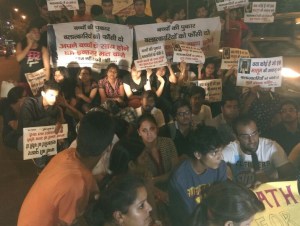
(Notes from the ongoing protests in the child sexual abuse case against Toddlers International Playschool, Rohini)

In a heinous and unfortunate show of power and violence, a two and a half year-old girl was raped by a male attendant at Toddlers International playschool (Rohini). Though the parents could manage to file an FIR, the management has threatened them with dire consequences. The principal has been openly shielding the accused, Amit Kumar, despite prior complaints of inappropriate behaviour by aggrieved parents and was allegedly shameless and audacious enough to tell the parents, ‘The police have been fed too well enough to open their mouths’! It also came to light during the protest yesterday that a similar FIR was filed two years back too but no police records could be found for the same; no wonder!

Almost 30 other girls have been detected with a certain strain of bacterial urinary infection, indicating the said two-year old is not the only victim. Many other children have been suffering from mouth-ulcers and a general loss of appetite too, reflecting also on the general lack of health and hygiene practices in the school. A group of parents, grandparents and concerned citizens, mostly young women and men, from in and around Rohini have got together for a relay protest but parents of other victims have not been forthcoming with formal complaints. Needless to say, the greater the delay in filing the complaints, the more legal intervention will get delayed.

Continue reading On a Long Road to Justice: Simin Akhter

Ruminations of a Holy Cow: Satya Sagar

Guest Post by SATYA SAGAR

I am a humble cow from India and writing this to clear up some of the bull being propagated about me and members of my family for a long time.

I am not using the term ‘humble’ out of some false sense of modesty but only because this reflects the true status of most cows in this country. Irrespective of the propaganda about our ‘exalted status’ cows in India are an oppressed lot, on par with the ordinary people of India.

In fact cows, have been the template for exploitation around the world, being among the first animals to be ‘domesticated’ by the human species. Once cows, along with dogs and sheep, were enslaved it was only a matter of time before the male of this evil species thought ‘how wonderful it would if I could also domesticate women, children and members of neighbouring tribes?’

The rest is history. Of course, the history of human ‘civilisation’. The four terms ‘captured, tethered, milked, butchered’ – which is what has happened to cows over millennia- can neatly describe the entire march of ‘progress’ of human societies from feudalism to modern day financial capitalism.

I laughed out loud reading Marx the other day ( I found his book while rummaging for food in a garbage bin) where he talks of ending the ‘exploitation of man by man’! Well before all that came the exploitation of cows by man! Continue reading Ruminations of a Holy Cow: Satya Sagar

The ‘new and improved’ Love Jihad formula, unethical media and ‘social science’ votaries

Caught on the back foot by the humiliating backfiring of their fantastical Meerut scenario of ‘gangrape and forcible conversion’, in which the role of the BJP as well as of sundry Hindutvavaadi organizations in breaking up a consensual Hindu-Muslim relationship have been thoroughly exposed, the Hindu Right appears to have arrived at a new formula. This formula has made its appearance in several spaces – in comments on Kafila (some of which have been passed, many more deleted; mostly pseudonymous or anonymous, and in varying degrees of abusiveness); on the social media and in personal blogs; and more respectably, in newspapers, in signed op-eds and articles, the most recent of them by the perennially amusing Madhu Kishwar.

The formula is patented across these sites and involves all or several of the following claims:

a) Hindutvavaadi groups are not the only ones to fear ‘Love Jihad’ – the Church in Kerala and the Akal Takht have also expressed their anxieties about this campaign. So there must be some fire generating all the smoke.

b) So real is the danger that the claims have been investigated by the police, as directed to do so by courts.

c) Hindutvavaadi groups have no objection to inter-faith marriage, what they object to is the cheating of Hindu women into marriage in a well orchestrated campaign by Muslim men who trap them in polygamous marriages only to convert them and produce several children, thus raising the Muslim population.

d) What is happening in India is only a small part of the Global Islamic Terror Machine’s global campaign to use non-Muslim women as sex slaves, to prostitute them, or to seduce them in order to convert them. The recent exposure of a pedophile ring in the UK run by Pakistani men is treated as proof of the existence of such a globally coordinated campaign in which all Muslims are suspect – from Al-Baghdadi of ISIS to your classmate.

e) As irrefutable proofs, three links are generally circulated: a) a programme of IBN7 that ‘exposes Love Jihad’, and b) two videos of young women who supposedly speak about being victims of Love Jihad.

Madhu Kishwar in her article asserts all of these claims produced by the RSS Myth Machine, although she is probably not yet aware of the last item – which I will address at length in conclusion. Continue reading The ‘new and improved’ Love Jihad formula, unethical media and ‘social science’ votaries

A Reply to Ranabir Samaddar on Jadavpur: Uditi Sen

Guest Post by UDITI SEN

Prof. Ranabir Samaddar of the Calcutta Research Group has recently published a screed (in the DNA Newspaper) against the #Hokkolorob movement  initiated by the students of Jadavpur University which has found resonance with students and young people all over West Bengal and elsewhere in India. Samaddar, who seems to have lost the ability to recognize the many intersections of solidarity between students, young people in metropolitan as well as non-metropolitan contexts, women, young workers, accuses the movement of what he calls ‘elitism’ and a disconnect with realities on the ground.

Uditi Sen responds.

It is settled then. With this latest denunciation (by Ranabir Samaddar, in DNA, see link above) of the student movement at Jadavpur, we finally have a verdict we can trust. Student politics is not what it used to be. The glory days of the 60s are long gone and the protesting young today fail to live up to the authentic radicalism of their elders. Those were the days, indeed. Those were the days when student politics, organised under the banner of the organised left took up real issues, such as those of the peasants and workers and did not distract themselves with inequities closer to home. Such as, why women ‘comrades’ were expected to cook and clean and provide for their men, who led the vanguard. Such as why even the most progressive politics, when speaking of the rights of peasants, meant the rights of male peasants. Those indeed were the days of glory, which we should remember and seek to emulate, when the leaders, usually dadas, had no answers when a peasant woman asked, ‘“Why should my comrade beat me at home?” (See Samita Sen’s Toward a Feminist Politics: The Indian Women’s Movement in Historical Perspective)

Continue reading A Reply to Ranabir Samaddar on Jadavpur: Uditi Sen

Sanskrit and Language Politics Then and Now: Muruganandham

Guest post by MURUGANANDHAM*

When all the arrangements were made by the corporate media and Hinduist forces for ensuring that Modi became the next Prime Minister, the democratic forces and progressive political organizations were still trying hard to make people understand his real agenda of imposing corporate capitalism and Brahminical Hinduism, in a rapidly fascist manner, in the guise of “development”. Middle class voters were lured by the media and believed him to be the harbinger of “development”. After taking over the rule at the center, Modi’s government has taken up the burden of disproving the undue trust placed on it by the unfortunate Indian middle class – through an array of anti-people activities like cutting of the gas subsidy, privatization of the public sector and substantial hike in train-fare, not to mention the red-carpet rolled out to FDI investments in defense and railway sectors. The Modi government has also been quite manipulative, and has tried to distract people’s attention from these vicious schemes, by working out cultural and social programs with attractive sounding slogans.  The imposition of Sanskrit week, Hindi usage for official purposes, Guru Utsav and more recently the Svach Bharat Abhiyan are only some of those programs which rely purely upon empty rhetoric, hardly having any logic or working mechanism. Invoking people’s imagination towards the “national” symbols is a constant resort of the rulers for political mobilization. More often than not in the Indian context, Sanskrit has been used for this political end in order to sustain the eternal hegemony of Brahminical forces. The present politics behind imposing Sanskrit as the symbol of national heritage and culture by the BJP government certainly demands a much broader understanding of the historical role played by Sanskrit and other languages in shaping the societal structure and cultures. The language which was once denied to the people is now promoted to be the language of all Indians. Let’s attempt to unearth this irony of imposing Sanskrit as the language of “ALL” so as to reveal the ridiculousness of these announcements and the urgent need to oppose them. Continue reading Sanskrit and Language Politics Then and Now: Muruganandham

Love Jihad and the roots of hate: John Dayal

JOHN DAYAL writes:

Three parallel strands of India’s cultural history have merged in recent times into a lethal phenomenon that has been termed “Love Jihad”, which has not only obtruded into the personal lives of young men and women of Hindu, Muslim, Sikh and Christian religious communities, but has put to grave risk individual security and community peace.

A attitude to Muslims that verges on Islamaphobia, a pathological hatred for conversions to Christianity – both seen as disturbing the demographic equation in India to  overwhelm the Hindu majority take the traditional national culture of feudalism and patriarchy to a new and explosive level. The current crisis in the Middle east and on the borders with Pakistan in Jammu and Kashmir provide the trigger, as it were, to the short fuse.

The Indo-Gangetic plans of North India are the main sites of this confrontation but its repercussions have been seen deep in the states of southern India, and the Indian and south Asian diaspora in the United Kingdom and the United states of America.

Political encouragement and patronage to lumpen and criminal moral vigilante groups, administrative and police impunity have led to targetted violence, a wave of hate campaigns, a polarized landscape, and deeply traumatised young couples who have dared, and sometimes married across religious borders. The media has taken sides, the Hindi language newspapers and  television news channels  exhibiting majoritarian bigotry. Civil society has found itself outnumbered.

The church, willy nilly, has found itself dragged into this unsavoury situation. Senior  episcopal and lay leadership of both Catholic and  protestant  denominations have so far not been audible in the defence of what, at the end of the day, are issues of human rights guaranteed under the Indian Constitution  and the Charter of the United Nations.

Read the rest of this article here.

“Haider” – Hamlet in Kashmir: Suhas Munshi

This is a guest post by SUHAS MUNSHI

The challenge of telling stories of a conflict is its victims. Each, traumatized in their own way, needs their own story. The narrator is bound to fail not only those he didn’t include but those who didn’t see their stories recreated faithfully. Had Basharat Peer set himself the task of faithfully adapting the violence done to Kashmiris he would have had to script a pornographic narrative for the screen. Some of the bile directed at him from Kashmiris comes from a dissatisfaction of not depicting the true extent of the brutality of the Indian army and rendering its casualties adequately pitiful. An opinion piece written on the movie in ‘The Parallel Post’ titled ‘Setting the wrong precedent’ condemns torture scenes in the movie as having actually undermined the actual extent of army atrocity in Kashmir. The piece goes on to say, ‘army excesses wane out by the time movie reaches its climax.’

However, the only service that a story teller from Kashmir could do to art and to humanity is to depict the people living there, especially the victims, as humans; as people, just as they are found anywhere else in the world, and not continue to peddle the cliché of the valley being a dehumanized pastoral paradise. Accusations of betrayal, conceit and condescension are being hurled at Basharat Peer, the writer, when he has got, for the first time ever, the words ‘plebiscite’, ‘half-widows’ and the rousing call of ‘Azadi’ in a script, through a movie, on mainstream cinema. Continue reading “Haider” – Hamlet in Kashmir: Suhas Munshi

‘Make in India’ – Modi’s War on the Poor

For some months now, I have been thinking of someone whom I saw on television during the parliamentary election campaign. The place was Benaras and Modi’s candidature from the seat had just been declared. The television journalist was interviewing a group of clearly poor people, taking their reactions on this new, though expected development. This person, fairly drunk in his Modi-elixir – and perhaps also a bit literally drunk – swaggered as he answered, affirming his support for Modi: Modi bhi chaiwala hai, hum bhi chaiwala hain (Modi is also a tea-seller and I am also a tea-seller). His words reflected the success of the remarkable gamble – that of projecting the new poster boy of corporate capital as a humble tea-seller. It was clear how so many of the poor had bought into this campaign.

What reminded me of this person initially, was that very soon after the election results were out, even before the government was formed, ‘team Modi’ announced a series of measures for the development of Benaras, which included the building of 60 flyovers – ‘to ease traffic congestion’. Mainly meant for the benefit of smooth flow of motorized traffic (rikshas, cycles and pedestrians, after all, have little place in the economy of the flyover), this was the beginning of a plan that would transform this holy city. If the experience of building flyovers anywhere in India is any experience, this would additionally mean mass demolition of settlements of the poor, shops and even entire informal markets – including tea shops that have long been part of life of local communities.

Then the government took office. Within a couple of months, the plan for Varanasi’s upgradation started being drawn up more concretely. Not everything in the proposed subsequent plan (end July 2014) seemed objectionable -not the least the idea to work on a possible mono rail, improvement of the bus network, and a Bus Rapid Transit System (BRTS) like the one in Ahmedabad. Except that this would mean more and more dislocation of the poor and destruction of their livelihoods. We have seen this happen in city after city in India, including in Delhi. Continue reading ‘Make in India’ – Modi’s War on the Poor

Un-owning – Archives in General, Ambedkar in Particular: Rajshree Chandra

Guest post by RAJSHREE CHANDRA

The immediate motivation for writing this piece has been the passionate and often partisan debate that surrounded the publication of the new, annotated critical edition of B. R. Ambedkar’s work, Annihilation of Caste (AoC) by Navayana Publishing. Sufficient water has flowed under the bridge to soften the various sharp edged stones and so it is perhaps time for some dispassionate perspective on the matter.

There are two kinds of debate that got triggered off by the publication of AoC. One of course relates to the 124 page provocative introduction to AoC written by Arundhati Roy titled ‘The Doctor and the Saint’ – The “Doctor” being Ambedkar and the “Saint” referring to Gandhi. The other relates to questions of ownership of archival material and questions of its fair dissemination. While the former has been hotly, and often intractably, debated by experts, scholars, followers and fans of Gandhi and Ambedkar, it is the latter that has received less attention than it deserves.

The question is important: It does not merely relate to the question of who owns Ambedkar, but in general relates to a wider question of authorship and representation of intellectual heritage. And as I have argued in my earlier posts on Kafila [1], for me the legal question is preceded by a normative concern and a political question, which is this: Should the answer to the question of who speaks for and about Ambedkar be selective? And relatedly, should ideas, works and publications of our thinkers and philosophers be policed and guarded by caretakers and/or representatives deemed to be “authentic” and/or “legal”? But before I come to these questions let me briefly contextualize the publication of AoC, as only a specific instance of his large body of work. Continue reading Un-owning – Archives in General, Ambedkar in Particular: Rajshree Chandra

DISSENT, DEBATE, CREATE