Media Freedoms, Coercive regimes and Blasphemy-mania: M. Amer Morgahi

Guest post by M. AMER MORGAHI

[What the corporate interests have done to the Indian media the military is doing in Pakistan. In the continuing face-off, the Pakistan Electronic Media Regulatory Authority (PEMRA) has suspended Geo TV’s license for fifteen days and imposed a fine of $ 104, 000 on it. See report here]

Media revolutions in different developing countries are seen as an important factor in democratic process, in acquiring information and in enhancing consciousness. However, the media can be manipulated, coerced and used to develop certain consensuses that favors the ruling groups, as the example of recent happenings in Pakistan shows.

Photo: Anjum Naveed
Photo: Anjum Naveed

Continue reading Media Freedoms, Coercive regimes and Blasphemy-mania: M. Amer Morgahi

#youhadonejob: Or, A Quick Legal Primer for Publishers. Or, What (Not) to Do When Dinanath (and other busybodies) Strike

This post is co-authored by Aarti Sethi and Shuddhabrata Sengupta

Dinanath Batra is at it again. Not content with having bullied Penguin and Aleph into withdrawing Wendy Doniger’s “The Hindus: An Alternative History”, and “On Hinduism”, respectively, he has now trained his guns on Orient Blackswan. And, in what seems to be emerging as a frighteningly predictable pattern, Orient Blackswan has succumbed to Dinanath Batra’s “legal suits”, not just by agreeing to consider the withdrawal of  a book that had attracted Batra’s attention, but also by withdrawing another book, on sexual violence during communal riots in Gujarat, as a ‘preventive measure’ regardless of the fact that it had not even been targeted by Batra and his organization. Clearly these are interesting times for publishing in India.

There is no need to rehash arguments on the importance of free speech and the circulation of books and words and texts. These have been extensively discussed here on Kafila, and everywhere else. At this stage it might be useful to simply clarify some pressing “legal” matters as there seems to be a bewildering confusion rife amongst publishers as to what exactly a legal notice is. Thus, to begin:

What a Legal Notice Is:

A Legal Notice is a grouse sent by registered post and has the same legal standing. Namely, none whatsoever. Any crank with half an hour, a typewriter and money for postage can send a legal notice to anyone about anything. You do not even have to get a lawyer to draft it. You just need a few minutes on the internet where pre-drafted forms are available for free. Or, just for fun, try drafting one yourself. Since it has no legal validity anyway, be creative! Continue reading #youhadonejob: Or, A Quick Legal Primer for Publishers. Or, What (Not) to Do When Dinanath (and other busybodies) Strike

Statement on the Hate Crime in Pune: Concerned IT professionals

Circulated by Concerned IT professionals from Pune

We, the undersigned express our deep shock at the gruesome incident of hate crime reported in the city of Pune earlier this week. A 28 year old IT professional Shaikh Mohsin Sadiq was thrashed to death by a group of people suspected to be connected with a radical Hindu outfit called Hindu Rashtra Sena.

Mohsin was reportedly returning home after offering namaz at a mosque on Monday night when he found himself caught by the mob. As is the case in every hate crime, a skull cap on head and beard were enough for the killers to pounce on him with deadly intentions. The city was witnessing bandh and violent street protests by Shiv Sena, BJP and other radical Hindu organizations in the wake of Facebook post(s) with allegedly derogatory references to Shivaji and former Shiva Sena Chief Bal Thackeray. The assailants were apparently involved in similar protests when they spotted Mohsin on Monday night in Bankar colony in Hadapsar area of Pune.

One cannot help seeing this incident vis-à-vis forthcoming assembly elections in Maharashtra. As a run-up to the elections which are due in a few months, an attempt to polarize the masses on communal lines with the sheer intention of electoral gains, as we have seen elsewhere, seems to be on the cards. We appeal to the state government to thwart any such attempts with alacrity while ensuring safety to every citizen; we also appeal to the people of Maharashtra to not fall prey to such hideous designs and uphold the progressive tradition of the state that has seen peaceful co-existence of various sects, religions and cultural groups with no place for hatred.

While offering our deepest condolences to the bereaved family members and friends of Mohsin, we extend our heartfelt solidarity to each and every member of minorities/disadvantaged communities in struggle to preserve the values of democracy, secularism and justice.

Sd/—

Neeraj Kholiya

Dhanesh Birajdar

Bharatbhooshan Tiwari

Nitin Agarwal

Vinod Pillai

Kamesh

Gokul Panigrahi

Rajat Johari

Ujjwal Barapatre

Kshitij Patil

Sanind Shaikh

Akbar Ali

Prince Shelley

Mohamed Shazad

Shaikh Asfaque Hossain

Religion, Modernity and Politics – Some Reflections on ‘Secularism’

I am grateful to Ravi Sinha for his post responding to the question of religion and politics that arises out of the brief exchange between Subhash Gatade and myself on Subhash’s post some time ago. Much has happened since the first draft of this response was written and with the advent of Narendra Modi as prime minister, ‘secularism’ too is back in public debate with renewed vigour.

Meanwhile, with Shiv Visvanathan entering the debate, flogging the long dead secularist horse, sections of the liberal and left intelligentsia seem to have gone into a tizzy. Shiv’s argument merely restates in 2014 what political analysts like Ashis Nandy had been saying at least since the mid-1980s and it does so without its nuance. The long and short of this argument is that secularism is the creed of a deracinated English-speaking, West-oriented elite which cares little about the beliefs and ways of thinking and being of the majority of their compatriots. (See also Visvanathan’s piece in Economic and Political Weekly, May 31, 2014, on ‘Narendra Modi’s Symbolic War’)

Somewhere between the two poles of the fast-dwindling tribe of the Leftist gung-ho secularist and the breast-beating liberal, the possibility of a serious debate dies a quiet death. The 1980s-1990s debate on secularism had raised all the important questions about secularism and its problematic practice that Shiv Visvanathan’s piece raises but which, it seems bypassed a whole generation of Leftists who either still seem to find it scandalous to relate to religion or are suddenly discovering their alienation or worse, the virtues of religiosity. Needless to say, such a rediscovery, in the face of political adversity is not likely to be anything more than instrumental use of religion.

The issues in 2014 invite us to revisit and indeed, go beyond what the earlier debate allowed for. Continue reading Religion, Modernity and Politics – Some Reflections on ‘Secularism’

Looking back – and forward – from Modi’s election: Shashank Kela

Guest post by SHASHANK KELA

So now the gloves are off. For the BJP, that is, whose victory in these elections gives India not only its most right-wing government, but, more to the point, a prime minister to the right of his party – more laissez faire, openly contemptuous of minorities, authoritarian in style. What the party, and Narendra Modi, will make of its – and his – comprehensive victory will soon be apparent, but the omens are far from good. Working in a coalition and under the supposedly moderate leadership of Atal Behari Vajpayee, the BJP between 1998 and 2004 achieved quite a lot – not just in the cultural wars that are its forte, but also in terms of putting economic “reform” on steroids. Now that it is being advised by that distinguished dispenser of received opinion and tireless self promoter, Dr Jagdish Bhagwati – an economist whose ignorance of history and the methods through which economic development was actually achieved in almost every successful industrial economy from Great Britain in the 16th and 17th centuries to South Korea in the 20th (cue: protectionism and lots of effective government intervention) is stupendous even by the low standards of the discipline – all bets are off. Continue reading Looking back – and forward – from Modi’s election: Shashank Kela

All Is Not Well at AUD: Natasha Narwal

Guest post by NATASHA NARWAL

Ambedkar University Delhi, a recently established State University in the NCR, has become the new buzz in the academic circles of the Capital. It is seen as space full of creative opportunities by an academic community exhausted by bureaucratic regimes and the sheer weight of established institutions stifling any real creativity and innovations in most central Universities. In a recent article in Economic and Political Weekly, Janaki Nair described AUD as a ‘viable, vibrant space of thinking and learning, striving to provide affordable and yet sustainable fee structures and encouraging creativity and non-hierarchical structures of learning.’ To be fair, such perceptions are not entirely baseless. As it is a recently established University, almost everything, from the various schools, courses, syllabus even physical infrastructure is in the making without very rigid contours. All this gives one a sense of an innovative and fluid space. Many of the faculty members indeed do strive hard to design courses in consultation with students and give them space to express themselves. But beneath this, on the grounds, all is not well at AUD. Continue reading All Is Not Well at AUD: Natasha Narwal

Enough is enough: Anand Teltumbde

ANAND TELTUMBDE in The Hindu today

http%3A%2F%2Fmedia.npr.org%2Fassets%2Fimg%2F2014%2F05%2F31%2F494819135_custom-58300287d01c3c0d94b0654967811781d07b8f74

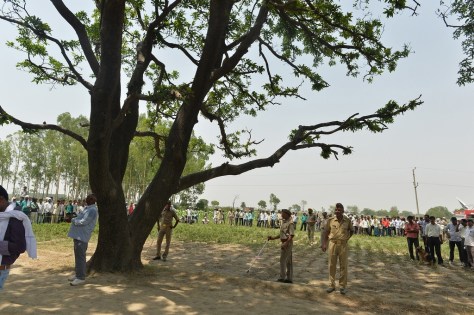
The tree in Katra Shahadatganj village (Badaun district) from which two young Dalit women, sisters, were found hanging after being gang-raped on May 27, 2014. Their bodies were found on May 28th.

The images of two innocent Dalit girls hanging from a tree in Katra village in Badaun district of Uttar Pradesh and a crowd of spectators looking bewildered at them best describes our national character. We can endure any amount of ignominy, can stand any level of injustice, and tolerate any kind of nonsense around us with equanimity. It is no use saying if those girls were our own daughters or our own sisters, we would still stare at them, bewildered and resigned like anyone in that crowd did. In just the past two months, while we as a country were busy playing fiddle to Narendra Modi and his promise of acche din, there have been a series of gory rapes and murders of Dalit teens across the country.

But beyond the residual anger, there is hardly any real concern for these atrocities. The rulers are not concerned, the media is hardly interested, and then there is indifference of the progressive lot and Dalits’ own frigidity towards them. It is shameful that we take the rape and murder of innocent Dalits as an adjunct of our social environment and forget about them.

A Chronicle of an Event Foretold? Sankaran Krishna

Guest Post by SANKARAN KRISHNA 

As journalists, academics and other pundits scramble to make sense of the just concluded elections to the Indian parliament, one can discern a few broad strands of opinion. One group – lets call them the Optimists – point to India’s almost seven-decades long experiment with electoral democracy and aver that we have the institutional strength and resilience in civil society to keep Prime Minister Narendra Modi and his Bharatiya Janata Party confined to a moderate middle that will be, ultimately, not very different from other regimes (single-party or coalition) that have ruled from Delhi. Prominent voices among the Optimists are Ashutosh Varshney, Ram Guha and Pratap Bhanu Mehta.

A second group – lets call them the Alarmists- see the BJP’s clear parliamentary majority (albeit arising from a mere 31% of the popular vote) as inaugurating an era of unapologetic Hindu majoritarianism that could severely strain and irreparably damage the plural fabric of Indian society. They are especially concerned about the fate of the Muslim minority and regard the 2002 pogrom in Gujarat as a foretaste of things to come.  The Alarmists range across activists like the late Asghar Ali Engineer, politicos like Mani Shankar Aiyar and intellectuals such as Akeel Bilgrami.  Continue reading A Chronicle of an Event Foretold? Sankaran Krishna

Some Good News for Planet Earth

17qkyzsqz2of9jpg


Two planets meet.

Oh hello, says one, long time no see. How are you?

Not doing so well, says the other. I think I have Homo Sapiens.

That’s terrible, responds the first planet, I had that too. But dont worry, it doesn’t last long.

(Popular climate change joke, courtesy Goran Fejic. Bottom line? The earth doesn’t need us, we need it.)

Honouring Mukul Sinha: The Struggle of Memory Against Forgetting: Saumya Uma and Arvind Narrain

This is a guest post by Saumya Uma and Arvind Narrain

Among the miniscule tribe of human rights lawyers, even one loss is irreplaceable. We felt that way when we lost K. Balagopal in 2009, K.G. Kannabiran in 2010 and most recently when, Mukul Sinha passed away on 12 May 2013. Each of these figures were giants in the world of human rights activism who struggled for an idea of India which all too often remained an ideal and a vision, sometimes far from reality. Regardless of how distant the vision of a real and functioning democracy, founded on the ideals of social and economic justice was, these three figures never lost heart, always communicating a spirit of hope about the future based on concrete and grounded work in the present. Continue reading Honouring Mukul Sinha: The Struggle of Memory Against Forgetting: Saumya Uma and Arvind Narrain

Footsoldiers in Search of an Icon

“The epitaph for the RSS volunteer will be that he was born, he joined the RSS and died without accomplishing anything.”-V. D. Savarkar

(D.V.Kelkar, “The R.S.S.” Economic Weekly ( 4 Feb 1950: 132) Page 36, The Brotherhood in Saffron,The RSS and The Hindu Revivalism, Andersen and Damle,Vistaar, 1986, Delhi)


Veer Savarkar was a Veer Purush who was not scared of death. He was a Shastra Upasak and Shaasrta Upasak: Shri Narendra Modi

May 29, 2013 Author: admin (http://www.narendramodi.in/)

I

Celebrations at the central hall of Parliament are a marker of the political ambience in the country.

The change of guard at the centre was very much visible at the place recently where the entire top brass of BJP including PM Narendra Modi were present to celebrate the birth anniversary of Savarkar. Modi described Savarkar as a prolific writer, poet and social reformer. “Tributes to Veer Savarkar on his birth anniversary. We remember and salute his tireless efforts towards the regeneration of our motherland.” Continue reading Footsoldiers in Search of an Icon

History and Idealism in the Aam Aadmi Party’s 2014 Victories in Panjab: Puninder Singh

Guest post by PUNINDER SINGH

article-2625216-1DBB956700000578-258_634x367

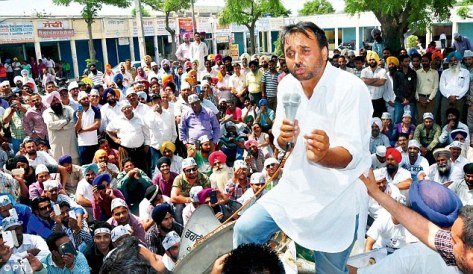
Bhagwant Singh Mann, now AAP MP from Sangrur, on the campaign trail

The Indian general election of 2014 will firstly be remembered for the signal self-destruction and implosion of independent India’s three-quarters-of-a-century-old ruling dynasty and its political arm, the Congress Party. Whether the unexpected series of victories by the fledgling Aam Aadmi Party (AAP) in Panjab will be remembered as an interesting anomaly, or as a galvanizing moment of genuine political change, remains to be seen. But just how a party that only a few months ago was essentially unknown on the national political scene, short on funding, and with virtually no organizational infrastructure, managed to secure 25% of the popular vote and four of thirteen Lok Sabha seats in Panjab (with a narrow miss on a fifth seat) is a tale that needs to be told. Although the newly demarcated role of the AAP as the gadfly and moral conscience of the political scene has been important to its success from a national perspective, it was the intersection of a new political ideology with a particular historical juncture that enabled the AAP to emerge as a giant-killer in Panjab where it met with frustrating disappointment in every other Parliamentary election that it contested elsewhere in India. 

The AAP’s success in Panjab comes almost exactly thirty years after the devastating events of 1984, including Operation Bluestar (the Indian army’s full out assault on one of the holiest of Sikh shrines, Harmandir Sahib, and the adjacent Akaal Takht, one of the seats of Sikh temporal power), the subsequent assassination of then Prime Minister Indira Gandhi, and in its aftermath, the Congress Party-orchestrated retaliatory massacres of thousands of Sikhs in New Delhi. The timing of the AAP’s success in Panjab precisely three decades after 1984 is by no means coincidental, but rather is closely tied to the unfolding history of Panjab in the post-1984 period. The momentous events of 1984 were followed by the tumultuous period of 1984-1992 in Panjab. Continue reading History and Idealism in the Aam Aadmi Party’s 2014 Victories in Panjab: Puninder Singh

A Brave and Startling Truth: Maya Angelou

mayaangelou

April 4, 1928 – May 28, 2014

We, this people, on a small and lonely planet
Traveling through casual space
Past aloof stars, across the way of indifferent suns
To a destination where all signs tell us
It is possible and imperative that we learn
A brave and startling truth

And when we come to it
To the day of peacemaking
When we release our fingers
From fists of hostility
And allow the pure air to cool our palms

When we come to it
When the curtain falls on the minstrel show of hate
And faces sooted with scorn are scrubbed clean
When battlefields and coliseum
No longer rake our unique and particular sons and daughters
Up with the bruised and bloody grass
To lie in identical plots in foreign soil

When the rapacious storming of the churches
The screaming racket in the temples have ceased
When the pennants are waving gaily
When the banners of the world tremble
Stoutly in the good, clean breeze

When we come to it
When we let the rifles fall from our shoulders
And children dress their dolls in flags of truce
When land mines of death have been removed
And the aged can walk into evenings of peace
When religious ritual is not perfumed
By the incense of burning flesh
And childhood dreams are not kicked awake
By nightmares of abuse

When we come to it
Then we will confess that not the Pyramids
With their stones set in mysterious perfection
Nor the Gardens of Babylon
Hanging as eternal beauty
In our collective memory
Not the Grand Canyon
Kindled into delicious color
By Western sunsets

Nor the Danube, flowing its blue soul into Europe
Not the sacred peak of Mount Fuji
Stretching to the Rising Sun
Neither Father Amazon nor Mother Mississippi who, without favor,
Nurture all creatures in the depths and on the shores
These are not the only wonders of the world

When we come to it
We, this people, on this minuscule and kithless globe
Who reach daily for the bomb, the blade and the dagger
Yet who petition in the dark for tokens of peace
We, this people on this mote of matter
In whose mouths abide cankerous words
Which challenge our very existence
Yet out of those same mouths
Come songs of such exquisite sweetness
That the heart falters in its labor
And the body is quieted into awe

We, this people, on this small and drifting planet
Whose hands can strike with such abandon
That in a twinkling, life is sapped from the living
Yet those same hands can touch with such healing, irresistible tenderness
That the haughty neck is happy to bow
And the proud back is glad to bend
Out of such chaos, of such contradiction
We learn that we are neither devils nor divines

When we come to it
We, this people, on this wayward, floating body
Created on this earth, of this earth
Have the power to fashion for this earth
A climate where every man and every woman
Can live freely without sanctimonious piety
Without crippling fear

When we come to it
We must confess that we are the possible
We are the miraculous, the true wonder of this world
That is when, and only when
We come to it.

Maya Angelou

Continue reading A Brave and Startling Truth: Maya Angelou

Waiting on Biafra and Lanka

As May turns into June the quiet loneliness of war-torn Jaffna lies before me. For how much longer, years or decades into the future, will I look back into the past? And who will help me reflect on that past?

Some, fifty years ago, the tragedy of Biafra unfolded. I grew up hearing about the legacy of Biafra. During the early years of Tamil militancy, my father and a few other Tamil intellectuals of his generation warned that we may end up like Biafra. That many intellectuals perished in the struggle for Biafra I knew, but what they did I did not know back then.

It is over the last year, that I returned to Biafra, through the powerful novel of Chimamanda Adichie, Half of a Yellow Sun. A novel sometimes helps us think about questions we find difficult to ask. Adichie made me think about how long it takes for us to grasp the suffering that comes with a devastating war. Indeed, Adichie writes about Biafra some forty years after. From Adichie, I moved to Chinua Achebe’s There Was a Country: A Personal History of Biafra. What struck me most about Achebe’s memoir, is that almost fifty years later, he is still struggling to come to terms with what Biafra meant to him, shackled by lingering nationalist sentiment. It takes a life time or even more to deal with the past in places like Biafra and Lanka.

Mid-May marked the fifth year since the end of the war in Sri Lanka. Continue reading Waiting on Biafra and Lanka

नेहरू कौन?

“नेहरू के बाद कौन ?” आज से पचास साल पहले यह सवाल रह-रह कर पूछा जाता था. भारत के राजनीतिक पटल पर ही नहीं, उसके दिल-दिमाग पर नेहरू कुछ इस कदर छाए थे कि अनेक लोगों के उनकी अनुपस्थिति की कल्पना करना कठिन था. लेकिन किसी भी मरणशील प्राणी की तरह नेहरू की भी मृत्यु हुई और लालबहादुर शास्त्री ने उनकी जगह प्रधान मंत्री का पद संभाला. यह बात बहुत कम लोग जानते हैं कि खुद नेहरू ने शास्त्रीजी का नाम अपने उत्तराधिकारी के रूप में सुझाया था और उनके गुण गिनाते हुए कहा था कि उनकी कद काठी और विनम्र व्यक्तित्व से इस भ्रम में न पड़ना चाहिए कि उनके अपने विचार नहीं हैं, वे स्वतंत्र मत के मालिक हैं और अत्यंत ही दृढ़ स्वभाव के व्यक्ति हैं. दूसरे, उनमें भिन्न प्रकार के लोगों को साथ लेकर चलने का गुण है, जो नेहरू के मुताबिक भारत का नेतृत्व करने के लिए अनिवार्य शर्त थी.

नेहरू के बाद कौन के साथ ही बार-बार यह सवाल भी उठता था कि उनके बाद क्या होगा. कवि मुक्तिबोध, जो मार्क्सवादी थे, इस आशंका से इस कदर पीड़ित थे कि स्वयं अपनी मृत्यु शय्या पर भी नेहरू के स्वास्थ्य के समाचार के लिए व्याकुल रहते थे. ‘अंधेरे में’ कविता में वे सैन्य शासन की आशंका व्यक्त करते हैं. Continue reading नेहरू कौन?

Queer Eye for Narendra bhai – Affect, Memory, and Politics in Desperate Times: Pronoy Rai

This is a guest post by Pronoy Rai

There is something awfully nostalgic about May 16. The election results brought with them a sense of melancholy-laden déjà vu. For the queers and allies on the political Left, the sinking feeling that May 16 brought with it, was reminiscent of yet another day, December 11, 2013; the day the Indian Supreme Court reversed the decision of the Delhi High Court decriminalizing homosexuality in India. It was once again criminal to be gay in India; once again the legal State apparatus had rendered queer bodies vulnerable to violence, from the State and from the political Right. There was a sense of desperation and disheartening injustice; what avenues remained to be sought when the country’s highest courts had us disappointed?

The Rashtriya Swayamsevak Sangh (RSS) and the Bharatiya Janata Party (BJP) had vehemently welcomed the Supreme Court judgment then, but our incoming Prime Minister, Narendra Modi, remained silent. It was perhaps too trivial an issue for him to address; when were rights anyway a matter of importance for him? If the indigenous people and forest dwellers of Gujarat could make the Indian mass media listen to them, they would tell us the story of Gujarat’s abysmal performance in settling land claims and distributing title deeds. Rights, especially of the fragments, are a roadblock for the Modi-style Development machine.

Continue reading Queer Eye for Narendra bhai – Affect, Memory, and Politics in Desperate Times: Pronoy Rai

Can NaMo do a Harper – Yesterday Maher Arar, Today Akshardham Six !

How many people remember today Canadian-Syrian Maher Arar, a softward engineer, whose travails and tribulations at the hands of the US government’s extraordinary rendition programme had shaken many people then.

Just to recapitulate he was seized by CIA operatives during a stopover at New York in 2002 and was secretly sent to Syria.Lodged in a grave like cell in Syria, Arar was repeatedly tortured to extract information which he did not know. Ultimately his tormentors released him within a span of year and half without ever being charged with a crime. As we can gather Maher Arar became a victim of the Islamophobia manufactured by the likes of Bush-Blair in the immediate aftermath of 9/11.

All those people who are familiar with the stigmatisation and terrorisation of a people and a community in the immediate aftermath of 9/11 attack can recount many such stories of miscarriage of justice, innocents being lodged in jail for years together and the tragedies which befell their families.

The case of Maher Arar was unique in many ways in the sense that because of the tremendous uproar in the Canadian society over this issue, Stephen Harper, then Prime Minister of Canada sought public apology for the ordeal which Maher went through and for the role played by Canadian officials in the whole affair . Continue reading Can NaMo do a Harper – Yesterday Maher Arar, Today Akshardham Six !

Remembering Adv. Mukul Sihna: Mahtab Alam

Guest post by MAHTAB ALAM

On 12th of May, while I was still trying to cope with the sad demise of noted human rights lawyer Advocate PurushothamPoojary, from Mangalore in Karnataka, I was informed of yet another loss. But this time, the loss was more personal and tragic. “Mukul Sinha passed away,” informed a friend who was calling from Delhi. The news shook me to the core and for a few hours, I went numb with disbelief and was unable to respond properly. In fact, it is still difficult for me to talk of him in the past tense.

Dr. Mukul Sinha, a physicist by training, a trade unionist and human rights activist by passion, and a lawyer by practice, succumbed to lung cancer in Ahmedabad, the former capital of Gujarat. His diagnosis with cancer was revealed to us a year ago. But the news had to be kept under wraps as it would ‘unnecessarily concern’ his distant friends and well-wishers. In the last one year, while he had almost stopped participating in public functions, he was very active on social media, especially Twitter. Continue reading Remembering Adv. Mukul Sihna: Mahtab Alam

Welcome to Pseudo-Democracy – Unpacking the BJP Victory: Irfan Ahmad

Guest Post by IRFAN AHMAD

This article offers a preliminary analysis of what the Modi phenomenon means in terms of BJP’s sweeping win on 16 May. It makes four propositions.

First, we stop seeing it as an individual phenomenon centered on the personality of Modi even as his votaries as well as some critics tend to view it that way.

Second, the Modi phenomenon is triumph of a massive ideological movement at the center of which stands the Rashtriya Swayamsewak Sangh, RSS. Sharply distinguishing between the BJP and the RSS is a naivety; the RSS’ influence goes far beyond as numerous politicians under its influence have gone to the non-RSS parties in the same way as politicians from the non-RSS parties have joined the RSS-BJP collective.

Third, the BJP victory is neither due to development nor due to anti-corruption but due to Hindutva dressed as development so that both were rendered synonymous. The BJP victory, I contend, is an outcome of a violent mobilization against “the other”, Muslims.

Fourth, BJP’s victory is not the triumph of democracy but its subversion. Charting a different genealogy of demokratiain Greek, I argue how it is pseudo democracy.

As I explain these propositions, I request readers to be somewhat patient –they are a bit long, like the night of 16 May.    Continue reading Welcome to Pseudo-Democracy – Unpacking the BJP Victory: Irfan Ahmad

Beyond the Elections – Need for a Vibrant and Credible Left

The Peaceful Counter-revolution

It may not be an exaggeration to say that what has just transpired is nothing short of a peaceful counter-revolution. Counter-revolution, not because there was an imminent threat of revolution that has been put down, but because the big bourgeoisie has finally put an end to the challenge from mass struggles that corporate interests had been facing. Struggles around land acquisition, the pressures for environmental clearance that held-up corporate projects, social welfare programmes that came in the way of the most unbridled pursuit of profit, and subsidies that supposedly introduced market distortions – all these had been greatly troubling the corporate sector and their ideologues. A campaign was built up, gradually over the past few years, to install a strong leader with a solid majority, who would give the bourgeoisie a free hand. And it must be admitted today that most of us failed to see where and how that threat was building up. We failed to see that for at least three, perhaps four years, the idea of the ‘Gujarat model’ was being put in place as a shorthand for an unrestrained play to private big capital.

Even when we realized that Modi was being pushed seriously, our eyes were still fixed on the older question of Modi’s culpability or otherwise in the 2002 carnage in Gujarat. The dream of the Gujarat model was sold over the years in many different ways, among precisely those sections whose support the Left (in its broadest sense) would have liked to enlist. The UPA government, of course, left no stone unturned in alienating itself from its popular support. Thus while important social welfare programmes, formulated under pressure from popular and social movements lagged behind in implementation, the neoliberal axis of Manmohan Singh, Chidambaram and Montek Singh Ahluwalia pushed relentlessly on matters like abolishing subsidy on cooking gas and direct cash transfers. The UPA government’s experience, in fact, showed that you cannot be all things to all people; that the interests of the big bourgeoisie and those of common people stand in irreconcilable contradiction. The balancing act cannot really go on for very long. Continue reading Beyond the Elections – Need for a Vibrant and Credible Left

Shazia Ilmi – Why Her Exit is Such a Blow: Jyoti Punwani

Guest post by JYOTI PUNWANI

Shazia Ilmi’s exit marks a real blow for AAP supporters. Her frequent TV appearances as AAP spokesperson made her out to be an articulate, confident woman who didn’t need to assert her religious identity to prove a point, which is a rare thing in today’s politics. Her participation in the Anna andolan was as much a pointer to its inclusive nature as it was to the emergence of a new kind of Muslim in public life: one who had no hesitation plunging into a mass movement which had strong nationalist overtones, was avowedly against the political system and had little to do with minority concerns.

When Shazia almost won from Delhi’s R K Puram constituency, it suddenly came home – for the first time in years, a Muslim candidate had been fielded from a Hindu-dominated constituency, and the Hindus had voted for her. In Mumbai, a Muslim political activist who’s friendly with every political party, has for long told Shiv Sena leaders that the moment they field a Muslim from any of their strongholds, he would join them. “The ability to take the other community along, that’s the test of a secular politician,’’   a senior Congress Muslim in Nanded  told me, rueing the fact that Muslims who could do this were ignored by his leader Ashok Chavan (one of the two Congressmen to win in the state this time). Continue reading Shazia Ilmi – Why Her Exit is Such a Blow: Jyoti Punwani

DISSENT, DEBATE, CREATE