All About So-called Sins and the Game Plan: Atul Sood

Guest post by ATUL SOOD

The lexicon of this election is very different. Some things are being said in coded language while for others, a new language is being invented. Hindutva is repackaged and reworded with suffixes like ‘constitutional boundaries’ and anti-women, anti-dalit, anti-tribal, anti-minority and anti-poor development agenda is being openly articulated as a model that works. The latest in this frenzy about newer ways of framing things is a coinage about policy decisions, especially policy decisions that have been made in the past by the elected governments of this country (See for instance, A game changing reform strategy, Arvind Panagriya’s, TOI special op-ed, April 5, 2014).

The two key policy decisions of the UPA namely, the Industrial Disputes Act and, the Land Ceiling Act, are viewed by Mr. Panagriya as a catastrophe fallen on the Indian people who are now “condemned to forever live with our past sins”. Why do only labour and land laws, which impact the vast majority of the working classes and the peasantry of this country, become ‘sinful’? Why living with primitive judicial system or uncivilized AFPSA or dark age 377, low tax rate laws and so many others are not equivalent to living with past sins? The irony of 2014 elections, it appears, is that there is no need to specify one’s vantage point. It is the point. The author’s confidence does not end here. His argument goes on further to say that if anyone disagrees i.e. if the provinces disagree with this definition of sins, then make them fall in line by redefining the federal structure. Continue reading All About So-called Sins and the Game Plan: Atul Sood
Bittersweet Gujarat: Reena Patel

This is a guest post by REENA PATEL

I looked around the room and my gaze was met with the kohl lined eyes and stares of bewilderment and distrust. My heart pounded as I listened to three Muslim women describe their latest attempt to find their father and brother after they disappeared in the riots. They were speaking to Rahidbhai* from a local NGO who was accompanying me into the Ahmedabad relief colonies for the first time. Why was I so scared? Why was my heart pounding? The eldest woman of the home disrupted my thoughts, she asked me for my name. I looked around and looked at Rahidbhai, who looked back uneasily. “Mera naam Reena hai.” I said, almost choking on the words, knowing what the next question would be. “Aap ka surname kya hai?” The room grew thick with silence. “Patel.”

As far back as I could remember, I was taught to regard Muslims differently from the rest of the general population. My parents, both from Surat, Gujarat moved and met in the United States in their twenties. They both lived in England and spent time in Gujarat, and had families that were deeply involved in the Gujarati community. My brother and I were born in Long Beach California. I went to Gujarati school on Sundays, went to every function, picnic, and cultural show put on by the Leuva Patidar Samaj in Southern California. Many of my family members were apart of the organization. In fact, my great grandfather Vallabhai Patel was one of the first Patels to land upon the shores of the United States, now estimated at a population of over 140,000. We went to religious camps that were meant to teach us about Hindu ideology, handed out saffron prayer books and modeled how to become ideal Hindu men and women for our communities.

Continue reading Bittersweet Gujarat: Reena Patel

Save the AP State Archives: Coalition of Concerned Citizens and Academics

This petition is being circulated by a coalition of concerned citizens, local and international academics and scholars

The historical collections at two major archives in Hyderabad, the Andhra Pradesh Government Oriental Manuscripts Library (APGOML) and the Andhra Pradesh State Archives and Research Institute (APSARI), are under threat in the bifurcation of Telangana and residuary Andhra Pradesh. The institutions’ collections are slated for division between the two new states. These collections have long suffered from neglect, and now face the likelihood of irreparable damage from arbitrary division, handling, and transfer.

Local and international scholars and activists have organized a petition to preserve these historical documents. Our primary concern is for the integrity of the collections and we seek to avoid entanglement in the Telangana/Andhra debates. The petition is aimed, in part, at demonstrating that there is a concerned audience of international scholars and interested parties who care about and use these collections. This wider expression of concern will help support the efforts of local citizens who plan to submit the petition to the Governor before the end of the month.

Please take a moment to add your voice:

http://www.ipetitions.com/petition/protect-the-andhra-pradesh-state-archives-and Continue reading Save the AP State Archives: Coalition of Concerned Citizens and Academics

AK versus NaMo

Neelanjan Mukhopadhyay, author of a much discussed book on Modi, made few interesting observations about AAP’s (Aam Aadmi Party ) foray into the electoral politics of Gujarat. Underlining the fact that Kejriwal’s entry into the state – wherein he tried to put the government on the mat for its acts of omission and commission – did raise expectations, he maintains that the momentum did peter away slowly.

What is more important to note that when the electoral battle started the party did not field a single candidate from the minority community despite the fact that population of Muslims in Gujarat is more than nine percent. According to the state leadership of the party it did not ‘find any suitable candidate from the community’ to contest elections. Questioning this explanation Neelanjan says that it thus did not challenge the prevalent norm that ‘Muslims are not to be given tickets’ by the mainstream parties. (Modi ki Raah Chale Kejriwal, Deshbandhu, 30 April 2014).

Any neutral observer of the whole situation – who is familiar with the fact that there are places where AAP did field ‘outsiders’ to fight elections – would also be of the opinion that this explanation seems insufficient and perhaps there are deeper reasons involved in this decision. If at the political level it could bracket BJP as well as Congress at the same level by portraying their alleged proximity to the Adanis’ and Ambanis’ why did not it try to make another strong political point by giving ticket(s) to candidate(s) belonging to the minority community. (To put it on record, the BJP did not field a single Muslim candidate and Congress could muster courage to do it in only one constituency). Continue reading AK versus NaMo

There’s a G on my Neck (again): Simran Kaur

Guest post by SIMRAN KAUR

Shekhar Gupta is at it again: lacing an insidious agenda with just enough actual facts that even the targets of his vitriol become eager to swallow. Aspiring Indian Journos, this is how a good Sardar Joke—and while you are at it, jibe at the poor, the rural, the unemployed, the mourning—is done, while earning your paycheck yet again as an esteemed Editor-in-Chief, at best with head-in-clouds, at worst, a stake-in-oppression.

Shekhar G’s latest thesis: The rest of the country has moved on but Punjab has become a prisoner of its boisterous old stereotype. It has forgotten its entrepreneurial energy, its competitive spirit and slipped into a complacent, decadent trance of perpetual balle-balle.

His first argument for the thesis of Punjab’s decline: “the Punjabification”…of Punjab. He bemoans that signs and posts are in Punjabi, in Punjab.

The 50s and 60s saw Punjabi Hindus becoming the unique community to denounce their own mother-tongue. Upping the ante, G. ridicules Punjabis who use Gurmukhi, the script developed in the time of the Sikh Gurus. He finds tell-tale signs over Punjab (he notes his fieldwork of actually travelling on the Grand Trunk Road and flying over Punjab by helicopter recently) of the people being un-couth:  signage on Punjabi establishments, in poor English.

You will take a minute figuring out what the “burgars” and “nudles” painted on so many fast-food shops mean, or why Lily is always spelt “Lilly”, whether it be the name of a restaurant in Phagwara or a beauty parlour in Bathinda…If you haven’t figured out already that this, indeed, is Singh’s English.

Brilliant two-birds strike, Shekhar G. Continue reading There’s a G on my Neck (again): Simran Kaur

BJP’s Campaign of Intimidation – A Report from Banaras: Monobina Gupta

Guest post by MONOBINA GUPTA

The narrow streets of Goduliya Chowk were bursting at the seams yesterday. It was the time of the famous Varanasi aarti at the ghats of the Ganga, a time when the crowd multiplies by several hundreds of people. Narendra Modi was preparing to head out on his triumphant road show through this area, choc-a-bloc full. The BJP’s activists were in a frenzied trance – waving saffron flags, flaunting Modi caps (a tawdry imitation of the original AAP trademark), dancing and chanting: Modi, Modi. As a person with no love lost for Modi, I responded to the exultant mood with some apprehension. My thoughts were straying to the nukkad sabha of the AAP that I attended last evening when a group of 20 young and old AAP volunteers had gone around campaigning for Medha Patkar’s meeting. I found myself thinking about the evening a couple of days ago when I stood with Anand Patwardhan and some activists who were distributing leaflets right there at Goduliya Chowk, and a group of BJP men came surrounded us. I thought about another night spent at Kabir Math Chowk after watching the Dastangoi performance – when a group of young men from Bangalore and Maharashtra were confronted by BJP supporters. I was worried about their safety standing amidst a crowd which appeared dangerous in its swaggering triumph. Yesterday, with Modi’s cavalcade approaching, frictions were reaching fever pitch – encounters one could not possibly see on the images on TV at home.

Standing there amidst the crowd, I spotted an elderly Sikh gentleman walking through the throng of people wearing his AAP topi. Suddenly a roar went up, as Modi sympathisers lunged after him shouting ‘pagal, pagal’ (mad/mad). A little distance ahead I saw another man wearing the AAP cap. The crowd spotted him too, and ran after them both, gesticulating, heckling. As I start walking quickly towards the men I saw them, seemingly unperturbed, walk right through the charging hoard, not a sign of nervousness about their gait. They were walking the confident walk of men who know no fear. Continue reading BJP’s Campaign of Intimidation – A Report from Banaras: Monobina Gupta

Notes on Velaveping Kerala : Inside a Brand-New Paradigm and Outside

Insiders: Velaveping Idukki

All I can say about the Supreme Court verdict striking down Kerala’s position on the Mullaperiyar Dam issue is that we are due for another round of the Hysterics vs. Imperialists media game. The managers of the Hysterics team, our local Malayali politicians, do have the advantage that their experience in fear-mongering has gone up considerably with the controversies over the Gadgil and Kasturirangan reports regarding ecological conservation of the Western Ghats. The Imperialists team out there in Tamil Nadu is also now more experienced, after their successful suppression of their own people’s fears for their lives at Koodankulam. So we are set for an interesting match!

However,please don’t underestimate us. The truth is that you north Indians (or others) never really got us — what we are today you will be –well — ten years later. There are of course simple souls, many ordinary folk in Idukki, who are scared for the land and their lives. But in any society, there are bound to be backward people who are always under old delusions? The sophisticated among us may be marginally scared of the dam break but our fear is not really that the land will disappear. Actually our issue is that the dam-break will make that happen too quickly. Please note that we intend to do it little by little, so that full economic advantage can be obtained! Ah, what is the use of letting everything get washed into the Arabian Sea? Our plan was simple and you will admit that no one can maximise advantage better than us. You have to realize that Kerala’s topography is too unfriendly towards profit-making ventures and we need to do something about it. Consider the following steps: Continue reading Notes on Velaveping Kerala : Inside a Brand-New Paradigm and Outside

Attitudes towards Menstruation – Notes from Assam: Priyanka Chakrabarty

This is a Guest Post by PRIYANKA CHAKRABARTY 

GOOD NEWS, GOOD NEWS…They are blessed with a child! Oh, what child, boy or girl? This is the most common response that new parents will encounter, one that indicates what people find most interesting about a new birth. We examine its genital parts and then say, it is a boy or girl. During this time, the difference between male and female is only the biological difference of sex,  of the presence of the penis or the vagina. Gradually the child is ‘socialised’ (read normalised) into a ‘woman’ or a ‘man’.

One of the key aspects of a girl’s socialization is her introduction to the bodily process of menstruation. Superficially, and as a purely biological process, menstruation is the discharge of blood from the vagina. This is widely considered to be the ‘development’ of the female body and after the start of menstruation, a girl is believed to have attained womanhood –attained puberty. Continue reading Attitudes towards Menstruation – Notes from Assam: Priyanka Chakrabarty

Why the Law may still Catch Up with Amit Shah: Warisha Farasat

Guest Post by WARISHA FARASAT 

Amit Shah seems to be on a roll this election season. First, he escaped any punishment after delivering one of the most disturbing hate speeches made during the 2014 election campaign. After the Muzaffarnagar riots, attempts were made by political parties to capitalize on the suffering of the locals, and provoke certain communities to vote for them. And when Amit Shah was censured by the Election Commission for indulging in objectionable speeches during the election campaign in Uttar Pradesh, BJP Primeminsterial candidate Narendra Modi came to the defence of his most loyal lieutenant. Clearly, Amit Shah’s statement was made with the intention of polarizing the voters in a politically surcharged environment in Uttar Pradesh and amounted to hate speech. However, the Election Commission soon did a u-turn, diluted its own stand, withdrew the ban against Shah and allowed him to go ahead with his campaign. The withdrawal of ban against Amit Shah ignoring the drastic implications of his hate speech during the campaign was alarming.

And now, the CBI has not named Shah as an accused in the Ishrat Jehan fake encounter case stating that there is no ‘prosecutable evidence’ available against him. But Shah and his supporters should not think that this so-called ‘clean chit’ absolves him of all criminal responsibility for indulging in fake encounters in Gujarat. If we believe the CBI in the Ishrat Jehan case when they claim that there is no prosecutable evidence against Shah, consequently, we also need to trust their investigations in atleast two other fake encounters, namely the Sohrabuddin Shiekh and the Tulsiram Prajapati cases where the CBI have named Shah as an accused. Shah is presently being tried in these cases and is able to campaign during these elections only because he is out on bail.

Continue reading Why the Law may still Catch Up with Amit Shah: Warisha Farasat

Democracy as Permanent Advertising – Indian Media and Elections : Irfan Ahmad

Guest post by IRFAN AHMAD

It was nothing short of a scandal. On 12 April, India TV, a Hindi channel, telecast 117-minute interview of the BJP Prime Ministerial candidate, Narendra Modi. Conducted by Rajat Sharma, it became, or was made, a mega hit. Tow days later, news director of Indian TV, Qamar Waheed Naqvi, resigned from his position alleging that the interview was ‘fixed’. Though Naqvi’s resignation was silenced in media, the fixed interview represents the dark and mutually constitutive relationships between media and politics.

Based on the analyses of select elections coverage by five television channels – India TV, NDTV, Aaj Tak, ANI, and IBN– I argue that:

  • The way journalists pose questions to their favorite politicians are often already answers;
  • In pursuing a storyline, journalists subordinate, even sacrifice, actual responses or events/facts to bolster their pre-determined narrative; and
  • Electoral polity like India is heading towards a designer democracy marked by permanent campaigning-cum-advertising.

In short, I caution against the use of widespread phrase: ‘media and politics’. It is more fitting to say: ‘media as politics’ or ‘politics as media’.

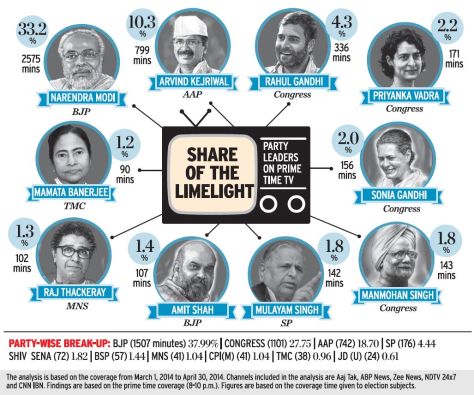
Share of prime time coverage, Image courtesy The Hindu

Modi’s ‘Fixed’ Interview: India TV Continue reading Democracy as Permanent Advertising – Indian Media and Elections : Irfan Ahmad

The curious case of Reliance Industries Ltd’s gravity defying stock price – Or, how you should learn to stop worrying about gas prices and buy RIL stock now: Vineeth Sukrithan

This is a guest post by VINEETH SUKRITHAN

The stark contrast between RIL’s latest march quarter performance and the almost- three-year highs that its stock price is perched on top, merits a deeper analysis. On April 18th, 2014, RIL released its quarterly data showing disappointing results that were entirely in line with industry expectations. Petrochemical business revenues fell 3.7%, while oil and gas turnover dropped 18.2% q-o-q. Net profit growth in its January-March quarter (Q4FY14) was at Rs 5,631 crore – only 0.7 per cent higher than Rs 5,589 crore it earned a year ago. The petrochemicals business’s Ebit was lower than in the December quarter and the company’s outstanding debt over shot its cash and equivalents. (Rs 89,968 crore against cash, and equivalents of Rs 88,190 crore.)

Yet, for a company that has always been known to be reticent about taking on high levels of debt, RIL has gone on what can only be called a remarkable splurge in capital expenditure. Its capital expenditure during the year was the highest ever. The company reported net addition to fixed assets of Rs 35,210 crore in FY14. In FY09, when the company commissioned its second refinery and K-G basin gas production, its capex was only Rs 24,907 crore. So, on all accounts, RIL’s actions and stock price seem counter to the predicaments of its current financial health, which begs the question, where does Reliance derive this level of confidence in its future profitability to be willing to take on tremendous amounts of debt?

Continue reading The curious case of Reliance Industries Ltd’s gravity defying stock price – Or, how you should learn to stop worrying about gas prices and buy RIL stock now: Vineeth Sukrithan

Should only Minorities be Worried over Mr Modi? Sanjay Kumar

(Photo Courtesy : ibnlive.in.com)

Guest Post by SANJAY KUMAR

By stealth, wealth, and media barrage a phalanx of powerful interests is trying to create a public opinion favourable to Mr Narendra Modi. It appears the entire privilegenstia of the country, the super rich capitalists, professional elites, entrepreneurs of the religion, top bureaucracy, including retired army men and police, upper castes, media pundits, even NRI academics, are united in their enthusiasm for Mr Modi. From Ratan Tata to Ramdev, people have been told how the man is the only saviour of a country in crisis. What exactly do this bunch of rich and privileged, but discontented people hope from Mr Modi as PM is important for the future of the country. The moot point here is the difference between declared intentions and actual motives. Perhaps even more important is the response of Mr Modi’s political opponents, because that indicates the kind of resources the country can fall back upon when confronted with the reality of him in power. The moot point here is a lack of understanding of the significance of the usual, non-Modi type politics for ordinary Indians. The stakes are high indeed. Far from what the phalanx and its ideologues claim, it is actually this politics which is their target, and which they wish to change under Mr Modi.

The most prominent charge leveled by Mr Modi’s opponents is that he is communal and divisive, and will alienate minorities. From Mr Lalu Prasad to Prof Amartya Sen, that appears to be the chief misgiving. If the charge against Mr Modi is so framed, then by implication it also appears to be asserting that if there had been no Gujarat 2002, Mr Modi and the kind of politics his party represents will be as good or bad as any other party politics. Are minorities’ misgivings about Mr Modi’s the only fact that the rest of Indians should worry about? Is the hesitation of minorities about him the only legitimate concern that may stop the man from reaching the PMO? Continue reading Should only Minorities be Worried over Mr Modi? Sanjay Kumar

बर्धन, ममता और मोदी

चुनाव के अनंतिम चरण के ठीक पहले भारतीय कम्युनिस्ट पार्टी के नेता ए. बी. बर्धन का बयान आया कि उनकी पार्टी नरेंद्र मोदी को सत्तासीन होने से रोकने के लिए ममता बनर्जी का साथ भी दे सकती है.बाद में इसकी कुछ सफाई भी दी गई लेकिन यह बयान अपने आप में बहुत महत्वपूर्ण है.उसके कुछ पहले कांग्रेस पार्टी की ओर से यह इशारा आया था कि चुनाव के बाद,ज़रूरी हुआ तो वह तीसरे मोर्चे की सरकार को समर्थन दे सकती है. बाद में उसके नेता राहुल गांधी ने इसका खंडन कर दिया. इन दोनों ही वक्तव्यों पर कुछ बात करने की आवश्यकता है.उसके पहले बनारस की कुछ बात कर ली जाए. Continue reading बर्धन, ममता और मोदी

Condemn the Gruesome Massacre in Bodoland (Assam) : Statement by New Socialist Initiative (NSI)

Text of a statement issued by New Socialist Initiative

New Delhi; 07/05/2014

New Socialist Initiative (NSI) strongly condemns the gruesome massacre of Bengali speaking Muslims in the Bodoland Territorial Autonomous Districts (BTAD) in Assam, which has witnessed the resurgence of the ugly head of ethnic violence. As per latest official reports, 38 people have been killed, the majority being women and children, while several have been injured and many are missing.

On the evening of 1st May at 7.30 pm, 8 armed Bodo youths riding on 4 bicycles entered a house in Narasinghbari village in Baksa District and fired gunshots. The next day (2nd May), allegedly 40 Bodo militants surrounded 77 houses in Narayanguri village in the same district and fired indiscriminately. Until now 30 dead bodies have been found. According to district administration 15 people are still missing, among them 12 children and 3 women. Simultaneously, in Balapara village in Kokrajhar district at around 12.30 am on 2nd May, armed Bodo youths killed 8 people. The survivors in Baksa district told that the death toll will substantially increase as the militants killed and threw the dead bodies into the Beki River that flows through the area. Continue reading Condemn the Gruesome Massacre in Bodoland (Assam) : Statement by New Socialist Initiative (NSI)

Universal Adult Francise? A Reality Check: Reena Gupta

Guest Post by REENA GUPTA

When polling began on the morning of April 10, our team coordinating the Aam Aadmi Party campaign in Bawal was expecting to respond to complaints of money and alcohol distribution. During the jan sabhas throughout the area, Yogendra Yadav, the AAP candidate for the constituency, had made it amply clear that, “na toh hum shraab bechenge, nah hum bikne denge.” We had spent days training booth volunteers who would be available to assist voters with information and monitor elections throughout the 200 odd villages in Bawal. Our mobile teams would document any violations of the electoral code and lodge complaints with the requisite authorities. Having campaigned in the Delhi elections for AAP, I knew firsthand that the secrecy of the ballot gave people the chance to rise above external pressures and inducements. After the hard yards of campaigning, voting day seemed set to be relaxing and I occupied myself with preparations for lunch for the numerous volunteers who were streaming in and out of our office.

Bawal is less than 100 kms from Delhi and is one of 9 legislative constituencies that comprise the Gurgaon Parliamentary constituency. In fact, Bawal falls within the National Capital Region and has been proclaimed as soon joining the constellation of Delhi’s satellite towns. There are already hi-tech factories strewn along the Delhi-Ajmer Highway and then there’s the buzz about the upcoming Delhi-Mumbai Industrial Corridor. Of course, the symptoms of lop-sided development are visible right behind the façade of big industrial complexes. With one quick turn off the highway, the roads fall apart and you are welcomed to villages with virtually non-existent education and public health infrastructure. However, I realized the extent of the distance between Bawal and Delhi only after our phones started ringing on the morning of 10th April and we set out to see for ourselves the manner in which citizens are allowed to exercise their electoral rights, in the world’s largest democracy.

Continue reading Universal Adult Francise? A Reality Check: Reena Gupta

EFLU Hyderabad Rusticates Students for Wanting to Keep Library Open: Sudha and Muhammad Afzal

Guest Post by Sudha K F and Muhammed Afzal P

The semester break seems to be the most active time for the English and Foreign Languages University (Hyderabad) administration. What are these activities that the administration invests so much of its energies in, when most students have left the campus for their vacation? It is sending memos, show cause notices and the latest: the RUSTICATION of two significant student leaders on the EFLU campus.

When the word ‘fascist’ has become an everyday term, to talk about the Modi nightmare and its anxieties, we have more to add to that list from EFLU, Hyderabad. Mohan Dharavath, President of Dalit Adivasi Bahujan Minority Students’ Association and Satish N, General Secretary of Telengana Students’ Association, have been rusticated from the University for two years, the latest in a series of draconian and undemocratic moves, on the part of the autocratic EFLU administration. The two students, along with another student, Subhash Kumar, were given show cause notices by the Proctor’s office on 24 March, to which they responded, denying the baseless charges levelled against them. The rustication is part of the disciplinary action against these students who were part of a massive protest that took place against the administration, called forth by the EFLU Students’ Union. This protest was against the absolute closure of the only 24-hour reading room, and library, on the small EFLU campus in the first week of March 2014.

Continue reading EFLU Hyderabad Rusticates Students for Wanting to Keep Library Open: Sudha and Muhammad Afzal

Some Reflections on the neutrality of political institutions and the project of making Modi more palatable: Moiz Tundawala

Guest Post by MOIZ TUNDAWALA

“ … . however good a Constitution may be, it is sure to turn out bad because those who are called to work it, happen to be a bad lot. However bad a Constitution may be, it may turn out to be good if those who are called to work it, happen to be a good lot. The working of a Constitution does not depend wholly upon the nature of the Constitution. The Constitution can provide only the organs of State such as the Legislature, the Executive and the Judiciary. The factors on which the working of those organs of the State depend are the people and the political parties they will set up as their instruments to carry out their wishes and their politics.”

[Dr. Bhimrao Amdedkar]

These observations of Babasaheb Ambedkar, made on the 25th of November, 1949, one day before the Constitution was finally adopted after three years worth of labour, should suffice for anyone who dismisses Modi skeptics as excessive scare mongers. As a second year law student in 2006-07, I couldn’t quite understand why our revered constitutional law teacher Prof. M.P. Singh would keep reiterating these sentiments in class, something which I thought was so axiomatic it did not need emphases. With only a few days left for the outcome of what is being called an election for the soul of India, I now realize the wisdom underlying those constant reminders, especially in a law school converted by the culture and priorities of its students into a factory churning out smart but unreflective products for the corporate sector. I think those of us who find Modi problematic, but would still vote him in for the lure of the promised economic miracle, while at the same time consoling ourselves with the talk of sufficiently robust political institutions capable of surviving any onslaught, must listen to Ambedkar carefully. The Constitution is an artefact, a human creation, constantly needing ‘good people’ at the helm to work it out. If nothing else, resistance to Modi’s rise to power is at least resistance against the enthronement of ‘bad people’, who deep down have only harboured contempt for the Constitution as a foreign document.

Continue reading Some Reflections on the neutrality of political institutions and the project of making Modi more palatable: Moiz Tundawala

Condemn the Massacre in Assam: A Statement by Civil Society Groups, Activists and Concerned Citizens

Text of a statement issued by Civil Society Groups and Concerned Citizens

5th May 2014

Condemn the Massacre in Assam, Demand immediate arrest of Pramila Rani Brahma; Ensure safety of Muslims in BTAD: A Statement by Civil Society Groups, Activists and Concerned Citizens

We, the undersigned, express our profound sense of grief and alarm over the gruesome massacre of Bengali-speaking Muslims on 2nd May. This most recent round of killings — in which 32 people, mostly women and children have lost their lives – is another link in the long and… bloody sequence of ethnic cleansing being carried out by tribal Bodo militant groups with impunity.

For years, Hindutva politics has successfully created the bogey of the ‘Bangladeshi’, rendering Muslims as suspects and targets, locked in a perpetual battle with the tribal Bodos. In his rally at Silchar, the BJP’s Prime Ministerial candidate reiterated precisely this. He said: “There are two kinds of people who came from Bangladesh to Assam: those brought as part of a political conspiracy for vote bank politics of a particular party (Muslims) and others who were harassed in the neighbouring country (Hindus). Those brought for vote bank politics and smugglers must be pushed back, while the second category must be accommodated.” (Silchar, 22nd February). Continue reading Condemn the Massacre in Assam: A Statement by Civil Society Groups, Activists and Concerned Citizens

India’s 16th Lok Sabha General Elections and Persons with Disabilities: Avinash Shahi

This is a guest post by Avinash Shahi

When the challenges and daily difficulties of approximately 70 million persons with disabilities in public life are not highlighted in political rallies and in the TV studios, it raises a serious question about an elite political class’s commitment to empower persons with disabilities. Do they consider persons with disabilities as India’s citizens to be taken seriously? Politicians of major political parties are crisscrossing India’s vast geographical terrain to address voters. But neither Narender Modi nor Rahul Gandhi have ever bothered to utter a single word about their plan for voters who are persons with disabilities in their campaigns. Continue reading India’s 16th Lok Sabha General Elections and Persons with Disabilities: Avinash Shahi

नरेंद्र मोदी और मुसलमान

कुछ दिन पहले तक माफी की माँग की जा रही थी. पिछले कुछ सालों से नरेंद्र मोदी से बार बार अनुरोध-सा किया जा रहा था कि वे मुसलमानों से माफी भऱ माँग लें,बात रफ़ा दफ़ा हो जाएगी।मुसलमानों को सुझाव दिया जा रहा था कि वे माफी की सूरत में इंसाफ की अपनी जिद छोड़ दें.  ऐसे मुसलमान खोज लिए गए हैं जो यह बता रहे हैं कि इस्लाम में तीन दिन से ज़्यादा शोक की इजाजत नहीं है,अब तो बारह साल गुजर चुके हैं. यह भी कहा गया कि 2002 के बाद गुजरात में जो सामान्य विकास हुआ है, उसका लाभ आखिर वहाँ के मुसलमानों को भी हुआ है. मानो हत्याओं और बलात्कार की भरपाई उस विकास के माध्यम से कर दी गई है.

अब पिछले कुछ वक्त से यह कहा जाने लगा है कि नरेंद्र मोदी तो अपने अतीत से आगे बढ़ जाना चाहते  हैं, ये तो उनके निंदक हैँ जो उन्हेँ आगे बढ़ने देना नहीं चाहते. इस तर्क से नरेंद्र मोदी प्रगतिशील, भविष्यद्रष्टा और उनके आलोचक प्रतिक्रियावादी व शिकायती दिखने लगे हैं. मुसलमानों को पहले से ही कहा जाता रहा है कि उन्हें पीड़ित-ग्रंथि से बाहर निकलने और आगे देखने की आदत डालने की ज़रूरत है. इस प्रकार का सुझाव कई बार दबे-ढँके तरीके से और अब तो खुले आम दिया जाने लगा है कि उन्हें यथार्थवादी होना चाहिए. मतलब मान लेना चाहिए कि भारत में यह सब कुछ बीच-बीच में उनके साथ होता रहेगा. अगर वे इंसाफ वगैरह की जिद पर अड़े रहे तो उनकी बाकी जिंदगी का क्या होगा ! क्या वे तमाम ज़िंदगी रोते-कुढ़ते ही गुजार देंगे? Continue reading नरेंद्र मोदी और मुसलमान

Two days with AAP in Banaras

‘Varanasi’ is only the official name. Sometimes, to make a poetic point, someone may say Kashi.   But ‘Banaras’ is how Banarasis refer to their city.

Banaras ki parampara, they say. Or hum Banaras ke musalman.

Kaal Bhairav Banaras ke kotwal hain, says the mahant of the Shitala Mata temple. Kaal Bhairav (Shiva) is the keeper of the gates of Banaras.

And of course, Banaras ki chaat khaayi hai aapne? Banaras ka paan nahin khayenge?

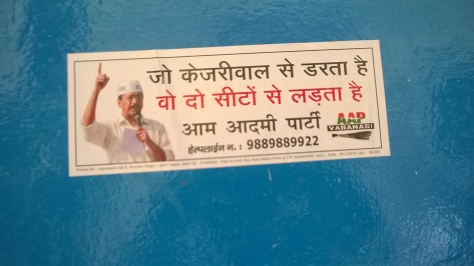
do seet

Sticker on wall of home in Rajmandir, a Hindu locality (All pictures by JAMAL KIDWAI)

My old friend and comrade Jamal Kidwai and I were in Banaras to observe the AAP campaign, being supporters of AAP (me) and of Arvind Kejriwal in Banaras (Jamal), and to hang out with the (largely young) volunteers who have landed up – from IT and advertising, from colleges and small government jobs, from Bangalore and Mumbai, from Madhya Pradesh and Arunachal Pradesh – to map Banaras with their feet. So this does not purport to be an objective account – unlike journalists’ accounts of the ‘Modi wave’, which do claim to be purely factual. As Professor Randhir Singh is fond of reminding us – in Paris in 1968, the first question the students would hurl at all speakers was always – “Where do you speak from?” Continue reading Two days with AAP in Banaras

DISSENT, DEBATE, CREATE