Modi Thugs on the Rampage – Where is the EC?

UPDATE on yesterday’s news

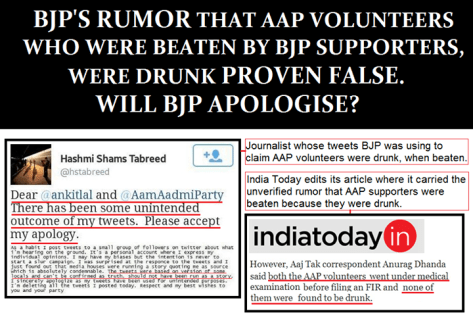
BJP's lie exposed

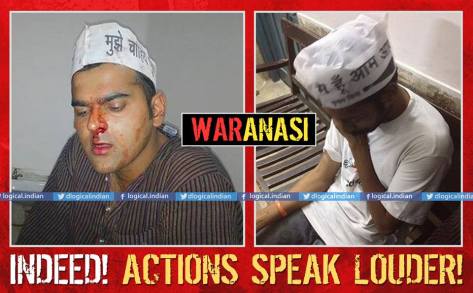
Reports of Modi Thugs on the rampage in Benaras: Over the last few days, as the days of the election appraoch, Modi supporters have become more and more desperate and violent. This is just one in a long series of disruptions of meetings and attacks that has been meted out by the goon squad to AAP volunteers.

जिन्हें नाज़ है हिन्द पर वो कहाँ हैं? उन्हें  ये गलियाँ, ये कूचे, ये मंज़र दिखाओ…

AAp activists attacked by Modi Thugs

Continue reading Modi Thugs on the Rampage – Where is the EC?

पार्टी विहीन गठबंधन का दिल्ली फतह ! संजीव कुमार

Guest post by SANJEEV KUMAR
अभी अभी सत्तरहवीं लोकसभा (2019) के चुनाव परिणाम आये है, देश की कोई भी पार्टी खाता भी नहीं खोल पाई है, जनता ने सभी सीटों पर निर्दलीय उम्मीदवार को चुनकर संसद का रास्ता दिखाया है। हमारे राष्ट्रपति महोदय सरकार बनाने के लिए आमंत्रित करें तो किसे करें? देश को इस संवैधानिक और क़ानूनी संकट से बाहर निकालने के लिए राष्ट्रपति ने सर्वोच्च न्यायलय के न्यायधीश को ख़त लिखा और दोनों ने मिलकर ये फैसला लिया कि सभी नव-निर्वाचित सांसदों को दिल्ली बुलाया जाय और उन्हें समग्र रूप से अगली सरकार बनाने का आग्रह किया जाय।

इधर हमारे सभी नव-निर्वाचित सांसदगन कन्फ्यूज्ड भी है पर दिल्ली के लिए अपना बोरिया बिस्तरा भी बाँध रहे है, आखिर महामहिम का आदेश जो है। दिल्ली पहुँचाने पर सभी सांसद जब राष्ट्रपति भवन में पहुंचे तो राष्ट्रपति ने सदन के दोनों सभाओ के संयुक्त बैठक को संबोधित कर सरकार बनाने की प्रक्रिया का ढांचा प्रस्तुत किया जिसमे सबसे पहले सभी नव-निर्वाचित सांसदों को एक एक कर देश की समस्याओं और उसके समाधान के उपाय पर बोलने की अनुमति दी जाएगी और उसके बाद उन सांसदों को प्रधान मंत्री बनाने का दावा पेश करने के लिए सामने आने को कहा जायेगा जिनको कम से कम 60 सांसदों का समर्थन प्राप्त हो। 60 सांसदों का समर्थन जुटाने के लिए उन्हें एक हफ्ते का समय दिया जायेगा और फिर उसके बाद संसद में प्रधानमंत्री पद के लिए अनुपातिक मतदान पद्धति से चुनाव होगा और हमारे प्रधान मंत्री को चुना जायेगा। उसके बाद ठीक इसी प्रकार से देश के अन्य मंत्रालयों के मंत्रियों का भी चुनाव होगा। सभी सांसदों को सभी मंत्रालयों को चलाने की क्षमता को संसद में सांसदों के सामने प्रकट करने का सामान अधिकार होगा। Continue reading पार्टी विहीन गठबंधन का दिल्ली फतह ! संजीव कुमार

Implausible Deniability – Reading Amish Tripathi’s ‘Shiva’ Trilogy: Eric Gurevitch

Guest Post by Eric .M. Gurevitch

A few years ago I had the pleasure of sitting in on a seminar Wendy Doniger taught on Hindu Mythology. On the final day of the class, Professor Doniger was addressing the continuing questions of students. A young man raised his hand and was called upon. “Professor Doniger,” he said somewhat sheepishly, “why do Indians keep retelling the same stories over and over again?” The rest of the students looked on somewhat aghast—clearly this student hadn’t understood the point of the class at all. But Doniger just chuckled. “Well,” she said, a sly grin creeping across her face, “because they can never get them quite right.” Her point is a simple but powerful one. As she went on to explain to the class (and in her book The Implied Spider), the stories we tell reflect the world around us. And as soon as we write a story down, the world we were trying to capture has changed. We cannot help but retell the stories that we value—after all, they are never quite right for us—in our time. And even if we manage to get them quite right, they are only right for us—other people living around us will have different reasons for telling similar stories, for appealing to the same stock of authoritative figures for different purposes. The importance of analyzing the implications of retelling of Indian stories takes on new meaning in a modern India where Wendy Dongier’s controversial book The Hindus, an Alternative History is no longer sold in stores.

Continue reading Implausible Deniability – Reading Amish Tripathi’s ‘Shiva’ Trilogy: Eric Gurevitch

David Cohen’s superficial understanding of Indian politics: Pran Kurup

Guest post by PRAN KURUP

This article is in response to a piece published in The Hindu by David Cohen: “Is India about to elect its Reagan” An American backing Modi seems to have got BJP fans all excited, given that the western media has, for the most part, taken an anti-Modi stance driven largely by his rather suspect human rights record.

Cohen finds that Indian elites “look down their noses at Mr. Modi, cringing at the thought of being led by a common chai wallah who can barely speak English.” Cohen is completely wrong here and appears to have a superficial understanding of India and the controversies surrounding Modi.

India has elected any number of leaders over the years who rose from humble beginnings and don’t speak English. Atal Bihari Vajpayee, former PM and BJP leader, is widely revered across the country though he never spoke English in public. Even to this day, you have so many elites who back leaders like Achutandanan from Kerala, Mayawati in UP, or Mamta Banerjee in Bengal. In fact, there are a whole host of Indian leaders who fit this “humble beginning, don’t speak English” profile. So Modi is no exception in this regard.  Continue reading David Cohen’s superficial understanding of Indian politics: Pran Kurup

A letter to Father Frazer Mascarenhas SJ

Endorsed by academics, activists and educationists across India.

Dear Father,
In these troubling times, when the mightiest are being bought over, lured, seduced, or silenced, we salute you for your courage and moral clarity in asking your students to choose wisely. By drawing the attention of your students (who would have voted for the first time) to the seamy underbelly of a ‘model’ that is being promoted unabashedly by the corporate media as the panacea of all that which ails India, we believe you acted responsibly and ethically. The purpose of education is to inculcate critical thinking, to provide
tools of analysis, and to make students sensitive to social realities – no matter how unpleasant they may be. Far from abusing your position, as the BJP is alleging, we think that your advice is the appropriate way for a teacher, and head of an academic institution, to act. Continue reading A letter to Father Frazer Mascarenhas SJ

Speak to us, not for us: students respond to media coverage of the St Xavier’s letter

On April 21st, 2014, Dr. Frazer Mascarenhas, S.J., Principal of St Xavier’s College, Mumbai, posted a letter on the college’s official website. In it, Fr. Mascarenhas, who also teaches a course in Anthropology of Development, dissected the “Gujarat model of development”. He warned against the dangers posed by an “alliance of corporate capital and communal forces coming to power”, and stressing the importance of a strong welfare state, ended by informing students to “choose well.”

The Bharatiya Janta Party (BJP) has lodged a complaint with the Election Commission, claiming this was “an attempt to influence the minds of students”, and that it “violated the Model Code of Conduct.” A simultaneous campaign on electronic and social media alleged Fr. Mascarenhas had overstepped his authority. Unfortunately, all this is being said on behalf of students of St Xavier’s, without considering their views on the same.

While we as alumni and students might not agree unanimously with Fr. Mascarenhas’ statement, or the method he chose to disseminate it, we strongly oppose the biased media reports and falsehoods propagated on social media, which are twisting this case beyond merit. Thus, we, students and alumni of St. Xavier’s College, Mumbai, wish to strongly bring home a few points: Continue reading Speak to us, not for us: students respond to media coverage of the St Xavier’s letter

In the Background of Elections – The Development Debate: Frazer Mascarenhas

This is the post by FRAZER MASCARENHAS, SJ that came under attack from the Moditva Brigade, aided ably by the ‘propaganda machine’ that the media has become, and which has since been taken down from the St Xavier’s College website. We have Fr Mascarenhas’ permission to reproduce it here. As any committed teacher would certify, it is our privilege and responsibility to place before our students a range of views, including our own, provided we make clear what our own views are, and do not cloak these as truth or the only valid view. I believe in this piece Fr Mascarenhas has adhered to this ethical principle.

It is also not a coincidence that the Moditva  Brigade frontally attacks particularly people from minority communities when they express their views fearlessly, whether it be Shazia Ilmi labelled as communal for asking Muslims to vote for their “own” – Arvind Kejriwal, mind you, not a Muslim, thus redefining the very idea of community as has been pointed out here – or Fr Mascarenhas placing his views before his students.

Of course, the fear of the Modi Masks is that “minorities” are communities that are “led” by their own.

The truth that they dare not confront is that Fr Mascarenhas and Shazia Ilmi belong to another community altogether – our community of Indians who believe in a strongly democratic society, a society that secures to its citizens justice, equality and dignity. As the two statements endorsing Fr Mascarenhas (that will shortly go up here on Kafila) show – one from the St Xavier’s academic community and the other from a wider set of people –  “We the People” will never ever fit neatly into the hateful divisions the Hindutvavaadis try so hard – and keep failing – to propagate.

The approaching elections have brought an interesting discussion to the public forum on what constitutes human development and how it is to be achieved. The Gujarat model has been highlighted for our consideration. That is very apt because it puts in stark contrast two current views. Is the growth of big business, the making of huge profits, the achievement of high production – what we seek? Or is it the quality of life for the majority in terms of affordable basic goods and services and the freedom to take forward the cultural aspirations of our plural social groups that make up India? Continue reading In the Background of Elections – The Development Debate: Frazer Mascarenhas

Unbroken History of Broken Promises – Adivasis and Election Manifestos: Kamal Nayan Choubey

Guest Post by KAMAL NAYAN CHOUBEY

Election manifestos of political parties have a distinct and vital role in the parliamentary elections. Parties present their policies on crucial issues of the country and their programmes to address the problems of the country. These elections, however, have seen minimal discussions on the contents of the manifestos of different parties because perhaps these elections are less policy centric and more individual centric. That is why the principal opposition party in the Parliament, BJP had not released its manifesto till the first day of polling. Election manifestos of all parties explain their policy and programme for the each and every section of society. It would be useful to consider that what kind of policies and programmes are promised for adivasis in the manifestos of prominent political parties. This is also necessary because these people have paid the price of the ‘development’ based on the extraction of natural resources and the use of corporate capital for this purpose. (Here I want to clarify that I will not focus on the issue of adivasis of North East India, because their problems are very different from the adivasis of the rest of India and one cannot do full justice by analyzing them as one unit).

In last twenty years this expropriation of resources has increased in the forest areas of the country. In each tribal dominated state, State Governments have signed hundreds of Memoranda of Understanding (MoUs) with many national, international and multinational companies. These are the areas where Maoists have strong influence as the ‘biggest internal security threat’ of the country. So, it is important to ask what the policies of various political parties for adivasis are and is there any continuation in their policies and their actual performance as the ruling party in the Centre or in the States? Can adivasis expect, on the basis of these policies and programmes, that next government would follow more sensitive approach towards their problems? Continue reading Unbroken History of Broken Promises – Adivasis and Election Manifestos: Kamal Nayan Choubey

Modi-Fascism and the Rise of the Propaganda Machine

Almost every day, Modi takes off from Ahmedabad airport in an EMB-135BJ, an Embraer aircraft, for his rallies. The jet is owned by Karnavati Aviation, a group company of the Adani Group. “We record two movements of Modi’s aircraft daily. No matter where he goes to address rallies, he always comes back home,” said an air traffic control official.

Recently, Modi’s aircraft was denied permission to fly by DGCA in Delhi for over two hours, following which he lashed out at the central government for stalling his movement. Ever since, Modi has increased the use of choppers to cover smaller distances. “Mostly, politicians use chopper to reach places where bigger aircraft can’t reach,” said an ATC official.

Over the past few days, Modi flew in an Augusta AW-139 chopper, owned by the DLF Group, for his rallies in north India, especially in Uttar Pradesh and Bihar. ‘Fleet of 3 aircrafts ensures Modi is home every night after day’s campaigning’, Times of India, April 22, 2014

The Political Culture of Fascism

In an earlier post, I had joined issue with a section of liberal intellectuals, whose ‘liberalism’ was either rendering them too gullible or simply complicit in the formation of the Narendra Modi phenomenon – which I have no hesitation in referring to as the Indian edition of fascism. The gullibility or complicity of many of these intellectuals also manifests itself in the myopia that grips them when the talk about the impending challenge before democratic politics in India – a brief glimpse of which is provided in the quote above, that indicates the alliance, the power bloc that will rule, were Modi to come to power.

The Modi-formation is ‘fascism’, in the sense that it takes direct inspiration from the particular history that goes by that name, especially its Nazi episode and knows that even though it cannot replicate the conditions of its existence in India, it can nevertheless use its cardinal ideas. The exaltation of the Nation/ nation-state, the manic obsession with ‘national security’ to the extent of the destruction of democratic rights, identification and suppression of scapegoats – the Other (the Jew, the Muslim, the homosexual, and all kinds of ‘wayward’ sexualities – often, all rolled into one) and of course, the intellectuals, artistes and human rights activists. A key aspect of this political culture is the combination of violence with mass frenzy that is sought to be continuously whipped up and directed against the imagined enemies of the ‘Nation’. Continue reading Modi-Fascism and the Rise of the Propaganda Machine

Two Tendencies in Industrial Areas: From Faridabad Majdoor Samachar

Even as news of elections seemingly eclipses everything else in India.  life, in the industrial suburbs of the National Capital Region, continues as usual. A report from Faridabad Majdoor Samachar. New Series 310, April, 2014.

Continue reading Two Tendencies in Industrial Areas: From Faridabad Majdoor Samachar

On Community Profiling

New York Police Department (NYPD) is in the news again for wrong reasons. It’s campaign to carry photos of citizens with its officers via Twitter backfired,as users flooded the hashtag with photos decrying alleged police brutality.

Not sometime ago it had to disband its Demographic Unit, which was engaged in spying on Muslim neighborhoods, infiltrating groups and eavesdropping on conversations across the northeastern United States, in the years following the Sept. 11 attacks. It had to finally admit that this secret Demographics Unit failed to yield a single terrorism investigation or even a single lead. Senior police officers of the department had to confess that the police gathered information on people even when there was no evidence of wrongdoing, simply because of their ethnicity and native language.

It may be added here that Adam Goldman, a journalist who with the help of his colleague Matt Apuzzo first broke this story about New York Police Department’s Muslim Spy Programme in a series of articles they wrote for Associated Press for which they were rewarded with Pulitzer Price.

Interestingly it was quite a coincidence that when the world at large was discussing how NYPD tried to stigmatise a community and terrorise a people, reports about the ‘informer-cop nexus behind Islamic Fundamentalism in Tamil Nadu’. Continue reading On Community Profiling

Ab ki baar Modi ki haar!

Yesterday from about 3 pm, nobody could get into Kafila. All we could see was a notice that said WordPress had suspended the blog for ‘violating terms of service’. We wrote immediately to WordPress, who replied that they would get back to us.  No reply from them so far, but Kafila suddenly reappeared at about 9 pm last night.

On a possibly unrelated note, we have all been noticing the mysterious disappearance from cyber space of much anti-Modi content, sometimes even his own previous speeches that do not fit his currently projected persona. Hmm.

Anyway, we’re celebrating Kafila’s return with this rousing anthem, in solidarity with all of us out there – from Mumbai to Banaras to Kudankulam. We’re here, and here we’ll stay. To Pakistan – a friendly reassurance – don’t bother about preparing for the sudden influx of a billion illegal immigrants!

We’ll see the bubble burst. Hum dekhenge.


Courtesy Bombay ki Kahani, Mumbai ki Zubani

Lesser Citizens: Trapped in a Queer world of Dystopia: Indrani Kar, Shuvojit Moulik & Somya Tyagi

This is a guest post by Indrani Kar, Shuvojit Moulik & Somya Tyagi

Any dominant, mainstream model undoes the very idea of multiple modes of living and diversity which excludes the real demands of the minority groups and contributes to their social exclusion. Whereas everyone is entitled to equal and inalienable rights and opportunities set forth in the Preamble to the Constitution of India without distinction of any kind, such commitments are yet to be translated into action. Although Article 21 of the Constitution guarantees ‘Right to life and personal liberty’ to all, of which the Right to Healthcare forms an integral part, a large section of the society is still insensitive to the healthcare needs of the transgender community.

n1

The transgender population faces grave misunderstanding, prejudice, harassment, ridicule, rejection and even exploitation at the hands of health service providers as they do not fit into the society’s prescribed, rigid gender roles. Though the transgender community is hardly a homogeneous entity and is considerably diverse in terms of gender identity and livelihoods, in public imagination such complex identities of gender ranging from hijra to transgender are all lumped into one category, which becomes extremely problematic. Unfortunately, government policies also seem to feed on these generalisations, making use of such umbrella terms rather than focus on the specific needs of different groups.

Continue reading Lesser Citizens: Trapped in a Queer world of Dystopia: Indrani Kar, Shuvojit Moulik & Somya Tyagi

द्वार पर नीरो !

नरम फासीवाद के सौंदर्यीकरण के वक्त़ में

(To be published in the next issue of ‘ Samakaleen Teesari Dunia’)


जनसंहार को अंजाम देने वाले लोग क्या बीमार मस्तिष्क और परपीड़क होते हैं।

अपनी बहुचर्चित किताब ‘आईशमैन इन जेरूसलेम: ए रिपोर्ट आन द बॅनालिटी आफ इविल’ में जर्मन-अमेरिकी दार्शनिक हाना अरेन्डट इस प्रश्न का जवाब देने की कोशिश करती हैं। एक नात्सी सैन्य अधिकारी एडॉल्फ आइशमैन जो हिटलर की हुकूमत में चली नस्लीय शुद्धिकरण की मुहिम के अग्रणी सूत्राधारों में से था, उस पर चले मुकदमे की चर्चा करते हुए वह बताती हैं कि किस तरह ऐसे घिनौने अपराधों को अंजाम देनेवाले अक्सर सामान्य, साधारण लोग होते हैं जो अपने काम को नौकरशाहाना दक्षता के साथ अंजाम देते हैं।

एक ऐसे समय में जबकि 2002 के स्याह दौर को – जब राज्य के कर्णधारों की अकर्मण्यता और संलिप्तता के चलते हजारों निरपराधों को जान से हाथ धोना पड़ा – और कुछ लाख लोग अपने मुल्क में ही शरणार्थी का जीवन जीने के लिए अभिशप्त हो चले हैं, को भुला देने की, उनका साफसुथराकरण करने की कोशिशें तेज हो चली हैं, और विकास का एक ऐसा शगूफा खड़ा किया जा रहा है जिसके तले असहज करनेवाले तमाम प्रश्न दफन हो जाएं तो इन सारे सवालों से रूबरू होने की जरूरत बनती है।

इसी पृष्ठभूमि में हम 2014 के चुनावों की आजाद भारत के इतिहास में अहमियत पर गौर कर सकते हैं और इस बात को समझ सकते हैं कि क्यों उसकी तुलना जर्मनी के 1933 के चुनावों से की जा रही है, जिसने हिटलर के आगमन का रास्ता सुगम किया था।

वजह साफ है कि आज़ादी के बाद पहली बार ऐसी घड़ी आयी है जब तमाम अनुदारवादी, संकीर्णमना, असमावेशी ताकतें – जिन्होंने हमेशा ही संविधान के बुनियादी मूल्यों की मुखालिफत की है- आज नयी वैधता हासिल कर जनता के एक हिस्से को अपनी ओर आकर्षित करने में कामयाब होती दिख रही हैं। और इस मुहिम की अगुआई वही शख्स कर रहा है जो खुद एक अकार्यक्षम मुख्यमंत्राी है जिसकी अकर्मण्यता या संलिप्तता के चलते उसका सूबा साम्प्रदायिक दावानल में झुलस गया था, और यह इल्जाम महज विपक्षी पार्टियों ने ही उसकी पार्टी के वरिष्ठतम नेता ने ही लगाया है कि वह कठिन समय में ‘राजधर्म’ निभाने में असफल रहा था। Continue reading द्वार पर नीरो !

Elections, Propaganda and Education

The Aam Aadmi Party was reluctant to include the issue of the rights of the LGBT people in its Delhi manifesto due to strategic reasons. Explaining the absence, the party officials said that conservative voters might turn away from the party if they find it supporting the LGBT cause. The LGBTs also seem to ‘understand’ the constraints of the poor party. The election meetings could have served as a wonderful platform had the party decided to talk to the people about this issue, telling them why it is important for us to ensure liberty to individuals to decide about their bodies. It would have been an educational exercise. Given the fact that people are ready to listen to this new party and its ideas, this reluctance on its part to take up this role says a lot not only about it, but also about the health of our polity.

The AAP candidate challenging Rahul Gandhi is harping on the bad condition of the roads of Amethi and lack of electricity there. One wonders whether Rahul Gandhi, in his response, would have the courage of a now-forgotten former Congressman. Abdul Ghafoor, once Chief Minister of Bihar, was campaigning in Siwan in a Parliamentary election. At a meeting, voters started complaining about the bad condition of roads and sanitation. He told them bluntly that he was there to seek their approval for his candidature for the membership of the Parliament and they should not waste their votes on him if they expected him to fix these problems. The problems they cited were something a municipal councilor was supposed to look after. It is a different story that he lost the election. Continue reading Elections, Propaganda and Education

Is Arvind Kejriwal dangerous for India? Pran Kurup

Guest Post by PRAN KURUP

Who is more dangerous for India – Arvind Kejriwal or Narendra Modi? This is a question that India needs to answer. But a recent article titled ‘Arvind Kejriwal: The most dangerous man in India’ has ventured to supply a one-sided answer to this question. The title is as catchy as it is misleading if not subversive. The ensuing ‘analysis’ is sadly not borne out by facts but relies on obfuscation and rhetoric. The tragic outcome is that many pertinent facts have been buried beneath the rubble of unsubstantiated allegations and sinister accusations. On the whole the article is an anti-Kejriwal diatribe disguised as an intellectual treatise.

While conferring on Modi the respectable halo of a “firebrand Hindu nationalist”, the writer goes on to indulge in pure speculation and sweeping generalizations about Kejriwal and other AAP leaders.

Here are some samples:

“Kejriwal spent his time in office preening for the cameras.” Continue reading Is Arvind Kejriwal dangerous for India? Pran Kurup

Pogrom Politics from 1984 to 2002: Sanjay Kumar

Guest post by SANJAY KUMAR

Delhi 1984 and Gujarat 2002 are among the darkest spots in India’s post independence history. Like all other communal killings in the country, they too were similar in the mechanics of their violence. Connivance of the top state authorities, active role of elected politicians, police and bureaucratic indifference, a cornered and hapless minority, and participation of ordinary folks in violence and looting, all elements of the process of communal killings almost reached the  point of perfection in these two pogroms. So much so, that they indeed were not contained, but played themselves out fully, till the time killers and looters got tired, or when nobody was left to be killed, and nothing remained to be burnt and looted. All those who talk, think, write or make claims about civilisation in India, should take a few moments off to come to terms with these two events. Victims of these pogroms too, like of other communal killings in the country, continue to wait for justice. Collusion of investigative agencies, protective shadow of state power and judicial lethargy has meant that prime movers behind these killings have remained beyond the arm of justice. In fact, particularly in these two cases, the political fortunes of parties involved in killings witnessed an unprecedented boom. Congress party under Rajiv Gandhi in 1984 returned with the largest ever national mandate to Lok Sabha; and the BJP under Narendra Modi has successfully decimated all political opposition in Gujarat, and is now eyeing central power under his leadership. Continue reading Pogrom Politics from 1984 to 2002: Sanjay Kumar

Why Modi will become PM of India: Uzair Belgami

Guest post by UZAIR BELGAMI

I have been reading around of late and was surprised to see that there are actually still some people who think there is still a chance that Narendra Modi will not become PM of this country in 2014. Hah! Must be those minorities, or those Secularists, or those Communists who are saying and thinking this – all are Pakistan-lovers, Leftists and anti-nationals. I felt it is necessary I deal with these people through this article, in order to deal the ‘final blow’ before the elections. Continue reading Why Modi will become PM of India: Uzair Belgami

The Pro-Establishment Intelligentsia and the Modi Phenomenon

For several months, I have been hearing Narendra Modi’s campaign speeches quite regularly, paying attention to his themes, rhetoric and imagery. As expected, he has vigorously attacked key political opponents — the Nehru-Gandhi family, Nitish Kumar, Mulayam Singh Yadav. But a systematic silence has also marked his campaign. Quite remarkably, Hindu nationalism has been absent from his speeches.

This is the opening paragraph from an article by an important US-based Indian political scientist, Ashutosh Varshney. This article, published in the Indian Express on 27 March 2014, under the caption “Modi the Moderate” has been now followed up by another piece in the same newspaper that somewhat modifies the earlier position, this time by “Hearing the Silence”. Strange that he did not hear the silence in the first instance, even after having listened to Modi’s speeches closely (‘paying attention to his rhetoric and imagery’). Not that he did not ‘hear the silence’ then. He did, but just two weeks ago, identified the silence as being about Hindu nationalism. In the second piece, the silence is apparently about  minority rights. How did he read the silence as one thing two weeks ago and as just the opposite two weeks down the line? What exactly was he reading?

Intellectuals generally take words very seriously. Words in their insularity, words in their most manifest meanings. But really, do words mean anything in and of themselves? One line of argument that derives from within the ancient Mimamsa tradition, for example, would argue that meaning lies in the way words are chosen, arranged and formed into sentences. There is something that happens in this process which Mimamsa scholars call ‘akanksha’ – or the expectation that this arrangement within a text generates in the reader of the text. The meaning that a text produces then, is a matter of a complex negotiations between the text and the reader – the bearer of akanksha. And since the reader is never one but many, the expectations that the text generates in different readers could arguably be many. Continue reading The Pro-Establishment Intelligentsia and the Modi Phenomenon

Democracy dies in Mewat – Should Gurgaon Elections be countermanded? Vivek Sharma

VIVEK SHARMA on FaceBook

If elections have been called the ‘dance of Indian democracy’, the number staged in Mewat recently could well be one of the most vulgar yet.  Evidently, the Executive has done the tango with the choreographers. The question now is: will the dance break records at the box-office or will it crash?

Last week Mewat demonstrated at the hustings how a people could be swindled in front of the half-shut eyes of the world’s largest democratic state. Beyond the squeaky clean Nirvachan Sadan on Ashoka Road, the supra-institution of the electoral process flounders in muddy waters. Its grassroots representative, the presiding officer on the last polling outpost, is conceivably either a stooge of the system or just too afraid of it. Mewat stands testimony.

Even in this day and age, women did not cast their vote in Mewat. Why not? The argument forwarded by one of the ostensibly independent election observers of the Gurgaon Parliamentary constituency – after the AAP team made their complaint – was, they are politically blind. After all, through the mustard-wheat harvest season in Mewat which coincided with the elections on April 10, the women worked in the fields while the men smoked hookahs and sipped on chai discussing politics. Women harvested, tended the cattle, ran the hearths, and raised the long train of children born to them practically every other year. With a life so busy where is the time to exercise their most basic right of casting their vote?

But in fact, not only did women not vote – nor did the youth, the poor and all those placed lower in the social pecking order. And the reason is simple. They did not vote because were physically prevented from reaching the polling stations. Continue reading Democracy dies in Mewat – Should Gurgaon Elections be countermanded? Vivek Sharma

(En) Gendering a Rights Revolution: Siddharth Narrain

Guest Post by SIDDHARTH NARRAIN

The Supreme Court, in the National Legal Services Authority (NALSA) judgment delivered today has recognized the legal and constitutional rights of transgender persons, including the rights of the hijra community as a ‘third gender’. In judgment of immense breadth and vision, Justices K.S. Radhakrishnan and A.K. Sikri have brought hope and a promise of citizenship to a community that has largely been outside the legal framework.

NALSA filed this petition in 2012. In 2013, this matter was tagged together with a petition filed in the Supreme Court by the Poojaya Mata Nasib Kaur Ji Women’s Welfare Society, an organization working for kinnars, a transgender community. Laxmi Narayan Tripathi, a well-known transgender rights activist from Mumbai also intervened in this case.

In this piece, I will point to the highlights of this judgment and why it will go down in history as one of the most rights enhancing decisions in the Court’s history. I cannot but remark on the irony of this judgment being delivered just a few months after Koushal, in which the Supreme Court recriminalized LGBT persons and upheld the constitutionality of section 377 of the IPC. The Court acknowledges this, but makes it clear that while it recognizes that section 377 is used to harass and discriminate against transgender persons, this judgment leaves Koushal undisturbed, and instead focuses specifically on the legal recognition of the transgender community.

Continue reading (En) Gendering a Rights Revolution: Siddharth Narrain

DISSENT, DEBATE, CREATE