‘Men never do evil so completely and cheerfully as when they do it from religious conviction.’ Blaise Pascal, French Mathematician and Physicist who lived some 400 years ago and died young (1623 to 1662 AD)
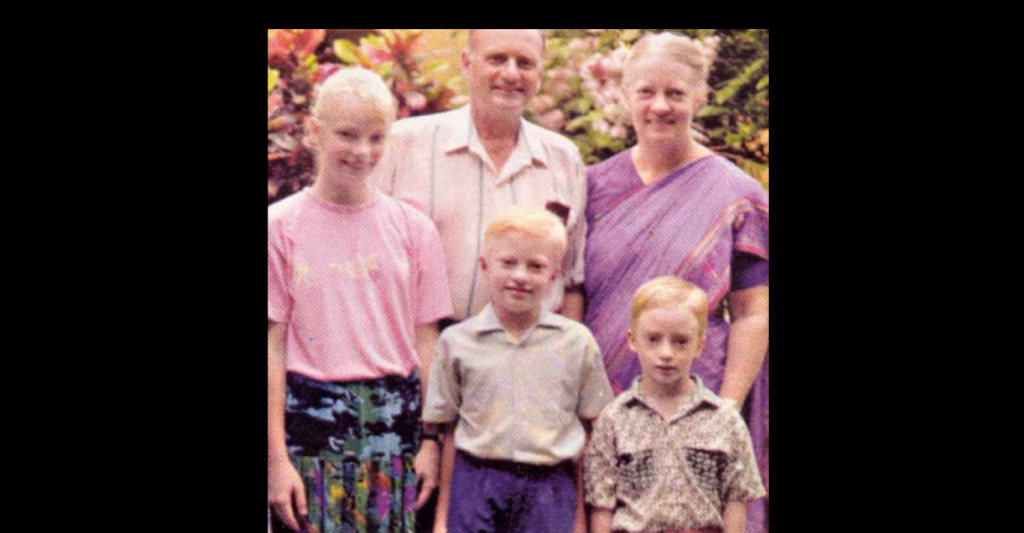
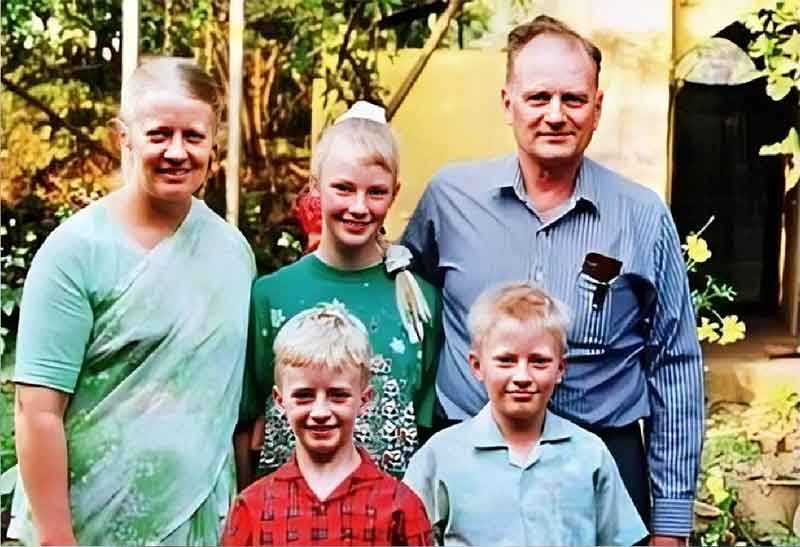
ग्राहम स्टेंस, जो ऑस्ट्रेलिया से भारत पहुंचे ईसाई पादरी थे और ओडिशा के बेहद पिछड़े आदिवासी बहुल इलाकों में गरीबों एवं कुष्ठरोगियों की सेवा में संलग्न थे, उन्हें और उनकी दो संतानों फिलिप और टिमोथी को कथित तौर पर हिंदुत्ववादी जमातों से जुड़े मानवद्रोहियों ने 22 जनवरी 1999 को जिंदा जलाया था.
22 जनवरी की तारीख की बीती तारीख को इस घटना की पच्चीसवीं सालगिरह थी.
राम मंदिर आयोजन की चकाचौंध में किसी ने इस बर्बर हत्या और उसके निहितार्थों को याद करना भी मुनासिब नहीं समझा, जबकि हम पाते हैं कि इस बर्बर हत्याकांड में वह तमाम संकेत मिलते हैं, जिन्हें 21वीं सदी की बहुसंख्यकवादी राजनीति में भरपूर प्रयोग में लाया गया.
The life of the dead is placed in the memory of the living.
– Marcus Tullius Cicero
Politics is nothing but theology in action
– Ambedkar
Right-wing politics suffers from a common syndrome everywhere.
It never feels confident to project its own icons for the rest of the humanity, whatever might be their claims about their worldview, it knows that its own icons are detested by a wide spectrum of people.
The easiest way it finds to overcome this lacunae is to appropriate already established icons – who were even opposed to their world view as well and claim them their own. In fact, it does not have any qualms in utilising dates – bearing special significance for exploited and oppressed and marginalised of the world – to put their stamp on it.
The project of Hindutva Supremacism – which yearns / strives to transform a Secular, Socialist, Democratic and Sovereign Republic into a Hindu Rashtra has perhaps achieved near perfection in this kind of politics.
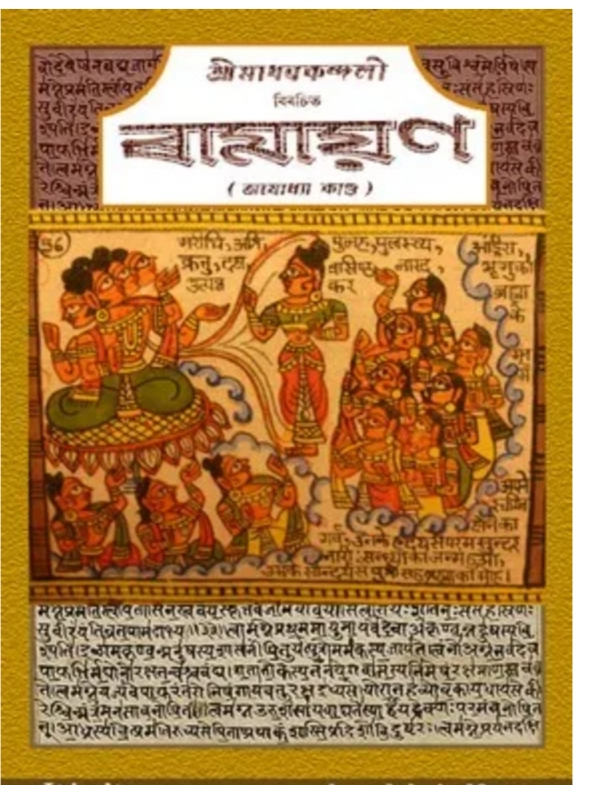
An excerpt from Sita’s Voice in the Assamese Ramayana: Selected Verses from the RAMAYANA of Madhava Kandali and UTTARAKANDA by Sankaradeva, Translated, with Introduction and commentary by TILOTTOMA MISRA (Zubaan: April 2024 Forthcoming)
The figure of Rāma has seldom attracted the Assamese vaiṣnava devotees as much as that of Kṛṣṇa. Rāma has been considered as an incarnation of Viṣṇu, while Kṛṣṇa has been worshipped as Viṣṇu himself. Significantly, there is also no known religious sect in Assam which claims to be “exclusively Ramaite”. While there are many references to Kṛṣṇa in the copper-plate inscriptions found in Assam which date back to the early seventh century, there is hardly any mention of Rāma in the early literary records of the region. Biswanarayan Shastri has observed that while a large number of temples dedicated to Rāma or Māruti exist all over India, there is no evidence of the existence of such a temple with the images of Rāma or Maruti, intact or in ruins, in Assam. According to him even in the architecture of ancient Assam, there is no known evidence of the Rāma legend being represented anywhere.
The Rāmāyaṇa of Mādhava Kandalī, therefore, as well as the two kāṇḍas prefixed and appended to it by Mādhavadeva and Śaṅkaradeva, have never held “that exalted position in popular estimation which the Rāmacarita-mānasa of Tulsidas has been occupying for the last few centuries in north India.” Rāma and Sītā seldom attained the stature of divinity in the imagination of the Assamese people although the heroic and miraculous elements in the Rāmāyaṇa and ‘Rāma-kathā’ have continued to be a lively ingredient of folk-drama and musical performances of the ojā-pāli. It is understandable therefore that for the common people of this region the Assamese Rāmāyaṇa is hardly the religious text that the Bhāgavata-purāṇa is. Continue reading Sita’s Voice in the Assamese Ramayana: Tilottoma Misra→
I’m relieved that you aren’t around these days. But I miss the sort of discussions we would have had if you were. Hence this letter, this sort of talking to you, this helpless and possibly meaningless, speaking into the ether because some things must just be said, remembered, felt, resisted, and held on to, even if everything around is telling you to move on, to get into the spirit of things and join the festivities, as it were.
I remember your reaction when you first saw my documentary film, Ayodhya Gatha. ‘Did you have to make our arguments about religion so public? If you get any recognition for this film, remember it’s thanks to me – like all your debating prizes!’ you said, loud enough for all to hear, both embarrassed and proud at the same time. We had a good laugh and a hug together. But in truth, over the years, religion was a topic on which we went from heated, impassioned arguments to considered, more careful discussions. You, tip toeing around my atheism (and asserting that deep down inside I was a believer) and me trying to be sensitive around your faith, even as we talked a lot about everything that’s been happening over the last four decades in the name of that religion.
Prof Romila Thapar, great historian and public intellectual , will be delivering the 28 th Lecture in the Democracy Dialogues Series on Sunday 28 th January 2024 at 6 PM (IST).
Please reserve the time and date for the lecture. Details are given below
Democracy Dialogues – 28 th Lecture
Organised by
New Socialist Initiative (NSI)
Theme : Our History, Their History, Whose History?
The zoom invite will be shared closer to the date.
Abstract: My purpose in this talk would be to examine the link between history and particular kinds of nationalism. I hope to show that nationalism can be a process, bringing together and uniting all the communities that inhabit a particular territory in support of a change in society or opposing a target common to all. This earlier form is what I would like to call a unitary, integrative nationalism that cut across communities and drew them together in a particular country to support a single purpose. This I would differentiate from the latter forms in some countries which identified with units of society or communities according to certain common features, such as a particular religion or language, or caste or ethnicity. I would call it segregated nationalism, where each community is segregated and treated as having a distinctly different identity and its own separate goal. History is brought in when the community that gives an identity to its nationalism insists on tracing its origins to a historical past. This pattern of integrated and segregated nationalisms would seem to apply to India of the twentieth century. There was the all-inclusive national movement whose participants were from every community; its objectives were to maintain the unity of the Indian people and overthrow colonial rule. The other nationalism, segregated nationalism, was seeded in the 1920s and assumed the existence of two nations – the Hindu and the Muslim – which, it was argued, go back to earlier times. Integrated nationalism succeeded in 1947 in bringing about independence, but its foundations needed strengthening, for we are now witnessing the strong presence of religious nationalism in the attempt to inaugurate a Hindu Rashtra in India.
– Romila Thapar
About the Speaker:
Internationally renowned scholar of Ancient History, Prof Thapar was elected General President of the Indian History Congress in 1983 and a Fellow of the British Academy in 1999. In 2008, she was awarded the prestigious Kluge Prize of the US Library of Congress which complements the Nobel, in honouring lifetime achievement in disciplines not covered by the latter. Prof Thapar has been a visiting professor at Cornell University, the University of Pennysylvania, and the College de France in Paris and holds honorary doctorates from the University of Chicago, the Institut National des Langues et Civilisations Orientales in Paris, the University of Oxford, the University of Edinburgh (2004), the University of Calcutta and from the University of Hyderabad
Here is a select list of Prof Thapar’s publications Ashoka and the Decline of the Mauryas, 1961 ( Oxford University Press) ; A History of India : Volume 1, 1966 ( Penguin) ; The Past and Prejudice, NBT ( 1975) ; Ancient Indian Social History : Some Interpretations, 1978 ( Orient Blackswan) ; From Lineages to State 1985 : Social Formations of the Mid-First Millenium B.C. in the Ganges Valley, 1985 ( Oxford University Press) ; Interpreting Early India, 1992 ( Oxford University Press) ; Sakuntala : Text, Reading, Historie, 2002 ( Anthem) . Somanatha : The Many Voices of History, Verso ( 2005) ; The Aryan : Recasting Constructs, Three Essays ( 2008) ; The Past As Present: Forging Contemporary Identities Through History, (2014) ;Voices of Dissent: An Essay, (2020); The Future in the Past: Essay ( 2023)
This guest post was written by HASINA, with co-authorship contributions from Sanjhana and Mridul from Bebaak Collective, ‘Voices of the Fearless,’ a collective dedicated to addressing the citizenship rights of marginalized communities.
A thread of commonality that ties together Indian society – from familial space to the entertainment industry, from the personal sphere to the political sphere – is the oppression of gender minorities under patriarchy. The longstanding structures of patriarchy and misogyny subject women to various forms of violence and abuse within and outside the household. Such a harsh reality of society is reflected by the popular media and film industry very promptly. The new movies that are being directed and the new music that’s being produced are a great reflection of how we, as a society, have failed women and queer communities. The peppy lyrics that objectify and hyper-sexualise women’s bodies and the movies that glorify toxic masculinity do nothing but perpetuate and normalise gendered violence. As we step into the New Year, we must ask ourselves if we can leave these outdated notions behind and step into a society that fosters peace, equality, and love amongst all.
Whether Modi will get a third term in 2024 or these elections can spring a surprise?
India at the beginning of the year stands at the cusp of a Momentous Change
The biggest question before everyone is whether the elections for the Parliament – the lower house – which will be over by end of May ( if they are not advanced by the ruling dispensation) would be able to disturb the stranglehold of the BJP-RSS over the levers of power at the Centre, whether it will lead to loosening of sorts of the grip it holds over the various institutions of Democracy ( critics even call that they have been subverted, weaponised) or it will slide the Indian Democracy further into the electoral autocracy mode much to the chagrin of well wishers of democracy everywhere.
This is a statement of support for Prof. Sameena Dalwai from the global and national academic community. We, the undersigned writers and teachers, are deeply concerned with the ordeal that Sameena Dalwai has faced for the past several weeks.
Education is key to the spirit of democracy. Autocratic regimes fear critical thinking and educators that foster it. In the series of relentless attacks on Indian universities, Prof. Sameena Dalwai is the latest.
It started with an email exchange on 7 November 2023, about Palestine shared within the university faculty that was leaked to the trolls. Dalwai was targeted as being ‘Hindu-phobic’ even though her email called for tolerance of opposing ideological views within the safe space of universities. Continue reading Statement of Support for Prof. Sameena Dalwai, Jindal University→
यह पोस्ट सोशल मीडिया पर कई लोगों ने साझा की थी । बताया जा रहा था कि इसके लेखक सरोज मिश्र हैं। इस बीच इसके असल लेखक से हमारा संपर्क हुआ है जिनका नाम विवेक कुमार उर्फ़ विवेक असरी है। मूल लेख 2010 में छपा था जिसे यहाँ पढ़ा का सकता है।
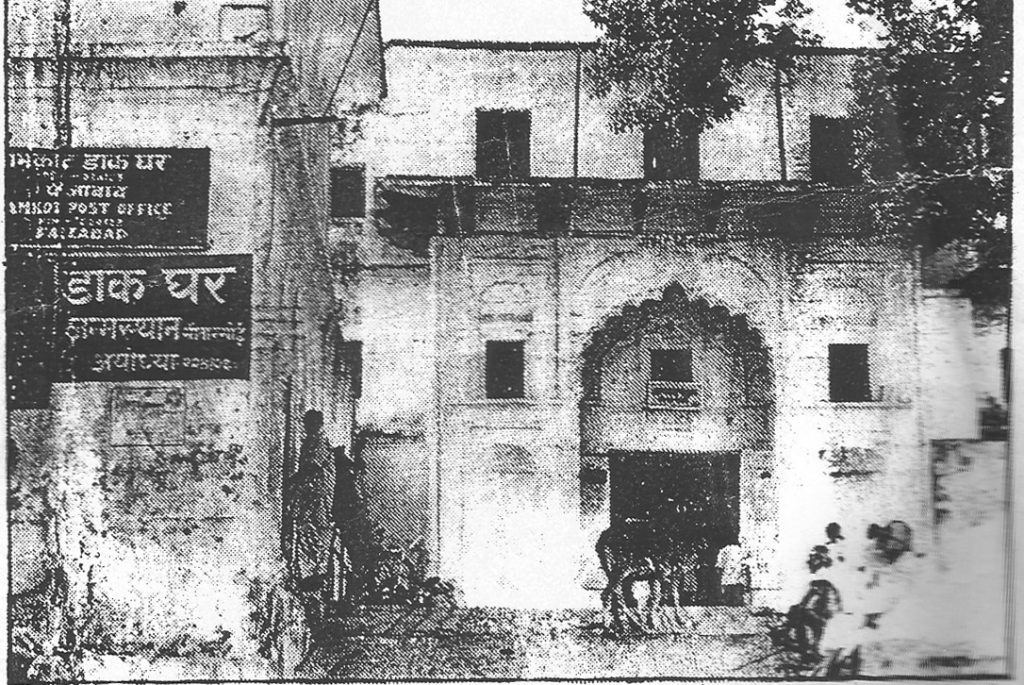
अयोध्या का यह 300 साल पुराना जन्मस्थान मंदिर था जिसके लिए ज़मीन एक मुसलमान ज़मींदार के दान की थी। नए राम मंदिर के विस्तार के लिए अगस्त 2020 में इसे ढहा दिया गया। (छवि साभार द वायर)
कहते हैं अयोध्या में राम जन्मे, वहीं खेले-कूदे, बड़े हुए, बनवास भेजे गये, लौटकर आये तो वहाँ राज भी किया। उनकी ज़िंदगी के हर पल को याद करने के लिए एक मंदिर बनाया गया। जहाँ खेले, वहाँ गुलेला मंदिर है। जहाँ पढ़ाई की, वहाँ वशिष्ठ मंदिर हैं। जहाँ बैठकर राज किया, वहाँ मंदिर है। जहाँ खाना खाया, वहाँ सीता रसोई है। जहाँ भरत रहे, वहाँ मंदिर है। हनुमान मंदिर है, कोप भवन है। सुमित्रा मंदिर है, दशरथ भवन है। ऐसे बीसियों मंदिर हैं, और इन सबकी उम्र 400-500 साल है। यानी ये मंदिर तब बने, जब हिंदुस्तान पर मुगल या मुसलमानों का राज रहा।
(Translated by Nivedita Menon from a widely circulating post earlier attributed to Saroj Mishra, on social media, originally in Hindi.
UPDATE: We have since heard from the author himself. This post was written in 2010 by VIVEK KUMAR (Vivek Asri) and so we have made the necessary changes. Here is the link to VIVEK KUMAR’s original post.
This 300 year old Janmasthan temple in Ayodhya, built on land donated by a Muslim zamindar, was demolished in August 2020 to accommodate an expanded vision of the new Ram Mandir. Image courtesy The Wire
They say Ram was born in Ayodhya; in Ayodhya he played and roamed around as a youth, grew into adulthood, was sent from there into exile in the forest, and then returned to rule there. There are temples in Ayodhya to commemorate every moment of his life. Where he played, there is Gulela Mandir. Where he studied there is Vashishta Mandir. Where he sat and ruled, there is a mandir. Where he ate his meals, there is Sita Rasoi. Where Bharat stayed, there is a mandir. There’s Hanuman Mandir, Kop Bhavan. There’s Sumitra Mandir, Dashrath Bhavan. There are many many such temples and all of them are about 400 to 500 years old. That is to say, these temples were built when Hindustan was ruled by the Mughals, by Muslims.
Herodotus, widely considered as the father of history, mentioned the existence of Palaistinê between Phoenicia and Egypt, and still failed to condemn Hamas. Damn all historians! – An Anonymous Disappointed Liberal
But you are neither a Palestinian nor a Muslim. Why put yourself out there in this climate? – An Anonymous Sanctimonious Liberal
When I look at the partition of Palestine in 1947 and 1967, the ghost of India and Pakistan rise like smoke from charred buildings of Karachi and Kolkata. – Tithi Bhattacharya (A historian from partitioned Bengal)
The solidarity that is needed today will have to be built primarily by the peoples themselves. Only then can hope be reborn…– Samir Amin (Egyptian-French economist of Marxist persuasion)
On 7 October 2023, the Hamas led an attack on the Gaza envelope, which is part of the southern district of Israel, killing reportedly 1200 people. The Hamas is a political and military organization governing the Gaza Strip of Palestinian territories that are under occupation by Israel. Many considered the military incursions of 7 October as an outright terrorist attack on civilians. Yet, others called this a ‘jail-break’ in terms of a reaction to Palestinian people bearing the burden of around seventy-five years of displacement, apartheid, surveillance, and endless other atrocities. Majority of inhabitants in the Gaza Strip are descendants of refugees who were displaced from the region which became Israel after the 1948 Arab–Israeli War. Nearly two million Palestinians have been notoriously cornered into this densely populated enclave where their movement has been severely restricted, and food, water and electricity supply has been controlled by the Israeli government; making such habitation the largest open-air jail in the world. After this attack, the Israeli military has launched a disproportionately brutal retaliation, resulting in massive suffering and a mounting death toll.
Some, of course, seek to rationalize the ensuing Israeli-Palestinian conflict by drawing on the belief that Israelis are the original inhabitants of this region and have suffered two millennia of exodus, and that they have the right to return and settle in what is considered as the ‘promised land’ as per the Biblical belief. Others consider that Israel is a settlers colony, and that Palestinians have all the rights to recover their country. Not so long back, the compromises of the Oslo Accords were thought to be a way forward in settling the crisis by creating two states, within which Israelis and Palestinians would achieve the long-lost peace in the region. Yet, such peace has failed to materialize. In the context of rising Islamophobia, conservative popular opinion asserts that the lack of peace in the region is due to a longer history of religious strife and supposed Muslim bigotry. Needless to say, history is more complex.
Jorg Haider, a far-right Austrian politician who died in 2008, is largely forgotten. It is also forgotten that merely two decades ago, he was considered a very dangerous man in Europe, whose ascent to power had prompted rare European Union unity aimed to thwart his ambitions.
Twice elected as governor of the southern state of Carinthia, Haider—who opposed immigration and was critical of Islam and Muslims—once praised the Nazi regime’s “employment policies”.
His Freedom Party of Austria allied with another party, the OVP, which allowed Haider to become the country’s chancellor. But the possibility of a ‘right-wing extremist’ ruling a European Union member country prompted the other 14 members to join hands punitively against Australia, putting Haider out of the chancellorship race.
The European Union stuck by the 1997 Treaty of Amsterdam principles and emphasised that nobody would be allowed to “breach them”.
Many European countries threatened to recall envoys from Austria, and some said that Austria could be shunted out of the union if the need arose. The Belgian foreign minister at the time said, “Europe can very well do without Austria. We don’t need it.
After much water has flown down the Thames, the Rheins, the Danubes and all other rivers of Europe, the world has Geert Wilders in the Netherlands, a “political earthquake”, whom some consider more extreme and fanatical than Haider. But Wilders’ views on immigration and Islam cause no similar outrage in European capitals today.
Wilders’s party, which promised to ban mosques and compared the Quran with the infamous Mein Kampf, has won 37 seats in a 150-member Parliament. It is now the number one party in the country’s parliament.
The following statement was issued by the CAMPAIGN AGAINST STATE REPRESSION (CASR) yesterday, 14 December 2023
It has come to light that the police have slapped the draconian UAPA on Neelam Verma, Sagar Sharma, Manoranjan D, Amol Shinde, and Vishal Sharma, the five persons held for releasing gas canisters in both the outside premises and inside the Lok Sabha mid-session on 13th December. The Indian state is treating this incident as a ‘terror attack’ and is charging these five individuals under the draconian anti-terror laws. It’s pertinent to point out that all four individuals committed the act as a form of political protest and exploding harmless coloured gas canisters is part of their protest, not an act “terror.” Sagar Sharma is an e-rickshaw driver and the son of a carpenter, Amol Shinde comes from a family of Dalit landless peasants unable to get a job in the Indian armed forces while Neelam Verma and Manoranjan D are MPhil and Engineering degree holders respectively who are both unemployed, with Neelam even cleared the Haryana Teacher Eligibility Test but still not landing a job. Vishal Sharma has also been roped into this case after he provided shelter to the four individuals and was not even involved in the act. Lalit Ojha, a sixth accused and also an unemployed youth is yet to be brought into police custody but has been charged. The political protest of these individuals against the Indian state and its brahmanical Hindutva fascist nature represents the angst of the working class, the peasantry, the academics and the middle class, all of whom are bearing the brunt of the BJP’s Hindutva-corporate nexus politics. The protest slogans raised by the four were slogans of both patriotism towards the people of India as well as dissent against the dictatorial politics of the ruling class.
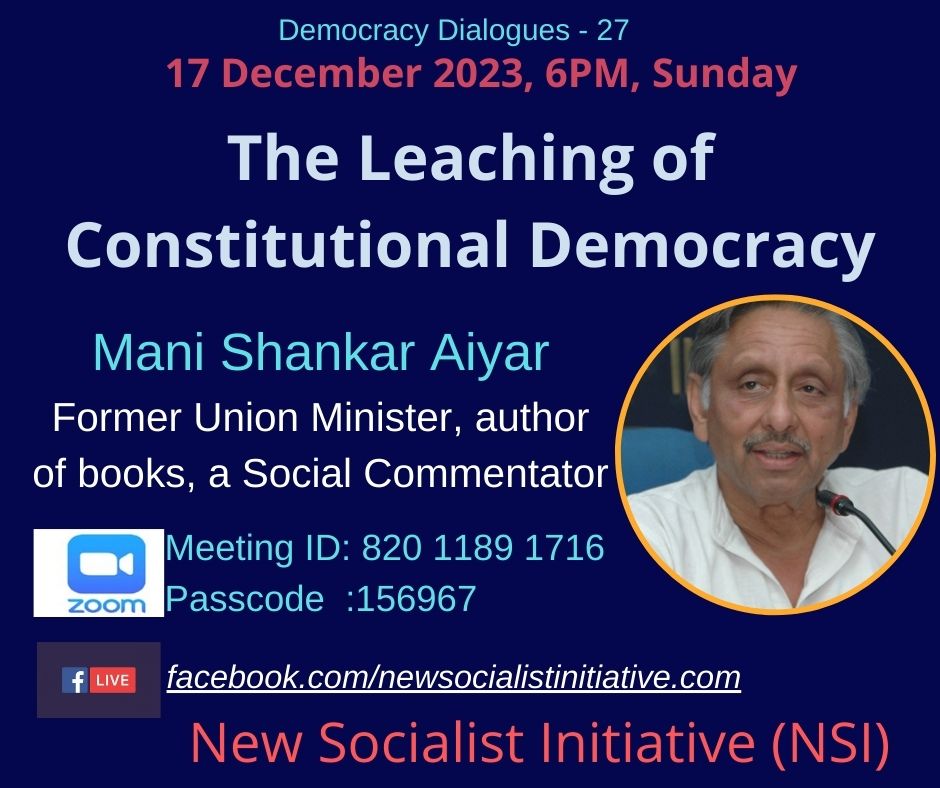
On the face of it, we are an on-going democracy. We have a Constitution which has been honoured by the present government declaring 26 November as Constitution Day. We have regular elections at national, State and panchayat levels. We have the various institutions of democracy in place: an elected Parliament; an independent judiciary; an accountable executive; and a functioning, non-governmental media. Yet, there is fear all around. a new fear, a fear not seen since the Emergency, that has been spreading over the past decade. Why? Is it perhaps because the “spirit of constitutionalism”, as Fali Nariman has put it in his latest work, missing? Can we continue to be the nation envisaged by Gurudev Rabindranath Tagore: “Where the mind is without fear/And the head is held high”? Are we progressing towards or in retreat from that “Heaven of Freedom” of which Tagore sang?. Are the institutions of democracy functioning? Is the Preamble being venerated or violated? Are our civil servants really free? Is our civil society being muzzled? Is the media glowing in the light of freedom of expression? Is the investigative and judicial process being made the punishment? Is the economy in any meaningful sense “socialist” as enjoined by the Preamble? Is the Constitution being reduced in practice to a non-justiciable set of Directive Principles of State Policy? Above all, are we as a nation still ‘secular” – again as enjoined by the Preamble? Is Hindutva compatible with the basics and parameters of the Constitution? Is our ‘unity in diversity” threatened or is it being revered?What are the challenges ahead that need to be addressed before we cease being the world’s largest democracy?
Speaker :
Mani Shankar Aiyar
Author of many books and a regular social commentator, Mani Shankar Aiyar, has had a distinguished foreign service career , he was Union Ministers during Congress led government (2004 till 2009) and has handled different ministries. Ministry of Petroleum and Natural Gas, ( 2004-06) Youth Affairs and Sports (2006-08), and Development of North Eastern Region ( 2008-09).
Here is a list of few of his publications :Memoirs of a Maverick Juggernaut, 2023 ; A Time of Transition: Rajiv Gandhi to the 21st Century, Penguin, 2009 ; Confessions of a Secular Fundamentalist, Penguin, 2004; Rajiv Gandhi’s India, 4 vols. (General Editor), UBSPD New Delhi, 1997, Knickerwallahs, Silly-Billies and Other Curious Creatures, UBS Publishers, 1995 . Pakistan Papers, UBSPD, New Delhi, 1994 ; One Year in Parliament, Konark, New Delhi, 1993 ; Remembering Rajiv, Rupa & Co., New Delhi, 1992 ; Rajiv Gandhi: The Great Computer Scientist of India, Mughal Publishers, New Delhi, 1991 ; How To Be A Sycophant, NBS, New Delhi, 1990
As academics and other concerned persons, we, the undersigned, are outraged at the manner in which discussions on the ongoing war against Palestine are being silenced on Indian campuses, and in the public sphere more broadly. We are issuing this statement to call upon university administrators and the government to respect our academic freedom. We would also like to remind everyone of India’s own long history of anti-colonial struggle which has historically provided the lens through which the Palestinian struggle for self-determination, equality and human rights has been viewed in India.
We object to the way in which any discussion of the historical context of the occupation of Palestineand the barbaric Israeli assault on Gaza, along with the denial of food, fuel and water, since October 7th 2023, is being projected as support for the brutal terror attack on civilians in Israel by Hamas on October 7th.
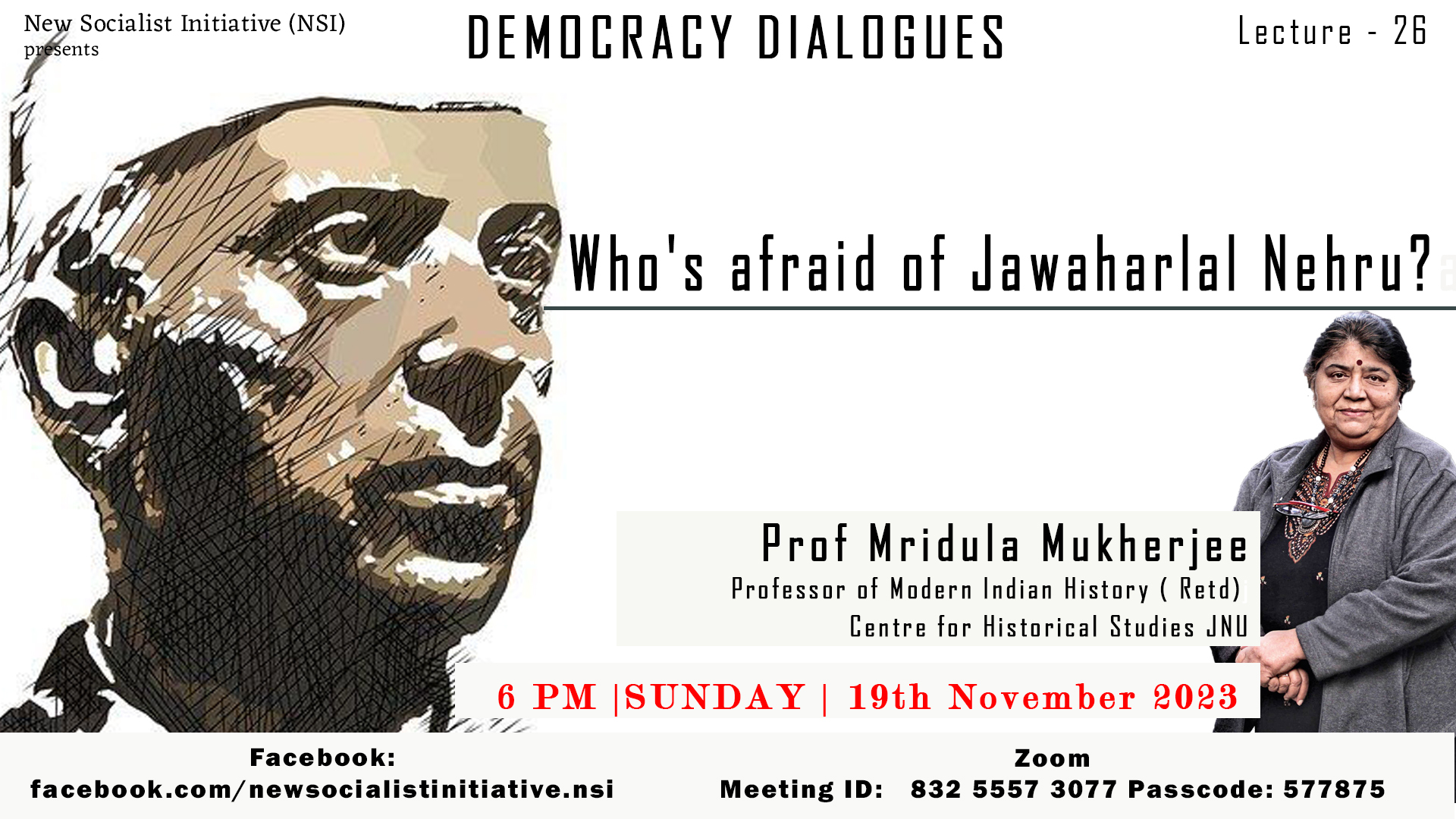
Professor Mridula Mukherjee, Professor of Modern Indian History ( Retd), Centre for Historical Studies, JNU, will be delivering the 26 th Democracy Dialogues Series lecture on Sunday, 19 th November 2023 at 6 PM (IST).
Theme : Who’s Afraid of Jawaharlal Nehru? Time: Nov 19, 2023 06:00 PM India
Summary : In his lifetime, Jawaharlal Nehru was recognized the world over as a statesman and an Indian leader second only to Gandhiji. A foremost leader of the freedom struggle, who gave it a decided socialist orientation, he remained unrivaled as Prime Minister after independence and built the solid foundations of a sovereign, secular, democratic, and egalitarian republic. He evolved the concept of non-alignment which enabled many ex-colonial countries to avoid becoming a part of the two power blocs engaged in the Cold War.
However, he is today the favourite whipping boy of the establishment. We are told he was responsible for the partition, for the mess in Kashmir, for the death of Subhash Bose, for delaying the integration of Hyderabad, and of Goa, for the defeat at the hands of China in 1962, for neglecting agriculture, and primary education, and much else. The reason for the defamation is of course that he stood for the exact opposite of what is valued today. His life and work present a continuous question mark to the regressive trends in fashion.
This will become evident as we focus in the talk especially on two areas of great relevance today in which we are facing a grave crisis: Democracy and Civil liberties, and Communalism/Secularism. We will also focus attention on Nehru’s evolving understanding of Mahatma Gandhi’s vision and method of non-violent struggle, of which he became the most ardent advocate after his death.
Speaker :
Author of many books, Prof Mukherjee has been a visiting Scholar at Duke University, USA, and at the Institute of Oriental Culture, University of Tokyo and was also Director of Nehru Memorial Museum and Library, ( NMML), New Delhi. She has published widely in the areas of agrarian history, peasant movements, social movements and the Indian national movement.
Here is a list of a few of her publications : Colonializing Agriculture, The Myth of Punjab Exceptionalism Sage (2005) ; Peasants in India’s Non Violent Revolution : Practice and Theory (Sage 2004).
This list also includes India’s Struggle for Independence (1999) and India After Independence 1947–2000 (2000), RSS, School Texts and the Murder of Mahatma Gandhi The Hindu Communal Project (2008) co-authored with Prof Bipan Chandra and others.
Diwali, or Deepavali as it is called in the south, is a joyous occasion but this time it has brought only tears. What a bizarre Deepavali it is this year, with the awful blazing fires in the sky and the earth, with ear-splitting sound from non-stop bombing. I may not be in Gaza, but my mind refuses to leave the place and my very soul shudders each moment.
At a media interaction on 26 October, the Malayali actor-turned-politician tried to turn his reel-life into real life. Once known mainly for his cine-avatar as the perpetually-angry, elite-justice hungry, thoroughly-misogynist ‘hero’ characters (yes, despite some better roles), Mr Gopi behaved with unbelievable condescension towards a woman journalist who asked him a question. Instead of answering her in a meaningful and civil manner, he turned into one of his obnoxious on-screen avatars. He put his hand on her shoulder and addressed her as ‘mole’ (daughter, literally, but also a condescending reference used by male lovers/husbands to refer to their loves/wives). She was clearly unhappy with the gesture, and backed away. Probably because the man has now become actually indistinguishable from the rotten, stinking masculinity he represents on-screen — knowingly or otherwise — he put his hand right back on her shoulder.
This evening I walked in the gaudily-lit main streets of Thiruvananthapuram among the crowds gaping at the show that is on, under the name of Keraleeyam or the Essence of Kerala.






 KAFILA - COLLECTIVE EXPLORATIONS SINCE 2006