Racist villagers versus hapless Africans and other simplistic binaries

The residents of Khirki are angry. They say they have been misrepresented, their grievances are not being given a patient hearing because the rest of us are doing politics over them. Nobody even wants to hear that they could have a case, that the story could be about more than just skin colour. Kafila and Times Now alike will tell you they are a bad, racist, evil lynch mob who deserve to be disenfranchised.

Even if that is what they are, will the summary dismissal of what they are saying be of help in resolving the situation? Forget the debates about the Aam Aadmi Party. As their elected representative, Somnath Bharti with all his vigilante zeal was doing what representative democracy makes representatives do. The people were making their voice heard through their elected representative. But we don’t want to hear their voice. If we did, we’d realise what the area needs is dialogue and understanding. All the problems with Africans and others in a 14th century ‘urban village’ next to 21st century shopping malls need a conversation that won’t come if we don’t want to appreciate the complexity of a social situation. By refusing to do so, we are being as unhelpful as the vigilantism of Somnath Bharti.

But at least we are thinking about Khirki. As for Sagarpur, where on earth is that?

These last few days, you have been fed one-sided angst by a media eager to help Narendra Modi overcome the pro-AAP mood, by pre-ideological leftists eager to bring down the AAP house so that Narendra Modi can come to power and they can do proper full-time chest-beating over fascism, by big industry already unhappy to see the AAP government move against Walmart. Is there a bigger picture?
AAP, Racism and Delhi – Perspective from a ‘North Eastern’ Citizen of Delhi: Anuraag Baruah

Guest Post by ANURAAG BARUAH

The recent ‘AAP’ state of affairs in the National Capital brought about by a dharna led by the Chief Minister Arvind Kejriwal has indeed shaken up the nation. Instead of judging and delivering a verdict on this so called ‘anarchism’, I stress upon something else here. The inherent racism prevalent in the mindset of our people actually found a shameless outlet through the antics of the new law minister of Delhi. The minister’s actions and words only reflect the mindset of the people of the concerned neighbourhood. His own words confirm that he was acting upon their complaints. This particular neighbourhood again reflects the mindset of any middle class neighbourhood in Delhi.

Continue reading AAP, Racism and Delhi – Perspective from a ‘North Eastern’ Citizen of Delhi: Anuraag Baruah

We The People, Reclaim the Republic: Various Citizens Groups

Call given by VARIOUS CITIZENS GROUPS

As we commemorate another Republic Day, We The People proclaim that the parade of the powerful at Rajpath does not represent us. We The People, Reclaim our Republic.

As members of the LGBT community, women, workers, sex workers, students, teachers, activists, persons with disabilities, health rights activists, Dalits, indigenous people, farmers, those affected by unconstitutional military rule, we are united not as “minorities” or “others,” but as the people. We invoke the promises of the Constitution of India in our name. Our struggle will continue until all arms of the state are unwavering in their constitutional promises towards the marginalized in our society, rather than only representing the powerful.

Continue reading We The People, Reclaim the Republic: Various Citizens Groups

For the sake of Form

The Aam Admi Party it seems has now decided to hit back at critics by uploading videos on Youtube to defend the controversial actions of Somnath Bharti, its Law Minister in Delhi done purportedly ‘in public interest’. Bharti has been chastised even by AAP supporters for his vigilantism and for trying to force the Delhi police to raid the house of suspected sex and drug racketeers and who in fact ‘helped’, along with his followers to catch two of the fleeing women.

Eight videos have been uploaded. They, according to the party contain incriminating evidence to prove that sex and drug racketeers were very much active in that area. Reporting the videos The Times of India says “… some of the scenes are not so easy to judge. Two clips show an African national walking around naked in the area. In another, three women in a car are rubbing some substance in their hands. Yet another shows several condoms lying about a car.” .

We do indeed see an African national moving around naked in the video. This is supposed to prove the allegation by the party that drugs are being used as according to one AAP worker “Walking around naked like this is an after-effect of drugs and this is a regular occurrence in the area”. You can also see for yourself condoms lying in the car. Do you need any more evidence to prove that the occupants of the car were indeed prostitutes carrying condoms with them and luring men to indulge in sex? Why are these three women rubbing some substance in their hands or trying to hide something by putting on gloves? Continue reading For the sake of Form

The Politics of Raid Governance – Aam Aurat v. Khas Aurat: Pratiksha Baxi

Guest Post by PRATIKSHA BAXI

Following the terrible gang-rape of a Danish woman in Delhi, Chief Minister Mr Kejriwal castigating the police for dereliction of duty pronounced his theory about how rape tendencies form. We are told that rape tendencies flow from drug and sex rackets; and when police corruption sustains these rackets, rates of gangrape are bound to escalate. Rape in this formulation is not an expression of sexualized power or preferred and targetted male violence against women. Rather it is linked to a series of vices located in certain geographies, circuits, substances and bodies, which produce a specific form of sexual venality. And, the technique of “raid” is a privileged form of sexual governance.

To sustain the technique of raid (or sting operations) as the privileged form of governance to stem sexual violence, a certificatory genealogy is instituted. A leader of AAP recites his gender credentials by tracing raid governance to the “damini” protests and experiences of state violence during these anti–rape protests. Mallika Sarabhai’s gender credentials are now interrogated by citing her purported absence from the “damini” protests. Some of us who did not experience police violence during the protests are now vulnerable to the charge of faking our commitment to the anti–rape movement, since certification comes from one kind of participation in the “damini” protests. However, can the badge of being invested in the kind of transformative politics required to challenge rape culture be so easily earned? When men participate in anti–rape protests, we are expected to applaud them and not feel offended when they deride women like Mallika Sarabhai who risked their being to speak against rightist manifestations of sexual impunity and immunity in Gujarat. Continue reading The Politics of Raid Governance – Aam Aurat v. Khas Aurat: Pratiksha Baxi

Documented Lives: Aadhar and the Identity Effect in Kashmir: Shrimoyee Nandini Ghosh

A version of this essay appeared in the Kashmir Reader, 10 December 2013

Guest Post by Shrimoyee Nandini Ghosh

On the road to the city from Srinagar Airport, I recently saw a billboard. Beneath the radiantly beaming faces of Manmohan Singh, and Sonia Gandhi, it bore the declaration ‘One Nation. One Card. AADHAR.’ Public Service advertisements in the same cheery vein have been airing on Radio Kashmir, and the state owned TV station Doordarshan- Kashir. Its critics assert that the AADHAR (‘its not a card, just a number!’) scheme exemplifies the financialisation of citizenship (each AADHAR number will require a corresponding bank account), a regime of biometric surveillance, the creation of a database nation and an expansion of the global corporate- military-intelligence empire. But AADHAR is only the latest chapter in the largely undocumented history of India’s intimate stranglehold over Kashmir through identity documents. It is a history told anecdotally, through stories about the sinking feeling of being stopped at a barricade and rifling through empty pockets, of cold hours spent pleading on a street or at a police station, of late night rescues of hapless friends from lonely check points, of miraculously narrow escapes despite having left home without it.

Though no Kashmiri adult I know leaves home without their ID, no one can seem to pin point exactly when the carrying of a photo-identity card became mandatory. Trying to understand the basis for the practice, I asked a friend under what law it was required that every person be able to prove their identity at all times. ‘Under the gun law!’ he replied succinctly. While its legal origins are uncertain, what is quite clear is that by the early 1990s no Kashmiri male could afford to be, quite literally, caught dead without one. As my plain speaking friend explained, “the most important reason for carrying one was if you were killed, somebody would hopefully find your card and inform your family.” The ID card was the tenuous piece of laminated paper that stood between him and an unmarked grave, an unmourned death.

Continue reading Documented Lives: Aadhar and the Identity Effect in Kashmir: Shrimoyee Nandini Ghosh

Why AAP’s Stance on Somnath Bharti Is Disturbing, Whether He is Eventually Sacked or Not: Kavita Krishnan

Guest Post by KAVITA KRISHNAN

AAP’s official position is: we’ll sack Bharti IF judicial probe finds him guilty. But what AAP leaders are saying about Bharti’s ‘version’ on TV is as disturbing as Bharti’s own actions and words.

Continue reading Why AAP’s Stance on Somnath Bharti Is Disturbing, Whether He is Eventually Sacked or Not: Kavita Krishnan

Of AAP, dreams and nightmares: Nityanand Jayaraman

Guest post by NITYANAND JAYARAMAN

I am avowedly anti-police. I am only half-convinced when I say that they are a necessary evil. The “necessary” part is what I get doubtful about. This last Saturday was different. I found myself uncomfortably on the same side as the police as I read the newspapers about Somnath Bharti’s self-righteous and racist escapades. To tell the truth, I did not immediately believe what I read. That was not because I had some personal knowledge of Bharti’s antecedents. But because, AAP was a phenomenon that I wanted to work.

These last few weeks, ever since AAP’s dramatic rise to power, I have been wafting in and out of mental states, between dreams and wakefulness. Dreams are fragile things. For me, AAP’s upsurge was a dream coming true. I come from a generation of Tamils that takes joy no matter whether AIADMK or DMK wins as long as the ruling party loses horribly. Ditto with Congress and BJP.
Now, this AAP thing was an early morning dream. I could see it, feel the joy of seeing disbelief and confusion writ large in the faces of BJP and Congress wallahs. I loved it. I did not know whether I liked AAP or not. But I liked what they did, how they did it. In terms of what they proposed to do, I had questions, suggestions and critical comments. To me, the stated lack of ideology – to begin with – was both an opportunity and a challenge. Continue reading Of AAP, dreams and nightmares: Nityanand Jayaraman

Open Letter to Delhi CM Demanding Action Against Racist Minister: Concerned Citizens

Guest Post by a group of Concerned Citizens

Open Letter by Citizens to Delhi CM Demanding Action Against Racist Minister

To 
Shri Arvind Kejriwal, 
Founder, Aam Aadmi Party and 
Chief Minister, Delhi


CC: Shri Yogendra Yadav, Shri Prashant Bhushan 


Our Demands


1. Remove Somnath Bharti from his position as Law Minister immediately


2. Punish all those, including Somnath Bharti, guilty of instigating and perpetrating racist and sexual violence on African women


3. Delhi Police must come under Delhi Government, but Delhi Police must be accountable to Constitution and not to the bidding of Ministers and mobs 


4. Meet and apologise to the Ugandan women who have complained of racist, sexual violence Continue reading Open Letter to Delhi CM Demanding Action Against Racist Minister: Concerned Citizens

Notes of Dissent on the AAP Dharna

I have no issues with anyone using dharnas as a political strategy, whether or not they are the Chief Minister. The “inconvenience” and “dignity of office” arguments being made by some also hold little truck with me. I write here then to mark my dissent on three specific fronts against the recently concluded AAP dharna from a different vantage point. As with all thoughts on things emergent, they are offered in the making with all their attendant uncertainties.

Continue reading Notes of Dissent on the AAP Dharna

सतत क्रान्ति की पैरोडी

पिछले कुछ समय से नागार्जुन और हरिशंकर परसाई की याद बेइंतहा सता रही है: भारतीय राजनीति के इस दौर का वर्णन करने के लिए हमें उनकी कलम की ज़रूरत थी !

क्रान्ति सतत चलने वाली प्रक्रिया है और असली विद्रोही वह है जो छह महीने बाद अपनी कुर्सी खुद उलट दे. आम आदमी पार्टी और दिल्ली सरकार के मुखिया ने केंद्र सरकार के खिलाफ़ बगावत की शुरुआत की,तो ऐसा ही लगा. दिल्ली के केंद्र में रेल भवन के पास दिल्ली की पूरी सरकार  अपने समर्थकों के साथ दस दिनों के धरने पर बैठ गए. उन्होंने धमकी दी कि वे राजपथ को लाखों लोगों से पाट देंगे और केंद्र सरकार की नींद हराम कर देंगे.किसान और सैनिक जब मिल जाएं तो क्रांति शुरू हो जाती है. इसकी पैरोडी करते हुए अरविंद ने दिल्ली के पुलिसवालों को वर्दी उतार कर धरने पर शामिल होने का आह्वान किया. कुछ लोगों को जयप्रकाश नारायण की याद आ गई. एक साथ लेनिन, लोहिया,क्रोपाटकिन और जयप्रकाश का तेज अरविंद केजरीवाल के रूप में पुंजीभूत हुआ. गांधी का आभा वलय अन्ना हजारे से हट कर अरविंद के माथे के पीछे पीछे तो तब ही लग गया था जब उनका भरपूर इस्तेमाल कर ठिकाने लगा दिया गया. क्या यह 2014 का भारतीय तहरीर चौक होने जा रहा है?

दिल्ली के मुख्य मंत्री ने एक बार फिर  आज़ादी की  नई लड़ाई की घोषणा की.यह दृश्य क्रांतिकारियों,समाजवादियों,अराजकतावादियों, सबके के लिए एक पुराने सपने के  पूरा होने जैसा ही था. एक पुरानी, दबी हुई इच्छा के पूरा होने का क्षण!यह आज़ादी झूठी है वाले नारे , वंदे मातरम और भारत माता का जयकार से रोमांचित होने का सुख!! Continue reading सतत क्रान्ति की पैरोडी

Skin Deep – Narratives of Racism in Delhi University: Aashima Saberwal Bonojit Hussain Devika Narayan

Aashima Saberwal, Bonojit Hussain and Devika Narayan are activists associated with New Socialist Initiative (NSI). This article was published in the November 2010 issue of CRiTIQUE, an irregular magazine brought out by the New Socialist Initiative (NSI) – Delhi University Chapter. 

Kevin is from Kenya. He studies at the faculty of Law. We ask him whether he likes India (he doesn’t) and about the kinds of challenges he faces. He shrugs and shakes his head “I have don’t face any discrimination” He often repeats this sentence at various points of the discussion. After he tells us about shopkeepers who refuse to sell him milk or before narrating how not a single shop at Patel Chest area was willing to type his assignment. “When you go to buy things from a shop they refuse to sell. If you ask for milk they say ‘no milk’ but you can see the Indians buying milk.” Later he tells us a similar story “My mobile phone was stolen. For one week I was thinking how to get a new one. The shops here don’t sell to Africans.” Kevin doesn’t think much of these experiences and dismisses them as insignificant, the ordinary trials of living in a foreign country. A woman on the road provokes a dog, provoking it to bite him, which it does. At Hans Charitable Trust Hospital they ask him for 10,000 rupees for the anti-rabbis injection. This is a service which is provided free of cost, however the small print reads ‘unless you are black’. Our interviews starkly shows that this particular subtext is present everywhere. We don’t realize that for the most mundane of daily activities (like buying milk) there are conditions that apply. The condition that you are not black.

These interviews give us a glimpse of how these students experience classrooms, hostels, streets, the metro and other public spaces. “What does kala bandar mean?” Boniface asks. They point. They laugh. They don’t like sitting next to you in the metro. What must it feel like to enter a strange foreign country where people across the board categorise you as sub-human? Strangers call you black monkey. “When I go back from college to hostel people on the streets keep laughing and staring. It is humiliating” Boniface says.

Read the rest of this article here.

Somnath Bharti and the Terrible, Everyday Racism of a South Delhi Mohalla: Aastha Chauhan

This article by AASTHA CHAUHAN was originally published on the Yahoo! News India web site. It is being republished  here so that it reaches a different audience because there is an urgent necessity to widen the discussion on racism in India. 

In the decade that I’ve been working in Khirki Extension in south Delhi, I’ve known it as a neighborhood in a constant state of flux.

When I first began working at KHOJ, an international artists’ association located in Khirki Extension in 2004, the neighborhood was home to architects’ studios, a theatre studio and various offices, followed by a wave of musicians and artists. It was a locality comprised mainly of houses, some built by well-known architects such as Ramu Katakam and Ashok B Lall. Even Jaya Jaitly had a house there. Soon enough, these large plots were sold to builders, who put in apartments that could accommodate more people. But given the terrible infrastructure in the area, with its poor roads and drainage and its tendency to get flooded, many of its earlier residents moved out. Continue reading Somnath Bharti and the Terrible, Everyday Racism of a South Delhi Mohalla: Aastha Chauhan

Letter to Arvind Kejriwal: Women against Sexual Violence and State Repression

Women against Sexual Violence and State Repression condemns the racial profiling, sexual violence and vigilantism by AAP against Ugandan women.

Women Against Sexual Violence and State Repression (WSS) is a network of women’s rights, Dalit rights, human rights and civil liberties organizations and individuals across India. It is a non-funded grassroots effort by women to stem the violence being perpetrated upon our bodies and on our societies by the State’s forces, by non-state actors and by the inability of our government to resolve conflict in a meaningful, sustainable and effective manner.

Women against Sexual Violence and State Repression strongly condemns the illegal raid conducted by the AAP cabinet law minister, Somnath Bharti and his mob of supporters, on the premises of the Ugandan women on 17th January 2014 residing in Khidki village, New Delhi.

One media report states that four women who were kept in a taxi for 3 hours were accused of conducting ‘drug rackets’ and ‘sex rackets’; and were terrorized by your cabinet minister and his mob. The women, who were eventually helped by the police, have registered their statements. Two of them have stated that they were physically assaulted by the mob and were also subjected to intense racist abuse – “black people break laws.” Continue reading Letter to Arvind Kejriwal: Women against Sexual Violence and State Repression

Taming of The Vamp: Suchitra Vijayan

This is a guest post by Suchitra Vijayan

When I first read the Myth of Sappho, I was reasonably troubled that a famed Greek poetess would jump off the Leucadian cliffs for love of Phaon, a deeply flawed man. Why would a woman like Sappho kill herself over unrequited love? Did she not realise that she deserved better than the love of a loathsome man? Rationality dictates that no life is worth giving up for another. But the prudent pragmatist in me would beg another version, a rethinking. It was not unrequited love that made Sappho’s leap – a mainstay of our myth – it was something else. It was a comforting misogynistic tale attached as an afterthought, many hundred years after her death. First it suggested that a “woman” who had dared to trespass, and be different had to be mad all along. Second, the subversives always had to be reclaimed. Political rebels, internal subversives and non ideal types had to be tamed or done away with. In Shakespeare’s Taming of the Shrew, a man “acquires” a headstrong woman as his bride. Minus the comedic sub-plots and slapstick humour, the bare bones of the story include “notoriously aggressive” Katherine and her “tamer” husband Petruchio. But Katherine is neither aggressive nor notorious, she wears her indescribable naivety and sheer straightforwardness with the innocent integrity of a woman who is comfortable in her skin. This sits uncomfortably with the author, readers and commentators. Later Petruchio drags Katherine away from her own wedding celebrations, insisting she is his “chattel”, he deprives her of food and sleep until she learns to bend her will to his entirely. Some have argued that Katherine subverts patriarchy by acting like a submissive wife, manipulating Petruchio to her ends. Whatever interpretation you choose to favor, the fact remains that the woman had to be tamed, she had to manifestly re-fashion her self to comply with the new set of realities. To win she had to transform herself into something else, someone she is not.

Continue reading Taming of The Vamp: Suchitra Vijayan

Kunan Poshpora – The Other Story : Shrimoyee Nandini Ghosh

This guest post by SHRIMOYEE NANDINI GHOSH is based on two essays about the men and women of Kunan Poshpora, that appeared in the Kashmir Reader dated 1 September 2013, and 13 January 2014

Information and updates about the campaign for justice and truth for the survivors of Mass Rape and Torture in Kunan Poshpora are available at https://www.facebook.com/KunanposhporaCampaign.

Beneath the horrors of the mass rape committed by  Indian troops in the twin villages that night in February 1991, lies the untold story of systematic torture of men, carried out by the same forces with the precision and deliberation of a planned military operation.

In June 2013, a Public Interest Litigation filed in the  Jammu and Kashmir High Court,   by fifty Srinagar based women, supported by human rights group Jammu and Kashmir Coalition of Civil society (JKCCS) had resulted in a Magisterial order for the  further investigations of the mass and gang rape by Indian army personnel of the women of Kunan, and neighbouring hamlet Poshpora, in Kupwara District of North Kashmir on the night of February 23rd-24th 1991. The police, it appears from the lack of any remotely investigative activities in the villages to have done little if anything, by way of following the court order in the last six months. On 14 September, 2013 they asked for and were granted an additional three months time for further investigations, without notice to the survivors who are legally represented in the case.

However, the closure report, which police had failed to file for twenty – two years, and which had been presented before the Magistrate of Kupwara just weeks before the Public Interest Litigation, in March 2013, had yielded several important previously unavailable official documents. Continue reading Kunan Poshpora – The Other Story : Shrimoyee Nandini Ghosh

The Savage Greed of The Civilized – AAP, Moral Posturing and Ordinary Racism

The savage greed of the civilized stripped naked its own unashamed inhumanity’

Africa, Rabindranath Tagore

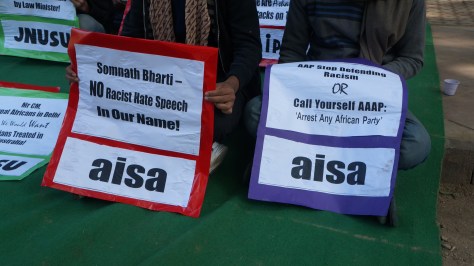
SIGNS AT ANTI RACISM PROTEST IN JANTAR MANTAR

Delhi Law Minister and Aam Aadmi Party leader Somnath Bharti’s midnight raid in Khirki village, during which he ordered policemen to search and enter houses, arrest people without warrants, and allegedly said that “black people, who are not like you and me, break laws” –  strips naked the unashamed inhumanity of the Aam Aadmi Party regime’s moral posturing. Underneath the holier-than-thou mask of that moral posture lies the unmistakably horrible sneer of the ordinary racist thug. This is the real face of Somnath Bharti. I hope it is a face that the Aam Aadmi Party can turn itself away from.

Continue reading The Savage Greed of The Civilized – AAP, Moral Posturing and Ordinary Racism

Protest Against Delhi Law Minister Somnath Bharti’s Racist Vigilantism in Delhi: Kavita Krishnan

Guest Post by KAVITA KRISHNAN

Many of us have felt disturbed by the implications of the incident involving the Delhi Law Minister’s attempted raid on African nationals in Khidki village.

The Minister, Somnath Bharti, (a member of the Aam Aadmii Party) insisted that the police conduct a raid minus a search warrant. Two African women have said, on record, that they were subjected to racist abuse (‘black people break laws’) and beaten by a mob of people (the Minister’s supporters), and that it was the Delhi police who protected them from the mob violence.

[ See Aditya Nigam’s post on the same issue in Kafila earlier ]

There are also reports that one of the women was forced to give a urine sample in public. The women were also subjected to cavity searches and tests – none of which yielded any sign of drugs. The violence against the women was defended in the name of anger against ‘prostitution’ and ‘drug peddling’, while no proof of the same has been presented as yet. In any case, the treatment meted out to the women cannot be justified even if they were indeed prostitutes! Continue reading Protest Against Delhi Law Minister Somnath Bharti’s Racist Vigilantism in Delhi: Kavita Krishnan

Cooking gas subsidy and the myth of market distortion

Have you been receiving SMS’s saying:

Dear XXXgas Consumer, to avail LPG Subsidy in your bank account, kindly submit your Aadhaar to your Distributor and to your Bank immediately

These SMS’s are being sent by Hindustan Petroleum Corporation Ltd (HPCL),  India Oil Corproation (IOC) and Bharat Petroleum Corporation Ltd (BPCL) to its consumers, in violation of the Supreme Court’s interim order that no one can insist on Aadhaar for any government schemes like ration card, bank account, cash transfer or issue of LPG subsidies.

This has been confirmed today by Oil Minister M Veerappa Moily. The unique identification card will no longer be mandatory for giving subsidies unless Supreme Court gives a clearance.

What ‘cash transfer’ essentially means is that instead of paying less at the point of purchase, the higher price must be paid, and the difference will be paid into your bank account.

The neoliberal theology against subsidies is that “Subsidies Create Market Distortions”. The unquestioned assumption we are supposed to accept here is that the market is  a natural phenomenon, like rain or snowfall, and that any state intervention will distort its finely tuned natural functioning. (And we all know how strongly capitalism and economics stands for preserving “other” natural entities like forests and rivers and mineral resources!) Continue reading Cooking gas subsidy and the myth of market distortion

Why I joined AAP and Quit the CPI: Kamal Mitra Chenoy

Guest post by KAMAL MITRA CHENOY

I first became conscious of politics as a student of economics in Kirorimal College, Delhi University in 1969 when I was elected to the students union executive committee. The same year I was persuaded by a senior to stand for the Delhi University Students Union’s Supreme Council. The latter body elected the DUSU office bearers. These were heady days with some of the leading pro- Naxalites students, students like Avdesh Sinha, who later became a highly respected IAS officer, and Rabindra Ray now a sociology professor in Delhi University. Another leading star who has written on his experiences was Dilip Simeon. I also became Left but did not agree with armed struggle. At this stage I watched the mainstream Left parties and along with Marxist texts read some Left Party pamphlets.

However, a deeper and much more expansive debate was snowballing where I joined in JNU in 1972. Prakash Karat who had earlier written a thought provoking book on the nationality and language question in India was widely respected as a political leader of the JNU students and a formidable theorist. In 1973, the Student Federation of India and the All India Students Federation of which I was the unit secretary aligned for the first time after the split in the communist movement in 1964. We called the alliance progressive democratic front. We were also attacked by an extremely erudite Trotskyist Jairus Banaji who considered us revisionist and quoted extensively from Marxist classics as well as literature, philosophy and the social sciences. Because of this challenge all of us had to do our readings. Continue reading Why I joined AAP and Quit the CPI: Kamal Mitra Chenoy

Xenophobia, Racism and Vigilantism – Danger Signals for AAP

The bizarre drama yesterday, involving one of the Aam Aadmi Party ministers, Somnath Bharti, should make the AAP leadership sit up and think. Here is a brief extract from a report:

Less than 24 hours after he led a midnight raid and tried to bully police into arresting some “Nigerians or Ugandans” who he alleged were members of “a prostitution-and-drug ring”, Delhi Law Minister Somnath Bharti returned to the very spot on Thursday and asked residents to draw up a list of houses where “such people” live and said he would personally check each one.

The minister got embroiled in a full-scale confrontation with the ACP, BS Jakhar, who insisted, correctly that the police were not legally empowered to do this. According to the same report, Jakhar said, “The minister told me that the women inside are part of a drug racket and that we should conduct a raid in all houses in the area. I told him that the law does not permit us to barge into someone’s house, so late in the night, without a search warrant.” But to not effect. The minister was not only unfazed; he even went on say that he had “received a lot of complaints from women in this locality against foreign nationals, yeh hum aur aap jaise nahin hain (They are not like you or me).” Continue reading Xenophobia, Racism and Vigilantism – Danger Signals for AAP

DISSENT, DEBATE, CREATE