Taming of The Vamp: Suchitra Vijayan

This is a guest post by Suchitra Vijayan

When I first read the Myth of Sappho, I was reasonably troubled that a famed Greek poetess would jump off the Leucadian cliffs for love of Phaon, a deeply flawed man. Why would a woman like Sappho kill herself over unrequited love? Did she not realise that she deserved better than the love of a loathsome man? Rationality dictates that no life is worth giving up for another. But the prudent pragmatist in me would beg another version, a rethinking. It was not unrequited love that made Sappho’s leap – a mainstay of our myth – it was something else. It was a comforting misogynistic tale attached as an afterthought, many hundred years after her death. First it suggested that a “woman” who had dared to trespass, and be different had to be mad all along. Second, the subversives always had to be reclaimed. Political rebels, internal subversives and non ideal types had to be tamed or done away with. In Shakespeare’s Taming of the Shrew, a man “acquires” a headstrong woman as his bride. Minus the comedic sub-plots and slapstick humour, the bare bones of the story include “notoriously aggressive” Katherine and her “tamer” husband Petruchio. But Katherine is neither aggressive nor notorious, she wears her indescribable naivety and sheer straightforwardness with the innocent integrity of a woman who is comfortable in her skin. This sits uncomfortably with the author, readers and commentators. Later Petruchio drags Katherine away from her own wedding celebrations, insisting she is his “chattel”, he deprives her of food and sleep until she learns to bend her will to his entirely. Some have argued that Katherine subverts patriarchy by acting like a submissive wife, manipulating Petruchio to her ends. Whatever interpretation you choose to favor, the fact remains that the woman had to be tamed, she had to manifestly re-fashion her self to comply with the new set of realities. To win she had to transform herself into something else, someone she is not.

Continue reading Taming of The Vamp: Suchitra Vijayan

Kunan Poshpora – The Other Story : Shrimoyee Nandini Ghosh

This guest post by SHRIMOYEE NANDINI GHOSH is based on two essays about the men and women of Kunan Poshpora, that appeared in the Kashmir Reader dated 1 September 2013, and 13 January 2014

Information and updates about the campaign for justice and truth for the survivors of Mass Rape and Torture in Kunan Poshpora are available at https://www.facebook.com/KunanposhporaCampaign.

Beneath the horrors of the mass rape committed by  Indian troops in the twin villages that night in February 1991, lies the untold story of systematic torture of men, carried out by the same forces with the precision and deliberation of a planned military operation.

In June 2013, a Public Interest Litigation filed in the  Jammu and Kashmir High Court,   by fifty Srinagar based women, supported by human rights group Jammu and Kashmir Coalition of Civil society (JKCCS) had resulted in a Magisterial order for the  further investigations of the mass and gang rape by Indian army personnel of the women of Kunan, and neighbouring hamlet Poshpora, in Kupwara District of North Kashmir on the night of February 23rd-24th 1991. The police, it appears from the lack of any remotely investigative activities in the villages to have done little if anything, by way of following the court order in the last six months. On 14 September, 2013 they asked for and were granted an additional three months time for further investigations, without notice to the survivors who are legally represented in the case.

However, the closure report, which police had failed to file for twenty – two years, and which had been presented before the Magistrate of Kupwara just weeks before the Public Interest Litigation, in March 2013, had yielded several important previously unavailable official documents. Continue reading Kunan Poshpora – The Other Story : Shrimoyee Nandini Ghosh

The Savage Greed of The Civilized – AAP, Moral Posturing and Ordinary Racism

The savage greed of the civilized stripped naked its own unashamed inhumanity’

Africa, Rabindranath Tagore

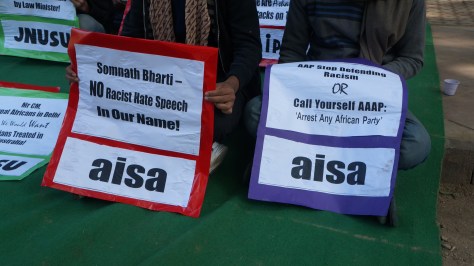
SIGNS AT ANTI RACISM PROTEST IN JANTAR MANTAR

Delhi Law Minister and Aam Aadmi Party leader Somnath Bharti’s midnight raid in Khirki village, during which he ordered policemen to search and enter houses, arrest people without warrants, and allegedly said that “black people, who are not like you and me, break laws” –  strips naked the unashamed inhumanity of the Aam Aadmi Party regime’s moral posturing. Underneath the holier-than-thou mask of that moral posture lies the unmistakably horrible sneer of the ordinary racist thug. This is the real face of Somnath Bharti. I hope it is a face that the Aam Aadmi Party can turn itself away from.

Continue reading The Savage Greed of The Civilized – AAP, Moral Posturing and Ordinary Racism

Protest Against Delhi Law Minister Somnath Bharti’s Racist Vigilantism in Delhi: Kavita Krishnan

Guest Post by KAVITA KRISHNAN

Many of us have felt disturbed by the implications of the incident involving the Delhi Law Minister’s attempted raid on African nationals in Khidki village.

The Minister, Somnath Bharti, (a member of the Aam Aadmii Party) insisted that the police conduct a raid minus a search warrant. Two African women have said, on record, that they were subjected to racist abuse (‘black people break laws’) and beaten by a mob of people (the Minister’s supporters), and that it was the Delhi police who protected them from the mob violence.

[ See Aditya Nigam’s post on the same issue in Kafila earlier ]

There are also reports that one of the women was forced to give a urine sample in public. The women were also subjected to cavity searches and tests – none of which yielded any sign of drugs. The violence against the women was defended in the name of anger against ‘prostitution’ and ‘drug peddling’, while no proof of the same has been presented as yet. In any case, the treatment meted out to the women cannot be justified even if they were indeed prostitutes! Continue reading Protest Against Delhi Law Minister Somnath Bharti’s Racist Vigilantism in Delhi: Kavita Krishnan

Cooking gas subsidy and the myth of market distortion

Have you been receiving SMS’s saying:

Dear XXXgas Consumer, to avail LPG Subsidy in your bank account, kindly submit your Aadhaar to your Distributor and to your Bank immediately

These SMS’s are being sent by Hindustan Petroleum Corporation Ltd (HPCL),  India Oil Corproation (IOC) and Bharat Petroleum Corporation Ltd (BPCL) to its consumers, in violation of the Supreme Court’s interim order that no one can insist on Aadhaar for any government schemes like ration card, bank account, cash transfer or issue of LPG subsidies.

This has been confirmed today by Oil Minister M Veerappa Moily. The unique identification card will no longer be mandatory for giving subsidies unless Supreme Court gives a clearance.

What ‘cash transfer’ essentially means is that instead of paying less at the point of purchase, the higher price must be paid, and the difference will be paid into your bank account.

The neoliberal theology against subsidies is that “Subsidies Create Market Distortions”. The unquestioned assumption we are supposed to accept here is that the market is  a natural phenomenon, like rain or snowfall, and that any state intervention will distort its finely tuned natural functioning. (And we all know how strongly capitalism and economics stands for preserving “other” natural entities like forests and rivers and mineral resources!) Continue reading Cooking gas subsidy and the myth of market distortion

Why I joined AAP and Quit the CPI: Kamal Mitra Chenoy

Guest post by KAMAL MITRA CHENOY

I first became conscious of politics as a student of economics in Kirorimal College, Delhi University in 1969 when I was elected to the students union executive committee. The same year I was persuaded by a senior to stand for the Delhi University Students Union’s Supreme Council. The latter body elected the DUSU office bearers. These were heady days with some of the leading pro- Naxalites students, students like Avdesh Sinha, who later became a highly respected IAS officer, and Rabindra Ray now a sociology professor in Delhi University. Another leading star who has written on his experiences was Dilip Simeon. I also became Left but did not agree with armed struggle. At this stage I watched the mainstream Left parties and along with Marxist texts read some Left Party pamphlets.

However, a deeper and much more expansive debate was snowballing where I joined in JNU in 1972. Prakash Karat who had earlier written a thought provoking book on the nationality and language question in India was widely respected as a political leader of the JNU students and a formidable theorist. In 1973, the Student Federation of India and the All India Students Federation of which I was the unit secretary aligned for the first time after the split in the communist movement in 1964. We called the alliance progressive democratic front. We were also attacked by an extremely erudite Trotskyist Jairus Banaji who considered us revisionist and quoted extensively from Marxist classics as well as literature, philosophy and the social sciences. Because of this challenge all of us had to do our readings. Continue reading Why I joined AAP and Quit the CPI: Kamal Mitra Chenoy

Xenophobia, Racism and Vigilantism – Danger Signals for AAP

The bizarre drama yesterday, involving one of the Aam Aadmi Party ministers, Somnath Bharti, should make the AAP leadership sit up and think. Here is a brief extract from a report:

Less than 24 hours after he led a midnight raid and tried to bully police into arresting some “Nigerians or Ugandans” who he alleged were members of “a prostitution-and-drug ring”, Delhi Law Minister Somnath Bharti returned to the very spot on Thursday and asked residents to draw up a list of houses where “such people” live and said he would personally check each one.

The minister got embroiled in a full-scale confrontation with the ACP, BS Jakhar, who insisted, correctly that the police were not legally empowered to do this. According to the same report, Jakhar said, “The minister told me that the women inside are part of a drug racket and that we should conduct a raid in all houses in the area. I told him that the law does not permit us to barge into someone’s house, so late in the night, without a search warrant.” But to not effect. The minister was not only unfazed; he even went on say that he had “received a lot of complaints from women in this locality against foreign nationals, yeh hum aur aap jaise nahin hain (They are not like you or me).” Continue reading Xenophobia, Racism and Vigilantism – Danger Signals for AAP

Climate, Culture, Cosmopolitanism – Notes from Shillong: Nabanipa Bhattacharjee

Guest post by NABANIPA BHATTACHARJEE

Surrounded by lush green hills, Shillong, the capital city of Meghalaya is widely known for its salubrious climate and natural beauty. As one of oldest hill stations of the sub-continent, Shillong was chosen – after the failure of the British administrators and soldiers to continue operating out of Cherrapunjee – to house the headquarters of the colonial government including the Sylhet Light Infantry in 1864. Following the creation of Assam as a Chief Commissioner’s province (carved out of the Bengal Presidency) in 1874, Shillong, a small town then, was declared its capital. Shillong scored over others in that part of the empire, among others, due to two important factors. First, its climate and second, the town being best suited to serve the colonial administrative, commercial and strategic interests.

As a result of the reorganised political geography of the region substantial number of European, Assamese and Bengali officers and clerks of the colonial bureaucracy lived and settled in Shillong. And so did a large number of tea planters of Assamese and European origins, Nepali staff of the colonial army, Marwari entrepreneurs and, so forth. Indeed, the quaint hill town, which was essentially populated by the Khasi tribe, acquired by the turn of the twentieth century a vibrant, cosmopolitan character which stood substantively (and perhaps best) reflected in the organisation of its cultural space. Shillong’s spirit of cosmopolitanism, as its socio-cultural history shows, was deeply embedded in the ideology of the recognition (and not mere political management) of cultural difference. Continue reading Climate, Culture, Cosmopolitanism – Notes from Shillong: Nabanipa Bhattacharjee

पाकिस्तान के प्रबोधन शहीद

14-year old Aitazaz Hassan Bangash is being hailed as a hero for ...

उस किशोर का नाम एतज़ाज हस्सन बंगश था, जिसे आज की तारीख में एक नए नायक का दर्जा दिया गया है, जिसने अपनी शहादत से हजारों सहपाठी छात्रों की जान बचायी। तालिबानी ताकतों के प्रभुत्ववाले पाकिस्तान के खैबर पख्तुनवा सूबे के शिया बहुल इलाके के एक इब्राहिमजई स्कूल का विद्यार्थी एतज़ाज उस दिन सुबह अपने चचेरे भाई मुसादिक अली बंगश के साथ स्कूल जा रहा था जब रास्ते में मिले एक शख्स को देख कर उनके मन में सन्देह प्रगट हुआ। उन्हीं के स्कूल यूनिफार्म पहना वह युवक उनके ही स्कूल का रास्ता पूछ रहा था। बाकी बच्चे तो वहां से भाग निकले, मगर कुछ अनहोनी देख कर एतज़ाज ने उसे ललकारा, इस हड़बड़ी में उस आत्मघाती बाम्बर ने बम विस्फोट किया। दोनों की वही ठौर मौत हुई और दो लोग घायल हुए। मालूम हो कि उस दिन सुबह की स्कूल असेम्ब्ली के लिए लगभग दो हजार छात्र एकत्रित थे। इस आतंकी हमले के लिए लश्कर ए झंगवी नामक आतंकी संगठन ने जिम्मेदारी ली है।
अपने बेटे की मृत्यु पर उसके पिताजी मुजाहिद अली का कहना था कि यह सही है कि मेरे बेटे ने उसकी मां को रूला दिया, मगर उसने सैकड़ों उन माताओं को अपनी सन्तानों के लिए रोने से बचाया और उसके लिए उसकी मृत्यु का शोक नहीं बल्कि उसकी जिन्दगी को हमें मनाना (celebrate) चाहिएContinue reading पाकिस्तान के प्रबोधन शहीद

The Party Left and Aap: Satya Sagar

GUEST POST by Satya Sagar

“Comrade! There is a man dying of thirst at the door. What is the Party line on giving water to thirsty people?”

There was a moment’s silence at the other end of the telephone and then the Great Ideologue said, “That is reformist activity. Tell him we can give our lives for the Revolution but cannot- as matter of policy- give water to the thirsty”

“But Comrade, he will die at our doorstep if we don’t give him water. Think what the bourgeois media will say then”

“You are right. Positive media coverage is important as that is the only way we reach the masses these days. But before you give him water to drink first ask him whether he believes in public or private supply of water” Continue reading The Party Left and Aap: Satya Sagar

आरोन श्वार्त्झ: मुक्त सूचना आन्दोलन का पहला शहीद (1986 –2013)

बीते शनिवार 11 जनवरी को इण्टरनेट की आज़ादी के कार्यकर्ता आरोन श्वार्त्झ की पहली बरसी थी। बीती 11 जनवरी को आरोन ने अपनी जीवनलीला खुद समाप्त की थी। मेसेच्युएटस इन्स्टिटयूट आफ टेक्नोलोजी के नेटवर्क का इस्तेमाल कर लाखों अकादमिक लेख डाउनलोड करने के लिए – जिन्हें वह मुफ्त उपलब्ध करना चाहता था – उस पर मुकदमा शुरू होनेवाला था। उसे 30 साल की कैद की सज़ा होती और काफी जुर्माना देना पड़ता। रविवार को हैकर ग्रुप ‘अनानिमस’ ने एमआईटी की कई वेबसाइटस् पर हमला कर उस पर आरोन पर मुकदमा चलाने के उसके निर्णय के खिलाफ मेसेज लिखे और इण्टरनेट नियमन में सुधार की मांग की। मेसेज में लिखा गया था ‘‘इस शोक की घड़ी में हम आवाहन करते हैं कि एक मुक्त एवं निर्बंधमुक्त इण्टरनेट के प्रति अपनी समझौताविहीन प्रतिबद्धता के लिए, जिसे किसी सेन्सरशिप का सामना न करना पड़े और जिस तक सभी की सुगम एवं आसान पहुंच हो, हम नए सिरेसे संकल्पबद्ध हों।’ सप्ताह के अन्त में श्वार्त्झ से जुड़े कार्यकर्ताओं के एक समूह ने ‘न्यू हैम्पशायर रिबेलियन’ की शुरूआत की जिसके तहत वह सरकारी भ्रष्टाचार के खिलाफ जनजागृति हेतु दो सप्ताह की यात्रा करेंगे। इस मार्च का अन्त डोरिस ‘ग्रेनी डी’ हेडोक के जनमदिन पर समाप्त होगा जिन्होंने वित्तीय सुधार की मुहिम के तहत 90 साल के उम्र में संयुक्त राज्य अमेरिका की पैदल यात्रा की थी।

यहां प्रस्तुत है वह आलेख जिसे मैंने ‘सूचना आन्दोलन के इस पहले शहीद’ के सम्मान में पिछले साल लिखा था : Continue reading आरोन श्वार्त्झ: मुक्त सूचना आन्दोलन का पहला शहीद (1986 –2013)

Why I’ll Wait for Aan Allaatha Party in Kerala

The discussions about the concrete shape the AAP will take in Kerala have begun to heat up here. Two suggestions appear to be equally strong at the moment. One, the apparent interest taken by VS Achutanandan and his supporters as well as groups that have broken away from the CPM and possess some electoral clout, like the RMP, have been read as a beginning. The second indication is from news that public intellectuals like Sarah Joseph, who have a long history of struggle in and within Kerala’s largely leftist oppositional civil society, are joining the AAP Kerala. There is also some fear that the fledgling party will be choked by middle-class college lecturers and others who are angry about Kerala being ‘too politicized’ and who would read AAP as essentially politics in the service of anti-politics. A fourth prominent group is of sceptics who ask if the AAP is doing anything more or different from the militant welfarism of the left in Kerala in the mid-20th century decades. Is the AAP even relevant in Kerala, they ask. Continue reading Why I’ll Wait for Aan Allaatha Party in Kerala

‘आप’ से मुलाक़ात

दुनिया के सबसे बड़े लोकतंत्र कहे जानेवाला हिन्दोस्तां और दुनिया के सबसे ताकतवर लोकतंत्र में शुमार संयुक्त राज्य अमेरिका – जो पिछले दिनों बिल्कुल अलग कारणों से आपस में एक नूराकुश्ती में लगे हुए रहे हैं – के दो अहम शहर न्यूयॉर्क और दिल्ली, पिछले दिनों लगभग एक ही किस्म के कारणों से सूर्खियों में रहे। अगर न्यूयॉर्क में मेयर पद पर डी ब्लासिओ का चुनाव और उनका शपथग्रहण, जिन्होंने 12 साल से कायम रिपब्लिकन नेता को बेदखल किया, और सबसे बढ़ कर उनका प्रोग्रेसिव एजेण्डा सूर्खियों में रहा तो सूबा दिल्ली में एक साल पुरानी पार्टी ‘आप’ (आम आदमी पार्टी) के नेता अरविन्द केजरीवाल और उनकी टीम ने सूर्खियां बटोरी।

दोनों को एक तरह से आन्दोलन की ‘पैदाइश’ के तौर पर देखा गया।

दो साल पहले अमेरिका में ‘आक्युपाई वॉल स्ट्रीट’ के नाम से खड़े आन्दोलन ने आर्थिक विषमता पर बहस को एक नयी उंचाई दी थी, जब उसने 1 फीसदी बनाम 99 फीसदी का नारा दिया था, हजारों लोगों की सहभागिता ने और उनके अभिनव तौरतरीकों ने पूरी अमेरिका के मेहनतकशों में नयी ऊर्जा का संचार किया था। डेमोक्रेट पार्टी से जुड़े शहर के वकील डी ब्लासिओ ने आन्दोलन की हिमायत की थी, एक अस्पताल की बन्दी को लेकर चले विरोध प्रदर्शन में उनकी गिरफ्तारी भी हुई थी। मेयर पद के लिए चले चुनाव प्रचार के दिनों में ही उन्होंने रईसों पर अधिक कर लगाने की बात की थी और ‘रोको और तलाशी लो’ जैसे न्यूयॉर्क पुलिस के विवादास्पद कार्यक्रम को चुनौती दी थी। वहीं अरविंद केजरीवाल , जनलोकपाल के लिए चले आन्दोलन जिसे लोकप्रिय जुबां में ‘अण्णा आन्दोलन’ कहा गया, उसके शिल्पकार कहे गये Continue reading ‘आप’ से मुलाक़ात

AAP and the Ideology Warriors

If ideology-warriors had their way, they would rather have Narendra Modi as the next prime minister than have their ideological purity compromised. Soon after AAP’s victory, many secularists rushed to declare, on Facebook and elsewhere, that they do not and will not partake of the AAP euphoria. ‘What is their stand on communalism?’, they asked indignantly. Some other friends insisted that Muslims need an assurance about AAP’s position on communalism and it should clarify its stand if it wanted the Muslim vote.

So what do the ideology warriors want? Just when the political agenda for the elections has decisively changed, throwing the BJP into a complete quandary, upsetting its strategic plans, they want the old familiar, secular/ communal divide back in place, opening up the political field once more to the same Hindu-Muslim polarization that we are so used to. The secular/ communal divide has been the millstone around our neck, preventing any other issue from being brought into public debate at election time and effectively preventing the emergence of any new force or formation. And let there be no mistake that in a communal polarization of Hindus and Muslims, secular forces will always, in the on-going drama of secular masochism, have to deposit themselves tied hand and foot, into the Congress party’s dungeon. The Amit Shahs will have a field day, creating one Muzaffarnagar after another, and erstwhile secular mascots like Mulayam Singh Yadav will vie with them in further entrenching the Hindu-Muslim divide. In all of this, the Congress will present itself as the saviour of Muslims.

The Congress, the BJP, the imaginary ‘third front’ – all have been able players and winners in this game. Continue reading AAP and the Ideology Warriors

Who will chop the Tree of Hubris?

devika

This is a photograph which appeared in the ‘Nagaram’ pullout on city affairs of the Mathrubhumi newspaper (Trivandrum edition,8 January 2014, p. III). The caption to the original photograph reads: ‘A man in Adivasi woman’s dress during the Secretariat March conducted by the Highrange Samrakshana Samithi and other farmer organizations’. The Highrange samrakshana Samity led by the Syro-Malabar Catholic Church, as is well-known, has monopolized the identity of ‘farmer’ in the hill districts and has been leading the protest against the implementation of the Gadgil Report and the Kasturirangan Report. Their rhetoric of helplessness in the face of state onslaught often leaves us blind to their history of ruthless exploitation and near-enslavement of adivasi people in these areas.No, they have never been helpless, and they never will be — the most powerful sections of civil and political societies in Kerala are on their side, as always. What else explains their hubris so well-reflected in this photograph? Continue reading Who will chop the Tree of Hubris?

Naz and its detractors: A response by Jordan Osserman

Guest Post by Jordan Osserman

Amidst the outcry of queer rage and mourning against the Supreme Court judgment has emerged a strand of skepticism (For examples See here , here and here)  from within queer circles, directed at the participants in the anti-377 campaign. These skeptics allege that the 377 organizers failed to adequately consider the impact of their activism on the most marginal queers in India (lower class/caste hijras, kothis, MSM, etc.). In the most biting version of the critique, the 377 campaign is portrayed as an elite middle class movement, fueled by foreign-funded NGOs, against a largely symbolic, immaterial enemy. 377, these critics allege, was never a central cause of LGBT oppression; a paper tiger, relatively unknown by police and Indian society writ large until middle-class queers arbitrarily put it on the agenda and invested it with symbolic meaning. To the extent that marginal sexual minorities have been represented at all, their voices have been appropriated in the service of a campaign at best irrelevant, and at worst dangerous, to their lives.

In this post, I’d like to challenge some of these claims. We can summarize the critics’ arguments as follows: 1. Section 377 has not historically targeted LGBT people, and rarely affected the lives of sexual minorities prior to the activist mobilization against it. 2. Instead of fighting 377, activists should have prioritized campaigns which would concretely benefit LGBT people, particularly the most marginalized. Alternately, if the 377 campaign had to go forward, the legal strategy and organizing should have been more inclusive. 3. The “liberal outrage” against 377 may be as much to blame for violence justified in the name of the law as the Supreme Court’s decision. For, now that queer activists and the Indian media have popularized the notion that the Supreme Court has “re-criminalized homosexuality,” homophobes have become aware of a new weapon with which to target sexual minorities. I will attempt to address these interlinked arguments in their respective order, before drawing some final conclusions about activism and organizing.

Continue reading Naz and its detractors: A response by Jordan Osserman

Condemn Attack on AAP Headquarters, Defend Freedom of Expression, Oppose Politics of Hurt Sentiments : New Socialist Initiative

New Socialist Initiative Condemns Attack on AAP Headquarters

New Socialist Initiative condemns the attack on the headquarters of AAP (Aam Aadmi Party) office at Kaushambi, Ghaziabad by vigilantes of the Hindutva Brigade and demands stern action against the culprits. Given the inordinate delay by the police in reaching the place and nabbing the hooligans in the case of an emergent political party and high-profile politicians, one can only imagine the safety and security of common citizen under such dispensation.

It is distressing that each time any individual or group has expressed views on the violation of human rights by Armed Forces protected by the draconian Armed Forces Special Powers Act, frenzied jingoism by the rightwing forces as well as by the print and electronic media turn to the rhetoric of hurt sentiments. It is equally distressing that the Aam Aadmi Party too succumbed to such jingoism, found it necessary to distance itself from Prashant Bhushan and turned the question of human rights violation by the armed forces into a question of national integrity. Continue reading Condemn Attack on AAP Headquarters, Defend Freedom of Expression, Oppose Politics of Hurt Sentiments : New Socialist Initiative

The Conundrum of Agency in Sexual Violence

This is a revised version of an article that appeared in Seminar January 2014.

The past year is bookended by two extraordinary moments, both of them inspired by the courage and determination of young women who refused to take sexual violence as routine.

December 2012 – a young paramedic fought till her last breath for justice.

November 2013 – a law intern exposed the sexual assault she faced from a retired Judge and a Tehelka journalist taught Tarun Tejpal a long deferred lesson – No Means No.

The massive mobilization of public opinion around these incidents has reopened the question of ‘agency’ in familiar and unfamiliar ways.

Feminists have long asserted women’s agency in contexts of sexual violence by attempting to desexualize rape – in law and in everyday life. Taken out of patriarchal discourses of honour, rape is merely an act of violence that violates bodily integrity. This delicate balance between two opposing notions – on the one hand, that sexual violence has a distinctive character, it is more humiliating, more paralyzing than physically less harmful actions; and on the other, that sexual violence is merely another kind of physical violence – this is the razor’s edge occupied by feminist understandings of rape. Continue reading The Conundrum of Agency in Sexual Violence

Anatomy of a Take Back the Night campaign : Nandini Rao

Guest post by NANDINI RAO 

Picture credits: Rakesh and Alana

TBTN

 “I want to break free…”. The Freddy Mercury anthem rang out in the cold winter night, in the middle of a busy marketplace in Delhi. One by one, a group of women appeared out of the crowd and started dancing to its compulsive beat. People gathered around, cheering them on and some women from the audience joined in too. Synchronising steps, the dancers swayed to the medley of music as it moved on to Hindi songs, a snatch of Spanish and finally, the compelling Punjabi phrase “Sadda haq, aithey rak!”. This was officially the first flash mob (or “mob dance”, as we call it) of the members of the Citizens’ Collective against Sexual Assault (CCSA).

The Citizens’ Collective against Sexual Assault (CCSA) is a Delhi/NCR-based group of organisations, individuals and activists from women’s movements and progressive movements. It works towards addressing issues of sexual violence against women, girls and transgender people. It raises awareness among the public, media, administration and the police on issues of gender rights. It works collectively to build an environment of safety in Delhi, Noida and Gurgaon. Continue reading Anatomy of a Take Back the Night campaign : Nandini Rao

The Aam Aadmi Party and Animal Farm

The plot of George Orwell’s ‘Animal Farm’ can be summarized in a single sentence – “This novel demonstrates the consequences of the addition of four important words -‘but’,  ‘some’, ‘more’, and ‘others’ to the phrase – <all animals are equal>”.

In other words, it describes the transition from the axiomatic statement <all animals are equal> to the qualified formula <all animals are equal, but some animals are more equal than others>.

Aam Aadmi Party founder and Delhi’s new chief minister Arvind Kejriwal’s ruling out the possibility of referendums in Kashmir about the presence of the armed forces in Jammu & Kashmir (in response to his party colleague Prashant Bhushan’s endorsement of the idea of such a referendum during a recent television appearance) could signify a shift within the Aam Aadmi Party’s evolving political doctrine that parallels the transition that the pigs in Animal Farm made while turning their revolution into a counter-revolution. Continue reading The Aam Aadmi Party and Animal Farm

Beating AAP with the Kashmir stick

When Prashant Bhushan first made his remarks supporting a referendum in Kashmir to decide whether Kashmir will stay in India, a hooligan had gone to his office and slapped him. The Aam Aadmi Party made it clear that these were Bhushan’s personal views and were not endorsed by the AAP, but the stick was too good to ignore. At a loss of words to see the rise of the AAP, somewhat dimming the euphoria over the rising fortunes of Narendra Modi, the BJP has gone on and on over Bhushan’s views on Kashmir. Even when the AAP was proving its majority on the floor of the house, the leader of the opposition, Harsh Vardhan, made Prashant Bhushan’s personal views out be somewhat of a national security threat to India. Just saying that a people should be allowed to decide their fate is anti-national because we know that making such an allowance would bring results we’d rather not see. Continue reading Beating AAP with the Kashmir stick

DISSENT, DEBATE, CREATE