Public Appeal by R.B. Sreekumar , Former DGP, Gujarat

Image


1. For enfeebling the validity and credibility of evidence presented by me to Judicial & Investigating bodies and to denigrate my image, the publicity managers of the Chief Minister of Gujarat State, Shri Narendra Modi and the Sangh Parivar, are widely propagating many lies about the motive and time frame of submission of evidence by me against authors of 2002 anti-minority bloodbath. A totally blatant falsehood spread about me is that I had brought out incriminating material against those responsible for 2002 carnage and subsequent subversion of the Criminal Justice System (CJS) ONLY after my super-cession in promotion to the rank of Director General of Police (DGP) in February, 2005. This contention is utterly baseless, false, malicious and misleading.

2. The real truth in this matter is given below:-
http://dilipsimeon.blogspot.in/2013/06/public-appeal-by-rb-sreekumar-former.html

Shahrukh Khan, Surrogacy and Sex-Selection: Sneha Banerjee

Guest post by SNEHA BANERJEE: It was a Monday morning that didn’t bring me blues, after many weeks of sweltering heat I could keep the door to my balcony open without fearing the skin-burning ‘loo’ and my room filled with the pleasant breeze which had the promise of bringing in rains once again.  I decided to keep my diligently prepared to-do list aside and embarked on staring at the neem tree observing the avian cohabitants of my neighbourhood with the radio on my phone tuned to a FM station.  It was then that the unnecessarily loud, over-enthusiastic voice of a radio-jockey broke the serenity of the surroundings.  His shrieky voice exhorted a promise to keep Dilliwalon up-to-date with the latest controversies in Bollywood.  Now, that was not something that I was very interested in – imagined competition among biggies, who ate what, who holidayed where and with whom and after betraying whom was going to be too depressing to handle, but before I could reach out to change the station, he took somebody’s name that still makes my heart skip a beat even after couple of leap-years have come and gone since I was sweet-sixteen.  Yes, any and every news about this ‘star’ interests me and I want to know it all, true or untrue, gossip or through ‘reliable sources’.

But what I heard then, broke my heart.  The RJ quoted a Mumbai tabloid, that Shah Rukh Khan (SRK) is having a third child through surrogacy and that he has ensured it is a son through sex-selection.  Continue reading Shahrukh Khan, Surrogacy and Sex-Selection: Sneha Banerjee

In the Belly of the Beast: Peggy Mohan

Guest post by PEGGY MOHAN: When the size and complexity of a system pass a certain threshold there is a new feature that typically and suddenly appears: self-regulation. If traffic flow through a crossing exceeds a certain amount we wake up one morning and find a traffic light. It is not there to favor any motorist: what it really signifies is that the scale of things has changed.  We are no longer in the realm of the individual but of something much, much larger: a traffic system with compulsions of its own.

It is comforting to think that there is human agency behind the bewildering transitions we are now seeing the world over towards more state surveillance and control along with less regulation of big business. Clearly there are individuals who benefit from the new order. But there is another way of looking at the direction the world is taking. It is possible to see all this as evidence of a phase change, with the emergence of the megasystem itself as a new protagonist, and with human beings relegated to the status of bacteria proliferating in (and dying in) its gut. Continue reading In the Belly of the Beast: Peggy Mohan

Can late Erdoğan learn from early Erdoğan?: Tamer Söyler

This guest post by TAMER SÖYLER is the first of a three-part series on Istanbul’s Taksim Square protests for Kafila.

taksim8
Photographs by Tamer Söyler

The 42nd President of the United States, Bill Clinton, is said to have remarked: being President is like running a cemetery; you have got a lot of people under you and nobody is listening. As is the case with any good politician, Clinton is known for his bamboo-like character. During his presidency whenever he looked the weakest, he proved to come stronger out of the chaos. Clinton’s remarkable flexibility provided him the ability to bend as much as he needed to achieve his goals without breaking. The Prime Minister of Turkey, Recep Tayyip Erdoğan, proved again that he does not have Clinton’s sense of humour, his presidency or his flexibility.

Turkey is a parliamentary representative democracy. Erdoğan has been expressing his intention to transform the country into a presidential system and become the first president of the country. The government plans to put the question of a constitutional referendum to a vote in the year 2014. The people of Turkey are suffering from a great anxiety related to a fear of finding themselves in an authoritarian, charismatic presidential system. Protestors worry that without adequate mechanisms to enforce the separation of powers in the constitution, Erdoğan can easily transform Turkey into an authoritarian regime.
Continue reading Can late Erdoğan learn from early Erdoğan?: Tamer Söyler

The Military and ‘Peripheral’ Violence in Naya Pakistan

Guest post by ZEHRA HASHMI

It has been many months now since the Hazaras in Quetta were attacked. They were targeted during the month of January in 2013 and then only 36 days later in February, both times on Alamdar road where most Hazaras live – an area that has been termed an “open air jail”. Both times the banned Sunni organization Lashkar-e-Jhangvi claimed responsibility. In recent years, as many as 2000 Hazaras have lost their lives to similar acts of targeted violence in Balochistan. As power has been handed over from one civilian government to another for the first time in Pakistan’s history, the systemic nature of this kind of violence should be central to the concerns of Pakistanis – maybe even more than electricity, dare I argue? As Pakistanis think long and hard about what democratic change could mean, I write about the Hazaras now in order to point to the seemingly peripheral minorities as central to Pakistan’s issues. These attacks speak to the complex ways in which violence embeds itself into the everyday lives of some Pakistanis. In other words, the kind of structural issues that trying to wish a ‘naya Pakistan’ into existence will not assuage. Continue reading The Military and ‘Peripheral’ Violence in Naya Pakistan

दो कठ्ठा ज़मीन : किशोर

Guest post by KISHORE

बच्चा मुसहर को सन 1986 में भूमि सुधार अधिनियम 1961 के तहत 0.26 डेसिमल (लगभग एक चौथाई एकड़) ज़मीन बिहार सरकार द्वारा दी गयी थी. इस एक्ट के तहत भूमिहीनों को ज़मींदारों से अर्जित अधिशेष भूमि दी जानी थी. बच्चा मुसहर ज़िंदगी भर सरकार द्वारा उनके नाम पर करी गयी ज़मीन पर हल चलाने को तरसते रह गए पर उन्हें अपनी ज़मीन पर कदम रखने का अवसर नहीं मिला. उन्होंने  ब्लाक, जिला और राजधानी तक ना जाने कितने दफ्तरों के चक्कर लगाये पर ज़मीन पर उनका मालिकाना हक, उस कागज़ के पुर्जे तक ही सीमित रहा.

सन 2000 में बच्चा मुसहर अपनी ज़मीन के मालिकाना हक़ के अधूरे सपने के साथ इस दुनिया से चले गए. बच्चा मुसहर को गुज़रे 13 साल बीत गए पर उनकी विधवा आज भी उस कागज़ के टुकड़े को संभाले बैठी है पर उनको ज़मीन पर कब्ज़ा नहीं मिल सका. दफ्तरों के चक्कर लगाने का सिलसिला बच्चा मुसहर के बाद उसकी विधवा और बच्चों ने भी जारी रखा पर ज़मीन की बंदोबस्ती के लगभग तीन दशकों के बाद आज भी ज़मीन उनके कब्जे में नहीं है. Continue reading दो कठ्ठा ज़मीन : किशोर

From Koodankulam, an open letter to the Indian media

koodankulam

Press release issued by the PEOPLE’S MOVEMENT AGAINST NUCLEAR ENERGY (PMANE), based in Idinthakarai in Tirunelveli district of Tamil Nadu.

Dear friends,

Greetings!

Please allow us to bring the following to your kind attention in the larger interests of our country, people and most importantly, our democracy and freedom.

As the Fourth Pillar of our democracy, the media in India plays an important role in the smooth running of our country and the perpetuation of our democratic heritage.

We are sure that you have noticed the postponement of the commissioning of the Koodankulam nuclear power project (KKNPP) to July 2013 without giving any reasons or explanations. Continue reading From Koodankulam, an open letter to the Indian media

IB’s desperate and dirty tricks to scuttle the Ishrat Jahan investigation

This is a press statement put out on 14 June 2013 by a group of individuals whose names are given at the end.

It is a clear indication of the desperation being felt by the IB establishment as the heat turns on its senior officers in the Ishrat Jahan probe, that they are down to doing what they do best: use pliant sections of the media to plant stories to deflect scrutiny and create a favourable public mood.  Following the summons issued to IB Special Director Rajender Kumar by the CBI (which is probing the case on the direction of the Gujarat High Court), the IB Director first sought to sell the familiar old story of ‘investigation will hit the morale of the IB’ – it seems as though a blanket immunity from any scrutiny and accountability is the only guarantee of IB morale.  The IB then ran complaining to the Prime Minister; and when nothing worked, it used the agency’s tried and tested trick of enlisting the support of discredited ‘journalists’.  Continue reading IB’s desperate and dirty tricks to scuttle the Ishrat Jahan investigation

‘Who Killed my daughter Ishrat Jehan ?’ – Statement by Shamima Kauser mother of deceased Ishrat Jehan

Image

18th June, 2013

My daughter Ishrat Jehan was abducted, illegally confined and killed in cold blood by officers and men of the Gujarat police, in June 2004. She was killed as part of a larger conspiracy which had a political agenda. Ishrat’s murder was projected as an ‘encounter’ and justified by branding her a terrorist who had come with 3 other men to attack the Gujarat Chief Minister Narendra Modi. This was not the first fake encounter in Gujarat, other Muslims too had been executed in similar staged encounters, committed in the name of protecting the Chief Minster of Gujarat. Some of these other fake encounters, which are nothing but pre meditated extra judicial killings, are already under investigation and prosecution. Continue reading ‘Who Killed my daughter Ishrat Jehan ?’ – Statement by Shamima Kauser mother of deceased Ishrat Jehan

Malleswaram or Hubli 2 ?

Image

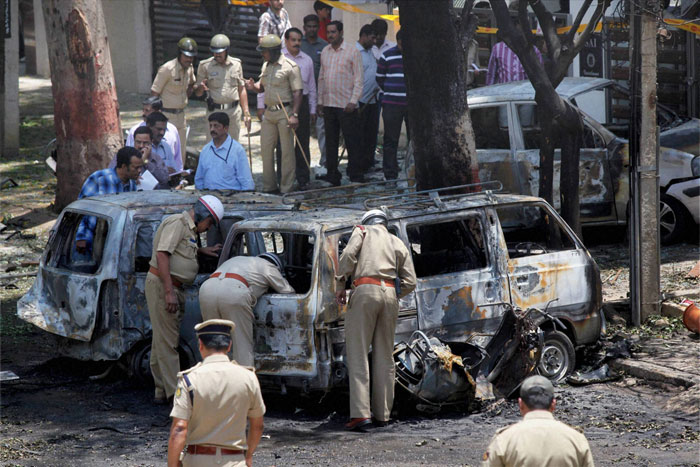
Imagine a bomb blast in a lane near the ruling party’s office just before the elections which is immediately attributed to an ubiquitous terrorist group by the powers that be. As expected the incident comes in handy not only for the news hungry 24 7 TV channels but helps the beleaguered ruling dispensation gain little breathing space bit far away from its internal squabbles and growing frustration of the people over cases of corruption and policies which have benefited only a few.

This ‘terrorist activity’ – as claimed by the home minister – propels the police machinery into action which promptly nabs within record time few of the alleged perpetrators alongwith the ‘mastermind’ who according to the police executed the cowardly act. Perhaps the matter should have ended their ‘happily’ with justice being done to the accused after a longwinding judicial process.

But a spate of fresh questions has put the whole probe in jeopardy.

Now it appears that the police in its rampant hurry has not investigated the case properly, not only leaving many loose ends but has supposedly resorted to third degree methods to extract confession from the said accused. Around a month after police claimed success in unearthing the case,  a news-item in a leading daily rather blew the lid from the lofty claims which makes it evident that despite having knowledge of the identity of the person whose SIM card was used to trigger the blast the police have not deemed it necessary even to question him as he happens to be an ‘influential RSS leader’.

Read the full article  here.

Madhu Mausi, Namo Mamu and the Ghost of Uncle Pepper

I’ve been thinking a lot about magic lately. The kind of magic that gets pulled at fairgrounds and birthday parties, or on stage, where the impossible is made to appear possible, where material objects dematerialize and specters appear, tantalizing us into suspending our disbelief. Some magicians, including those I would like to think of as friends, do what they can with consummate skill, so that we attain a state of wonder while they effect transformations using ordinary things for extraordinary purposes. They make us inhabit parallel universes on a table top. There is a kind of poetry and grace in that kind of magic. That is the kind of magic that makes men out of god-men, and re-affirms even a non-patriot’s faith in the ‘waters of India’.

There is another kind of magic, a bag of tricks that relies on the cheapening of our impulses, on our addictions to false premises, on our giving in to our basest instincts. And because sometimes old cliches are useful, we could call this kind black magic. The greatest practitioner of this art, at this moment, seems to me to  be none other than the man who is setting himself up as the caudillo of the future, the chief minister of Gujarat, our prime-minister in waiting, Narendrabhai Damodardas Modi. We,a stunned would be electorate, are the rabbit he is aiming to pull out of his hat.
Continue reading Madhu Mausi, Namo Mamu and the Ghost of Uncle Pepper

An appeal to help Pakistani Hindu refugees in Jaipur: PUCL

This is the text of a memorandum submitted recently by the PEOPLE’S UNION FOR CIVIL LIBERTIES, Rajasthan, to the state’s chief secretary.

12th June, 2013

Sh. CK Mathew,
Chief Secretary,
Government of Rajasthan, Jaipur

Subject: Urgently providing temporary housing and other support to refugees from Sindh, Pakistan living in Paldi Meena, Jaipur

Dear Sir,

This is in continuance of our telephonic conversation regarding provision of temporary housing to the 23 persons belonging to six families who have come to Jaipur in the last five months from Umerkot, in Sindh province of Pakistan due to deteriorating conditions of the minorities and there existence in fear there. Some came in January 2013 and others came in March. They all arrived in India via the Thar Express which they boarded from Mirpur and first came to Jodhpur before moving to Jaipur. They are mostly on visitors and pilgrimage Indian visas. Continue reading An appeal to help Pakistani Hindu refugees in Jaipur: PUCL

Aap Kare toh Renovation, Hum Kare toh Gentrification

It appears that a Delhi bookstore has relocated. This, in itself, isn’t news in a city of relocation,dislocation, demolition, destruction; a city built, looted and sacked at least seven times. Yet, the emotional coverage of Yodakin’s move – from one part of Hauz Khaas village to another – assures us that Delhi has lost a vital cultural hub, a “safe space”, an “indie book store with the ambience of a salon“. In a city of “aggression, pollution and anxiety”, Yodakin apparently offers us “reassurance”.

The problem, familiar to any intellectual in search of reassurance, is skyrocketing rents. As one particularly maudlin tribute explains: (emphasis in original):

I remember sitting with Arpita and Smita (of 11.11 Celldsgn/ The Grey Garden/ Elma’s/ Edward’s & TLR) at Elma’s across the street from Yodakin (the bakery was still only open for tastings) and vociferously advocating a shopkeeper’s union of sorts back in 2011.We were concerned about the escalating rates, discussing the impending gentrification (and doom) of our little alternative urban village. Everything popular gets subsumed into consumer culture eventually, we argued. The alternative is always being wiggled out of the spaces it fosters. The little guys make the place and then the big rich guns swoop in to ruin it, commercialize it.

But, don’t panic just yet, the bookstore is now sharing space with an organic food and art cafe called Tattva, where a  Tattvaamrita “Fruit Yogurt with Honey and Nuts” costs Rs 245, and a “cooling fennel juice” costs Rs. 175.  If the little guys are charging Rs 625 plus tax for a couscous salad, one genuinely fears what the “big rich guns” will charge. This of course brings us to a much needed conversation about all the things that you talk about in when you live in Delhi: Gentrification, alternative publishing, independent bookstores, and the all things that New York has and Delhi shall soon acquire.

Continue reading Aap Kare toh Renovation, Hum Kare toh Gentrification

Barasat Rape, Murder and the Culture of Rape in West Bengal: Soma Marik

Guest post by SOMA MARIK. [We are publishing below two articles by Soma Marik, Visiting Professor, School of Women’s Studies, Jadavpur University. The first deals with the recent case of the rape and murder of a young girl in North 24 Parganas while the second one below was written in 2003 when the Left Front was in power and documents the widespread culture of rape in the state. Between them, the two pieces alert us to the way we tend to respond selectively to such matters. This is particularly so in the case of political parties in power.]

The Barasat Rape and Murder: Some Reflections

On 8th June, a young woman, a second year college student, was returning home, Kamduni, a remote village of Barasat in the district of North 24 Parganas. She was waylaid by some criminals, who took her to a godown, where they gang raped and then proceeded to murder her. Six hours after she was seen alighting from a bus, her body was found by her brothers and other villagers. The police were forced into some action, after the family and people of the locality refused to even let them shift her body without action first. They accused a number of people, including some connected to the ruling Trinamul Congress, of being rapists. The young woman was well known, as she used to help many children of the locality in their study.

The first response from the police was to play it down, till local anger made that an impossible proposition. The first response from the government was to declare it a stray incident, and also to offer jobs and cash compensation to the family. This was angrily turned down, with the family members turning up in Kolkata, meeting Chief Minister Mamata Banerjee, and demanding the death penalty for the rapists and murderers. Continue reading Barasat Rape, Murder and the Culture of Rape in West Bengal: Soma Marik

दलाल स्ट्रीट और जे. एन. यू. : अपूर्वानंद

क्या जे.एन. यू.( जवाहर लाल नेहरू विश्वविद्यालय ) दरिद्रता या दरिद्र्तावाद की दलाल स्ट्रीट है? अगर एक प्रभावशाली संपादक और एक लोकप्रिय दलित चिन्तक की मानें तो यही उसका डी.एन.ए. है. वह लोगों के आत्म- निर्भर होने के खयाल के खिलाफ है. आत्मनिर्भरता का अर्थ क्या है? क्यों सारे दलित बराबरी के लिए पूंजीवाद नामक रामबाण को नहीं अपना लेते और क्यों वे बराबरी को जितना आर्थिक, उतना ही राजनीतिक और सांस्कृतिक मसला समझते हैं, इस पर बात कभी और की जा सकती है. इस पर भी कि क्यों ऐसा मानना खराब अर्थों में मार्क्सवादी होना है. भारत के मार्क्सवादी ही नहीं अनेक उदार लोकतांत्रिक विचारों वाले लोगों को पूंजी की शक्ति पर जो भरोसा था, उससे उबारने के लिए उन्हें दया पवार , नामदेव ढसाल, कुमुद पावड़े, शरण कुमार लिम्बाले, ओमप्रकाश वाल्मीकि जैसे लेखकों को अपनी कहानी सुनानी पड़ी. वह कहानी कितनी लंबी है, यह रोज़ ऐसे लेखकों की आमद से पता चलता है जो खुद को लेखक नहीं, दलित लेखक ही कहलाना चाहते हैं. अलग-अलग भाषाओं में कही जा रही यह कहानी पाठकों को ‘एक-सी’ लगती है. इन्हें पढ़ते हुए वे ‘दुहराव’ और ‘ऊब’ की शिकायत भी करते हैं. इन आख्यानों में ‘सर्जनात्मकता और कल्पनाशीलता की कमी’ मालूम पड़ती है. लेखक के अपने विशिष्ट व्यक्तित्व के दर्शन उन्हें नहीं हो पाते. Continue reading दलाल स्ट्रीट और जे. एन. यू. : अपूर्वानंद

Uphold the Freedom of Expression, Condemn the Fabricated Cases Against Film and Media Persons

The space for dissent has been shrinking steadily under the predatory-capital-friendly government in Kerala. The police has been smelling the presence of ‘Maoists’ and ‘Islamic terrorists’ in strategic parts of the state; though hard evidence for the presence of such forces is almost entirely lacking, this move is surely not unexpected. There has been  a spurt in the number of arrests under the UAPA. In the bargain, all expressions of protest against the suppression of human rights may be interpreted as ‘unlawful’ and ‘obstructive’. The following is a petition signed by prominent persons in film and media protesting against the most recent instance of the ongoing repression.

Petition to the Chief Minister, Kerala

We the undersigned strongly condemn the blatant attempt by the Kerala police to intimidate five colleagues from the field of film and media by filing fabricated cases against them for ‘rioting’, ‘unlawful assembly’ and ‘public obstruction’ (IPC Sections 143, 147, 149 and 283 ). These five individuals- K.P.Sasi, noted filmmaker and activist, I. Shanmukhadas, film critic, Prasannakumar T.N., film activist, Shafeek, journalist and Deepak, filmmaker and film society activist- were participating in a peaceful protest on February 11 at Thrissur, Kerala, along with many others, outside the venue of the Vibgyor Film Festival 2013 against the concept of capital punishment and the summary execution of Afzal Guru. The peaceful protest which lasted for an hour, in no way disturbed public order or caused communal unrest. For this act of democratic expression, these fraudulent and trumped charges have been filed against them. Continue reading Uphold the Freedom of Expression, Condemn the Fabricated Cases Against Film and Media Persons

Interview with Amalia Ziv – queer, feminist and anti-occupation in Israel

KveesaShchora020403CWPsm

On April 3rd, 2002, Israeli peace organizations led by women activists tried to enter Palestine, but were violently rebuffed by Israeli soldiers – 21 required hospitalization when it was all over. The picture shows seven members (six women and one man) of the organization Kveesa Shchora – Lesbians and Gay Men Against the Occupation – as they set out that morning.

It was through Amalia Ziv ‘s work that I came to know about ‘Kvisa Shchora’ (Black Laundry), an Israeli anti-Occupation queer group, which positions itself against both Israeli Zionist queer politics and the Israeli Left, against whose universalist understanding Black Laundry poses its queer identity as a platform for critique. Ziv suggests that Black Laundry tied together ‘sexual deviance’ and ‘national deviance’ with slogans like ‘Free Condoms, Free Palestine’, ‘Bull Dykes, Not Missile Strikes’, ‘Transgender not Transfer’ (that is, forced deportation of Palestinians)  – which break down the hierarchies of Nation and Sex, challenging queer politics in Israel with anti-occupation politics and Left anti-occupation politics with the queer gaze. Ziv argues that through the ‘twin strategies of national betrayal and sexual depravity’, Black Laundry deliberately situated itself outside both  discursive communities – that of Israel/Palestine as well as of hetero/homosexual.

Read this wonderful interview by  TSAFI SAAR with Amalia Ziv in which she talks about queer parenting, pornography, masochistic fantasies, her envy of people who have the capacity to be polyamorous, how tolerance in Israel for queer politics  ‘runs out when queer politics melds with politics against the occupation,’ and about her crush as an adolescent for Woody Allen. ‘Eros is blind’, she says unrepentantly. Continue reading Interview with Amalia Ziv – queer, feminist and anti-occupation in Israel

Three questions for Madhu Kishwar: Dilip D’Souza

Guest post by DILIP D’SOUZA

Dear Madhu,

20+ years ago, I picked you up at the airport in Austin and you stayed at my home there for a few days. You had come there to deliver a lecture, as I’m sure you remember. We developed a friendship based on a degree of mutual respect and liking. I think you’ll agree? Several years after that I remember a stimulating afternoon sitting with you in Panchgani, catching up on many things and discussing various issues threadbare.

We haven’t met in some years now, but I’m going to call on the privilege of our 20+ years of friendship as I write these lines.

I have no problem at all with your desire to learn about Gujarat and Narendra Modi for yourself. Nor with your desire to see beyond what you’ve called the “targeting” of Modi. Nor with your speaking in support of Modi: if there are people who criticize Modi, I understand and accept that there are those who support him — it’s a democracy we live in after all. Nor with your speaking your mind: you have always done so and it’s the least I expect from you. (In turn, it’s the least you should expect from me). Continue reading Three questions for Madhu Kishwar: Dilip D’Souza

Theme Park Mumbai: Hussain Indorewala

This is a guest post by HUSSAIN INDOREWALA: The draft of Mumbai’s twenty year Development Plan is scheduled for release soon. There is another plan that is worth looking at, if only to get a sense of what the city’s power elite have in mind for its future. This plan may be found on the website of the Mumbai Transformation Support Unit (MTSU) by the name Concept Plan for MMR. Though not a statutory document, it claims to become the “guiding framework” for all the subsequent Development Plans in the MMR region, and also the basis for local sectoral schemes on transportation, infrastructure, housing, industrial development, and others.

Mumbai’s Concept Plan

In May 2011, a Singapore based planning firm, Surbana Corporation, with experience in planning for cities in Africa, Asia and the Middle East, submitted a “Concept Plan” for the Mumbai Metropolitan Region (MMR) to the MTSU. The object of the plan is to provide a “long-term development framework which directs future investments and urban growth in the region.”[1] With a population of 37 million, by 2032 the MMR will become a “world class metropolis,” with a “vibrant economy” and “globally competitive quality of life.” By 2052, with a population of 44 million, the Region will be “elevated” to become a “Global City,” recognised around the world as an “international business hub, a leading technological innovator, a melting pot of local and cosmopolitan cultures, and a centre of excellence for urban environmental management.”

Continue reading Theme Park Mumbai: Hussain Indorewala

A memorable evening with Vidya Charan Shukla

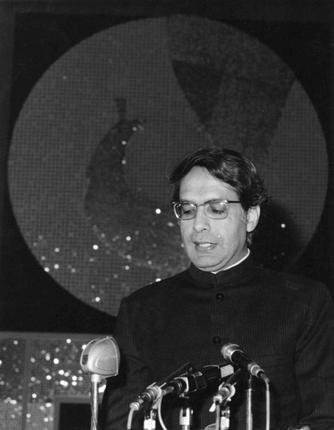
In this January 3, 1977 photo, V.C. Shukla, Union Minister of Information and Broadcasting inaugurates the sixth International Film Festival of India in New Delhi. The Justice Shah Commission of Inquiry which went into the Emergency execesses, had mentioned Shukla's name in its report. Photo: The Hindu Archives / TheHindu.com
In this January 3, 1977 photo, V.C. Shukla, Union Minister of Information and Broadcasting inaugurates the sixth International Film Festival of India in New Delhi. The Justice Shah Commission of Inquiry which went into the Emergency execesses, had mentioned Shukla’s name in its report. Photo: The Hindu Archives

By SOHAIL HASHMI: Though the East and the West have great differences in issues cultural, in one matter they are like twin brothers. Both insist we should not speak ill of the dead. This does not apply to Changez Khan, Hitler and Mussolini. Some would add a few more to the list, but there are chances of violent disagreements on some of those names.

There have been honourable deviations from this haloed creed and if my memory serves me right,  at least one of them has been attributed to The Bard, who made Mark Antony declare at the funeral of Caesar, “Friends Romans and Countrymen, we have gathered here to bury Caesar and not to praise him,” or words to that effect.

These were some of the confused musings that floated to the top of the mind when I heard the news of V.C. Shukla’s passing away. Does the fact that he is dead or the dastardly fashion in which death stalked him and ultimately consumed him, give him an escape from his deeds?

It is a commentary on our justice delivery system that V.C. Shukla, one of those who belonged to the coterie that ran the Emergency establishment for Mrs Gandhi, did not spend a long time behind bars for his acts of commission as Minister of Information and Broadcasting. Some of his achievements as Minister of Information included snapping power supply to newspapers critical of the Emergency, introducing Draconian censorship, banning magazines and newspapers, and sealing printing presses that dared to publish anything critical of the infamous Mrs G or her Emergency regime. Continue reading A memorable evening with Vidya Charan Shukla

The Fatherly Sphinx and the Riddle of the Researcher: Anirban Kapil Baishya and Darshana Sreedhar

This is a guest post by ANIRBAN KAPIL BAISHYA and DARSHANA SREEDHAR

Ratan Tata Library, Delhi School of Economics…3rd June, 2013. The time was 11:30 AM, the weather outside, a little more than merely hot. The head librarian sat in his armchair in an air-conditioned room, a television screen playing back CCTV footage from each and every corner of the library. Continue reading The Fatherly Sphinx and the Riddle of the Researcher: Anirban Kapil Baishya and Darshana Sreedhar

DISSENT, DEBATE, CREATE